

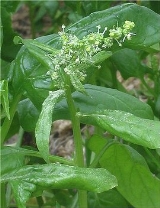
Spinach

Encyclopedia
Spinach is an edible flowering plant
in the family of Amaranthaceae
. It is native to central and southwestern Asia
. It is an annual plant
(rarely biennial
), which grows to a height of up to 30 cm. Spinach may survive over winter in temperate regions. The leaves
are alternate, simple, ovate to triangular-based, very variable in size from about 2–30 cm long and 1–15 cm broad, with larger leaves at the base of the plant and small leaves higher on the flowering stem. The flower
s are inconspicuous, yellow-green, 3–4 mm diameter, maturing into a small, hard, dry, lumpy fruit
cluster 5–10 mm across containing several seed
s.
Common spinach, Spinacia oleracea, was long considered to be in the Chinopodiaceae family, but in 2003 the Chinopodiaceae family was combined with the Amaranthaceae family under the family name 'Amaranthaceae' in the order Caryophyllales. Within the Amaranthaceae family there are now a subfamily Amaranthoideae and a subfamily Chenopodioideae, for the amaranths and the chenopods, respectively.
In AD 827, the Saracens introduced spinach to Sicily. The first written evidence of spinach in the Mediterranean are in three 10th-century works, the medical work by al-Razi (known as Rhazes in the West) and in two agricultural treatises, one by Ibn Wahshiya and the other by Qustus al-Rumi. Spinach became a popular vegetable in the Arab Mediterranean, and arrived in Spain by the latter part of the 12th century, where the great Arab agronomist Ibn al-'Awwam called it the "captain of leafy greens". Spinach was also the subject of a special treatise in the 11th century by Ibn Hajjaj.
The prickly-seeded form of spinach was known in Germany by no later than the 13th century, though the smooth-seeded form was not described till 1552. (The smooth-seeded form is used in modern commercial production.)
Spinach first appeared in England and France in the 14th century, probably via Spain, and it gained quick popularity because it appeared in early spring, when other vegetables were scarce and when Lenten dietary restrictions discouraged consumption of other foods. Spinach is mentioned in the first known English cookbook, The Forme of Cury (1390), where it is referred to as spinnedge and/or spynoches. Smooth-seeded spinach was described in 1552.
In 1533, Catherine de' Medici
became queen of France; she so fancied spinach that she insisted it be served at every meal. To this day, dishes made with spinach are known as "Florentine", reflecting Catherine's birth in Florence
.
During World War
I, wine fortified with spinach juice was given to French soldiers weakened by hemorrhage.
(and especially high in lutein
), vitamin C
, vitamin E
, vitamin K
, magnesium
, manganese
, folate, betaine, iron
, vitamin B2, calcium
, potassium
, vitamin B6
, folic acid
, copper
, protein
, phosphorus
, zinc
, niacin
, selenium
and omega-3 fatty acids. Recently, opioid peptide
s called rubiscolin
s have also been found in spinach.
Polyglutamyl folate (vitamin B9 or folic acid) is a vital constituent of cells, and spinach is a good source of folic acid. Boiling spinach can more than halve the level of folate left in the spinach, but microwaving does not affect folate content. Vitamin B9 was first isolated from spinach in 1941.
states that a serving of boiled spinach contains of iron, whereas one ground hamburger patty contains at most .
The bioavailability of iron is dependent on its absorption, which is influenced by a number of factors. Iron enters the body in two forms: heme
iron and nonheme iron. All of the iron in grains and vegetables, and about three-fifths of the iron in animal food sources (meats), is nonheme iron. The remaining portion from meats is heme iron.
The larger portion of dietary iron (nonheme) is absorbed slowly in its many food sources, including spinach. This absorption may vary widely depending on the presence of binders, such as fiber, or enhancers, such as vitamin C. Therefore, the body's absorption of nonheme iron can be improved by consuming foods that are rich in vitamin C. However, spinach contains iron absorption-inhibiting substances, including high levels of oxalate
, which can bind to the iron to form ferrous oxalate and render much of the iron in spinach unusable by the body. In addition to preventing absorption and use, high levels of oxalates remove iron from the body. But some studies have found that the addition of oxalic acid
to the diet may improve iron absorption in rats over a diet with spinach without additional oxalic acid.
content. However, the oxalate content in spinach also binds with calcium, decreasing its absorption. Calcium and zinc also limit iron absorption. The calcium in spinach is the least bioavailable of calcium sources. By way of comparison, the body can absorb about half of the calcium present in broccoli
, yet only around 5% of the calcium in spinach.
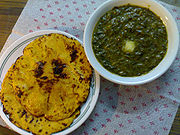
There are three basic types of spinach:
 Spinach is sold loose, bunched, in prepackaged bags, canned, or frozen. Fresh spinach loses much of its nutritional value with storage of more than a few days. While refrigeration slows this effect to about eight days, spinach will lose most of its folate and carotenoid content, so for longer storage it is frozen, cooked and frozen, or canned. Storage in the freezer can be for up to eight months.
The Environmental Working Group
reported spinach is one of the dozen most heavily pesticide
-contaminated produce products.
The most common pesticides found on spinach are permethrin
, dimethoate
, and DDT
.
Spinach is packaged in air, or in nitrogen gas to extend shelf life. Some packaged spinach is exposed to radiation to kill any harmful bacteria that may be on the leaves. The Food and Drug Administration
approves of irradiation of spinach leaves up to 4.0 kilograys (kGy); however, there is concern that using radiation to sanitize spinach depletes the leaves of their nutritional value. Researchers at the Agricultural Research Service
experimentally tested the concentrations of vitamins C, E, K, B9, and four other carotenoids in packaged spinach following irradiation. They found that with increasing level of irradiation, four nutrients showed little or no change. Those nutrients include vitamins B9, E, K, and the carotenoid neoxanthin. This study showed the irradiation of packaged spinach to have little or no change to the nutritional value of the crop, and the health benefits of irradiating packed spinach seem to outweigh the health risks of transmitting harmful bacteria.
is portrayed as having a strong affinity for spinach, becoming physically stronger after consuming it. A frequently circulated story claims this portrayal was based on faulty calculations of the iron content. In the story, German scientist Emil von Wolff misplaced a decimal point in an 1870 measurement of spinach's iron content, leading to an iron value 10 times higher than it should have been, and this faulty measurement was not noticed until the 1930s. However, recent research has shown that this is just another long-standing myth
, and spinach was chosen and promoted in Popeye
for its vitamin A content alone.
Spinach, along with Brussels sprout
s and other green vegetables, is often portrayed in children's shows to be undesirable.
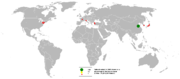
The United States is the world’s second-largest producer of spinach, with 3% of world output, following China
(PRC), which accounts for 85% of output.
California
(73% of 2004–06 U.S. output), Arizona
(12%), and New Jersey
(3%) are the top producing states, with 12 other states reporting production of at least 100 acres (2002 census). Over the 2004–06 period, U.S. growers produced an average of 867 million pounds of spinach for all uses, with about three-fourths sold into the fresh-market (includes fresh-cut/processed). According to the 2002 Census of Agriculture, spinach was grown on 1,109 U.S. farms—down 17% from 1997, but about the same number as in 1987.
The farm value of U.S. spinach crops (fresh and processed) averaged $175 million during 2004–06, with fresh market spinach accounting for 94%. The value of fresh market spinach has more than doubled over the past decade as stronger demand has boosted production, while inflation-adjusted prices largely remained constant. California accounts for about three-fourths of the value of both the fresh and processing spinach crops.
Like other cool-season leafy crops, most (about 96%) of the fresh spinach consumed in the United States is produced domestically. Although rising, imports (largely from Mexico
) totaled about 23 million pounds in 2004–06, compared with 3 million pounds in 1994–06. During the last 10 years, exports (largely to Canada
) have jumped 70 percent to 47 million pounds (2004–06), with much of the growth occurring earlier this decade.
Per capita spinach consumption is greatest in the Northeast and Western US. About 80% of fresh-market spinach is purchased at retail and consumed at home, while 91% of processed spinach is consumed at home. Per capita spinach use is strongest among Asians, highest among women 40 and older, and weakest among teenage girls.
in 21 U.S. states. Over a hundred cases were reported, including five deaths. The E. coli was linked to bags of fresh spinach, after which the FDA issued a warning not to eat uncooked fresh spinach or products containing it. The U.S. Food and Drug Administration (FDA) issued a press release updating the available information. According to the FDA release on 2006-10-4, 192 cases of E. coli O157:H7 infection have been reported to the Centers for Disease Control and Prevention
(CDC), including 30 cases of hemolytic uremic syndrome; there was one death and 98 hospitalizations. The infection affected 26 states. By early 2007, there were 206 illnesses and three deaths attributed to E. coli-tainted spinach.
Based on epidemiological and laboratory evidence, the FDA determined that the implicated spinach originated from an organic spinach field grown by Mission Organics and processed by Natural Selection Foods LLC of San Juan Bautista, California
. The FDA speculated the spinach had been tainted by irrigation water contaminated with wild pig feces because feral pigs were seen in the vicinity of the implicated ranch.
-based grower and shipper, Salinas Valley
, California
) were recalled after Salmonella
was discovered upon routine testing. Consumer advocates and some lawmakers complained it exposed big gaps in food safety, even if 90% of suspect vegetables did not reach the shelves.
Flowering plant
The flowering plants , also known as Angiospermae or Magnoliophyta, are the most diverse group of land plants. Angiosperms are seed-producing plants like the gymnosperms and can be distinguished from the gymnosperms by a series of synapomorphies...
in the family of Amaranthaceae
Amaranthaceae
The flowering plant family Amaranthaceae, the Amaranth family, contains about 176 genera and 2,400 species.- Description :Most of these species are herbs or subshrubs; very few are trees or climbers. Some species are succulent....
. It is native to central and southwestern Asia
Asia
Asia is the world's largest and most populous continent, located primarily in the eastern and northern hemispheres. It covers 8.7% of the Earth's total surface area and with approximately 3.879 billion people, it hosts 60% of the world's current human population...
. It is an annual plant
Annual plant
An annual plant is a plant that usually germinates, flowers, and dies in a year or season. True annuals will only live longer than a year if they are prevented from setting seed...
(rarely biennial
Biennial plant
A biennial plant is a flowering plant that takes two years to complete its biological lifecycle. In the first year the plant grows leaves, stems, and roots , then it enters a period of dormancy over the colder months. Usually the stem remains very short and the leaves are low to the ground, forming...
), which grows to a height of up to 30 cm. Spinach may survive over winter in temperate regions. The leaves
Leaf
A leaf is an organ of a vascular plant, as defined in botanical terms, and in particular in plant morphology. Foliage is a mass noun that refers to leaves as a feature of plants....
are alternate, simple, ovate to triangular-based, very variable in size from about 2–30 cm long and 1–15 cm broad, with larger leaves at the base of the plant and small leaves higher on the flowering stem. The flower
Flower
A flower, sometimes known as a bloom or blossom, is the reproductive structure found in flowering plants . The biological function of a flower is to effect reproduction, usually by providing a mechanism for the union of sperm with eggs...
s are inconspicuous, yellow-green, 3–4 mm diameter, maturing into a small, hard, dry, lumpy fruit
Fruit
In broad terms, a fruit is a structure of a plant that contains its seeds.The term has different meanings dependent on context. In non-technical usage, such as food preparation, fruit normally means the fleshy seed-associated structures of certain plants that are sweet and edible in the raw state,...
cluster 5–10 mm across containing several seed
Seed
A seed is a small embryonic plant enclosed in a covering called the seed coat, usually with some stored food. It is the product of the ripened ovule of gymnosperm and angiosperm plants which occurs after fertilization and some growth within the mother plant...
s.
Common spinach, Spinacia oleracea, was long considered to be in the Chinopodiaceae family, but in 2003 the Chinopodiaceae family was combined with the Amaranthaceae family under the family name 'Amaranthaceae' in the order Caryophyllales. Within the Amaranthaceae family there are now a subfamily Amaranthoideae and a subfamily Chenopodioideae, for the amaranths and the chenopods, respectively.
Etymology
The English word "spinach" dates to 1530, and is from espinache (Fr. épinard), of uncertain origin. The traditional view derives it from O.Prov. espinarc, which perhaps is via Catalan espinac, from Andalusian Arabic asbinakh (اسبيناخ), from Arabic es-sabaanikh (السبانخ), from Persian اسپاناخ aspanakh, meaning roughly "green hand", but the multiplicity of forms makes the theory doubtful.History
Spinach is thought to have originated in ancient Persia (modern Iran and neighboring countries). Arab traders carried spinach into India, and then the plant was introduced into ancient China, where it was known as "Persian vegetable" (bōsī cài; 波斯菜; present:菠菜). The earliest available record of the spinach plant was recorded in Chinese, stating it was introduced into China via Nepal (probably in 647 AD).In AD 827, the Saracens introduced spinach to Sicily. The first written evidence of spinach in the Mediterranean are in three 10th-century works, the medical work by al-Razi (known as Rhazes in the West) and in two agricultural treatises, one by Ibn Wahshiya and the other by Qustus al-Rumi. Spinach became a popular vegetable in the Arab Mediterranean, and arrived in Spain by the latter part of the 12th century, where the great Arab agronomist Ibn al-'Awwam called it the "captain of leafy greens". Spinach was also the subject of a special treatise in the 11th century by Ibn Hajjaj.
The prickly-seeded form of spinach was known in Germany by no later than the 13th century, though the smooth-seeded form was not described till 1552. (The smooth-seeded form is used in modern commercial production.)
Spinach first appeared in England and France in the 14th century, probably via Spain, and it gained quick popularity because it appeared in early spring, when other vegetables were scarce and when Lenten dietary restrictions discouraged consumption of other foods. Spinach is mentioned in the first known English cookbook, The Forme of Cury (1390), where it is referred to as spinnedge and/or spynoches. Smooth-seeded spinach was described in 1552.
In 1533, Catherine de' Medici
Catherine de' Medici
Catherine de' Medici was an Italian noblewoman who was Queen consort of France from 1547 until 1559, as the wife of King Henry II of France....
became queen of France; she so fancied spinach that she insisted it be served at every meal. To this day, dishes made with spinach are known as "Florentine", reflecting Catherine's birth in Florence
Florence
Florence is the capital city of the Italian region of Tuscany and of the province of Florence. It is the most populous city in Tuscany, with approximately 370,000 inhabitants, expanding to over 1.5 million in the metropolitan area....
.
During World War
World war
A world war is a war affecting the majority of the world's most powerful and populous nations. World wars span multiple countries on multiple continents, with battles fought in multiple theaters....
I, wine fortified with spinach juice was given to French soldiers weakened by hemorrhage.
Nutrition
Spinach has a high nutritional value and is extremely rich in antioxidants, especially when fresh, steamed, or quickly boiled. It is a rich source of vitamin AVitamin A
Vitamin A is a vitamin that is needed by the retina of the eye in the form of a specific metabolite, the light-absorbing molecule retinal, that is necessary for both low-light and color vision...
(and especially high in lutein
Lutein
Lutein is a xanthophyll and one of 600 known naturally occurring carotenoids. Lutein is synthesized only by plants and like other xanthophylls is found in high quantities in green leafy vegetables such as spinach and kale...
), vitamin C
Vitamin C
Vitamin C or L-ascorbic acid or L-ascorbate is an essential nutrient for humans and certain other animal species. In living organisms ascorbate acts as an antioxidant by protecting the body against oxidative stress...
, vitamin E
Tocopherol
Tocopherols are a class of chemical compounds of which many have vitamin E activity. It is a series of organic compounds consisting of various methylated phenols...
, vitamin K
Vitamin K
Vitamin K is a group of structurally similar, fat soluble vitamins that are needed for the posttranslational modification of certain proteins required for blood coagulation and in metabolic pathways in bone and other tissue. They are 2-methyl-1,4-naphthoquinone derivatives...
, magnesium
Magnesium
Magnesium is a chemical element with the symbol Mg, atomic number 12, and common oxidation number +2. It is an alkaline earth metal and the eighth most abundant element in the Earth's crust and ninth in the known universe as a whole...
, manganese
Manganese
Manganese is a chemical element, designated by the symbol Mn. It has the atomic number 25. It is found as a free element in nature , and in many minerals...
, folate, betaine, iron
Iron
Iron is a chemical element with the symbol Fe and atomic number 26. It is a metal in the first transition series. It is the most common element forming the planet Earth as a whole, forming much of Earth's outer and inner core. It is the fourth most common element in the Earth's crust...
, vitamin B2, calcium
Calcium
Calcium is the chemical element with the symbol Ca and atomic number 20. It has an atomic mass of 40.078 amu. Calcium is a soft gray alkaline earth metal, and is the fifth-most-abundant element by mass in the Earth's crust...
, potassium
Potassium
Potassium is the chemical element with the symbol K and atomic number 19. Elemental potassium is a soft silvery-white alkali metal that oxidizes rapidly in air and is very reactive with water, generating sufficient heat to ignite the hydrogen emitted in the reaction.Potassium and sodium are...
, vitamin B6
Vitamin B6
Vitamin B6 is a water-soluble vitamin and is part of the vitamin B complex group. Several forms of the vitamin are known, but pyridoxal phosphate is the active form and is a cofactor in many reactions of amino acid metabolism, including transamination, deamination, and decarboxylation...
, folic acid
Folic acid
Folic acid and folate , as well as pteroyl-L-glutamic acid, pteroyl-L-glutamate, and pteroylmonoglutamic acid are forms of the water-soluble vitamin B9...
, copper
Copper
Copper is a chemical element with the symbol Cu and atomic number 29. It is a ductile metal with very high thermal and electrical conductivity. Pure copper is soft and malleable; an exposed surface has a reddish-orange tarnish...
, protein
Protein
Proteins are biochemical compounds consisting of one or more polypeptides typically folded into a globular or fibrous form, facilitating a biological function. A polypeptide is a single linear polymer chain of amino acids bonded together by peptide bonds between the carboxyl and amino groups of...
, phosphorus
Phosphorus
Phosphorus is the chemical element that has the symbol P and atomic number 15. A multivalent nonmetal of the nitrogen group, phosphorus as a mineral is almost always present in its maximally oxidized state, as inorganic phosphate rocks...
, zinc
Zinc
Zinc , or spelter , is a metallic chemical element; it has the symbol Zn and atomic number 30. It is the first element in group 12 of the periodic table. Zinc is, in some respects, chemically similar to magnesium, because its ion is of similar size and its only common oxidation state is +2...
, niacin
Niacin
"Niacin" redirects here. For the neo-fusion band, see Niacin .Niacin is an organic compound with the formula and, depending on the definition used, one of the forty to eighty essential human nutrients.Niacin is one of five vitamins associated with a pandemic deficiency disease: niacin deficiency...
, selenium
Selenium
Selenium is a chemical element with atomic number 34, chemical symbol Se, and an atomic mass of 78.96. It is a nonmetal, whose properties are intermediate between those of adjacent chalcogen elements sulfur and tellurium...
and omega-3 fatty acids. Recently, opioid peptide
Opioid peptide
Opioid peptides are short sequences of amino acids that bind to opioid receptors in the brain; opiates and opioids mimic the effect of these peptides. Opioid peptides may be produced by the body itself, for example endorphins. The effects of these peptides vary, but they all resemble opiates...
s called rubiscolin
Rubiscolin
The rubiscolins are a group of opioid peptides which are formed during digestion of the ribulose bisphosphate carboxylase/oxygenase protein from spinach leaves. Rubiscolins mimic the effects of opiates and therefore influence the brain...
s have also been found in spinach.
Polyglutamyl folate (vitamin B9 or folic acid) is a vital constituent of cells, and spinach is a good source of folic acid. Boiling spinach can more than halve the level of folate left in the spinach, but microwaving does not affect folate content. Vitamin B9 was first isolated from spinach in 1941.
Iron
Spinach, along with other green leafy vegetables, is considered to be a rich source of iron. For example, the United States Department of AgricultureUnited States Department of Agriculture
The United States Department of Agriculture is the United States federal executive department responsible for developing and executing U.S. federal government policy on farming, agriculture, and food...
states that a serving of boiled spinach contains of iron, whereas one ground hamburger patty contains at most .
The bioavailability of iron is dependent on its absorption, which is influenced by a number of factors. Iron enters the body in two forms: heme
Heme
A heme or haem is a prosthetic group that consists of an iron atom contained in the center of a large heterocyclic organic ring called a porphyrin. Not all porphyrins contain iron, but a substantial fraction of porphyrin-containing metalloproteins have heme as their prosthetic group; these are...
iron and nonheme iron. All of the iron in grains and vegetables, and about three-fifths of the iron in animal food sources (meats), is nonheme iron. The remaining portion from meats is heme iron.
The larger portion of dietary iron (nonheme) is absorbed slowly in its many food sources, including spinach. This absorption may vary widely depending on the presence of binders, such as fiber, or enhancers, such as vitamin C. Therefore, the body's absorption of nonheme iron can be improved by consuming foods that are rich in vitamin C. However, spinach contains iron absorption-inhibiting substances, including high levels of oxalate
Oxalate
Oxalate , is the dianion with formula C2O42− also written 22−. Either name is often used for derivatives, such as disodium oxalate, 2C2O42−, or an ester of oxalic acid Oxalate (IUPAC: ethanedioate), is the dianion with formula C2O42− also written (COO)22−. Either...
, which can bind to the iron to form ferrous oxalate and render much of the iron in spinach unusable by the body. In addition to preventing absorption and use, high levels of oxalates remove iron from the body. But some studies have found that the addition of oxalic acid
Oxalic acid
Oxalic acid is an organic compound with the formula H2C2O4. This colourless solid is a dicarboxylic acid. In terms of acid strength, it is about 3,000 times stronger than acetic acid. Oxalic acid is a reducing agent and its conjugate base, known as oxalate , is a chelating agent for metal cations...
to the diet may improve iron absorption in rats over a diet with spinach without additional oxalic acid.
Calcium
Spinach also has a high calciumCalcium
Calcium is the chemical element with the symbol Ca and atomic number 20. It has an atomic mass of 40.078 amu. Calcium is a soft gray alkaline earth metal, and is the fifth-most-abundant element by mass in the Earth's crust...
content. However, the oxalate content in spinach also binds with calcium, decreasing its absorption. Calcium and zinc also limit iron absorption. The calcium in spinach is the least bioavailable of calcium sources. By way of comparison, the body can absorb about half of the calcium present in broccoli
Broccoli
Broccoli is a plant in the cabbage family, whose large flower head is used as a vegetable.-General:The word broccoli, from the Italian plural of , refers to "the flowering top of a cabbage"....
, yet only around 5% of the calcium in spinach.
Types of spinach
A distinction can be made between older varieties of spinach and more modern ones. Older varieties tend to bolt too early in warm conditions. Newer varieties tend to grow more rapidly, but have less of an inclination to run up to seed. The older varieties have narrower leaves and tend to have a stronger and more bitter taste. Most newer varieties have broader leaves and round seeds.There are three basic types of spinach:
- Savoy has dark green, crinkly and curly leaves. It is the type sold in fresh bunches in most supermarkets . One heirloom variety of savoy is 'Bloomsdale', which is somewhat resistant to bolting. Other common heirloom varieties are 'Merlo Nero' (a mild variety from ItalyItalyItaly , officially the Italian Republic languages]] under the European Charter for Regional or Minority Languages. In each of these, Italy's official name is as follows:;;;;;;;;), is a unitary parliamentary republic in South-Central Europe. To the north it borders France, Switzerland, Austria and...
) and 'Viroflay' (a very large spinach with great yields). - Flat/smooth leaf spinach has broad, smooth leaves that are easier to clean than 'Savoy'. This type is often grown for canned and frozen spinach, as well as soups, baby foods, and processed foods.
- Semi-savoy is a hybrid variety with slightly crinkled leaves. It has the same texture as 'Savoy', but it is not as difficult to clean. It is grown for both fresh market and processing. 'Five Star', a widely grown variety, has good resistance to running up to seed.
Production, marketing and storage
The Environmental Working Group
Environmental Working Group
The Environmental Working Group is an American environmental organization that specializes in research and advocacy in the areas of toxic chemicals, agricultural subsidies, public lands, and corporate accountability...
reported spinach is one of the dozen most heavily pesticide
Pesticide
Pesticides are substances or mixture of substances intended for preventing, destroying, repelling or mitigating any pest.A pesticide may be a chemical unicycle, biological agent , antimicrobial, disinfectant or device used against any pest...
-contaminated produce products.
The most common pesticides found on spinach are permethrin
Permethrin
Permethrin is a common synthetic chemical, widely used as an insecticide, acaricide, and insect repellent. It belongs to the family of synthetic chemicals called pyrethroids and functions as a neurotoxin, affecting neuron membranes by prolonging sodium channel activation. It is not known to...
, dimethoate
Dimethoate
Dimethoate is a widely used organophosphate insecticide used to kill insects on contact. It was patented and introduced in the 1950s by American Cyanamid. Like other organophosphates, dimethoate is an anticholinesterase which disables cholinesterase, an enzyme essential for central nervous system...
, and DDT
DDT
DDT is one of the most well-known synthetic insecticides. It is a chemical with a long, unique, and controversial history....
.
Spinach is packaged in air, or in nitrogen gas to extend shelf life. Some packaged spinach is exposed to radiation to kill any harmful bacteria that may be on the leaves. The Food and Drug Administration
Food and Drug Administration
The Food and Drug Administration is an agency of the United States Department of Health and Human Services, one of the United States federal executive departments...
approves of irradiation of spinach leaves up to 4.0 kilograys (kGy); however, there is concern that using radiation to sanitize spinach depletes the leaves of their nutritional value. Researchers at the Agricultural Research Service
Agricultural Research Service
The Agricultural Research Service is the principal in-house research agency of the United States Department of Agriculture . ARS is one of four agencies in USDA's Research, Education and Economics mission area...
experimentally tested the concentrations of vitamins C, E, K, B9, and four other carotenoids in packaged spinach following irradiation. They found that with increasing level of irradiation, four nutrients showed little or no change. Those nutrients include vitamins B9, E, K, and the carotenoid neoxanthin. This study showed the irradiation of packaged spinach to have little or no change to the nutritional value of the crop, and the health benefits of irradiating packed spinach seem to outweigh the health risks of transmitting harmful bacteria.
Spinach, Popeye and the myth
The cartoon character Popeye the Sailor ManPopeye
Popeye the Sailor is a cartoon fictional character created by Elzie Crisler Segar, who has appeared in comic strips and animated cartoons in the cinema as well as on television. He first appeared in the daily King Features comic strip Thimble Theatre on January 17, 1929...
is portrayed as having a strong affinity for spinach, becoming physically stronger after consuming it. A frequently circulated story claims this portrayal was based on faulty calculations of the iron content. In the story, German scientist Emil von Wolff misplaced a decimal point in an 1870 measurement of spinach's iron content, leading to an iron value 10 times higher than it should have been, and this faulty measurement was not noticed until the 1930s. However, recent research has shown that this is just another long-standing myth
Urban legend
An urban legend, urban myth, urban tale, or contemporary legend, is a form of modern folklore consisting of stories that may or may not have been believed by their tellers to be true...
, and spinach was chosen and promoted in Popeye
Popeye
Popeye the Sailor is a cartoon fictional character created by Elzie Crisler Segar, who has appeared in comic strips and animated cartoons in the cinema as well as on television. He first appeared in the daily King Features comic strip Thimble Theatre on January 17, 1929...
for its vitamin A content alone.
Spinach, along with Brussels sprout
Brussels sprout
The Brussels sprout is a cultivar of wild cabbage grown for its edible buds. The leafy green vegetables are typically 2.5–4 cm in diameter and look like miniature cabbages. The sprout is Brassica oleracea, in the "gemmifera" group of the family Brassicaceae...
s and other green vegetables, is often portrayed in children's shows to be undesirable.
United States
Driven by fresh-market use, the consumption of Spinacia oleracea has been on the rise in the United States. Per capita use of fresh-market spinach averaged 1 kg during 2004–06, the highest since the mid-1940s. The fresh market now accounts for about three-fourths of all U.S. spinach consumed. Much of the growth over the past decade has been due to sales of triple-washed cello-packed spinach and, more recently, baby spinach. These packaged products have been one of the fastest-growing segments of the packaged salad industry.The United States is the world’s second-largest producer of spinach, with 3% of world output, following China
China
Chinese civilization may refer to:* China for more general discussion of the country.* Chinese culture* Greater China, the transnational community of ethnic Chinese.* History of China* Sinosphere, the area historically affected by Chinese culture...
(PRC), which accounts for 85% of output.
California
California
California is a state located on the West Coast of the United States. It is by far the most populous U.S. state, and the third-largest by land area...
(73% of 2004–06 U.S. output), Arizona
Arizona
Arizona ; is a state located in the southwestern region of the United States. It is also part of the western United States and the mountain west. The capital and largest city is Phoenix...
(12%), and New Jersey
New Jersey
New Jersey is a state in the Northeastern and Middle Atlantic regions of the United States. , its population was 8,791,894. It is bordered on the north and east by the state of New York, on the southeast and south by the Atlantic Ocean, on the west by Pennsylvania and on the southwest by Delaware...
(3%) are the top producing states, with 12 other states reporting production of at least 100 acres (2002 census). Over the 2004–06 period, U.S. growers produced an average of 867 million pounds of spinach for all uses, with about three-fourths sold into the fresh-market (includes fresh-cut/processed). According to the 2002 Census of Agriculture, spinach was grown on 1,109 U.S. farms—down 17% from 1997, but about the same number as in 1987.
The farm value of U.S. spinach crops (fresh and processed) averaged $175 million during 2004–06, with fresh market spinach accounting for 94%. The value of fresh market spinach has more than doubled over the past decade as stronger demand has boosted production, while inflation-adjusted prices largely remained constant. California accounts for about three-fourths of the value of both the fresh and processing spinach crops.
Like other cool-season leafy crops, most (about 96%) of the fresh spinach consumed in the United States is produced domestically. Although rising, imports (largely from Mexico
Mexico
The United Mexican States , commonly known as Mexico , is a federal constitutional republic in North America. It is bordered on the north by the United States; on the south and west by the Pacific Ocean; on the southeast by Guatemala, Belize, and the Caribbean Sea; and on the east by the Gulf of...
) totaled about 23 million pounds in 2004–06, compared with 3 million pounds in 1994–06. During the last 10 years, exports (largely to Canada
Canada
Canada is a North American country consisting of ten provinces and three territories. Located in the northern part of the continent, it extends from the Atlantic Ocean in the east to the Pacific Ocean in the west, and northward into the Arctic Ocean...
) have jumped 70 percent to 47 million pounds (2004–06), with much of the growth occurring earlier this decade.
Per capita spinach consumption is greatest in the Northeast and Western US. About 80% of fresh-market spinach is purchased at retail and consumed at home, while 91% of processed spinach is consumed at home. Per capita spinach use is strongest among Asians, highest among women 40 and older, and weakest among teenage girls.
2006 United States E. coli outbreak
In September 2006, there was an outbreak of disease caused by the E. coli strain O157:H7Escherichia coli O157:H7
Escherichia coli O157:H7 is an enterohemorrhagic strain of the bacterium Escherichia coli and a cause of foodborne illness. Infection often leads to hemorrhagic diarrhea, and occasionally to kidney failure, especially in young children and elderly persons...
in 21 U.S. states. Over a hundred cases were reported, including five deaths. The E. coli was linked to bags of fresh spinach, after which the FDA issued a warning not to eat uncooked fresh spinach or products containing it. The U.S. Food and Drug Administration (FDA) issued a press release updating the available information. According to the FDA release on 2006-10-4, 192 cases of E. coli O157:H7 infection have been reported to the Centers for Disease Control and Prevention
Centers for Disease Control and Prevention
The Centers for Disease Control and Prevention are a United States federal agency under the Department of Health and Human Services headquartered in Druid Hills, unincorporated DeKalb County, Georgia, in Greater Atlanta...
(CDC), including 30 cases of hemolytic uremic syndrome; there was one death and 98 hospitalizations. The infection affected 26 states. By early 2007, there were 206 illnesses and three deaths attributed to E. coli-tainted spinach.
Based on epidemiological and laboratory evidence, the FDA determined that the implicated spinach originated from an organic spinach field grown by Mission Organics and processed by Natural Selection Foods LLC of San Juan Bautista, California
San Juan Bautista, California
San Juan Bautista is a city in San Benito County, California, United States. The population was 1,862 at the 2010 census, up from 1,549 at the 2000 census. The city of San Juan Bautista was named after Mission San Juan Bautista...
. The FDA speculated the spinach had been tainted by irrigation water contaminated with wild pig feces because feral pigs were seen in the vicinity of the implicated ranch.
2007 United States Salmonella outbreak
On August 30, 2007, 8,000 cartons of spinach (from Metz Fresh, a King CityKing City, California
King City is a city in Monterey County, California, United States. King City is located on the Salinas River southeast of Salinas, at an elevation of 335 feet . It lies along U.S. Route 101 in the Salinas Valley of the Central Coast of California. King City is a member of the Association of...
-based grower and shipper, Salinas Valley
Salinas Valley
The Salinas Valley lies south of San Francisco, California.The word "salina" is spanish for salt marsh, salt lake or salt pan.-Geography:The Salinas Valley runs approximately south-east from Salinas towards King City. The valley lends its name to the geologic province in which it's located, the...
, California
California
California is a state located on the West Coast of the United States. It is by far the most populous U.S. state, and the third-largest by land area...
) were recalled after Salmonella
Salmonella
Salmonella is a genus of rod-shaped, Gram-negative, non-spore-forming, predominantly motile enterobacteria with diameters around 0.7 to 1.5 µm, lengths from 2 to 5 µm, and flagella which grade in all directions . They are chemoorganotrophs, obtaining their energy from oxidation and reduction...
was discovered upon routine testing. Consumer advocates and some lawmakers complained it exposed big gaps in food safety, even if 90% of suspect vegetables did not reach the shelves.
Further reading
Abstract- Overview of Spinach from Innvista
- Rogers, Jo. What Food is That?: and how healthy is it?. The Rocks, Sydney, NSW: Lansdowne Publishing Pty Ltd, 1990. ISBN 1-86302-823-4.
- Cardwell, Glenn. Spinach is a Good Source of What?. The Skeptic. Volume 25, No 2, Winter 2005. Pp 31–33. ISSN 0726-9897
- Blazey, Clive. The Australian Vegetable Garden: What's new is old. Sydney, NSW: New Holland Publishers, 1999. ISBN 1-86436-538-2
- Stanton, Rosemary. Complete Book of Food and Nutrition. Australia, Simon & Schuster, Revised Edition, 1995. ISBN 0-7318-0538-0
- Sutton, M. SPINACH, IRON and POPEYE: Ironic lessons from biochemistry and history on the importance of healthy eating, healthy scepticism and adequate citation. Internet Journal of Criminology, 2010. http://www.internetjournalofcriminology.com/Sutton_Spinach_Iron_and_Popeye_March_2010.pdf (checked 04.05.2010)
- Sutton, M. (2010) The Spinach Popeye Iron Decimal Error Myth is Finally Busted. Best Thinking.Com: http://www.bestthinking.com/articles/science/chemistry/biochemistry/the-spinach-popeye-iron-decimal-error-myth-is-finally-busted