

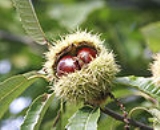
Sweet Chestnut

Encyclopedia
Castanea sativa is a species of the flowering plant
family Fagaceae
, the tree and its edible seeds are referred to by several common names such Sweet Chestnut or Marron. Originally native to southeastern Europe
and Asia Minor
, it is now widely dispersed throughout Europe and parts of Asia, such as the lower Himalayas
and other temperate parts of the Indian Subcontinent
. The trees are hardy, long lived and well known, especially for its chestnuts which are used as an ingredient in cooking.
, chinkapins and chestnuts, which is contained by the diverse Fagaceae family of beech and oak trees. The first description was by Phillip Miller
in 1768. Castanea sativa is referred to as a Chestnut, which is distinguished as the Spanish Chestnut, Portuguese Chestnut, European chestnut.
Castanea sativa is a medium-sized to large deciduous
tree
attaining a height of 20–35 m with a trunk often 2 m in diameter. The oblong-lanceolate, boldly toothed leaves
are 16–28 cm long and 5–9 cm broad.
The flower
s of both sexes are borne in 10–20 cm long, upright catkin
s, the male flowers in the upper part and female flowers in the lower part. In the northern hemisphere, they appear in late June to July, and by autumn, the female flowers develop into spiny cupule
s containing 3-7 brownish nuts
that are shed during October. The female flowers eventually form a spiky sheath that deters predators from the seed.
Some cultivars ('Marron de Lyon', 'Paragon' and some hybrids) produce only 1 large nut per cupule, rather than the average two to four nuts of edible, though smaller, size.
The bark often has a net-shaped (retiform) pattern with deep furrows or fissures running spirally in both directions up the trunk.
The tree requires a mild climate and adequate moisture for good growth and a good nut harvest. Its year-growth (but not the rest of the tree) is sensitive to late spring and early autumn frosts, and is intolerant of lime. Under forest conditions it will tolerate moderate shade well.
The leaves provide food for some animals, including Lepidoptera
such as the case-bearer moth
Coleophora anatipennella
.
The species was originated in southern Europe, the Balkans and maybe regions nearby. The use as food and an ornamental tree caused it to be introduced throughout western Europe, localised populations and cultivation occur on other continents.
.jpg) The species is widely cultivated for its edible seed
The species is widely cultivated for its edible seed
s (also called nut
s) and for its wood
. As early as Roman
times it was introduced into more northerly regions, and later was also cultivated in monastery gardens by monks. Today, centuries-old specimens may be found in Great Britain
and the whole of central, western and southern Europe
. They are widely popular in Greece
, Austria
, Turkey
, Portugal
, France
, Hungary
, Italy
, Slovenia
, Slovakia
, Serbia
, Bosnia
, Croatia
, and particularly in Corsica
.
The raw nuts, with their pithy skin around the seed, are somewhat astringent. That skin can be relatively easily removed by quickly blanching the nuts after having made a cross slit at the tufted end. Once cooked they become delicious, developing, when roasted, a sweet flavour and floury texture not unlike sweet potato. The cooked nuts can be used by confectioners, puddings, desserts and cakes or eaten roasted. They are used for flour, bread making, a cereal substitute, coffee substitute, a thickener in soups and other cookery uses, as well as for fattening stock. A sugar can be extracted from it. The Corsican variety of polenta
(called pulenta) is made with sweet chestnut flour. A local variety of Corsican beer also uses chestnuts. The product is sold as a sweetened paste mixed with vanilla, crème de marron, sweetened or unsweetened as chestnut purée or purée de marron, and candied chestnuts as marron glacés. Roman soldiers were given chestnut porridge before entering battle.
Leaves infusions are used in respiratory diseases and are a popular remedy for whooping cough. A hair shampoo can be made from infusing leaves and fruit husks.
This tree responds very well to coppicing
, which is still practised in Britain, and produces a good crop of tannin
-rich wood every twelve to thirty years, depending on intended use and local growth rate. The tannin renders the young growing wood durable and resistant to outdoor use, thus suitable for posts, fencing or stakes.
The timber of the species is marketed as chestnut. The wood is of light colour, hard and strong. It is also used to make furniture, barrels (sometimes used to age balsamic vinegar
), and roof beams notably in southern Europe (for example in houses of the Alpujarra, Spain, in southern France and elsewhere). The timber has a density of 560 kg per cubic meter, and due to its durability in ground contact is often used for external purposes such as fencing. It is also a good fuel, though not favoured for open fires as it tends to spit.
Tannin
is found in the following proportions on a 10% moisture basis: bark
(6.8%), wood (13.4%), seed husks (10 - 13%). The leaves also contain tannin.
The tree was a popular choice for landscaping in England, particularly in the eighteenth and nineteenth century. The flowering period is between June and July in this country. Castanea sativa was probably introduced to the region during the Roman occupation, and many ancient examples are recorded.
More recently, the tree has been planted as a street tree in England
, and examples can be seen particularly in the London
borough of Islington
.
A tree grown from seed may take twenty years or more before it bears fruits, but a grafted cultivar such as 'Marron de Lyon' or 'Paragon' may start production within five years of being planted. Both cultivars bear fruits with a single large kernel, rather than an average of two to four smaller kernels.
Flowering plant
The flowering plants , also known as Angiospermae or Magnoliophyta, are the most diverse group of land plants. Angiosperms are seed-producing plants like the gymnosperms and can be distinguished from the gymnosperms by a series of synapomorphies...
family Fagaceae
Fagaceae
The family Fagaceae, or beech family, comprises about 900 species of both evergreen and deciduous trees and shrubs, which are characterized by alternate simple leaves with pinnate venation, unisexual flowers in the form of catkins, and fruit in the form of cup-like nuts. Fagaceous leaves are often...
, the tree and its edible seeds are referred to by several common names such Sweet Chestnut or Marron. Originally native to southeastern Europe
Europe
Europe is, by convention, one of the world's seven continents. Comprising the westernmost peninsula of Eurasia, Europe is generally 'divided' from Asia to its east by the watershed divides of the Ural and Caucasus Mountains, the Ural River, the Caspian and Black Seas, and the waterways connecting...
and Asia Minor
Asia Minor
Asia Minor is a geographical location at the westernmost protrusion of Asia, also called Anatolia, and corresponds to the western two thirds of the Asian part of Turkey...
, it is now widely dispersed throughout Europe and parts of Asia, such as the lower Himalayas
Himalayas
The Himalaya Range or Himalaya Mountains Sanskrit: Devanagari: हिमालय, literally "abode of snow"), usually called the Himalayas or Himalaya for short, is a mountain range in Asia, separating the Indian subcontinent from the Tibetan Plateau...
and other temperate parts of the Indian Subcontinent
Indian subcontinent
The Indian subcontinent, also Indian Subcontinent, Indo-Pak Subcontinent or South Asian Subcontinent is a region of the Asian continent on the Indian tectonic plate from the Hindu Kush or Hindu Koh, Himalayas and including the Kuen Lun and Karakoram ranges, forming a land mass which extends...
. The trees are hardy, long lived and well known, especially for its chestnuts which are used as an ingredient in cooking.
Description
A species of the genus CastaneaCastanea
Castanea can mean:* Castanea , a plant genus including the chestnuts and chinkapins* Castanea, Pennsylvania, a census-designated place * Castanea Township, Pennsylvania, which surrounds the CDP of the same name...
, chinkapins and chestnuts, which is contained by the diverse Fagaceae family of beech and oak trees. The first description was by Phillip Miller
Phillip Miller
Phillip Miller is an American former mixed martial artist who retired undefeated and competed in the Middleweight division. He won his last fight at HOOKnSHOOT – Absolute Fighting Championships 2 against Moacir Oliveira on March 28, 2003...
in 1768. Castanea sativa is referred to as a Chestnut, which is distinguished as the Spanish Chestnut, Portuguese Chestnut, European chestnut.
Castanea sativa is a medium-sized to large deciduous
Deciduous
Deciduous means "falling off at maturity" or "tending to fall off", and is typically used in reference to trees or shrubs that lose their leaves seasonally, and to the shedding of other plant structures such as petals after flowering or fruit when ripe...
tree
Tree
A tree is a perennial woody plant. It is most often defined as a woody plant that has many secondary branches supported clear of the ground on a single main stem or trunk with clear apical dominance. A minimum height specification at maturity is cited by some authors, varying from 3 m to...
attaining a height of 20–35 m with a trunk often 2 m in diameter. The oblong-lanceolate, boldly toothed leaves
Leaf
A leaf is an organ of a vascular plant, as defined in botanical terms, and in particular in plant morphology. Foliage is a mass noun that refers to leaves as a feature of plants....
are 16–28 cm long and 5–9 cm broad.
The flower
Flower
A flower, sometimes known as a bloom or blossom, is the reproductive structure found in flowering plants . The biological function of a flower is to effect reproduction, usually by providing a mechanism for the union of sperm with eggs...
s of both sexes are borne in 10–20 cm long, upright catkin
Catkin
A catkin or ament is a slim, cylindrical flower cluster, with inconspicuous or no petals, usually wind-pollinated but sometimes insect pollinated . They contain many, usually unisexual flowers, arranged closely along a central stem which is often drooping...
s, the male flowers in the upper part and female flowers in the lower part. In the northern hemisphere, they appear in late June to July, and by autumn, the female flowers develop into spiny cupule
Cupule
The calybium and the cupule make up the accessory fruit of flowering plants in the family Fagaceae. These two parts derive from different flower components....
s containing 3-7 brownish nuts
Nut (fruit)
A nut is a hard-shelled fruit of some plants having an indehiscent seed. While a wide variety of dried seeds and fruits are called nuts in English, only a certain number of them are considered by biologists to be true nuts...
that are shed during October. The female flowers eventually form a spiky sheath that deters predators from the seed.
Some cultivars ('Marron de Lyon', 'Paragon' and some hybrids) produce only 1 large nut per cupule, rather than the average two to four nuts of edible, though smaller, size.
The bark often has a net-shaped (retiform) pattern with deep furrows or fissures running spirally in both directions up the trunk.
The tree requires a mild climate and adequate moisture for good growth and a good nut harvest. Its year-growth (but not the rest of the tree) is sensitive to late spring and early autumn frosts, and is intolerant of lime. Under forest conditions it will tolerate moderate shade well.
- See also List of Lepidoptera that feed on chestnut trees
The leaves provide food for some animals, including Lepidoptera
Lepidoptera
Lepidoptera is a large order of insects that includes moths and butterflies . It is one of the most widespread and widely recognizable insect orders in the world, encompassing moths and the three superfamilies of butterflies, skipper butterflies, and moth-butterflies...
such as the case-bearer moth
Moth
A moth is an insect closely related to the butterfly, both being of the order Lepidoptera. Moths form the majority of this order; there are thought to be 150,000 to 250,000 different species of moth , with thousands of species yet to be described...
Coleophora anatipennella
Coleophora anatipennella
Coleophora anatipennella is a moth of the case-bearer family . It is the type species of its genus and, via that, of its family....
.
The species was originated in southern Europe, the Balkans and maybe regions nearby. The use as food and an ornamental tree caused it to be introduced throughout western Europe, localised populations and cultivation occur on other continents.
Uses
Seed
A seed is a small embryonic plant enclosed in a covering called the seed coat, usually with some stored food. It is the product of the ripened ovule of gymnosperm and angiosperm plants which occurs after fertilization and some growth within the mother plant...
s (also called nut
Nut (fruit)
A nut is a hard-shelled fruit of some plants having an indehiscent seed. While a wide variety of dried seeds and fruits are called nuts in English, only a certain number of them are considered by biologists to be true nuts...
s) and for its wood
Wood
Wood is a hard, fibrous tissue found in many trees. It has been used for hundreds of thousands of years for both fuel and as a construction material. It is an organic material, a natural composite of cellulose fibers embedded in a matrix of lignin which resists compression...
. As early as Roman
Ancient Rome
Ancient Rome was a thriving civilization that grew on the Italian Peninsula as early as the 8th century BC. Located along the Mediterranean Sea and centered on the city of Rome, it expanded to one of the largest empires in the ancient world....
times it was introduced into more northerly regions, and later was also cultivated in monastery gardens by monks. Today, centuries-old specimens may be found in Great Britain
Great Britain
Great Britain or Britain is an island situated to the northwest of Continental Europe. It is the ninth largest island in the world, and the largest European island, as well as the largest of the British Isles...
and the whole of central, western and southern Europe
Europe
Europe is, by convention, one of the world's seven continents. Comprising the westernmost peninsula of Eurasia, Europe is generally 'divided' from Asia to its east by the watershed divides of the Ural and Caucasus Mountains, the Ural River, the Caspian and Black Seas, and the waterways connecting...
. They are widely popular in Greece
Greece
Greece , officially the Hellenic Republic , and historically Hellas or the Republic of Greece in English, is a country in southeastern Europe....
, Austria
Austria
Austria , officially the Republic of Austria , is a landlocked country of roughly 8.4 million people in Central Europe. It is bordered by the Czech Republic and Germany to the north, Slovakia and Hungary to the east, Slovenia and Italy to the south, and Switzerland and Liechtenstein to the...
, Turkey
Turkey
Turkey , known officially as the Republic of Turkey , is a Eurasian country located in Western Asia and in East Thrace in Southeastern Europe...
, Portugal
Portugal
Portugal , officially the Portuguese Republic is a country situated in southwestern Europe on the Iberian Peninsula. Portugal is the westernmost country of Europe, and is bordered by the Atlantic Ocean to the West and South and by Spain to the North and East. The Atlantic archipelagos of the...
, France
France
The French Republic , The French Republic , The French Republic , (commonly known as France , is a unitary semi-presidential republic in Western Europe with several overseas territories and islands located on other continents and in the Indian, Pacific, and Atlantic oceans. Metropolitan France...
, Hungary
Hungary
Hungary , officially the Republic of Hungary , is a landlocked country in Central Europe. It is situated in the Carpathian Basin and is bordered by Slovakia to the north, Ukraine and Romania to the east, Serbia and Croatia to the south, Slovenia to the southwest and Austria to the west. The...
, Italy
Italy
Italy , officially the Italian Republic languages]] under the European Charter for Regional or Minority Languages. In each of these, Italy's official name is as follows:;;;;;;;;), is a unitary parliamentary republic in South-Central Europe. To the north it borders France, Switzerland, Austria and...
, Slovenia
Slovenia
Slovenia , officially the Republic of Slovenia , is a country in Central and Southeastern Europe touching the Alps and bordering the Mediterranean. Slovenia borders Italy to the west, Croatia to the south and east, Hungary to the northeast, and Austria to the north, and also has a small portion of...
, Slovakia
Slovakia
The Slovak Republic is a landlocked state in Central Europe. It has a population of over five million and an area of about . Slovakia is bordered by the Czech Republic and Austria to the west, Poland to the north, Ukraine to the east and Hungary to the south...
, Serbia
Serbia
Serbia , officially the Republic of Serbia , is a landlocked country located at the crossroads of Central and Southeast Europe, covering the southern part of the Carpathian basin and the central part of the Balkans...
, Bosnia
Bosnia and Herzegovina
Bosnia and Herzegovina , sometimes called Bosnia-Herzegovina or simply Bosnia, is a country in Southern Europe, on the Balkan Peninsula. Bordered by Croatia to the north, west and south, Serbia to the east, and Montenegro to the southeast, Bosnia and Herzegovina is almost landlocked, except for the...
, Croatia
Croatia
Croatia , officially the Republic of Croatia , is a unitary democratic parliamentary republic in Europe at the crossroads of the Mitteleuropa, the Balkans, and the Mediterranean. Its capital and largest city is Zagreb. The country is divided into 20 counties and the city of Zagreb. Croatia covers ...
, and particularly in Corsica
Corsica
Corsica is an island in the Mediterranean Sea. It is located west of Italy, southeast of the French mainland, and north of the island of Sardinia....
.
The raw nuts, with their pithy skin around the seed, are somewhat astringent. That skin can be relatively easily removed by quickly blanching the nuts after having made a cross slit at the tufted end. Once cooked they become delicious, developing, when roasted, a sweet flavour and floury texture not unlike sweet potato. The cooked nuts can be used by confectioners, puddings, desserts and cakes or eaten roasted. They are used for flour, bread making, a cereal substitute, coffee substitute, a thickener in soups and other cookery uses, as well as for fattening stock. A sugar can be extracted from it. The Corsican variety of polenta
Polenta
Polenta is a dish made from boiled cornmeal. The word "polenta" is borrowed from Italian.-Description:Polenta is made with ground yellow or white cornmeal , which can be ground coarsely or finely depending on the region and the texture desired.As it is known today, polenta derives from earlier...
(called pulenta) is made with sweet chestnut flour. A local variety of Corsican beer also uses chestnuts. The product is sold as a sweetened paste mixed with vanilla, crème de marron, sweetened or unsweetened as chestnut purée or purée de marron, and candied chestnuts as marron glacés. Roman soldiers were given chestnut porridge before entering battle.
Leaves infusions are used in respiratory diseases and are a popular remedy for whooping cough. A hair shampoo can be made from infusing leaves and fruit husks.
This tree responds very well to coppicing
Coppicing
Coppicing is a traditional method of woodland management which takes advantage of the fact that many trees make new growth from the stump or roots if cut down. In a coppiced wood, young tree stems are repeatedly cut down to near ground level...
, which is still practised in Britain, and produces a good crop of tannin
Tannin
A tannin is an astringent, bitter plant polyphenolic compound that binds to and precipitates proteins and various other organic compounds including amino acids and alkaloids.The term tannin refers to the use of...
-rich wood every twelve to thirty years, depending on intended use and local growth rate. The tannin renders the young growing wood durable and resistant to outdoor use, thus suitable for posts, fencing or stakes.
The timber of the species is marketed as chestnut. The wood is of light colour, hard and strong. It is also used to make furniture, barrels (sometimes used to age balsamic vinegar
Balsamic vinegar
Balsamic vinegar is a condiment originating from Italy.The original traditional product , made from a reduction of cooked white Trebbiano grape juice and not a vinegar in the usual sense, has been made in Modena and Reggio Emilia since the Middle Ages: the production of the balsamic vinegar is...
), and roof beams notably in southern Europe (for example in houses of the Alpujarra, Spain, in southern France and elsewhere). The timber has a density of 560 kg per cubic meter, and due to its durability in ground contact is often used for external purposes such as fencing. It is also a good fuel, though not favoured for open fires as it tends to spit.
Tannin
Tannin
A tannin is an astringent, bitter plant polyphenolic compound that binds to and precipitates proteins and various other organic compounds including amino acids and alkaloids.The term tannin refers to the use of...
is found in the following proportions on a 10% moisture basis: bark
Bark
Bark is the outermost layers of stems and roots of woody plants. Plants with bark include trees, woody vines and shrubs. Bark refers to all the tissues outside of the vascular cambium and is a nontechnical term. It overlays the wood and consists of the inner bark and the outer bark. The inner...
(6.8%), wood (13.4%), seed husks (10 - 13%). The leaves also contain tannin.
The tree was a popular choice for landscaping in England, particularly in the eighteenth and nineteenth century. The flowering period is between June and July in this country. Castanea sativa was probably introduced to the region during the Roman occupation, and many ancient examples are recorded.
More recently, the tree has been planted as a street tree in England
England
England is a country that is part of the United Kingdom. It shares land borders with Scotland to the north and Wales to the west; the Irish Sea is to the north west, the Celtic Sea to the south west, with the North Sea to the east and the English Channel to the south separating it from continental...
, and examples can be seen particularly in the London
London
London is the capital city of :England and the :United Kingdom, the largest metropolitan area in the United Kingdom, and the largest urban zone in the European Union by most measures. Located on the River Thames, London has been a major settlement for two millennia, its history going back to its...
borough of Islington
Islington
Islington is a neighbourhood in Greater London, England and forms the central district of the London Borough of Islington. It is a district of Inner London, spanning from Islington High Street to Highbury Fields, encompassing the area around the busy Upper Street...
.
A tree grown from seed may take twenty years or more before it bears fruits, but a grafted cultivar such as 'Marron de Lyon' or 'Paragon' may start production within five years of being planted. Both cultivars bear fruits with a single large kernel, rather than an average of two to four smaller kernels.