
All Topics  
Moss

 
Moss

   Email Print
   Bookmark   Link


Moss


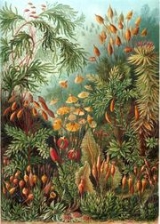
Mosses are small, soft plant
Plant

Plants are Life organisms belonging to the Kingdom Plantae. They include familiar organisms such as trees, herbs, bushes, grasses, vines, ferns, mosses, and green algae....
s that are typically 1–10 cm (0.4-4 in) tall, though some species are much larger. They commonly grow close together in clumps or mats in damp or shady locations. They do not have flowers or seed
Seed

A seed is a small Plant embryogenesis plant enclosed in a covering called the seed coat, usually with some Food storage. It is the product of the ripened ovule of gymnosperm and angiosperm plants which occurs after fertilization and some growth within the mother plant....
s, and their simple leaves
Leaf

In botany, a leaf is an above-ground plant Organ specialized for photosynthesis. For this purpose, a leaf is typically flat and thin, to expose the cells containing chloroplast to light over a broad area, and to allow light to penetrate fully into the tissues....
 cover the thin wiry stems. At certain times mosses produce spore
Spore

In biology, a spore is a reproduction structure that is adapted for biological dispersal and surviving for extended periods of time in unfavorable conditions....
 capsules which may appear as beak-like capsules borne aloft on thin stalks.

There are approximately 12,000 species of moss classified in the Bryophyta.


Discussion
Ask a question about 'Moss'
Start a new discussion about 'Moss'
Answer questions from other users
Full Discussion Forum


Encyclopedia


Mosses are small, soft plant
Plant

Plants are Life organisms belonging to the Kingdom Plantae. They include familiar organisms such as trees, herbs, bushes, grasses, vines, ferns, mosses, and green algae....
s that are typically 1–10 cm (0.4-4 in) tall, though some species are much larger. They commonly grow close together in clumps or mats in damp or shady locations. They do not have flowers or seed
Seed

A seed is a small Plant embryogenesis plant enclosed in a covering called the seed coat, usually with some Food storage. It is the product of the ripened ovule of gymnosperm and angiosperm plants which occurs after fertilization and some growth within the mother plant....
s, and their simple leaves
Leaf

In botany, a leaf is an above-ground plant Organ specialized for photosynthesis. For this purpose, a leaf is typically flat and thin, to expose the cells containing chloroplast to light over a broad area, and to allow light to penetrate fully into the tissues....
 cover the thin wiry stems. At certain times mosses produce spore
Spore

In biology, a spore is a reproduction structure that is adapted for biological dispersal and surviving for extended periods of time in unfavorable conditions....
 capsules which may appear as beak-like capsules borne aloft on thin stalks.

There are approximately 12,000 species of moss classified in the Bryophyta. The division Bryophyta formerly included not only mosses, but also liverworts and hornwort
Hornwort

Hornworts are a group of bryophytes, or non-vascular plants, comprising the division Anthocerotophyta. The common name refers to the elongated horn-like structure, which is the sporophyte....
s. These other two groups of bryophyte
Bryophyte

Bryophytes are all embryophytes that are non-vascular plant: they have tissues and enclosed reproductive systems, but they lack vascular tissue that circulates liquids....
s now are often placed in their own divisions.

Physical characteristics


Description

Botanically, mosses are bryophyte
Bryophyte

Bryophytes are all embryophytes that are non-vascular plant: they have tissues and enclosed reproductive systems, but they lack vascular tissue that circulates liquids....
s, or non-vascular plant
Non-vascular plant

Non-vascular plants is a general term for those plants without a vascular tissue . Although non-vascular plants lack these particular tissues, a number of non-vascular plants possess tissues specialized for internal transport of water....
s. They can be distinguished from the apparently similar liverworts (Marchantiophyta or Hepaticae) by their multi-cellular rhizoid
Rhizoid

Rhizoids are a structure in plants, fungi and some other organisms that functions like a root in support or absorption.In fungi, rhizoids are small branching hyphae that grow downwards from the stolons that anchor the fungus....
s. Other differences are not universal for all mosses and all liverworts, but the presence of clearly differentiated "stem" and "leaves", the lack of deeply lobed or segmented leaves, and the absence of leaves arranged in three ranks, all point to the plant being a moss.

In addition to lacking a vascular system, mosses have a gametophyte
Gametophyte

In plants and algae that undergo alternation of generations, a gametophyte is the multicellular structure, or phase, that is haploid, containing a single set of chromosomes:...
-dominant life cycle
Biological life cycle

A life cycle is a period involving one generation of an organism through means of reproduction, whether through asexual reproduction or sexual reproduction....
, i.e. the plant's cells are haploid for most of its life cycle. Sporophytes (i.e. the diploid body) are short-lived and dependent on the gametophyte. This is in contrast to the pattern exhibited by most "higher" plants and by most animals. In seed plants, for example, the haploid generation is represented by the pollen and the ovule, whilst the diploid generation is the familiar flowering plant.

Life cycle

Most kinds of plant
Plant

Plants are Life organisms belonging to the Kingdom Plantae. They include familiar organisms such as trees, herbs, bushes, grasses, vines, ferns, mosses, and green algae....
s excluding algae
Algae

Algae are a large and diverse group of simple, typically autotrophic organisms, ranging from unicellular to multicellular forms. The largest and most complex marine forms are called seaweeds....
 and bryophytes have two sets of chromosome
Chromosome

A chromosome is an organized structure of DNA and protein that is found in Cell . A chromosome is a single piece of DNA that contains many genes, regulatory sequence and other genetic sequence....
s in their vegetative cells and are said to be diploid, i.e. each chromosome has a partner that contains the same, or similar, genetic information. Mosses (and other bryophyte
Bryophyte

Bryophytes are all embryophytes that are non-vascular plant: they have tissues and enclosed reproductive systems, but they lack vascular tissue that circulates liquids....
s) have only a single set of chromosomes (haploid, i.e. each chromosome exists in a unique copy within the cell). There are periods in the moss lifecycle when they do have a full, double set of paired chromosomes but this is only during the sporophyte
Sporophyte

All land plants, and some algae, have life cycles in which a haploid gametophyte generation alternates with a diploid sporophyte, the generation of a plant or alga that has a double set of chromosomes....
 stage.

The life of a moss starts from a haploid spore
Spore

In biology, a spore is a reproduction structure that is adapted for biological dispersal and surviving for extended periods of time in unfavorable conditions....
, which germinates to produce a protonema
Protonema

A protonema is a thread-like chain of cells that forms the earliest stage of a bryophyte life cycle. When a moss or Marchantiophyta first grows from the spore, it grows as a protonema which develops into a leafy gametophore....
, which is either a mass of filaments or thalloid (flat and thallus-like). This is a transitory stage in the life of a moss. From the protonema grows the gametophore
Gametophore

The word gametophore, also known as gametangiophore, is composed of gametangium and "phore" . In moss and fern the gametophore is the bearer of the sex organs , the female archegonia and the male antheridia....
 ("gamete-bearer") that is differentiated into stems and leaves. From the tips of stems or branches develop the sex organs of the mosses. The female organs are known as archegonia (sing. archegonium
Archegonium

An archegonium , from the ancient Greek ???? and ????? , is a multicellular structure or organ of the gametophyte phase of certain plants producing and containing the ovum or female gamete....
) and are protected by a group of modified leaves known as the perichaetum (plural, perichaeta). The archegonia have necks called venters which the male sperm swim down. The male organs are known as antheridia (singular antheridium
Antheridium

An antheridium is a haploid structure or organ producing and containing male gametes . It is present in the gametophyte phase of lower plants like mosses and ferns, and also in the primitive vascular Psilotophyta....
) and are enclosed by modified leaves called the perigonium (plural, perigonia).

Mosses can be either dioicous (compare dioecious
Dioecious

Dioecious - from Greek language for "two households" - refers to species of seed-bearing plants having separate male and female plants. That is, no individual plant of the species produces both microspores and megaspores; individual plants are either male or female ....
 in seed plants) or monoicous
Monoicous

Monoicous organisms are defined as having both sperm-producing and egg-producing reproductive organs in the same individual. By contrast dioicous organisms produce male and female reproductive organs on different individuals....
 (compare monoecious). In dioicous mosses, both male and female sex organs are borne on different gametophyte plants. In monoicous (also called autoicous) mosses, they are borne on the same plant. In the presence of water, sperm from the antheridia swim to the archegonia and fertilisation
Fertilisation

Fertilisation , is the fusion of gametes to produce a new organism. In animals, the process involves a sperm fusing with an ovum, which eventually leads to the development of an embryo....
 occurs, leading to the production of a diploid sporophyte. The sperm of mosses is biflagellate, i.e. they have two flagellae that aid in propulsion. Since the sperm must swim to the archegonium, fertilisation cannot occur without water. After fertilisation, the immature sporophyte pushes its way out of the archegonial venter. It takes about a quarter to half a year for the sporophyte
Sporophyte

All land plants, and some algae, have life cycles in which a haploid gametophyte generation alternates with a diploid sporophyte, the generation of a plant or alga that has a double set of chromosomes....
 to mature. The sporophyte body comprises a long stalk, called a seta, and a capsule capped by a cap called the operculum
Operculum (botany)

In botany, operculum may be used to describe any of the following:*A flap of the Sporangium of a Moss, covering the peristome .*The cap of the Ascus in certain Ascomycota fungi....
. The capsule and operculum are in turn sheathed by a haploid calyptra which is the remains of the archegonial venter. The calyptra usually falls off when the capsule is mature. Within the capsule, spore-producing cells undergo meiosis
Meiosis

In biology or life science, meiosis is a process of reductional division in which the number of chromosomes per cell is halved. In animals, meiosis always results in the formation of gametes, while in other organisms it can give rise to spores....
 to form haploid spores, upon which the cycle can start again. The mouth of the capsule is usually ringed by a set of teeth called peristome. This may be absent in some mosses.

In some mosses, e.g. Ulota phyllantha, green vegetative structures called gemmae are produced on leaves or branches, which can break off and form new plants without the need to go through the cycle of fertilization. This is a means of asexual reproduction
Asexual reproduction

Asexual reproduction is reproduction which does not involve meiosis, ploidy reduction, or fertilization. Only one parent is involved in asexual reproduction....
, and the genetically identical units can lead to the formation of clonal
Cloning

Cloning in biology is the process of producing populations of genetically-identical individuals that occurs in nature when organisms such as bacteria, insects or plants reproduce Asexual Reproduction....
 populations.

Classification

Three Mosses and A Tree
Mosses were traditionally grouped with the liverworts and hornwort
Hornwort

Hornworts are a group of bryophytes, or non-vascular plants, comprising the division Anthocerotophyta. The common name refers to the elongated horn-like structure, which is the sporophyte....
s in the Division Bryophyta (bryophyte
Bryophyte

Bryophytes are all embryophytes that are non-vascular plant: they have tissues and enclosed reproductive systems, but they lack vascular tissue that circulates liquids....
s), within which the mosses made up the class Musci. This group, however, is paraphyletic and now tends to be split up. In such a system, the Division Bryophyta refers specifically to mosses. They appear to be the closest living relatives of the vascular plant
Vascular plant

Vascular plants are those plants that have lignin tissue for conducting water, minerals, and photosynthetic products through the plant. Vascular plants include the ferns, clubmosses, flowering plants, conifers and other gymnosperms....
s.

The mosses are grouped as a single division, now named Bryophyta, and divided into six classes:

  • Takakiopsida
  • Sphagnopsida
    Sphagnopsida

    The Sphagnopsida includes a single subclass Sphagnidae, with three orders. The order Sphagnales contains only the genus Sphagnum, with all but two of the species....
  • Andreaeopsida
  • Andreaeobryopsida
  • Polytrichopsida
    Polytrichopsida

    The Polytrichopsida is a class of mosses containing two orders. Most of the species in this class are larger than other mosses and have a thickened central stem....
  • Bryopsida
    Bryopsida

    The Bryopsida constitute the largest class of mosses, containing 95% of all moss species. It consists of approximately 9,500 species, common throughout the whole world....
Andreaeopsida and Andreaeobryopsida are distinguished by the biseriate (two rows of cells) rhizoids, multiseriate (many rows of cells) protonema, and sporangium that splits along longitudinal lines. Most mosses have capsules that open at the top.

The Sphagnopsida, the peat-mosses, comprise the two living genera Ambuchanania
Ambuchanania

Ambuchanania leucobryoides is the only species of genus Ambuchanania. It is a Sphagnum-like moss endemic to Tasmania. Originally described as a species of Sphagnum, it is now a separate genus on the basis of both unusual morphology and genetic differences....
 and Sphagnum
Sphagnum

Sphagnum is a genus of between 151-350 Specie of mosses commonly called peat moss, due to its prevalence in peat bogs and mires. A distinction is made between sphagnum moss, the live moss growing on top of a peat bog, and sphagnum peat moss, the decaying matter underneath....
, as well as fossil taxa. These large mosses form extensive acidic bogs in peat swamps. The leaves of Sphagnum have large dead cells alternating with living photosynthetic cells. The dead cells help to store water. Aside from this character, the unique branching, thallose (flat and expanded) protonema, and explosively rupturing sporangium place it apart from other mosses.

Polytrichopsida have leaves with sets of parallel lamellae, flaps of chloroplast-containing cells that look like the fins on a heat sink. These carry out photosynthesis and may help to conserve moisture by partially enclosing the gas exchange surfaces. The Polytrichopsida differ from other mosses in other details of their development and anatomy too, and can also become larger than most other mosses, with e.g. Polytrichum commune
Polytrichum commune

Polytrichum commune is a species of moss found in many regions with high humidity and rainfall. The species can be exceptionally tall for a moss with stems often exceeding 30 cm and rarely reaching up to 70 cm , but it is most commonly found at shorter lengths of 5 to 10 cm ....
 forming cushions up to 40 cm (16 in) high. The tallest land moss, a member of the Polytrichidae is probably Dawsonia superba, a native to New Zealand
New Zealand

New Zealand is an island country in the south-western Pacific Ocean comprising two main landmasses , and numerous Islands of New Zealand, most notably Stewart Island/Rakiura and the Chatham Islands....
 and other parts of Australasia
Australasia

Australasia is a region of Oceania: New Zealand, Australia, Papua New Guinea, and neighbouring islands in the Pacific Ocean. The term was coined by Charles de Brosses in Histoire des navigations aux terres australes ....
.

The Bryopsida are the most diverse group; over 95% of moss species belong to this class.

The Archidiidae are distinguished by their extremely large spores and the way the sporangium develops.

Geological history

The fossil record of moss is sparse, due to their soft-walled and fragile nature. Unambiguous moss fossils have been recovered from as early as the Permian
Permian

The PermianThe term "Permian" was introduced into geology in 1841 by Sir Roderick Murchison, president of the Geological Society of London, who identified typical strata in extensive Russian explorations undertaken with Edouard de Verneuil; Murchison asserted in 1841 that he named his "Permian system" after the ancient kingdom...
 of Antarctica and Russia, and a case is put forwards for Carboniferous
Carboniferous

The Carboniferous is a geologic period that extends from the end of the Devonian period, about 359.2 ? 2.5 annum , to the beginning of the Permian period, about 299.0 ? 0.8 Ma ...
 mosses. It has further been claimed that tube-like fossils from the Silurian
Silurian

The Silurian is a geologic period that extends from the end of the Ordovician period, about 443.7 ? 1.5 annum , to the beginning of the Devonian period, about 416.0 ? 2.8 Mya ....
 are the macerated remains of moss calyptræ.

Habitat


Mech Plonnik Mlode Sporofity
Mosses are found chiefly in areas of dampness and low light. Mosses are common in wooded areas and at the edges of streams. Mosses are also found in cracks between paving stones in damp city streets. Some types have adapted to urban conditions and are found only in cities. A few species are wholly aquatic, such as Fontinalis antipyretica, and others such as Sphagnum inhabit bogs, marshes and very slow-moving waterways. Such aquatic or semi-aquatic mosses can greatly exceed the normal range of lengths seen in terrestrial mosses. Individual plants 20–30 cm (8-12 in) or more long are common in Sphagnum species for example.

Wherever they occur, mosses require moisture to survive because of the small size and thinness of tissues, lack of cuticle (waxy covering to prevent water loss), and the need for liquid water to complete fertilisation. Some mosses can survive desiccation
Desiccation

Desiccation is the state of extreme dryness, or the process of extreme drying. A desiccant is a hygroscopic substance that induces or sustains such a state in its local vicinity in a moderately-well sealed container....
, returning to life within a few hours of rehydration.

In northern latitudes, the north side of trees and rocks will generally have more moss on average than other sides (though south-side outcroppings are not unknown). This is assumed to be because of the lack of sufficient water for reproduction on the sun-facing side of trees. South of the equator the reverse is true. In deep forests where sunlight does not penetrate, mosses grow equally well on all sides of the tree trunk.

Cultivation

Moss is considered a weed in grass lawns, but is deliberately encouraged to grow under aesthetic principles exemplified by Japanese garden
Japanese garden

, that is, gardens in traditional Japanese style, can be found at private homes, in neighborhood or city parks, and at historical landmarks such as Buddhism temples and old Japanese castles....
ing. In old temple gardens, moss can carpet a forest scene. Moss is thought to add a sense of calm, age, and stillness to a garden scene. Rules of cultivation are not widely established. Moss collections are quite often begun using samples transplanted from the wild in a water-retaining bag. However, specific species of moss can be extremely difficult to maintain away from their natural sites with their unique combinations of light, humidity, shelter from wind, etc.

Growing moss from spores is even less controlled. Moss spores fall in a constant rain on exposed surfaces; those surfaces which are hospitable to a certain species of moss will typically be colonised by that moss within a few years of exposure to wind and rain. Materials which are porous and moisture retentive, such as brick
Brick

A brick is a block of ceramic material used in masonry construction, usually laid using mortar ....
, wood
Wood

Wood is an organic material; in the strict sense wood is produced as secondary xylem in the stems of woody plants, notably trees but also shrubs, etc....
, and certain coarse concrete mixtures are hospitable to moss. Surfaces can also be prepared with acidic substances, including buttermilk
Buttermilk

Buttermilk is a fermented dairy product produced from cow's milk with a characteristically sour taste. The product is made in one of two ways....
, yogurt, urine
Urine

Urine is a liquid waste product of the body secreted by the kidneys by a process of filtration from blood called urination and excreted through the urethra....
, and gently puréed mixtures of moss samples, water and ericaceous compost
Compost

Compost , sometimes known as brown manure, is the end result of controlled aerobic decomposition of organic matter known as composting. It is used in landscaping, horticulture and agriculture as a soil conditioner and fertilizer to add vital humus or humic acids....
.

Inhibiting moss growth

Moss growth can be inhibited by a number of methods:
  • Decreasing availability of water
    Water

    Water is a common chemical substance that is essential for the survival of all known forms of life. In typical usage, water refers only to its liquid form or States of matter, but the substance also has a solid state, ice, and a gaseous state, water vapor or steam....
     through drainage
    Drainage

    Drainage is the natural or artificial removal of surface and groundwater from an area. Many agricultural soils need drainage to improve production or to manage water supplies....
     or direct application changes.
  • Increasing direct sunlight.
  • Increasing number and resources available for competitive plants like grass
    Grass

    Grass is the common word that generally describes monocotyledonous green plants. The family Poaceae are the "true grasses" and include most plants grown as grains, for pasture, and for lawns ....
    es.
  • Increasing the soil pH
    PH

    pH is a measure of the Acid or Base of a solution. It is defined as the cologarithm of the Activity of dissolved hydrogen ions . Hydrogen ion activity coefficients cannot be measured experimentally, so they are based on theoretical calculations....
     with the application of lime
    Lime (mineral)

    Lime is a general term for calcium-containing inorganic materials, in which carbonates, oxides and hydroxides predominate. Strictly speaking, lime is calcium oxide or calcium hydroxide....
    .
Heavy traffic or manually disturbing the moss bed with a rake will also inhibit moss growth.

The application of products containing ferrous sulfate or ferrous ammonium sulfate will kill moss, these ingredients are typically in commercial moss control products and fertilizer
Fertilizer

Fertilizers are chemical compounds given to plants to promote growth; they are usually applied either through the soil, for uptake by plant roots, or by foliar feeding, for uptake through leaves....
s. Sulfur
Sulfur

Sulfur or sulphur is the chemical element that has the atomic number 16. It is denoted with the symbol S. It is an abundant Valence non-metal....
 and Iron
Iron

Iron is a chemical element with the symbol Fe and atomic number 26. Iron is a Group 8 element and period 4 element. Iron is lustrous and silvery in color....
 are essential nutrient
Essential nutrient

An essential nutrient is a nutrient required for normal body functioning that cannot be synthesized by the body and thus must be obtained from a Diet source....
s for some competing plants like grasses. Killing moss will not prevent regrowth unless conditions favorable to their growth are changed.

Mossery

A passing fad for moss-collecting in the late 19th century led to the establishment of mosseries in many British and American gardens. The mossery is typically constructed out of slatted wood, with a flat roof, open to the north side (maintaining shade). Samples of moss were installed in the cracks between wood slats. The whole mossery would then be regularly moistened to maintain growth.

Commercial use

There is a substantial market in mosses gathered from the wild. The uses for intact moss are principally in the florist
Flower

A flower, sometimes known as a bloom or blossom, is the reproduction structure found in flowering plants . The biological function of a flower is to mediate the union of male sperm with female ovum in order to produce seeds....
 trade and for home decoration. Decaying moss in the genus Sphagnum is also the major component of peat
Peat

Peat is an accumulation of partially decayed vegetation biological tissue. Peat forms in wetlands or peatlands, variously called bogs, Moorland, muskegs, pocosins, mires, and peat swamp forests....
, which is "mined" for use as a fuel
Fuel

Fuel is any material that is burned or altered in order to obtain energy and to heat or to move an object. Fuel releases its energy either through a chemical reaction means, such as combustion, or nuclear means, such as nuclear fission or nuclear fusion....
, as a horticultural
Horticulture

'Horticulture' is the industry and science of plant cultivation. Horticulturists work and conduct research in the disciplines of plant propagation and cultivation, Crop , plant breeding and genetic engineering, plant biochemistry, and plant physiology....
 soil additive, and in smoking malt
Malt

Malting is a process applied to cereal grains, in which the grains are made to germinate by soaking in water and are then quickly halted from germinating further by drying/heating with hot air....
 in the production of Scotch whisky
Scotch whisky

Scotch whisky is whisky made in Scotland. In Britain, the term whisky is usually taken to mean Scotch unless otherwise specified. In List of countries where English is an official language, it is often referred to as "Scotch"....
.

Sphagnum moss, generally the species cristatum and subnitens, is harvested while still growing and is dried out to be used in nurseries and horticulture as a plant growing medium. The practice of harvesting peat moss should not be confused with the harvesting of moss peat.

Peat moss can be harvested on a sustainable basis and managed so that regrowth is allowed, whereas the harvesting of moss peat is generally considered to cause significant environmental damage as the peat is stripped with little or no chance of recovery.

In World War II
World War II

World War II, or the Second World War , was a global military conflict which involved a Participants in World War II, including all of the great powers, organised into two opposing military alliances: the Allies of World War II and the Axis powers....
, Sphagnum mosses were used as first-aid dressings on soldiers' wounds, as these mosses are highly absorbent and have mild antibacterial properties. Some early people used it as a diaper due to its high absorbency.

In rural UK
United Kingdom

The United Kingdom of Great Britain and Northern Ireland, commonly known as the United Kingdom , the UK or Britain,is a sovereign state located off the northwestern coast of continental Europe....
, Fontinalis antipyretica was traditionally used to extinguish fires as it could be found in substantial quantities in slow-moving rivers and the moss retained large volumes of water which helped extinguish the flames. This historical use is reflected in its specific
Binomial nomenclature

In biology, binomial nomenclature is the formal system of naming species. The system is called binominal nomenclature , binary nomenclature , or the binomial classification system....
 Latin
Latin

Latin is an Italic language, historically spoken in Latium and Ancient Rome. Through the Military history of the Roman Empire, Latin spread throughout the Mediterranean and a large part of Europe....
/Greek
Greek language

Greek is an Indo-European languages native to the southern Balkan peninsula, the language of the Greek people. It forms an independent branch within Indo-European....
 name, the approximate meaning of which is "against fire".

In Finland
Finland

Finland , officially the Republic of Finland , is a Nordic countries situated in the Fennoscandian region of northern Europe. It borders Sweden on the west, Russia on the east, and Norway on the north, while Estonia lies to its south across the Gulf of Finland....
, peat mosses have been used to make bread during famines.

In Mexico
Mexico

The United Mexican States , commonly known as Mexico , is a federalism constitutionalism republic in North America. It is bordered on the north by the United States; on the south and west by the Pacific Ocean; on the southeast by Guatemala, Belize, and the Caribbean Sea; and on the east by the Gulf of Mexico....
, Moss is used as a Christmas decoration.

Physcomitrella patens

Physcomitrella patens is a moss used as a model organism for studies on plant evolution, development and physiology....
 is increasingly used in biotechnology
Biotechnology

Biotechnology is technology based on biology, especially when used in agriculture, food science, and medicine. United Nations Convention on Biological Diversity defines biotechnology as:...
. Prominent examples are the identification of moss gene
Gene

A gene is the basic unit of heredity in a living organism. All living things depend on genes. Genes hold the information to build and maintain their cell and pass genetic trait to offspring....
s with implications for crop
Crop

Crop may refer to:* Crop, a plant grown and harvested for agricultural use* Crop , a plant cultivated and harvested on an annual basis considered as personal property as opposed to real property....
 improvement or human health
Health

In 1948, the World Health Organisation defined health as ?a state of complete physical, mental, and social well-being and not merely the absence of disease or infirmity.? ...
  and the safe production of complex biopharmaceuticals in the moss bioreactor, developed by Ralf Reski
Ralf Reski

Ralf Reski is a Germany Professor of Plant Biotechnology at the Faculty of Biology of the University of Freiburg....
 and his co-workers .

See also

  • Embryophyte
    Embryophyte

    The embryophytes are the most familiar group of plants. They include trees, flowers, ferns, mosses, and various other green land plants. All are complex multicellular eukaryotes with specialized reproductive organs....
  • Bryophyte
    Bryophyte

    Bryophytes are all embryophytes that are non-vascular plant: they have tissues and enclosed reproductive systems, but they lack vascular tissue that circulates liquids....
  • Lichen
    Lichen

    Lichens are composite organisms consisting of a symbiosis association of a fungus with a Photosynthesis partner , usually either a green algae or Cyanobacteria ....


External links