
All Topics  
Parsnip

 
Parsnip

   Email Print
   Bookmark   Link


Parsnip


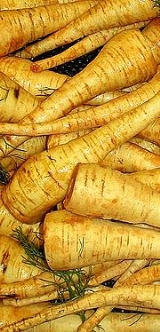
The parsnip (Pastinaca sativa) is a root vegetable
Root vegetable

Root vegetables are plant roots used as vegetables. Other underground plants are often, erroneously, called root vegetables. Root vegetables include both true roots such as tuberous roots and taproots, but exclude non-roots such as tubers, rhizomes, corms, and bulbs....
 related to the carrot
Carrot

The carrot is a root vegetable, usually orange or white, or red-white blend in colour, with a crisp texture when fresh. The edible part of a carrot is a taproot....
. Parsnips resemble carrots, but are paler than most of them and have a stronger flavor. Like carrots, parsnips are native to Eurasia and have been eaten there since ancient times. Zohary and Hopf note that the archeological evidence for the cultivation of the parsnip is “still rather limited,” and that Greek and Roman literary sources are a major source about its early use, but warn "there are some difficulties in distinguishing between parsnip and carrot (which, in Roman times, were white or purple) in classical writings since both vegetables seem to have been sometimes called pastinaca yet each vegetable appears to be well under cultivation in Roman times."

Uses
Until the potato
Potato

The potato is a starchy, tuberous crop from the perennial plant Solanum tuberosum of the Solanaceae family. The word potato may refer to the plant itself as well....
 arrived from the New World
New World

The New World is one of the names used for the non-Eurasian/non-African parts of the Earth, specifically the Americas and Australasia. When the term originated in the late 15th century, the Americas were new to the Europeans, who previously thought of the world as consisting only of Europe, Asia, and Africa ....
, its place in dishes was occupied by the parsnip and other root vegetables such as the turnip
Turnip

The turnip is a root vegetable commonly grown in temperate climates worldwide for its white, bulbous taproot. Small, tender, varieties are grown for human consumption, while larger varieties are grown as fodder for livestock....
.


Nutrition Facts


Discussion
Ask a question about 'Parsnip'
Start a new discussion about 'Parsnip'
Answer questions from other users
Full Discussion Forum


Encyclopedia


The parsnip (Pastinaca sativa) is a root vegetable
Root vegetable

Root vegetables are plant roots used as vegetables. Other underground plants are often, erroneously, called root vegetables. Root vegetables include both true roots such as tuberous roots and taproots, but exclude non-roots such as tubers, rhizomes, corms, and bulbs....
 related to the carrot
Carrot

The carrot is a root vegetable, usually orange or white, or red-white blend in colour, with a crisp texture when fresh. The edible part of a carrot is a taproot....
. Parsnips resemble carrots, but are paler than most of them and have a stronger flavor. Like carrots, parsnips are native to Eurasia and have been eaten there since ancient times. Zohary and Hopf note that the archeological evidence for the cultivation of the parsnip is “still rather limited,” and that Greek and Roman literary sources are a major source about its early use, but warn "there are some difficulties in distinguishing between parsnip and carrot (which, in Roman times, were white or purple) in classical writings since both vegetables seem to have been sometimes called pastinaca yet each vegetable appears to be well under cultivation in Roman times."

Uses


Until the potato
Potato

The potato is a starchy, tuberous crop from the perennial plant Solanum tuberosum of the Solanaceae family. The word potato may refer to the plant itself as well....
 arrived from the New World
New World

The New World is one of the names used for the non-Eurasian/non-African parts of the Earth, specifically the Americas and Australasia. When the term originated in the late 15th century, the Americas were new to the Europeans, who previously thought of the world as consisting only of Europe, Asia, and Africa ....
, its place in dishes was occupied by the parsnip and other root vegetables such as the turnip
Turnip

The turnip is a root vegetable commonly grown in temperate climates worldwide for its white, bulbous taproot. Small, tender, varieties are grown for human consumption, while larger varieties are grown as fodder for livestock....
. Parsnips can be boiled, roasted or used in stew
Stew

A stew is a combination of solid food ingredients that have been cooked in liquid and served in the resultant gravy.Ingredients in a stew can include any combination of vegetables , meat, poultry, sausages and seafood....
s, soup
Soup

Soup is a food that is made by combining ingredients such as meat and vegetables in Stock or hot/boiling water, until the flavor is extracted, forming a broth....
s and casserole
Casserole

A casserole, from the French language for "saucepan," is a large, deep pot or dish used both in the oven and as a serving dish. The word casserole is also used for the food cooked and served in such a dish....
s. In some cases, the parsnip is boiled and the solid portions are removed from the soup or stew, leaving behind a more subtle flavor than the whole root and contributing starch
Starch

File:Amylose2.svgFile:Amylopektin Sessel.svgStarch or amylum is a polysaccharide carbohydrate consisting of a large number of glucose units joined together by glycosidic bonds....
 to thicken the dish. Roasted parsnip is considered an essential part of Christmas dinner
Christmas dinner

Christmas dinner is the primary meal traditionally eaten on Christmas Eve or Christmas. In many ways the meal is similar to a standard Sunday dinner....
 in some parts of the English-speaking world and frequently features in the traditional Sunday Roast
Sunday roast

The Sunday roast is a traditional British cuisine main meal served on Sundays , consisting of roasted meat, roast potatoes together with accompaniments, such as vegetables and gravy....
. Parsnips can also be fried, or be eaten raw.

The parsnip originates in the Mediterranean region and originally was the size of a baby carrot when full grown. When the Roman Empire expanded north through Europe the Romans brought the parsnip with them. They found that the parsnip grew bigger the further north they went.

Name

While folk etymology sometimes assumes the name is a portmanteau of parsley
Parsley

Parsley is a bright green, biennial plant herb, also used as spice. It is very common in Middle Eastern cuisine, European cuisine, and American cuisine cooking....
 and turnip
Turnip

The turnip is a root vegetable commonly grown in temperate climates worldwide for its white, bulbous taproot. Small, tender, varieties are grown for human consumption, while larger varieties are grown as fodder for livestock....
, it actually comes from a Latin
Latin

Latin is an Italic language, historically spoken in Latium and Ancient Rome. Through the Military history of the Roman Empire, Latin spread throughout the Mediterranean and a large part of Europe....
 word for "forked", plus the -nip ending because it was assumed to be a kind of turnip. It is among the closest relatives of actual parsley, which can be bred to develop a very parsnip-like root.

Cultivation

Parsnips are not grown in warm climates, since frost is necessary to develop their flavor. The parsnip is a favorite with gardeners in areas with short growing seasons. Sandy, loam
Loam

Loam is soil composed of sand, silt, and clay in relatively even concentration , considered ideal for gardening and agricultural uses. Loam soils generally contain more nutrients and humus than sandy soils, have better infiltration and drainage than silty soils, and are easier to tillage than clay soils....
y soil is preferred; silty, clay, and rocky soils are unsuitable as they produce short forked roots.

Seeds can be planted in early spring, as soon as the ground can be worked. Harvesting can begin in late fall after the first frost, and continue through winter until the ground freezes over.

More than almost any other vegetable seed, parsnip seed significantly deteriorates in viability if stored for long, so it is advisable to use fresh seed each year.

In Roman
Ancient Rome

Ancient Rome was a civilization that grew out of a small agricultural community founded on the Italian Peninsula as early as the 10th century BC....
 times, parsnips were believed to be an aphrodisiac
Aphrodisiac

An aphrodisiac is a substance which is used in the belief that it increases sexual desire. The name comes from Aphrodite, the Greek mythology of sensuality....
.

In the United States
United States

The United States of America is a Federal government constitutional republic comprising U.S. state and a federal district. The country is situated mostly in central North America, where its Contiguous United States and Washington, D.C., the Capital districts and territories, lie between the Pacific Ocean and Atlantic Oceans, Borders of the U...
, this plant was introduced fairly early in history by British colonists as a root vegetable. It was thereafter replaced in popularity by the potato
Potato

The potato is a starchy, tuberous crop from the perennial plant Solanum tuberosum of the Solanaceae family. The word potato may refer to the plant itself as well....
 in the mid-nineteenth century and consequently escaped from cultivation, so today most states have wild parsnip on their list of noxious weeds
Noxious weeds

Noxious weeds are plant species that have been designated by state or national agricultural authorities as plants that are injurious to agricultural and/or horticultural crops and/or humans and livestock....
 or invasive species
Invasive species

Invasive species is a phrase with several definitions. The first definition expresses the phrase in terms of non-indigenous species that adversely affect the habitats they invade economically, environmentally or ecologically....
.

Parsnip is used as a food plant by the larva
Larva

A larva is a young form of animal with indirect developmental biology, going through or undergoing metamorphosis .The larva can look completely different from the adult form, for example, a caterpillar differs from a butterfly....
e of some Lepidoptera
Lepidoptera

Lepidoptera is an order of insect that includes moths and butterfly. It is one of the most speciose orders in the class Insecta, encompassing moths and the three superfamilies of butterfly, skipper , and Hedylidae....
 species, including its namesake, the Parsnip swallowtail and also the Common Swift
Common Swift (moth)

The Common Swift is a moth of the family Hepialidae. It was previously placed in the genus Hepialus. It is a common, often abundant European species....
, Garden Dart
Garden Dart

The Garden Dart is a moth of the family Noctuidae. It is distributed throughout Europe.This is a rather drab species, forewings ranging from pale to dark brown with indistinct markings....
, and Ghost Moth
Ghost Moth

The Ghost Moth , also known as the Ghost Swift, is a moth of the family Hepialidae. It is common throughout Europe except for the far south-east....
.

Nutritional properties

The parsnip is richer in vitamin
Vitamin

A vitamin is an organic compound required as a nutrient in tiny amounts by an organism. A compound is called a vitamin when it cannot be biosynthesis in sufficient quantities by an organism, and must be obtained from the diet....
s and minerals
Dietary mineral

Dietary minerals are the chemical elements required by living organisms, other than the four elements carbon, hydrogen, nitrogen, and oxygen present in common organic chemistry....
 than its close relative the carrot. It is particularly rich in potassium
Potassium

Potassium is a chemical element. It has the symbol K , atomic number 19, and atomic mass 39.0983. Potassium was first isolated from potash, hence the name....
 with 600 mg per 100 g. The parsnip is also a good source of dietary fiber
Dietary fiber

Dietary fiber, sometimes called "roughage", is the indigestible portion of plant foods that pushes food through the digestive system, absorbing water and easing defecation....
. 100 g of parsnip contains 55 Calorie
Calorie

The calorie is a pre-SI metric system unit of energy. The unit was first defined by Professor Nicolas Cl?ment in 1824 as a unit of heat. This definition entered French and English dictionaries between 1841 and 1867....
s (230 kJ) energy.

Some people can have an allergic reaction to parsnip, and parsnip leaves may irritate the skin.

Dangers connected to wild parsnips

Picking of wild parsnip may cause phytophotodermatitis
Phytophotodermatitis

Phytophotodermatitis is a chemical reaction which makes skin hypersensitive to ultraviolet light. It is frequently mistaken for hereditary conditions such as atopic dermatitis or chemical burns, but it is caused by contact with the photosensitizing compounds found naturally in some plants....
, as is the case with parsley and celery.

When picking wild vegetables it is easy to mistake poison hemlock
Conium

Conium is a genus of two species of highly poisonous Perennial plant herbaceous flowering plants in the family Apiaceae, native to Europe and the Mediterranean region , and to southern Africa ....
 (Conium maculatum
Conium

Conium is a genus of two species of highly poisonous Perennial plant herbaceous flowering plants in the family Apiaceae, native to Europe and the Mediterranean region , and to southern Africa ....
) for parsnip with deadly results. All parts of this hemlock are poisonous: leaves, stem, roots, and fruit. Poison hemlock contains volatile alkaloids that have been used as poisons since ancient times. The best way to differentiate it from parsnip are purple streaks and blotches on a smooth hairless stem. Other ways include the small wispy flowers and fernlike leaves which vary slightly from those on the parsnip.

External links

  • on the USDA
    United States Department of Agriculture

    The United States Department of Agriculture is the United States federal executive departments responsible for developing and executing Federal government of the United States policy on farming, agriculture, and food....
     
  • on


Recipe Links