


Almond

Unanswered Questions

Encyclopedia
The almond is a species of tree native to the Middle East and South Asia. Almond is also the name of the edible and widely cultivated seed of this tree. Within the genus Prunus
, it is classified with the peach
in the subgenus Amygdalus, distinguished from the other subgenera by the corrugated shell (endocarp) surrounding the seed.
The fruit of the almond is not a true nut
, but a drupe
, consisting of an outer hull and a hard shell with the seed ("nut") inside. Shelling almonds refers to removing the shell to reveal the seed
. Almonds are commonly sold shelled (i.e., after the shells are removed), or unshelled (i.e., with the shells still attached). Blanched almonds are shelled almonds that have been treated with hot water to soften the seedcoat, which is then removed to reveal the white embryo
.
tree
, growing 4–10 m (13.1–32.8 ) in height, with a trunk of up to 30 centimetres (12 in) in diameter. The young twig
s are green at first, becoming purplish where exposed to sunlight, then grey in their second year. The leaves
are 3–5 inches long, with a serrated margin and a 2.5 cm (0.984251968503937 in) petiole
. The flower
s are white or pale pink, 3–5 cm (1.2–2 ) diameter with five petals, produced singly or in pairs before the leaves in early spring.
Almonds begin bearing an economic crop in the third year after planting. Trees reach full bearing after five to six years after planting. The fruit is mature in the autumn, 7–8 months after flowering.
, but a drupe
3.5–6 cm (1.4–2.4 ) long. The outer covering or exocarp, fleshy in other members of Prunus such as the plum
and cherry
, is instead a thick leathery grey-green coat (with a downy exterior), called the hull. Inside the hull is a reticulated hard woody shell (like the outside of a peach pit) called the endocarp. Inside the shell is the edible seed, commonly called a nut. Generally, one seed is present, but occasionally there are two.
region of the Middle East
, eastward as far as the Indus. It was spread by humans in ancient times along the shores of the Mediterranean into northern Africa and southern Europe and more recently transported to other parts of the world, notably California
, United States.
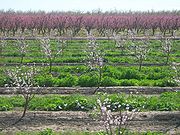 The wild form of domesticated almond grows in parts of the Levant
; almonds must first have been taken into cultivation in this region. The fruit of the wild forms contains the glycoside
amygdalin
, "which becomes transformed into deadly prussic acid (hydrogen cyanide) after crushing, chewing, or any other injury to the seed."
However, domesticated almonds are not toxic; Jared Diamond
argues that a common genetic mutation causes an absence of glycoside amygdalin, and this mutant was grown by early farmers, "at first unintentionally in the garbage heaps, and later intentionally in their orchards". Zohary and Hopf believe that almonds were one of the earliest domesticated fruit trees due to "the ability of the grower to raise attractive almonds from seed. Thus, in spite of the fact that this plant does not lend itself to propagation from suckers or from cuttings, it could have been domesticated even before the introduction of grafting
". Domesticated almonds appear in the Early Bronze Age (3000–2000 BC) of the Near East, or possibly a little earlier. A well-known archaeological example of the almond is the fruit found in Tutankhamun
's tomb in Egypt (c. 1325 BC), probably imported from the Levant. Of the Europe
an countries that the Royal Botanic Garden Edinburgh reported as cultivating almonds, Germany
is the northernmost, though the domesticated form can be found as far north as Iceland
.
amandola, derived through a form amingdolouhha from the Greek αμυγδαλη (cf amygdala
), an almond. The al- in English, for the a- used in other languages may be due a confusion with the Arabic article al, the word having first dropped the a- as in the Italian
form mandorla; the British pronunciation ah-mond and the modern Catalan ametlla and modern French amande show a form of the word closer to the original.
The adjective amygdaloid (literally "like an almond") is used to describe objects which are roughly almond-shaped, particularly a shape which is part way between a rectangle
and an ellipse
. See, for example, the brain structure
amygdala
, which uses a direct borrowing of the Greek term.
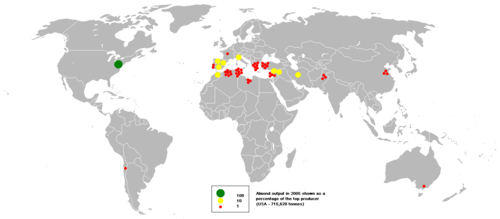
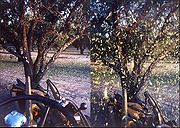 Global production of almonds is around 1.7 million tonnes, with a low of 1 million tonnes in 1995 and a peak of 1.85 million tonnes in 2002 according to Food and Agriculture Organization
(FAO) figures; world production of almonds was 1.76 million tonnes in 2006. According to the FAO, major producers are the USA (715,623 t, 41%), Spain (220,000 t, 13%), Syria (119,648 t, 7%), Italy (112,796 t, 6%), Iran (108,677 t, 6%) and Morocco (83,000 t, 5%). Algeria, Tunisia, and Greece each account for 3%, Turkey, Pakistan, Lebanon, and China each account for 2%. In Turkey
, most of the production comes from the Datça Peninsula
. In Spain, numerous commercial cultivars of sweet almond are produced, most notably the Jordan almond (imported from Málaga
) and the Valencia
almond.
In Greece
, most of the production comes from the Thessalia, in region of Magnesia
at the area of Almyros
. The most cultivating types of almonds in Greece are ferragnes and Texas (mission) which are known for their sweet taste and premium quality. Because of its quality, it is used as a luxury nut.
In the United States, production is concentrated in California
, with almonds being California's third leading agricultural product and its top agricultural export in 2008. California produces 80% of the world’s almonds and 100% of the U.S. commercial supply. California exported almonds valued at $1.08 billion in 2003, about 70% of total California almond crop.
The top 10 almond production countries in 2009 according to FAO in tonnes
of California's almonds is the largest annual managed pollination
event in the world, with close to one million hives (nearly half of all beehives
in the USA) being trucked in February to the almond groves. Much of the pollination is managed by pollination brokers, who contract with migratory beekeeper
s from at least 49 states for the event. This business has been heavily impacted by colony collapse disorder
, causing nationwide shortages of honey bees and increasing the price of insect pollination. To alleviate almond growers from the rising cost of insect pollination, researchers at the Agricultural Research Service
(ARS) have developed a new line of self-pollinating almond trees. Self-pollinating almond trees, such as the Tuono almond tree, have been around for a while, but their harvest is not as desirable as the insect-pollinated California Nonpareil almond tree. The Nonpareil tree produces large, smooth almonds and offer 60–65% edible kernel per nut. The Tuono, on the other hand, has thicker, hairier shells and offers only 32% of edible kernel per nut. However, there are advantages to having a thick shell. The Tuono’s shell protects the nut from threatening pests such as the navel orangeworm. ARS researchers have managed to cross breed the pest-resistant Tuono tree with California’s attractive Nonpareil tree, resulting in hybridized varieties of almond trees that are self-pollinated and maintain a high quality of nut. The new, self-pollinating almond tree hybrids possess quality skin color, flavor, and oil content, and reduce almond growers’ dependency on insect pollination.
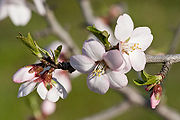
 The fruit of Prunus dulcis is predominately sweet, but a few bitter almonds may be found on each tree.
The fruits from Prunus dulcis var. amara are always bitter as are the kernels from other Prunus species like apricot, peach and cherry (to a lesser extent).
The bitter almond is slightly broader and shorter than the sweet almond, and contains about 50% of the fixed oil that occurs in sweet almonds. It also contains the enzyme emulsin which, in the presence of water, acts on a soluble glucoside
, amygdalin
, yielding glucose
, cyanide
and the essential oil
of bitter almonds, which is nearly pure benzaldehyde
. Bitter almonds may yield from 4–9 mg of hydrogen cyanide per almond. Extract of bitter almond was once used medicinally, but even in small doses, effects are severe, and in larger doses can be deadly; the cyanide must be removed before consumption.
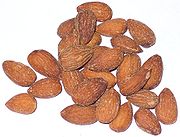 While the almond is often eaten on its own, raw or toasted, it is also a component of various dishes. Almonds are available in many forms, such as whole, sliced (flaked, slivered), and as almond butter, almond milk and almond oil. These variations can be used in both sweet and savory dishes.
Along with other nuts, sweet almonds can be sprinkled over desserts, particularly ice cream based dishes. Sweet almonds are used in marzipan
, nougat
, many pastries (including jesuite
s), cookies (including French macarons
, macaroon
s), and cakes (including financiers
), noghl
and other sweets and desserts. They are also used to make almond butter
, a spread similar to peanut butter
, popular with peanut allergy
sufferers and for its less salty taste. The young, developing fruit of the almond tree can be eaten whole ("green almonds") when they are still green and fleshy on the outside and the inner shell has not yet hardened. The fruit is somewhat sour, but is a popular snack in parts of the Middle East, eaten dipped in salt to balance the sour taste. Available only from mid April to mid June (northern hemisphere), pickling or brining extends the fruit's shelf life.
Almonds can be processed into a milk substitute
called almond milk
; the nut's soft texture, mild flavour, and light colouring (when skinned) make for an efficient analog to dairy, and a soy-free choice for lactose intolerant people and vegans. Raw, blanched, and lightly toasted almonds work well for different production techniques, some of which are similar to that of soymilk and some of which use no heat, resulting in "raw milk" (see raw foodism
).
The Marcona variety of almond, which is shorter, rounder, sweeter, and more delicate in texture than other varieties, originated in Spain and is becoming popular in North America and other parts of the world. Marcona almonds are traditionally served after being lightly fried in oil, and are used by Spanish chefs to prepare a dessert called turrón
.
of sweet and bitter almonds, usually made with barley syrup (orgeat syrup
) or in a syrup of orange flower water
and sugar
.
The Grocer's Encyclopedia
(1911) notes that "Ten parts of sweet almonds are generally employed to three parts of bitter almonds"; however, due to the cyanide
found in bitter almonds, modern syrups generally consist of only sweet almonds.
, of which 62% is monounsaturated oleic acid
(an omega-9 fatty acid
), 24% is linoleic acid
(a polyunsaturated omega-6 essential fatty acid
), and 6% is palmitic acid
(a saturated fatty acid).
"Oleum Amygdalae", the fixed oil, is prepared from either variety of almond and is a glyceryl oleate, with a slight odour and a nutty taste. It is almost insoluble in alcohol
but readily soluble in chloroform
or ether
. Sweet almond oil is obtained from the dried kernel
of sweet almonds.
The oil is good for application to the skin as an emollient, and has been traditionally used by massage therapists to lubricate the skin during a massage session. It is a mild, lightweight oil that can be used as a substitute for olive oil
.
Almond oil is also used as a wood conditioner of certain woodwind instruments, such as the oboe and clarinet.
This Almond oil is used to remove black spots and black marks on the skin.
, for a net of 10 g of carbohydrate per cup. This makes almond flour very desirable for use in cake and bread recipes by people on carbohydrate-restricted diets.
Almonds are a rich source of vitamin E
, containing 26 mg per 100 g (Table). They are also rich in dietary fiber
, B vitamins, essential minerals and monounsaturated fat
(see nutrient table), one of the two "good" fats which potentially may lower LDL cholesterol. Typical of nuts and seeds, almonds also contain phytosterol
s, associated with cholesterol-lowering properties.
Potential health benefits, which have not been scientifically validated, include improved complexion
and possibly a lower risk of cancer
. Preliminary research associates consumption of almonds with elevating blood levels of high density lipoprotein
s and lowering low density lipoprotein
s. A preliminary trial showed that, in spite of the high fat content of almonds, using them in the daily diet might lower several factors associated with heart disease, including cholesterol and blood lipids.
Almonds contain polyphenol
s in their skins analogous to those of certain fruits and vegetables.
Almonds may cause allergy
or intolerance
. Cross-reactivity is common with peach
allergens (lipid transfer proteins
) and tree nut
allergens. Symptoms range from local symptoms (e.g., oral allergy syndrome
, contact urticaria) to systemic symptoms including anaphylaxis
(e.g., urticaria
, angioedema
, gastrointestinal and respiratory symptoms).
traced to almonds in 2001 and 2004, the Almond Board of California proposed rules in 2006 regarding pasteurization
of almonds available to the public, and the USDA approved them. The almond pasteurization program became mandatory for the California industry on September 1, 2007, and was implemented voluntarily over the previous two years. Since September 1, 2007, raw untreated California almonds have technically not been available in the United States. Controversially, California almonds labeled as "raw" are required to be steam-pasteurized or chemically treated with propylene oxide
. This does not apply to imported almonds, or to almonds sold from the grower directly to the consumer in small quantities. Nor is the treatment required for raw almonds sold as exports to countries outside of North America.
This USDA-approved marketing order has been challenged in court by organic farmers organized by the Cornucopia Institute, a Wisconsin-based farm policy research group. According to the Cornucopia Institute, this almond marketing order has imposed significant financial burdens on small-scale and organic growers and damaged domestic almond markets. The federal judge dismissed the lawsuit in the spring of 2009 on procedural grounds, but farmers are appealing this decision in August 2009, seeking to have the merits of their arguments heard in court.
, it is designated as the state tree of Kashmir.
The tree grows in Lebanon
, Syria
and Israel
, and is mentioned numerous times in the Bible.
In the Old Testament, the almond was a symbol of watchfulness and promise due to its early flowering, symbolizing God's sudden and rapid punishment of His people; in Jeremiah
1:11–12, for instance. In the Bible
the almond is mentioned ten times, beginning with Book of Genesis 43:11, where it is described as "among the best of fruits". In Numbers
17 Levi
is chosen from the other tribes of Israel by Aaron's rod
, which brought forth almond flowers. According to tradition, the rod of Aaron bore sweet almonds on one side and bitter on the other; if the Israelites followed the Lord, the sweet almonds would be ripe and edible, but if they were to forsake the path of the Lord, the bitter almonds would predominate. The almond blossom supplied a model for the menorah which stood in the Holy Temple, "Three cups, shaped like almond blossoms, were on one branch, with a knob and a flower; and three cups, shaped like almond blossoms, were on the other...on the candlestick itself were four cups, shaped like almond blossoms, with its knobs and flowers" (Exodus 25:33–34; 37:19–20). Similarly, Christian symbolism often uses almond branches as a symbol of the Virgin Birth of Jesus; paintings often include almonds encircling the baby Jesus
and as a symbol of Mary. The word "Luz
", which appears in Genesis 30:37, is sometimes translated as "hazel
", may actually be derived from the Aramaic name for almond (Luz), and is translated as such in some Bible versions such as the NIV.
In India, consumption of almonds is believed to be good for the brain, while the Chinese
consider it a symbol of enduring sadness and female beauty.
Prunus
Prunus is a genus of trees and shrubs, which includes the plums, cherries, peaches, apricots and almonds. There are around 430 species spread throughout the northern temperate regions of the globe. Many members of the genus are widely cultivated for fruit and ornament.-Botany:Members of the genus...
, it is classified with the peach
Peach
The peach tree is a deciduous tree growing to tall and 6 in. in diameter, belonging to the subfamily Prunoideae of the family Rosaceae. It bears an edible juicy fruit called a peach...
in the subgenus Amygdalus, distinguished from the other subgenera by the corrugated shell (endocarp) surrounding the seed.
The fruit of the almond is not a true nut
Nut (fruit)
A nut is a hard-shelled fruit of some plants having an indehiscent seed. While a wide variety of dried seeds and fruits are called nuts in English, only a certain number of them are considered by biologists to be true nuts...
, but a drupe
Drupe
In botany, a drupe is a fruit in which an outer fleshy part surrounds a shell of hardened endocarp with a seed inside. These fruits develop from a single carpel, and mostly from flowers with superior ovaries...
, consisting of an outer hull and a hard shell with the seed ("nut") inside. Shelling almonds refers to removing the shell to reveal the seed
Seed
A seed is a small embryonic plant enclosed in a covering called the seed coat, usually with some stored food. It is the product of the ripened ovule of gymnosperm and angiosperm plants which occurs after fertilization and some growth within the mother plant...
. Almonds are commonly sold shelled (i.e., after the shells are removed), or unshelled (i.e., with the shells still attached). Blanched almonds are shelled almonds that have been treated with hot water to soften the seedcoat, which is then removed to reveal the white embryo
Embryo
An embryo is a multicellular diploid eukaryote in its earliest stage of development, from the time of first cell division until birth, hatching, or germination...
.
Tree
The almond is a small deciduousDeciduous
Deciduous means "falling off at maturity" or "tending to fall off", and is typically used in reference to trees or shrubs that lose their leaves seasonally, and to the shedding of other plant structures such as petals after flowering or fruit when ripe...
tree
Tree
A tree is a perennial woody plant. It is most often defined as a woody plant that has many secondary branches supported clear of the ground on a single main stem or trunk with clear apical dominance. A minimum height specification at maturity is cited by some authors, varying from 3 m to...
, growing 4–10 m (13.1–32.8 ) in height, with a trunk of up to 30 centimetres (12 in) in diameter. The young twig
Twig
A twig is a small thin terminal branch of a woody plant. Twigs are critically important in identification of trees, shrubs and vines, especially in wintertime. The buds on the twig are an important diagnostic characteristic, as are the abscission scars where the leaves have fallen away...
s are green at first, becoming purplish where exposed to sunlight, then grey in their second year. The leaves
Leaf
A leaf is an organ of a vascular plant, as defined in botanical terms, and in particular in plant morphology. Foliage is a mass noun that refers to leaves as a feature of plants....
are 3–5 inches long, with a serrated margin and a 2.5 cm (0.984251968503937 in) petiole
Petiole (botany)
In botany, the petiole is the stalk attaching the leaf blade to the stem. The petiole usually has the same internal structure as the stem. Outgrowths appearing on each side of the petiole are called stipules. Leaves lacking a petiole are called sessile, or clasping when they partly surround the...
. The flower
Flower
A flower, sometimes known as a bloom or blossom, is the reproductive structure found in flowering plants . The biological function of a flower is to effect reproduction, usually by providing a mechanism for the union of sperm with eggs...
s are white or pale pink, 3–5 cm (1.2–2 ) diameter with five petals, produced singly or in pairs before the leaves in early spring.
Almonds begin bearing an economic crop in the third year after planting. Trees reach full bearing after five to six years after planting. The fruit is mature in the autumn, 7–8 months after flowering.
Nut
In botanical terms, the almond fruit is not a nutNut (fruit)
A nut is a hard-shelled fruit of some plants having an indehiscent seed. While a wide variety of dried seeds and fruits are called nuts in English, only a certain number of them are considered by biologists to be true nuts...
, but a drupe
Drupe
In botany, a drupe is a fruit in which an outer fleshy part surrounds a shell of hardened endocarp with a seed inside. These fruits develop from a single carpel, and mostly from flowers with superior ovaries...
3.5–6 cm (1.4–2.4 ) long. The outer covering or exocarp, fleshy in other members of Prunus such as the plum
Plum
A plum or gage is a stone fruit tree in the genus Prunus, subgenus Prunus. The subgenus is distinguished from other subgenera in the shoots having a terminal bud and solitary side buds , the flowers in groups of one to five together on short stems, and the fruit having a groove running down one...
and cherry
Cherry
The cherry is the fruit of many plants of the genus Prunus, and is a fleshy stone fruit. The cherry fruits of commerce are usually obtained from a limited number of species, including especially cultivars of the wild cherry, Prunus avium....
, is instead a thick leathery grey-green coat (with a downy exterior), called the hull. Inside the hull is a reticulated hard woody shell (like the outside of a peach pit) called the endocarp. Inside the shell is the edible seed, commonly called a nut. Generally, one seed is present, but occasionally there are two.
Origin and history
The almond is a native to the Mediterranean climateMediterranean climate
A Mediterranean climate is the climate typical of most of the lands in the Mediterranean Basin, and is a particular variety of subtropical climate...
region of the Middle East
Middle East
The Middle East is a region that encompasses Western Asia and Northern Africa. It is often used as a synonym for Near East, in opposition to Far East...
, eastward as far as the Indus. It was spread by humans in ancient times along the shores of the Mediterranean into northern Africa and southern Europe and more recently transported to other parts of the world, notably California
California
California is a state located on the West Coast of the United States. It is by far the most populous U.S. state, and the third-largest by land area...
, United States.
Levant
The Levant or ) is the geographic region and culture zone of the "eastern Mediterranean littoral between Anatolia and Egypt" . The Levant includes most of modern Lebanon, Syria, Jordan, Israel, the Palestinian territories, and sometimes parts of Turkey and Iraq, and corresponds roughly to the...
; almonds must first have been taken into cultivation in this region. The fruit of the wild forms contains the glycoside
Glycoside
In chemistry, a glycoside is a molecule in which a sugar is bound to a non-carbohydrate moiety, usually a small organic molecule. Glycosides play numerous important roles in living organisms. Many plants store chemicals in the form of inactive glycosides. These can be activated by enzyme...
amygdalin
Amygdalin
Amygdalin , C20H27NO11, is a glycoside initially isolated from the seeds of the tree Prunus dulcis, also known as bitter almonds, by Pierre-Jean Robiquet...
, "which becomes transformed into deadly prussic acid (hydrogen cyanide) after crushing, chewing, or any other injury to the seed."
However, domesticated almonds are not toxic; Jared Diamond
Jared Diamond
Jared Mason Diamond is an American scientist and author whose work draws from a variety of fields. He is currently Professor of Geography and Physiology at UCLA...
argues that a common genetic mutation causes an absence of glycoside amygdalin, and this mutant was grown by early farmers, "at first unintentionally in the garbage heaps, and later intentionally in their orchards". Zohary and Hopf believe that almonds were one of the earliest domesticated fruit trees due to "the ability of the grower to raise attractive almonds from seed. Thus, in spite of the fact that this plant does not lend itself to propagation from suckers or from cuttings, it could have been domesticated even before the introduction of grafting
Grafting
Grafting is a horticultural technique whereby tissues from one plant are inserted into those of another so that the two sets of vascular tissues may join together. This vascular joining is called inosculation...
". Domesticated almonds appear in the Early Bronze Age (3000–2000 BC) of the Near East, or possibly a little earlier. A well-known archaeological example of the almond is the fruit found in Tutankhamun
Tutankhamun
Tutankhamun , Egyptian , ; approx. 1341 BC – 1323 BC) was an Egyptian pharaoh of the 18th dynasty , during the period of Egyptian history known as the New Kingdom...
's tomb in Egypt (c. 1325 BC), probably imported from the Levant. Of the Europe
Europe
Europe is, by convention, one of the world's seven continents. Comprising the westernmost peninsula of Eurasia, Europe is generally 'divided' from Asia to its east by the watershed divides of the Ural and Caucasus Mountains, the Ural River, the Caspian and Black Seas, and the waterways connecting...
an countries that the Royal Botanic Garden Edinburgh reported as cultivating almonds, Germany
Germany
Germany , officially the Federal Republic of Germany , is a federal parliamentary republic in Europe. The country consists of 16 states while the capital and largest city is Berlin. Germany covers an area of 357,021 km2 and has a largely temperate seasonal climate...
is the northernmost, though the domesticated form can be found as far north as Iceland
Iceland
Iceland , described as the Republic of Iceland, is a Nordic and European island country in the North Atlantic Ocean, on the Mid-Atlantic Ridge. Iceland also refers to the main island of the country, which contains almost all the population and almost all the land area. The country has a population...
.
Etymology and names
The word "almond" comes from Old French almande or alemande, Late LatinLate Latin
Late Latin is the scholarly name for the written Latin of Late Antiquity. The English dictionary definition of Late Latin dates this period from the 3rd to the 6th centuries AD extending in Spain to the 7th. This somewhat ambiguously defined period fits between Classical Latin and Medieval Latin...
amandola, derived through a form amingdolouhha from the Greek αμυγδαλη (cf amygdala
Amygdala
The ' are almond-shaped groups of nuclei located deep within the medial temporal lobes of the brain in complex vertebrates, including humans. Shown in research to perform a primary role in the processing and memory of emotional reactions, the amygdalae are considered part of the limbic system.-...
), an almond. The al- in English, for the a- used in other languages may be due a confusion with the Arabic article al, the word having first dropped the a- as in the Italian
Italian language
Italian is a Romance language spoken mainly in Europe: Italy, Switzerland, San Marino, Vatican City, by minorities in Malta, Monaco, Croatia, Slovenia, France, Libya, Eritrea, and Somalia, and by immigrant communities in the Americas and Australia...
form mandorla; the British pronunciation ah-mond and the modern Catalan ametlla and modern French amande show a form of the word closer to the original.
The adjective amygdaloid (literally "like an almond") is used to describe objects which are roughly almond-shaped, particularly a shape which is part way between a rectangle
Rectangle
In Euclidean plane geometry, a rectangle is any quadrilateral with four right angles. The term "oblong" is occasionally used to refer to a non-square rectangle...
and an ellipse
Ellipse
In geometry, an ellipse is a plane curve that results from the intersection of a cone by a plane in a way that produces a closed curve. Circles are special cases of ellipses, obtained when the cutting plane is orthogonal to the cone's axis...
. See, for example, the brain structure
Neuroanatomy
Neuroanatomy is the study of the anatomy and organization of the nervous system. In contrast to animals with radial symmetry, whose nervous system consists of a distributed network of cells, animals with bilateral symmetry have segregated, defined nervous systems, and thus we can begin to speak of...
amygdala
Amygdala
The ' are almond-shaped groups of nuclei located deep within the medial temporal lobes of the brain in complex vertebrates, including humans. Shown in research to perform a primary role in the processing and memory of emotional reactions, the amygdalae are considered part of the limbic system.-...
, which uses a direct borrowing of the Greek term.
Production
Food and Agriculture Organization
The Food and Agriculture Organization of the United Nations is a specialised agency of the United Nations that leads international efforts to defeat hunger. Serving both developed and developing countries, FAO acts as a neutral forum where all nations meet as equals to negotiate agreements and...
(FAO) figures; world production of almonds was 1.76 million tonnes in 2006. According to the FAO, major producers are the USA (715,623 t, 41%), Spain (220,000 t, 13%), Syria (119,648 t, 7%), Italy (112,796 t, 6%), Iran (108,677 t, 6%) and Morocco (83,000 t, 5%). Algeria, Tunisia, and Greece each account for 3%, Turkey, Pakistan, Lebanon, and China each account for 2%. In Turkey
Turkey
Turkey , known officially as the Republic of Turkey , is a Eurasian country located in Western Asia and in East Thrace in Southeastern Europe...
, most of the production comes from the Datça Peninsula
Datça Peninsula
The Datça Peninsula is an 80 km-long, narrow peninsula in southwest Turkey separating the Gulf of Gökova to the north from the Gulf of Hisarönü to the south. The peninsula corresponds almost exactly to the administrative district of Datça, part of Muğla Province...
. In Spain, numerous commercial cultivars of sweet almond are produced, most notably the Jordan almond (imported from Málaga
Málaga
Málaga is a city and a municipality in the Autonomous Community of Andalusia, Spain. With a population of 568,507 in 2010, it is the second most populous city of Andalusia and the sixth largest in Spain. This is the southernmost large city in Europe...
) and the Valencia
Valencia (city in Spain)
Valencia or València is the capital and most populous city of the autonomous community of Valencia and the third largest city in Spain, with a population of 809,267 in 2010. It is the 15th-most populous municipality in the European Union...
almond.
In Greece
Greece
Greece , officially the Hellenic Republic , and historically Hellas or the Republic of Greece in English, is a country in southeastern Europe....
, most of the production comes from the Thessalia, in region of Magnesia
Magnesia
Magnesia , deriving from the tribe name Magnetes, is one of the regional units of Greece. It is part of the region of Thessaly. Its capital is the city of Volos. About 70% of the population of Magnesia live in the Greater Volos area, which is the second-largest city in Thessaly and the third...
at the area of Almyros
Almyros
Almyros is a town and a municipality of the peripheral unit of Magnesia, periphery of Thessaly, Greece. It lies in the center of prosperous fertile plain known as 'Krokio Pedio', which is crossed by torrents, and produces wheat, tobacco, and other crops. Almyros is an important agricultural and...
. The most cultivating types of almonds in Greece are ferragnes and Texas (mission) which are known for their sweet taste and premium quality. Because of its quality, it is used as a luxury nut.
In the United States, production is concentrated in California
California
California is a state located on the West Coast of the United States. It is by far the most populous U.S. state, and the third-largest by land area...
, with almonds being California's third leading agricultural product and its top agricultural export in 2008. California produces 80% of the world’s almonds and 100% of the U.S. commercial supply. California exported almonds valued at $1.08 billion in 2003, about 70% of total California almond crop.
The top 10 almond production countries in 2009 according to FAO in tonnes
 United States 1,162,200
 Spain 282,100
 Iran 128,464
 Italy 113,700
 Morocco 104,115
 Syria 97,002
 Tunisia 60,000
 Turkey 54,844
 Algeria 47,393
 Greece 44,273
Pollination
The pollinationPollination
Pollination is the process by which pollen is transferred in plants, thereby enabling fertilisation and sexual reproduction. Pollen grains transport the male gametes to where the female gamete are contained within the carpel; in gymnosperms the pollen is directly applied to the ovule itself...
of California's almonds is the largest annual managed pollination
Pollination management
Pollination Management is the label for horticultural practices that accomplish or enhance pollination of a crop, to improve yield or quality, by understanding of the particular crop's pollination needs, and by knowledgeable management of pollenizers, pollinators, and pollination...
event in the world, with close to one million hives (nearly half of all beehives
Beehive (beekeeping)
A beehive is an enclosed structure in which some honey bee species of the subgenus Apis live and raise their young. Natural beehives are naturally occurring structures occupied by honeybee colonies, while domesticated honeybees live in man-made beehives, often in an apiary. These man-made...
in the USA) being trucked in February to the almond groves. Much of the pollination is managed by pollination brokers, who contract with migratory beekeeper
Beekeeper
A beekeeper is a person who keeps honey bees for the purposes of securing commodities such as honey, beeswax, pollen, royal jelly; pollinating fruits and vegetables; raising queens and bees for sale to other farmers; and/or for purposes satisfying natural scientific curiosity...
s from at least 49 states for the event. This business has been heavily impacted by colony collapse disorder
Colony Collapse Disorder
Colony collapse disorder is a phenomenon in which worker bees from a beehive or European honey bee colony abruptly disappear. While such disappearances have occurred throughout the history of apiculture, the term colony collapse disorder was first applied to a drastic rise in the number of...
, causing nationwide shortages of honey bees and increasing the price of insect pollination. To alleviate almond growers from the rising cost of insect pollination, researchers at the Agricultural Research Service
Agricultural Research Service
The Agricultural Research Service is the principal in-house research agency of the United States Department of Agriculture . ARS is one of four agencies in USDA's Research, Education and Economics mission area...
(ARS) have developed a new line of self-pollinating almond trees. Self-pollinating almond trees, such as the Tuono almond tree, have been around for a while, but their harvest is not as desirable as the insect-pollinated California Nonpareil almond tree. The Nonpareil tree produces large, smooth almonds and offer 60–65% edible kernel per nut. The Tuono, on the other hand, has thicker, hairier shells and offers only 32% of edible kernel per nut. However, there are advantages to having a thick shell. The Tuono’s shell protects the nut from threatening pests such as the navel orangeworm. ARS researchers have managed to cross breed the pest-resistant Tuono tree with California’s attractive Nonpareil tree, resulting in hybridized varieties of almond trees that are self-pollinated and maintain a high quality of nut. The new, self-pollinating almond tree hybrids possess quality skin color, flavor, and oil content, and reduce almond growers’ dependency on insect pollination.
Sweet and bitter almonds
The fruits from Prunus dulcis var. amara are always bitter as are the kernels from other Prunus species like apricot, peach and cherry (to a lesser extent).
The bitter almond is slightly broader and shorter than the sweet almond, and contains about 50% of the fixed oil that occurs in sweet almonds. It also contains the enzyme emulsin which, in the presence of water, acts on a soluble glucoside
Glucoside
A glucoside is a glycoside that is derived from glucose. Glucosides are common in plants, but rare in animals. Glucose is produced when a glucoside is hydrolysed by purely chemical means, or decomposed by fermentation or enzymes....
, amygdalin
Amygdalin
Amygdalin , C20H27NO11, is a glycoside initially isolated from the seeds of the tree Prunus dulcis, also known as bitter almonds, by Pierre-Jean Robiquet...
, yielding glucose
Glucose
Glucose is a simple sugar and an important carbohydrate in biology. Cells use it as the primary source of energy and a metabolic intermediate...
, cyanide
Cyanide
A cyanide is a chemical compound that contains the cyano group, -C≡N, which consists of a carbon atom triple-bonded to a nitrogen atom. Cyanides most commonly refer to salts of the anion CN−. Most cyanides are highly toxic....
and the essential oil
Essential oil
An essential oil is a concentrated hydrophobic liquid containing volatile aroma compounds from plants. Essential oils are also known as volatile oils, ethereal oils or aetherolea, or simply as the "oil of" the plant from which they were extracted, such as oil of clove...
of bitter almonds, which is nearly pure benzaldehyde
Benzaldehyde
Benzaldehyde is an organic compound consisting of a benzene ring with a formyl substituent. It is the simplest aromatic aldehyde and one of the most industrially useful. This colorless liquid has a characteristic pleasant almond-like odor...
. Bitter almonds may yield from 4–9 mg of hydrogen cyanide per almond. Extract of bitter almond was once used medicinally, but even in small doses, effects are severe, and in larger doses can be deadly; the cyanide must be removed before consumption.
Culinary uses
Along with other nuts, sweet almonds can be sprinkled over desserts, particularly ice cream based dishes. Sweet almonds are used in marzipan
Marzipan
Marzipan is a confection consisting primarily of sugar and almond meal. Persipan is a similar, yet less expensive product, in which the almonds are replaced by apricot or peach kernels...
, nougat
Nougat
Nougat is a variety of similar traditional confectioneries made with sugar and/or honey, roasted nuts , and sometimes chopped candied fruit. The consistency of nougat can range from soft and chewy to hard and crunchy depending on its composition, and it is used in a variety of candy bars and...
, many pastries (including jesuite
Jesuite
A Jesuite is triangular, flake pastry filled with frangipane cream and topped with sliced almonds and powdered sugar. The pastry originated in France and the name refers to the triangular shape of a Jesuit’s hat....
s), cookies (including French macarons
Macaron
A macaron is a sweet confectionery made with egg whites, icing sugar, granulated sugar, almond powder or ground almond, and food coloring. The macaron is commonly filled with buttercream or jam filling sandwiched between two cookies. Its name is derived from an Italian word "maccarone" or...
, macaroon
Macaroon
A macaroon is a type of light, baked confection, described as either small cakes or meringue-like cookies depending on their consistency. The original macaroon was a "small sweet cake consisting largely of ground almonds" similar to Italian or Moroccan amaretti.The English word macaroon and French...
s), and cakes (including financiers
Financier (pastry)
A financier is a small French cake, often mistaken for a pastry. The financier is a light, moist teacake, similar to sponge cake, and usually contains almond flour, crushed or ground almonds, or almond flavoring. The basis of the cake itself is beurre noisette , egg whites, powdered sugar and...
), noghl
Noghl
Noghl , or Nuql , or sugar-coated almonds, is a traditional Iranian and Afghan confection. It is made by boiling sugar with water and rose water and then coating roasted almonds in the mixture. It can also be made with other nuts such as walnuts or other items...
and other sweets and desserts. They are also used to make almond butter
Almond butter
Almond butter is a food paste made from almonds. Almonds are high in monounsaturated fats, which is a healthier form of fat than saturated fat. Almond butter is an excellent source of Vitamin E and magnesium and a good source of fiber. Almond butter also contains protein, potassium, calcium,...
, a spread similar to peanut butter
Peanut butter
Peanut butter is a food paste made primarily from ground dry roasted peanuts, popular in North America, Netherlands, United Kingdom, and parts of Asia, particularly the Philippines and Indonesia. It is mainly used as a sandwich spread, sometimes in combination as in the peanut butter and jelly...
, popular with peanut allergy
Peanut allergy
Peanut allergy is a type of food allergy distinct from nut allergies. It is a type 1 hypersensitivity reaction to dietary substances from peanuts causing an overreaction of the immune system which in a small percentage of people may lead to severe physical symptoms. It is estimated to affect...
sufferers and for its less salty taste. The young, developing fruit of the almond tree can be eaten whole ("green almonds") when they are still green and fleshy on the outside and the inner shell has not yet hardened. The fruit is somewhat sour, but is a popular snack in parts of the Middle East, eaten dipped in salt to balance the sour taste. Available only from mid April to mid June (northern hemisphere), pickling or brining extends the fruit's shelf life.
- In ChinaCulture of ChinaChinese culture is one of the world's oldest and most complex. The area in which the culture is dominant covers a large geographical region in eastern Asia with customs and traditions varying greatly between towns, cities and provinces...
, almonds are used in a popular dessert where they are mixed with milk and then served hot.
- In GreeceGreeceGreece , officially the Hellenic Republic , and historically Hellas or the Republic of Greece in English, is a country in southeastern Europe....
, ground blanched almonds are used as the base material in a great variety of desserts, usually called amygdalota (αμυγδαλωτά). Because of their white colour, most are traditionally considered "wedding sweets" and are served at wedding banquets. In addition, a soft drink known as soumadaSoumadaSoumada, also spelled Soumatha is a popularly-consumed non-alcoholic soft-drink in Greece that is made from almonds. It can also be delicately flavored with flowers ....
is made from almonds in various regions.
- In IranIranIran , officially the Islamic Republic of Iran , is a country in Southern and Western Asia. The name "Iran" has been in use natively since the Sassanian era and came into use internationally in 1935, before which the country was known to the Western world as Persia...
, green almonds are dipped in sea saltSea saltSea salt, salt obtained by the evaporation of seawater, is used in cooking and cosmetics. It is historically called bay salt or solar salt...
and eaten as snacks on street markets; they are called Chaqalu bâdom.
- In ItalyItalyItaly , officially the Italian Republic languages]] under the European Charter for Regional or Minority Languages. In each of these, Italy's official name is as follows:;;;;;;;;), is a unitary parliamentary republic in South-Central Europe. To the north it borders France, Switzerland, Austria and...
, the bitter almonds from apricots are the base for amarettiAmaretti di SaronnoAmaretti di Saronno refer to an amaretto macaroon that is traditional to Saronno, a comune of Lombardy, Italy. It is one of many types of traditional amaretto biscuits....
(almond macaroons), a common dessert. Traditionally, a low percentage of bitter almonds (10-20%) is added to the ingredients, which gives the cookies their bitter taste (commercially, apricot kernels are used as a substitute for bitter almonds). Almonds are also a common choice as the nuts to include in torrone. In Puglia and SicilySicilySicily is a region of Italy, and is the largest island in the Mediterranean Sea. Along with the surrounding minor islands, it constitutes an autonomous region of Italy, the Regione Autonoma Siciliana Sicily has a rich and unique culture, especially with regard to the arts, music, literature,...
, "pasta di mandorle" (almond paste) is used to make small soft cakes, often decorated with jam, pistacchio or chocolate.
- In MoroccoMoroccoMorocco , officially the Kingdom of Morocco , is a country located in North Africa. It has a population of more than 32 million and an area of 710,850 km², and also primarily administers the disputed region of the Western Sahara...
, almonds in the form of sweet almond pasteAlmond pasteAlmond paste is made from ground almonds or almond meal and sugar, typically 50-55%, with a small amount of cooking oil, beaten eggs, heavy cream or corn syrup added to bind the two ingredients...
are the main ingredient in pastry fillings, and several other desserts. Fried blanched whole almonds are also used to decorate sweet tajineTajineA tajine, or tagine , is a dish from North Africa, that is named after the special earthenware pot in which it is cooked. A similar dish, known as tavvas, is found in the cuisine of Cyprus. The traditional tajine pot is formed entirely of a heavy clay, which is sometimes painted or glazed...
s such as lamb with prunes. A drink made from almonds mixed with milk is served in important ceremonies such as weddings and can also be ordered in some cafes. Southwestern Berber regions of EssaouiraEssaouiraMogador redirects here, for the hamlet in Surrey see Mogador, Surrey.Essaouira is a city in the western Moroccan economic region of Marrakech-Tensift-Al Haouz, on the Atlantic coast. Since the 16th century, the city has also been known by its Portuguese name of Mogador or Mogadore...
and Souss are also known for "Amlou" a spread made of almond paste, argan oilArgan oilArgan oil is an oil produced from the kernels of the argan tree, endemic to Morocco, that is valued for its nutritive, cosmetic and numerous medicinal properties. The tree, a relict species from the Tertiary age, is extremely well adapted to drought and other environmentally difficult conditions of...
, and honey. Almond paste is also mixed with toasted flour and among others, honey, olive oil or butter, anise, fennel, sesame seeds, and cinnamon to make "Sellou" (also called "Zamita" in MeknesMeknesMeknes is a city in northern Morocco, located from the capital Rabat and from Fes. It is served by the A2 expressway between those two cities and by the corresponding railway. Meknes was the capital of Morocco under the reign of Moulay Ismail , before it was relocated to Marrakech. The...
or "Slilou" in MarrakechMarrakechMarrakech or Marrakesh , known as the "Ochre city", is the most important former imperial city in Morocco's history...
), a sweet snack known for its long shelf life and high nutritive value.
- In IndiaIndian cuisineIndian cuisine consists of thousands of regional cuisines which date back thousands of years. The dishes of India are characterised by the extensive use of various Indian spices, herbs, vegetables and fruit. Indian cuisine is also known for the widespread practice of vegetarianism in Indian society...
, almonds are the base ingredients of pasandaPasandaPasanda is a popular North Indian and Pakistani meat dish, derived from a meal served in the Court of the Moghul Emperors. The word is a variation on the Urdu word "pasande," or "the favorite one," which refers to the prime cut of meat traditionally used within.-Ingredients and preparation:Pasanda...
-style curriesCurryCurry is a generic description used throughout Western culture to describe a variety of dishes from Indian, Pakistani, Bangladeshi, Sri Lankan, Thai or other Southeast Asian cuisines...
. Badam halva is a sweet made from almonds with added coloring. Almond flakes are added to many sweets (such as sohan barfi), and are usually visible sticking to the outer surface.
- In Pakistan, almonds are the base ingredients of many food items. Meat dishes containing almonds include pasandaPasandaPasanda is a popular North Indian and Pakistani meat dish, derived from a meal served in the Court of the Moghul Emperors. The word is a variation on the Urdu word "pasande," or "the favorite one," which refers to the prime cut of meat traditionally used within.-Ingredients and preparation:Pasanda...
-style or Mughalai curriesCurryCurry is a generic description used throughout Western culture to describe a variety of dishes from Indian, Pakistani, Bangladeshi, Sri Lankan, Thai or other Southeast Asian cuisines...
. Badam halva is a sweet made from almonds with added coloring. Almond flakes are added to many sweets (such as sohan barfi), and are usually visible sticking to the outer surface. Almonds form the base of various drinks which are supposed to have cooling properties. Almond sherbet or 'Sherbet-e-Badaam' in UrduUrduUrdu is a register of the Hindustani language that is identified with Muslims in South Asia. It belongs to the Indo-European family. Urdu is the national language and lingua franca of Pakistan. It is also widely spoken in some regions of India, where it is one of the 22 scheduled languages and an...
, is a popular summer drink. Almonds are also sold as a snack with added salt.
Almonds can be processed into a milk substitute
Milk substitute
A milk substitute is a liquid that replaces milk in a diet or recipe. This overlaps with but is distinct from the group of milk-like liquids called "milks" because of their similarity to the liquid produced by mammary glands....
called almond milk
Almond milk
Almond milk is a milky drink made from ground almonds. Unlike animal milk, almond milk contains no cholesterol or lactose. Regular, unsweetened almond milk can be used as a substitute for animal milk in many recipes, and as it does not contain any animal products, is suitable for vegetarians and...
; the nut's soft texture, mild flavour, and light colouring (when skinned) make for an efficient analog to dairy, and a soy-free choice for lactose intolerant people and vegans. Raw, blanched, and lightly toasted almonds work well for different production techniques, some of which are similar to that of soymilk and some of which use no heat, resulting in "raw milk" (see raw foodism
Raw foodism
Raw foodism is the practice of consuming uncooked, unprocessed, and often organic foods as a large percentage of the diet....
).
The Marcona variety of almond, which is shorter, rounder, sweeter, and more delicate in texture than other varieties, originated in Spain and is becoming popular in North America and other parts of the world. Marcona almonds are traditionally served after being lightly fried in oil, and are used by Spanish chefs to prepare a dessert called turrón
Turrón
Turrón , torró , or torrone , or nougat is a confection, typically made of honey, sugar, and egg white, with toasted almonds or other nuts, and usually shaped into either a rectangular tablet or a round cake. It is frequently consumed as a traditional Christmas dessert in Spain and Italy. There are...
.
Almond syrup
Historically, almond syrup was an emulsionEmulsion
An emulsion is a mixture of two or more liquids that are normally immiscible . Emulsions are part of a more general class of two-phase systems of matter called colloids. Although the terms colloid and emulsion are sometimes used interchangeably, emulsion is used when both the dispersed and the...
of sweet and bitter almonds, usually made with barley syrup (orgeat syrup
Orgeat syrup
Orgeat syrup is a sweet syrup made from almonds, sugar and rose water or orange flower water. It was, however, originally made with a barley-almond blend...
) or in a syrup of orange flower water
Orange flower water
Orange flower water, or orange blossom water, is a clear, perfumed distillation of fresh bitter-orange blossoms.This essential water has traditionally been used in many French and Mediterranean dessert dishes, such as the gibassier and pompe à l'huile, but has more recently found its way into...
and sugar
Sugar
Sugar is a class of edible crystalline carbohydrates, mainly sucrose, lactose, and fructose, characterized by a sweet flavor.Sucrose in its refined form primarily comes from sugar cane and sugar beet...
.
The Grocer's Encyclopedia
The Grocer's Encyclopedia
The Grocer's Encyclopedia is a book about the growing, preparation, and marketing of foods written by Artemas Ward.Also known as The Encyclopedia of Food and Beverages, the title page of the work is very descriptive:...
(1911) notes that "Ten parts of sweet almonds are generally employed to three parts of bitter almonds"; however, due to the cyanide
Cyanide
A cyanide is a chemical compound that contains the cyano group, -C≡N, which consists of a carbon atom triple-bonded to a nitrogen atom. Cyanides most commonly refer to salts of the anion CN−. Most cyanides are highly toxic....
found in bitter almonds, modern syrups generally consist of only sweet almonds.
Oils
Almonds contain approximately 49% oilsFat
Fats consist of a wide group of compounds that are generally soluble in organic solvents and generally insoluble in water. Chemically, fats are triglycerides, triesters of glycerol and any of several fatty acids. Fats may be either solid or liquid at room temperature, depending on their structure...
, of which 62% is monounsaturated oleic acid
Oleic acid
Oleic acid is a monounsaturated omega-9 fatty acid found in various animal and vegetable fats. It has the formula CH37CH=CH7COOH. It is an odorless, colourless oil, although commercial samples may be yellowish. The trans isomer of oleic acid is called elaidic acid...
(an omega-9 fatty acid
Omega-9 fatty acid
n−9 fatty acids are a family of unsaturated fatty acids which have in common a final carbon–carbon double bond in the n−9 position; that is, the ninth bond from the end of the fatty acid.-Background:Some n−9s are common components of animal fat and vegetable oil...
), 24% is linoleic acid
Linoleic acid
Linoleic acid is an unsaturated n-6 fatty acid. It is a colorless liquid at room temperature. In physiological literature, it has a lipid number of 18:2...
(a polyunsaturated omega-6 essential fatty acid
Essential fatty acid
Essential fatty acids, or EFAs, are fatty acids that humans and other animals must ingest because the body requires them for good health but cannot synthesize them...
), and 6% is palmitic acid
Palmitic acid
Palmitic acid, or hexadecanoic acid in IUPAC nomenclature, is one of the most common saturated fatty acids found in animals and plants. Its molecular formula is CH314CO2H. As its name indicates, it is a major component of the oil from palm trees . Palmitate is a term for the salts and esters of...
(a saturated fatty acid).
"Oleum Amygdalae", the fixed oil, is prepared from either variety of almond and is a glyceryl oleate, with a slight odour and a nutty taste. It is almost insoluble in alcohol
Ethanol
Ethanol, also called ethyl alcohol, pure alcohol, grain alcohol, or drinking alcohol, is a volatile, flammable, colorless liquid. It is a psychoactive drug and one of the oldest recreational drugs. Best known as the type of alcohol found in alcoholic beverages, it is also used in thermometers, as a...
but readily soluble in chloroform
Chloroform
Chloroform is an organic compound with formula CHCl3. It is one of the four chloromethanes. The colorless, sweet-smelling, dense liquid is a trihalomethane, and is considered somewhat hazardous...
or ether
Diethyl ether
Diethyl ether, also known as ethyl ether, simply ether, or ethoxyethane, is an organic compound in the ether class with the formula . It is a colorless, highly volatile flammable liquid with a characteristic odor...
. Sweet almond oil is obtained from the dried kernel
Seed
A seed is a small embryonic plant enclosed in a covering called the seed coat, usually with some stored food. It is the product of the ripened ovule of gymnosperm and angiosperm plants which occurs after fertilization and some growth within the mother plant...
of sweet almonds.
The oil is good for application to the skin as an emollient, and has been traditionally used by massage therapists to lubricate the skin during a massage session. It is a mild, lightweight oil that can be used as a substitute for olive oil
Olive oil
Olive oil is an oil obtained from the olive , a traditional tree crop of the Mediterranean Basin. It is commonly used in cooking, cosmetics, pharmaceuticals, and soaps and as a fuel for traditional oil lamps...
.
Almond oil is also used as a wood conditioner of certain woodwind instruments, such as the oboe and clarinet.
This Almond oil is used to remove black spots and black marks on the skin.
Nutrition
The sweet almond contains about 26% carbohydrates (12% dietary fiber, 6.3% sugars, 0.7% starch and the rest miscellaneous carbohydrates), and may therefore be made into flour for cakes and cookies (biscuits) for low-carbohydrate diets. A standard serving of almond flour, 1 cup, contains 20 grams of carbohydrates, of which 10 g is dietary fiberDietary fiber
Dietary fiber, dietary fibre, or sometimes roughage is the indigestible portion of plant foods having two main components:* soluble fiber that is readily fermented in the colon into gases and physiologically active byproducts, and* insoluble fiber that is metabolically inert, absorbing water as it...
, for a net of 10 g of carbohydrate per cup. This makes almond flour very desirable for use in cake and bread recipes by people on carbohydrate-restricted diets.
Almonds are a rich source of vitamin E
Vitamin E
Vitamin E is used to refer to a group of fat-soluble compounds that include both tocopherols and tocotrienols. There are many different forms of vitamin E, of which γ-tocopherol is the most common in the North American diet. γ-Tocopherol can be found in corn oil, soybean oil, margarine and dressings...
, containing 26 mg per 100 g (Table). They are also rich in dietary fiber
Dietary fiber
Dietary fiber, dietary fibre, or sometimes roughage is the indigestible portion of plant foods having two main components:* soluble fiber that is readily fermented in the colon into gases and physiologically active byproducts, and* insoluble fiber that is metabolically inert, absorbing water as it...
, B vitamins, essential minerals and monounsaturated fat
Monounsaturated fat
In biochemistry and nutrition, monounsaturated fats or MUFA are fatty acids that have one double bond in the fatty acid chain and all of the remainder of the carbon atoms in the chain are single-bonded...
(see nutrient table), one of the two "good" fats which potentially may lower LDL cholesterol. Typical of nuts and seeds, almonds also contain phytosterol
Phytosterol
Phytosterols, which encompass plant sterols and stanols, are steroid compounds similar to cholesterol which occur in plants and vary only in carbon side chains and/or presence or absence of a double bond. Stanols are saturated sterols, having no double bonds in the sterol ring structure. More than...
s, associated with cholesterol-lowering properties.
Potential health benefits, which have not been scientifically validated, include improved complexion
Complexion
Complexion refers to the natural color, texture, and appearance of the skin, especially that of the face.-History:The word "complexion" is derived from the Late Latin complexi, which initially referred in general terms to a combination of things, and later in physiological terms, to the balance of...
and possibly a lower risk of cancer
Cancer
Cancer , known medically as a malignant neoplasm, is a large group of different diseases, all involving unregulated cell growth. In cancer, cells divide and grow uncontrollably, forming malignant tumors, and invade nearby parts of the body. The cancer may also spread to more distant parts of the...
. Preliminary research associates consumption of almonds with elevating blood levels of high density lipoprotein
High density lipoprotein
High-density lipoprotein is one of the five major groups of lipoproteins, which, in order of sizes, largest to smallest, are chylomicrons, VLDL, IDL, LDL, and HDL, which enable lipids like cholesterol and triglycerides to be transported within the water-based bloodstream...
s and lowering low density lipoprotein
Low density lipoprotein
Low-density lipoprotein is one of the five major groups of lipoproteins, which in order of size, largest to smallest, are chylomicrons, VLDL, IDL, LDL, and HDL, that enable transport of cholesterol within the water-based bloodstream...
s. A preliminary trial showed that, in spite of the high fat content of almonds, using them in the daily diet might lower several factors associated with heart disease, including cholesterol and blood lipids.
Almonds contain polyphenol
Polyphenol
Polyphenols are a structural class of natural, synthetic, and semisynthetic organic chemicals characterized by the presence of large multiples of phenol structural units...
s in their skins analogous to those of certain fruits and vegetables.
Almonds may cause allergy
Food allergy
A food allergy is an adverse immune response to a food protein. They are distinct from other adverse responses to food, such as food intolerance, pharmacological reactions, and toxin-mediated reactions....
or intolerance
Food intolerance
Food intolerance or non-allergic food hypersensitivity is a term used widely for varied physiological responses associated with a particular food, or compound found in a range of foods....
. Cross-reactivity is common with peach
Peach
The peach tree is a deciduous tree growing to tall and 6 in. in diameter, belonging to the subfamily Prunoideae of the family Rosaceae. It bears an edible juicy fruit called a peach...
allergens (lipid transfer proteins
Lipid transfer proteins
Plant lipid transfer proteins, also known as plant LTPs or PLTPs, are a group of highly-conserved proteins of about 9kDa found in higher plant tissues. As its name implies, lipid transfer proteins are responsible for the shuttling of phospholipids and other fatty acid groups between cell membranes...
) and tree nut
Nut (fruit)
A nut is a hard-shelled fruit of some plants having an indehiscent seed. While a wide variety of dried seeds and fruits are called nuts in English, only a certain number of them are considered by biologists to be true nuts...
allergens. Symptoms range from local symptoms (e.g., oral allergy syndrome
Oral allergy syndrome
Oral allergy syndrome or OAS is a type of food allergy classified by a cluster of allergic reactions in the mouth in response to eating certain fruits, nuts, and vegetables that typically develops in adult hay fever sufferers....
, contact urticaria) to systemic symptoms including anaphylaxis
Anaphylaxis
Anaphylaxis is defined as "a serious allergic reaction that is rapid in onset and may cause death". It typically results in a number of symptoms including throat swelling, an itchy rash, and low blood pressure...
(e.g., urticaria
Urticaria
Urticaria is a kind of skin rash notable for pale red, raised, itchy bumps. Hives is frequently caused by allergic reactions; however, there are many non-allergic causes...
, angioedema
Angioedema
Angioedema or Quincke's edema is the rapid swelling of the dermis, subcutaneous tissue, mucosa and submucosal tissues. It is very similar to urticaria, but urticaria, commonly known as hives, occurs in the upper dermis...
, gastrointestinal and respiratory symptoms).
Mandatory pasteurization in California
Because of two cases of salmonellosisSalmonellosis
Salmonellosis is an infection with Salmonella bacteria. Most people infected with Salmonella develop diarrhea, fever, vomiting, and abdominal cramps 12 to 72 hours after infection. In most cases, the illness lasts four to seven days, and most people recover without treatment...
traced to almonds in 2001 and 2004, the Almond Board of California proposed rules in 2006 regarding pasteurization
Pasteurization
Pasteurization is a process of heating a food, usually liquid, to a specific temperature for a definite length of time, and then cooling it immediately. This process slows microbial growth in food...
of almonds available to the public, and the USDA approved them. The almond pasteurization program became mandatory for the California industry on September 1, 2007, and was implemented voluntarily over the previous two years. Since September 1, 2007, raw untreated California almonds have technically not been available in the United States. Controversially, California almonds labeled as "raw" are required to be steam-pasteurized or chemically treated with propylene oxide
Propylene oxide
Propylene oxide is an organic compound with the molecular formula CH3CHCH2O. This colourless volatile liquid is produced on a large scale industrially, its major application being its use for the production of polyether polyols for use in making polyurethane plastics...
. This does not apply to imported almonds, or to almonds sold from the grower directly to the consumer in small quantities. Nor is the treatment required for raw almonds sold as exports to countries outside of North America.
This USDA-approved marketing order has been challenged in court by organic farmers organized by the Cornucopia Institute, a Wisconsin-based farm policy research group. According to the Cornucopia Institute, this almond marketing order has imposed significant financial burdens on small-scale and organic growers and damaged domestic almond markets. The federal judge dismissed the lawsuit in the spring of 2009 on procedural grounds, but farmers are appealing this decision in August 2009, seeking to have the merits of their arguments heard in court.
Cultural aspects
The almond is highly revered in some cultures. In northern Indian state, Jammu and KashmirJammu and Kashmir
Jammu and Kashmir is the northernmost state of India. It is situated mostly in the Himalayan mountains. Jammu and Kashmir shares a border with the states of Himachal Pradesh and Punjab to the south and internationally with the People's Republic of China to the north and east and the...
, it is designated as the state tree of Kashmir.
The tree grows in Lebanon
Lebanon
Lebanon , officially the Republic of LebanonRepublic of Lebanon is the most common term used by Lebanese government agencies. The term Lebanese Republic, a literal translation of the official Arabic and French names that is not used in today's world. Arabic is the most common language spoken among...
, Syria
Syria
Syria , officially the Syrian Arab Republic , is a country in Western Asia, bordering Lebanon and the Mediterranean Sea to the West, Turkey to the north, Iraq to the east, Jordan to the south, and Israel to the southwest....
and Israel
Israel
The State of Israel is a parliamentary republic located in the Middle East, along the eastern shore of the Mediterranean Sea...
, and is mentioned numerous times in the Bible.
In the Old Testament, the almond was a symbol of watchfulness and promise due to its early flowering, symbolizing God's sudden and rapid punishment of His people; in Jeremiah
Jeremiah
Jeremiah Hebrew:יִרְמְיָה , Modern Hebrew:Yirməyāhū, IPA: jirməˈjaːhu, Tiberian:Yirmĭyahu, Greek:Ἰερεμίας), meaning "Yahweh exalts", or called the "Weeping prophet" was one of the main prophets of the Hebrew Bible...
1:11–12, for instance. In the Bible
Bible
The Bible refers to any one of the collections of the primary religious texts of Judaism and Christianity. There is no common version of the Bible, as the individual books , their contents and their order vary among denominations...
the almond is mentioned ten times, beginning with Book of Genesis 43:11, where it is described as "among the best of fruits". In Numbers
Book of Numbers
The Book of Numbers is the fourth book of the Hebrew Bible, and the fourth of five books of the Jewish Torah/Pentateuch....
17 Levi
Levi
Levi/Levy was, according to the Book of Genesis, the third son of Jacob and Leah, and the founder of the Israelite Tribe of Levi ; however Peake's commentary suggests this as postdiction, an eponymous metaphor providing an aetiology of the connectedness of the tribe to others in the Israelite...
is chosen from the other tribes of Israel by Aaron's rod
Aaron's rod
Aaron's rod refers to any of the staves carried by Moses' brother, Aaron, in the Old Testament of the Bible. The Bible tells how, along with Moses' rod, Aaron's rod was endowed with miraculous power during the Plagues of Egypt which preceded the Exodus...
, which brought forth almond flowers. According to tradition, the rod of Aaron bore sweet almonds on one side and bitter on the other; if the Israelites followed the Lord, the sweet almonds would be ripe and edible, but if they were to forsake the path of the Lord, the bitter almonds would predominate. The almond blossom supplied a model for the menorah which stood in the Holy Temple, "Three cups, shaped like almond blossoms, were on one branch, with a knob and a flower; and three cups, shaped like almond blossoms, were on the other...on the candlestick itself were four cups, shaped like almond blossoms, with its knobs and flowers" (Exodus 25:33–34; 37:19–20). Similarly, Christian symbolism often uses almond branches as a symbol of the Virgin Birth of Jesus; paintings often include almonds encircling the baby Jesus
Child Jesus
The Child Jesus represents Jesus from his Nativity to age 12. At 13 he was considered to be adult, in accordance with the Jewish custom of his time, and that of most Christian cultures until recent centuries.The Child Jesus is frequently depicted in art, from around the third or fourth century...
and as a symbol of Mary. The word "Luz
Luz
Luz is the name of two places in the Bible.Luz is the ancient name of a royal Canaanite city, connected with Bethel . It is debated among scholars whether Luz and Bethel represent one and the same town - the former the Canaanite name, and the latter the Hebrew name - or whether they were distinct...
", which appears in Genesis 30:37, is sometimes translated as "hazel
Hazel
The hazels are a genus of deciduous trees and large shrubs native to the temperate northern hemisphere. The genus is usually placed in the birch family Betulaceae, though some botanists split the hazels into a separate family Corylaceae.They have simple, rounded leaves with double-serrate margins...
", may actually be derived from the Aramaic name for almond (Luz), and is translated as such in some Bible versions such as the NIV.
In India, consumption of almonds is believed to be good for the brain, while the Chinese
China
Chinese civilization may refer to:* China for more general discussion of the country.* Chinese culture* Greater China, the transnational community of ethnic Chinese.* History of China* Sinosphere, the area historically affected by Chinese culture...
consider it a symbol of enduring sadness and female beauty.
See also
- Almond biscuitAlmond biscuitAlmond biscuit is a type of Chinese pastry. The biscuit is one of the most standard pastries in Hong Kong, and can also be found in some Chinatown bakery shops overseas. Most that are sold overseas are imported from Macau. The biscuits are small with no filling by default...
- Almond JoyAlmond JoyAn Almond Joy is a candy bar manufactured by Hershey's. It consists of a coconut-based center topped with two almonds and enrobed in a layer of milk chocolate...
, a candy barCandy barA chocolate bar is a confection in bar form comprising some or all of the following components: cocoa solids, cocoa butter, sugar, milk. The relative presence or absence of these components form the subclasses of dark chocolate, milk chocolate, and white chocolate. In addition to these main... - Almond milkAlmond milkAlmond milk is a milky drink made from ground almonds. Unlike animal milk, almond milk contains no cholesterol or lactose. Regular, unsweetened almond milk can be used as a substitute for animal milk in many recipes, and as it does not contain any animal products, is suitable for vegetarians and...
- ApricotApricotThe apricot, Prunus armeniaca, is a species of Prunus, classified with the plum in the subgenus Prunus. The native range is somewhat uncertain due to its extensive prehistoric cultivation.- Description :...
, a related fruit tree - Blanching
- Fruit tree formsFruit tree formsThe Forms, or shapes, of most fruit trees can be manipulated by pruning and training in order to increase yield. Tree shaping can improve their suitability for different situations and conditions. Pruning a tree to a pyramid shape means that trees can be planted closer together...
- Fruit tree propagationFruit tree propagationFruit tree propagation is usually carried out through asexual reproduction by grafting or budding the desired variety onto a suitable rootstock.Perennial plants can be propagated either by sexual or vegetative means...
- Fruit trees
- List of edible seeds
- Pruning fruit treesPruning fruit treesPruning fruit trees is a technique that is employed by arboriculture to control growth, remove dead or diseased wood, and stimulate the formation of flowers and fruit buds. Pruning often means cutting branches back to laterals or back to the main stem using proper pruning techniques. It may also...
- CarnitineCarnitineCarnitine is a quaternary ammonium compound biosynthesized from the amino acids lysine and methionine. In living cells, it is required for the transport of fatty acids from the cytosol into the mitochondria during the breakdown of lipids for the generation of metabolic energy. It is widely...
External links
- INC, International Nut and Dried Fruit Council Foundation
- thealmonddoctor.com: Articles about almond production practices for California
- Arborday.org Tree Guide - Hall's Hardy Almond/Bitter Almond