
All Topics  
Turnip

 
Turnip

   Email Print
   Bookmark   Link


Turnip


For similar vegetables also called "turnip", see Turnip (disambiguation)
Turnip (disambiguation)

Turnip can refer to three vegetables, which are described under the articles Turnip, Rutabaga, and Jicama. The confusion results from the following regional differences of usage....
.
The turnip (Brassica rapa
Brassica rapa

Brassica rapa, commonly known as field mustard or turnip mustard is a plant widely cultivated as a leaf vegetable , a root vegetable, and an oilseed....
 var. rapa) is a root vegetable
Root vegetable

Root vegetables are plant roots used as vegetables. Other underground plants are often, erroneously, called root vegetables. Root vegetables include both true roots such as tuberous roots and taproots, but exclude non-roots such as tubers, rhizomes, corms, and bulbs....
 commonly grown in temperate climates worldwide for its white, bulbous taproot
Taproot

A plant's taproot is a somewhat straight tapering root that grows vertically downward. It forms a center from which other roots sprout laterally....
. Small, tender, varieties are grown for human consumption, while larger varieties are grown as feed
Fodder

In agriculture, fodder or animal feed is any foodstuff that is used specifically to feed domesticated livestock, such as cattle, goats, sheep, horses, chickens and pigs....
 for livestock
Livestock

Livestock is the term used to refer to a domesticated animal intentionally reared in an agricultural setting to produce things such as food or fibre, or for its labour....
.

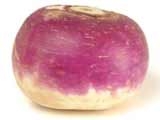
most common type of turnip is mostly white-skinned apart from the upper 1–6 centimeters, which protrude above the ground and are purple, red, or greenish wherever sunlight has fallen.


Nutrition Facts


Discussion
Ask a question about 'Turnip'
Start a new discussion about 'Turnip'
Answer questions from other users
Full Discussion Forum


Encyclopedia


For similar vegetables also called "turnip", see Turnip (disambiguation)
Turnip (disambiguation)

Turnip can refer to three vegetables, which are described under the articles Turnip, Rutabaga, and Jicama. The confusion results from the following regional differences of usage....
.
The turnip (Brassica rapa
Brassica rapa

Brassica rapa, commonly known as field mustard or turnip mustard is a plant widely cultivated as a leaf vegetable , a root vegetable, and an oilseed....
 var. rapa) is a root vegetable
Root vegetable

Root vegetables are plant roots used as vegetables. Other underground plants are often, erroneously, called root vegetables. Root vegetables include both true roots such as tuberous roots and taproots, but exclude non-roots such as tubers, rhizomes, corms, and bulbs....
 commonly grown in temperate climates worldwide for its white, bulbous taproot
Taproot

A plant's taproot is a somewhat straight tapering root that grows vertically downward. It forms a center from which other roots sprout laterally....
. Small, tender, varieties are grown for human consumption, while larger varieties are grown as feed
Fodder

In agriculture, fodder or animal feed is any foodstuff that is used specifically to feed domesticated livestock, such as cattle, goats, sheep, horses, chickens and pigs....
 for livestock
Livestock

Livestock is the term used to refer to a domesticated animal intentionally reared in an agricultural setting to produce things such as food or fibre, or for its labour....
.

Description

The most common type of turnip is mostly white-skinned apart from the upper 1–6 centimeters, which protrude above the ground and are purple, red, or greenish wherever sunlight has fallen. This above-ground part develops from stem tissue, but is fused with the root. The interior flesh is entirely white. The entire root is roughly conical, but occasionally squircle
Squircle

Squircle is a portmanteau word used to refer to a mathematical shape with properties between those of a Square and those of a circle. It is a special case of superellipse....
 in shape, about 5–20 centimeters in diameter, and lacks side roots. The taproot
Taproot

A plant's taproot is a somewhat straight tapering root that grows vertically downward. It forms a center from which other roots sprout laterally....
 (the normal root below the swollen storage root) is thin and 10 centimeters or more in length; it is trimmed off before marketing. The leaves grow directly from the above-ground shoulder of the root, with little or no visible crown or neck (as found in rutabaga
Rutabaga

The rutabaga, swede , or yellow turnip is a root vegetable that originated as a cross between the cabbage and the turnip. Its leaves can also be eaten as a leaf vegetable....
s).

Turnip leaves
Spring greens

Spring greens are a cultivar of Brassica oleracea in the cultivar Acephala Group, similar to kale, in which the central leaves do not form a head or form only a very loose one....
 are sometimes eaten as "turnip greens" ("turnip tops" in the UK), and they resemble mustard greens
Brassica juncea

Brassica juncea, also known as mustard greens, Indian mustard and leaf mustard, is a species of mustard plant. Sub-varieties include Southern Giant Curled Mustard, which resembles a headless cabbage such as Kale, but with a distinct horseradish-mustard flavor....
 in flavor. Turnip greens are a common side dish in southeastern US cooking, primarily during late fall and winter. Smaller leaves are preferred; however, any bitter taste of larger leaves can be reduced by pouring off the water from initial boiling and replacing it with fresh water. Varieties specifically grown for the leaves resemble mustard greens more than those grown for the roots, with small or no storage roots. Varieties of B. rapa that have been developed only for use as leaves are called Chinese cabbage
Chinese cabbage

Chinese cabbage , also known as snow cabbage, is a China leaf vegetable commonly used in Chinese cuisine. The vegetable is related to the Western cabbage, and is of the same species as the Turnip ....
. Both leaves and root have a pungent flavor similar to raw cabbage
Cabbage

The cabbage is a leafy garden plant of the Family Brassicaceae , used as a Leaf vegetable. It is a herbaceous, biennial plant, dicotyledonous flowering plant distinguished by a short stem upon which is crowded a mass of leaves, usually green but in some varieties red or purplish, forming a characteristic compact, globular cluster ....
 or radishes that becomes mild after cooking.

Turnip roots weigh up to about 1 kilogram, although they can be harvested when smaller. Size is partly a function of variety and partly a function of the length of time that the turnip has grown. Most very small turnips (also called baby turnips) are specialty varieties. These are only available when freshly harvested and do not keep well. Most baby turnips can be eaten whole, including their leaves. Baby turnips come in yellow-, orange-, and red-fleshed varieties as well as white-fleshed. Their flavor is mild, so they can be eaten raw in salad
Salad

Salad is a mixture of cold or hot foods, usually including vegetables and/or fruits, often with a dressing, occasionally nuts or croutons, and sometimes with the addition of meat, fish, pasta, cheese, eggs, or whole grains....
s like radishes.

Nutrition

Turnips are high only in Vitamin C. On the other hand, turnip greens are a good source of Vitamin A, folate, Vitamin C, Vitamin K and calcium. Turnip greens are high in lutein
Lutein

Lutein is one of over 600 known naturally occurring carotenoids. Found in green leafy vegetables such as spinach and kale, lutein is employed by organisms as an antioxidant and for blue light absorption....
 (8.4mg / 100g).

Origin

The turnip was a well-established crop in Hellenistic and Roman
Roman Empire

The Roman Empire was the Roman Republic phase of the Ancient Rome, characterised by an autocracy form of government and large territorial holdings in Europe and around the Mediterranean....
 times, which leads to the assumption that it was brought into cultivation earlier. But Zohary and Hopf note that "there are almost no archeological records available" to help determine its earlier history and domestication. Wild forms of the hot turnip and its relatives the mustards
Mustard plant

Mustards are several plant species in the genera Brassica and Sinapis whose small mustard seeds are used as a spice and, by grinding and mixing them with water, vinegar or other liquids, are turned into the condiment known as Mustard ....
 and radish
Radish

The radish is an Eating root vegetable of the Brassicaceae family that was domesticated in Europe in pre-Roman Empire times. They are grown and consumed throughout the world....
 are found over west Asia
Asia

Asia is the world's largest and most populous continent. It covers 8.6% of the Earth's total surface area and, with over 4 billion people, it contains more than 60% of the world's current human population....
 and Europe
Europe

Europe is, conventionally, one of the world's seven continents. Comprising the westernmost peninsula of Eurasia, Europe is generally divided from Asia to its east by the water divide of the Ural Mountains, the Ural , the Caspian Sea, and by the Caucasus Mountains to the southeast....
, suggesting that their domestication took place somewhere in that area. However Zohary and Hopf conclude, "Suggestions as to the origins of these plants are necessarily based on linguistic considerations."
Brosen Flower Nn1

Cultivation

The 1881 Household Cyclopedia
Household Cyclopedia

The Household Cyclopedia was an American 1881 guide to housekeeping.External links ...
 gives these instructions for field cultivation of turnips:
Turnip Greens 1
The benefits derived from turnip husbandry are of great magnitude; light soils are cultivated with profit and facility; abundance of food is provided for man and beast; the earth is turned to the uses for which it is physically calculated, and by being suitably cleaned with this preparatory crop, a bed is provided for grass seeds, wherein they flourish and prosper with greater vigor than after any other preparation.

The first ploughing is given immediately after harvest, or as soon as the wheat seed is finished, either in length or across the field, as circumstances may seem to require. In this state the ground remains till the oat seed is finished, when a second ploughing is given to it, usually in a contrary direction to the first. It is then repeatedly harrowed, often rolled between the harrowings and every particle of root-weeds carefully picked off with the hand; a third ploughing is then bestowed, and the other operations are repeated. In this stage, if the ground has not been very foul, the seed process.

The next part of the process is the sowing of the seed; this may be performed by drilling machines of different sizes and constructions, through all acting on the same principle. A machine drawn by a horse in a pair of shafts, sows two drills at a time and answers extremely well, where the ground is flat, and the drills properly made up. The weight of the machine ensures a regularity of sowing hardly to be gained by those of a different size and construction. From two to three pounds of seed are sown upon the acre (2 to 3 kg/hectare), though the smallest of these quantities will give many more plants in ordinary seasons than are necessary; but as the seed is not an expensive article the greater part of farmers incline to sow thick, which both provides against the danger of part of the seed perishing, and gives the young plants an advantage at the outset.

Turnips are sown from the beginning to the end of June, but the second and third weeks of the month are, by judicious farmers, accounted the most proper time. Some people have sown as early as May, and with advantage, but these early fields are apt to run to seed before winter, especially if the autumn be favorable to vegetation. As a general rule it may be laid down that the earliest sowings should be on the latest soils; plants on such soils are often long before they make any great progress, and, in the end, may be far behind those in other situations, which were much later sown. The hot turnip plant, indeed, does not thrive rapidly till its roots reach the dung, and the previous nourishment afforded them is often so scanty as to stunt them altogether before they get so far.

The first thing to be done in this process is to run a horse-hoe, called a scraper, along the intervals, keeping at such a distance from the young plants that they shall not be injured; this operation destroys all the annual weeds which have sprung up, and leaves the plants standing in regular stripes or rows. The hand hoeing then commences, by which the turnips are all singled out at a distance of from 8-12 inches, and the redundant ones drawn into the spaces between the rows. The singling out of the young plants is an operation of great importance, for an error committed in this process can hardly be afterward rectified. Boys and girls are always employed as hoers; but a steady and trusty man-servant is usually set over them to see that the work is properly executed.

In eight or ten days, or such a length of time as circumstances may require, a horse-hoe of a different construction from the scraper is used. This, in fact, is generally a small plough, of the same kind with that commonly wrought, but of smaller dimensions. By this implement, the earth is pared away from the sides of the drills, and a sort of new ridge formed in the middle of the former interval. The hand-hoers are again set to work, and every weed and superfluous turnip is cut up; afterward the horse-hoe is employed to separate the earth, which it formerly threw into the furrows, and lay it back to the sides of the drills. On dry lands this is done by the scraper, but where the least tendency to moisture prevails, the small plough is used, in order that the furrows may be perfectly cleaned out. This latter mode, indeed, is very generally practiced.

Human use

Pliny the Elder
Pliny the Elder

Gaius Plinius Secundus , better known as Pliny the Elder, was an ancient author, naturalist or natural philosopher and naval and military commander of some importance who wrote Natural History ....
 writes that he considered the turnip one of the most important vegetables of his day, rating it "directly after cereals or at all events after the bean
Bean

Bean is a common name for large plant seeds of several genus of the Family Fabaceae used for human food or animal feed.The whole young pods of bean plants, if picked before the pods ripen and dry, can be tender enough to eat whole, whether cooked or raw....
, since its utility surpasses that of any other plant." Pliny praises it as a source of fodder
Fodder

In agriculture, fodder or animal feed is any foodstuff that is used specifically to feed domesticated livestock, such as cattle, goats, sheep, horses, chickens and pigs....
 for farm animals, and this vegetable is not particular about the type of soil it grows in and because it can be left in the ground until the next harvest, it "prevents the effects of famine" for humans (N.H. 18.34).

In Turkey
Turkey

Turkey , known officially as the Republic of Turkey , is a Eurasian country that stretches across the Anatolian peninsula in southwest Asia and Thrace in the Balkans region of Southern Europe....
, particularly in the area near Adana
Adana

Adana , is the capital of Adana Province in Turkey. The city administrates two districts, Seyhan and Y?regir, with a total population of 2,530,257 and an area of 1,945 km?....
, turnips are used to flavor salgam, a juice made from purple carrots and spices served ice cold.

The Macomber turnip is featured in one of the very few historic markers for a vegetable, on Main Road in Westport, Massachusetts
Westport, Massachusetts

Westport is a New England town in Bristol County, Massachusetts, Massachusetts, United States. The population was 14,183 at the 2000 census.The village of North Westport, Massachusetts lies in the town....
.

Turnip lanterns are an old tradition, see Jack o' Lantern for their association with Halloween. Laurie Lee
Laurie Lee

Laurence Edward Alan "Laurie" Lee, Order of the British Empire was an England poet, novelist, and screenwriter, raised in the village of Slad, Gloucestershire....
, in "The Edge of Day", an autobiography of a childhood in the Cotswolds, mentions the Parochial Church Tea and Annual Entertainment, which took place around Twelfth night. "We...saw his red face lit like a hot turnip lamp as he crouched to stoke up the flames."

In British English, the idiom "having the IQ of a turnip" is used to describe low intelligence or stupidity.

Heraldry

The turnip is an old vegetable charge in heraldry. It was used by Leonhard von Keutschach
Leonhard von Keutschach

Leonhard von Keutschach , Archbishopric of Salzburg , the last to rule the city in the feudal style. His parents were Otto von Keutschach, a judge of the court and Gertrud von M?derndorf, both of Viktring, Austria....
, prince-archbishop of Salzburg. The turnip is still the heart shield in the arms of Keutschach am See
Keutschach am See

Keutschach am See is a town in the district of Klagenfurt-Land in Carinthia in Austria.According to the 2001 census 5.6% of the population are Carinthian Slovenes....
.

Cultural references

The acquisition of turnips was the only ambition of Baldrick
Baldrick

Baldrick is the name of several fictional characters featured in the television series Blackadder. Each one serves as Edmund Blackadder's servant and sidekick....
, a protagonist of the popular sitcom Blackadder
Blackadder

Blackadder is the generic name that encompasses four series of an acclaimed BBC One historical British sitcom, along with several List of Blackadder episodes#See also....
 (portrayed by actor Tony Robinson
Tony Robinson

Tony Robinson is an England actor, broadcasting and political campaigner, best known for playing Baldrick in the BBC television series Blackadder, and for hosting Channel 4 programmes such as Time Team and The Worst Jobs in History....
).

See also

  • Rutabaga
    Rutabaga

    The rutabaga, swede , or yellow turnip is a root vegetable that originated as a cross between the cabbage and the turnip. Its leaves can also be eaten as a leaf vegetable....
     or yellow turnip, also referred to a swede in the UK, Ireland, New Zealand and Australia
  • Radish
    Radish

    The radish is an Eating root vegetable of the Brassicaceae family that was domesticated in Europe in pre-Roman Empire times. They are grown and consumed throughout the world....
  • Daikon
    Daikon

    is the Japanese name for a mild-flavored, very large, white, East Asian radish. Despite being known most commonly by its Japanese name, it did not originate in Japan, but rather in continental Asia....
  • Turnip Prize
    Turnip Prize

    The Turnip Prize is a spoof UK prize that satirises the Tate Gallery's Turner Prize by exhibiting deliberately badly made "art" created with minimal effort....
  • Rapini
    Rapini

    Rapini is a common vegetable in Galician cuisine, Chinese cuisine, Italian cuisine, and Portuguese cuisine cuisine. The plant is a member of the Brassiceae tribe of the Brassicaceae, whose taxonomy is very difficult....
     (Broccoli rabe)


External links