


Chamois

Encyclopedia
The chamois, Rupicapra rupicapra, is a goat-antelope species
native to mountains in Europe
, including the Carpathian Mountains
of Romania
, the European Alps
, the Tatra Mountains
, the Balkans
, parts of Turkey
, and the Caucasus
. The chamois has also been introduced to the South Island
of New Zealand
. Some subspecies of chamois are strictly protected in the EU under the European Habitats Directive.
chamois. This is derived from Latin
camox, borrowed from Gaulish, itself perhaps a borrowing from Iberian
or Aquitanian
, akin to modern Basque
ahuntz, "goat".
The usual pronunciation for the animal in British English
is ˈʃæmwɑː, or in American English
ʃæmˈwɑː, approximating the French
pronunciation. However when referring to chamois leather
, and in New Zealand often for the animal itself, it is ˈʃæmi, and sometimes spelt "shammy" or "chamy". The plural of "chamois" is spelled the same as the singular, and it may be pronounced with the final "s" sounded: /ˈʃæmwɑːz/, /ʃæmˈwɑːz/, /ˈʃæmiz/. However, as with many other quarry
species, the plural for the animal is often pronounced the same as the singular.
The Dutch
name for the chamois is gems, and the male is called a gemsbok. In Afrikaans
, the name "gemsbok" came to refer to a species of Subsaharan antelope
of the genus Oryx
, and this meaning of "gemsbok
" has been adopted into English.
Rupicapra: R. rupicapra and R. pyrenaica
, which occurs in the Pyrenees
and the Appennines. The chamois (along with sheep and goat
s) are in the goat-antelope subfamily (Caprinae) of the family Bovid
ae.
The chamois (Rupicapra rupicapra) is categorized into several subspecies:
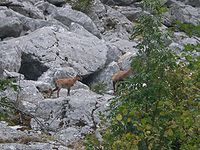
and a black stripe along the back. Chamois can reach an age of 20 years.
Female chamois and their young live in herds; adult males tend to live solitarily for most of the year. During the rut
(late November/early December in Europe, May in New Zealand
), males engage in fierce battles for the attention of unmated females. An impregnated
female undergoes a gestation
period of 20 weeks, after which a single kid is born. The kid is fully grown by 1 year of age.
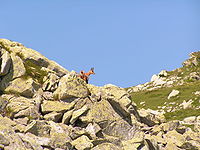
n Emperor, Franz Joseph I
. The first surviving releases were made in the Aoraki/Mount Cook
region and these animals gradually spread over much of the South Island
.
In New Zealand, hunting of chamois is unrestricted and even encouraged by the Department of Conservation to limit the animal's impact on New Zealand's native alpine flora
.
New Zealand chamois tend to weigh about 20% less than European individuals of the same age, suggesting that food supplies may be limited.

animals. Chamois have two traits that are exploited by hunters. The first is that they are most active in the morning and evening when they feed. The second trait is that chamois tend to look for danger from below. This means that a hunter stalking chamois from above is less likely to be observed and more likely to be successful.
The tuft of hair from the back of the neck, the gamsbart
(chamois "beard"), is traditionally worn as a decoration on hats throughout the alpine countries.
or domestic goat
s or sheep are commonly used.
}
}}
Species
In biology, a species is one of the basic units of biological classification and a taxonomic rank. A species is often defined as a group of organisms capable of interbreeding and producing fertile offspring. While in many cases this definition is adequate, more precise or differing measures are...
native to mountains in Europe
Europe
Europe is, by convention, one of the world's seven continents. Comprising the westernmost peninsula of Eurasia, Europe is generally 'divided' from Asia to its east by the watershed divides of the Ural and Caucasus Mountains, the Ural River, the Caspian and Black Seas, and the waterways connecting...
, including the Carpathian Mountains
Carpathian Mountains
The Carpathian Mountains or Carpathians are a range of mountains forming an arc roughly long across Central and Eastern Europe, making them the second-longest mountain range in Europe...
of Romania
Romania
Romania is a country located at the crossroads of Central and Southeastern Europe, on the Lower Danube, within and outside the Carpathian arch, bordering on the Black Sea...
, the European Alps
Alps
The Alps is one of the great mountain range systems of Europe, stretching from Austria and Slovenia in the east through Italy, Switzerland, Liechtenstein and Germany to France in the west....
, the Tatra Mountains
Tatra Mountains
The Tatra Mountains, Tatras or Tatra , are a mountain range which forms a natural border between Slovakia and Poland, and are the highest mountain range in the Carpathian Mountains...
, the Balkans
Balkans
The Balkans is a geopolitical and cultural region of southeastern Europe...
, parts of Turkey
Turkey
Turkey , known officially as the Republic of Turkey , is a Eurasian country located in Western Asia and in East Thrace in Southeastern Europe...
, and the Caucasus
Caucasus
The Caucasus, also Caucas or Caucasia , is a geopolitical region at the border of Europe and Asia, and situated between the Black and the Caspian sea...
. The chamois has also been introduced to the South Island
South Island
The South Island is the larger of the two major islands of New Zealand, the other being the more populous North Island. It is bordered to the north by Cook Strait, to the west by the Tasman Sea, to the south and east by the Pacific Ocean...
of New Zealand
New Zealand
New Zealand is an island country in the south-western Pacific Ocean comprising two main landmasses and numerous smaller islands. The country is situated some east of Australia across the Tasman Sea, and roughly south of the Pacific island nations of New Caledonia, Fiji, and Tonga...
. Some subspecies of chamois are strictly protected in the EU under the European Habitats Directive.
Names
The English name is from the FrenchFrench language
French is a Romance language spoken as a first language in France, the Romandy region in Switzerland, Wallonia and Brussels in Belgium, Monaco, the regions of Quebec and Acadia in Canada, and by various communities elsewhere. Second-language speakers of French are distributed throughout many parts...
chamois. This is derived from Latin
Latin
Latin is an Italic language originally spoken in Latium and Ancient Rome. It, along with most European languages, is a descendant of the ancient Proto-Indo-European language. Although it is considered a dead language, a number of scholars and members of the Christian clergy speak it fluently, and...
camox, borrowed from Gaulish, itself perhaps a borrowing from Iberian
Iberian language
The Iberian language was the language of a people identified by Greek and Roman sources who lived in the eastern and southeastern regions of the Iberian peninsula. The ancient Iberians can be identified as a rather nebulous local culture between the 7th and 1st century BC...
or Aquitanian
Aquitanian language
The Aquitanian language was spoken in ancient Aquitaine before the Roman conquest and, probably much later, until the Early Middle Ages....
, akin to modern Basque
Basque language
Basque is the ancestral language of the Basque people, who inhabit the Basque Country, a region spanning an area in northeastern Spain and southwestern France. It is spoken by 25.7% of Basques in all territories...
ahuntz, "goat".
The usual pronunciation for the animal in British English
British English
British English, or English , is the broad term used to distinguish the forms of the English language used in the United Kingdom from forms used elsewhere...
is ˈʃæmwɑː, or in American English
American English
American English is a set of dialects of the English language used mostly in the United States. Approximately two-thirds of the world's native speakers of English live in the United States....
ʃæmˈwɑː, approximating the French
French language
French is a Romance language spoken as a first language in France, the Romandy region in Switzerland, Wallonia and Brussels in Belgium, Monaco, the regions of Quebec and Acadia in Canada, and by various communities elsewhere. Second-language speakers of French are distributed throughout many parts...
pronunciation. However when referring to chamois leather
Chamois leather
Chamois leather , sometimes known as a shammy, is a type of porous leather that is favored for its gentle, non-abrasive composition and exceptional absorption properties...
, and in New Zealand often for the animal itself, it is ˈʃæmi, and sometimes spelt "shammy" or "chamy". The plural of "chamois" is spelled the same as the singular, and it may be pronounced with the final "s" sounded: /ˈʃæmwɑːz/, /ʃæmˈwɑːz/, /ˈʃæmiz/. However, as with many other quarry
Game (food)
Game is any animal hunted for food or not normally domesticated. Game animals are also hunted for sport.The type and range of animals hunted for food varies in different parts of the world. This will be influenced by climate, animal diversity, local taste and locally accepted view about what can or...
species, the plural for the animal is often pronounced the same as the singular.
The Dutch
Dutch language
Dutch is a West Germanic language and the native language of the majority of the population of the Netherlands, Belgium, and Suriname, the three member states of the Dutch Language Union. Most speakers live in the European Union, where it is a first language for about 23 million and a second...
name for the chamois is gems, and the male is called a gemsbok. In Afrikaans
Afrikaans
Afrikaans is a West Germanic language, spoken natively in South Africa and Namibia. It is a daughter language of Dutch, originating in its 17th century dialects, collectively referred to as Cape Dutch .Afrikaans is a daughter language of Dutch; see , , , , , .Afrikaans was historically called Cape...
, the name "gemsbok" came to refer to a species of Subsaharan antelope
Antelope
Antelope is a term referring to many even-toed ungulate species indigenous to various regions in Africa and Eurasia. Antelopes comprise a miscellaneous group within the family Bovidae, encompassing those old-world species that are neither cattle, sheep, buffalo, bison, nor goats...
of the genus Oryx
Oryx
Oryx is one of four large antelope species of the genus Oryx. Three of the species are native to arid parts of Africa, with a fourth native to the Arabian Peninsula. Their pelage is pale with contrasing dark markings in the face and on the legs, and their long horns are almost straight...
, and this meaning of "gemsbok
Gemsbok
The gemsbok or gemsbuck is a large antelope in the Oryx genus. It is native to the arid regions of southern Africa, but formerly some authorities included the East African Oryx as a subspecies...
" has been adopted into English.
Taxonomy
There are two species of chamois in the genusGenus
In biology, a genus is a low-level taxonomic rank used in the biological classification of living and fossil organisms, which is an example of definition by genus and differentia...
Rupicapra: R. rupicapra and R. pyrenaica
Pyrenean Chamois
The Pyrenean Chamois , Rupicapra pyrenaica, is a goat antelope that lives in the Pyrenees, Cantabrian Mountains and Apennine Mountains...
, which occurs in the Pyrenees
Pyrenees
The Pyrenees is a range of mountains in southwest Europe that forms a natural border between France and Spain...
and the Appennines. The chamois (along with sheep and goat
Goat
The domestic goat is a subspecies of goat domesticated from the wild goat of southwest Asia and Eastern Europe. The goat is a member of the Bovidae family and is closely related to the sheep as both are in the goat-antelope subfamily Caprinae. There are over three hundred distinct breeds of...
s) are in the goat-antelope subfamily (Caprinae) of the family Bovid
Bovid
A bovid is any of almost 140 species of cloven-hoofed ruminant mammal at least the males of which bear characteristic unbranching horns covered in a permanent sheath of keratin....
ae.
The chamois (Rupicapra rupicapra) is categorized into several subspecies:
- R. r. rupicapra (Alpine chamois): AustriaAustriaAustria , officially the Republic of Austria , is a landlocked country of roughly 8.4 million people in Central Europe. It is bordered by the Czech Republic and Germany to the north, Slovakia and Hungary to the east, Slovenia and Italy to the south, and Switzerland and Liechtenstein to the...
, FranceFranceThe French Republic , The French Republic , The French Republic , (commonly known as France , is a unitary semi-presidential republic in Western Europe with several overseas territories and islands located on other continents and in the Indian, Pacific, and Atlantic oceans. Metropolitan France...
, GermanyGermanyGermany , officially the Federal Republic of Germany , is a federal parliamentary republic in Europe. The country consists of 16 states while the capital and largest city is Berlin. Germany covers an area of 357,021 km2 and has a largely temperate seasonal climate...
, ItalyItalyItaly , officially the Italian Republic languages]] under the European Charter for Regional or Minority Languages. In each of these, Italy's official name is as follows:;;;;;;;;), is a unitary parliamentary republic in South-Central Europe. To the north it borders France, Switzerland, Austria and...
, SwitzerlandSwitzerlandSwitzerland name of one of the Swiss cantons. ; ; ; or ), in its full name the Swiss Confederation , is a federal republic consisting of 26 cantons, with Bern as the seat of the federal authorities. The country is situated in Western Europe,Or Central Europe depending on the definition....
, SloveniaSloveniaSlovenia , officially the Republic of Slovenia , is a country in Central and Southeastern Europe touching the Alps and bordering the Mediterranean. Slovenia borders Italy to the west, Croatia to the south and east, Hungary to the northeast, and Austria to the north, and also has a small portion of...
, SlovakiaSlovakiaThe Slovak Republic is a landlocked state in Central Europe. It has a population of over five million and an area of about . Slovakia is bordered by the Czech Republic and Austria to the west, Poland to the north, Ukraine to the east and Hungary to the south...
(Veľká FatraGreater FatraGreater Fatra or Veľká Fatra is a mountain range in the Western Carpathians in Slovakia. In the geomorphological system, it is a part of the Fatra-Tatra Area. It is situated approximately among the towns of Ružomberok, Harmanec, Turčianske Teplice and Martin...
, Slovak ParadiseSlovak ParadiseSlovak Paradise is a mountain range in central Slovakia. It is a part of the Spiš-Gemer Karst, which in turn is a part of the Slovenské rudohorie Mountains, a major subdivision of the Western Carpathians....
) - R. r. tatricaTatra chamoisThe Tatra chamois is a subspecies of the Chamois of the Rupicapra genus. Tatra chamois lives in the Tatra Mountains in Slovakia and Poland and, unknown to many, the Low Tatras in Slovakia....
(Tatra chamois): Slovakia (Tatras and Low Tatras) and PolandPolandPoland , officially the Republic of Poland , is a country in Central Europe bordered by Germany to the west; the Czech Republic and Slovakia to the south; Ukraine, Belarus and Lithuania to the east; and the Baltic Sea and Kaliningrad Oblast, a Russian exclave, to the north...
(Tatras) - R. r. balcanica (Balkan chamois): AlbaniaAlbaniaAlbania , officially known as the Republic of Albania , is a country in Southeastern Europe, in the Balkans region. It is bordered by Montenegro to the northwest, Kosovo to the northeast, the Republic of Macedonia to the east and Greece to the south and southeast. It has a coast on the Adriatic Sea...
, Bosnia and HerzegovinaBosnia and HerzegovinaBosnia and Herzegovina , sometimes called Bosnia-Herzegovina or simply Bosnia, is a country in Southern Europe, on the Balkan Peninsula. Bordered by Croatia to the north, west and south, Serbia to the east, and Montenegro to the southeast, Bosnia and Herzegovina is almost landlocked, except for the...
, BulgariaBulgariaBulgaria , officially the Republic of Bulgaria , is a parliamentary democracy within a unitary constitutional republic in Southeast Europe. The country borders Romania to the north, Serbia and Macedonia to the west, Greece and Turkey to the south, as well as the Black Sea to the east...
, CroatiaCroatiaCroatia , officially the Republic of Croatia , is a unitary democratic parliamentary republic in Europe at the crossroads of the Mitteleuropa, the Balkans, and the Mediterranean. Its capital and largest city is Zagreb. The country is divided into 20 counties and the city of Zagreb. Croatia covers ...
, northern GreeceGreeceGreece , officially the Hellenic Republic , and historically Hellas or the Republic of Greece in English, is a country in southeastern Europe....
(The PindusPindusThe Pindus mountain range is located in northern Greece and southern Albania. It is roughly 160 km long, with a maximum elevation of 2637 m . Because it runs along the border of Thessaly and Epirus, the Pindus range is often called the "spine of Greece"...
Mountains), Republic of MacedoniaRepublic of MacedoniaMacedonia , officially the Republic of Macedonia , is a country located in the central Balkan peninsula in Southeast Europe. It is one of the successor states of the former Yugoslavia, from which it declared independence in 1991...
, SerbiaSerbiaSerbia , officially the Republic of Serbia , is a landlocked country located at the crossroads of Central and Southeast Europe, covering the southern part of the Carpathian basin and the central part of the Balkans...
, MontenegroMontenegroMontenegro Montenegrin: Crna Gora Црна Гора , meaning "Black Mountain") is a country located in Southeastern Europe. It has a coast on the Adriatic Sea to the south-west and is bordered by Croatia to the west, Bosnia and Herzegovina to the northwest, Serbia to the northeast and Albania to the...
, and Slovenia (isolated populations)
- R. r. carpatica (Carpathian chamois): RomaniaRomaniaRomania is a country located at the crossroads of Central and Southeastern Europe, on the Lower Danube, within and outside the Carpathian arch, bordering on the Black Sea...
- R. r. cartusiana (Chartreuse chamois): France
- R. r. asiatica (Anatolian chamois or Turkish chamois): TurkeyTurkeyTurkey , known officially as the Republic of Turkey , is a Eurasian country located in Western Asia and in East Thrace in Southeastern Europe...
- R. r. caucasica (Caucasian chamois): AzerbaijanAzerbaijanAzerbaijan , officially the Republic of Azerbaijan is the largest country in the Caucasus region of Eurasia. Located at the crossroads of Western Asia and Eastern Europe, it is bounded by the Caspian Sea to the east, Russia to the north, Georgia to the northwest, Armenia to the west, and Iran to...
, GeorgiaGeorgia (country)Georgia is a sovereign state in the Caucasus region of Eurasia. Located at the crossroads of Western Asia and Eastern Europe, it is bounded to the west by the Black Sea, to the north by Russia, to the southwest by Turkey, to the south by Armenia, and to the southeast by Azerbaijan. The capital of...
, Russian Federation
Biology and behaviour
Chamois live at moderately high altitudes and are adapted to living in steep, rugged, rocky terrain. A fully grown chamois reaches a height of about 75 centimetres (29.5 in) and weighs between 20 kilograms (44.1 lb) and 30 kilograms (66.1 lb). Both males and females have short, straightish horns which are hooked backwards near the tip. In summer, the fur has a rich brown colour which turns to a light grey in winter. Distinct characteristics are a white face with pronounced black stripes below the eyes, a white rumpRump (animal)
The rump or croup, in the external morphology of an animal, is the portion of the posterior dorsum that is posterior to the loins and anterior to the tail. Anatomically, the rump corresponds to the sacrum....
and a black stripe along the back. Chamois can reach an age of 20 years.
Female chamois and their young live in herds; adult males tend to live solitarily for most of the year. During the rut
Rut (mammalian reproduction)
The rut is the mating season of ruminant animals such as deer, sheep, elk, moose, caribou, ibex, goats, pronghorn and Asian and African antelope....
(late November/early December in Europe, May in New Zealand
New Zealand
New Zealand is an island country in the south-western Pacific Ocean comprising two main landmasses and numerous smaller islands. The country is situated some east of Australia across the Tasman Sea, and roughly south of the Pacific island nations of New Caledonia, Fiji, and Tonga...
), males engage in fierce battles for the attention of unmated females. An impregnated
Fertilisation
Fertilisation is the fusion of gametes to produce a new organism. In animals, the process involves the fusion of an ovum with a sperm, which eventually leads to the development of an embryo...
female undergoes a gestation
Gestation
Gestation is the carrying of an embryo or fetus inside a female viviparous animal. Mammals during pregnancy can have one or more gestations at the same time ....
period of 20 weeks, after which a single kid is born. The kid is fully grown by 1 year of age.
Distribution and habitat
New Zealand
Alpine chamois arrived in New Zealand in 1907 as a gift from the AustriaAustrian Empire
The Austrian Empire was a modern era successor empire, which was centered on what is today's Austria and which officially lasted from 1804 to 1867. It was followed by the Empire of Austria-Hungary, whose proclamation was a diplomatic move that elevated Hungary's status within the Austrian Empire...
n Emperor, Franz Joseph I
Franz Joseph I of Austria
Franz Joseph I or Francis Joseph I was Emperor of Austria, King of Bohemia, King of Croatia, Apostolic King of Hungary, King of Galicia and Lodomeria and Grand Duke of Cracow from 1848 until his death in 1916.In the December of 1848, Emperor Ferdinand I of Austria abdicated the throne as part of...
. The first surviving releases were made in the Aoraki/Mount Cook
Aoraki/Mount Cook
Aoraki / Mount Cook is the highest mountain in New Zealand, reaching .It lies in the Southern Alps, the mountain range which runs the length of the South Island. A popular tourist destination, it is also a favourite challenge for mountain climbers...
region and these animals gradually spread over much of the South Island
South Island
The South Island is the larger of the two major islands of New Zealand, the other being the more populous North Island. It is bordered to the north by Cook Strait, to the west by the Tasman Sea, to the south and east by the Pacific Ocean...
.
In New Zealand, hunting of chamois is unrestricted and even encouraged by the Department of Conservation to limit the animal's impact on New Zealand's native alpine flora
Alpine tundra
Alpine tundra is a natural region that does not contain trees because it is at high altitude. Alpine tundra is distinguished from arctic tundra, because alpine soils are generally better drained than arctic soils...
.
New Zealand chamois tend to weigh about 20% less than European individuals of the same age, suggesting that food supplies may be limited.
Hunting and wildlife management
As their meat is considered tasty, chamois are popular gameGame (food)
Game is any animal hunted for food or not normally domesticated. Game animals are also hunted for sport.The type and range of animals hunted for food varies in different parts of the world. This will be influenced by climate, animal diversity, local taste and locally accepted view about what can or...
animals. Chamois have two traits that are exploited by hunters. The first is that they are most active in the morning and evening when they feed. The second trait is that chamois tend to look for danger from below. This means that a hunter stalking chamois from above is less likely to be observed and more likely to be successful.
The tuft of hair from the back of the neck, the gamsbart
Gamsbart
The Gamsbart is a tuft of hair traditionally worn as a decoration on trachten-hats in the alpine regions of Austria and Bavaria....
(chamois "beard"), is traditionally worn as a decoration on hats throughout the alpine countries.
Chamois leather
Chamois leather, traditionally made from the hide of the chamois, is very smooth and absorbent and is favoured in cleaning and polishing because it produces no streaking. Modern chamois leather may be made from chamois hide, but hides of deerDeer
Deer are the ruminant mammals forming the family Cervidae. Species in the Cervidae family include white-tailed deer, elk, moose, red deer, reindeer, fallow deer, roe deer and chital. Male deer of all species and female reindeer grow and shed new antlers each year...
or domestic goat
Goat
The domestic goat is a subspecies of goat domesticated from the wild goat of southwest Asia and Eastern Europe. The goat is a member of the Bovidae family and is closely related to the sheep as both are in the goat-antelope subfamily Caprinae. There are over three hundred distinct breeds of...
s or sheep are commonly used.
External links
- ITIS (Integrated Taxonomic Information System) report for the species Chamois
- New Zealand Chamois and their distribution in New Zealand
}
}}