

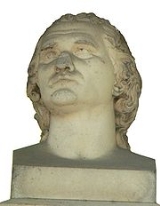
Gaspard Monge

Encyclopedia
Gaspard Monge, Comte de Péluse (9 May 1746 – 28 July 1818) was a French
mathematician
, revolutionary, and was inventor of descriptive geometry
. During the French Revolution
, he was involved in the complete reorganization of the educational system, founding the École Polytechnique
. He also served as minister of the Marine during the revolution.
, Côte-d'Or
. He was first educated at the college of the Oratorians at Beaune, and then in their college at Lyon
- where, at sixteen, one year after he had begun studying physics
, he was made an instructor. Returning to Beaune for a vacation, he made, a large scale plan of the town, inventing the methods of observation and constructing the necessary instruments; the plan was presented to the town, and preserved in their library. An officer of engineers seeing it wrote to recommend Monge to the commandant of the military school at Mézières
, and he was received as a draftsman
and pupil in the practical school attached to that institution; due to the aristocratic nature of the school, he was not allowed admission to the institution itself. His manual skill was highly regarded. "I was a thousand times tempted," he said long afterwards, "to tear up my drawings in disgust at the esteem in which they were held, as if I had been good for nothing better."
An opportunity, however, presented itself: being required to work out from data supplied to him the defilading of a proposed fortress (an operation then only performed by a long arithmetical process), Monge, substituting for this a geometrical method, obtained the result so quickly that the commandant at first refused to receive it - the time necessary for the work had not been taken; but upon examination the value of the discovery was recognized, and the method was adopted. And Monge, continuing his researches, arrived at that general method of the application of geometry to the arts of construction which is now called descriptive geometry.
began at this time. In 1783, after leaving Mézières, he was, on the death of É. Bézout
, appointed examiner of naval candidates. Although pressed by the minister to prepare for them a complete course of mathematics, he declined to do so, on the ground that it would deprive Mme Bézout of her only income, from the sale of the works of her late husband. In 1786, he did write and publish his Traité élémentaire de la statique.
, in his paper on curvature in the Berlin Memoirs for 1760, had considered, not the normals of the surface, but the normals of the plane sections through a particular normal, so that the question of the intersection of successive normals of the surface had never presented itself to him. Monge's memoir just referred to gives the ordinary differential equation of the curves of curvature, and establishes the general theory in a very satisfactory manner; but the application to the interesting particular case of the ellipsoid was first made by him in a later paper in 1795. (Monge's 1781 memoir is also the earliest known anticipation of Linear Programming type of problems, in particular of the transportation problem. Related to that, the Monge soil-transport problem leads to a weak-topology definition of a distance between distributions rediscovered many times since by such as L. V. Kantorovich, P. Levy, L. N. Wasserstein, and others; and bearing their names in various combinations in various contexts.) A memoir in the volume for 1783 relates to the production of water by the combustion of hydrogen
; but Monge's results had been anticipated by Henry Cavendish
.
 In 1792, on the creation by the Legislative Assembly
of an executive council, Monge accepted the office of minister of the marine, and held this office from 10 August 1792 to 10 April 1793. When the Committee of Public Safety
made an appeal to the savants to assist in producing the materiel required for the defence of the republic, he applied himself wholly to these operations, and distinguished himself by his indefatigable activity therein; he wrote at this time his Description de l'art de fabriquer les canons, and his Avis aux ouvriers en fer sur la fabrication de l'acier.
He took a very active part in the measures for the establishment of the normal school (which existed only during the first four months of the year 1795), and of the school for public works, afterwards the École Polytechnique
, and was at each of them professor for descriptive geometry; his methods in that science were first published in the form in which the shorthand writers took down his lessons given at the normal school in 1795, and again in 1798—1799.
In 1796 Monge was sent into Italy
with C.L. Berthollet and some artists to receive the pictures and statues levied from several Italian towns, and made there the acquaintance of General Bonaparte
. Two years later he was sent to Rome
on a mission which ended in the establishment, under A. Masséna, of the short-lived Roman Republic
; and he thence joined the expedition to Egypt
, taking part with his friend Berthollet as well in various operations of the war as in the scientific labours of the Institut d'Égypte
and Egyptian Institute of Sciences and Arts
; they accompanied Bonaparte to Syria
, and returned with him in 1798 to France. Monge was appointed president of the Egyptian commission, and he resumed his connection with the École Polytechnique. His later mathematical papers are published (1794–1816) in the Journal and the Correspondence of the École Polytechnique. On the formation of the Sénat conservateur
he was appointed a member of that body, with an ample provision and the title of count of Pelusium
(Comte de Péluse), and became the Sénat conservateur's president in 1806-07; but on the fall of Napoleon he was deprived of all his honours, and even excluded from the list of members of the reconstituted Institute.
Monge died at Paris on 28 July 1818 and was interred in Le Père Lachaise Cemetery, in Paris, in a mausoleum
. He was later transferred to the Panthéon
.
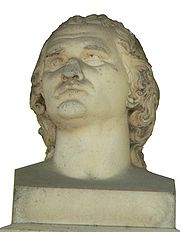
A statue portraying him was erected in Beaune in 1849. His name is one of the 72 names inscribed on the Eiffel Tower.
French people
The French are a nation that share a common French culture and speak the French language as a mother tongue. Historically, the French population are descended from peoples of Celtic, Latin and Germanic origin, and are today a mixture of several ethnic groups...
mathematician
Mathematician
A mathematician is a person whose primary area of study is the field of mathematics. Mathematicians are concerned with quantity, structure, space, and change....
, revolutionary, and was inventor of descriptive geometry
Descriptive geometry
Descriptive geometry is the branch of geometry which allows the representation of three-dimensional objects in two dimensions, by using a specific set of procedures. The resulting techniques are important for engineering, architecture, design and in art...
. During the French Revolution
French Revolution
The French Revolution , sometimes distinguished as the 'Great French Revolution' , was a period of radical social and political upheaval in France and Europe. The absolute monarchy that had ruled France for centuries collapsed in three years...
, he was involved in the complete reorganization of the educational system, founding the École Polytechnique
École Polytechnique
The École Polytechnique is a state-run institution of higher education and research in Palaiseau, Essonne, France, near Paris. Polytechnique is renowned for its four year undergraduate/graduate Master's program...
. He also served as minister of the Marine during the revolution.
Early life
Monge was born at BeauneBeaune
Beaune is the wine capital of Burgundy in the Cote d'Or department in eastern France. It is located between Paris and Geneva.Beaune is one of the key wine centers in France and the annual wine auction of the Hospices de Beaune is the primary wine auction in France...
, Côte-d'Or
Côte-d'Or
Côte-d'Or is a department in the eastern part of France.- History :Côte-d'Or is one of the original 83 departments created during the French Revolution on 4 March 1790. It was formed from part of the former province of Burgundy.- Geography :...
. He was first educated at the college of the Oratorians at Beaune, and then in their college at Lyon
Lyon
Lyon , is a city in east-central France in the Rhône-Alpes region, situated between Paris and Marseille. Lyon is located at from Paris, from Marseille, from Geneva, from Turin, and from Barcelona. The residents of the city are called Lyonnais....
- where, at sixteen, one year after he had begun studying physics
Physics
Physics is a natural science that involves the study of matter and its motion through spacetime, along with related concepts such as energy and force. More broadly, it is the general analysis of nature, conducted in order to understand how the universe behaves.Physics is one of the oldest academic...
, he was made an instructor. Returning to Beaune for a vacation, he made, a large scale plan of the town, inventing the methods of observation and constructing the necessary instruments; the plan was presented to the town, and preserved in their library. An officer of engineers seeing it wrote to recommend Monge to the commandant of the military school at Mézières
Charleville-Mézières
Charleville-Mézières is a commune in northern France, capital of the Ardennes department in the Champagne-Ardenne region. Charleville-Mézières is located on the banks of the Meuse River.-History:...
, and he was received as a draftsman
Technical drawing
Technical drawing, also known as drafting or draughting, is the act and discipline of composing plans that visually communicate how something functions or has to be constructed.Drafting is the language of industry....
and pupil in the practical school attached to that institution; due to the aristocratic nature of the school, he was not allowed admission to the institution itself. His manual skill was highly regarded. "I was a thousand times tempted," he said long afterwards, "to tear up my drawings in disgust at the esteem in which they were held, as if I had been good for nothing better."
An opportunity, however, presented itself: being required to work out from data supplied to him the defilading of a proposed fortress (an operation then only performed by a long arithmetical process), Monge, substituting for this a geometrical method, obtained the result so quickly that the commandant at first refused to receive it - the time necessary for the work had not been taken; but upon examination the value of the discovery was recognized, and the method was adopted. And Monge, continuing his researches, arrived at that general method of the application of geometry to the arts of construction which is now called descriptive geometry.
Academic career
In 1768 Monge became professor of mathematics, and in 1771 professor of physics at Mézières. In 1778 he married Mme Horbon, a young widow. In 1780 he became a member of the Académie; his intimate friendship with C.L. BertholletClaude Louis Berthollet
Claude Louis Berthollet was a Savoyard-French chemist who became vice president of the French Senate in 1804.-Biography:...
began at this time. In 1783, after leaving Mézières, he was, on the death of É. Bézout
Étienne Bézout
-External links:...
, appointed examiner of naval candidates. Although pressed by the minister to prepare for them a complete course of mathematics, he declined to do so, on the ground that it would deprive Mme Bézout of her only income, from the sale of the works of her late husband. In 1786, he did write and publish his Traité élémentaire de la statique.
Works
Monge contributed (1770–1790) to the Memoirs of the Academy of Turin, the Mémoires des savantes étrangers of the Academy of Paris, the Mémoires of the same Academy, and the Annales de chimie, various mathematical and physical papers. Among these may be noticed the memoir "Sur la théorie des déblais et des remblais" (Mém. de l’acad. de Paris, 1781), which, while giving a remarkably elegant investigation in regard to the problem of earth-work referred to in the title, establishes in connection with it his capital discovery of the curves of curvature of a surface. Leonhard EulerLeonhard Euler
Leonhard Euler was a pioneering Swiss mathematician and physicist. He made important discoveries in fields as diverse as infinitesimal calculus and graph theory. He also introduced much of the modern mathematical terminology and notation, particularly for mathematical analysis, such as the notion...
, in his paper on curvature in the Berlin Memoirs for 1760, had considered, not the normals of the surface, but the normals of the plane sections through a particular normal, so that the question of the intersection of successive normals of the surface had never presented itself to him. Monge's memoir just referred to gives the ordinary differential equation of the curves of curvature, and establishes the general theory in a very satisfactory manner; but the application to the interesting particular case of the ellipsoid was first made by him in a later paper in 1795. (Monge's 1781 memoir is also the earliest known anticipation of Linear Programming type of problems, in particular of the transportation problem. Related to that, the Monge soil-transport problem leads to a weak-topology definition of a distance between distributions rediscovered many times since by such as L. V. Kantorovich, P. Levy, L. N. Wasserstein, and others; and bearing their names in various combinations in various contexts.) A memoir in the volume for 1783 relates to the production of water by the combustion of hydrogen
Hydrogen
Hydrogen is the chemical element with atomic number 1. It is represented by the symbol H. With an average atomic weight of , hydrogen is the lightest and most abundant chemical element, constituting roughly 75% of the Universe's chemical elemental mass. Stars in the main sequence are mainly...
; but Monge's results had been anticipated by Henry Cavendish
Henry Cavendish
Henry Cavendish FRS was a British scientist noted for his discovery of hydrogen or what he called "inflammable air". He described the density of inflammable air, which formed water on combustion, in a 1766 paper "On Factitious Airs". Antoine Lavoisier later reproduced Cavendish's experiment and...
.
Public service
Legislative Assembly (France)
During the French Revolution, the Legislative Assembly was the legislature of France from 1 October 1791 to September 1792. It provided the focus of political debate and revolutionary law-making between the periods of the National Constituent Assembly and of the National Convention.The Legislative...
of an executive council, Monge accepted the office of minister of the marine, and held this office from 10 August 1792 to 10 April 1793. When the Committee of Public Safety
Committee of Public Safety
The Committee of Public Safety , created in April 1793 by the National Convention and then restructured in July 1793, formed the de facto executive government in France during the Reign of Terror , a stage of the French Revolution...
made an appeal to the savants to assist in producing the materiel required for the defence of the republic, he applied himself wholly to these operations, and distinguished himself by his indefatigable activity therein; he wrote at this time his Description de l'art de fabriquer les canons, and his Avis aux ouvriers en fer sur la fabrication de l'acier.
He took a very active part in the measures for the establishment of the normal school (which existed only during the first four months of the year 1795), and of the school for public works, afterwards the École Polytechnique
École Polytechnique
The École Polytechnique is a state-run institution of higher education and research in Palaiseau, Essonne, France, near Paris. Polytechnique is renowned for its four year undergraduate/graduate Master's program...
, and was at each of them professor for descriptive geometry; his methods in that science were first published in the form in which the shorthand writers took down his lessons given at the normal school in 1795, and again in 1798—1799.
In 1796 Monge was sent into Italy
Italy
Italy , officially the Italian Republic languages]] under the European Charter for Regional or Minority Languages. In each of these, Italy's official name is as follows:;;;;;;;;), is a unitary parliamentary republic in South-Central Europe. To the north it borders France, Switzerland, Austria and...
with C.L. Berthollet and some artists to receive the pictures and statues levied from several Italian towns, and made there the acquaintance of General Bonaparte
Napoleon I of France
Napoleon Bonaparte was a French military and political leader during the latter stages of the French Revolution.As Napoleon I, he was Emperor of the French from 1804 to 1815...
. Two years later he was sent to Rome
Rome
Rome is the capital of Italy and the country's largest and most populated city and comune, with over 2.7 million residents in . The city is located in the central-western portion of the Italian Peninsula, on the Tiber River within the Lazio region of Italy.Rome's history spans two and a half...
on a mission which ended in the establishment, under A. Masséna, of the short-lived Roman Republic
Roman Republic (18th century)
The Roman Republic was proclaimed on February 15, 1798 after Louis Alexandre Berthier, a general of Napoleon, had invaded the city of Rome on February 10....
; and he thence joined the expedition to Egypt
Egypt
Egypt , officially the Arab Republic of Egypt, Arabic: , is a country mainly in North Africa, with the Sinai Peninsula forming a land bridge in Southwest Asia. Egypt is thus a transcontinental country, and a major power in Africa, the Mediterranean Basin, the Middle East and the Muslim world...
, taking part with his friend Berthollet as well in various operations of the war as in the scientific labours of the Institut d'Égypte
Institut d'Égypte
The Institut d’Égypte was a learned academy formed by Napoleon Bonaparte to carry out research during his Egyptian campaign.-Early work:It first met on 24 August 1798, with Gaspard Monge as president, Bonaparte himself as vice-president and Joseph Fourier and Costaz as secretaries...
and Egyptian Institute of Sciences and Arts
Egyptian Institute of Sciences and Arts
The Commission des Sciences et des Arts or "Commission of the Sciences and Arts" was a French learned body set up on 16 March 1798. It was made up of 167 members, of which all but 16 joined Napoleon Bonaparte's invasion of Egypt and produced the Description de l'Égypte...
; they accompanied Bonaparte to Syria
Syria
Syria , officially the Syrian Arab Republic , is a country in Western Asia, bordering Lebanon and the Mediterranean Sea to the West, Turkey to the north, Iraq to the east, Jordan to the south, and Israel to the southwest....
, and returned with him in 1798 to France. Monge was appointed president of the Egyptian commission, and he resumed his connection with the École Polytechnique. His later mathematical papers are published (1794–1816) in the Journal and the Correspondence of the École Polytechnique. On the formation of the Sénat conservateur
Sénat conservateur
The Sénat conservateur was a body set up in France during the Consulate by the Constitution of the Year VIII. With the Tribunat and the Corps législatif, it formed one of the three legislative assemblies of the Consulate...
he was appointed a member of that body, with an ample provision and the title of count of Pelusium
Pelusium
Pelusium was a city in the eastern extremes of Egypt's Nile Delta, 30 km to the southeast of the modern Port Said. Alternative names include Sena and Per-Amun , Pelousion , Sin , Seyân , and Tell el-Farama...
(Comte de Péluse), and became the Sénat conservateur's president in 1806-07; but on the fall of Napoleon he was deprived of all his honours, and even excluded from the list of members of the reconstituted Institute.
Monge died at Paris on 28 July 1818 and was interred in Le Père Lachaise Cemetery, in Paris, in a mausoleum
Gaspard Monge's mausoleum
Gaspard Monge, whose remains are deposited in the burying ground in Père Lachaise Cemetery, at Paris, in a magnificent mausoleum, was professor of geometry in the École polytechnique at Paris, and with Denon accompanied Napoleon Bonaparte on his memorable expedition to Egypt; one to make drawings...
. He was later transferred to the Panthéon
Panthéon, Paris
The Panthéon is a building in the Latin Quarter in Paris. It was originally built as a church dedicated to St. Genevieve and to house the reliquary châsse containing her relics but, after many changes, now functions as a secular mausoleum containing the remains of distinguished French citizens...
.
A statue portraying him was erected in Beaune in 1849. His name is one of the 72 names inscribed on the Eiffel Tower.
External links
- books.google.com An Elementary Treatise on Statics With a Biographical Notice of the Author (Biddle, Philadelphia, 1851)
- books.google.com An elementary treatise on descriptive geometry, with a theory of shadows and of perspective (Weale, London, 1851)