
All Topics  
Lemon


   Email Print
   Bookmark   Link


Lemon


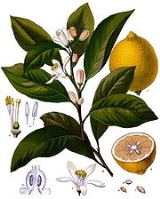
The lemon is the common name for Citrus limon. The reproductive tissue surrounds the seed of the angiosperm lemon tree. The lemon is used for culinary and nonculinary purposes throughout the world. The fruit
Fruit

The term fruit has different meanings dependent on context, and the term is not synonymous in food preparation and biology. In botany, which is the scientific study of plants, fruits are the ripened Ovary of flowering plants....
 is used primarily for its juice
Juice

Juice is a liquid naturally contained in fruit or vegetable tissue. Juice is prepared by mechanically squeezing or Maceration fresh fruits or vegetables without the application of heat or solvents....
, though the pulp and rind
Peel (fruit)

Peel, also known as rind or skin, is the outer protective layer of a fruit or vegetable which could be peeled off. The rind is usually the Botany exocarp, but the term exocarp does also include the hard cases of nut , which are not named peels since they are not peeled off by hand or peeler, but rather shells because of their har...
 (zest
Zest (ingredient)

Zest is the outer, colorful skin of citrus, known botanically as the exocarp. It is often used to add flavor to foods....
) are also used, primarily in cooking
Cooking

Cooking is the process of preparing food by applying heat, selecting, measuring and combining of ingredients in an ordered procedure for producing safe and edible food....
 and baking
Baking

Baking is the technique of prolonged cooking of food by dry heat acting by Heat convection, and not by Thermal radiation, normally in an oven, but also in hot ashes, or on hot stones....
. Lemon juice
Lemon juice

Lemon juice, a fruit juice, is the juice of lemons . Fresh lemon juice is obtained by squeezing lemons. Lemon juice, either in natural strength or concentrated, is sold as a bottled product most of the time, usually with the addition of ascorbic acid and a preservative such as E223....
 is about 5% (approximately 0.3 mole per liter) citric acid
Citric acid

Citric acid is a weak organic chemistry acid, and it is a natural preservative and is also used to add an acidic, or sour, taste to foods and soft drinks....
, which gives lemons a tart taste, and a pH
PH

pH is a measure of the Acid or Base of a solution. It is defined as the cologarithm of the Activity of dissolved hydrogen ions . Hydrogen ion activity coefficients cannot be measured experimentally, so they are based on theoretical calculations....
 of 2 to 3.


Nutrition Facts


Discussion
Ask a question about 'Lemon'
Start a new discussion about 'Lemon'
Answer questions from other users
Full Discussion Forum


Recent Posts


Encyclopedia


The lemon is the common name for Citrus limon. The reproductive tissue surrounds the seed of the angiosperm lemon tree. The lemon is used for culinary and nonculinary purposes throughout the world. The fruit
Fruit

The term fruit has different meanings dependent on context, and the term is not synonymous in food preparation and biology. In botany, which is the scientific study of plants, fruits are the ripened Ovary of flowering plants....
 is used primarily for its juice
Juice

Juice is a liquid naturally contained in fruit or vegetable tissue. Juice is prepared by mechanically squeezing or Maceration fresh fruits or vegetables without the application of heat or solvents....
, though the pulp and rind
Peel (fruit)

Peel, also known as rind or skin, is the outer protective layer of a fruit or vegetable which could be peeled off. The rind is usually the Botany exocarp, but the term exocarp does also include the hard cases of nut , which are not named peels since they are not peeled off by hand or peeler, but rather shells because of their har...
 (zest
Zest (ingredient)

Zest is the outer, colorful skin of citrus, known botanically as the exocarp. It is often used to add flavor to foods....
) are also used, primarily in cooking
Cooking

Cooking is the process of preparing food by applying heat, selecting, measuring and combining of ingredients in an ordered procedure for producing safe and edible food....
 and baking
Baking

Baking is the technique of prolonged cooking of food by dry heat acting by Heat convection, and not by Thermal radiation, normally in an oven, but also in hot ashes, or on hot stones....
. Lemon juice
Lemon juice

Lemon juice, a fruit juice, is the juice of lemons . Fresh lemon juice is obtained by squeezing lemons. Lemon juice, either in natural strength or concentrated, is sold as a bottled product most of the time, usually with the addition of ascorbic acid and a preservative such as E223....
 is about 5% (approximately 0.3 mole per liter) citric acid
Citric acid

Citric acid is a weak organic chemistry acid, and it is a natural preservative and is also used to add an acidic, or sour, taste to foods and soft drinks....
, which gives lemons a tart taste, and a pH
PH

pH is a measure of the Acid or Base of a solution. It is defined as the cologarithm of the Activity of dissolved hydrogen ions . Hydrogen ion activity coefficients cannot be measured experimentally, so they are based on theoretical calculations....
 of 2 to 3. This makes lemon juice an inexpensive, readily available acid
Acid

An acid is traditionally considered any chemical compound that, when dissolved in water, gives a solution with a hydrogen ion Activity greater than in pure water, i.e....
 for use in educational science experiments. Lemons are also known for their sourness. Because of the tart flavor, many lemon-flavored drinks and candies are available on the market, including lemonade
Lemonade

File:Homemade Lemonade.jpgLemonade is a lemon-flavored soft drink. As the name suggests, lemonade is made from lemons. It is an ade. When combined with sugar, it gives a pleasant mixture of sour and sweet to produce a flavor very agreeable to the taste buds....
.

History

Lemon
The exact origin of the lemon has remained a mystery, though it is widely presumed that lemons first grew in India
India

India, officially the Republic of India , is a country in South Asia. It is the List of countries and outlying territories by total area country by geographical area, the List of countries by population country, and the most populous liberal democracy in the world....
, northern Burma, and China
China

China is a Culture of China, an ancient civilization, and, depending on perspective, a national or multinational entity extending over a large area in East Asia....
. In South and South East Asia, it was known for its antiseptic properties and it was used as an antidote for various poisons. It was later introduced to Persia and then to Iraq
Iraq

Iraq , officially the Republic of Iraq , is a country in Western Asia spanning most of the northwestern end of the Zagros Mountains, the eastern part of the Syrian Desert and the northern part of the Arabian Desert....
 and Egypt
Egypt

Egypt is a country mainly in North Africa, with the Sinai Peninsula forming a land bridge in Western Asia. Covering an area of about , Egypt borders the Mediterranean Sea to the north, the Gaza Strip and Israel to the northeast, the Red Sea to the east, Sudan to the south and Libya to the west....
 around AD 700. The lemon was first recorded in literature in a tenth century Arabic treatise on farming, and was also used as an ornamental plant in early Islamic gardens. It was distributed widely throughout the Arab world and the Mediterranean region between AD 1000 and AD 1150.

Lemons entered Europe (near southern Italy) no later than the first century AD, during the time of Ancient Rome. However, they were not widely cultivated. The first real lemon cultivation in Europe began in Genoa
Genoa

Genoa is a city and an important seaport in northern Italy, the capital of the Province of Genoa and of the region of Liguria. The city has a population of about 610,000 and the urban area has a population of about 900,000....
 in the middle of the fifteenth century. It was later introduced to the Americas
Americas

The Americas are the region of the Western hemisphere that consists of the continents of North America and South America with their associated islands and regions....
 in 1493 when Christopher Columbus
Christopher Columbus

Christopher Columbus was a Republic of Genoa navigator, colonialist and explorer whose voyages across the Atlantic Ocean?funded by Queen Isabella of Spain?led to general European awareness of the America in the Western Hemisphere....
 brought lemon seeds to Hispaniola along his voyages. Spanish conquest throughout the New World helped spread lemon seeds. It was mainly used as ornament and medicine. In 1700s and late 1800s, lemons were increasingly planted in Florida
Florida

Florida is a U.S. state located in the Southeastern United States of the United States, bordering Alabama to the northwest and Georgia to the northeast....
 and California
California

California is a U.S. state on the West Coast of the United States of the United States, along the Pacific Ocean. It is bordered by Oregon to the north, Nevada to the east, Arizona to the southeast, and to the south the Mexico state of Baja California....
 when lemons began to be used in cooking and flavoring.

In 1747, James Lind's experiments on seamen suffering from scurvy
Scurvy

Scurvy is a disease resulting from a deficiency of vitamin C, which is required for the synthesis of collagen in humans. The chemical name for vitamin C, ascorbic acid, is derived from the Latin name of scurvy, scorbutus....
 involved adding Vitamin C to their diets through lemon juice.

The name lemon was originated from Arabic
Arabic language

Arabic is a Central Semitic language, thus related to and classified alongside other Semitic languages languages such as Hebrew language and Aramaic language....
 limun ????? and Persian limun through Old Italian and Old French limone.

The Meyer lemon
Meyer lemon

The Meyer lemon is a citrus fruit, native to China, thought to be a cross between a true lemon and a mandarin orange or orange . The Meyer lemon was introduced to the United States in 1908 as S.P.I....
, actually a cross between a lemon and possibly an orange or a mandarin, was named for Frank N. Meyer who first discovered it in 1908. Thin-skinned and slightly less acidic than the Lisbon and Eureka lemons, Meyer lemons require more care when shipping and are not widely grown on a commercial basis.

Culinary uses

Marmalade Spread On Bread
Lemons are used to make lemonade
Lemonade

File:Homemade Lemonade.jpgLemonade is a lemon-flavored soft drink. As the name suggests, lemonade is made from lemons. It is an ade. When combined with sugar, it gives a pleasant mixture of sour and sweet to produce a flavor very agreeable to the taste buds....
, and as a garnish for drinks. Many mixed drinks, soft drinks, iced tea
Iced tea

Iced tea, also known as ice tea, is a form of cold tea, often served in a glass over ice cubes. It may or may not be sweetened. Iced tea is also a popular packaged drink....
, and water are often served with a wedge or slice of lemon in the glass or on the rim. The average lemon contains approximately 3 tablespoons of juice. Allowing lemons to come to room temperature before squeezing (or heating briefly in a microwave
Microwave oven

A microwave oven, or a microwave, is a kitchen appliance that cookings or heats food by dielectric heating. This is accomplished by using microwave radiation to heat water and other dipole within the food....
) makes the juice easier to extract. Lemons left unrefrigerated for long periods of time are susceptible to mold
Mold

Molds include all species of microscopic fungi that grow in the form of Multicellular organism filaments, called hyphae. In contrast, microscopic fungi that grow as single cells are called yeasts....
.

Fish are marinated in lemon juice
Lemon juice

Lemon juice, a fruit juice, is the juice of lemons . Fresh lemon juice is obtained by squeezing lemons. Lemon juice, either in natural strength or concentrated, is sold as a bottled product most of the time, usually with the addition of ascorbic acid and a preservative such as E223....
 to neutralize the odor. The acid neutralizes the amine
Amine

Amines are organic compounds and functional groups that contain a base nitrogen atom with a lone pair. Amines are derivative s of ammonia, wherein one or more hydrogen atoms are replaced by organic substituents such as alkyl and aryl groups....
s in fish by converting them into nonvolatile ammonium
Ammonium

The ammonium cation is a positively electric charge polyatomic ion of the chemical formula NH4+. It has a formula weight of 18.05 and is formed by protonation of ammonia ....
 salts.

Lemon juice, alone or in combination with other ingredients, is used to marinate meat before cooking: the acid provided by the juice partially hydrolyzes
Hydrolysis

Hydrolysis is a chemical reaction during which one or more water are split into hydrogen and hydroxide ions which may go on to participate in further reactions....
 the tough collagen fibers in the meat (tenderizing
Tenderizing

In cooking, tenderizing is a process to break down collagens in meat to make it more palatable for consumption.There are three basic forms:*Mechanical tenderization, such as meat tenderizer....
 the meat), though the juice does not have any antibiotic
Antibiotic

In common usage, an antibiotic is a substance or compound that kills or inhibits the growth of bacteria. Antibiotics belong to the group of antimicrobial compounds used to treat infections caused by microorganisms, including fungus and protozoa....
 effects.

Lemons, alone or with oranges
Orange (fruit)

An orange?specifically, the sweet orange?is the citrus Citrus sinensis and its fruit. The orange is a Hybrid of ancient cultivated origin, possibly between pomelo and tangerine ....
, are used to make marmalade
Marmalade

Marmalade is a fruit fruit preserves usually made of citrus fruits. British-style marmalade is sweet marmalade with a bitter tang made from fruit, sugar, water, zest and a gelling agent....
. The grated rind of the lemon, called lemon zest, is used to add flavor to baked goods, puddings, rice and other dishes. Pickled lemons
Preserved lemon

Preserved lemon is a citrus preparation that is technically a Pickling, rather than a fruit preserves. Common in Middle Eastern cuisine, it is also known as "country lemon" or leems....
 are a Moroccan delicacy. A liqueur called limoncello
Limoncello

File:Homemade limoncello.jpgLimoncello [limon'tl?o] is a lemon liqueur produced in Mezzogiorno, mainly in the region around the Gulf of Naples, the Sorrentine Peninsula and the coast of Amalfi and islands of Procida, Ischia and Capri, but also in Sicily, Sardinia, Menton in France and the Malta island of Gozo....
 is made from lemon rind.

When lemon juice is sprinkled on certain foods that tend to oxidize and turn brown after being sliced, such as apples, bananas and avocados, the acid acts as a short-term preservative by denaturing the enzymes that cause browning and degradation.

Non-culinary uses

  • Citric acid
    Citric acid

    Citric acid is a weak organic chemistry acid, and it is a natural preservative and is also used to add an acidic, or sour, taste to foods and soft drinks....
     - Lemons were the primary commercial source of this substance prior to the development of fermentation
    Fermentation

    Fermentation may refer to:* Fermentation , the process of energy production in a cell under anaerobic conditions * Ethanol fermentation, a form of anaerobic respiration used primarily by yeasts when oxygen is not present in sufficient quantity for normal cellular respiration...
    -based processes.
  • Lemon battery
    Lemon battery

    A Lemon Battery is a device used in experiments proposed in many science textbooks around the world.It consists of inserting two different metallic objects, for example a galvanization nail and a copper coin, into a lemon....
     - A popular science experiment in schools involves attaching electrode
    Electrode

    An electrode is an electrical conductor used to make contact with a nonmetallic part of a Electronic circuit . The word was coined by the scientist Michael Faraday from the Greek language words elektron and hodos, a way....
    s to a lemon and using it as a battery
    Battery (electricity)

    In electronics, a battery or voltaic cell is a combination of one or more electrochemical cell Galvanic cells which store chemical energy that can be converted into electric potential energy, creating electricity....
     to power a light. The electricity generated in this way can also power a small motor. These experiments also work with other fruits and vegetables.
  • Sanitary kitchen deodorizer - deodorize, remove grease, bleach stain, and disinfect; when mixed with baking soda, lemon can remove stains from plastic food storage containers.
  • Insecticide - The d-limonene in lemon oil is used as a non-toxic insecticide treatment. See orange oil
    Orange oil

    Orange oil is an essential oil produced by glands inside the rind of an orange . It is extracted or Steam distillation as a by-product of orange juice production....
    .
  • Antibacterial uses because it has a low pH
  • Wood treatment - the traditional lemon oil used on the unsealed rosewood fingerboards of guitars and other stringed instruments is not made from lemons. It's a different product altogether, made from mineral oil and a solvent, usually naphtha, and got its name from its color and tart smell, and should not be confused with the corrosive oil of lemons.
  • A halved lemon is used as a finger moistener for those counting large amounts of bills such as tellers and cashiers.
  • Aromatherapy
    Aromatherapy

    Aromatherapy is a form of alternative medicine that uses volatile liquid plant materials, known as essential oils , and other aromatic compounds from plants for the purpose of affecting a person's mood or health....
     - Researchers at Ohio State University reveals that lemon oil aroma may enhance your mood, and relax you.
  • A halved lemon dipped in salt or baking powder can be used to brighten copper cookware. The acid cuts through the tarnish and the abrasives assist the cleaning.


Lemon alternatives

Several other plants have a similar taste to lemons. In recent times, the Australian bush food lemon myrtle
Lemon myrtle

Backhousia citriodora is a flowering plant in the family Myrtaceae, genus Backhousia, native to subtropical rainforests of Queensland, Australia....
 has become a popular alternative to lemons. The crushed and dried leaves and edible essential oils have a strong, sweet lemon taste but contain no citric acid. Lemon myrtle is popular in foods that curdle with lemon juice, such as cheesecake
Cheesecake

Cheesecake is a large family of sweet, cheese-based tarts and cakes.Cheesecakes are generally made with soft, fresh cheeses. Other ingredients such as sugar, eggs, flour, and liquids are often mixed in as well....
 and ice cream
Ice cream

Ice cream or ice-cream is a frozen dessert usually made from dairy products, such as milk and cream, combined with fruits or other ingredients....
. Limes are often used instead of lemons.

Many other plants are noted to have a lemon-like taste or scent. Among them are Cymbopogon
Cymbopogon

Cymbopogon is a genus of about 55 species of Poaceae, native to warm temperate and tropical regions of the Old World and Oceania. It is a tall perennial plant grass....
 (lemon grass), lemon balm
Lemon balm

Lemon balm , not to be confused with bee balm, Monarda species, is a perennial plant herb in the mentha family Lamiaceae, native to southern Europe and the Mediterranean region....
, lemon thyme, lemon verbena
Lemon verbena

Lemon verbena or Lemon beebrush is a deciduous perennial shrub native to Argentina, Paraguay, Brazil, Uruguay, Chile, and Peru. This plant was brought to Europe by the Spain in the 17th century....
, scented geranium
Pelargonium

Pelargonium is a genus of flowering plants which includes about 200 species of perennial plants, succulent plants, and shrubs, commonly known as geraniums or storksbills....
s, certain cultivars of basil
Basil

Basil , of the Family Lamiaceae. Basil is a tender low-growing herb that is grown as a Perennial plant in warm, tropical climates. Basil is originally native to Iran, India and other tropical regions of Asia, having been cultivated there for more than 5,000 years....
, and certain cultivars of mint
Mentha

Mentha is a genus of about 25 species of flowering plants in the Family Lamiaceae . Species within Mentha have a cosmopolitan distribution distribution across Europe, Africa, Asia, Australia, and North America....
.

Production

India tops the production list with ~16% of the world's overall lemon and lime output followed by Mexico(~14.5%), Argentina(~10%), Brazil(~8%) and Spain(~7%).

External links

  • Morton, Julia F.
    Julia Morton

    Julia Francis McHugh Morton was an American author and botanist. She was research professor of biology, and director of the Morton Collectanea at the University of Miami....
     1987. "Lemon". pp. 160–168, in Fruits of warm climates. (Julia F. Morton, Miami)