
See Also

Rye

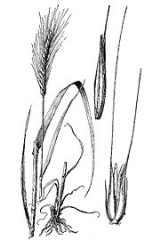
Rye is a grass Poaceae

The true grasses are monocotyledon [i]ous plant [i]s in the Family Poaceae, also known as Gram ... 

 grown extensively as a grain and forage crop. It is a member of the wheat tribe and is closely related to barley Barley

Barley is a major food and animal feed crop, a member of the grass family Poaceae.... 

 and wheat Wheat

Wheat is a grass [i] that is cultivated worldwide. ... 

. Rye grain is used for flour Flour

An ingredient used in many food [i]s, flour is a fine powder made from cereal [i]s or other starch [i]y ... 

, rye bread, rye beer, some whiskies Rye whisky

Rye whisky describes two types of whiskies [i], theoretically distilled from rye [i]. ... 

, some vodka Vodka

Vodka is typically a color [i]less liquor [i], usually distilled [i] from fermented [i] ... 

s, and animal fodder Fodder

In agriculture [i], fodder or animal feed is any foodstuff [i] that is used specifically to f ... 

. It can also be eaten whole, either as boiled rye berries, or by being rolled, similar to rolled oats Rolled oats

The oat [i], like some other cereal [i]s, has a hard, inedible outer hull [i] that must be removed before ... 

. Rye should not be confused with Ryegrass Ryegrass

Ryegrass is a genus of nine species of tufted grass [i]es, family Poaceae [i]. ... 

 which is used for lawns, pasture, and hay for livestock.

Discussions

  Discussion Features

   Ask a question about 'Rye'

   Start a new discussion about 'Rye'

   Answer questions about 'Rye'

   'Rye' discussion forum


Encyclopedia

Rye is a grass Poaceae

The true grasses are monocotyledon [i]ous plant [i]s in the Family Poaceae, also known as Gram ... 

 grown extensively as a grain and forage crop. It is a member of the wheat tribe and is closely related to barley Barley

Barley is a major food and animal feed crop, a member of the grass family Poaceae.... 

 and wheat Wheat

Wheat is a grass [i] that is cultivated worldwide. ... 

. Rye grain is used for flour Flour

An ingredient used in many food [i]s, flour is a fine powder made from cereal [i]s or other starch [i]y ... 

, rye bread, rye beer, some whiskies Rye whisky

Rye whisky describes two types of whiskies [i], theoretically distilled from rye [i].
... 

, some vodka Vodka

Vodka is typically a color [i]less liquor [i], usually distilled [i] from fermented [i] ... 

s, and animal fodder Fodder

In agriculture [i], fodder or animal feed is any foodstuff [i] that is used specifically to f ... 

. It can also be eaten whole, either as boiled rye berries, or by being rolled, similar to rolled oats Rolled oats

The oat [i], like some other cereal [i]s, has a hard, inedible outer hull [i] that must be removed before ... 

.

Rye should not be confused with Ryegrass Ryegrass

Ryegrass is a genus of nine species of tufted grass [i]es, family Poaceae [i].... 

 which is used for lawns, pasture, and hay for livestock.


History

The early history of rye is unclear. The wild ancestor of rye has not been identified with certainty, but is one of a number of species that grow wild in central and eastern Turkey, and adjacent areas. Domesticated rye occurs in small quantities at a number of Neolithic sites in Turkey, such as PPNB Can Hasan III, but is otherwise virtually absent from the archaeological record until the Bronze Age of central Europe, c. 1800-1500 BC. It is possible that rye travelled west from Turkey as a minor admixture in wheat, and was only later cultivated in its own right.

Since the Middle Ages Middle Ages

The Middle Ages formed the middle period in a traditional schematic division of European history [i] ... 

, rye has been widely cultivated in Central Central Europe

Central Europe is the region [i] lying between the variously and vaguely defined areas of Eastern [i] ... 

 and Eastern Europe Eastern Europe

Eastern Europe is the east [i]ern region [i] of Europe [i] variably defined. ... 

 and is the main bread Bread

Bread is a staple food [i] which is prepared by baking [i], steaming [i], or frying [i] dough [i]. ... 

 cereal in most areas east of the French France

France, officially the French Republic, is a country [i] whose metropolitan territory [i] ... 

-German Germany

Germany , officially the Federal Republic of Germany , is a country [i] in central Europe [i]. ... 

 border and north of Hungary Hungary

Hungary , officially the Republic of Hungary , is a landlocked [i] country in Central Europe [i], ... 

.

Claims of much earlier cultivation of rye, at the Epipalaeolithic site of Tell Abu Hureyra in the Euphrates valley of northern Syria, remain controversial. Critics point to inconsistencies in the radiocarbon dates, and identifications based solely on grain, rather than on chaff.

Agronomy

Rye, alone or overseeded, is planted as a livestock forage or harvested for hay. It is highly tolerant of soil acidity and is more tolerant of dry and cool conditions than wheat Wheat

Wheat is a grass [i] that is cultivated worldwide. ... 

, though not as tolerant of cold as barley Barley

Barley is a major food and animal feed crop, a member of the grass family Poaceae.... 

. In Turkey, rye is often grown as an admixture in wheat crops. It is appreciated for the flavour it brings to bread, as well as its ability to compensate for wheat's reduced yields in hard years.

The flame moth Flame

A flame is the product of a highly exothermic [i] reaction a self-sustaining oxidation [i] reaction [i]... 

, rustic shoulder-knot and turnip moth are among the species of Lepidoptera Lepidoptera

The order Lepidoptera is the second largest order [i] in the class [i] insect [i]a and inc ... 

 whose larvae feed on rye.

Rye is highly susceptible to the ergot Ergot

Ergot is the common name of a fungus [i] in the genus Claviceps. ... 

 fungus. Consumption of ergot-infected rye by humans and animals results in a serious medical condition known as ergotism. Ergotism can cause both physical and mental harm, including convulsions, miscarriage, necrosis of digits, and hallucinations. Historically, damp northern countries that have depended on rye as a staple crop were subject to periodic epidemics of this condition.

Uses

Rye bread, including pumpernickel Pumpernickel

[i] that is made with a combination of [[rye]... 

, is a widely eaten food in Northern Europe. Rye is also used to make the familiar crisp bread Crisp bread

[i] or [[Cracker|cracker]... 

. Rye flour Flour

An ingredient used in many food [i]s, flour is a fine powder made from cereal [i]s or other starch [i]y ... 

 has a lower gluten Gluten

Gluten is an amorphous ergastic [i] protein [i] found combined with starch [i] in the ... 

 content than wheat Wheat

Wheat is a grass [i] that is cultivated worldwide. ... 

 flour, and contains a higher proportion of soluble fiber.

Some non-food uses of rye include rye whisky Rye whisky

Rye whisky describes two types of whiskies [i], theoretically distilled from rye [i].
... 

 and use as an alternative medicine in a liquid form, known as rye extract. Often marketed as Oralmat, rye extract is a liquid obtained from rye and similar to that extracted from Wheatgrass Wheatgrass

Wheatgrass is a young plant of the genus Agropyron [i],. ... 

. Its benefits are said to include a strengthened immune system Immune system

The immune system is composed of a complex constellation of cells, organs and tissues, arranged in an el... 

, increased energy levels and relief from allergies Allergy

An allergy can refer to several kinds of immune reactions including Type I hypersensitivity in wh... 

, but there is no clinical evidence for its efficacy.

Rye straw is used to make corn dollies.

See also

  • Ergot Ergot

    Ergot is the common name of a fungus [i] in the genus Claviceps. ... 

     and ergotism
  • Rye beer
  • Rye whisky Rye whisky

    Rye whisky describes two types of whiskies [i], theoretically distilled from rye [i].

... 


References


External links

  • Gordon Hillmann: , in: The Holocene 11/4 , p. 383-393.


Categories: