

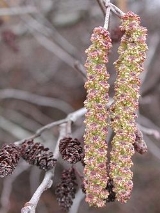
Alder

Encyclopedia
Alder is the common name of a genus
of flowering plant
s (Alnus) belonging to the birch
family (Family Betulaceae
). The genus comprises about 30 species
of monoecious
tree
s and shrub
s, few reaching large size, distributed throughout the North Temperate Zone and in the Americas
along the Andes
southwards to Argentina
.
"verne" for alder or copse of alders. The botanic name Alnus is the equivalent Latin
name. Both the Latin and the Germanic words derive from the Proto-Indo-European
root el-, meaning "red" or "brown", which is also a root for the English words elk and another tree: elm, a tree distantly related to the alders.
(not evergreen
), their leaves are alternate, simple, and serrated. The flower
s are catkin
s with elongate male catkins on the same plant as shorter female catkins, often before leaves appear; they are mainly wind-pollinated, but also visited by bee
s to a small extent. They differ from the birch
es (Betula, the other genus in the family) in that the female catkins are woody and do not disintegrate at maturity, opening to release the seeds in a similar manner to many conifer cone
s.
The largest species are Red Alder
(A. rubra) on the west coast of North America
and Black Alder (A. glutinosa), native to most of Europe
and widely introduced elsewhere, both reaching over 30 m. By contrast, the widespread Green Alder
(A. viridis) is rarely more than a 5 m tall shrub.
s; see List of Lepidoptera that feed on alders.
A. glutinosa and A. viridis are classed as environmental weeds in New Zealand
.
, actinomycete filamentous
nitrogen-fixing bacterium. This bacterium is found in root nodules which may be as large as a human fist, with many small lobes and light brown in appearance. The bacterium absorbs nitrogen
from the air and makes it available to the tree. Alder, in turn, provides the bacterium with carbon
, which it produces through photosynthesis
. As a result of this mutually-beneficial relationship, alder improves the fertility of the soils where it grows, and as a pioneer species
, it helps provide additional nitrogen for the successional
species which follow.
of some alder species have a degree of edibility and may be rich in protein. Reported to have a bitter and unpleasant taste, they are more useful for survival purposes. The wood of certain alder species is often used to smoke various food items.
Alder bark contains the anti-inflammatory salicin which is metabolized into salicylic acid
in the body. Native Americans used Red Alder bark (Alnus rubra) to treat poison oak, insect bites, and skin irritations. Blackfeet Indians used an infusion made from the bark of Red Alder to treat lymphatic disorders and tuberculosis. Recent clinical studies have verified that red alder contains betulin
and lupeol
, compounds shown to be effective against a variety of tumors.
The inner bark of the alder, as well as red osier dogwood, or chokecherry, was also used by Native Americans
in their smoking mixtures, known as kinnikinnick, to improve the taste of the bearberry
leaf.
Alder is illustrated in the coat of arms for the Austrian town of Grossarl.
Electric guitars, most notably the Fender Stratocaster
and Fender Telecaster
have been built with alder bodies since the 1950s. Alder is appreciated for its bright tone, and has been adopted by many electric guitar manufacturers.
Subgenus Alnus. Trees. Shoot buds stalked. Male and female catkins produced in autumn (fall) but staying closed over winter, pollinating in late winter or early spring. About 15–25 species, including:
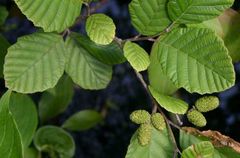
Subgenus Clethropsis. Trees or shrubs. Shoot buds stalked. Male and female catkins produced in autumn (fall) and expanding and pollinating then. Three species:
Subgenus Alnobetula. Shrubs. Shoot buds not stalked. Male and female catkins produced in late spring (after leaves appear) and expanding and pollinating then. One to four species:
Genus
In biology, a genus is a low-level taxonomic rank used in the biological classification of living and fossil organisms, which is an example of definition by genus and differentia...
of flowering plant
Flowering plant
The flowering plants , also known as Angiospermae or Magnoliophyta, are the most diverse group of land plants. Angiosperms are seed-producing plants like the gymnosperms and can be distinguished from the gymnosperms by a series of synapomorphies...
s (Alnus) belonging to the birch
Birch
Birch is a tree or shrub of the genus Betula , in the family Betulaceae, closely related to the beech/oak family, Fagaceae. The Betula genus contains 30–60 known taxa...
family (Family Betulaceae
Betulaceae
Betulaceae, or the Birch Family, includes six genera of deciduous nut-bearing trees and shrubs, including the birches, alders, hazels, hornbeams and hop-hornbeams, numbering about 130 species...
). The genus comprises about 30 species
Species
In biology, a species is one of the basic units of biological classification and a taxonomic rank. A species is often defined as a group of organisms capable of interbreeding and producing fertile offspring. While in many cases this definition is adequate, more precise or differing measures are...
of monoecious
Plant sexuality
Plant sexuality covers the wide variety of sexual reproduction systems found across the plant kingdom. This article describes morphological aspects of sexual reproduction of plants....
tree
Tree
A tree is a perennial woody plant. It is most often defined as a woody plant that has many secondary branches supported clear of the ground on a single main stem or trunk with clear apical dominance. A minimum height specification at maturity is cited by some authors, varying from 3 m to...
s and shrub
Shrub
A shrub or bush is distinguished from a tree by its multiple stems and shorter height, usually under 5–6 m tall. A large number of plants may become either shrubs or trees, depending on the growing conditions they experience...
s, few reaching large size, distributed throughout the North Temperate Zone and in the Americas
Americas
The Americas, or America , are lands in the Western hemisphere, also known as the New World. In English, the plural form the Americas is often used to refer to the landmasses of North America and South America with their associated islands and regions, while the singular form America is primarily...
along the Andes
Andes
The Andes is the world's longest continental mountain range. It is a continual range of highlands along the western coast of South America. This range is about long, about to wide , and of an average height of about .Along its length, the Andes is split into several ranges, which are separated...
southwards to Argentina
Argentina
Argentina , officially the Argentine Republic , is the second largest country in South America by land area, after Brazil. It is constituted as a federation of 23 provinces and an autonomous city, Buenos Aires...
.
Etymology
The common name alder is derived from an old Germanic root, also found to be the translation of the Old FrenchOld French
Old French was the Romance dialect continuum spoken in territories that span roughly the northern half of modern France and parts of modern Belgium and Switzerland from the 9th century to the 14th century...
"verne" for alder or copse of alders. The botanic name Alnus is the equivalent Latin
Latin
Latin is an Italic language originally spoken in Latium and Ancient Rome. It, along with most European languages, is a descendant of the ancient Proto-Indo-European language. Although it is considered a dead language, a number of scholars and members of the Christian clergy speak it fluently, and...
name. Both the Latin and the Germanic words derive from the Proto-Indo-European
Proto-Indo-European language
The Proto-Indo-European language is the reconstructed common ancestor of the Indo-European languages, spoken by the Proto-Indo-Europeans...
root el-, meaning "red" or "brown", which is also a root for the English words elk and another tree: elm, a tree distantly related to the alders.
Description
With few exceptions Alders are deciduousDeciduous
Deciduous means "falling off at maturity" or "tending to fall off", and is typically used in reference to trees or shrubs that lose their leaves seasonally, and to the shedding of other plant structures such as petals after flowering or fruit when ripe...
(not evergreen
Evergreen
In botany, an evergreen plant is a plant that has leaves in all seasons. This contrasts with deciduous plants, which completely lose their foliage during the winter or dry season.There are many different kinds of evergreen plants, both trees and shrubs...
), their leaves are alternate, simple, and serrated. The flower
Flower
A flower, sometimes known as a bloom or blossom, is the reproductive structure found in flowering plants . The biological function of a flower is to effect reproduction, usually by providing a mechanism for the union of sperm with eggs...
s are catkin
Catkin
A catkin or ament is a slim, cylindrical flower cluster, with inconspicuous or no petals, usually wind-pollinated but sometimes insect pollinated . They contain many, usually unisexual flowers, arranged closely along a central stem which is often drooping...
s with elongate male catkins on the same plant as shorter female catkins, often before leaves appear; they are mainly wind-pollinated, but also visited by bee
Bee
Bees are flying insects closely related to wasps and ants, and are known for their role in pollination and for producing honey and beeswax. Bees are a monophyletic lineage within the superfamily Apoidea, presently classified by the unranked taxon name Anthophila...
s to a small extent. They differ from the birch
Birch
Birch is a tree or shrub of the genus Betula , in the family Betulaceae, closely related to the beech/oak family, Fagaceae. The Betula genus contains 30–60 known taxa...
es (Betula, the other genus in the family) in that the female catkins are woody and do not disintegrate at maturity, opening to release the seeds in a similar manner to many conifer cone
Conifer cone
A cone is an organ on plants in the division Pinophyta that contains the reproductive structures. The familiar woody cone is the female cone, which produces seeds. The male cones, which produce pollen, are usually herbaceous and much less conspicuous even at full maturity...
s.
The largest species are Red Alder
Red Alder
Alnus rubra, the Red alder, is a deciduous broadleaf tree native to western North America.-Description:It is the largest species of alder in North America and one of the largest in the world, reaching heights of 20–35 m. The official tallest red alder stands 32 meters tall in Clatsop County, Oregon...
(A. rubra) on the west coast of North America
North America
North America is a continent wholly within the Northern Hemisphere and almost wholly within the Western Hemisphere. It is also considered a northern subcontinent of the Americas...
and Black Alder (A. glutinosa), native to most of Europe
Europe
Europe is, by convention, one of the world's seven continents. Comprising the westernmost peninsula of Eurasia, Europe is generally 'divided' from Asia to its east by the watershed divides of the Ural and Caucasus Mountains, the Ural River, the Caspian and Black Seas, and the waterways connecting...
and widely introduced elsewhere, both reaching over 30 m. By contrast, the widespread Green Alder
Green Alder
Alnus viridis is an alder with a wide range across the cooler parts of the Northern Hemisphere.-Description:It is a large shrub or small tree 3–12 m tall with smooth grey bark even in old age. The leaves are shiny green, ovoid, 3–8 cm long and 2–6 cm broad...
(A. viridis) is rarely more than a 5 m tall shrub.
Ecology
Alder leaves and sometimes catkins are used as food by numerous butterflies and mothMoth
A moth is an insect closely related to the butterfly, both being of the order Lepidoptera. Moths form the majority of this order; there are thought to be 150,000 to 250,000 different species of moth , with thousands of species yet to be described...
s; see List of Lepidoptera that feed on alders.
A. glutinosa and A. viridis are classed as environmental weeds in New Zealand
New Zealand
New Zealand is an island country in the south-western Pacific Ocean comprising two main landmasses and numerous smaller islands. The country is situated some east of Australia across the Tasman Sea, and roughly south of the Pacific island nations of New Caledonia, Fiji, and Tonga...
.
Nitrogen fixation
Alder is particularly noted for its important symbiotic relationship with Frankia alniFrankia alni
Frankia alni is a species of actinomycete filamentous bacterium that lives in symbiosis with actinorhizal plants in the genus Alnus. It is a nitrogen-fixing bacterium and forms nodules on the roots of alder trees.-Distribution:...
, actinomycete filamentous
Filamentation
Filamentation is the anomalous growth of certain bacteria, such as E. coli, in which cells continue to elongate but do not divide . Bacterial filamentation is often observed as a result of bacteria responding to various stresses, including DNA damage or inhibition of replication...
nitrogen-fixing bacterium. This bacterium is found in root nodules which may be as large as a human fist, with many small lobes and light brown in appearance. The bacterium absorbs nitrogen
Nitrogen
Nitrogen is a chemical element that has the symbol N, atomic number of 7 and atomic mass 14.00674 u. Elemental nitrogen is a colorless, odorless, tasteless, and mostly inert diatomic gas at standard conditions, constituting 78.08% by volume of Earth's atmosphere...
from the air and makes it available to the tree. Alder, in turn, provides the bacterium with carbon
Carbon
Carbon is the chemical element with symbol C and atomic number 6. As a member of group 14 on the periodic table, it is nonmetallic and tetravalent—making four electrons available to form covalent chemical bonds...
, which it produces through photosynthesis
Photosynthesis
Photosynthesis is a chemical process that converts carbon dioxide into organic compounds, especially sugars, using the energy from sunlight. Photosynthesis occurs in plants, algae, and many species of bacteria, but not in archaea. Photosynthetic organisms are called photoautotrophs, since they can...
. As a result of this mutually-beneficial relationship, alder improves the fertility of the soils where it grows, and as a pioneer species
Pioneer species
Pioneer species are species which colonize previously uncolonized land, usually leading to ecological succession. They are the first organisms to start the chain of events leading to a livable biosphere or ecosystem...
, it helps provide additional nitrogen for the successional
Ecological succession
Ecological succession, is the phenomenon or process by which a community progressively transforms itself until a stable community is formed. It is a fundamental concept in ecology, and refers to more or less predictable and orderly changes in the composition or structure of an ecological community...
species which follow.
Use by humans
The catkinsCatkin
A catkin or ament is a slim, cylindrical flower cluster, with inconspicuous or no petals, usually wind-pollinated but sometimes insect pollinated . They contain many, usually unisexual flowers, arranged closely along a central stem which is often drooping...
of some alder species have a degree of edibility and may be rich in protein. Reported to have a bitter and unpleasant taste, they are more useful for survival purposes. The wood of certain alder species is often used to smoke various food items.
Alder bark contains the anti-inflammatory salicin which is metabolized into salicylic acid
Salicylic acid
Salicylic acid is a monohydroxybenzoic acid, a type of phenolic acid and a beta hydroxy acid. This colorless crystalline organic acid is widely used in organic synthesis and functions as a plant hormone. It is derived from the metabolism of salicin...
in the body. Native Americans used Red Alder bark (Alnus rubra) to treat poison oak, insect bites, and skin irritations. Blackfeet Indians used an infusion made from the bark of Red Alder to treat lymphatic disorders and tuberculosis. Recent clinical studies have verified that red alder contains betulin
Betulin
Betulin is an abundant naturally occurring triterpene. It is commonly isolated from the bark of birch trees and forms up to 30% of the dry weight of the extractive . The purpose of the compound in the bark is not known...
and lupeol
Lupeol
Lupeol is a pharmacologically active triterpenoid found in a variety of plants, including mango and acacia visco. It has several medicinal properties, one being anti-inflammatory...
, compounds shown to be effective against a variety of tumors.
The inner bark of the alder, as well as red osier dogwood, or chokecherry, was also used by Native Americans
Indigenous peoples of the Americas
The indigenous peoples of the Americas are the pre-Columbian inhabitants of North and South America, their descendants and other ethnic groups who are identified with those peoples. Indigenous peoples are known in Canada as Aboriginal peoples, and in the United States as Native Americans...
in their smoking mixtures, known as kinnikinnick, to improve the taste of the bearberry
Bearberry
Bearberries are three species of dwarf shrubs in the genus Arctostaphylos. Unlike the other species of Arctostaphylos , they are adapted to Arctic and sub-Arctic climates, and have a circumpolar distribution in northern North America, Asia and Europe, one with a small highly disjunctive population...
leaf.
Alder is illustrated in the coat of arms for the Austrian town of Grossarl.
Electric guitars, most notably the Fender Stratocaster
Fender Stratocaster
The Fender Stratocaster, often referred to as "Strat", is a model of electric guitar designed by Leo Fender, George Fullerton, and Freddie Tavares in 1954, and manufactured continuously by the Fender Musical Instruments Corporation to the present. It is a double-cutaway guitar, with an extended top...
and Fender Telecaster
Fender Telecaster
The Fender Telecaster, colloquially known as the Tele , is typically a dual-pickup, solid-body electric guitar made by Fender.Its simple yet effective design and revolutionary sound broke ground and set trends in electric guitar manufacturing and popular music...
have been built with alder bodies since the 1950s. Alder is appreciated for its bright tone, and has been adopted by many electric guitar manufacturers.
Classification
The genus is divided into three subgenera:Subgenus Alnus. Trees. Shoot buds stalked. Male and female catkins produced in autumn (fall) but staying closed over winter, pollinating in late winter or early spring. About 15–25 species, including:
- Alnus acuminataAlnus acuminataAlnus acuminata Alnus acuminata Alnus acuminata (also called Alder is a species of tree in the Betulaceae family. It is found in Argentina, Bolivia, Colombia, Costa Rica, Ecuador, Guatemala, Mexico, Panama, Peru and Venezuela.-References:...
—Andean Alder. Andes Mountains, South America. - Alnus cordata—Italian Alder. Italy.
- Alnus cremastogyne
- Alnus firma—KyūshūKyushuis the third largest island of Japan and most southwesterly of its four main islands. Its alternate ancient names include , , and . The historical regional name is referred to Kyushu and its surrounding islands....
(JapanJapanJapan is an island nation in East Asia. Located in the Pacific Ocean, it lies to the east of the Sea of Japan, China, North Korea, South Korea and Russia, stretching from the Sea of Okhotsk in the north to the East China Sea and Taiwan in the south...
) - Alnus glutinosa—Black Alder. Europe.
- Alnus incana—Grey Alder. Eurasia.
- Alnus hirsuta (A. incana subsp. hirsuta)—Manchurian Alder. Northeastern AsiaAsiaAsia is the world's largest and most populous continent, located primarily in the eastern and northern hemispheres. It covers 8.7% of the Earth's total surface area and with approximately 3.879 billion people, it hosts 60% of the world's current human population...
, and central Asia in mountains. - Alnus oblongifolia (A. incana subsp. oblongifolia)—Arizona Alder. Southwestern North America.
- Alnus rugosa (A. incana subsp. rugosa)—Speckled Alder. Northeastern North America.
- Alnus tenuifolia (A. incana subsp. tenuifolia)—Thinleaf or Mountain Alder. Northwestern North America.
- Alnus hirsuta (A. incana subsp. hirsuta)—Manchurian Alder. Northeastern Asia
- Alnus japonica—Japanese Alder. Japan.
- Alnus jorullensis—Mexican Alder. Mexico, Guatemala (one of the few evergreen species).
- Alnus mandshurica—Russian Far EastRussian Far EastRussian Far East is a term that refers to the Russian part of the Far East, i.e., extreme east parts of Russia, between Lake Baikal in Eastern Siberia and the Pacific Ocean...
, ChinaChinaChinese civilization may refer to:* China for more general discussion of the country.* Chinese culture* Greater China, the transnational community of ethnic Chinese.* History of China* Sinosphere, the area historically affected by Chinese culture...
, KoreaKoreaKorea ) is an East Asian geographic region that is currently divided into two separate sovereign states — North Korea and South Korea. Located on the Korean Peninsula, Korea is bordered by the People's Republic of China to the northwest, Russia to the northeast, and is separated from Japan to the...
. - Alnus matsumurae—HonshūHonshuis the largest island of Japan. The nation's main island, it is south of Hokkaido across the Tsugaru Strait, north of Shikoku across the Inland Sea, and northeast of Kyushu across the Kanmon Strait...
(JapanJapanJapan is an island nation in East Asia. Located in the Pacific Ocean, it lies to the east of the Sea of Japan, China, North Korea, South Korea and Russia, stretching from the Sea of Okhotsk in the north to the East China Sea and Taiwan in the south...
). - Alnus nepalensis—Nepalese Alder. Eastern Himalaya, southwest China.
- Alnus orientalis—Oriental Alder. Southern Turkey, northwest Syria, Cyprus.
- Alnus pendula—JapanJapanJapan is an island nation in East Asia. Located in the Pacific Ocean, it lies to the east of the Sea of Japan, China, North Korea, South Korea and Russia, stretching from the Sea of Okhotsk in the north to the East China Sea and Taiwan in the south...
, KoreaKoreaKorea ) is an East Asian geographic region that is currently divided into two separate sovereign states — North Korea and South Korea. Located on the Korean Peninsula, Korea is bordered by the People's Republic of China to the northwest, Russia to the northeast, and is separated from Japan to the...
. - Alnus rhombifoliaAlnus rhombifoliaAlnus rhombifolia, the White Alder, is an alder tree native to western North America, from Washington east to western Montana, southeast to the Sierra Nevada, and south through the Peninsular Ranges and Colorado Desert oases in Southern California. It occurs in riparian zone habitats at an...
—White Alder. Interior western North America. - Alnus rubra—Red Alder. West coastal North America.
- Alnus serrulataAlnus serrulataAlnus serrulata, the hazel alder,or smooth alder is a thicket-forming shrub in the family Betulaceae. It is native to eastern North America and can be found found from western Nova Scotia and southern New Brunswick south to Florida and Texas....
—Hazel alder, Tag Alder or Smooth alder. Eastern North America. - Alnus sieboldiana—HonshūHonshuis the largest island of Japan. The nation's main island, it is south of Hokkaido across the Tsugaru Strait, north of Shikoku across the Inland Sea, and northeast of Kyushu across the Kanmon Strait...
(JapanJapanJapan is an island nation in East Asia. Located in the Pacific Ocean, it lies to the east of the Sea of Japan, China, North Korea, South Korea and Russia, stretching from the Sea of Okhotsk in the north to the East China Sea and Taiwan in the south...
). - Alnus subcordata—Caucasian Alder. Caucasus, Iran.
- Alnus trabeculosa—ChinaChinaChinese civilization may refer to:* China for more general discussion of the country.* Chinese culture* Greater China, the transnational community of ethnic Chinese.* History of China* Sinosphere, the area historically affected by Chinese culture...
, JapanJapanJapan is an island nation in East Asia. Located in the Pacific Ocean, it lies to the east of the Sea of Japan, China, North Korea, South Korea and Russia, stretching from the Sea of Okhotsk in the north to the East China Sea and Taiwan in the south...
.
Subgenus Clethropsis. Trees or shrubs. Shoot buds stalked. Male and female catkins produced in autumn (fall) and expanding and pollinating then. Three species:
- Alnus formosana—Formosan Alder Taiwan
- Alnus maritimaAlnus maritimaAlnus maritima is a species of plant in the Betulaceae family. Alnus maritima is endemic to the United States, and is found naturally in three disjunct populations in Oklahoma, Georgia, and in Maryland and Delaware on the Delmarva Peninsula...
—Seaside Alder. East coastal North America, plus disjunct population in Oklahoma. - Alnus nitida—Himalayan Alder. Western Himalaya.
Subgenus Alnobetula. Shrubs. Shoot buds not stalked. Male and female catkins produced in late spring (after leaves appear) and expanding and pollinating then. One to four species:
- Alnus viridis—Green Alder. Widespread:
- Alnus viridis subsp. viridis. Eurasia.
- Alnus viridis subsp. maximowiczii (A. maximowiczii). Japan.
- Alnus viridis subsp. crispa (A. crispa). Northern North America.
- Alnus viridis subsp. sinuata (A. sinuata, Sitka Alder or Slide Alder). Western North America, far northeastern Siberia.
Further reading
- Chen, Zhiduan and Li, Jianhua (2004). Phylogenetics and Biogeography of Alnus (Betulaceae) Inferred from Sequences of Nuclear Ribosomal DNA ITS Region. International Journal of Plant Sciences 165: 325–335.