

18 Brumaire

Encyclopedia
The coup of 18 Brumaire (often simply 18 Brumaire or Brumaire) was the coup d'état by which General Napoleon Bonaparte
overthrew the French Directory
, replacing it with the French Consulate
. This occurred on 9 November 1799, which was 18 Brumaire
, Year VIII under the French Republican Calendar
.
The name, already well-established in common usage, was reinforced by the title of Karl Marx
's The Eighteenth Brumaire of Louis Napoleon
(Der achtzehnte Brumaire des Louis Bonaparte, 1852), an account of the 2 December 1851 coup by Napoleon's nephew
, which begins with the oft-quoted "Hegel remarks somewhere that all great world-historic facts and personages appear, so to speak, twice. He forgot to add: the first time as tragedy, the second time as farce."
was suffering the effects of military reverses brought on by Bonaparte's adventurism in the Middle East
. The looming threat of opportunistic invasion by the Second Coalition had provoked internal unrest, with Bonaparte stuck in Egypt
.
The coup was first prepared not by Napoleon, but by the Abbé Sieyès, then one of the five Directors, attempting to head off a return to Jacobinism
. Dazzled by Napoleon's victories in the East, the public ignored the impending calamitous ending of the Egyptian expedition. They received Napoleon with an ardor which convinced Sieyès he had found the general indispensable to his coup. However, from the moment of his return in September 1799, Napoleon plotted a coup within the coup, ultimately gaining power for himself rather than Sieyès.
Perhaps the gravest potential obstacles to a coup were in the army. Some generals, such as Jourdan
, honestly believed in republicanism; others, such as Bernadotte, believed themselves capable of governing France. With perfect subtlety, Napoleon worked on the feelings of all, keeping secret his own intentions.
An army contractor named Collot advanced two million francs to finance the coup. There were troops conveniently deployed around Paris
. The plan was, first, to persuade the Directors to resign, then, second, to get the Council of Ancients
and the Council of Five Hundred
(the upper and lower houses of the legislature) to appoint a pliant commission that would draw up a new constitution
to the plotters' specifications.
sympathetic to the coup warned their colleagues of a Jacobin conspiracy and persuaded them to remove to the Château de Saint-Cloud
, west of Paris. General Bonaparte was charged with the safety of the two Councils. Later that morning Sieyès and Roger Ducos
resigned as Directors. Talleyrand persuaded Barras
to do the same (the troops in the garden outside were persuasive).
The resignation of three of the five Directors prevented a quorum
and thus practically abolished the Directory, but the two Jacobin Directors, Gohier and Moulin
, continued to protest furiously. Both men were arrested by Napoleon's ally, General Moreau
, and by the following day they were compelled to give up their resistance.
In contrast to the Directory, the two Councils were not yet intimidated and continued meeting.
Napoleon met with heckling as he addressed the Ancients with such "home truths" as, "the Republic has no government" and, most likely, "the Revolution is over." One deputy called out, "And the Constitution?" Napoleon replied, referring to earlier parliamentary coups, "The Constitution! You yourselves have destroyed it. You violated it on 18 Fructidor; you violated it on 22 Floreal; you violated it on 30 Prairial. It no longer has the respect of anyone."
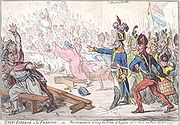 Napoleon withdrew to the chateau's Orangerie
, where the Council of Five Hundred
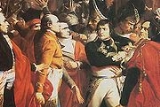
was meeting. His reception here was even more hostile. Napoleon and his grenadiers entered just as the legality of Barras' resignation was being challenged by the Jacobins in the chamber. Upon entering, Napoleon was first jostled, then outright assaulted. Depending on whose account is accepted, he may or may not have come close to fainting. It was not Napoleon himself, but his brother Lucien
, President of the Council, who called upon the grenadiers to defend their leader. Napoleon escaped, but only through the use of military force.
A motion was raised in the Council of Five Hundred to declare Napoleon an outlaw. At this point, Lucien Bonaparte apparently slipped out of the chamber and told the soldiers guarding the Councils that the majority of the Five Hundred were being terrorized by a group of deputies brandishing daggers. Then, according to Michael Rapport, "He pointed to Napoleon's bloody, pallid face as proof. Then, in a theatrical gesture, he seized a sword and promised to plunge it through his own brother's heart if he were a traitor." Lucien ordered the troops to expel the violent deputies from the chamber. Grenadiers under the command of General Murat
marched into the Orangerie and dispersed the Council. This was effectively the end of the Directory.
The Ancients passed a decree which adjourned the Councils for three months, appointed Napoleon, Sieyès, and Ducos provisional consuls, and named the Legislative Commission. Some tractable members of the Five Hundred, rounded up afterwards, served to give these measures the confirmation of their House. Thus the Directory and the Councils came to an end.
with Napoleon, Sieyès, and Ducos as Consuls. The lack of reaction from the streets proved that the revolution was, indeed, over. "A shabby compound of brute force and imposture, the 18th Brumaire was nevertheless condoned, nay applauded, by the French nation. Weary of revolution, men sought no more than to be wisely and firmly governed." Resistance by Jacobin officeholders in the provinces was quickly crushed. Twenty Jacobin deputies were exiled, and others were arrested. The commissions then drew up the "short and obscure Constitution of the Year VIII
", the first of the constitutions since the Revolution without a Declaration of Rights.
Bonaparte thus completed his coup within a coup by the adoption of a constitution under which the First Consul, a position he was sure to hold, had greater power than the other two. In particular, he appointed the Senate and the Senate interpreted the constitution. The Senate allowed him to rule by decree, so the more independent State Council and Tribunate degenerated into impotence, serving merely as window dressing. It led ultimately to Empire
.
Napoleon I of France
Napoleon Bonaparte was a French military and political leader during the latter stages of the French Revolution.As Napoleon I, he was Emperor of the French from 1804 to 1815...
overthrew the French Directory
French Directory
The Directory was a body of five Directors that held executive power in France following the Convention and preceding the Consulate...
, replacing it with the French Consulate
French Consulate
The Consulate was the government of France between the fall of the Directory in the coup of 18 Brumaire in 1799 until the start of the Napoleonic Empire in 1804...
. This occurred on 9 November 1799, which was 18 Brumaire
Brumaire
Brumaire was the second month in the French Republican Calendar. The month was named after the French word brume which occurs frequently in France at that time of the year....
, Year VIII under the French Republican Calendar
French Republican Calendar
The French Republican Calendar or French Revolutionary Calendar was a calendar created and implemented during the French Revolution, and used by the French government for about 12 years from late 1793 to 1805, and for 18 days by the Paris Commune in 1871...
.
The name, already well-established in common usage, was reinforced by the title of Karl Marx
Karl Marx
Karl Heinrich Marx was a German philosopher, economist, sociologist, historian, journalist, and revolutionary socialist. His ideas played a significant role in the development of social science and the socialist political movement...
's The Eighteenth Brumaire of Louis Napoleon
The Eighteenth Brumaire of Louis Napoleon
Der 18te Brumaire des Louis Napoleon was written by Karl Marx between December 1851 and March 1852, and originally published in 1852 in Die Revolution, a German-language monthly magazine published in New York and established by Joseph Weydemeyer...
(Der achtzehnte Brumaire des Louis Bonaparte, 1852), an account of the 2 December 1851 coup by Napoleon's nephew
Napoleon III of France
Louis-Napoléon Bonaparte was the President of the French Second Republic and as Napoleon III, the ruler of the Second French Empire. He was the nephew and heir of Napoleon I, christened as Charles Louis Napoléon Bonaparte...
, which begins with the oft-quoted "Hegel remarks somewhere that all great world-historic facts and personages appear, so to speak, twice. He forgot to add: the first time as tragedy, the second time as farce."
Context
The reasons for General Bonaparte's coup may have lain more in his defeats than by his victories. In November 1799, FranceFrance
The French Republic , The French Republic , The French Republic , (commonly known as France , is a unitary semi-presidential republic in Western Europe with several overseas territories and islands located on other continents and in the Indian, Pacific, and Atlantic oceans. Metropolitan France...
was suffering the effects of military reverses brought on by Bonaparte's adventurism in the Middle East
Middle East
The Middle East is a region that encompasses Western Asia and Northern Africa. It is often used as a synonym for Near East, in opposition to Far East...
. The looming threat of opportunistic invasion by the Second Coalition had provoked internal unrest, with Bonaparte stuck in Egypt
Egypt
Egypt , officially the Arab Republic of Egypt, Arabic: , is a country mainly in North Africa, with the Sinai Peninsula forming a land bridge in Southwest Asia. Egypt is thus a transcontinental country, and a major power in Africa, the Mediterranean Basin, the Middle East and the Muslim world...
.
The coup was first prepared not by Napoleon, but by the Abbé Sieyès, then one of the five Directors, attempting to head off a return to Jacobinism
Jacobin Club
The Jacobin Club was the most famous and influential political club in the development of the French Revolution, so-named because of the Dominican convent where they met, located in the Rue St. Jacques , Paris. The club originated as the Club Benthorn, formed at Versailles from a group of Breton...
. Dazzled by Napoleon's victories in the East, the public ignored the impending calamitous ending of the Egyptian expedition. They received Napoleon with an ardor which convinced Sieyès he had found the general indispensable to his coup. However, from the moment of his return in September 1799, Napoleon plotted a coup within the coup, ultimately gaining power for himself rather than Sieyès.
Perhaps the gravest potential obstacles to a coup were in the army. Some generals, such as Jourdan
Jean-Baptiste Jourdan
Jean-Baptiste Jourdan, 1st Comte Jourdan , enlisted as a private in the French royal army and rose to command armies during the French Revolutionary Wars. Emperor Napoleon I of France named him a Marshal of France in 1804 and he also fought in the Napoleonic Wars. After 1815, he became reconciled...
, honestly believed in republicanism; others, such as Bernadotte, believed themselves capable of governing France. With perfect subtlety, Napoleon worked on the feelings of all, keeping secret his own intentions.
An army contractor named Collot advanced two million francs to finance the coup. There were troops conveniently deployed around Paris
Paris
Paris is the capital and largest city in France, situated on the river Seine, in northern France, at the heart of the Île-de-France region...
. The plan was, first, to persuade the Directors to resign, then, second, to get the Council of Ancients
Council of Ancients
The Council of Ancients or Council of Elders was the upper house of the Directory , the legislature of France from 22 August 1795 until 9 November 1799, roughly the second half of the period generally referred to as the French Revolution.The Council of Ancients was the senior of the two halves of...
and the Council of Five Hundred
Council of Five Hundred
The Council of Five Hundred , or simply the Five Hundred was the lower house of the legislature of France during the period commonly known as the Directory , from 22 August 1795 until 9 November 1799, roughly the second half of the period generally referred to as the...
(the upper and lower houses of the legislature) to appoint a pliant commission that would draw up a new constitution
Constitution
A constitution is a set of fundamental principles or established precedents according to which a state or other organization is governed. These rules together make up, i.e. constitute, what the entity is...
to the plotters' specifications.
Events of 18 Brumaire, Year VIII
On the morning of 18 Brumaire, members of the Council of AncientsCouncil of Ancients
The Council of Ancients or Council of Elders was the upper house of the Directory , the legislature of France from 22 August 1795 until 9 November 1799, roughly the second half of the period generally referred to as the French Revolution.The Council of Ancients was the senior of the two halves of...
sympathetic to the coup warned their colleagues of a Jacobin conspiracy and persuaded them to remove to the Château de Saint-Cloud
Château de Saint-Cloud
The Château de Saint-Cloud was a Palace in France, built on a magnificent site overlooking the Seine at Saint-Cloud in Hauts-de-Seine, about 10 kilometres west of Paris. Today it is a large park on the outskirts of the capital and is owned by the state, but the area as a whole has had a large...
, west of Paris. General Bonaparte was charged with the safety of the two Councils. Later that morning Sieyès and Roger Ducos
Roger Ducos
Pierre Roger Ducos , better known as Roger Ducos, was a French political figure during the Revolution and First Empire, a member of the National Convention, and of the Directory....
resigned as Directors. Talleyrand persuaded Barras
Paul François Jean Nicolas, vicomte de Barras
Paul François Jean Nicolas, vicomte de Barras was a French politician of the French Revolution, and the main executive leader of the Directory regime of 1795–1799.-Early life:...
to do the same (the troops in the garden outside were persuasive).
The resignation of three of the five Directors prevented a quorum
Quorum
A quorum is the minimum number of members of a deliberative assembly necessary to conduct the business of that group...
and thus practically abolished the Directory, but the two Jacobin Directors, Gohier and Moulin
Jean-François-Auguste Moulin
Jean-François-Auguste Moulin was a member of the French Directory. He had a long career as a military officer serving France in the Royal Army of King Louis XVI, the Garde Nationale of the French Revolution, and the Grande Armée of Napoleon Bonaparte.-Early life and military career:Moulin was...
, continued to protest furiously. Both men were arrested by Napoleon's ally, General Moreau
Jean Victor Marie Moreau
Jean Victor Marie Moreau was a French general who helped Napoleon Bonaparte to power, but later became a rival and was banished to the United States.- Early life :Moreau was born at Morlaix in Brittany...
, and by the following day they were compelled to give up their resistance.
In contrast to the Directory, the two Councils were not yet intimidated and continued meeting.
Events of 19 Brumaire
By the following day, the deputies had, for the most part, realized that they were facing an attempted coup rather than being protected from a Jacobin rebellion. Faced with their recalcitrance, Napoleon stormed into the chambers, escorted by a small force of grenadiers. While perhaps unplanned, this proved to be the coup within the coup: from this point, this was a military affair.Napoleon met with heckling as he addressed the Ancients with such "home truths" as, "the Republic has no government" and, most likely, "the Revolution is over." One deputy called out, "And the Constitution?" Napoleon replied, referring to earlier parliamentary coups, "The Constitution! You yourselves have destroyed it. You violated it on 18 Fructidor; you violated it on 22 Floreal; you violated it on 30 Prairial. It no longer has the respect of anyone."
Orangery
An orangery was a building in the grounds of fashionable residences from the 17th to the 19th centuries and given a classicising architectural form. The orangery was similar to a greenhouse or conservatory...
, where the Council of Five Hundred
Council of Five Hundred
The Council of Five Hundred , or simply the Five Hundred was the lower house of the legislature of France during the period commonly known as the Directory , from 22 August 1795 until 9 November 1799, roughly the second half of the period generally referred to as the...
was meeting. His reception here was even more hostile. Napoleon and his grenadiers entered just as the legality of Barras' resignation was being challenged by the Jacobins in the chamber. Upon entering, Napoleon was first jostled, then outright assaulted. Depending on whose account is accepted, he may or may not have come close to fainting. It was not Napoleon himself, but his brother Lucien
Lucien Bonaparte
Lucien Bonaparte, Prince Français, 1st Prince of Canino and Musignano , born Luciano Buonaparte, was the third surviving son of Carlo Buonaparte and his wife Letizia Ramolino....
, President of the Council, who called upon the grenadiers to defend their leader. Napoleon escaped, but only through the use of military force.
A motion was raised in the Council of Five Hundred to declare Napoleon an outlaw. At this point, Lucien Bonaparte apparently slipped out of the chamber and told the soldiers guarding the Councils that the majority of the Five Hundred were being terrorized by a group of deputies brandishing daggers. Then, according to Michael Rapport, "He pointed to Napoleon's bloody, pallid face as proof. Then, in a theatrical gesture, he seized a sword and promised to plunge it through his own brother's heart if he were a traitor." Lucien ordered the troops to expel the violent deputies from the chamber. Grenadiers under the command of General Murat
Joachim Murat
Joachim-Napoléon Murat , Marshal of France and Grand Admiral or Admiral of France, 1st Prince Murat, was Grand Duke of Berg from 1806 to 1808 and then King of Naples from 1808 to 1815...
marched into the Orangerie and dispersed the Council. This was effectively the end of the Directory.
The Ancients passed a decree which adjourned the Councils for three months, appointed Napoleon, Sieyès, and Ducos provisional consuls, and named the Legislative Commission. Some tractable members of the Five Hundred, rounded up afterwards, served to give these measures the confirmation of their House. Thus the Directory and the Councils came to an end.
Aftermath
The Directory was crushed, but the coup within the coup was not yet complete. The use of military force had certainly strengthened Napoleon's hand vis à vis Sieyès and the other plotters. With the Council routed, the plotters convened two commissions, each consisting of twenty-five deputies from the two Councils. The plotters essentially intimidated the commissions into declaring a provisional government, the first form of the ConsulateFrench Consulate
The Consulate was the government of France between the fall of the Directory in the coup of 18 Brumaire in 1799 until the start of the Napoleonic Empire in 1804...
with Napoleon, Sieyès, and Ducos as Consuls. The lack of reaction from the streets proved that the revolution was, indeed, over. "A shabby compound of brute force and imposture, the 18th Brumaire was nevertheless condoned, nay applauded, by the French nation. Weary of revolution, men sought no more than to be wisely and firmly governed." Resistance by Jacobin officeholders in the provinces was quickly crushed. Twenty Jacobin deputies were exiled, and others were arrested. The commissions then drew up the "short and obscure Constitution of the Year VIII
Constitution of the Year VIII
The Constitution of the Year VIII was a national constitution of France, adopted December 24, 1799 , which established the form of government known as the Consulate...
", the first of the constitutions since the Revolution without a Declaration of Rights.
Bonaparte thus completed his coup within a coup by the adoption of a constitution under which the First Consul, a position he was sure to hold, had greater power than the other two. In particular, he appointed the Senate and the Senate interpreted the constitution. The Senate allowed him to rule by decree, so the more independent State Council and Tribunate degenerated into impotence, serving merely as window dressing. It led ultimately to Empire
Formation of the Napoleonic Empire
Between 1795 and 1799, the constitution governing France dictated there be an executive arm of government – the Directoire, composed of five Directors. One of these five, Emmanuel Joseph Sieyès, approached General Napoleon Bonaparte in 1799, seeking his support for a coup d'état to overthrow the...
.