
All Topics  
Peony

 
Peony

   Email Print
   Bookmark   Link


Peony


The peony or paeony (Paeonia) is the only genus in the flowering plant
Flowering plant

The flowering plants or angiosperms are the most widespread group of Embryophytes. The flowering plants and the gymnosperms are the only extant groups of Spermatophyte....
 family Paeoniaceae. They are native to Asia
Asia

Asia is the world's largest and most populous continent. It covers 8.6% of the Earth's total surface area and, with over 4 billion people, it contains more than 60% of the world's current human population....
, southern Europe
Europe

Europe is, conventionally, one of the world's seven continents. Comprising the westernmost peninsula of Eurasia, Europe is generally divided from Asia to its east by the water divide of the Ural Mountains, the Ural , the Caspian Sea, and by the Caucasus Mountains to the southeast....
 and western North America
North America

North America is the northern continent of the Americas, situated in the Earth's northern hemisphere and almost totally in the western hemisphere....
.

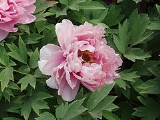
Most are herbaceous perennial plants 0.5–1.5 metres tall, but some are woody shrubs up to 1.5–3 metres tall. They have compound, deeply lobed leaves, and large, often fragrant flowers, ranging from red to white or yellow, in late spring and early summer.


Discussion
Ask a question about 'Peony'
Start a new discussion about 'Peony'
Answer questions from other users
Full Discussion Forum


Encyclopedia


The peony or paeony (Paeonia) is the only genus in the flowering plant
Flowering plant

The flowering plants or angiosperms are the most widespread group of Embryophytes. The flowering plants and the gymnosperms are the only extant groups of Spermatophyte....
 family Paeoniaceae. They are native to Asia
Asia

Asia is the world's largest and most populous continent. It covers 8.6% of the Earth's total surface area and, with over 4 billion people, it contains more than 60% of the world's current human population....
, southern Europe
Europe

Europe is, conventionally, one of the world's seven continents. Comprising the westernmost peninsula of Eurasia, Europe is generally divided from Asia to its east by the water divide of the Ural Mountains, the Ural , the Caspian Sea, and by the Caucasus Mountains to the southeast....
 and western North America
North America

North America is the northern continent of the Americas, situated in the Earth's northern hemisphere and almost totally in the western hemisphere....
.

Most are herbaceous perennial plants 0.5–1.5 metres tall, but some are woody shrubs up to 1.5–3 metres tall. They have compound, deeply lobed leaves, and large, often fragrant flowers, ranging from red to white or yellow, in late spring and early summer. In the past, the peonies were often classified in the family Ranunculaceae
Ranunculaceae

Ranunculaceae is a family of flowering plants also known as the "buttercup family" or "crowfoot family". The family name is derived from the genus Ranunculus....
, alongside Hellebore
Hellebore

Commonly known as Hellebores, members of the genus Helleborus comprise approximately 20 species of herbaceous perennial plant flowering plants in the family Ranunculaceae, within which it gave its name to the tribe of Helleboreae....
s and Anemone
Anemone

Anemone , is a genus of about 120 species of flowering plants in the buttercup family Ranunculaceae in the north and south temperate zones. They are closely related to Pasque flowers and Hepaticas ; some botanists include both of these genera within Anemone....
s.

Name

The peony is named after Paeon
Paean

Paean is a term used to describe a type of triumphal or grateful song, usually choral though sometimes individual. It comes from the ancient Greek pa??? "song of triumph, any solemn song or chant" and it was also used as the name for the physician of the Greek gods and as an epithet of Apollo....
 or Paean
Paean

Paean is a term used to describe a type of triumphal or grateful song, usually choral though sometimes individual. It comes from the ancient Greek pa??? "song of triumph, any solemn song or chant" and it was also used as the name for the physician of the Greek gods and as an epithet of Apollo....
, a student of Asclepius
Asclepius

Asclepius is the god of medicine and healing in ancient Greek mythology. Asclepius represents the healing aspect of the medical arts, while his daughters Hygieia, Meditrina, Iaso, Aceso, Aglaea and Panacea symbolize the forces of cleanliness, medicine, and healing, respectively....
, the Greek
Ancient Greece

The term Ancient Greece refers to the period of History of Greece lasting from the Greek Dark Ages ca. 1100 BC and the Dorian invasion, to 146 BC and the Roman Republic conquest of Greece after the Battle of Corinth ....
 god
God

God is a deity in theism and deism religions and other belief systems, representing either the sole deity in monotheism, or a principal deity in polytheism....
 of medicine and healing. Asclepius became jealous of his pupil; Zeus
Zeus

Zeus in Greek mythology is the king of the gods, the ruler of Mount Olympus and the god of the sky father and List of thunder gods. His symbols are the thunderbolt, eagle, bull , and oak....
 saved Paeon from the wrath of Asclepius by turning him into the peony flower.

Species

  • Herbaceous species (about 30 species)
    • Paeonia abchasica
    • Paeonia anomala
    • Paeonia bakeri
    • Paeonia broteri
    • Paeonia brownii
      Paeonia brownii

      Paeonia brownii , is a herbaceous perennial plant flowering plant in the family Paeoniaceae, native to the western United States, growing in dry sagebrush and Ponderosa Pine country....
       (Brown's Peony)
    • Paeonia californica
      Paeonia californica

      Paeonia californica is one of two species of Peony native to the North America. It is Endemic to southwest California, United States, where it grows on dry hillsides in the coastal sage scrub and chaparral communities of the coastal mountains of Southern and Central California, often as an understory plant....
       (California Peony)
    • Paeonia cambessedesii
    • Paeonia caucasica
    • Paeonia clusii
    • Paeonia coriacea
    • Paeonia daurica
    • Paeonia emodi
      Paeonia emodi

      Paeonia emodi, or Himalayan peony, is named after the latin for Himalaya, "emodi montes", where it grows in the western part of the mountain range....
    • Paeonia hirsuta
    • Paeonia intermedia
    • Paeonia japonica (Japanese Peony)
    • Paeonia kesrouanensis (Syrian Peony)
    • Paeonia lactiflora
      Paeonia lactiflora

      Paeonia lactiflora, also Chinese Peony , and common garden peony is a herbaceous perennial plant flowering plant in the family Paeoniaceae, native to central and eastern Asia from eastern Tibet across northern China to eastern Siberia....
       (Chinese Peony, "common garden peony")
    • Paeonia macrophylla
    • Paeonia mairei
    • Paeonia mascula
      Paeonia mascula

      The Wild Peony also known as the Male or Balkan Peony and sometimes referred to by the synonym Paeonia corallina is a species of peony. A herbaceous perennial plant 0.5?1.5 metres tall, the Wild Peony has leaves which are divided into three segments and large red flowers in late spring and early summer....
       (Balkan Peony)
    • Paeonia mlokosewitschii
      Paeonia mlokosewitschii

      Paeonia mlokosewitschii is a species of peony, native to the Caucasus Mountains in Azerbaijan, Georgia , and Dagestan, where it grows on rocky slopes in oak, hornbeam, or beech forests....
       (Golden Peony)
    • Paeonia obovata
      Paeonia obovata

      Paeonia obovata is a plant in the peony family, Paeoniaceae....
    • Paeonia officinalis
      Paeonia officinalis

      Paeonia officinalis, or European peony, Common peony, is the common peony cultivated in Europe for five hundred years. It was first used for medicinal purposes, then grown as an ornamental....
       (European Peony)
    • Paeonia parnassica (Greek Peony)
    • Paeonia peregrina
      Paeonia peregrina

      Paeonia peregrina is a herbaceous plant species native from Southeastern Europe and Western Asia in Turkey....
    • Paeonia rhodia
    • Paeonia sinjiangensis
    • Paeonia sterniana
    • Paeonia steveniana
    • Paeonia tenuifolia
    • Paeonia tomentosa
    • Paeonia veitchii
      Paeonia veitchii

      Paeonia veitchii, or Veitch's peony, is native to a wide range of altitudes in central China. It's one of the shorter Paoenia, with a raspberry-magenta flower and fine foliage....
       (Veitch's Peony)
    • Paeonia wittmanniana


  • Woody species (about 8 species)
    • Paeonia decomposita
    • Paeonia delavayi (Delavay's Tree Peony)
    • Paeonia jishanensis (syn. Paeonia spontanea; Jishan Peony)
    • Paeonia ludlowii (Ludlow's Tree Peony)
    • Paeonia ostii (Osti's Peony)
    • Paeonia qiui (Qiu's Peony)
    • Paeonia rockii
      Rock's Peony

      Rock's peony or Rock's tree peony is a woody species of peony that is named after Joseph Rock. It is one of several species given the vernacular name tree peony, and is native to the mountains of western China, mainly in Gansu and adjoining provinces....
       (syn. Paeonia suffruticosa subsp. rockii; Rock's Peony or Tree Peony)
    • Paeonia suffruticosa


Symbolism and uses

The peony is among the longest-used flowers in ornamental culture and is one of the smallest living creature national emblem
National emblem

A national emblem national symbols represents a nation. Most national emblems originate in the natural world, such as animals or birds, but another object may serve....
s in China
China

China is a Culture of China, an ancient civilization, and, depending on perspective, a national or multinational entity extending over a large area in East Asia....
. Along with the plum blossom
Ume

Prunus mume, common name as or Japanese apricot, or Chinese plum is a species of Asian Prunus in the family Rosaceae. The flower, long a beloved subject in the traditional painting of East Asia and Vietnam, is usually translated as plum blossom....
, it is a traditional floral symbol of China, where it is called ?? (mu dan). It is also known as ??? (fuguihua) "flower of riches and honour", and is used symbolically in Chinese art. In 1903, the Qing Dynasty
Qing Dynasty

The Qing Dynasty , also known as the Manchu Dynasty, followed the Ming Dynasty in History of China, and was the last ruling Chinese Dynasties of China, ruling from 1644 to 1912 ....
 declared the peony as the national flower. Currently, the Republic of China
Republic of China

The Republic of China , also known as Nationalist China is a country in East Asia that has evolved from a single-party state with full global recognition into a multi-party democratic state with Political status of Taiwan....
 on Taiwan
Taiwan

Taiwan is an island in East Asia. "Taiwan" is also commonly used to refer to the country governed by the Republic of China and to the ROC itself, which governs the island of Taiwan, Orchid Island and Green Island, Taiwan in the Pacific Ocean off the Taiwan coast, the Penghu islands in the Taiwan Strait, and Kinmen and the Matsu Islands...
 designates the plum blossom as the national flower, while the People's Republic of China
People's Republic of China

The People's Republic of China , commonly known as China, is the largest country in East Asia and the List of countries by population in the world with over 1.3 billion people, approximately a fifth of the world's population....
 has no legally designated national flower. In 1994, the peony was proposed as the national flower after a nationwide poll, but the National People's Congress
National People's Congress

The National People's Congress , abbreviated NPC , is the highest state body and only legislative house in the People's Republic of China....
 failed to ratify the selection. In 2003, another selection process has begun, but to date, no choice has been made.

The famous ancient Chinese city Luoyang
Luoyang

Luoyang is a prefecture-level city in western Henan province of China, People's Republic of China. It borders the provincial capital of Zhengzhou to the east, Pingdingshan to the southeast, Nanyang to the south, Sanmenxia to the west, Jiyuan to the north, and Jiaozuo to the northeast....
 has a reputation as a cultivation centre for the peonies. Throughout Chinese history, peonies in Luoyang are often said to be the finest in the country. Dozens of peony exhibitions and shows are still held there annually.

In Japan
Japan

Japan is an island country in East Asia. Located in the Pacific Ocean, it lies to the east of the Sea of Japan, People's Republic of China, North Korea, South Korea and Russia, stretching from the Sea of Okhotsk in the north to the East China Sea and Taiwan in the south....
, Paeonia lactiflora
Paeonia lactiflora

Paeonia lactiflora, also Chinese Peony , and common garden peony is a herbaceous perennial plant flowering plant in the family Paeoniaceae, native to central and eastern Asia from eastern Tibet across northern China to eastern Siberia....
 used to be called ebisugusuri ("foreign medicine"). In kampo
Kampo

Kampo medicine is the Japanese study and adaptation of Traditional Chinese medicine. The basic works of Traditional Chinese medicine came to Japan between the 7th and 9th centuries....
 (the Japanese adaptation of Chinese medicine
Traditional Chinese medicine

Traditional Chinese medicine includes a range of traditional medicine practices originating in China. Although well accepted in the mainstream of medical care throughout East Asia, it is considered an alternative medicine system in much of the western world....
), its root was used as a treatment for convulsions. It is also cultivated as a garden plant. In Japan Paeonia suffruticosa is called the "The King of flowers" and Paeonia lactiflora is called the "prime minister of flowers".

Pronunciation of ?? (peony) in Japan is "botan". Before the Meiji period
Meiji period

The , or Meiji era, denotes the 45-year reign of the Meiji Emperor, running, in the Gregorian calendar, from 23 October 1868 to 30 July 1912. During this time, Japan started its modernization and rose to world power status....
, meat taken from quadruped
Quadruped

Quadrupedalism is a form of Terrestrial locomotion in animals using four limbs or leg . An animal or machine that usually moves in a quadrupedal manner is known as a quadruped, meaning "four feet" ....
s was seldom consumed in Japan due to Buddhism
Buddhism

Buddhism is a family of beliefs and practices considered by most to be a religionand is based on the teachings attributed to Siddhartha Gautama, commonly known as "The Buddha" , who was born in what is today Nepal....
. Thus in cases where such meat was handled, it was paraphrased using the names of flowers. The term botan was used (and is still used) to paraphrase wild boar meat. This comes from the flowery resemblance of the sliced meat when spread over a dish. Another example is sakura
Sakura

Sakura is the Japanese language name for cherry trees, and their blossoms. In English, the word "sakura" is equivalent to the Japanese flowering cherry, and their blossoms are commonly called cherry blossoms....
 (cherry blossoms) which stands for horsemeat.

In 1957, the Indiana General Assembly
Indiana General Assembly

The Indiana General Assembly is the State legislature , or legislative branch, of the state of Indiana. It is a bicameral legislature that consists of a lower house, the Indiana House of Representatives, and an upper house, the Indiana Senate....
 passed a law to make the peony the state flower of Indiana
Indiana

The State of Indiana was the 19th U.S. state admitted into the union. It is located in the Midwestern United States of the United States of America....
, a title which it holds to this day. It replaced the zinnia
Zinnia

Zinnia is a genus of 20 species of Annual plant and perennial plant plants of family Asteraceae, originally from scrub and dry grassland in an area stretching from the American Southwest to South America, but primarily Mexico, and notable for their solitary long-stemmed flowers that come in a variety of bright colors....
, which had been the state flower since 1931.

Mischievous nymphs were said to hide in the petals of the Peony thus causing this magnificent flower to be given the meaning of Shame or Bashfulness in the Language of Flowers. It was named after Pæon, a physician to the gods, who obtained the plant on Mount Olympus
Mount Olympus

Mount Olympus is the highest mountain in Greece at 2,919 metres high . Since its base is located at sea level, it is one of the highest mountains in Europe in terms of topographic prominence, the relative altitude from base to top....
 from the mother of Apollo
Apollo

In Greek mythology and Roman mythology, Apollo , is one of the most important and many-sided of the Twelve Olympians. The ideal of the kouros , Apollo has been variously recognized as a god of light and the sun; truth and prophecy; archery; medicine and healing; music, poetry, and the arts; and more....
. Once planted the Peony likes to be left alone and punishes those who try to move it by not flowering again for several years. Once established, however, it produces splendid blooms each year for decades (Taken from The Language of Flowers
The Language of Flowers

"The Language of Flowers" is a song with both words and music written by the English composer Edward Elgar and dated May 29th 1872, when he was only fourteen years old....
, edited by Sheila Pickles, 1990).

Peonies are also extensively grown as ornamental plant
Ornamental plant

Ornamental plants are typically grown in the flower garden or as house plants. Most commonly they are grown for the display of their flowers. Other common ornamental features include leaves, scent, fruit, Plant stem and bark....
s for their very large, often scented flowers.

Peonies tend to attract ant
Ant

Ants are Eusociality insects of the family Formicidae, and along with the related wasps and bees, they belong to the order Hymenoptera. Ants evolution from wasp-like ancestors in the mid-Cretaceous period between 110 and 130 million years ago and Evolutionary radiation after the rise of flowering plants....
s to the flower buds. This is due to the nectar that forms on the outside of the flower buds.

Peonies are a common subject in tattoos, often used along with koi-fish.

Gallery

Image:Peonies.jpeg|A cultivated hybrid peony Image:Pfingstrose.jpg|A cultivar
Cultivar

A cultivar is a cultivated plant that has been selected and given a unique name because of its decorative or useful characteristics; it is usually distinct from similar plants and when Plant propagation it retains those characteristics....
 of Paeonia lactiflora Image:Poeny-botanical-drawing.jpg|1800s botanical drawing of a single-flowered peony Image:Paeonia lutea0.jpg|Paeonia ludlowii (syn. Paeonia lutea var. ludlowii Image:Paeonia officinalis officinalis0.jpg|Paeonia officinalis 'Rubra Plena' double-flowered cultivar Image:Paeonia_19.jpg|Paeonia lactiflora cultivar Image:Peony1.jpg|Paeonia officinalis Image:Peony_closeup.jpg|Peony close-up Image:Peony2.jpg|Paeonia peregrina
Paeonia peregrina

Paeonia peregrina is a herbaceous plant species native from Southeastern Europe and Western Asia in Turkey....
Image:White peony.png|Paeonia lactiflora cultivar