


Roe Deer

Encyclopedia
The European Roe Deer also known as the Western Roe Deer, chevreuil or just Roe Deer, is a Eurasia
n species of deer
. It is relatively small, reddish and grey-brown, and well-adapted to cold environments. Roe Deer are widespread in Western Europe
, from the Mediterranean to Scandinavia
, and from the British Isles
to the Caucasus
. It is distinct from the somewhat larger Siberian Roe Deer
.
rá and German
Reh. A fifth century runic inscription on a roe deer ankle bone
found in England (the "Caistor-by-Norwich astragalus
") transliterates as raïhan, thought to refer to the deer itself. Ultimately, the word may be drawn from the Proto-Indo-European
root *rei-, meaning "streaked" or "spotted." Another translation suggests that "Roe" is an ancient word meaning the colour red.
(Capreolus pygargus) that is found from the Ural Mountains
to as far east as China
and Siberia
. The two species meet at the Caucasus Mountains
, with the European species occupying the southern flank of the mountain ranges and adjacent Asia Minor and the Siberian species occupying the northern flank of the mountain ranges.
Within Europe, the European Roe Deer occurs in most areas, with the exception of northernmost Scandinavia
(north of Narvik
) and some of the island
s, notably Iceland
, Ireland
, and the Mediterranean Sea
islands; in the Mediterranean region it is largely confined to mountainous regions, and is absent or rare at low levels. Scottish roe deer were introduced to the Lissadell Estate in Co. Sligo in the Republic of Ireland around 1870 by Sir Henry Gore-Booth, Bt. The Lissadell deer were noted for their occasional abnormal antlers and survived in that general area for about 50 years before they died out and there are not believed to be any roe deer currently extant in Ireland.
German colonial administrators introduced Roe deer to the island of Pohnpei
in Micronesia
. They are hunted by locals in very steep and heavily vegetated terrain. The meat is openly sold in markets and restaurants in Kolonia
, the capital city of Pohnpei and the Federated States of Micronesia
.
.jpg) The Roe Deer is a relatively small deer, with a body length of 95–135 cm (3.1–4.4 ft), a shoulder height of 65–75 cm (2.1–2.5 ft), and a weight of 15–30 kg (33.1–66.1 lb). It has rather short, erect antler
The Roe Deer is a relatively small deer, with a body length of 95–135 cm (3.1–4.4 ft), a shoulder height of 65–75 cm (2.1–2.5 ft), and a weight of 15–30 kg (33.1–66.1 lb). It has rather short, erect antler
s and a reddish body with a grey face. Its hide is golden red in summer, darkening to brown or even black in winter, with lighter undersides and a white rump patch; the tail is very short (2 –), and barely visible. Only the males have antlers. The first and second set of antlers are unbranched and short (5 –), while older bucks in good conditions develop antlers up to 20–25 cm (7.9–9.8 in) long with two or three, rarely even four, points. When the male's antlers begin to regrow, they are covered in a thin layer of velvet-like fur which disappears later on after the hair's blood supply is lost. Males may speed up the process by rubbing their antlers on trees, so that their antlers are hard and stiff for the duels during the mating season. Unlike most cervids, roe deer begin regrowing antlers almost immediately after they are shed.
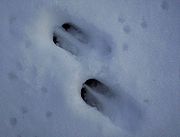 The Roe Deer is primarily crepuscular
, or primarily active during the twilight, very quick and graceful, lives in woods although it may venture into grasslands and sparse forests. It feeds mainly on grass, leaves, berries and young shoots. It particularly likes very young, tender grass with a high moisture content, i.e., grass that has received rain the day before. Roe deer will not generally venture into a field that has had or has livestock (sheep, cattle) in it because the livestock make the grass unclean. A pioneer species
commonly associated with biotic communities at an early stage of succession, during the Neolithic
period in Europe
the Roe Deer was abundant, taking advantage of areas of forest or woodland cleared by Neolithic farmers.
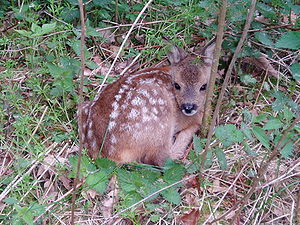
Roe Deer males clash over territory in early summer and mate in early fall. During courtship, when the males chase the females, they often flatten the underbrush leaving behind areas of the forest in the shape of a figure eight called 'roe rings'. Males may also use their antlers to shovel around fallen foliage and dirt as a way of attracting a mate. Roebucks enter rutting inappetence during the July and August breeding season. Females are monoestrous and after delayed implantation usually give birth the following June, after a ten-month gestation period, typically to two spotted fawns of opposite sexes. The fawns remain hidden in long grass from predators until they are ready to join the rest of the herd; they are suckled by their mother several times a day for around three months. Roe deer adults will often abandon their young if they sense or smell that an animal or human has been near it. Young female roe deer can begin to reproduce when they are around 16 months old.
, and its sequel Bambi's Children
, by Felix Salten
) is originally a roe deer. It was only when the story was adapted into the animated feature film Bambi
, by the Walt Disney Studios
, was Bambi changed to a white-tailed deer
. This change was made due to the white-tail being a more familiar species to the mainstream U.S. viewers. Consequently, the setting was also changed to a North American wilderness.
Eurasia
Eurasia is a continent or supercontinent comprising the traditional continents of Europe and Asia ; covering about 52,990,000 km2 or about 10.6% of the Earth's surface located primarily in the eastern and northern hemispheres...
n species of deer
Deer
Deer are the ruminant mammals forming the family Cervidae. Species in the Cervidae family include white-tailed deer, elk, moose, red deer, reindeer, fallow deer, roe deer and chital. Male deer of all species and female reindeer grow and shed new antlers each year...
. It is relatively small, reddish and grey-brown, and well-adapted to cold environments. Roe Deer are widespread in Western Europe
Western Europe
Western Europe is a loose term for the collection of countries in the western most region of the European continents, though this definition is context-dependent and carries cultural and political connotations. One definition describes Western Europe as a geographic entity—the region lying in the...
, from the Mediterranean to Scandinavia
Scandinavia
Scandinavia is a cultural, historical and ethno-linguistic region in northern Europe that includes the three kingdoms of Denmark, Norway and Sweden, characterized by their common ethno-cultural heritage and language. Modern Norway and Sweden proper are situated on the Scandinavian Peninsula,...
, and from the British Isles
British Isles
The British Isles are a group of islands off the northwest coast of continental Europe that include the islands of Great Britain and Ireland and over six thousand smaller isles. There are two sovereign states located on the islands: the United Kingdom of Great Britain and Northern Ireland and...
to the Caucasus
Caucasus
The Caucasus, also Caucas or Caucasia , is a geopolitical region at the border of Europe and Asia, and situated between the Black and the Caspian sea...
. It is distinct from the somewhat larger Siberian Roe Deer
Siberian Roe Deer
Capreolus pygargus, also known as the Siberian roe deer or eastern roe deer, is a species of roe deer found in northeastern Asia. In addition to Siberia and Mongolia, it is found in Kazakhstan, the Tian Shan Mountains, Eastern Tibet, the Korean peninsula, and northeastern China...
.
Etymology
English roe is from Old English raha, from Proto-Germanic *raikhon, cognate to Old NorseOld Norse
Old Norse is a North Germanic language that was spoken by inhabitants of Scandinavia and inhabitants of their overseas settlements during the Viking Age, until about 1300....
rá and German
German language
German is a West Germanic language, related to and classified alongside English and Dutch. With an estimated 90 – 98 million native speakers, German is one of the world's major languages and is the most widely-spoken first language in the European Union....
Reh. A fifth century runic inscription on a roe deer ankle bone
Talus bone
-External links:* *...
found in England (the "Caistor-by-Norwich astragalus
Caistor-by-Norwich astragalus
The Caistor-by-Norwich astralagus is a roe deer astragalus found in an urn at Caistor St. Edmund, Norfolk, England. The astralagus is inscribed with a 5th-century Elder Futhark inscription, reading ' "roe"...
") transliterates as raïhan, thought to refer to the deer itself. Ultimately, the word may be drawn from the Proto-Indo-European
Proto-Indo-European language
The Proto-Indo-European language is the reconstructed common ancestor of the Indo-European languages, spoken by the Proto-Indo-Europeans...
root *rei-, meaning "streaked" or "spotted." Another translation suggests that "Roe" is an ancient word meaning the colour red.
Distribution and related species
The Roe Deer is distinct from the somewhat larger Siberian Roe DeerSiberian Roe Deer
Capreolus pygargus, also known as the Siberian roe deer or eastern roe deer, is a species of roe deer found in northeastern Asia. In addition to Siberia and Mongolia, it is found in Kazakhstan, the Tian Shan Mountains, Eastern Tibet, the Korean peninsula, and northeastern China...
(Capreolus pygargus) that is found from the Ural Mountains
Ural Mountains
The Ural Mountains , or simply the Urals, are a mountain range that runs approximately from north to south through western Russia, from the coast of the Arctic Ocean to the Ural River and northwestern Kazakhstan. Their eastern side is usually considered the natural boundary between Europe and Asia...
to as far east as China
China
Chinese civilization may refer to:* China for more general discussion of the country.* Chinese culture* Greater China, the transnational community of ethnic Chinese.* History of China* Sinosphere, the area historically affected by Chinese culture...
and Siberia
Siberia
Siberia is an extensive region constituting almost all of Northern Asia. Comprising the central and eastern portion of the Russian Federation, it was part of the Soviet Union from its beginning, as its predecessor states, the Tsardom of Russia and the Russian Empire, conquered it during the 16th...
. The two species meet at the Caucasus Mountains
Caucasus Mountains
The Caucasus Mountains is a mountain system in Eurasia between the Black Sea and the Caspian Sea in the Caucasus region .The Caucasus Mountains includes:* the Greater Caucasus Mountain Range and* the Lesser Caucasus Mountains....
, with the European species occupying the southern flank of the mountain ranges and adjacent Asia Minor and the Siberian species occupying the northern flank of the mountain ranges.
Within Europe, the European Roe Deer occurs in most areas, with the exception of northernmost Scandinavia
Scandinavia
Scandinavia is a cultural, historical and ethno-linguistic region in northern Europe that includes the three kingdoms of Denmark, Norway and Sweden, characterized by their common ethno-cultural heritage and language. Modern Norway and Sweden proper are situated on the Scandinavian Peninsula,...
(north of Narvik
Narvik
is the third largest city and municipality in Nordland county, Norway by population. Narvik is located on the shores of the Narvik Fjord . The municipality is part of the Ofoten traditional region of North Norway, inside the arctic circle...
) and some of the island
Island
An island or isle is any piece of sub-continental land that is surrounded by water. Very small islands such as emergent land features on atolls can be called islets, cays or keys. An island in a river or lake may be called an eyot , or holm...
s, notably Iceland
Iceland
Iceland , described as the Republic of Iceland, is a Nordic and European island country in the North Atlantic Ocean, on the Mid-Atlantic Ridge. Iceland also refers to the main island of the country, which contains almost all the population and almost all the land area. The country has a population...
, Ireland
Ireland
Ireland is an island to the northwest of continental Europe. It is the third-largest island in Europe and the twentieth-largest island on Earth...
, and the Mediterranean Sea
Mediterranean Sea
The Mediterranean Sea is a sea connected to the Atlantic Ocean surrounded by the Mediterranean region and almost completely enclosed by land: on the north by Anatolia and Europe, on the south by North Africa, and on the east by the Levant...
islands; in the Mediterranean region it is largely confined to mountainous regions, and is absent or rare at low levels. Scottish roe deer were introduced to the Lissadell Estate in Co. Sligo in the Republic of Ireland around 1870 by Sir Henry Gore-Booth, Bt. The Lissadell deer were noted for their occasional abnormal antlers and survived in that general area for about 50 years before they died out and there are not believed to be any roe deer currently extant in Ireland.
German colonial administrators introduced Roe deer to the island of Pohnpei
Pohnpei
Not to be confused with Pompeii, the ancient city destroyed by Vesuvius in AD 79.Pohnpei "upon a stone altar " is the name of one of the four states in the Federated States of Micronesia , situated among the Senyavin Islands which are part of the larger Caroline Islands group...
in Micronesia
Micronesia
Micronesia is a subregion of Oceania, comprising thousands of small islands in the western Pacific Ocean. It is distinct from Melanesia to the south, and Polynesia to the east. The Philippines lie to the west, and Indonesia to the southwest....
. They are hunted by locals in very steep and heavily vegetated terrain. The meat is openly sold in markets and restaurants in Kolonia
Kolonia
Kolonia is a coastal town and the capital of Pohnpei State in the Federated States of Micronesia . It was also the former FSM capital before being replaced by Palikir in 1989, located nearby to the southwest in the municipality of Sokehs.-Description:...
, the capital city of Pohnpei and the Federated States of Micronesia
Federated States of Micronesia
The Federated States of Micronesia or FSM is an independent, sovereign island nation, made up of four states from west to east: Yap, Chuuk, Pohnpei and Kosrae. It comprises approximately 607 islands with c...
.
Physical appearance
Antler
Antlers are the usually large, branching bony appendages on the heads of most deer species.-Etymology:Antler originally meant the lowest tine, the "brow tine"...
s and a reddish body with a grey face. Its hide is golden red in summer, darkening to brown or even black in winter, with lighter undersides and a white rump patch; the tail is very short (2 –), and barely visible. Only the males have antlers. The first and second set of antlers are unbranched and short (5 –), while older bucks in good conditions develop antlers up to 20–25 cm (7.9–9.8 in) long with two or three, rarely even four, points. When the male's antlers begin to regrow, they are covered in a thin layer of velvet-like fur which disappears later on after the hair's blood supply is lost. Males may speed up the process by rubbing their antlers on trees, so that their antlers are hard and stiff for the duels during the mating season. Unlike most cervids, roe deer begin regrowing antlers almost immediately after they are shed.
Habitat and diet
Crepuscular
Crepuscular animals are those that are active primarily during twilight, that is during dawn and dusk. The word is derived from the Latin word crepusculum, meaning "twilight." Crepuscular is, thus, in contrast with diurnal and nocturnal behavior. Crepuscular animals may also be active on a bright...
, or primarily active during the twilight, very quick and graceful, lives in woods although it may venture into grasslands and sparse forests. It feeds mainly on grass, leaves, berries and young shoots. It particularly likes very young, tender grass with a high moisture content, i.e., grass that has received rain the day before. Roe deer will not generally venture into a field that has had or has livestock (sheep, cattle) in it because the livestock make the grass unclean. A pioneer species
Pioneer species
Pioneer species are species which colonize previously uncolonized land, usually leading to ecological succession. They are the first organisms to start the chain of events leading to a livable biosphere or ecosystem...
commonly associated with biotic communities at an early stage of succession, during the Neolithic
Neolithic
The Neolithic Age, Era, or Period, or New Stone Age, was a period in the development of human technology, beginning about 9500 BC in some parts of the Middle East, and later in other parts of the world. It is traditionally considered as the last part of the Stone Age...
period in Europe
Europe
Europe is, by convention, one of the world's seven continents. Comprising the westernmost peninsula of Eurasia, Europe is generally 'divided' from Asia to its east by the watershed divides of the Ural and Caucasus Mountains, the Ural River, the Caspian and Black Seas, and the waterways connecting...
the Roe Deer was abundant, taking advantage of areas of forest or woodland cleared by Neolithic farmers.
Behaviour and life cycle
The Roe Deer attains a maximum life span (in the wild) of ten years. When alarmed, it will bark a sound much like a dog and flash out its white rump patch. Rump patches differ between the sexes, with the white rump patches heart-shaped on females and kidney-shaped on males. Males may also bark, make a low grunting noise or make a high pitched wolf-like whine when attracting mates during the breeding season, often luring multiple does into their territory. The Roe Deer lives usually in small groups. Group includes male, 2-3 females and fawns.Reproduction
The polygamousPolygamy
Polygamy is a marriage which includes more than two partners...
Roe Deer males clash over territory in early summer and mate in early fall. During courtship, when the males chase the females, they often flatten the underbrush leaving behind areas of the forest in the shape of a figure eight called 'roe rings'. Males may also use their antlers to shovel around fallen foliage and dirt as a way of attracting a mate. Roebucks enter rutting inappetence during the July and August breeding season. Females are monoestrous and after delayed implantation usually give birth the following June, after a ten-month gestation period, typically to two spotted fawns of opposite sexes. The fawns remain hidden in long grass from predators until they are ready to join the rest of the herd; they are suckled by their mother several times a day for around three months. Roe deer adults will often abandon their young if they sense or smell that an animal or human has been near it. Young female roe deer can begin to reproduce when they are around 16 months old.
Hybridization
There have been reports which suggest that Roe Deer can interbreed with some types of domestic ruminants. As example, there have been alleged reports about interbreeding between Roe Deer and domestic sheep (the genus Ovis).In popular culture
The world-famous deer Bambi (the eponymous character of the books Bambi, A Life in the WoodsBambi, A Life in the Woods
Bambi, a Life in the Woods, originally published in Austria as Bambi. Eine Lebensgeschichte aus dem Walde, is a 1923 Austrian novel written by Felix Salten and published by Paul Zsolnay Verlag...
, and its sequel Bambi's Children
Bambi's Children
Bambi's Children, The Story of a Forest Family, originally titled Bambis Kinder, eine Familie im Walde, is a German Children's novel written by Felix Salten as a sequel to his successful work Bambi, A Life in the Woods. The sequel follows the lives of the deer Bambi's twin fawns as they grow from...
, by Felix Salten
Felix Salten
Felix Salten was an Austrian author and critic in Vienna. His most famous work is Bambi .-Life:...
) is originally a roe deer. It was only when the story was adapted into the animated feature film Bambi
Bambi
Bambi is a 1942 American animated film directed by David Hand , produced by Walt Disney and based on the book Bambi, A Life in the Woods by Austrian author Felix Salten...
, by the Walt Disney Studios
Walt Disney Pictures
Walt Disney Pictures is an American film studio owned by The Walt Disney Company. Walt Disney Pictures and Television, a subsidiary of the Walt Disney Studios and the main production company for live-action feature films within the Walt Disney Motion Pictures Group, based at the Walt Disney...
, was Bambi changed to a white-tailed deer
White-tailed Deer
The white-tailed deer , also known as the Virginia deer or simply as the whitetail, is a medium-sized deer native to the United States , Canada, Mexico, Central America, and South America as far south as Peru...
. This change was made due to the white-tail being a more familiar species to the mainstream U.S. viewers. Consequently, the setting was also changed to a North American wilderness.