

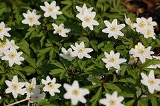
Anemone nemorosa

Encyclopedia
Anemone nemorosa is an early-spring flowering plant in the genus Anemone
in the family Ranunculaceae
, native to Europe
. Common names include wood anemone
, windflower, thimbleweed and smell fox, an allusion to the musky smell of the leaves. It is a perennial herbaceous
plant, growing in early spring from 5 to 15 cm tall.
The flower
is 2 cm diameter, with six or seven (and in rare occasions eight, nine or ten) petal
-like segments (actually tepal
s) with many stamen
s. In the wild the flowers are usually white, but may be pinkish, lilac, blue or yellow and often have a darker tint to the back of the 'petals'. The flowers lack both fragrance and nectar and it has been suggested by some authors that they are primarily self-pollinated
, but it has also been demonstrated that they are pollinated by bees and other insects that visit the flowers to collect pollen (Shirreffs 1985).
Yellow wood anemone, Anemone ranunculoides
, also known as the buttercup anemone, is a similar plant with slightly smaller flowers of rich yellow colouring.
, which can cause severe skin and gastrointestinal irritation, burning mouth sensation, burning throat sensation, mouth ulcers, nausea, vomiting, diarrhea, bitter taste in mouth, blood in vomit
for use in garden
s and park
s.
Cultivars
Many cultivar
s have been selected for garden use, such as Anemone nemorosa 'Allenii' which has large blue flowers. It has been awarded an Award of Garden Merit
(AGM) H4 (hardy throughout the British Isles
) by the Royal Horticultural Society
, as have several of its cultivars (see below).
The RHS Plant Finder 2008–2009 lists 70 cultivars of Anemone nemorosa (AGM H4) available from nurseries in the UK. Some of those most widely available are:
Anemone ×lipsiensis, a hybrid between A. nemorosa and A. ranunculoides, has pale yellow flowers; A. × lipsiensis 'Pallida' is the best-known result of this cross. It has been awarded the AGM H4, like both of its parents.
Anemone
Anemone , is a genus of about 120 species of flowering plants in the buttercup family Ranunculaceae in the north and south temperate zones...
in the family Ranunculaceae
Ranunculaceae
Ranunculaceae are a family of about 1700 species of flowering plants in about 60 genera, distributed worldwide....
, native to Europe
Europe
Europe is, by convention, one of the world's seven continents. Comprising the westernmost peninsula of Eurasia, Europe is generally 'divided' from Asia to its east by the watershed divides of the Ural and Caucasus Mountains, the Ural River, the Caspian and Black Seas, and the waterways connecting...
. Common names include wood anemone
Wood Anemone
Wood anemone is a common name for three closely related species of woodland anemone.In Europe: Anemone nemorosaIn North America: Anemone quinquefoliaThe Yellow wood anemone is Anemone ranunculoides....
, windflower, thimbleweed and smell fox, an allusion to the musky smell of the leaves. It is a perennial herbaceous
Herbaceous
A herbaceous plant is a plant that has leaves and stems that die down at the end of the growing season to the soil level. They have no persistent woody stem above ground...
plant, growing in early spring from 5 to 15 cm tall.
Growth
The plants start blooming soon after the foliage emerges from the ground. The leaves are divided into three segments and the flowers, produced on short stems, are held above the foliage with one flower per stem. They grow from underground root-like stems called rhizomes and the foliage dies back down by mid summer (summer dormant). The rhizomes spread just below the soil surface, forming long spreading clumps that grow quickly, contributing to its rapid spread in woodland conditions, where they often carpet large areas.The flower
Flower
A flower, sometimes known as a bloom or blossom, is the reproductive structure found in flowering plants . The biological function of a flower is to effect reproduction, usually by providing a mechanism for the union of sperm with eggs...
is 2 cm diameter, with six or seven (and in rare occasions eight, nine or ten) petal
Petal
Petals are modified leaves that surround the reproductive parts of flowers. They often are brightly colored or unusually shaped to attract pollinators. Together, all of the petals of a flower are called a corolla. Petals are usually accompanied by another set of special leaves called sepals lying...
-like segments (actually tepal
Tepal
Tepals are elements of the perianth, or outer part of a flower, which include the petals or sepals. The term tepal is more often applied specifically when all segments of the perianth are of similar shape and color, or undifferentiated, which is called perigone...
s) with many stamen
Stamen
The stamen is the pollen producing reproductive organ of a flower...
s. In the wild the flowers are usually white, but may be pinkish, lilac, blue or yellow and often have a darker tint to the back of the 'petals'. The flowers lack both fragrance and nectar and it has been suggested by some authors that they are primarily self-pollinated
Pollination
Pollination is the process by which pollen is transferred in plants, thereby enabling fertilisation and sexual reproduction. Pollen grains transport the male gametes to where the female gamete are contained within the carpel; in gymnosperms the pollen is directly applied to the ovule itself...
, but it has also been demonstrated that they are pollinated by bees and other insects that visit the flowers to collect pollen (Shirreffs 1985).
Yellow wood anemone, Anemone ranunculoides
Anemone ranunculoides
Anemone ranunculoides, the yellow anemone, yellow wood anemone or buttercup anemone, is a species of herbaceous perennial plant that grows in forests across most of Continental Europe, and less frequently in the Mediterranean region...
, also known as the buttercup anemone, is a similar plant with slightly smaller flowers of rich yellow colouring.
Medicinal uses
The plant contains poisonous chemicals that are toxic to animals including humans, but it has also been used as a medicine. All parts of the plant contain protoanemoninProtoanemonin
Protoanemonin is a toxin found in all plants of the buttercup family . On maceration, for example when the plant is wounded, it is produced by an enzymatic process from the glucoside ranunculin...
, which can cause severe skin and gastrointestinal irritation, burning mouth sensation, burning throat sensation, mouth ulcers, nausea, vomiting, diarrhea, bitter taste in mouth, blood in vomit
Cultivation
Anemone nemorosa is grown as an ornamental plantOrnamental plant
Ornamental plants are plants that are grown for decorative purposes in gardens and landscape design projects, as house plants, for cut flowers and specimen display...
for use in garden
Garden
A garden is a planned space, usually outdoors, set aside for the display, cultivation, and enjoyment of plants and other forms of nature. The garden can incorporate both natural and man-made materials. The most common form today is known as a residential garden, but the term garden has...
s and park
Park
A park is a protected area, in its natural or semi-natural state, or planted, and set aside for human recreation and enjoyment, or for the protection of wildlife or natural habitats. It may consist of rocks, soil, water, flora and fauna and grass areas. Many parks are legally protected by...
s.
Cultivars
Many cultivar
Cultivar
A cultivar'Cultivar has two meanings as explained under Formal definition. When used in reference to a taxon, the word does not apply to an individual plant but to all those plants sharing the unique characteristics that define the cultivar. is a plant or group of plants selected for desirable...
s have been selected for garden use, such as Anemone nemorosa 'Allenii' which has large blue flowers. It has been awarded an Award of Garden Merit
Award of Garden Merit
The Award of Garden Merit, or AGM, is an award made to garden plants by the British Royal Horticultural Society after a period of assessment by the appropriate committees of the Society...
(AGM) H4 (hardy throughout the British Isles
British Isles
The British Isles are a group of islands off the northwest coast of continental Europe that include the islands of Great Britain and Ireland and over six thousand smaller isles. There are two sovereign states located on the islands: the United Kingdom of Great Britain and Northern Ireland and...
) by the Royal Horticultural Society
Royal Horticultural Society
The Royal Horticultural Society was founded in 1804 in London, England as the Horticultural Society of London, and gained its present name in a Royal Charter granted in 1861 by Prince Albert...
, as have several of its cultivars (see below).
The RHS Plant Finder 2008–2009 lists 70 cultivars of Anemone nemorosa (AGM H4) available from nurseries in the UK. Some of those most widely available are:
- 'Alba Plena' - double white
- 'Allenii' (AGM H4) - large lavender-blue flowers, often with seven petals (named after James AllenJames Allen (nurseryman)James Allen was a nurseryman of Shepton Mallet, Somerset, United Kingdom, known principally for his hybridizations of snowdrops and anemones. He is credited with the discovery of Galanthus ×allenii ....
, nurseryman) - 'Bowles' Purple' - purple flowers (named after E.A. BowlesEdward Augustus BowlesEdward Augustus Bowles, VMH , known professionally as E. A. Bowles, was a British horticulturalist, plantsman and garden writer. He developed an important garden at Myddelton House, his lifelong home at Bulls Cross in Enfield, Middlesex and his name has been preserved in many varieties of...
, plantsman and garden writer) - 'Bracteata Pleniflora' - double, white flowers, with green streaks and a frilly ruff of bracts
- 'Robinsoniana' (AGM H4) - pale lavender-blue flowers (named after William RobinsonWilliam Robinson (gardener)William Robinson was an Irish practical gardener and journalist whose ideas about wild gardening spurred the movement that evolved into the English cottage garden, a parallel to the search for honest simplicity and vernacular style of the British Arts and Crafts movement...
, plantsman and garden writer) - 'Royal Blue' - deep blue flowers with purple backs
- 'Vestal' (AGM H4) - white, anemone-centred flowers
- 'Virescens' (AGM H4) - flowers mutated into small conical clusters of leaves.
Anemone ×lipsiensis, a hybrid between A. nemorosa and A. ranunculoides, has pale yellow flowers; A. × lipsiensis 'Pallida' is the best-known result of this cross. It has been awarded the AGM H4, like both of its parents.
Further reading
- Shirreffs, D.A. 1985. Anemone nemorosa L. Journal of Ecology 73: 1005-1020.
- RHS Plant Finder 2008–2009, Tony Lord (editor), Dorling Kindersley (2008) ISBN 978-1-4053-3190-6