

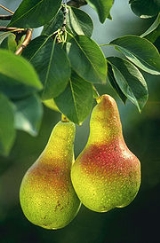
Pear

Encyclopedia
The pear is any of several tree species of genus
Pyrus (icon) and also the name of the pomaceous
fruit
of these trees. Several species of pear are valued by humans for their edible fruit, but the fruit of other species is small, hard, and astringent.
The genus Pyrus is classified in subtribe Pyrinae within tribe Pyreae. The apple
(Malus domestica), which it resembles in floral structure, is also a member of this subcategory.
The English
word “pear” is probably from Common West Germanic pera, probably a loanword
of Vulgar Latin
pira, the plural of pirum, akin to Greek
ἄπιος apios (from Mycenaean ápisos), which is likely of Semitic
origin. The place name Perry
and Pharisoulopol can indicate the historical presence of pear trees. The term "pyriform" is sometimes used to describe something which is "pear-shaped".
 The cultivation
of the pear in cool temperate climates extends to the remotest antiquity
, and there is evidence of its use as a food since prehistoric times. Many traces of it have been found in the Swiss lake-dwellings. The word “pear”, or its equivalent
, occurs in all the Celtic languages
, while in Slavonic and other dialects differ in appellations, but still referring to the same thing, are found—a diversity and multiplicity of nomenclature
which led Alphonse de Candolle to infer a very ancient cultivation of the tree from the shores of the Caspian
to those of the Atlantic.
Pears grow in the sublime orchard
of Alcinous
, in Odyssey
vii: "Therein grow trees, tall and luxuriant, pears and pomegranate
s and apple
-trees with their bright fruit, and sweet fig
s, and luxuriant olive
s. Of these the fruit perishes not nor fails in winter
or in summer, but lasts throughout the year."
The pear was also cultivated by the Romans
, who did not eat them raw: Pliny's Natural History recommended stewing them with honey and noted three dozen varieties. The Roman cookbook attributed to Apicius
, De re coquinaria, has a recipe for a spiced, stewed-pear patina, or soufflé.
A certain race of pears, with white down on the under surface
of their leaves, is supposed to have originated from P. nivalis, and their fruit is chiefly used in France in the manufacture of perry
(see also cider
). Other small-fruited pears, distinguished by their early ripening and apple-like fruit, may be referred to P. cordata, a species found wild in western France
, and in Devon
and Cornwall
. Pears have been cultivated in China
for approximately 3000 years.
The genus
is thought to have originated in present-day western China in the foothills of the Tian Shan
, a mountain range
of Central Asia
, and to have spread to the north and south along mountain chains, evolving
into a diverse group of over 20 widely recognized primary species . The enormous number of varieties of the cultivated Europe
an pear (Pyrus communis subsp. communis), are without doubt derived from one or two wild
subspecies
(P. communis subsp. pyraster and P. communis subsp. caucasica), widely distributed throughout Europe, and sometimes forming part of the natural vegetation
of the forest
s. In England
, where an ancient pear tree gave its name to Pirio (Perry Barr
, a district of Birmingham) in Domesday, the pear is sometimes considered wild; there is always the doubt that it may not really be so, but the produce of some seed of a cultivated tree deposited by bird
s or otherwise, which has germinated as a wild-form spine-bearing tree. Court accounts of Henry III of England
record pears shipped from Rochelle
and presented to the King by the Sheriffs of London. The French names of pears grown in English medieval gardens suggests that their reputation, at the least, was French; a favored variety in the accounts was named for Saint Rule or Regul', bishop of Senlis.
Asian species with medium to large edible fruit include P. pyrifolia, P. ussuriensis, P. × bretschneideri, P. × sinkiangensis, and P. pashia. Other small-fruited species are frequently used as rootstock
s for the cultivated forms.
, from western Europe
and north Africa
east right across Asia
. They are medium-sized trees, reaching 10–17 m tall, often with a tall, narrow crown; a few species are shrub
by. The leaves
are alternately arranged, simple, 2–12 cm long, glossy green on some species, densely silvery-hairy in some others; leaf shape varies from broad oval to narrow lanceolate. Most pears are deciduous
, but one or two species in southeast Asia are evergreen
. Most are cold-hardy, withstanding temperatures between −25 °C and −40 °C in winter, except for the evergreen species, which only tolerate temperatures down to about −15 °C.
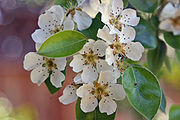
The flower
s are white, rarely tinted yellow or pink, 2–4 cm diameter, and have five petals. Like that of the related apple
, the pear fruit is a pome
, in most wild species 1–4 cm diameter, but in some cultivated forms up to 18 cm long and 8 cm broad; the shape varies in most species from oblate or globose, to the classic pyriform 'pear-shape
' of the European pear
with an elongated basal portion and a bulbous end.
The fruit is composed of the receptacle or upper end of the flower-stalk (the so-called calyx tube) greatly dilated. Enclosed within its cellular flesh is the true fruit: five cartilaginous carpels, known colloquially as the "core". From the upper rim of the receptacle are given off the five sepal
s, the five petal
s, and the very numerous stamen
s.
The pear is very similar to the apple
in cultivation, propagation
and pollination
. The pear and the apple are also related to the quince
.
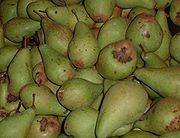
Pears and apples cannot always be distinguished by the form of the fruit; some pears look very much like some apples. One major difference is that the flesh of pear fruit contains stone cells (also called "grit"). Pear trees and apple trees do have several visible differences.
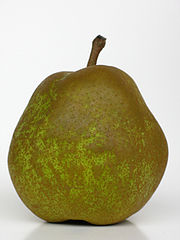
According to Pear Bureau Northwest, about 3000 known varieties of pears are grown worldwide. In the United States, only 10 heirloom varieties are widely recognized: Green Bartlett, Red Bartlett, Bosc, Green Anjou, Red Anjou, Comice, Forelle, Seckel, Concorde, and Starkrimson.
for increase. Both quince and clonally-produced pear rootstocks are also used for Pyrus communis orchards. For new varieties the flowers can be cross-bred to preserve or combine desirable traits. The fruit of the pear is produced on spurs, which appear on shoots more than one year old.
Three species account for the vast majority of edible fruit production, the European pear
Pyrus communis subsp. communis cultivated mainly in Europe and North America
, the Chinese white pear (bai li) Pyrus ×bretschneideri, and the Nashi pear
Pyrus pyrifolia (also known as Asian pear or apple pear), both grown mainly in eastern Asia. There are thousands of cultivar
s of these three species. A species grown in western China, P. sinkiangensis, and P. pashia, grown in southern China and south Asia, are also produced to a lesser degree.
Other species are used as rootstock
s for European and Asian pears and as ornamental trees
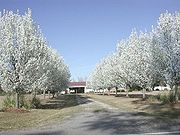
. The Siberian pear, Pyrus ussuriensis (which produces unpalatable fruit) has been crossed with Pyrus communis to breed hardier pear cultivars. The Bradford pear
(Pyrus calleryana 'Bradford') in particular has become widespread in North America, and is used only as an ornamental tree, as well as a blight-resistant rootstock for Pyrus communis fruit orchards. The willow-leafed pear (Pyrus salicifolia) is grown for its attractive, slender, densely silvery-hairy leaves.
s of Pyrus communis, being climacteric fruits
, are gathered before they are fully ripe, while they are still green, but snap off when lifted. In the case of the 'Passe Crassane', long the favored winter pear in France
, the crop should is traditionally gathered at three different times: the first a fortnight or more before it is ripe, the second a week or ten days after that, and the third when fully ripe. The first gathering will come into eating last, and thus the season of the fruit may be considerably prolonged.
Nashi pears are allowed to ripen on the tree.
, and dried
. The juice can also be used in jellies and jams, usually in combination with other fruits or berries. Fermented pear juice is called perry
or pear cider.
Pears ripen at room temperature. They will ripen faster
if placed next to banana
s in a fruit bowl. Refrigeration will slow further ripening. Pear Bureau Northwest offers tips on ripening and judging ripeness: Although the skin on Bartlett pears changes from green to yellow as they ripen, most varieties show little color change as they ripen. Because pears ripen from the inside out, the best way to judge ripeness is to "Check the Neck." To Check the Neck for ripeness, apply gentle thumb pressure to the neck, or stem end of the pear. If it yields to gentle pressure, then the pear is ripe, sweet, and juicy. If it is firm, leave pear at room temperature and Check the Neck daily for ripeness. Source: Pear Bureau Northwest
The culinary or cooking pear is green but dry and hard and only edible after several hours of cooking. Two Dutch cultivars are "Gieser Wildeman" and "Saint Remy". They are traditionally stewed in wine with spices and served both warm and cold.
Pear wood
is one of the preferred materials in the manufacture of high-quality woodwind instruments and furniture
. It is also used for wood carving, and as a firewood
to produce aromatic smoke for smoking meat or tobacco
. Pear wood is valued for kitchen spoons, scoops and stirrers, as it does not contaminate food with color, flavor or smell and resists warping and splintering despite repeated soaking and drying cycles. Lincoln describes it as "a fairly tough, very stable wood... (used for) carving... brushbacks, umbrella handles, measuring instruments such as set squares and T-squares... recorders... violin and guitar fingerboards and piano keys... decorative veneering." Pearwood is the favored wood for architect's rulers because it does not warp. It is similar to the wood of its relative, the apple tree, (Pyrus malus [also called Malus domestica]) and used for many of the same purposes.
Pear leaves were smoked in Europe before tobacco was introduced.
and a good source of vitamin C
. Most of the vitamin C, as well as the dietary fiber, is contained within the skin of the fruit. According to the FDA's final rule dated July 25, 2006 "Food Labeling; Guidelines for Voluntary Nutrition Labeling of Raw Fruits, Vegetables, and Fish," the nutritional content of a medium-sized fresh pear weighing 166g/5.9oz is as follows:
Pears are less allergenic than many other fruits, and pear juice is therefore sometimes used as the first juice introduced to infants. However, caution is recommended for all fruit juice consumption by infants, as studies have suggested a link between excessive fruit juice consumption and reduced nutrient intake, as well as a tendency towards obesity. Pears are low in salicylates and benzoates
, so are recommended in exclusion diets for allergy sufferers. Along with lamb
and rice
, pears may form part of the strictest exclusion diet for allergy sufferers
Most of the fiber is insoluble, making pears a good laxative. The gritty fiber content may reduce the number of cancerous colon polyps.
Genus
In biology, a genus is a low-level taxonomic rank used in the biological classification of living and fossil organisms, which is an example of definition by genus and differentia...
Pyrus (icon) and also the name of the pomaceous
Pome
In botany, a pome is a type of fruit produced by flowering plants in the subfamily Maloideae of the family Rosaceae.A pome is an accessory fruit composed of one or more carpels surrounded by accessory tissue...
fruit
Fruit
In broad terms, a fruit is a structure of a plant that contains its seeds.The term has different meanings dependent on context. In non-technical usage, such as food preparation, fruit normally means the fleshy seed-associated structures of certain plants that are sweet and edible in the raw state,...
of these trees. Several species of pear are valued by humans for their edible fruit, but the fruit of other species is small, hard, and astringent.
The genus Pyrus is classified in subtribe Pyrinae within tribe Pyreae. The apple
Apple
The apple is the pomaceous fruit of the apple tree, species Malus domestica in the rose family . It is one of the most widely cultivated tree fruits, and the most widely known of the many members of genus Malus that are used by humans. Apple grow on small, deciduous trees that blossom in the spring...
(Malus domestica), which it resembles in floral structure, is also a member of this subcategory.
The English
English language
English is a West Germanic language that arose in the Anglo-Saxon kingdoms of England and spread into what was to become south-east Scotland under the influence of the Anglian medieval kingdom of Northumbria...
word “pear” is probably from Common West Germanic pera, probably a loanword
Loanword
A loanword is a word borrowed from a donor language and incorporated into a recipient language. By contrast, a calque or loan translation is a related concept where the meaning or idiom is borrowed rather than the lexical item itself. The word loanword is itself a calque of the German Lehnwort,...
of Vulgar Latin
Vulgar Latin
Vulgar Latin is any of the nonstandard forms of Latin from which the Romance languages developed. Because of its nonstandard nature, it had no official orthography. All written works used Classical Latin, with very few exceptions...
pira, the plural of pirum, akin to Greek
Ancient Greek
Ancient Greek is the stage of the Greek language in the periods spanning the times c. 9th–6th centuries BC, , c. 5th–4th centuries BC , and the c. 3rd century BC – 6th century AD of ancient Greece and the ancient world; being predated in the 2nd millennium BC by Mycenaean Greek...
ἄπιος apios (from Mycenaean ápisos), which is likely of Semitic
Semitic
In linguistics and ethnology, Semitic was first used to refer to a language family of largely Middle Eastern origin, now called the Semitic languages...
origin. The place name Perry
Perry (disambiguation)
Perry is an alcoholic beverage made of fermented pear juice.Perry may also refer to:- Canada :* Perry, Ontario* Perry's Cove, Newfoundland and Labrador* Port Perry, Ontario- England :* Perry, Cambridgeshire* Perry Barr, Birmingham...
and Pharisoulopol can indicate the historical presence of pear trees. The term "pyriform" is sometimes used to describe something which is "pear-shaped".
History
Pomology
Pomology is a branch of botany that studies and cultivates pome fruit, particularly from the genera Malus, Prunus and Pyrus belonging to the Rosaceae. The term is sometimes applied more broadly, to the cultivation of any type of fruit...
of the pear in cool temperate climates extends to the remotest antiquity
Prehistory
Prehistory is the span of time before recorded history. Prehistory can refer to the period of human existence before the availability of those written records with which recorded history begins. More broadly, it refers to all the time preceding human existence and the invention of writing...
, and there is evidence of its use as a food since prehistoric times. Many traces of it have been found in the Swiss lake-dwellings. The word “pear”, or its equivalent
Cognate
In linguistics, cognates are words that have a common etymological origin. This learned term derives from the Latin cognatus . Cognates within the same language are called doublets. Strictly speaking, loanwords from another language are usually not meant by the term, e.g...
, occurs in all the Celtic languages
Celtic languages
The Celtic languages are descended from Proto-Celtic, or "Common Celtic"; a branch of the greater Indo-European language family...
, while in Slavonic and other dialects differ in appellations, but still referring to the same thing, are found—a diversity and multiplicity of nomenclature
Nomenclature
Nomenclature is a term that applies to either a list of names or terms, or to the system of principles, procedures and terms related to naming - which is the assigning of a word or phrase to a particular object or property...
which led Alphonse de Candolle to infer a very ancient cultivation of the tree from the shores of the Caspian
Caspian Sea
The Caspian Sea is the largest enclosed body of water on Earth by area, variously classed as the world's largest lake or a full-fledged sea. The sea has a surface area of and a volume of...
to those of the Atlantic.
Pears grow in the sublime orchard
Orchard
An orchard is an intentional planting of trees or shrubs that is maintained for food production. Orchards comprise fruit or nut-producing trees which are grown for commercial production. Orchards are also sometimes a feature of large gardens, where they serve an aesthetic as well as a productive...
of Alcinous
Alcinous
Alcinous or Alkínoös was, in Greek mythology, a son of Nausithous, or of Phaeax , and father of Nausicaa, Halius, Clytoneus and Laodamas with Arete. His name literally means "mighty mind"...
, in Odyssey
Odyssey
The Odyssey is one of two major ancient Greek epic poems attributed to Homer. It is, in part, a sequel to the Iliad, the other work ascribed to Homer. The poem is fundamental to the modern Western canon, and is the second—the Iliad being the first—extant work of Western literature...
vii: "Therein grow trees, tall and luxuriant, pears and pomegranate
Pomegranate
The pomegranate , Punica granatum, is a fruit-bearing deciduous shrub or small tree growing between five and eight meters tall.Native to the area of modern day Iran, the pomegranate has been cultivated in the Caucasus since ancient times. From there it spread to Asian areas such as the Caucasus as...
s and apple
Apple
The apple is the pomaceous fruit of the apple tree, species Malus domestica in the rose family . It is one of the most widely cultivated tree fruits, and the most widely known of the many members of genus Malus that are used by humans. Apple grow on small, deciduous trees that blossom in the spring...
-trees with their bright fruit, and sweet fig
Ficus
Ficus is a genus of about 850 species of woody trees, shrubs, vines, epiphytes, and hemiepiphyte in the family Moraceae. Collectively known as fig trees or figs, they are native throughout the tropics with a few species extending into the semi-warm temperate zone. The Common Fig Ficus is a genus of...
s, and luxuriant olive
Olive
The olive , Olea europaea), is a species of a small tree in the family Oleaceae, native to the coastal areas of the eastern Mediterranean Basin as well as northern Iran at the south end of the Caspian Sea.Its fruit, also called the olive, is of major agricultural importance in the...
s. Of these the fruit perishes not nor fails in winter
Winter
Winter is the coldest season of the year in temperate climates, between autumn and spring. At the winter solstice, the days are shortest and the nights are longest, with days lengthening as the season progresses after the solstice.-Meteorology:...
or in summer, but lasts throughout the year."
The pear was also cultivated by the Romans
Ancient Rome
Ancient Rome was a thriving civilization that grew on the Italian Peninsula as early as the 8th century BC. Located along the Mediterranean Sea and centered on the city of Rome, it expanded to one of the largest empires in the ancient world....
, who did not eat them raw: Pliny's Natural History recommended stewing them with honey and noted three dozen varieties. The Roman cookbook attributed to Apicius
Apicius
Apicius is the title of a collection of Roman cookery recipes, usually thought to have been compiled in the late 4th or early 5th century AD and written in a language that is in many ways closer to Vulgar than to Classical Latin....
, De re coquinaria, has a recipe for a spiced, stewed-pear patina, or soufflé.
A certain race of pears, with white down on the under surface
Epidermis (botany)
The epidermis is a single-layered group of cells that covers plants' leaves, flowers, roots and stems. It forms a boundary between the plant and the external environment. The epidermis serves several functions, it protects against water loss, regulates gas exchange, secretes metabolic compounds,...
of their leaves, is supposed to have originated from P. nivalis, and their fruit is chiefly used in France in the manufacture of perry
Perry
Perry is an alcoholic beverage made from fermented pears. Perry has been common for centuries in Britain, particularly in the Three Counties of Gloucestershire, Herefordshire and Worcestershire, and in parts of south Wales; and France, especially Normandy and Anjou.In more recent years, commercial...
(see also cider
Cider
Cider or cyder is a fermented alcoholic beverage made from apple juice. Cider varies in alcohol content from 2% abv to 8.5% abv or more in traditional English ciders. In some regions, such as Germany and America, cider may be termed "apple wine"...
). Other small-fruited pears, distinguished by their early ripening and apple-like fruit, may be referred to P. cordata, a species found wild in western France
France
The French Republic , The French Republic , The French Republic , (commonly known as France , is a unitary semi-presidential republic in Western Europe with several overseas territories and islands located on other continents and in the Indian, Pacific, and Atlantic oceans. Metropolitan France...
, and in Devon
Devon
Devon is a large county in southwestern England. The county is sometimes referred to as Devonshire, although the term is rarely used inside the county itself as the county has never been officially "shired", it often indicates a traditional or historical context.The county shares borders with...
and Cornwall
Cornwall
Cornwall is a unitary authority and ceremonial county of England, within the United Kingdom. It is bordered to the north and west by the Celtic Sea, to the south by the English Channel, and to the east by the county of Devon, over the River Tamar. Cornwall has a population of , and covers an area of...
. Pears have been cultivated in China
China
Chinese civilization may refer to:* China for more general discussion of the country.* Chinese culture* Greater China, the transnational community of ethnic Chinese.* History of China* Sinosphere, the area historically affected by Chinese culture...
for approximately 3000 years.
The genus
Genus
In biology, a genus is a low-level taxonomic rank used in the biological classification of living and fossil organisms, which is an example of definition by genus and differentia...
is thought to have originated in present-day western China in the foothills of the Tian Shan
Tian Shan
The Tian Shan , also spelled Tien Shan, is a large mountain system located in Central Asia. The highest peak in the Tian Shan is Victory Peak , ....
, a mountain range
Mountain range
A mountain range is a single, large mass consisting of a succession of mountains or narrowly spaced mountain ridges, with or without peaks, closely related in position, direction, formation, and age; a component part of a mountain system or of a mountain chain...
of Central Asia
Central Asia
Central Asia is a core region of the Asian continent from the Caspian Sea in the west, China in the east, Afghanistan in the south, and Russia in the north...
, and to have spread to the north and south along mountain chains, evolving
Evolution
Evolution is any change across successive generations in the heritable characteristics of biological populations. Evolutionary processes give rise to diversity at every level of biological organisation, including species, individual organisms and molecules such as DNA and proteins.Life on Earth...
into a diverse group of over 20 widely recognized primary species . The enormous number of varieties of the cultivated Europe
Europe
Europe is, by convention, one of the world's seven continents. Comprising the westernmost peninsula of Eurasia, Europe is generally 'divided' from Asia to its east by the watershed divides of the Ural and Caucasus Mountains, the Ural River, the Caspian and Black Seas, and the waterways connecting...
an pear (Pyrus communis subsp. communis), are without doubt derived from one or two wild
Wildlife
Wildlife includes all non-domesticated plants, animals and other organisms. Domesticating wild plant and animal species for human benefit has occurred many times all over the planet, and has a major impact on the environment, both positive and negative....
subspecies
Subspecies
Subspecies in biological classification, is either a taxonomic rank subordinate to species, ora taxonomic unit in that rank . A subspecies cannot be recognized in isolation: a species will either be recognized as having no subspecies at all or two or more, never just one...
(P. communis subsp. pyraster and P. communis subsp. caucasica), widely distributed throughout Europe, and sometimes forming part of the natural vegetation
Vegetation
Vegetation is a general term for the plant life of a region; it refers to the ground cover provided by plants. It is a general term, without specific reference to particular taxa, life forms, structure, spatial extent, or any other specific botanical or geographic characteristics. It is broader...
of the forest
Forest
A forest, also referred to as a wood or the woods, is an area with a high density of trees. As with cities, depending where you are in the world, what is considered a forest may vary significantly in size and have various classification according to how and what of the forest is composed...
s. In England
England
England is a country that is part of the United Kingdom. It shares land borders with Scotland to the north and Wales to the west; the Irish Sea is to the north west, the Celtic Sea to the south west, with the North Sea to the east and the English Channel to the south separating it from continental...
, where an ancient pear tree gave its name to Pirio (Perry Barr
Perry Barr
Perry Barr is an inner-city area in north Birmingham, England. It is also a council constituency, managed by its own district committee. The constituency includes the smaller Perry Barr ward and the wards of Handsworth Wood, Lozells and East Handsworth, and Oscott, which elect three councillors to...
, a district of Birmingham) in Domesday, the pear is sometimes considered wild; there is always the doubt that it may not really be so, but the produce of some seed of a cultivated tree deposited by bird
Bird
Birds are feathered, winged, bipedal, endothermic , egg-laying, vertebrate animals. Around 10,000 living species and 188 families makes them the most speciose class of tetrapod vertebrates. They inhabit ecosystems across the globe, from the Arctic to the Antarctic. Extant birds range in size from...
s or otherwise, which has germinated as a wild-form spine-bearing tree. Court accounts of Henry III of England
Henry III of England
Henry III was the son and successor of John as King of England, reigning for 56 years from 1216 until his death. His contemporaries knew him as Henry of Winchester. He was the first child king in England since the reign of Æthelred the Unready...
record pears shipped from Rochelle
Rochelle
Rochelle is a French name derived from rocher, which means "rock."Rochelle may refer to:-Places:*Rochelle, Florida*Rochelle, Georgia*Rochelle, Illinois*Rochelle, Texas*Rochelle, Virginia-People:...
and presented to the King by the Sheriffs of London. The French names of pears grown in English medieval gardens suggests that their reputation, at the least, was French; a favored variety in the accounts was named for Saint Rule or Regul', bishop of Senlis.
Asian species with medium to large edible fruit include P. pyrifolia, P. ussuriensis, P. × bretschneideri, P. × sinkiangensis, and P. pashia. Other small-fruited species are frequently used as rootstock
Rootstock
A rootstock is a plant, and sometimes just the stump, which already has an established, healthy root system, used for grafting a cutting or budding from another plant. The tree part being grafted onto the rootstock is usually called the scion...
s for the cultivated forms.
Botany
Pears are native to coastal and mildly temperate regions of the Old WorldOld World
The Old World consists of those parts of the world known to classical antiquity and the European Middle Ages. It is used in the context of, and contrast with, the "New World" ....
, from western Europe
Europe
Europe is, by convention, one of the world's seven continents. Comprising the westernmost peninsula of Eurasia, Europe is generally 'divided' from Asia to its east by the watershed divides of the Ural and Caucasus Mountains, the Ural River, the Caspian and Black Seas, and the waterways connecting...
and north Africa
Africa
Africa is the world's second largest and second most populous continent, after Asia. At about 30.2 million km² including adjacent islands, it covers 6% of the Earth's total surface area and 20.4% of the total land area...
east right across Asia
Asia
Asia is the world's largest and most populous continent, located primarily in the eastern and northern hemispheres. It covers 8.7% of the Earth's total surface area and with approximately 3.879 billion people, it hosts 60% of the world's current human population...
. They are medium-sized trees, reaching 10–17 m tall, often with a tall, narrow crown; a few species are shrub
Shrub
A shrub or bush is distinguished from a tree by its multiple stems and shorter height, usually under 5–6 m tall. A large number of plants may become either shrubs or trees, depending on the growing conditions they experience...
by. The leaves
Leaf
A leaf is an organ of a vascular plant, as defined in botanical terms, and in particular in plant morphology. Foliage is a mass noun that refers to leaves as a feature of plants....
are alternately arranged, simple, 2–12 cm long, glossy green on some species, densely silvery-hairy in some others; leaf shape varies from broad oval to narrow lanceolate. Most pears are deciduous
Deciduous
Deciduous means "falling off at maturity" or "tending to fall off", and is typically used in reference to trees or shrubs that lose their leaves seasonally, and to the shedding of other plant structures such as petals after flowering or fruit when ripe...
, but one or two species in southeast Asia are evergreen
Evergreen
In botany, an evergreen plant is a plant that has leaves in all seasons. This contrasts with deciduous plants, which completely lose their foliage during the winter or dry season.There are many different kinds of evergreen plants, both trees and shrubs...
. Most are cold-hardy, withstanding temperatures between −25 °C and −40 °C in winter, except for the evergreen species, which only tolerate temperatures down to about −15 °C.
The flower
Flower
A flower, sometimes known as a bloom or blossom, is the reproductive structure found in flowering plants . The biological function of a flower is to effect reproduction, usually by providing a mechanism for the union of sperm with eggs...
s are white, rarely tinted yellow or pink, 2–4 cm diameter, and have five petals. Like that of the related apple
Apple
The apple is the pomaceous fruit of the apple tree, species Malus domestica in the rose family . It is one of the most widely cultivated tree fruits, and the most widely known of the many members of genus Malus that are used by humans. Apple grow on small, deciduous trees that blossom in the spring...
, the pear fruit is a pome
Pome
In botany, a pome is a type of fruit produced by flowering plants in the subfamily Maloideae of the family Rosaceae.A pome is an accessory fruit composed of one or more carpels surrounded by accessory tissue...
, in most wild species 1–4 cm diameter, but in some cultivated forms up to 18 cm long and 8 cm broad; the shape varies in most species from oblate or globose, to the classic pyriform 'pear-shape
Pear shaped
Pear-shaped is a metaphorical term with several meanings, all in reference to the shape of a pear, i.e. tapering towards the top and rounded at the bottom....
' of the European pear
European Pear
The European Pear, Pyrus communis, is a species of pear native to central and eastern Europe and southwest Asia. The European Pear is one of the most important fruits of temperate regions, being the species from which most orchard pear cultivars grown in Europe, North America and Australia have...
with an elongated basal portion and a bulbous end.
The fruit is composed of the receptacle or upper end of the flower-stalk (the so-called calyx tube) greatly dilated. Enclosed within its cellular flesh is the true fruit: five cartilaginous carpels, known colloquially as the "core". From the upper rim of the receptacle are given off the five sepal
Sepal
A sepal is a part of the flower of angiosperms . Collectively the sepals form the calyx, which is the outermost whorl of parts that form a flower. Usually green, sepals have the typical function of protecting the petals when the flower is in bud...
s, the five petal
Petal
Petals are modified leaves that surround the reproductive parts of flowers. They often are brightly colored or unusually shaped to attract pollinators. Together, all of the petals of a flower are called a corolla. Petals are usually accompanied by another set of special leaves called sepals lying...
s, and the very numerous stamen
Stamen
The stamen is the pollen producing reproductive organ of a flower...
s.
The pear is very similar to the apple
Apple
The apple is the pomaceous fruit of the apple tree, species Malus domestica in the rose family . It is one of the most widely cultivated tree fruits, and the most widely known of the many members of genus Malus that are used by humans. Apple grow on small, deciduous trees that blossom in the spring...
in cultivation, propagation
Fruit tree propagation
Fruit tree propagation is usually carried out through asexual reproduction by grafting or budding the desired variety onto a suitable rootstock.Perennial plants can be propagated either by sexual or vegetative means...
and pollination
Fruit tree pollination
-Apple:Most Apples are self incompatible and must be cross pollinated. A few are described as "self-fertile" and are capable of self-pollination although they tend to carry larger crops when pollinated. A relatively small number of species are "Triploid", meaning that they provide no viable pollen...
. The pear and the apple are also related to the quince
Quince
The quince , or Cydonia oblonga, is the sole member of the genus Cydonia and native to warm-temperate southwest Asia in the Caucasus region...
.
Pears and apples cannot always be distinguished by the form of the fruit; some pears look very much like some apples. One major difference is that the flesh of pear fruit contains stone cells (also called "grit"). Pear trees and apple trees do have several visible differences.
According to Pear Bureau Northwest, about 3000 known varieties of pears are grown worldwide. In the United States, only 10 heirloom varieties are widely recognized: Green Bartlett, Red Bartlett, Bosc, Green Anjou, Red Anjou, Comice, Forelle, Seckel, Concorde, and Starkrimson.
Major recognized taxa
|
Ecology
In the wild, some species such as the Iberian pear are dispersed by mammals and some birds.Cultivation
The pear is frequently raised by sowing the pips (seeds) of ordinary cultivated or of wild kinds, these forming what are known as free or pear stocks, on which the choicer varieties are graftedGrafting
Grafting is a horticultural technique whereby tissues from one plant are inserted into those of another so that the two sets of vascular tissues may join together. This vascular joining is called inosculation...
for increase. Both quince and clonally-produced pear rootstocks are also used for Pyrus communis orchards. For new varieties the flowers can be cross-bred to preserve or combine desirable traits. The fruit of the pear is produced on spurs, which appear on shoots more than one year old.
Three species account for the vast majority of edible fruit production, the European pear
European Pear
The European Pear, Pyrus communis, is a species of pear native to central and eastern Europe and southwest Asia. The European Pear is one of the most important fruits of temperate regions, being the species from which most orchard pear cultivars grown in Europe, North America and Australia have...
Pyrus communis subsp. communis cultivated mainly in Europe and North America
North America
North America is a continent wholly within the Northern Hemisphere and almost wholly within the Western Hemisphere. It is also considered a northern subcontinent of the Americas...
, the Chinese white pear (bai li) Pyrus ×bretschneideri, and the Nashi pear
Nashi Pear
Pyrus pyrifolia is a pear tree species native to China, Japan, and Korea. The tree's edible fruit is known by many names, including: Asian pear, Chinese pear, Korean pear, Japanese pear, Taiwan pear, and sand pear.....
Pyrus pyrifolia (also known as Asian pear or apple pear), both grown mainly in eastern Asia. There are thousands of cultivar
Cultivar
A cultivar'Cultivar has two meanings as explained under Formal definition. When used in reference to a taxon, the word does not apply to an individual plant but to all those plants sharing the unique characteristics that define the cultivar. is a plant or group of plants selected for desirable...
s of these three species. A species grown in western China, P. sinkiangensis, and P. pashia, grown in southern China and south Asia, are also produced to a lesser degree.
Other species are used as rootstock
Rootstock
A rootstock is a plant, and sometimes just the stump, which already has an established, healthy root system, used for grafting a cutting or budding from another plant. The tree part being grafted onto the rootstock is usually called the scion...
s for European and Asian pears and as ornamental trees
Ornamental plant
Ornamental plants are plants that are grown for decorative purposes in gardens and landscape design projects, as house plants, for cut flowers and specimen display...
. The Siberian pear, Pyrus ussuriensis (which produces unpalatable fruit) has been crossed with Pyrus communis to breed hardier pear cultivars. The Bradford pear
Callery Pear
The Callery pear is a species of pear native to China and Vietnam, in the rose family . Callery pears are deciduous trees growing to tall, often with a conic to rounded crown. Their leaves are oval, long, glossy dark green above, and slightly paler below. The white, five-petaled flowers are...
(Pyrus calleryana 'Bradford') in particular has become widespread in North America, and is used only as an ornamental tree, as well as a blight-resistant rootstock for Pyrus communis fruit orchards. The willow-leafed pear (Pyrus salicifolia) is grown for its attractive, slender, densely silvery-hairy leaves.
Harvest
Summer and autumn cultivarCultivar
A cultivar'Cultivar has two meanings as explained under Formal definition. When used in reference to a taxon, the word does not apply to an individual plant but to all those plants sharing the unique characteristics that define the cultivar. is a plant or group of plants selected for desirable...
s of Pyrus communis, being climacteric fruits
Climacteric fruits
Climacteric fruits refer to fruits that have high respiration rate during the fruit's ripening. During the ripening process of climacteric fruits, the production of a phytohormone, ethylene, dramatically increase up to 1000-fold of the basal ethylene level.Climacteric fruits are ones that are able...
, are gathered before they are fully ripe, while they are still green, but snap off when lifted. In the case of the 'Passe Crassane', long the favored winter pear in France
France
The French Republic , The French Republic , The French Republic , (commonly known as France , is a unitary semi-presidential republic in Western Europe with several overseas territories and islands located on other continents and in the Indian, Pacific, and Atlantic oceans. Metropolitan France...
, the crop should is traditionally gathered at three different times: the first a fortnight or more before it is ripe, the second a week or ten days after that, and the third when fully ripe. The first gathering will come into eating last, and thus the season of the fruit may be considerably prolonged.
Nashi pears are allowed to ripen on the tree.
Production
| Top ten pear producers | ||||
|---|---|---|---|---|
| Country | Production (tonne Tonne The tonne, known as the metric ton in the US , often put pleonastically as "metric tonne" to avoid confusion with ton, is a metric system unit of mass equal to 1000 kilograms. The tonne is not an International System of Units unit, but is accepted for use with the SI... s) |
Footnote | ||
| 12,625,000 | F | |||
| 840,516 | ||||
| 799,180 | ||||
| 537,400 | ||||
| 520,000 | F | |||
| 425,000 | F | |||
| 349,420 | ||||
| 325,000 | F | |||
| 325,000 | F | |||
| 224,000 | F | |||
| World | 20,105,683 | A | ||
| No symbol = official figure, P = official figure, F = FAO estimate, * = Unofficial/Semi-official/mirror data, C = Calculated figure A = Aggregate (may include official, semi-official, or estimates); Source: Food And Agricultural Organization of United Nations: Economic And Social Department: The Statistical Division |
||||
Storage
Pears may be stored at room temperature until ripe. Pears are ripe when flesh around stem gives to gentle pressure. Ripe pears are optimally stored refrigerated, uncovered in a single layer, where they have a shelf life of 2 to 3 days.Uses
Pears are consumed fresh, canned, as juiceJuice
Juice is the liquid that is naturally contained in fruit or vegetable tissue.Juice is prepared by mechanically squeezing or macerating fruit or vegetable flesh without the application of heat or solvents. For example, orange juice is the liquid extract of the fruit of the orange tree...
, and dried
Dried fruit
Dried fruit is fruit where the majority of the original water content has been removed either naturally, through sun drying, or through the use of specialized dryers or dehydrators. Dried fruit has a long tradition of use dating back to the fourth millennium BC in Mesopotamia, and is prized...
. The juice can also be used in jellies and jams, usually in combination with other fruits or berries. Fermented pear juice is called perry
Perry
Perry is an alcoholic beverage made from fermented pears. Perry has been common for centuries in Britain, particularly in the Three Counties of Gloucestershire, Herefordshire and Worcestershire, and in parts of south Wales; and France, especially Normandy and Anjou.In more recent years, commercial...
or pear cider.
Pears ripen at room temperature. They will ripen faster
Ethylene
Ethylene is a gaseous organic compound with the formula . It is the simplest alkene . Because it contains a carbon-carbon double bond, ethylene is classified as an unsaturated hydrocarbon. Ethylene is widely used in industry and is also a plant hormone...
if placed next to banana
Banana
Banana is the common name for herbaceous plants of the genus Musa and for the fruit they produce. Bananas come in a variety of sizes and colors when ripe, including yellow, purple, and red....
s in a fruit bowl. Refrigeration will slow further ripening. Pear Bureau Northwest offers tips on ripening and judging ripeness: Although the skin on Bartlett pears changes from green to yellow as they ripen, most varieties show little color change as they ripen. Because pears ripen from the inside out, the best way to judge ripeness is to "Check the Neck." To Check the Neck for ripeness, apply gentle thumb pressure to the neck, or stem end of the pear. If it yields to gentle pressure, then the pear is ripe, sweet, and juicy. If it is firm, leave pear at room temperature and Check the Neck daily for ripeness. Source: Pear Bureau Northwest
The culinary or cooking pear is green but dry and hard and only edible after several hours of cooking. Two Dutch cultivars are "Gieser Wildeman" and "Saint Remy". They are traditionally stewed in wine with spices and served both warm and cold.
Pear wood
Wood
Wood is a hard, fibrous tissue found in many trees. It has been used for hundreds of thousands of years for both fuel and as a construction material. It is an organic material, a natural composite of cellulose fibers embedded in a matrix of lignin which resists compression...
is one of the preferred materials in the manufacture of high-quality woodwind instruments and furniture
Furniture
Furniture is the mass noun for the movable objects intended to support various human activities such as seating and sleeping in beds, to hold objects at a convenient height for work using horizontal surfaces above the ground, or to store things...
. It is also used for wood carving, and as a firewood
Firewood
Firewood is any wood-like material that is gathered and used for fuel. Generally, firewood is not highly processed and is in some sort of recognizable log or branch form....
to produce aromatic smoke for smoking meat or tobacco
Tobacco
Tobacco is an agricultural product processed from the leaves of plants in the genus Nicotiana. It can be consumed, used as a pesticide and, in the form of nicotine tartrate, used in some medicines...
. Pear wood is valued for kitchen spoons, scoops and stirrers, as it does not contaminate food with color, flavor or smell and resists warping and splintering despite repeated soaking and drying cycles. Lincoln describes it as "a fairly tough, very stable wood... (used for) carving... brushbacks, umbrella handles, measuring instruments such as set squares and T-squares... recorders... violin and guitar fingerboards and piano keys... decorative veneering." Pearwood is the favored wood for architect's rulers because it does not warp. It is similar to the wood of its relative, the apple tree, (Pyrus malus [also called Malus domestica]) and used for many of the same purposes.
Pear leaves were smoked in Europe before tobacco was introduced.
Health benefits
Pears are a good source of dietary fiberDietary fiber
Dietary fiber, dietary fibre, or sometimes roughage is the indigestible portion of plant foods having two main components:* soluble fiber that is readily fermented in the colon into gases and physiologically active byproducts, and* insoluble fiber that is metabolically inert, absorbing water as it...
and a good source of vitamin C
Vitamin C
Vitamin C or L-ascorbic acid or L-ascorbate is an essential nutrient for humans and certain other animal species. In living organisms ascorbate acts as an antioxidant by protecting the body against oxidative stress...
. Most of the vitamin C, as well as the dietary fiber, is contained within the skin of the fruit. According to the FDA's final rule dated July 25, 2006 "Food Labeling; Guidelines for Voluntary Nutrition Labeling of Raw Fruits, Vegetables, and Fish," the nutritional content of a medium-sized fresh pear weighing 166g/5.9oz is as follows:
| Calories | 100 |
| Sodium: | 0 mg/0% |
| Potassium: | 190 mg/5% |
| Total carbohydrate: | 26 mg/9% |
| Dietary Fiber: | 6g/24% |
| Sugars: | 16g |
| Protein: | 1g |
| Vitamin C: | 10% |
| Calcium: | 2% |
Pears are less allergenic than many other fruits, and pear juice is therefore sometimes used as the first juice introduced to infants. However, caution is recommended for all fruit juice consumption by infants, as studies have suggested a link between excessive fruit juice consumption and reduced nutrient intake, as well as a tendency towards obesity. Pears are low in salicylates and benzoates
Benzoic acid
Benzoic acid , C7H6O2 , is a colorless crystalline solid and the simplest aromatic carboxylic acid. The name derived from gum benzoin, which was for a long time the only source for benzoic acid. Its salts are used as a food preservative and benzoic acid is an important precursor for the synthesis...
, so are recommended in exclusion diets for allergy sufferers. Along with lamb
Domestic sheep
Sheep are quadrupedal, ruminant mammals typically kept as livestock. Like all ruminants, sheep are members of the order Artiodactyla, the even-toed ungulates. Although the name "sheep" applies to many species in the genus Ovis, in everyday usage it almost always refers to Ovis aries...
and rice
Rice
Rice is the seed of the monocot plants Oryza sativa or Oryza glaberrima . As a cereal grain, it is the most important staple food for a large part of the world's human population, especially in East Asia, Southeast Asia, South Asia, the Middle East, and the West Indies...
, pears may form part of the strictest exclusion diet for allergy sufferers
Most of the fiber is insoluble, making pears a good laxative. The gritty fiber content may reduce the number of cancerous colon polyps.
External links
- California Pear Recipes – Over one hundred pear recipes from California Pears.
- European pear varieties – description of Australian commercial pears
- Fruit in mythology – Symbolism of pears
- Handbook of Practical Gardening – Gardening information on pears.
- "The Pear in History, Literature, Popular Culture, and Art"
- Pear Panache – a collection of pear recipes for chefs and by chefs
- Pear Recipes – collection of pear recipes from Pear Bureau Northwest
- Pear Varieties – Information about pear varieties grown in California.
- University of Georgia Pear Page – History of cultivation and commerce.
- USA Pears – descriptions of pear varieties from a U.S. advocacy group.
- Wild Pear, Pyrus pyraster – Diagnostic photos, Morton ArboretumMorton ArboretumThe Morton Arboretum, in Lisle, Illinois, covers 1,700 acres and is made up of gardens of various plant types and collections of trees from specific taxonomical and geographical areas. It includes native woodlands and a restored Illinois prairie. The Arboretum has over 4,100 different species of...
specimens