
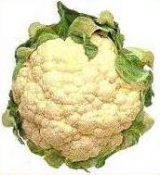
Cauliflower is one of several vegetables in the species
Brassica oleraceaBrassica oleracea, or wild cabbage, is a species of Brassica native to coastal southern and western Europe, where its tolerance of salt and lime and its intolerance of competition from other plants typically restrict its natural occurrence to limestone sea cliffs, like the chalk cliffs on both...
, in the family
BrassicaceaeBrassicaceae, a medium sized and economically important family of flowering plants , are informally known as the mustards, mustard flowers, the crucifers or the cabbage family....
. It is an
annual plantAn annual plant is a plant that usually germinates, flowers, and dies in a year or season. True annuals will only live longer than a year if they are prevented from setting seed...
that reproduces by seed. Typically, only the head (the
white curd) of aborted floral
meristemA meristem is the tissue in most plants consisting of undifferentiated cells , found in zones of the plant where growth can take place....
s is eaten, while the stalk and surrounding thick, green leaves are used in vegetable broth or discarded.
Its name is from
LatinLatin is an Italic language originally spoken in Latium and Ancient Rome. It, along with most European languages, is a descendant of the ancient Proto-Indo-European language. Although it is considered a dead language, a number of scholars and members of the Christian clergy speak it fluently, and...
caulis (cabbage) and flower, an acknowledgment of its unusual place among a family of food plants which normally produces only leafy greens for eating.
Brassica oleracea also includes
cabbageCabbage is a popular cultivar of the species Brassica oleracea Linne of the Family Brassicaceae and is a leafy green vegetable...
,
brussels sproutThe Brussels sprout is a cultivar of wild cabbage grown for its edible buds. The leafy green vegetables are typically 2.5–4 cm in diameter and look like miniature cabbages. The sprout is Brassica oleracea, in the "gemmifera" group of the family Brassicaceae...
s, kale,
broccoliBroccoli is a plant in the cabbage family, whose large flower head is used as a vegetable.-General:The word broccoli, from the Italian plural of , refers to "the flowering top of a cabbage"....
, and
collard greensCollard greens are various loose-leafed cultivars of Brassica oleracea , the same species as cabbage and broccoli. The plant is grown for its large, dark-colored, edible leaves and as a garden ornamental, mainly in Brazil, Portugal, the southern United States, many parts of Africa, Montenegro,...
, though they are of different
cultivar groupIn naming cultivated plants, a Group is a formal classification category, under the International Code of Nomenclature for Cultivated Plants :The term "Group" was introduced in the 2004 ICNCP, replacing the "Cultivar-group" of the 1995 ICNCP.A Group is united by some common trait; for example...
s.
For such a highly modified plant, cauliflower has a long history.
François Pierre La VarenneFrançois Pierre de la Varenne , Burgundian by birth, was the author of Le Cuisinier françois , the founding text of modern French cuisine. La Varenne broke with the Italian traditions that had revolutionized medieval French cookery in the 16th century...
employed
chouxfleurs in
Le cuisinier françois. They had been introduced to France from Genoa in the 16th century, and are featured in
Olivier de SerresOlivier de Serres was a French author and soil scientist whose Théâtre d'Agriculture was the text book of French agriculture in the 17th century..Serres was born at Villeneuve-de-Berg, Ardèche...
'
Théâtre de l'agriculture (1600), as
cauli-fiori "as the Italians call it, which are still rather rare in France; they hold an honorable place in the garden because of their delicacy", but they did not commonly appear on grand tables until the time of
Louis XIVLouis XIV , known as Louis the Great or the Sun King , was a Bourbon monarch who ruled as King of France and Navarre. His reign, from 1643 to his death in 1715, began at the age of four and lasted seventy-two years, three months, and eighteen days...
.
Botanical varieties
Cauliflower and
broccoliBroccoli is a plant in the cabbage family, whose large flower head is used as a vegetable.-General:The word broccoli, from the Italian plural of , refers to "the flowering top of a cabbage"....
are the same
speciesBrassica oleracea, or wild cabbage, is a species of Brassica native to coastal southern and western Europe, where its tolerance of salt and lime and its intolerance of competition from other plants typically restrict its natural occurrence to limestone sea cliffs, like the chalk cliffs on both...
and have very similar structures, though cauliflower replaces the green flower buds with a white
inflorescenceAn inflorescence is a group or cluster of flowers arranged on a stem that is composed of a main branch or a complicated arrangement of branches. Strictly, it is the part of the shoot of seed plants where flowers are formed and which is accordingly modified...
meristemA meristem is the tissue in most plants consisting of undifferentiated cells , found in zones of the plant where growth can take place....
.
Major groups
There are four major groups of cauliflower.
Italian : Diverse in appearance, and biennial and annual in type, this group includes white, Romanesco, various green, purple, brown and yellow cultivars. This type is the ancestral form from which the others were derived.
Northwest European biennial : Used in Europe for winter and early spring harvest, this was developed in France in the 19th century, and includes the old cultivars Roscoff and Angers.
Northern European annuals : Used in Europe and North America for summer and fall harvest, it was developed in Germany in the 18th century, and includes old cultivars Erfurt and Snowball.
Asian : A tropical cauliflower used in China and India, it was developed in India during the 19th century from the now-abandoned Cornish type, and includes old varieties Early Patna and Early Benaras.
Varieties
A comprehensive list of varieties is maintained at North Carolina State University.
Traditional varieties include 'Snowball', 'Hybrid White', 'Super Snowball', 'Snow Crown', 'Mayflower', Candid Charm', 'Mormon', 'Agrahani', 'poushi', 'maghi', 'Snow White' and 'Snow Grace'.
Self-blanching varieties are 'Self Blanche', 'Early Tuscan' and 'Late Tuscan'.
Heirloom varieties include 'All the Year Round', 'Early Pearl', 'Early Snowball', 'Igloo', 'Violetta Italia' and 'Walcheren Winter'.
Commercial varieties include 'Fremont', 'Igloo' and 'Snow Crown'
Colors
White : White cauliflower is the most common colour of cauliflower.
Orange : Orange cauliflower (
B. oleracea L. var.
botrytis) contains 25 times the level of
vitamin AVitamin A is a vitamin that is needed by the retina of the eye in the form of a specific metabolite, the light-absorbing molecule retinal, that is necessary for both low-light and color vision...
of white varieties. This trait came from a natural
mutantIn biology and especially genetics, a mutant is an individual, organism, or new genetic character, arising or resulting from an instance of mutation, which is a base-pair sequence change within the DNA of a gene or chromosome of an organism resulting in the creation of a new character or trait not...
found in a cauliflower field in
CanadaCanada is a North American country consisting of ten provinces and three territories. Located in the northern part of the continent, it extends from the Atlantic Ocean in the east to the Pacific Ocean in the west, and northward into the Arctic Ocean...
. Cultivars include 'Cheddar' and 'Orange Bouquet'.
Green : Green cauliflower, of the
B. oleracea botrytis group, is sometimes called
broccoflowerBroccoflower refers to either of two edible plants of the species Brassica oleracea with light green heads. The edible portion is the immature flower head of the plant....
. It is available both with the normal curd shape and a variant spiky curd called
Romanesco broccoliRomanesco broccoli, or Roman cauliflower, is an edible flower of the species Brassica oleracea, and a variant form of cauliflower.-History:Romanesco broccoli was first documented in Italy in the sixteenth century...
. Both types have been commercially available in the U.S. and Europe since the early 1990s. Green-curded varieties include 'Alverda', 'Green Goddess' and 'Vorda'. Romanesco varieties include 'Minaret' and 'Veronica'.
Purple : Purple color in cauliflower is caused by the presence of the antioxidant group
anthocyaninAnthocyanins are water-soluble vacuolar pigments that may appear red, purple, or blue according to pH...
s, which can also be found in
red cabbageThe red cabbage is a sort of cabbage, also known as Red Kraut or Blue Kraut after preparation....
and red wine. Varieties include 'Graffiti' and 'Purple Cape'. In Great Britain and southern Italy, a
broccoliBroccoli is a plant in the cabbage family, whose large flower head is used as a vegetable.-General:The word broccoli, from the Italian plural of , refers to "the flowering top of a cabbage"....
with tiny flower buds is sold as a vegetable under the name "purple cauliflower". It is not the same as standard cauliflower with a purple curd.
Nutrition
Cauliflower is low in fat, low in carbs but high in
dietary fiberDietary fiber, dietary fibre, or sometimes roughage is the indigestible portion of plant foods having two main components:* soluble fiber that is readily fermented in the colon into gases and physiologically active byproducts, and* insoluble fiber that is metabolically inert, absorbing water as it...
, folate, water, and
vitamin CVitamin C or L-ascorbic acid or L-ascorbate is an essential nutrient for humans and certain other animal species. In living organisms ascorbate acts as an antioxidant by protecting the body against oxidative stress...
, possessing a high
nutritional densityThe term nutrient density has several meanings.Most commonly, nutrient density is defined as a ratio of nutrient content to the total energy content . Nutrient-dense food is opposite to energy-dense food...
.
Cauliflower contains several
phytochemicalPhytochemicals are biologically active chemical compounds that occur naturally in plants . Phytochemicals are the molecules responsible for the color and organoleptic properties . For example, the deep purple color of blueberries and the smell of garlic...
s, common in the
cabbage familyBrassicaceae, a medium sized and economically important family of flowering plants , are informally known as the mustards, mustard flowers, the crucifers or the cabbage family....
, that may be beneficial to human health.
- Sulforaphane
Sulforaphane is an organosulfur compound that exhibits anticancer, antidiabetic, and antimicrobial properties in experimental models. It is obtained from cruciferous vegetables such as broccoli, Brussels sprouts or cabbages. The enzyme myrosinase transforms glucoraphanin, a glucosinolate, into...
, a compound released when cauliflower is chopped or chewed, may protect against cancer.
- Other glucosinolate
The glucosinolates are a class of organic compounds that contain sulfur and nitrogen and are derived from glucose and an amino acid. They occur as secondary metabolites of almost all plants of the order Brassicales , but also in the genus Drypetes .-Chemistry:Glucosinolates are water-soluble...
s
- Carotenoids
- Indole-3-carbinol
Indole-3-carbinol is produced by the breakdown of the glucosinolate glucobrassicin, which can be found at relatively high levels in cruciferous vegetables. Indole-3-carbinol is the subject of on-going Biomedical research into its possible anticarcinogenic, antioxidant, and anti-atherogenic effects...
, a chemical that enhances DNA repair, and acts as an estrogenEstrogens , oestrogens , or œstrogens, are a group of compounds named for their importance in the estrous cycle of humans and other animals. They are the primary female sex hormones. Natural estrogens are steroid hormones, while some synthetic ones are non-steroidal...
antagonist, slowing the growth of cancer cells.
Boiling reduces the levels of these compounds, with losses of 20–30% after five minutes, 40–50% after ten minutes, and 75% after thirty minutes. However, other preparation methods, such as
steamingSteaming is a method of cooking using steam. Steaming is considered a healthy cooking technique and capable of cooking almost all kinds of food.-Method:...
,
microwavingA microwave oven is a kitchen appliance that heats food by dielectric heating, using microwave radiation to heat polarized molecules within the food...
, and
stir fryingStir frying is an umbrella term used to describe two Chinese cooking techniques for preparing food in a wok: chǎo and bào . The term stir-fry was introduced into the English language by Buwei Yang Chao, in her book How to Cook and Eat in Chinese, to describe the chǎo technique...
, had no significant effect on the compounds.
A high intake of cauliflower has been associated with reduced risk of aggressive
prostate cancerProstate cancer is a form of cancer that develops in the prostate, a gland in the male reproductive system. Most prostate cancers are slow growing; however, there are cases of aggressive prostate cancers. The cancer cells may metastasize from the prostate to other parts of the body, particularly...
.
100g of cauliflower contains the following nutritional information according to the USDA:
- Calories : 25
- Fat: 0.28
- Carbohydrates: 4.97
- Fibers: 2
- Protein: 1.92
Cooking
Cauliflower can be roasted, boiled,
friedFried cauliflower, also known as Zahra Mekleyah , is a Levantine vegetarian dish served cold or hot, consisting of fried cauliflower, often accompanied by tahini sauce, lettuce, parsley and tomatoes, served on pita bread or sliced bread, often grilled or toasted...
, steamed or eaten raw. Steaming or microwaving better preserves anticancer compounds than boiling. When cooking, the outer leaves and thick stalks are removed, leaving only the florets. The leaves are also edible, but are most often discarded. The florets should be broken into similar-sized pieces so they are cooked evenly. After eight minutes of steaming, or five minutes of boiling, the florets should be soft, but not mushy (depending on size). Stirring while cooking can break the florets into smaller, uneven pieces. Cauliflower is often served with a cheese sauce, as in the dish
cauliflower cheeseCauliflower cheese, sometimes called cauliflower and cheese, is a British dish. It can be eaten as a main course, for lunch or dinner, or as a side dish, commonly accompanying roast meats such as beef or pork....
.
Low carbohydrate dieters can use cauliflower as a reasonable substitute for potatoes; while they can produce a similar texture, or mouth feel, they lack the
starchStarch or amylum is a carbohydrate consisting of a large number of glucose units joined together by glycosidic bonds. This polysaccharide is produced by all green plants as an energy store...
of potatoes.
Fractal dimension
Cauliflower has been noticed by mathematicians for its distinct
fractal dimensionIn fractal geometry, the fractal dimension, D, is a statistical quantity that gives an indication of how completely a fractal appears to fill space, as one zooms down to finer and finer scales. There are many specific definitions of fractal dimension. The most important theoretical fractal...
, predicted to be about 2.8.
History
The first reliable reference to cauliflower is found in the writings of the Arab Muslim scientists
Ibn al-'AwwamAbu Zakariya Yahya ibn Muhammad ibn Ahmad ibn Al-Awwam Al-Ishbili, was a Hispano-Muslim agriculturist who flourished at Seville about the end of the 12th century. He wrote the famous treatise on agriculture, Kitab al-fila-hah, one of the most important medieval works on the subject...
and Ibn al-Baitar, which date from the 12th and 13th centuries.
External links