
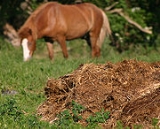
Manure is
organic matterOrganic matter is matter that has come from a once-living organism; is capable of decay, or the product of decay; or is composed of organic compounds...
used as
organic fertilizerOrganic fertilizers are naturally occurring fertilizers .Naturally occurring organic fertilizers include manure, slurry, worm castings, peat, seaweed, humic acid, and guano. Sewage sludge use in organic agricultural operations in the U.S...
in
agricultureAgriculture is the cultivation of animals, plants, fungi and other life forms for food, fiber, and other products used to sustain life. Agriculture was the key implement in the rise of sedentary human civilization, whereby farming of domesticated species created food surpluses that nurtured the...
. Manures contribute to the fertility of the soil by adding organic matter and nutrients, such as
nitrogenNitrogen is a chemical element that has the symbol N, atomic number of 7 and atomic mass 14.00674 u. Elemental nitrogen is a colorless, odorless, tasteless, and mostly inert diatomic gas at standard conditions, constituting 78.08% by volume of Earth's atmosphere...
, that are trapped by bacteria in the soil. Higher organisms then feed on the
fungiA fungus is a member of a large group of eukaryotic organisms that includes microorganisms such as yeasts and molds , as well as the more familiar mushrooms. These organisms are classified as a kingdom, Fungi, which is separate from plants, animals, and bacteria...
and bacteria in a chain of life that comprises the
soil food webThe soil food web is the community of organisms living all or part of their lives in the soil. It describes a complex living system in the soil and how it interacts with the environment, plants, and animals....
.
In the past, the term “manure” included inorganic
fertilizerFertilizer is any organic or inorganic material of natural or synthetic origin that is added to a soil to supply one or more plant nutrients essential to the growth of plants. A recent assessment found that about 40 to 60% of crop yields are attributable to commercial fertilizer use...
s, but this usage is now very rare.
Animal manures
Most animal manure is
fecesFeces, faeces, or fæces is a waste product from an animal's digestive tract expelled through the anus or cloaca during defecation.-Etymology:...
. Common forms of animal manure include farmyard manure (FYM) or farm slurry (liquid manure). FYM also contains plant material (often straw), which has been used as bedding for animals and has absorbed the feces and
urineUrine is a typically sterile liquid by-product of the body that is secreted by the kidneys through a process called urination and excreted through the urethra. Cellular metabolism generates numerous by-products, many rich in nitrogen, that require elimination from the bloodstream...
. Agricultural manure in liquid form, known as
slurryA slurry is, in general, a thick suspension of solids in a liquid.-Examples of slurries:Examples of slurries include:* Lahars* A mixture of water and cement to form concrete* A mixture of water, gelling agent, and oxidizers used as an explosive...
, is produced by more intensive livestock rearing systems where concrete or slats are used, instead of straw bedding. Manure from different animals has different qualities and requires different application rates when used as fertilizer. For example
horseThe horse is one of two extant subspecies of Equus ferus, or the wild horse. It is a single-hooved mammal belonging to the taxonomic family Equidae. The horse has evolved over the past 45 to 55 million years from a small multi-toed creature into the large, single-toed animal of today...
s,
cattleCattle are the most common type of large domesticated ungulates. They are a prominent modern member of the subfamily Bovinae, are the most widespread species of the genus Bos, and are most commonly classified collectively as Bos primigenius...
,
pigA pig is any of the animals in the genus Sus, within the Suidae family of even-toed ungulates. Pigs include the domestic pig, its ancestor the wild boar, and several other wild relatives...
s, sheep,
chickenThe chicken is a domesticated fowl, a subspecies of the Red Junglefowl. As one of the most common and widespread domestic animals, and with a population of more than 24 billion in 2003, there are more chickens in the world than any other species of bird...
s,
turkeyTurkey , known officially as the Republic of Turkey , is a Eurasian country located in Western Asia and in East Thrace in Southeastern Europe...
s,
rabbitRabbits are small mammals in the family Leporidae of the order Lagomorpha, found in several parts of the world...
s, humans (
sewageSewage is water-carried waste, in solution or suspension, that is intended to be removed from a community. Also known as wastewater, it is more than 99% water and is characterized by volume or rate of flow, physical condition, chemical constituents and the bacteriological organisms that it contains...
), and
guanoGuano is the excrement of seabirds, cave dwelling bats, and seals. Guano manure is an effective fertilizer due to its high levels of phosphorus and nitrogen and also its lack of odor. It was an important source of nitrates for gunpowder...
from
seabirdSeabirds are birds that have adapted to life within the marine environment. While seabirds vary greatly in lifestyle, behaviour and physiology, they often exhibit striking convergent evolution, as the same environmental problems and feeding niches have resulted in similar adaptations...
s and
batBats are mammals of the order Chiroptera "hand" and pteron "wing") whose forelimbs form webbed wings, making them the only mammals naturally capable of true and sustained flight. By contrast, other mammals said to fly, such as flying squirrels, gliding possums, and colugos, glide rather than fly,...
s all have different properties. For instance, sheep manure is high in nitrogen and potash, while pig manure is relatively low in both. Horse manure also contains lots of weed seeds, as horses do not digest seeds the way that cattle do. Chicken litter, coming from a bird, is very concentrated in nitrogen and protein and is prized for both properties.
Animal manures may be adulterated or contaminated with other animal products, such as
woolWool is the textile fiber obtained from sheep and certain other animals, including cashmere from goats, mohair from goats, qiviut from muskoxen, vicuña, alpaca, camel from animals in the camel family, and angora from rabbits....
(shoddy and other
hairHair is a filamentous biomaterial, that grows from follicles found in the dermis. Found exclusively in mammals, hair is one of the defining characteristics of the mammalian class....
),
featherFeathers are one of the epidermal growths that form the distinctive outer covering, or plumage, on birds and some non-avian theropod dinosaurs. They are considered the most complex integumentary structures found in vertebrates, and indeed a premier example of a complex evolutionary novelty. They...
s,
bloodBlood is a specialized bodily fluid in animals that delivers necessary substances such as nutrients and oxygen to the cells and transports metabolic waste products away from those same cells....
, and
boneBones are rigid organs that constitute part of the endoskeleton of vertebrates. They support, and protect the various organs of the body, produce red and white blood cells and store minerals. Bone tissue is a type of dense connective tissue...
. Livestock feed can be mixed with the manure due to spillage. For example, chickens are often fed
meat and bone mealMeat and bone meal is a product of the rendering industry. It is typically about 48 - 52% protein, 33-...
, an animal product, which can end up becoming mixed with chicken litter.
Compost
Compost is the decomposed remnants of organic materials – usually of plant origin, but often including some animal dung or bedding.
Plant manures
Green manureIn agriculture, a green manure is a type of cover crop grown primarily to add nutrients and organic matter to the soil. Typically, a green manure crop is grown for a specific period of time , and then plowed under and incorporated into the soil while green or shortly after flowering...
s are crops grown for the express purpose of plowing them in, thus increasing fertility through the incorporation of nutrients and organic matter into the soil.
Leguminous plants such as clover are often used for this, as they fix nitrogen using
RhizobiaRhizobia are soil bacteria that fix nitrogen after becoming established inside root nodules of legumes . Rhizobia require a plant host; they cannot independently fix nitrogen...
bacteria in specialized
nodesRoot nodules occur on the roots of plants that associate with symbiotic nitrogen-fixing bacteria. Under nitrogen-limiting conditions, capable plants form a symbiotic relationship with a host-specific strain of bacteria known as rhizobia...
in the root structure.
Other types of plant matter used as manure include the contents of the
rumenThe rumen, also known as a paunch, forms the larger part of the reticulorumen, which is the first chamber in the alimentary canal of ruminant animals. It serves as the primary site for microbial fermentation of ingested feed...
s of slaughtered
ruminantA ruminant is a mammal of the order Artiodactyla that digests plant-based food by initially softening it within the animal's first compartment of the stomach, principally through bacterial actions, then regurgitating the semi-digested mass, now known as cud, and chewing it again...
s, spent
hopsHops are the female flower clusters , of a hop species, Humulus lupulus. They are used primarily as a flavoring and stability agent in beer, to which they impart a bitter, tangy flavor, though hops are also used for various purposes in other beverages and herbal medicine...
(left over from
brewingBrewing is the production of beer through steeping a starch source in water and then fermenting with yeast. Brewing has taken place since around the 6th millennium BCE, and archeological evidence suggests that this technique was used in ancient Egypt...
beerBeer is the world's most widely consumed andprobably oldest alcoholic beverage; it is the third most popular drink overall, after water and tea. It is produced by the brewing and fermentation of sugars, mainly derived from malted cereal grains, most commonly malted barley and malted wheat...
) and
seaweedSeaweed is a loose, colloquial term encompassing macroscopic, multicellular, benthic marine algae. The term includes some members of the red, brown and green algae...
.
Uses of manure
Animal dung has been used for centuries as a
fertilizerFertilizer is any organic or inorganic material of natural or synthetic origin that is added to a soil to supply one or more plant nutrients essential to the growth of plants. A recent assessment found that about 40 to 60% of crop yields are attributable to commercial fertilizer use...
for farming, as it improves the soil structure (aggregation), so that it holds more nutrients and water, and becomes more fertile. Animal manure also encourages soil microbial activity, which promotes the soil's trace mineral supply, improving plant nutrition. It also contains some nitrogen and other nutrients that assist the growth of plants.
Manures with a particularly unpleasant odor (such as human sewage or slurry from
intensive pig farmingIntensive farming or intensive agriculture is an agricultural production system characterized by the high inputs of capital, labour, or heavy usage of technologies such as pesticides and chemical fertilizers relative to land area....
) are usually knifed (injected) directly into the soil to reduce release of the odor. Manure from pigs and cattle is usually spread on fields using a
manure spreaderA manure spreader or muck spreader or honey wagon is an agricultural machine used to distribute manure over a field as a fertilizer. A typical manure spreader consists of a trailer towed behind a tractor with a rotating mechanism driven by the tractor's power take off...
. Due to the relatively lower level of proteins in vegetable matter,
herbivoreHerbivores are organisms that are anatomically and physiologically adapted to eat plant-based foods. Herbivory is a form of consumption in which an organism principally eats autotrophs such as plants, algae and photosynthesizing bacteria. More generally, organisms that feed on autotrophs in...
manure has a milder smell than the dung of
carnivoreA carnivore meaning 'meat eater' is an organism that derives its energy and nutrient requirements from a diet consisting mainly or exclusively of animal tissue, whether through predation or scavenging...
s or
omnivoreOmnivores are species that eat both plants and animals as their primary food source...
s – for example,
elephantElephants are large land mammals in two extant genera of the family Elephantidae: Elephas and Loxodonta, with the third genus Mammuthus extinct...
dung is practically odorless. However, herbivore slurry that has undergone anaerobic
fermentationFermentation is the process of extracting energy from the oxidation of organic compounds, such as carbohydrates, using an endogenous electron acceptor, which is usually an organic compound. In contrast, respiration is where electrons are donated to an exogenous electron acceptor, such as oxygen,...
may develop more unpleasant odors, and this can be a problem in some agricultural regions. Poultry droppings are harmful to plants when fresh but, after a period of
compostCompost is organic matter that has been decomposed and recycled as a fertilizer and soil amendment. Compost is a key ingredient in organic farming. At its most essential, the process of composting requires simply piling up waste outdoors and waiting for the materials to break down from anywhere...
ing, are valuable fertilizers.
Manure is also commercially composted and bagged and sold retail as a soil amendment. Sometimes even human sewage sludge is used, as is the case for
Dillo DirtDillo Dirt is a compost made by the City of Austin, Texas since 1989. It was the first program of its kind in the state and one of the oldest in the nation. Dillo Dirt is named after the Nine-banded Armadillo , which is a mammal native to Texas...
, a product that has been sold by the city of
AustinAustin is the capital city of the U.S. state of :Texas and the seat of Travis County. Located in Central Texas on the eastern edge of the American Southwest, it is the fourth-largest city in Texas and the 14th most populous city in the United States. It was the third-fastest-growing large city in...
,
TexasTexas is the second largest U.S. state by both area and population, and the largest state by area in the contiguous United States.The name, based on the Caddo word "Tejas" meaning "friends" or "allies", was applied by the Spanish to the Caddo themselves and to the region of their settlement in...
municipal wastewater department since 1989.
Precautions
Manure generates
heatIn physics and thermodynamics, heat is energy transferred from one body, region, or thermodynamic system to another due to thermal contact or thermal radiation when the systems are at different temperatures. It is often described as one of the fundamental processes of energy transfer between...
as it decomposes, and it is possible for manure to
ignite spontaneouslySpontaneous combustion is the self-ignition of a mass, for example, a pile of oily rags. Allegedly, humans can also ignite and burn without an obvious cause; this phenomenon is known as spontaneous human combustion....
should it be stored in a massive pile. Once such a large pile of manure is burning, it will
foul the airAir pollution is the introduction of chemicals, particulate matter, or biological materials that cause harm or discomfort to humans or other living organisms, or cause damage to the natural environment or built environment, into the atmosphere....
over a very large area and require considerable effort to extinguish. Therefore, large
feedlotA feedlot or feedyard is a type of animal feeding operation which is used in factory farming for finishing livestock, notably beef cattle, but also swine, horses, sheep, turkeys, chickens or ducks, prior to slaughter. Large beef feedlots are called Concentrated Animal Feeding Operations . They...
s must take care to ensure that piles of fresh manure (faeces) do not get excessively large. There is no serious risk of spontaneous combustion in smaller operations.
There is also a risk of insects carrying feces to food and water supplies, making them unsuitable for human consumption.
Livestock antibiotics and hormones
In 2007, a University of Minnesota study indicated that foods such as corn, lettuce, and potatoes have been found to accumulate antibiotics from soils spread with animal manure that contains these drugs.
Organic foods are much less likely to contain antibiotics as veterinary drugs are not routinely used in organic farming systems. Most organic arable farmers either have their own supply of manure (which would, therefore, not normally contain drug residues) or else rely on green manure crops for the extra fertility (if any nonorganic manure is used by organic farmers, then it usually has to be rotted or composted to degrade any residues of drugs and eliminate any pathogenic bacteria - Standard 4.7.38, Soil Association organic farming standards).
See also
- Album graecum
Album græcum, or stercus canis officinale, is the dung of dogs or hyenas that has become white through exposure to air. It is used in dressing leather....
- Anaerobic digestion
Anaerobic digestion is a series of processes in which microorganisms break down biodegradable material in the absence of oxygen. It is used for industrial or domestic purposes to manage waste and/or to release energy....
- Biofuel
Biofuel is a type of fuel whose energy is derived from biological carbon fixation. Biofuels include fuels derived from biomass conversion, as well as solid biomass, liquid fuels and various biogases...
- Biomass
Biomass, as a renewable energy source, is biological material from living, or recently living organisms. As an energy source, biomass can either be used directly, or converted into other energy products such as biofuel....
- Coprophilous fungi
Coprophilous fungi are a type of saprobic fungi that grow on animal dung. The hardy spores of coprophilous species are unwittingly consumed by herbivores from vegetation, and are excreted along with the plant matter...
- Cow dung
Cow dung is the waste product of bovine animal species. These species include domestic cattle , bison , yak and water buffalo. Cow dung is the undigested residue of plant matter which has passed through the animal's gut. The resultant faecal matter is rich in minerals...
- ECODIPTERA
ECODIPTERA project, co-financed by the European program LIFE , aims at showing an innovative method of treating pig manure...
- Ecological sanitation
Ecological sanitation, also known as ecosan or eco-san, are terms coined to describe a form of sanitation that usually involves urine diversion and the recycling of water and nutrients contained within human wastes back into the local environment....
- Feces
Feces, faeces, or fæces is a waste product from an animal's digestive tract expelled through the anus or cloaca during defecation.-Etymology:...
External links