

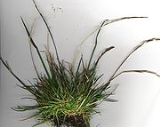
Ryegrass

Encyclopedia
Ryegrass is a genus of nine species of tufted grass
es in the Pooideae
subfamily of the Poaceae
family. Also called tares (even though there is no firm evidence that this is the same as the plant given that name in English language translations of the Bible
- vetches are another candidate), these plants are native to Europe
, Asia
and northern Africa
, but are widely cultivated and naturalized elsewhere. Ryegrasses are naturally diploid, with 2n = 14, and are closely related to the fescue
s Festuca.
Ryegrass should not be confused with rye
, which is a grain crop.
s, and as pasture
and for grazing and hay
for livestock
, being a highly nutritious stock feed. Ryegrasses are also used in soil
erosion
control programs. It is the principal grazing grass in New Zealand
where some 10 million kilograms of certified seed are produced every year. There is a large range of cultivar
s. The primary species found worldwide and used for both lawns and as a forage crop is perennial ryegrass (Lolium perenne). Like many cool-season grasses of the family Poaceae
, it harbors a symbiotic fungal endophyte, either Epichloë
or its close relative Neotyphodium
, of which both are of the fungal family Clavicipitaceae
Some species, particularly L. temulentum, are weed
s which can have a severe impact on the production of wheat and other crops. Ryegrass pollen
is also one of the major causes of hay fever
.
Many grass tennis courts are planted in ryegrass in different compositions, depending on the tournament.
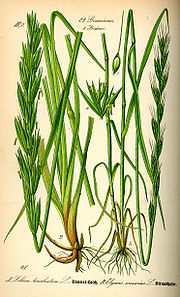
Grass
Grasses, or more technically graminoids, are monocotyledonous, usually herbaceous plants with narrow leaves growing from the base. They include the "true grasses", of the Poaceae family, as well as the sedges and the rushes . The true grasses include cereals, bamboo and the grasses of lawns ...
es in the Pooideae
Pooideae
The Pooideae is a subfamily of the true grass family Poaceae. It includes some major cereals such as wheat, barley, oat, rye and many lawn and pasture grasses.- List :...
subfamily of the Poaceae
Poaceae
The Poaceae is a large and nearly ubiquitous family of flowering plants. Members of this family are commonly called grasses, although the term "grass" is also applied to plants that are not in the Poaceae lineage, including the rushes and sedges...
family. Also called tares (even though there is no firm evidence that this is the same as the plant given that name in English language translations of the Bible
Bible
The Bible refers to any one of the collections of the primary religious texts of Judaism and Christianity. There is no common version of the Bible, as the individual books , their contents and their order vary among denominations...
- vetches are another candidate), these plants are native to Europe
Europe
Europe is, by convention, one of the world's seven continents. Comprising the westernmost peninsula of Eurasia, Europe is generally 'divided' from Asia to its east by the watershed divides of the Ural and Caucasus Mountains, the Ural River, the Caspian and Black Seas, and the waterways connecting...
, Asia
Asia
Asia is the world's largest and most populous continent, located primarily in the eastern and northern hemispheres. It covers 8.7% of the Earth's total surface area and with approximately 3.879 billion people, it hosts 60% of the world's current human population...
and northern Africa
Africa
Africa is the world's second largest and second most populous continent, after Asia. At about 30.2 million km² including adjacent islands, it covers 6% of the Earth's total surface area and 20.4% of the total land area...
, but are widely cultivated and naturalized elsewhere. Ryegrasses are naturally diploid, with 2n = 14, and are closely related to the fescue
Fescue
Festuce is a genus of about 300 species of perennial tufted grasses, belonging to the grass family Poaceae . The genus has a cosmopolitan distribution, although the majority of the species are found in cool temperate areas...
s Festuca.
Ryegrass should not be confused with rye
Rye
Rye is a grass grown extensively as a grain and as a forage crop. It is a member of the wheat tribe and is closely related to barley and wheat. Rye grain is used for flour, rye bread, rye beer, some whiskeys, some vodkas, and animal fodder...
, which is a grain crop.
Species
The following are accepted as distinct species:- Lolium canariense Steud. - Canary Islands ryegrass
- Lolium edwardii H.Scholz, Stierst. & Gaisberg
- Lolium multiflorumLolium multiflorumLolium multiflorum is a ryegrass native to temperate Europe, although the precise location of its origin is unknown....
Lam. - Italian ryegrass - Lolium perenneLolium perenneLolium perenne, common name Perennial Ryegrass, is a grass from the family Poaceae. It is native to Europe, Asia and northern Africa, but is widely cultivated and naturalised around the world.-Description:...
L. - Perennial ryegrass - Lolium persicum - Persian ryegrass or Persian darnel
- Lolium remotum Schrank
- Lolium rigidum Gaudin - Stiff darnel, Wimmera ryegrass
- Lolium temulentumLolium temulentumLolium temulentum, typically known as darnel, poison darnel or cockle, is an annual plant that forms part of the Poaceae family and part of the Lolium genus. The plant stem can grow up to one meter tall, with inflorescence in the ears and purple grain...
L. - Darnel, poison darnel
Cultivation and uses
Ryegrasses contain some species which are important grasses for both lawnLawn
A lawn is an area of aesthetic and recreational land planted with grasses or other durable plants, which usually are maintained at a low and consistent height. Low ornamental meadows in natural landscaping styles are a contemporary option of a lawn...
s, and as pasture
Pasture
Pasture is land used for grazing. Pasture lands in the narrow sense are enclosed tracts of farmland, grazed by domesticated livestock, such as horses, cattle, sheep or swine. The vegetation of tended pasture, forage, consists mainly of grasses, with an interspersion of legumes and other forbs...
and for grazing and hay
Hay
Hay is grass, legumes or other herbaceous plants that have been cut, dried, and stored for use as animal fodder, particularly for grazing livestock such as cattle, horses, goats, and sheep. Hay is also fed to pets such as rabbits and guinea pigs...
for livestock
Livestock
Livestock refers to one or more domesticated animals raised in an agricultural setting to produce commodities such as food, fiber and labor. The term "livestock" as used in this article does not include poultry or farmed fish; however the inclusion of these, especially poultry, within the meaning...
, being a highly nutritious stock feed. Ryegrasses are also used in soil
Soil
Soil is a natural body consisting of layers of mineral constituents of variable thicknesses, which differ from the parent materials in their morphological, physical, chemical, and mineralogical characteristics...
erosion
Erosion
Erosion is when materials are removed from the surface and changed into something else. It only works by hydraulic actions and transport of solids in the natural environment, and leads to the deposition of these materials elsewhere...
control programs. It is the principal grazing grass in New Zealand
New Zealand
New Zealand is an island country in the south-western Pacific Ocean comprising two main landmasses and numerous smaller islands. The country is situated some east of Australia across the Tasman Sea, and roughly south of the Pacific island nations of New Caledonia, Fiji, and Tonga...
where some 10 million kilograms of certified seed are produced every year. There is a large range of cultivar
Cultivar
A cultivar'Cultivar has two meanings as explained under Formal definition. When used in reference to a taxon, the word does not apply to an individual plant but to all those plants sharing the unique characteristics that define the cultivar. is a plant or group of plants selected for desirable...
s. The primary species found worldwide and used for both lawns and as a forage crop is perennial ryegrass (Lolium perenne). Like many cool-season grasses of the family Poaceae
Poaceae
The Poaceae is a large and nearly ubiquitous family of flowering plants. Members of this family are commonly called grasses, although the term "grass" is also applied to plants that are not in the Poaceae lineage, including the rushes and sedges...
, it harbors a symbiotic fungal endophyte, either Epichloë
Epichloë
Epichloë species and their close relatives, the Neotyphodium species, are systemic and constitutive symbionts of cool-season grasses , and belong to the fungal family Clavicipitaceae...
or its close relative Neotyphodium
Neotyphodium
Neotyphodium is a form genus containing species of endophytic fungi. These endophytes are asexual, seed-borne symbionts of cool-season grasses, and grow intercellularly throughout the aerial tissues of their hosts, including shoot apical meristems, leaf sheaths and blades, inflorescences, seeds and...
, of which both are of the fungal family Clavicipitaceae
Clavicipitaceae
Clavicipitaceae is a family of fungi within the order Hypocreales. It consists of 43 genera, and 321 species.-Phylogeny:Molecular phylogenetic analysis of multigene DNA sequence data indicates that the taxon, Clavicipitaceae, is paraphyletic, and consists of three well-defined clades, at least one...
Some species, particularly L. temulentum, are weed
Weed
A weed in a general sense is a plant that is considered by the user of the term to be a nuisance, and normally applied to unwanted plants in human-controlled settings, especially farm fields and gardens, but also lawns, parks, woods, and other areas. More specifically, the term is often used to...
s which can have a severe impact on the production of wheat and other crops. Ryegrass pollen
Pollen
Pollen is a fine to coarse powder containing the microgametophytes of seed plants, which produce the male gametes . Pollen grains have a hard coat that protects the sperm cells during the process of their movement from the stamens to the pistil of flowering plants or from the male cone to the...
is also one of the major causes of hay fever
Hay Fever
Hay Fever is a comic play written by Noël Coward in 1924 and first produced in 1925 with Marie Tempest as the first Judith Bliss. Laura Hope Crews played the role in New York...
.
Many grass tennis courts are planted in ryegrass in different compositions, depending on the tournament.
Synonyms
- L. ambiguum = Lolium multiflorum
- L. annuum = Lolium temulentum
- L. arundinaceum = Festuca arundinacea
- L. berteronianum = Lolium temulentum
- L. brasilianum = Lolium perenne
- L. canadense = Lolium perenne
- L. crassiculme = Lolium rigidum
- L. cuneatum = Lolium temulentum
- L. dorei = Lolium persicum
- L. giganteum = Festuca gigantea
- L. gracile = Lolium temulentum
- L. lepturoides = Lolium rigidum subsp. lepturoides
- L. marschallii = Lolium perenne
- L. parabolicae = Lolium rigidum
- L. pratense = Festuca pratensis
- L. remotum = Lolium temulentum subsp. remotum
- L. romanum = Lolium multiflorum
- L. scabrum = Lolium multiflorum
- L. siculum = Lolium multiflorum
- L. subulatum = Lolium rigidum subsp. lepturoides
- L. teres = Lolium rigidum subsp. lepturoides
- L. trabutii = Lolium rigidum