


Sans-culottes

Encyclopedia
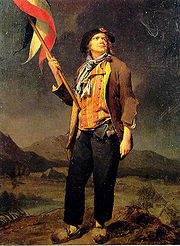
French Revolution
The French Revolution , sometimes distinguished as the 'Great French Revolution' , was a period of radical social and political upheaval in France and Europe. The absolute monarchy that had ruled France for centuries collapsed in three years...
, the sans-culottes (sɑ̃ kylɔt, without silk knee-breeches) were the radical militants of the lower classes, typically urban laborers. Though ill-clad and ill-equipped, they made up the bulk of the Revolutionary army
French Revolutionary Army
The French Revolutionary Army is the term used to refer to the military of France during the period between the fall of the ancien regime under Louis XVI in 1792 and the formation of the First French Empire under Napoleon Bonaparte in 1804. These armies were characterised by their revolutionary...
during the early years of the French Revolutionary Wars
French Revolutionary Wars
The French Revolutionary Wars were a series of major conflicts, from 1792 until 1802, fought between the French Revolutionary government and several European states...
. The appellation refers to the fashionable culottes
Culottes
Culottes is a word that originated in French. Historically, "culottes" referred to the knee-breeches commonly worn by gentlemen of the European upper-classes from the late Middle Ages or Renaissance through the early nineteenth century. This style of tight pants ending just below the knee was first...
(silk knee-breeches) of the moderate bourgeois
Bourgeoisie
In sociology and political science, bourgeoisie describes a range of groups across history. In the Western world, between the late 18th century and the present day, the bourgeoisie is a social class "characterized by their ownership of capital and their related culture." A member of the...
revolutionaries as distinguished from the working class
Working class
Working class is a term used in the social sciences and in ordinary conversation to describe those employed in lower tier jobs , often extending to those in unemployment or otherwise possessing below-average incomes...
sans-culottes, who traditionally wore pantalons (long trousers).
Among the political ideals held by the sans-culottes were popular democracy
Popular democracy
Popular democracy is a notion of direct democracy based on referendums and other devices of empowerment and concretization of popular will. The concept evolved out of the political philosophy of Populism, as a fully democratic version of this popular empowerment ideology, but since it has become...
, social
Social equality
Social equality is a social state of affairs in which all people within a specific society or isolated group have the same status in a certain respect. At the very least, social equality includes equal rights under the law, such as security, voting rights, freedom of speech and assembly, and the...
and economic equality
Economic egalitarianism
Economic egalitarianism is a state of economic affairs in which equality of outcome has been manufactured for all the participants of a society...
, affordable food, rejection of the free-market economy
Free market
A free market is a competitive market where prices are determined by supply and demand. However, the term is also commonly used for markets in which economic intervention and regulation by the state is limited to tax collection, and enforcement of private ownership and contracts...
, and zealous pursuit of perceived counter-revolutionaries and political enemies. During the peak of their influence, roughly 1792 to 1795, the sans-culottes provided the principal support behind the two far-left
Left-wing politics
In politics, Left, left-wing and leftist generally refer to support for social change to create a more egalitarian society...
factions of the Paris Commune
Paris Commune (French Revolution)
The Paris Commune during the French Revolution was the government of Paris from 1789 until 1795. Established in the Hôtel de Ville just after the storming of the Bastille, the Commune became insurrectionary in the summer of 1792, essentially refusing to take orders from the central French...
, the Enragés
Enragés
Les Enragés were a loose amalgam of radicals active during the French Revolution. Politically they stood to the left of the Jacobins. Represented by Jacques Roux, Théophile Leclerc, Jean Varlet and others, they believed that liberty for all meant more than mere constitutional rights...
and the Hébertists
Hébertists
The Hébertists were an ultra-revolutionary political faction associated with the populist journalist Jacques Hébert. They came to power during the Reign of Terror and played a significant role in the French Revolution....
. Led by revolutionaries such as Jacques Roux
Jacques Roux
Jacques Roux was a radical Roman Catholic priest that took an active role in the revolutionary politics of Paris 1789, during the French Revolution...
and Jacques Hébert
Jacques Hébert
Jacques René Hébert was a French journalist, and the founder and editor of the extreme radical newspaper Le Père Duchesne during the French Revolution...
, the sans-culottes were rallied to provide critical support for the most radical left-wing
Left-wing politics
In politics, Left, left-wing and leftist generally refer to support for social change to create a more egalitarian society...
factions in the successive governments of the revolution. Radicalized and militarized, the sans-culottes likely provided the material strength for the more violent and visceral events of the revolution, such as September massacres
September Massacres
The September Massacres were a wave of mob violence which overtook Paris in late summer 1792, during the French Revolution. By the time it had subsided, half the prison population of Paris had been executed: some 1,200 trapped prisoners, including many women and young boys...
of 1792. During the Reign of Terror
Reign of Terror
The Reign of Terror , also known simply as The Terror , was a period of violence that occurred after the onset of the French Revolution, incited by conflict between rival political factions, the Girondins and the Jacobins, and marked by mass executions of "enemies of...
, they provided important support for the violent policies of Maximilien Robespierre
Maximilien Robespierre
Maximilien François Marie Isidore de Robespierre is one of the best-known and most influential figures of the French Revolution. He largely dominated the Committee of Public Safety and was instrumental in the period of the Revolution commonly known as the Reign of Terror, which ended with his...
and the Committee of Public Safety
Committee of Public Safety
The Committee of Public Safety , created in April 1793 by the National Convention and then restructured in July 1793, formed the de facto executive government in France during the Reign of Terror , a stage of the French Revolution...
.
By early 1794, however, radicalism
Political radicalism
The term political radicalism denotes political principles focused on altering social structures through revolutionary means and changing value systems in fundamental ways...
was rapidly losing influence and political legitimacy in the Paris Commune
Paris Commune (French Revolution)
The Paris Commune during the French Revolution was the government of Paris from 1789 until 1795. Established in the Hôtel de Ville just after the storming of the Bastille, the Commune became insurrectionary in the summer of 1792, essentially refusing to take orders from the central French...
. The far-left factions that enjoyed the support of the sans-culottes began feeling the wrath of Robespierre and the Committee of Public Safety, and the important leaders of the Enragés and Hébertists were imprisoned and executed by the very Revolutionary Tribunal
Revolutionary Tribunal
The Revolutionary Tribunal was a court which was instituted in Paris by the Convention during the French Revolution for the trial of political offenders, and eventually became one of the most powerful engines of the Reign of Terror....
s they had supported. With the absence of effective leadership and having lost their favor with the Jacobins
Jacobin Club
The Jacobin Club was the most famous and influential political club in the development of the French Revolution, so-named because of the Dominican convent where they met, located in the Rue St. Jacques , Paris. The club originated as the Club Benthorn, formed at Versailles from a group of Breton...
, the sans-culottes withered. Within a year of the execution of Robespierre and the Thermidorian Reaction
Thermidorian Reaction
The Thermidorian Reaction was a revolt in the French Revolution against the excesses of the Reign of Terror. It was triggered by a vote of the Committee of Public Safety to execute Maximilien Robespierre, Antoine Louis Léon de Saint-Just de Richebourg and several other leading members of the Terror...
the militants were forcibly - and permanently - suppressed by the more conservative new government, the French Directory
French Directory
The Directory was a body of five Directors that held executive power in France following the Convention and preceding the Consulate...
.
Appearance
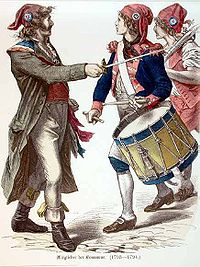
- the pantalon (long trousers) - in place of the culottes (knee-breeches) worn by the upper classes
- the carmagnole (short-skirted coat)
- the red cap of liberty
- sabots (clogs)
Legacy
The popular image of the sans-culotte has gained currency as an enduring symbol for the passion, idealism and patriotismPatriotism
Patriotism is a devotion to one's country, excluding differences caused by the dependencies of the term's meaning upon context, geography and philosophy...
of the common man of the French Revolution
French Revolution
The French Revolution , sometimes distinguished as the 'Great French Revolution' , was a period of radical social and political upheaval in France and Europe. The absolute monarchy that had ruled France for centuries collapsed in three years...
. The term sans-culottism (French: sans-culottisme) refers to this idealized image and the themes associated with it. Many public figures and revolutionaries who were not strictly working class styled themselves citoyens sans-culottes in solidarity and recognition. However, in the period immediately following the Thermidorian Reaction
Thermidorian Reaction
The Thermidorian Reaction was a revolt in the French Revolution against the excesses of the Reign of Terror. It was triggered by a vote of the Committee of Public Safety to execute Maximilien Robespierre, Antoine Louis Léon de Saint-Just de Richebourg and several other leading members of the Terror...
the sans-culottes and other far-left
Left-wing politics
In politics, Left, left-wing and leftist generally refer to support for social change to create a more egalitarian society...
political faction
Political faction
A political faction is a grouping of individuals, such as a political party, a trade union, or other group with a political purpose. A faction or political party may include fragmented sub-factions, “parties within a party," which may be referred to as power blocs, or voting blocs. The individuals...
s were heavily persecuted and repressed.
The Republican Calendar at first termed the complementary days at the end of the year Sans-culottides; however, the National Convention
National Convention
During the French Revolution, the National Convention or Convention, in France, comprised the constitutional and legislative assembly which sat from 20 September 1792 to 26 October 1795 . It held executive power in France during the first years of the French First Republic...
suppressed the name when adopting the Constitution of the Year III (1795) and substituted the name jours complémentaires.
Criticism
Marxist historian Eric HobsbawmEric Hobsbawm
Eric John Ernest Hobsbawm , CH, FBA, is a British Marxist historian, public intellectual, and author...
claims that the sans-culottes were a 'shapeless, mostly urban movement of the labouring poor, small craftsmen, shopkeepers, artisans, tiny entrepreneurs and the like'. He observes they were organised notably in the local political clubs of Paris and "provided the main striking-force of the revolution". These were the actual demonstrators, rioters and the constructors of barricades. However, Hobsbawm argues that sans-culottism provided no real alternative to the bourgeois radicalism of the Jacobins
Jacobin (politics)
A Jacobin , in the context of the French Revolution, was a member of the Jacobin Club, a revolutionary far-left political movement. The Jacobin Club was the most famous political club of the French Revolution. So called from the Dominican convent where they originally met, in the Rue St. Jacques ,...
. From Hobsbawm's perspective, the ideal of the sans-culottes, which sought to express the interests of the 'little men' who existed between the poles of the bourgeois
Bourgeoisie
In sociology and political science, bourgeoisie describes a range of groups across history. In the Western world, between the late 18th century and the present day, the bourgeoisie is a social class "characterized by their ownership of capital and their related culture." A member of the...
and the proletarian
Proletariat
The proletariat is a term used to identify a lower social class, usually the working class; a member of such a class is proletarian...
, was contradictory and ultimately unrealisable.
See Also
- French RevolutionFrench RevolutionThe French Revolution , sometimes distinguished as the 'Great French Revolution' , was a period of radical social and political upheaval in France and Europe. The absolute monarchy that had ruled France for centuries collapsed in three years...
- EnragésEnragésLes Enragés were a loose amalgam of radicals active during the French Revolution. Politically they stood to the left of the Jacobins. Represented by Jacques Roux, Théophile Leclerc, Jean Varlet and others, they believed that liberty for all meant more than mere constitutional rights...
- HébertistsHébertistsThe Hébertists were an ultra-revolutionary political faction associated with the populist journalist Jacques Hébert. They came to power during the Reign of Terror and played a significant role in the French Revolution....
- DescamisadoDescamisadoDescamisado is a Spanish word that literally means "without shirt" or "shirtless." The term was originally used as an insult by the elite of Argentina to describe the followers of Juan Perón, who served as president of Argentina from 1946 until 1955, and then again briefly from 1973 to 1974...