
All Topics  
Radish

 
Radish

   Email Print
   Bookmark   Link


Radish


The radish (Raphanus sativus) is an edible
Eating

In general terms, eating is the process of consuming food to provide for the nutritional needs of an animal, particularly their food energy requirements and to growth....
 root vegetable
Root vegetable

Root vegetables are plant roots used as vegetables. Other underground plants are often, erroneously, called root vegetables. Root vegetables include both true roots such as tuberous roots and taproots, but exclude non-roots such as tubers, rhizomes, corms, and bulbs....
 of the Brassicaceae
Brassicaceae

Brassicaceae or Cruciferae, also known as the crucifers, the mustard family or cabbage family is a Family of flowering plants ....
 family that was domesticated in Europe
Europe

Europe is, conventionally, one of the world's seven continents. Comprising the westernmost peninsula of Eurasia, Europe is generally divided from Asia to its east by the water divide of the Ural Mountains, the Ural , the Caspian Sea, and by the Caucasus Mountains to the southeast....
 in pre-Roman
Roman Empire

The Roman Empire was the Roman Republic phase of the Ancient Rome, characterised by an autocracy form of government and large territorial holdings in Europe and around the Mediterranean....
 times. They are grown and consumed throughout the world. Radishes have numerous varieties, varying in size, color and duration of required cultivation time. There are some radishes that are grown for their seeds; oilseed radishes are grown, as the name implies, for oil production.

History
The descriptive Greek name of the genus Raphanus means "quickly appearing" and refers to the rapid germination of these plants.


Nutrition Facts


Discussion
Ask a question about 'Radish'
Start a new discussion about 'Radish'
Answer questions from other users
Full Discussion Forum


Recent Posts


Encyclopedia


The radish (Raphanus sativus) is an edible
Eating

In general terms, eating is the process of consuming food to provide for the nutritional needs of an animal, particularly their food energy requirements and to growth....
 root vegetable
Root vegetable

Root vegetables are plant roots used as vegetables. Other underground plants are often, erroneously, called root vegetables. Root vegetables include both true roots such as tuberous roots and taproots, but exclude non-roots such as tubers, rhizomes, corms, and bulbs....
 of the Brassicaceae
Brassicaceae

Brassicaceae or Cruciferae, also known as the crucifers, the mustard family or cabbage family is a Family of flowering plants ....
 family that was domesticated in Europe
Europe

Europe is, conventionally, one of the world's seven continents. Comprising the westernmost peninsula of Eurasia, Europe is generally divided from Asia to its east by the water divide of the Ural Mountains, the Ural , the Caspian Sea, and by the Caucasus Mountains to the southeast....
 in pre-Roman
Roman Empire

The Roman Empire was the Roman Republic phase of the Ancient Rome, characterised by an autocracy form of government and large territorial holdings in Europe and around the Mediterranean....
 times. They are grown and consumed throughout the world. Radishes have numerous varieties, varying in size, color and duration of required cultivation time. There are some radishes that are grown for their seeds; oilseed radishes are grown, as the name implies, for oil production.

History


The descriptive Greek name of the genus Raphanus means "quickly appearing" and refers to the rapid germination of these plants. Raphanistrum from the same Greek root is an old name once used for this genus.

Although the radish was a well-established crop in Hellenistic and Roman
Roman Empire

The Roman Empire was the Roman Republic phase of the Ancient Rome, characterised by an autocracy form of government and large territorial holdings in Europe and around the Mediterranean....
 times, which leads to the assumption that it was brought into cultivation at an earlier time, Zohary and Hopf note that "there are almost no archeological records available" to help determine its earlier history and domestication. Wild forms of the radish and its relatives the mustards
Mustard plant

Mustards are several plant species in the genera Brassica and Sinapis whose small mustard seeds are used as a spice and, by grinding and mixing them with water, vinegar or other liquids, are turned into the condiment known as Mustard ....
 and turnip
Turnip

The turnip is a root vegetable commonly grown in temperate climates worldwide for its white, bulbous taproot. Small, tender, varieties are grown for human consumption, while larger varieties are grown as fodder for livestock....
 can be found over west Asia and Europe, suggesting that their domestication took place somewhere in that area. However Zohary and Hopf conclude, "Suggestions as to the origins of these plants are necessarily based on linguistic considerations."

Cultivation

Summer radishes mature rapidly, with many varieties germinating in 3-7 days, and reaching maturity in three to four weeks. A common garden crop in the U.S., the fast harvest cycle makes them a popular choice for children's gardens. Harvesting periods can be extended through repeated plantings, spaced a week or two apart. Radishes grow best in full sun and light, sandy loams with pH 6.5 - 7.0. They are in season from April to June and from October to January in most parts of North America; in Europe and Japan they are available year-round due to the plurality of varieties grown. As with other root crops, tilling the soil helps the roots grow. Most soil types will work, though sandy loams are particularly good for winter and spring crops, while soils that form a hard crust can impair growth. The depth at which seeds are planted affects the size of the root, from 1 cm deep recommended for small radishes to 4 cm for large radishes.

Varieties

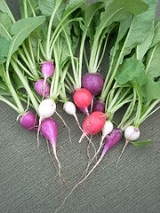
Broadly speaking, radishes can be categorized into four main types (summer, fall, winter, and spring) and a variety of shapes, colours, and sizes, such as black or multi-coloured radishes, with round or elongated roots that can grow longer than a parsnip
Parsnip

The parsnip is a root vegetable related to the carrot. Parsnips resemble carrots, but are paler than most of them and have a stronger flavor. Like carrots, parsnips are native to Eurasia and have been eaten there since ancient times....
.

Spring or summer radishes

Sometimes referred to as European radishes, or as spring radishes if they're typically planted in cooler weather, summer radishes are generally small and have a relatively short 3-4 week cultivation time.

  • The April Cross is a giant white radish hybrid that bolts very slowly.
  • Cherry Belle is a bright red-skinned round variety with a white interior. It is familiar in North American supermarkets.
  • Champion is round and red-skinned like the Cherry Belle, but with slightly larger roots, up to about 5 cm, and a milder flavor.
  • Red King has a mild flavor, with good resistance to club foot, a problem that can arise from poor drainage.
  • Snow Belle is an all-white variety of radish, also round like the Cherry Belle.
  • White Icicle or just Icicle is a white carrot-shaped variety, around 10-12 cm long, dating back to the 16th century. It slices easily, and has better than average resistance to pithiness.
  • French Breakfast is an elongated red-skinned radish with a white splash at the root end. It is typically slightly milder than other summer varieties, but is among the quickest to turn pithy.
  • Plum Purple a purple-fuchsia
    Fuchsia

    Fuchsia is a genus of flowering plants, mostly shrubs and can grow long shoots, which were identified by Charles Plumier in the late-17th century, and named by Charles Plumier in 1703 after the Germany botanist Leonhart Fuchs ....
     radish that tends to stay crisp longer than the average radish.
  • Gala and Roodbol are two varieties popular in the Netherlands in a breakfast dish, thinly sliced on buttered bread.
  • Easter Egg is not an actual variety, but a mix of varieties with different skin colors, typically including white, pink, red, and purple radishes. Sold in markets or seed packets under the name, the seed mixes can extend harvesting duration from a single planting, as different varieties may mature at different times.


Winter varieties

Black Spanish or Black Spanish Round occur in both round and elongated forms, and are sometimes simply called the black radish or known by the French name Gros Noir d'Hiver. It dates in Europe to 1548, and was a common garden variety in England and France the early 19th century. It has a rough black skin with hot-flavored white flesh, is round or irregularly pear shaped, and grows to around 10cm in diameter. There has also been a new radish recently discovered in Japan, which scienists believe is from a hybrid of the "White Icicle" radish and the "Plum Purple" radish.It is a deep purple color and is found mostly at the base of Mt. Fuji in caves. Scientists are calling it the "Night's Air" radish, since it does not grow as well in direct sunlight.

Daikon
Daikon

is the Japanese name for a mild-flavored, very large, white, East Asian radish. Despite being known most commonly by its Japanese name, it did not originate in Japan, but rather in continental Asia....
 refers to a wide variety of winter radishes from east Asia. While the Japanese name daikon has been adopted in English, it is also sometimes called the Japanese radish, Chinese radish, or Oriental radish. In areas with a large South Asian population, it is marketed as mooli. Daikon commonly have elongated white roots, although many varieties of daikon exist. One well known variety is April Cross, with smooth white roots. The New York Times describes Masato Red and Masato Green varieties as extremely long, well suited for fall planting and winter storage. The Sakurajima
Sakurajima

, also romanized as Sakurashima,s a composite with the Summit split into three peaks, Kitadake , Nakadake and Minamidake which is active now....
 daikon is a hot flavored variety which is typically grown to around 10 kg when harvested, but which has grown as heavy as 30 kg when left in the ground.

Seed pod varieties

The seeds of radishes grow in pods, following flowering that happens when left to grow past their normal harvesting period. The seeds are edible, and are sometimes used as a crunchy, spicy addition to salads. Some varieties are grown specifically for their seeds or seed pods, rather than their roots. The Rat-tailed radish, an old European variety thought to have come from East Asia centuries ago, has long, thin, curly pods which can exceed 20cm in length. In the 17th century, the pods were often pickled and served with meat. The München Bier variety supplies spicy seeds that are sometimes served raw as an accompaniment to beer in Germany.

Nutritional value

Radishes are rich in ascorbic acid
Ascorbic acid

Ascorbic acid is a sugar acid with antioxidant properties. Its appearance is white to light-yellow crystals or powder. It is water-soluble. The L-enantiomer of ascorbic acid is commonly known as vitamin C....
, folic acid
Folic acid

Folic acid and Folate are forms of the water-soluble B vitamins. Vitamin B9 is essential to numerous bodily functions ranging from nucleotide synthesis to the remethylation of homocysteine....
, and potassium
Potassium

Potassium is a chemical element. It has the symbol K , atomic number 19, and atomic mass 39.0983. Potassium was first isolated from potash, hence the name....
. They are a good source of vitamin B6
Vitamin B6

Vitamin B6 is a water-soluble vitamin and is part of the vitamin B complex group. Pyridoxal phosphate is the active form and is a cofactor in many reactions of amino acid metabolism, including transamination, deamination, and decarboxylation....
, riboflavin
Riboflavin

Riboflavin , also known as vitamin B2, is an easily absorbed micronutrient with a key role in maintaining health in humans and animals....
, magnesium
Magnesium

Magnesium is a chemical element with the symbol Mg, atomic number 12, atomic weight 24.3050 and common oxidation number +2.Magnesium, an alkaline earth metal, is the ninth most abundance of the chemical elements in the universe by mass....
, copper
Copper

Copper is a chemical element with the symbol Cu and atomic number 29.It is a ductile metal with very high thermal and electrical conductivity....
, and calcium
Calcium

Calcium is the chemical element with the symbol Ca and atomic number 20. It has an atomic mass of 40.078 amu. Calcium is a soft grey alkaline earth metal, and is the fifth most abundant element by mass in the earth's Crust ....
. One cup of sliced red radish bulbs provides approximately 20 Calorie
Calorie

The calorie is a pre-SI metric system unit of energy. The unit was first defined by Professor Nicolas Cl?ment in 1824 as a unit of heat. This definition entered French and English dictionaries between 1841 and 1867....
s or less, coming largely from carbohydrate
Carbohydrate

Carbohydrates or saccharides are the most abundant of the four major classes of biomolecules. They fill numerous roles in living things, such as the storage and transport of energy and structural components ....
s, making radishes, relative to their size, a very filling food for their caloric value.

Uses


In cooking


The most popular part for eating is the napiform taproot
Taproot

A plant's taproot is a somewhat straight tapering root that grows vertically downward. It forms a center from which other roots sprout laterally....
, although the entire plant is edible and the tops can be used as a leaf vegetable
Leaf vegetable

Leaf vegetables, also called potherbs, greens, or leafy greens, are plant leaf eaten as a vegetable, sometimes accompanied by tender Petiole s and shoots....
. The skin comes in a variety of colours. Most commonly known is the round, red-skinned variety but other varieties may have a pink, white or gray-black skin, and there is a yellow-skinned variety.

The bulb of the radish is usually eaten raw, but tougher specimens can be steamed. The raw flesh has a crisp texture and a pungent, peppery flavor, caused by chewing glucosinolate
Glucosinolate

The glucosinolates are a class of organic compounds that contain sulfur and nitrogen and are derived from glucose and an amino acid. They occur as secondary metabolites of almost all plants of the order Brassicales , but also in the genus Drypetes ....
s and the enzyme myrosinase in the radish, that, when brought together form allyl isothiocyanate
Allyl isothiocyanate

Allyl isothiocyanate is the organosulfur compound with the formula CH2CHCH2NCS. This colourless oil is responsible for the pungent taste of Mustard , horseradish, and wasabi....
s , also present in mustard
Mustard plant

Mustards are several plant species in the genera Brassica and Sinapis whose small mustard seeds are used as a spice and, by grinding and mixing them with water, vinegar or other liquids, are turned into the condiment known as Mustard ....
, horseradish
Horseradish

Horseradish is a perennial plant of the Brassicaceae family, which also includes Mustard plant, wasabi, and cabbages. The plant is probably native to southeastern Europe and western Asia, but is popular around the world today....
 and wasabi
Wasabi

Wasabi is a member of the Brassicaceae family, which includes cabbages, horseradish and Mustard plant. Known as "Japanese horseradish", its root is used as a spice and has an extremely strong flavour....
.

Radishes can be used in salads, as well as in many European dishes.

In medicine

Radishes are suggested as an alternative
Alternative medicine

The term alternative medicine, as used in the modern western world, encompasses any healing practice "that does not fall within the realm of conventional medicine"....
 treatment for a variety of ailments including whooping cough, cancer
Cancer

Cancer is a class of diseases in which a group of cell display uncontrolled growth , invasion , and sometimes metastasis . These three malignant properties of cancers differentiate them from benign tumors, which are self-limited, do not invade or metastasize....
, cough
Cough

A cough , in medicine, is a sudden and often repetitively occurring defense reflex which helps to clear the large breathing passages from excess secretions, irritants, foreign particles and microbes....
s, gastric discomfort, liver
Liver

The liver is a vital organ present in vertebrates and some other animals; it has a wide range of functions, a few of which are detoxification, protein synthesis, and production of biochemicals necessary for digestion....
 problems, constipation
Constipation

Constipation, costiveness, or irregularity, is a condition of the digestive system in which a person experiences hard feces that are difficult to expel....
, dyspepsia
Dyspepsia

Dyspepsia , popularly known as indigestion, meaning hard or difficult digestion, is a medical condition characterized by chronic or recurrent pain in the upper abdomen, upper abdominal fullness and feeling full earlier than expected when eating....
, gallbladder
Gallbladder

The gallbladder is a small non-vital Organ which aids in the digestive process and concentrates bile produced in the liver....
 problems, arthritis
Arthritis

Arthritis is a group of conditions involving damage to the joints of the body. Arthritis is the leading cause of disability in people older than fifty-five years....
, gallstone
Gallstone

In medicine, gallstones are crystalline bodies formed within the body by accretion or concretion of normal or abnormal bile component.Gallstones can occur anywhere within the biliary tree, including the gallbladder and the common bile duct....
s, kidney stone
Kidney stone

Kidney stones, also called renal Calculus , are solid concretions of dissolved dietary mineral in urine; calculi typically form inside the kidneys or bladder....
s and intestinal parasite
Intestinal parasite

Intestinal parasites are parasites that populate the gastro-intestinal tract in humans. They can live throughout the body, but most prefer the intestinal wall....
s.

In industry

The seeds of the Raphanus sativus species can be pressed to extract seed oil. Wild radish seeds contain up to 48% oil content, and while not suitable for human consumption the oil has promise as a source of biofuel
Biofuel

Biofuel is defined as solid, liquid or gaseous fuel derived from relatively recently dead biological material and is distinguished from fossil fuels, which are petroleum#formation....
. The oilseed radish grows well in cool climates.

In culture

Citizens of Oaxaca, Mexico celebrate the radish in a festival called Noche de los Rábanos (Radish Night) on December 23rd as a part of Christmas celebrations. Locals carve religious and popular figures out of radishes and display them in the town square.

External links

  • hosted by the