


Plum

Encyclopedia
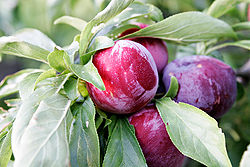
A plum or gage is a stone fruit
tree
in the genus Prunus
, subgenus Prunus. The subgenus is distinguished from other subgenera (peach
es, cherries
, bird cherries, etc.) in the shoot
s having a terminal bud
and solitary side buds (not clustered), the flower
s in groups of one to five together on short stems
, and the fruit
having a groove running down one side and a smooth stone
(or pit).
Mature plum fruit may have a dusty-white coating that gives them a glaucous
appearance; this is easily rubbed off. This is an epicuticular wax
coating and is known as "wax bloom". Dried plum fruits are called dried plums or prunes, although prune
s are a distinct type of plum, and may have antedated the fruits now commonly known as plums.
 The subgenus is divided into three sections:
Sect. Armeniaca (apricots) - leaves in bud rolled inwards; flowers very short-stalked; fruit velvety; treated as a distinct subgenus by some authors
known in Eastern Europe as Slivovitz
, Rakia
, Ţuică
or Pálinka
. In central England, a cider-like alcoholic beverage known as plum jerkum
is made from plums.
Dried plums (or prunes) are also sweet and juicy and contain several antioxidant
s. Plums and prunes are known for their laxative
effect. This effect has been attributed to various compounds present in the fruits, such as dietary fiber
, sorbitol
, and isatin
. Prunes and prune juice are often used to help regulate the functioning of the digestive system. Dried prune marketers in the United States
have, in recent years, begun marketing their product as "dried plums". This is due to "prune" having negative connotations connected with elderly people suffering from constipation
.
Dried, salted plums are used as a snack, sometimes known as saladito
or salao. Various flavors of dried plum are available at Chinese
grocers and specialty stores worldwide. They tend to be much drier than the standard prune. Cream, ginsing, spicy, and salty are among the common varieties. Licorice is generally used to intensify the flavor of these plums and is used to make salty plum drinks and toppings for shaved ice
or baobing
.
Pickled plums are another type of preserve available in Asia and international specialty stores. The Japanese variety, called umeboshi
, is often used for rice balls, called onigiri or omusubi. The ume
, from which umeboshi are made, is more closely related, however, to the apricot
than to the plum.
As with many other members of the rose family, plum seeds contain cyanogenic glycosides, including amygdalin
. These substances are capable of decomposing into a sugar molecule and hydrogen cyanide
gas. While plum seeds are not the most toxic within the rose family (the bitter almond is the most toxic), large doses of these chemicals from any source are hazardous to human health.
Prune kernel oil is made from the fleshy inner part of the pit of the plum.
Plums come in a wide variety of colors and sizes. Some are much firmer-fleshed than others, and some have yellow, white, green or red flesh, with equally varying skin color.
Plum cultivar
s in use today include:
When it flowers in the early spring, a plum tree will be covered in blossom
s, and in a good year approximately 50% of the flowers will be pollinated and become plums. Flowering starts after 80 growing degree day
s.
If the weather is too dry, the plums will not develop past a certain stage, but will fall from the tree while still tiny, green buds, and if it is unseasonably wet or if the plums are not harvested as soon as they are ripe, the fruit may develop a fungal condition called brown rot
. Brown rot is not toxic, and very small affected areas can be cut out of the fruit, but unless the rot is caught immediately, the fruit will no longer be edible. Plum is used as a food plant by the larva
e of some Lepidoptera
, including November moth
, willow beauty
and short-cloaked moth
.
The Serbian plum (Serbian
: шљива / šljiva) is the third most produced in the world and the alcoholic drink slivovitz
(plum brandy) (Serbian: шљивовица / šljivovica) is the national drink of Serbia. The plum production averages 424,300 tons per year; FAO 1991–2001.
A large number of plums, of the Damson variety, are also grown in Hungary
, where they are called szilva and are used to make lekvar
(a plum paste jam), palinka
(a slivovitz-type liquor), plum dumplings, and other foods. The region of Szabolcs-Szatmár, in the northeastern part of the country near the borders with Ukraine and Romania, is a major producer of plums.
The plum blossom or meihua , along with the peony
, are considered traditional floral emblems of China
.
The plum is commonly used in China, Yunnan area, to produce a local plum wine with a smooth, sweet, fruity taste and approximately 12% alcohol by volume.
, a Roman historian and scientist of the first century, who maintained the apricot
was a kind of a plum, and had originally come from Armenia
. Armenia
n sources support their claims by referring to a 6,000-year-old apricot pit found in an archaeological site near Yerevan
. Other historians point to Mesopotamia
as a clue to the Latin name. Apricots were cultivated in Mesopotamia, and it was known as armanu in the Akkadian language
, but this did not refer to Armenia as that is not the name by which that geographic region was known in the Akkadian language. It is likely that Pliny's explanation is a folk etymology based on the similarity between the Mesopotamian name for the fruit and the Latin name for Armenia.
Drupe
In botany, a drupe is a fruit in which an outer fleshy part surrounds a shell of hardened endocarp with a seed inside. These fruits develop from a single carpel, and mostly from flowers with superior ovaries...
tree
Tree
A tree is a perennial woody plant. It is most often defined as a woody plant that has many secondary branches supported clear of the ground on a single main stem or trunk with clear apical dominance. A minimum height specification at maturity is cited by some authors, varying from 3 m to...
in the genus Prunus
Prunus
Prunus is a genus of trees and shrubs, which includes the plums, cherries, peaches, apricots and almonds. There are around 430 species spread throughout the northern temperate regions of the globe. Many members of the genus are widely cultivated for fruit and ornament.-Botany:Members of the genus...
, subgenus Prunus. The subgenus is distinguished from other subgenera (peach
Peach
The peach tree is a deciduous tree growing to tall and 6 in. in diameter, belonging to the subfamily Prunoideae of the family Rosaceae. It bears an edible juicy fruit called a peach...
es, cherries
Cherry
The cherry is the fruit of many plants of the genus Prunus, and is a fleshy stone fruit. The cherry fruits of commerce are usually obtained from a limited number of species, including especially cultivars of the wild cherry, Prunus avium....
, bird cherries, etc.) in the shoot
Shoot
Shoots are new plant growth, they can include stems, flowering stems with flower buds, and leaves. The new growth from seed germination that grows upward is a shoot where leaves will develop...
s having a terminal bud
Bud
In botany, a bud is an undeveloped or embryonic shoot and normally occurs in the axil of a leaf or at the tip of the stem. Once formed, a bud may remain for some time in a dormant condition, or it may form a shoot immediately. Buds may be specialized to develop flowers or short shoots, or may have...
and solitary side buds (not clustered), the flower
Flower
A flower, sometimes known as a bloom or blossom, is the reproductive structure found in flowering plants . The biological function of a flower is to effect reproduction, usually by providing a mechanism for the union of sperm with eggs...
s in groups of one to five together on short stems
Plant stem
A stem is one of two main structural axes of a vascular plant. The stem is normally divided into nodes and internodes, the nodes hold buds which grow into one or more leaves, inflorescence , conifer cones, roots, other stems etc. The internodes distance one node from another...
, and the fruit
Fruit
In broad terms, a fruit is a structure of a plant that contains its seeds.The term has different meanings dependent on context. In non-technical usage, such as food preparation, fruit normally means the fleshy seed-associated structures of certain plants that are sweet and edible in the raw state,...
having a groove running down one side and a smooth stone
Pyrena
Pyrena or pyrene is the name for a nutlet resembling a seed, or the kernel of a drupe or drupelet....
(or pit).
Mature plum fruit may have a dusty-white coating that gives them a glaucous
Glaucous
Glaucous is used to describe the pale grey or bluish-green appearance of the surfaces of some plants, as well as in the names of birds, such as the Glaucous Gull , Glaucous-winged Gull , Glaucous Macaw , and Glaucous...
appearance; this is easily rubbed off. This is an epicuticular wax
Epicuticular wax
In botany, the plant cuticle is covered by epicuticular wax or bloom mainly consistingof straight-chain aliphatic hydrocarbons with a variety of substituted groups, serving to decrease moisture loss and decay...
coating and is known as "wax bloom". Dried plum fruits are called dried plums or prunes, although prune
Prune
A prune is any of various plum cultivars, mostly Prunus domestica or European Plum, sold as fresh or dried fruit. The dried fruit is also referred to as a dried plum...
s are a distinct type of plum, and may have antedated the fruits now commonly known as plums.
Species
- Sect. Prunus (Old WorldOld WorldThe Old World consists of those parts of the world known to classical antiquity and the European Middle Ages. It is used in the context of, and contrast with, the "New World" ....
plums)- leaves in bud rolled inwards; flowers 1-3 together; fruit smooth, often wax-bloomed- P. cerasiferaCherry plumPrunus cerasifera is a species of plum known by the common names cherry plum and myrobalan plum. It is native to Europe and Asia....
(cherry plum) - P. cocomiliaPrunus cocomiliaPrunus cocomilia is a species of plum commonly called Italian plum. It is endemic to Turkey, and well known in Serbia, Croatia, Macedonia, Montenegro and Bosnia, where it is called Dzenerika or Dzanja.-References:...
(Italian plum) - P. consociiflora"
- P. domesticaPrunus domesticaPrunus domestica is a Prunus species with many varieties. These are often called "plums" in common English, though not all plums belong to this species. Its hybrid parentage is believed to be Prunus spinosa and Prunus cerasifera var. divaricata...
(species of most "plums" and "prunePruneA prune is any of various plum cultivars, mostly Prunus domestica or European Plum, sold as fresh or dried fruit. The dried fruit is also referred to as a dried plum...
s" sold as such) - P. insititiaDamsonThe damson or damson plum is an edible drupaceous fruit, a subspecies of the plum tree. Sometimes called the Damask plum, damsons are commonly used in the preparation of jams and jellies...
(damsons) - P. simonii
- P. spinosaPrunus spinosaPrunus spinosa is a species of Prunus native to Europe, western Asia, and locally in northwest Africa. It is also locally naturalised in New Zealand and eastern North America....
(blackthorn or sloe)
- P. cerasifera
- Sect. Prunocerasus (New WorldNew WorldThe New World is one of the names used for the Western Hemisphere, specifically America and sometimes Oceania . The term originated in the late 15th century, when America had been recently discovered by European explorers, expanding the geographical horizon of the people of the European middle...
plums) - leaves in bud folded inwards; flowers 3-5 together; fruit smooth, often wax-bloomedPrunus alleghaniensisThe Allegheny Plum is a species of New World plum, native to North America.-Identification:The leaves are two to three and a half inches long, the tip is usually long and pointed. The leaf margins are finely toothed. The twigs sometimes have thorns. The bark is fissured in older specimens.The...
(Allegheny plum) - P. americanaPrunus americanaPrunus americana, commonly called the American Plum, Wild Plum, or Marshall's Large Yellow Sweet Plum, is a species of Prunus native to North America from Saskatchewan to New Mexico east to New Hampshire and Florida. It has often been planted outside its core range and sometimes escapes cultivation...
(American plum) - P. angustifoliaPrunus angustifoliaPrunus angustifolia pronounced , known commonly as Chickasaw Plum, Cherokee plum, Florida sand plum, sandhill plum, or sand plum, is a plum bearing tree native to North America. It was originally cultivated by Native Americans before the arrival of Europeans...
(Chickasaw plum) - P. hortulana
- P. maritima (beach plum)
- P. mexicanaPrunus mexicanaPrunus mexicana, commonly known as the Mexican Plum, is a species of plum tree that is found in the Midwestern and Southeastern United States as well as Northern Mexico. Its native range stretches from South Dakota and Ohio in the north to as far south as Alabama and Coahuila. Mexican Plum is...
_(Mexican plum) - P. nigraPrunus nigraPrunus nigra is a species of Prunus, native to eastern North America from New Brunswick west to southeastern Manitoba, and south to Connecticut across to Iowa...
(Canada plum, Black plum) - P. × orthosepala (P. americana × P. angustifolia)
- P. subcordataPrunus subcordataPrunus subcordata, known by the common names Klamath plum, Oregon plum, and Sierra plum, is a member of the genus Prunus , native to the west coast of the Western United States in California and western and southern Oregon...
(Klamath, Oregon, or Sierra plum)
- P. armeniacaApricotThe apricot, Prunus armeniaca, is a species of Prunus, classified with the plum in the subgenus Prunus. The native range is somewhat uncertain due to its extensive prehistoric cultivation.- Description :...
(apricot) - P. brigantina
- P. mume (Chinese plum, Japanese apricot)
- P. sibirica
Cultivation and uses
Plum fruit tastes sweet and/or tart; the skin may be particularly tart. It is juicy and can be eaten fresh or used in jam-making or other recipes. Plum juice can be fermented into plum wine; when distilled, this produces a brandyBrandy
Brandy is a spirit produced by distilling wine. Brandy generally contains 35%–60% alcohol by volume and is typically taken as an after-dinner drink...
known in Eastern Europe as Slivovitz
Slivovitz
Slivovitz or Slivovitsais a distilled beverage made from Damson plums. It is frequently called plum brandy, and in the Balkans is part of the category of drinks called rakia...
, Rakia
Rakia
Rakia is an alcoholic beverage that is produced by distillation of fermented fruit; it is a popular beverage throughout the Balkans. Its alcohol content is normally 40% ABV, but home-produced rakia can be stronger . Prepečenica is double-distilled rakia which has an alcohol content that may...
, Ţuică
Tuica
Ţuică is a traditional Romanian spirit of somewhere in between 45%-60% alcohol by volume. It is usually made from plums.Ţuică is the official name for the drink when it is prepared only from plums...
or Pálinka
Palinka
Pálinka or Palincă is a traditional fruit brandy made in regions of the Carpathian Basin. Modern commercial production occurs in Hungary, Romania and parts of Austria. It is commonly made from the fermentation of plums, but other fruits used include apricots, apples, pears, peaches and cherries...
. In central England, a cider-like alcoholic beverage known as plum jerkum
Plum jerkum
Plum jerkum is a type of fruit wine produced from plums, similar in the manner to which cider and perry are made. The drink is native to areas of central England such as Warwickshire and the Cotswolds....
is made from plums.
Dried plums (or prunes) are also sweet and juicy and contain several antioxidant
Antioxidant
An antioxidant is a molecule capable of inhibiting the oxidation of other molecules. Oxidation is a chemical reaction that transfers electrons or hydrogen from a substance to an oxidizing agent. Oxidation reactions can produce free radicals. In turn, these radicals can start chain reactions. When...
s. Plums and prunes are known for their laxative
Laxative
Laxatives are foods, compounds, or drugs taken to induce bowel movements or to loosen the stool, most often taken to treat constipation. Certain stimulant, lubricant, and saline laxatives are used to evacuate the colon for rectal and/or bowel examinations, and may be supplemented by enemas under...
effect. This effect has been attributed to various compounds present in the fruits, such as dietary fiber
Dietary fiber
Dietary fiber, dietary fibre, or sometimes roughage is the indigestible portion of plant foods having two main components:* soluble fiber that is readily fermented in the colon into gases and physiologically active byproducts, and* insoluble fiber that is metabolically inert, absorbing water as it...
, sorbitol
Sorbitol
Sorbitol, also known as glucitol, Sorbogem® and Sorbo®, is a sugar alcohol that the human body metabolizes slowly. It can be obtained by reduction of glucose, changing the aldehyde group to a hydroxyl group. Sorbitol is found in apples, pears, peaches, and prunes...
, and isatin
Isatin
Isatin or 1H-indole-2,3-dione is an indole derivative. The compound was first obtained by Erdman and Laurent in 1841 as a product from the oxidation of indigo dye by nitric acid and chromic acids...
. Prunes and prune juice are often used to help regulate the functioning of the digestive system. Dried prune marketers in the United States
United States
The United States of America is a federal constitutional republic comprising fifty states and a federal district...
have, in recent years, begun marketing their product as "dried plums". This is due to "prune" having negative connotations connected with elderly people suffering from constipation
Constipation
Constipation refers to bowel movements that are infrequent or hard to pass. Constipation is a common cause of painful defecation...
.
Dried, salted plums are used as a snack, sometimes known as saladito
Saladitos
Saladitos are dried, salted plums, which can also be sweetened with sugar and anise or coated in chile and lime.They are considered a candy in Mexico, though they originate from China. In Mandarin, the name for saladitos is "Suan-Mei", literally "sour plum"...
or salao. Various flavors of dried plum are available at Chinese
Chinese people
The term Chinese people may refer to any of the following:*People with Han Chinese ethnicity ....
grocers and specialty stores worldwide. They tend to be much drier than the standard prune. Cream, ginsing, spicy, and salty are among the common varieties. Licorice is generally used to intensify the flavor of these plums and is used to make salty plum drinks and toppings for shaved ice
Slush (beverage)
A slush is a flavored frozen drink.There are a number of different kinds of slush drinks:* Frozen carbonated beverages, typified by the Slurpee or ICEE, are made by freezing a carbonated drink. These machines are complicated and expensive, and notably require a carbon dioxide supply...
or baobing
Bàobing
Baobing , called tsua-bing in Taiwanese Hokkien, is a Taiwanese shaved ice dessert very common in Taiwan. It is especially popular during the hot summer months there as an inexpensive and healthy way to enjoy something cool and refreshing....
.
Pickled plums are another type of preserve available in Asia and international specialty stores. The Japanese variety, called umeboshi
Umeboshi
Umeboshi are pickled ume fruits common in Japan. Ume is a species of fruit-bearing tree in the genus Prunus, which is often called a plum but is actually more closely related to the apricot. Umeboshi are a popular kind of tsukemono and are extremely sour and salty...
, is often used for rice balls, called onigiri or omusubi. The ume
Ume
Prunus mume, with the common names including Chinese plum and Japanese apricot, is an Asian tree species classified in the Armeniaca section of the genus Prunus. The flower, long a beloved subject in the traditional painting of East Asia, is usually translated as plum blossom. This distinct tree...
, from which umeboshi are made, is more closely related, however, to the apricot
Apricot
The apricot, Prunus armeniaca, is a species of Prunus, classified with the plum in the subgenus Prunus. The native range is somewhat uncertain due to its extensive prehistoric cultivation.- Description :...
than to the plum.
As with many other members of the rose family, plum seeds contain cyanogenic glycosides, including amygdalin
Amygdalin
Amygdalin , C20H27NO11, is a glycoside initially isolated from the seeds of the tree Prunus dulcis, also known as bitter almonds, by Pierre-Jean Robiquet...
. These substances are capable of decomposing into a sugar molecule and hydrogen cyanide
Cyanide
A cyanide is a chemical compound that contains the cyano group, -C≡N, which consists of a carbon atom triple-bonded to a nitrogen atom. Cyanides most commonly refer to salts of the anion CN−. Most cyanides are highly toxic....
gas. While plum seeds are not the most toxic within the rose family (the bitter almond is the most toxic), large doses of these chemicals from any source are hazardous to human health.
Prune kernel oil is made from the fleshy inner part of the pit of the plum.
Plums come in a wide variety of colors and sizes. Some are much firmer-fleshed than others, and some have yellow, white, green or red flesh, with equally varying skin color.
Plum cultivar
Cultivar
A cultivar'Cultivar has two meanings as explained under Formal definition. When used in reference to a taxon, the word does not apply to an individual plant but to all those plants sharing the unique characteristics that define the cultivar. is a plant or group of plants selected for desirable...
s in use today include:
- DamsonDamsonThe damson or damson plum is an edible drupaceous fruit, a subspecies of the plum tree. Sometimes called the Damask plum, damsons are commonly used in the preparation of jams and jellies...
or Damask plum - GreengageGreengageThe greengages, also known as the Reine Claudes, are the edible drupaceous fruits of a cultivar group of the common European plum. The first true greengage was bred in Moissac, France, from a green-fruited wild plum originally found in Asia Minor; the original greengage cultivar nowadays survives...
(firm, green flesh and skin even when ripe) - MirabelleMirabelle plumThe mirabelle plum, also known as the mirabelle prune , is the edible drupaceous fruit of the mirabelle prune tree, a cultivar of the plum tree of the genus Prunus...
(dark yellow, predominantly grown in northeast FranceFranceThe French Republic , The French Republic , The French Republic , (commonly known as France , is a unitary semi-presidential republic in Western Europe with several overseas territories and islands located on other continents and in the Indian, Pacific, and Atlantic oceans. Metropolitan France...
) - Satsuma plum (firm red flesh with a red skin)
- Victoria (yellow flesh with a red or mottled skin)
- Yellowgage or golden plum (similar to greengage, but yellow)
When it flowers in the early spring, a plum tree will be covered in blossom
Blossom
In botany, blossom is a term given to the flowers of stone fruit trees and of some other plants with a similar appearance that flower profusely for a period of time in spring...
s, and in a good year approximately 50% of the flowers will be pollinated and become plums. Flowering starts after 80 growing degree day
Growing degree day
Growing degree days , also called growing degree units , are a heuristic tool in phenology. GDD are a measure of heat accumulation used by horticulturists, gardeners, and farmers to predict plant and pest development rates such as the date that a flower will bloom or a crop reach...
s.
If the weather is too dry, the plums will not develop past a certain stage, but will fall from the tree while still tiny, green buds, and if it is unseasonably wet or if the plums are not harvested as soon as they are ripe, the fruit may develop a fungal condition called brown rot
Brown rot
Brown rot may refer to the following diseases:*Wood-decay fungus, a disease of trees and wood.*Ralstonia solanacearum, a disease of plants caused by bacteria.*Monilinia fructicola, a disease of stone fruits....
. Brown rot is not toxic, and very small affected areas can be cut out of the fruit, but unless the rot is caught immediately, the fruit will no longer be edible. Plum is used as a food plant by the larva
Larva
A larva is a distinct juvenile form many animals undergo before metamorphosis into adults. Animals with indirect development such as insects, amphibians, or cnidarians typically have a larval phase of their life cycle...
e of some Lepidoptera
Lepidoptera
Lepidoptera is a large order of insects that includes moths and butterflies . It is one of the most widespread and widely recognizable insect orders in the world, encompassing moths and the three superfamilies of butterflies, skipper butterflies, and moth-butterflies...
, including November moth
November Moth
The November Moth is a moth of the family Geometridae. It is found throughout Europe and the Near East....
, willow beauty
Willow Beauty
| image = Peribatodes.rhomboidaria.7197.jpg| image_width = 240px| image_caption = Adult male from Dresden | regnum = Animalia| phylum = Arthropoda| classis = Insecta| ordo = Lepidoptera| zoodivisio = Ditrysia| familia = Geometridae...
and short-cloaked moth
Short-cloaked Moth
The Short-cloaked Moth is a moth of the family Nolidae. It is distributed through most of Europe. It was collected in 2008 in the greaterVancouver area of British Columbia...
.
The Serbian plum (Serbian
Serbian language
Serbian is a form of Serbo-Croatian, a South Slavic language, spoken by Serbs in Serbia, Bosnia and Herzegovina, Montenegro, Croatia and neighbouring countries....
: шљива / šljiva) is the third most produced in the world and the alcoholic drink slivovitz
Slivovitz
Slivovitz or Slivovitsais a distilled beverage made from Damson plums. It is frequently called plum brandy, and in the Balkans is part of the category of drinks called rakia...
(plum brandy) (Serbian: шљивовица / šljivovica) is the national drink of Serbia. The plum production averages 424,300 tons per year; FAO 1991–2001.
A large number of plums, of the Damson variety, are also grown in Hungary
Hungary
Hungary , officially the Republic of Hungary , is a landlocked country in Central Europe. It is situated in the Carpathian Basin and is bordered by Slovakia to the north, Ukraine and Romania to the east, Serbia and Croatia to the south, Slovenia to the southwest and Austria to the west. The...
, where they are called szilva and are used to make lekvar
Lekvar
Lekvar is a thick jam or fruit butter. Lekvár is a very thick, sometimes coarse jam of pure ripe fruit. Lekvar is of Central and Eastern European origin....
(a plum paste jam), palinka
Palinka
Pálinka or Palincă is a traditional fruit brandy made in regions of the Carpathian Basin. Modern commercial production occurs in Hungary, Romania and parts of Austria. It is commonly made from the fermentation of plums, but other fruits used include apricots, apples, pears, peaches and cherries...
(a slivovitz-type liquor), plum dumplings, and other foods. The region of Szabolcs-Szatmár, in the northeastern part of the country near the borders with Ukraine and Romania, is a major producer of plums.
The plum blossom or meihua , along with the peony
Peony
Peony or paeony is a name for plants in the genus Paeonia, the only genus in the flowering plant family Paeoniaceae. They are native to Asia, southern Europe and western North America...
, are considered traditional floral emblems of China
China
Chinese civilization may refer to:* China for more general discussion of the country.* Chinese culture* Greater China, the transnational community of ethnic Chinese.* History of China* Sinosphere, the area historically affected by Chinese culture...
.
The plum is commonly used in China, Yunnan area, to produce a local plum wine with a smooth, sweet, fruity taste and approximately 12% alcohol by volume.
Etymology
The fruit Prunus armeniaca gained its name from the beliefs of Pliny the ElderPliny the Elder
Gaius Plinius Secundus , better known as Pliny the Elder, was a Roman author, naturalist, and natural philosopher, as well as naval and army commander of the early Roman Empire, and personal friend of the emperor Vespasian...
, a Roman historian and scientist of the first century, who maintained the apricot
Apricot
The apricot, Prunus armeniaca, is a species of Prunus, classified with the plum in the subgenus Prunus. The native range is somewhat uncertain due to its extensive prehistoric cultivation.- Description :...
was a kind of a plum, and had originally come from Armenia
Armenia
Armenia , officially the Republic of Armenia , is a landlocked mountainous country in the Caucasus region of Eurasia...
. Armenia
Armenia
Armenia , officially the Republic of Armenia , is a landlocked mountainous country in the Caucasus region of Eurasia...
n sources support their claims by referring to a 6,000-year-old apricot pit found in an archaeological site near Yerevan
Yerevan
Yerevan is the capital and largest city of Armenia and one of the world's oldest continuously-inhabited cities. Situated along the Hrazdan River, Yerevan is the administrative, cultural, and industrial center of the country...
. Other historians point to Mesopotamia
Mesopotamia
Mesopotamia is a toponym for the area of the Tigris–Euphrates river system, largely corresponding to modern-day Iraq, northeastern Syria, southeastern Turkey and southwestern Iran.Widely considered to be the cradle of civilization, Bronze Age Mesopotamia included Sumer and the...
as a clue to the Latin name. Apricots were cultivated in Mesopotamia, and it was known as armanu in the Akkadian language
Akkadian language
Akkadian is an extinct Semitic language that was spoken in ancient Mesopotamia. The earliest attested Semitic language, it used the cuneiform writing system derived ultimately from ancient Sumerian, an unrelated language isolate...
, but this did not refer to Armenia as that is not the name by which that geographic region was known in the Akkadian language. It is likely that Pliny's explanation is a folk etymology based on the similarity between the Mesopotamian name for the fruit and the Latin name for Armenia.
Production
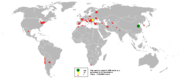
| Top ten plum producers in 2009 | ||||
|---|---|---|---|---|
| Country | Production (ton Ton The ton is a unit of measure. It has a long history and has acquired a number of meanings and uses over the years. It is used principally as a unit of weight, and as a unit of volume. It can also be used as a measure of energy, for truck classification, or as a colloquial term.It is derived from... s) |
Note | ||
 Mainland China Mainland China |
5,373,001 | [E] | ||
 Serbia Serbia |
662,631 | |||
 United States United States |
561,366 | |||
 Kingdom of Romania Kingdom of Romania |
533,691 | |||
 Turkey Turkey |
245,782 | |||
 Spain Spain |
200,100 | |||
 Italy Italy |
194,100 | |||
 Bosnia and Herzegovina Bosnia and Herzegovina |
155,767 | |||
 Early Modern France Early Modern France |
150,000 | [E] | ||
 Ukraine Ukraine |
136,700 | |||
| World | 10,679,206 | [A] | ||
| No symbol = official figure, E = FAO Estimate, A = may include official, semi-official or estimates.FAOSTAT | ||||
See also
- Dietary fiberDietary fiberDietary fiber, dietary fibre, or sometimes roughage is the indigestible portion of plant foods having two main components:* soluble fiber that is readily fermented in the colon into gases and physiologically active byproducts, and* insoluble fiber that is metabolically inert, absorbing water as it...
- Fruit tree formsFruit tree formsThe Forms, or shapes, of most fruit trees can be manipulated by pruning and training in order to increase yield. Tree shaping can improve their suitability for different situations and conditions. Pruning a tree to a pyramid shape means that trees can be planted closer together...
- Fruit tree propagationFruit tree propagationFruit tree propagation is usually carried out through asexual reproduction by grafting or budding the desired variety onto a suitable rootstock.Perennial plants can be propagated either by sexual or vegetative means...
- Fruit trees
- Plumcot, Apriplum, Pluot, or ApriumPlumcot, Apriplum, Pluot, or ApriumPlumcots, apriplums, pluots, and apriums are some of the hybrids between different Prunus species that are also called interspecific or IS plums. In the United States, these fruit are known by most regulatory agencies as interspecific plums...
- Prune (fruit)
- Pruning fruit treesPruning fruit treesPruning fruit trees is a technique that is employed by arboriculture to control growth, remove dead or diseased wood, and stimulate the formation of flowers and fruit buds. Pruning often means cutting branches back to laterals or back to the main stem using proper pruning techniques. It may also...
- Sljivovica
External links
- Handbook of Practical Gardening - Gardening information about plums
- Prunus americanum images hosted by the Department of Biological Sciences of Vanderbilt UniversityVanderbilt UniversityVanderbilt University is a private research university located in Nashville, Tennessee, United States. Founded in 1873, the university is named for shipping and rail magnate "Commodore" Cornelius Vanderbilt, who provided Vanderbilt its initial $1 million endowment despite having never been to the...