
All Topics  
Watermelon


   Email Print
   Bookmark   Link


Watermelon


Watermelon (Citrullus lanatus (Thunb.
Carl Peter Thunberg

Carl Peter Thunberg was a Sweden Natural history. He has been called "the father of South African botany" and the "Japanese Linnaeus"....
) Matsum & Nakai, family Cucurbitaceae
Cucurbitaceae

Cucurbitaceae is a plant family commonly known as melons, gourds or cucurbits and includes crops like cucumbers, squash , luffas, melons and watermelons....
) refers to both fruit
Fruit

The term fruit has different meanings dependent on context, and the term is not synonymous in food preparation and biology. In botany, which is the scientific study of plants, fruits are the ripened Ovary of flowering plants....
 and plant
Plant

Plants are Life organisms belonging to the Kingdom Plantae. They include familiar organisms such as trees, herbs, bushes, grasses, vines, ferns, mosses, and green algae....
 of a vine-like (climber and trailer) herb
Herb

A herb is a plant that is valued for qualities such as medicinal properties, flavor, scent, or the like....
 originally from southern Africa
Africa

Africa is the world's second-largest and second most-populous continent, after Asia. At about 30.2 million km? including adjacent islands, it covers 6% of the Earth's total surface area and 20.4% of the total land area....
 and one of the most common types of melon
Melon

Melon is a name given to various members of the Cucurbitaceae family with fleshy fruit. Melon can refer to either the plant or the fruit, which is a Epigynous berry....
. This flowering plant
Flowering plant

The flowering plants or angiosperms are the most widespread group of Embryophytes. The flowering plants and the gymnosperms are the only extant groups of Spermatophyte....
 produces a special type of fruit known by botanists
Botany

Botany, plant science, phytology, or plant biology is a branch of biology and is the Scientific method of plant life and development....
 as a pepo, which has a thick rind
Peel (fruit)

Peel, also known as rind or skin, is the outer protective layer of a fruit or vegetable which could be peeled off. The rind is usually the Botany exocarp, but the term exocarp does also include the hard cases of nut , which are not named peels since they are not peeled off by hand or peeler, but rather shells because of their har...
 (exocarp) and fleshy center (mesocarp and endocarp); pepos are derived from an inferior ovary and are characteristic of the Cucurbitaceae.


Nutrition Facts


Discussion
Ask a question about 'Watermelon'
Start a new discussion about 'Watermelon'
Answer questions from other users
Full Discussion Forum


Encyclopedia


Watermelon (Citrullus lanatus (Thunb.
Carl Peter Thunberg

Carl Peter Thunberg was a Sweden Natural history. He has been called "the father of South African botany" and the "Japanese Linnaeus"....
) Matsum & Nakai, family Cucurbitaceae
Cucurbitaceae

Cucurbitaceae is a plant family commonly known as melons, gourds or cucurbits and includes crops like cucumbers, squash , luffas, melons and watermelons....
) refers to both fruit
Fruit

The term fruit has different meanings dependent on context, and the term is not synonymous in food preparation and biology. In botany, which is the scientific study of plants, fruits are the ripened Ovary of flowering plants....
 and plant
Plant

Plants are Life organisms belonging to the Kingdom Plantae. They include familiar organisms such as trees, herbs, bushes, grasses, vines, ferns, mosses, and green algae....
 of a vine-like (climber and trailer) herb
Herb

A herb is a plant that is valued for qualities such as medicinal properties, flavor, scent, or the like....
 originally from southern Africa
Africa

Africa is the world's second-largest and second most-populous continent, after Asia. At about 30.2 million km? including adjacent islands, it covers 6% of the Earth's total surface area and 20.4% of the total land area....
 and one of the most common types of melon
Melon

Melon is a name given to various members of the Cucurbitaceae family with fleshy fruit. Melon can refer to either the plant or the fruit, which is a Epigynous berry....
. This flowering plant
Flowering plant

The flowering plants or angiosperms are the most widespread group of Embryophytes. The flowering plants and the gymnosperms are the only extant groups of Spermatophyte....
 produces a special type of fruit known by botanists
Botany

Botany, plant science, phytology, or plant biology is a branch of biology and is the Scientific method of plant life and development....
 as a pepo, which has a thick rind
Peel (fruit)

Peel, also known as rind or skin, is the outer protective layer of a fruit or vegetable which could be peeled off. The rind is usually the Botany exocarp, but the term exocarp does also include the hard cases of nut , which are not named peels since they are not peeled off by hand or peeler, but rather shells because of their har...
 (exocarp) and fleshy center (mesocarp and endocarp); pepos are derived from an inferior ovary and are characteristic of the Cucurbitaceae. The watermelon fruit, loosely considered a type of melon
Melon

Melon is a name given to various members of the Cucurbitaceae family with fleshy fruit. Melon can refer to either the plant or the fruit, which is a Epigynous berry....
 (although not in the genus Cucumis
Cucumis

Cucumis is a genus of vine, tendril-bearing plants in the Cucurbitaceae family which includes the cucumber, true melons, the horned melon, and Cucumis anguria, the West Indian gherkin....
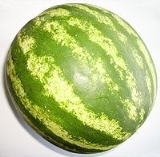
), has a smooth exterior rind (green and yellow) and a juicy, sweet, usually red, but sometimes orange, yellow, or pink interior flesh.

History

David Livingstone
David Livingstone

Doctor David Livingstone was a Scotland Congregational church pioneer medical missionary with the London Missionary Society and List of explorers in Central Africa Africa....
, an explorer of Africa
Africa

Africa is the world's second-largest and second most-populous continent, after Asia. At about 30.2 million km? including adjacent islands, it covers 6% of the Earth's total surface area and 20.4% of the total land area....
, described watermelon as abundant in the Kalahari desert
Kalahari Desert

The Kalahari Desert is a large, arid desert area in southwestern Sub-Saharan Africa extending 900,000 km? , covering much of Botswana and parts of Namibia and South Africa....
, where it is believed to have originated. There, the ancestral melon grows wild and is known as the Tsamma melon (Citrullus lanatus var tastius). It is also known in Zimbabwe as 'nwiwa, mwiwa or iswe'. The plant has pinnatifid leaves. The flesh is similar to the rind
Rind

Rind may refer to:*Peel *Pork rind*Rind , a giantess in Norse mythology*Rind, Armenia, also Rrind*Rind et al. , a controversial study on child sexual abuse...
 of a watermelon and is often known as citron melon
Citron melon

The citron melon , or tsamma, is thought to be the original/ancestral variety of watermelon, a cucurbitaceae. Its fruit has a hard white flesh, rendering it less likely to be eaten raw; more often it is "pickled" or used to make preserves....
 (distinct from the actual citron
Citron

The citron is a fragrant fruit with the botanical name Citrus medica Carolus Linnaeus, which applies to both the Walter Tennyson Swingle and Nobuyuki Tanaka systems....
, of the citrus family); it is used for making jam and other preserves, and has a high content of pectin
Pectin

Pectin is a structural heteropolysaccharide contained in the primary cell walls of terrestrial plants. It was first isolated and described in 1825 by Henri Braconnot....
. It has established itself in the wild in Baja California
Baja California

Baja California is the northernmost States of Mexico of Mexico. Before becoming a state in 1953, the area was known as the North Territory of Baja California....
.

It is not known when the plant was first cultivated, but Zohary and Hopf note evidence of its cultivation in the Nile Valley from at least as early as the second millennium BC. Finds of the characteristically large seed are reported in Twelfth dynasty
Twelfth dynasty of Egypt

The Eleventh , Twelfth, Thirteenth and Fourteenth Dynasties of ancient Egypt are often combined under the group title, Middle Kingdom of Egypt....
 sites; numerous watermelon seeds were recovered from the tomb of Pharaoh
Pharaoh

Pharaoh is a title used in many modern discussions of the ancient Egyptian rulers of all periods. In antiquity this title began to be used for the ruler who was the religious and political leader of united ancient Egypt, only during the New Kingdom, specifically, during the middle of the Eighteenth dynasty of Egypt....
 Tutankhamun
Tutankhamun

Tutankhamun , Egyptian language was an Ancient Egypt Pharaoh of the Eighteenth dynasty of Egypt , during the period of History of Egypt known as the New Kingdom....
, although the existence of the fruit in ancient Egypt is not certain because it is not depicted in any hieroglyphic text nor does any ancient writer mention it. It wasn't present in any other culture of the ancient Mediterranean. By the 10th century AD, watermelons were being cultivated in China
China

China is a Culture of China, an ancient civilization, and, depending on perspective, a national or multinational entity extending over a large area in East Asia....
, which is today the world's single largest watermelon producer. By the 13th century, Moorish
Moors

In the Spanish language, the term for Moors is Moro; in Portuguese language the word is mouro. There seems to have been some confusion about the relationship of the word moro/mouro to the word moreno , both from Greek language ma?ros, i.e....
 invaders had introduced the fruit to Europe; and, according to John Mariani's The Dictionary of American Food and Drink, "watermelon" made its first appearance in an English dictionary in 1615.

In Vietnam, legend holds that watermelon was discovered in Vietnam long before it reached China, in the era of the Hùng
Hung

Hung can refer to:* Hung language, a Viet-Muong languages language spoken in Laos.* Hung is one of the transliterations of the sixth syllable in Buddhist "Six syllable mantra" Om mani padme hum....
 Kings. According to legend, watermelon was discovered by Prince Mai An Tiêm, an adopted son of the 11th Hùng King. When he was exiled unjustly to an island, he was told that if he could survive for six months, he would be allowed to return. When he prayed for guidance, a bird flew past and dropped a seed. He cultivated the seed and called its fruit "dua tây" or western melon, because the birds who ate it flew from the west. When the Chinese took over Vietnam in about 110 BC, they called the melons "dua h?o" (good melon) or "dua h?u", "dua Tây", "dua h?o", "dua h?u"—all words for "watermelon". An Tiêm's island is now a peninsula in the suburban district of Nga Son.

Museums Online South Africa list watermelons as having been introduced to North America
North America

North America is the northern continent of the Americas, situated in the Earth's northern hemisphere and almost totally in the western hemisphere....
n Indians
Native Americans in the United States

Native Americans in the United States are the Indigenous peoples of the Americas from the regions of North America now encompassed by the continental United States United States, including parts of Alaska and the island state of Hawaii....
 in the 1500s. Early French explorers found Native Americans cultivating the fruit in the Mississippi Valley. Many sources list the watermelon as being introduced in Massachusetts
Massachusetts

The Commonwealth of Massachusetts is a U.S. state located in the New England region of the Northeastern United States United States. It borders Rhode Island and Connecticut to the south, New York to the west, and Vermont and New Hampshire to the north....
 as early as 1629. Southern
Southern United States

The Southern United States—commonly referred to as the American South, Dixie, or simply the South—constitutes a large distinctive region in the southeastern and south-central United States....
 food historian John Egerton has said he believes African slaves
Atlantic slave trade

The Atlantic slave trade, also known as the transatlantic slave trade, was the trade of primarily African people supplied to the colonies of the New World that occurred in and around the Atlantic Ocean....
 helped introduce the watermelon to the United States
United States

The United States of America is a Federal government constitutional republic comprising U.S. state and a federal district. The country is situated mostly in central North America, where its Contiguous United States and Washington, D.C., the Capital districts and territories, lie between the Pacific Ocean and Atlantic Oceans, Borders of the U...
. Texas Agricultural Extension horticulturalist Jerry Parsons lists African slaves and European colonists as having distributed watermelons to many areas of the world. Parsons also mentions the crop being farmed by Native Americans in Florida
Florida

Florida is a U.S. state located in the Southeastern United States of the United States, bordering Alabama to the northwest and Georgia to the northeast....
 (by 1664) and the Colorado River
Colorado River

The Colorado River is a river in the southwestern United States and northwestern Mexico, approximately 1,450 mi long, draining a part of the arid regions on the western slope of the Rocky Mountains....
 area (by 1799). Other early watermelon sightings include the Midwestern states (1673), Connecticut
Connecticut

Connecticut is a U.S. state located in the New England region of the northeastern United States. The state borders New York to the west and south , Massachusetts to the north, and Rhode Island to the east....
 (1747), and the Illiana
Illiana

Illiana is the general area around the border between the U.S. states of Illinois and Indiana, containing the eastern edge of Illinois and the western edge of Indiana....
 region (1822).
Watermelon Seedless
Charles Fredric Andrus, a horticulturist at the USDA
United States Department of Agriculture

The United States Department of Agriculture is the United States federal executive departments responsible for developing and executing Federal government of the United States policy on farming, agriculture, and food....
 Vegetable Breeding Laboratory in Charleston, South Carolina
Charleston, South Carolina

Charleston is a city in Charleston County, South Carolina in the U.S. state of South Carolina. It is the largest city and county seat of Charleston County....
, set out to produce a disease-resistant and wilt-resistant watermelon. The result was "that gray melon from Charleston." Its oblong shape and hard rind made it easy to stack and ship. Its adaptability meant it could be grown over a wide geographical area. It produced high yields and was resistant to the most serious watermelon diseases: anthracnose and fusarium wilt. Today, farmers in approximately 44 states in the U.S. grow watermelon commercially, and almost all these varieties have some Charleston Gray in their lineage. Georgia
Georgia (U.S. state)

Georgia is a U.S. state in the United States and was one of the original Thirteen Colonies that revolted against United Kingdom rule in the American Revolution....
, Florida
Florida

Florida is a U.S. state located in the Southeastern United States of the United States, bordering Alabama to the northwest and Georgia to the northeast....
, Texas
Texas

Texas is a U.S. state located in the South Central United States, nicknamed the Lone Star State. Texas is the second largest U.S. state in both area and population, spanning , and with a growing population of 24.3 million residents....
, California
California

California is a U.S. state on the West Coast of the United States of the United States, along the Pacific Ocean. It is bordered by Oregon to the north, Nevada to the east, Arizona to the southeast, and to the south the Mexico state of Baja California....
 and Arizona
Arizona

The State of Arizona is a U.S. state located in the Southwestern United States of the United States. The capital and largest city is Phoenix, Arizona....
 are the USA's largest watermelon producers.

This now-common watermelon is often large enough that groceries often sell half or quarter melons. There are also some smaller, spherical varieties of watermelon, both red- and yellow-fleshed, sometimes called "icebox melons."

Culture

Male and Female Watermelon 1458
For commercial plantings, one beehive
Beehive

Beehive may refer to:Bee-keeping* Beehive is a structure in which bees live and raise their young. It includes both natural and man-made hives; the latter includes traditional designs such as skeps and gums and modern designs such as:...
 per acre (over 9,000 m² per hive) is the minimum recommendation by the US Department of Agriculture for pollination
Pollination

Pollination in flowering plants and gymnosperms is the process that transfers pollen, which contain the male gametes to where the female gamete are contained within the carpel; in gymnosperms the pollen is directly applied to the ovule itself....
 of conventional, seeded varieties. Because seedless hybrids have sterile pollen, pollinizer rows of varieties with viable pollen must also be planted. Since the supply of viable pollen is reduced and pollination is much more critical in producing the seedless variety, the recommended number of hives per acre, or pollinator
Pollinator

A pollinator is the biotic agent that moves pollen from the male anthers of a flower to the female carpel of a flower to accomplish fertilization or syngamy of the female gamete in the ovule of the flower by the male gamete from the pollen grain....
 density, increases to three hives per acre (1,300 m² per hive).

In Japan
Japan

Japan is an island country in East Asia. Located in the Pacific Ocean, it lies to the east of the Sea of Japan, People's Republic of China, North Korea, South Korea and Russia, stretching from the Sea of Okhotsk in the north to the East China Sea and Taiwan in the south....
, farmers of the Zentsuji region found a way to grow cubic watermelons, by growing the fruits in glass boxes and letting them naturally assume the shape of the receptacle. The square shape is designed to make the melons easier to stack and store, but the square watermelons are often more than double the price of normal ones. Pyramid shaped watermelons have also been developed.


Seedless watermelons

Although so-called "seedless" watermelons have far fewer seeds than the seeded varieties, they generally contain at least a few soft, pale seeds. They are the product of crossing a female tetraploid plant (itself the product of genetic manipulation, using colchicine
Colchicine

Colchicine is a toxic natural product and secondary metabolite, originally extracted from plants of the genus Colchicum . Originally used to treat rheumatic complaints and especially gout, it was also prescribed for its cathartic and emetic effects....
) with diploid pollen
Pollen

Pollen is a fine to coarse powder consisting of Gametophyte , which produce the male gametes of spermatophyta. A hard coat covering the pollen grain protects the sperm cells during the process of their movement between the stamens of the flower to the pistil of the next flower....
. The resulting triploid plant is sterile, but will produce the seedless fruit if pollenized by a diploid plant. For this reason, commercially available seedless watermelon seeds actually contain two varieties of seeds; that of the triploid seedless plant itself (recognizable because the seed is larger), and the diploid plant which is needed to pollenize the triploid. Unless both plant types are grown in the same vicinity, no seedless fruit will result.

Nutrition


Fresh watermelon may be eaten in a variety of ways and is also often used to flavor summer drinks and smoothie
Smoothie

A smoothie is a blended, chilled, sweet beverage made from fresh fruit. In addition to fruit, many smoothies include crushed ice, frozen fruit, honey or frozen yogurt, although some smoothies are 100% fruit....
s.

Watermelon contains about six percent sugar by weight, the rest being mostly water. As with many other fruits, it is a source of vitamin C
Vitamin C

Vitamin C or ascorbic acid is an essential nutrient for humans, a large number of simian species, a small number of other mammalian species , a few species of birds, and some fish....
. It is not a significant source of other vitamins and minerals unless one eats several kilograms per day.

The amino acid citrulline
Citrulline

The organic compound citrulline is an a-amino acid. Its name is derived from citrullus, the Latin word for watermelon, from which it was first isolated in 1930....
 was first extracted from watermelon and analysed. Watermelons contain a significant amount of citrulline
Citrulline

The organic compound citrulline is an a-amino acid. Its name is derived from citrullus, the Latin word for watermelon, from which it was first isolated in 1930....
 and after consumption of several kg an elevated concentration is measured in the blood plasma
Blood plasma

Blood plasma is the liquid component of blood, in which the blood cells are suspended. It makes up about 55% of total blood volume. It is composed of mostly water , and contains dissolved proteins, glucose, clotting factors, mineral ions, Hormone and carbon dioxide ....
, this could be mistaken for citrullinaemia or other urea cycle
Urea cycle

The urea cycle is a cycle of biochemistry reactions occurring in many animals that produces urea 2carbonoxygen from ammonia . This cycle was the first metabolic cycle discovered ....
 disorder.

Watermelon rinds are also edible, and sometimes used as a vegetable
Vegetable

The term "vegetable" generally means the Eating parts of plants. The definition of the word is traditional rather than scientific, however, and therefore the usage of the word is somewhat arbitrary and subjective, as it is determined by individual cultural customs of food selection and food preparation....
. In China, they are stir-fried
Stir frying

Stir frying is an umbrella term used to describe two fast cooking techniques: chao and b?o . The term stir-fry was introduced into the English language by Buwei Yang Chao, in her book How to Cook and Eat in Chinese, to describe the chao technique....
, stew
Stew

A stew is a combination of solid food ingredients that have been cooked in liquid and served in the resultant gravy.Ingredients in a stew can include any combination of vegetables , meat, poultry, sausages and seafood....
ed, or more often pickled
Pickling

Pickling, also known as brining or corning, is the process of preserving food by Anaerobic organism fermentation in brine , to produce lactic acid bacteria, or marination and storing it in an acid solution, usually vinegar ....
. When stir-fried, the de-skinned and de-fruited rind is cooked with olive oil
Olive oil

Olive oil is a fruit oil obtained from the olive , a traditional tree crop of the Mediterranean Basin. The wild olive tree originated in Anatolia and spread from there as far as southern Africa, Australia, Japan and China....
, garlic
Garlic

Allium sativum L., commonly known as garlic, is a species in the onion family Alliaceae. Its close relatives include the onion, shallot, leek, and chive....
, chili pepper
Chili pepper

Chili pepper is the fruit of the plants from the genus Capsicum, members of the Solanaceae, Solanaceae. Botany considers the plant a berry bush....
s, scallions, sugar
Sugar

Sugar is a class of edible crystalline substances, mainly sucrose, lactose, and fructose. Human taste buds interpret its flavor as sweet. Sugar as a basic food carbohydrate primarily comes from sugar cane and from sugar beet, but also appears in fruit, honey, sorghum, sugar maple , and in many other sources....
 and rum
Rûm

R?m, also Roum or Rhum , is a very indefinite term used at different times in the Muslim world to refer to the Balkans and Anatolia generally, and for the Byzantine Empire in particular, for the Seljuk Sultanate of R?m in Asia Minor, and for Greeks inhabiting Ottoman Empire or modern Turkey territory as well as for Greek Cypriots....
. Pickled watermelon rind is also commonly consumed in the Southern US, Russia
Russia

Russia , or the Russian Federation , is a list of countries spanning more than one continent country extending over much of northern Eurasia....
, Ukraine
Ukraine

Ukraine is a country in Eastern Europe. It is bordered by Russia to the east; Belarus to the north; Poland, Slovakia, and Hungary to the west; Romania and Moldova to the southwest; and the Black Sea and Sea of Azov to the south....
, Romania
Romania

Romania is a country located in Southeastern Europe Central Europe, North of the Balkan Peninsula, on the Lower Danube, within and outside the Carpathian Mountains, bordering on the Black Sea....
 and Bulgaria
Bulgaria

The state of Bulgaria , Scientific transliteration Balgarija, officially the Republic of Bulgaria has played a significant role in the Balkans in south-eastern Europe for over fourteen centuries....
. In Balkans, specially Serbia, watermelon slatko
Slatko

Slatko which means ?sweet? in Serbian is a thin fruit preserve made of fruit or rose petals in the Serbian cuisine. Almost any kind of fruit can be used, like wild strawberry, blueberry, plum, and cherry....
 is also popular .

Watermelon seed
Seed

A seed is a small Plant embryogenesis plant enclosed in a covering called the seed coat, usually with some Food storage. It is the product of the ripened ovule of gymnosperm and angiosperm plants which occurs after fertilization and some growth within the mother plant....
s are rich in fat
Fat

Fats consist of a wide group of compounds that are generally soluble in organic solvents and largely insoluble in water. Chemistry, fats are generally ester of glycerol and fatty acids....
 and protein
Protein

Proteins are organic compounds made of amino acids arranged in a linear chain and joined together by peptide bonds between the carboxyl and amino groups of adjacent amino acid Residue ....
, and are widely eaten as a snack, added to other dishes, or used as an oilseed. Specialized varieties are grown which have little watery flesh but concentrate their energy into seed production. In China watermelon seeds are one of the most common snack foods, competing with sunflower seed
Sunflower seed

File:Sunflower seeds 2009.jpg Botanically speaking, a sunflower seed is more properly referred to as an achene. When dehulled, the edible remainder is called the sunflower kernel....
s, and sold roasted
Roasting

Roasting is a cooking method that uses dry heat, whether an open flame, oven, or other heat source. Roasting usually causes caramelization or Maillard reaction of the surface of the food, which is considered a flavour enhancement....
 and seasoned
Seasoning

Seasoning is the process of imparting flavor to, or improving the flavor of, food. Seasonings include herbs, spices, and all other condiments, which are themselves frequently referred to as "seasonings"....
. In West Africa
West Africa

West Africa or Western Africa is the westernmost region of the African continent. Geopolitically, the United Nations subregion of Western Africa includes the following 16 countries distributed over an area of approximately 5 million square km:...
, they are pressed for oil, and are popular in egusi
Egusi

Egusi seeds are the fat- and protein-rich seeds of certain cucurbitaceous plants. Authorities disagree whether the word is used more properly for the seeds of the colocynth, those of a particular large-seeded variety of the watermelon, or generically for those of any cucurbitaceous plant....
 soup and other dishes. There can be some confusion between seed-specialized watermelon varieties and the colocynth
Colocynth

The colocynth, also known as bitter apple, bitter cucumber, egusi, or vine of Sodom, is a vine plant native to the Mediterranean Basin and Asia, especially Turkey , Nubia, and Trieste....
, a closely-related species with which they share many characteristics, uses, and similar or identical names.

Watermelon is 92 percent water
Water

Water is a common chemical substance that is essential for the survival of all known forms of life. In typical usage, water refers only to its liquid form or States of matter, but the substance also has a solid state, ice, and a gaseous state, water vapor or steam....
 by weight.

Watermelon is also mildly diuretic
Diuretic

A diuretic is any drug that elevates the rate of urination and thus provides a means of forced diuresis. There are several categories of diuretics....
.

Watermelon with red flesh is a significant source of lycopene
Lycopene

Lycopene is a bright red carotenoid pigment and phytochemical found in tomatoes and other red fruits.In plants, algae, and other Photosynthesis, lycopene is an important intermediate in the biosynthesis of many carotenoids, including beta carotene, responsible for yellow, orange or red pigmentation, photosynthesis, and photo-protection....
.

A traditional food plant in Africa, this fruit has potential to improve nutrition, boost food security, foster rural development and support sustainable landcare.

Some people also prepare and eat watermelon peel (i.e., rind).

Varieties

Citrullus Lanatus
There are more than twelve hundred varieties of watermelon ranging in size from less than a pound, to more than two hundred pounds with flesh that is red, orange, yellow, or white. Several notable varieties are included here.

  • Carolina Cross: This variety of watermelon produced the current world record watermelon weighing 262 pounds. It has green skin, red flesh and commonly produces fruit between 65 and 150 pounds. It takes about 90 days from planting to harvest.


  • Yellow Crimson Watermelon: variety of watermelon that has a yellow colored flesh. This particular type of watermelon has been described as "sweeter" and more "honey" flavored than the more popular red flesh watermelon.


  • Orangeglo: This variety has a very sweet orange pulp, and is a large oblong fruit weighing 9-14kg (20-30 pounds). It has a light green rind with jagged dark green stripes. It takes about 90-100 days from planting to harvest.


  • The Moon and Stars variety of watermelon has been around since 1926. The rind is purple/black and has many small yellow circles (stars) and one or two large yellow circles (moon). The melon weighs 9-23kg (20-50 pounds). The flesh is pink or red and has brown seeds. The foliage is also spotted. The time from planting to harvest is about 90 days.


  • Cream of Saskatchewan: This variety consists of small round fruits, around 25cm (10 inches) in diameter. It has a quite thin, light green with dark green striped rind, with sweet white flesh and black seeds. It can grow well in cool climates. It was originally brought to Saskatchewan
    Saskatchewan

    Saskatchewan is a prairie provinces in Canada, which has an area of 588,276.09 square kilometres and a population of 1,015,895 , mostly living in the southern half of the province....
    , Canada
    Canada

    Canada is a country occupying most of northern North America, extending from the Atlantic Ocean in the east to the Pacific Ocean in the west and northward into the Arctic Ocean....
     by Russian immigrants
    Russian Canadians

    A Russian Canadian is a Canadian citizenship or permanent resident of Canada who is from Russia or has Russian descent....
    . These melons take 80-85 days from planting to harvest.


  • Melitopolski: This variety has small round fruits roughly 28-30cm (11-12 inches) in diameter. It is an early ripening variety that originated from the Volga River
    Volga River

    The Volga is the largest river in Europe in terms of length, Discharge , and Drainage basin. It flows through the western part of Russia, and is widely viewed as the national river of Russia....
     region of Russia, an area known for cultivation of watermelons. The Melitopolski watermelons are seen piled high by vendors in Moscow in summer. This variety takes around 95 days from planting to harvest.


  • Densuke Watermelon: This variety has round fruit up to . The rind is black with no stripes or spots. It is only grown on the island of Hokkaido, Japan, where up to 10 000 watermelons are produced every year. In June 2008, one of the first harvested watermelons was sold at an auction for 650 000 yen (6300 USD), making the most expensive watermelon ever sold. The average selling price is generally around 25 000 yen (250 USD).


Cultural uses and references

Kustodiev Merchants Wife
Watermelons are used in many parts of the world as symbols and during various celebrations.

  • Art related to the Mexican
    Mexico

    The United Mexican States , commonly known as Mexico , is a federalism constitutionalism republic in North America. It is bordered on the north by the United States; on the south and west by the Pacific Ocean; on the southeast by Guatemala, Belize, and the Caribbean Sea; and on the east by the Gulf of Mexico....
     holiday Dia de los Muertos
    Day of the Dead

    The Day of the Dead is a holiday celebrated mainly in Latin America and by Latinos living in the United States and Canada. The holiday focuses on gatherings of family and friends to pray for and remember friends and family members who have died....
     commonly depicts watermelons being eaten by the dead or shown in close conjunction with the dead. This theme appears regularly on ceramic
    Ceramic

    File:Bridge from dental porcelain.jpgFile:Qing vase p1070256.jpgA ceramic is an inorganic, nonmetal solid prepared by the action of heat and subsequent cooling....
    s and in other art from the holiday. Watermelons also appear as a subject in Mexican still life
    Still life

    A still life is a work of art depicting mostly inanimate subject matter, typically commonplace objects which may be either natural or man-made in an artificial setting....
     art.


  • In Vietnam
    Vietnam

    Vietnam , officially the Socialist Republic of Vietnam , is the easternmost country on the Indochina Peninsula in Southeast Asia. It is bordered by People's Republic of China to the north, Laos to the northwest, Cambodia to the southwest, and the South China Sea to the east....
     watermelon is used as part of the Vietnamese New Year's holiday, T?t
    T?t

    T?t Nguy?n ??n , more commonly known by its shortened name T?t, is the most important and popular Holidays in Vietnam and festival in Vietnam....
    , because it is considered a lucky colour. The seeds are also consumed during the holiday as a snack
    Snack food

    A snack food is seen in Western culture as a type of food not meant to be eaten as a main meal of the day ? breakfast, lunch, or dinner ? but one rather that is intended to assuage a person's hunger between these meals, providing a brief supply of energy for the body....
    .


  • Racist
    Racism

    Racism, by its simplest definition is the belief that Race is the primary determinant of human traits and capacities and that racial differences produce an inherent superiority of a particular race....
     caricature
    Caricature

    A caricature is either a portrait that exaggerates or distorts the essence of a person or thing to create an easily identifiable visual likeness, or in literature, a description of a person using exaggeration of some characteristics and oversimplification of others....
    s may depict African American
    African American

    African Americans or Black Americans are citizens or residents of the United States who have origins in any of the Black people populations of Africa....
    s as being inordinately fond of watermelon.


  • The Oklahoma
    Oklahoma

    Oklahoma is a U.S. state and a sovereignty located in the South Central United States and Southern United States of the United States of America ....
     State Senate passed a bill on 17 April, 2007 declaring watermelon as the official state vegetable
    Vegetable

    The term "vegetable" generally means the Eating parts of plants. The definition of the word is traditional rather than scientific, however, and therefore the usage of the word is somewhat arbitrary and subjective, as it is determined by individual cultural customs of food selection and food preparation....
    , with some controversy as the watermelon is a fruit.


  • The Citrulline
    Citrulline

    The organic compound citrulline is an a-amino acid. Its name is derived from citrullus, the Latin word for watermelon, from which it was first isolated in 1930....
     which exists in watermelon (especially in the rind) is a known stimulator of nitric oxide, NO is thought to relax and expand blood vessels, much like the erectile dysfunction drug, Viagra, and may even increase libido
    Libido

    Libido in its common usage means sexual desire; however, more technical definitions, such as those found in the work of Carl Jung, are more general, referring to libido as the free creative?or psychic?energy an individual has to put toward personal development or individuation....
    ,however no one knows how much watermelon you would have to eat to see similar results to these drug products.


See also

  • List of fruits
  • Vampire pumpkins and watermelons
    Vampire pumpkins and watermelons

    Vampire pumpkins and watermelons are a folk legend from the Balkans, in southeastern Europe, described by ethnologist Tatomir Vukanovic. The story is associated with the Roma people of the region, from whom much of traditional vampire folklore, among other unusual legends, originated....
  • Gallagher
    Leo Gallagher

    Gallagher is an United States comedian and prop comic, most popularly known for smashing watermelons as part of his act....
    , a prop comic whose most famous bit involves smashing watermelons


External links