
Encyclopedia
Granite is a common and widely-occurring type of
intrusive, felsic,
igneous rock.
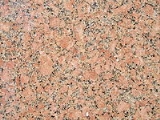
Granites are usually a white, black or buff color and are medium to coarse grained, occasionally with some individual crystals larger than the groundmass forming a rock known as porphyry. Granites can be pink to dark gray or even black, depending on their chemistry and mineralogy.
Outcrops of granite tend to form
tors, rounded massifs, and terrains of rounded boulders cropping out of flat, sandy soils. Granites sometimes occur in circular depressions surrounded by a range of hills, formed by the metamorphic
aureole or hornfels.
Granite is nearly always massive, hard and tough, and it is for this reason it has gained widespread use as a construction stone.
The average density of granite is 2.75 g·cm
−3 with a range of 1.74 g·cm
−3 to 2.80 g·cm
−3.
The word granite comes from the
Latin granum, a grain, in reference to the coarse-grained structure of such a
crystalline rock.
Mineralogy
Granite primarily consists of
orthoclase and
plagioclase feldspars,
quartz,
hornblende,
muscovite and/or
biotite micas, and minor accessory minerals such as
magnetite,
garnet,
zircon and
apatite. Rarely, a
pyroxene is present.
Granite is classified according to the
QAPF diagram for coarse grained plutonic rocks and is named according to the percentage of Quartz, Alkali feldspar and Plagioclase Feldspar on the A-Q-P half of the diagram. Highly peralkaline forms of granite which are silica undersaturated may have a feldspathoid such as
nepheline, and are classified on the A-F-P half of the diagram. See Figure 1, below.
True granite according to modern petrology contains both plagioclase and orthoclase feldspars. When a granitoid is devoid of orthoclase the rock is referred to as alkali granite or
adamellite. When a granitoid contains <5% orthoclase it is known as a granodiorite, or tonalite when pyroxene is present.
A granite containing both muscovite and biotite
micas is called a binary or
two-mica granite. Two-mica granites are typically high in potassium and low in plagioclase, and are usually S-type granites or A-type granites.
The
volcanic equivalent of
plutonic granite is
rhyolite.
Chemical Composition
A worldwide average of the average proportion of the different chemical components in granites, in descending order, is approximately:
- SiO2 — 70.18%
- Al2O3 — 14.47%
- K2O — 4.11%
- Na2O — 3.48%
- CaO — 1.99%
- FeO
...
— 1.78%
...
— 1.57%
Occurrence
Granite is currently known only on Earth where it forms a major part of
continental crust. Granite occurs as relatively small, less than 100 km
2 stock-like masses and as large
batholiths often associated with
orogenic mountain ranges and is frequently of great extent. Small dikes of granitic composition called
aplites are associated with granite margins. In some locations very coarse-grained
pegmatite masses occur with granite.
Granite has been intruded into the crust of the
Earth during all
geologic periods; much of it is of Precambrian age. Granite is widely distributed throughout the
continental crust of the Earth and is the most abundant basement rock that underlies the relatively thin
sedimentary veneer of the continents.
Despite being fairly common throughout the world, the areas with the most commercial granite quarries are located in the
Scandinavian Peninsula ,
Spain ,
Brazil,
India and several countries in the South end of the African continent, namely
Angola,
Namibia,
Zimbabwe and
South Africa.
Origin
Granite is an
igneous rock and is formed from magma. Granite magma has many potential origins but it must intrude other rocks. Most granite intrusions are emplaced at depth within the crust, usually greater than 1.5 km and up to 50 km depth within thick continental crust.
The origin of granite is contentious and has led to varied schemes of classification. Classification schemes are regional; there is a French scheme, a British scheme and an American scheme. This confusion arises because the classification schemes define granite by different means. Generally the 'alphabet-soup' classification is used because it classifies based on genesis or origin of the magma.
Geochemical origins
Granitoids are a ubiquitous component of the crust because they represent a
eutectic point to which magmas will evolve via igneous differentiation. This occurs because fractional crystallisation serves to reduce a melt in iron, magnesium, titanium, calcium and sodium, and enrich the melt in potassium, aluminium and silicon - which are the major constituents of a granite.
This process operates regardless of the origin of the parental magma to the granite, and regardless of its chemistry. However, the composition and origin of the magma which differentiates into granite, leaves certain geochemical and mineralogical evidence as to what the granite's parental rock was. The final mineralogy, texture and chemical composition of a granite is often distinctive as to its origin.
For instance, a granite which is formed from melted sediments will have more alkali feldspar, whereas a granite derived from melted
basalt will be richer in
plagioclase feldspar. It is on this basis that the modern classification shemes are based.
Alphabet Soup Classification
The 'alphabet soup' scheme of Chappell & White was proposed initially to divide granites into
I-type granite granite and
S-type or sedimentary protolith granite. Both of these types of granite are formed by melting of high grade metamorphic rocks, either other granite or intrusive mafic rocks, or buried sediment, respectively.
M-type or
mantle derived granite was proposed later, to cover those granites which were clearly sourced from crystallised mafic magmas, generally sourced from the mantle. These are rare, because it is difficult to turn
basalt into granite via fractional crystallisation.
A-type or
anorogenic granites are formed above volcanic "hot spot" activity and have peculiar mineralogy and geochemistry. These granites are formed by melting of the lower crust under conditions that are usually extremely dry. The granite
caldera of Yellowstone National Park is an example of an A-type granite.
Granitization
The granitization theory states that granite is formed in place by extreme metamorphism. The production of granite by metamorphic heat is difficult, but is observed to occur in certain
amphibolite and
granulite terrains. In-situ granitisation or melting by metamorphism is difficult to recognise except where leucosome and melanosome textures are present in
gneisses. Once a metamorphic rock is melted it is no longer a metamorphic rock and is a magma, so these rocks are seen as a transitional between the two, but are not technically granite as they do not actually intrude into other rocks. In all cases, melting of solid rock requires high temperature, and also
water or volatiles which act as a
catalyst by lowering the solidus temperature of the rock.
Emplacement mechanisms
The problem of emplacing large volumes of molten rock within the solid Earth has faced geologists for over a century, and is not entirely resolved. Granite magma must make room for itself or be intruded into other rocks in order to form an intrusion, and several mechanisms have been proposed to explain how large batholiths have been emplaced.
- Stoping, where the granite cracks the wall rocks and pushes upwards as it removes blocks of the overlying crust
- Diapirism where the density of the lighter granite causes relative buoyancy and the granite pushes upwards, warping and folding the rock above it
- Assimilation, where the granite melts its way up into the crust and removes overlying material in this way
- Inflation, where the granite body inflates under pressure and is injected into position
Most geologists today accept that a combination of these phenomenon can be used to explain granite intrusions, and that not all granites can be explained by one or another mechanism.
Uses
Antiquity
The
Red Pyramid of
Ancient Egypt , named for the light crimson hue of its exposed granite surfaces, is the third largest of
Egyptian pyramids.
Menkaure's Pyramid, likely dating to the same era, was constructed of
limestone and granite blocks. The
Great Pyramid of Giza contains a huge granite
sarcophagus fashioned of "Red
Aswan Granite." The mostly ruined Black Pyramid dating from the reign of
Amenemhat III once had a polished granite
pyramidion or capstone, now on display in the main hall of the
Egyptian Museum in
Cairo . Other uses in
Ancient Egypt, include
columns, door
lintels, sills, jambs, and wall and floor veneer.
How the Egyptians worked the solid granite is still a matter of debate. Dr. Patrick Hunt has postulated that the Egyptians used emery shown to have higher
hardness on the Mohs scale.
Many large Hindu temples in southern India, particularly those built by the 11th century king
Rajaraja Chola I, were made of granite. In fact, the amount of granite in them is comparable to the Great Pyramid of Giza.
Modern
Granite has been extensively used as a dimension stone and as flooring tiles in public and commercial buildings and monuments. With increasing amounts of
acid rain in parts of the world, granite has begun to supplant
marble as a monument material, since it is much more durable. Polished granite has been a popular choice for
kitchen countertops due to its high durability and aesthetic qualities. The Black Galaxy granites from the Cheemakurthy area of
Andhra Pradesh in
India are world-reknowned for their elegance.
Engineers have traditionally used polished granite surfaces to establish a plane of reference, since they are relatively impervious and inflexible.
In the world of sports,
curling rocks are traditionally fashioned of granite.
Sandblasted
concrete with a heavy aggregate content has an appearance similar to rough granite, and is often used as a substitute when use of real granite is impractical.
See also
...
References
External links