

Common sage

Encyclopedia
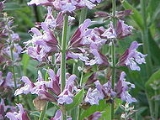
Salvia officinalis is a small, perennial, evergreen subshrub
, with woody stems, grayish leaves, and blue to purplish flowers. It is a member of the family Lamiaceae
and is native to the Mediterranean region, though it has naturalized in many places throughout the world. It has a long history of medicinal and culinary use, and in modern times as an ornamental garden plant. The common name "sage" is also used for a number of related and unrelated species.
s for the many miraculous properties attributed to it. The specific epithet, officinalis, refers to the plant's medicinal use—the officina was the traditional storeroom of a monastery where herbs and medicines were stored. S. officinalis has been classified under many other scientific names over the years, including six different names since 1940 alone.
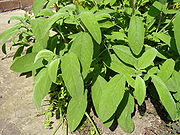 Cultivars are quite variable in size, leaf and flower color, and foliage pattern, with many variegated leaf types. The Old World type grows to approximately 2 ft (0.6096 m) tall and wide, with lavender flowers most common, though they can also be white, pink, or purple. The plant flowers in late spring or summer. The leaves are oblong, ranging in size up to 2.5 in (6.4 cm) long by 1 in (2.5 cm) wide. Leaves are grey-green, rugose on the upper side, and nearly white underneath due to the many short soft hairs. Modern cultivars include leaves with purple, rose, cream, and yellow in many variegated combinations.
 Salvia officinalis has been used since ancient times for warding off evil
, snakebites, increasing women's fertility, and more. The Romans likely introduced it to Europe from Egypt as a medicinal herb. Theophrastus
wrote about two different sages, a wild undershrub he called sphakos, and a similar cultivated plant he called elelisphakos. Pliny the Elder
said the latter plant was called salvia by the Romans, and used as a diuretic
, a local anesthetic
for the skin, a styptic, and for other uses. Charlemagne
recommended the plant for cultivation in the early Middle Ages, and during the Carolingian Empire
, it was cultivated in monastery gardens. Walafrid Strabo
described it in his poem Hortulus as having a sweet scent and being useful for many human ailments—he went back to the Greek root for the name and called it lelifagus.
The plant had a high reputation throughout the Middle Ages, with many sayings referring to its healing properties and value. It was sometimes called S. salvatrix (sage the savior), and was one of the ingredients of Four Thieves Vinegar
, a blend of herbs which was supposed to ward off the plague. Dioscorides, Pliny, and Galen
all recommended sage as a diuretic, hemostatic, emmenagogue
, and tonic.

 Common sage is grown in parts of Europe for distillation of an essential oil
, though other species, such as Salvia fruticosa may also be harvested and distilled with it.
As a kitchen herb, sage has a slight peppery flavor. In British cooking, it is used for flavoring fatty meats, Sage Derby cheese
, poultry or pork stuffing
, Lincolnshire sausage
, and in sauces. Sage is also used in Italian cooking, in the Balkans, and the Middle East
. It is one of the major herbs used in the traditional turkey stuffing for the Thanksgiving Day
dinner in the United States. Despite the common use of traditional and available herbs in French cuisine
, sage never found favour there.
Salvia and "sage" are derived from the Latin salvere (to save), referring to the healing properties long attributed to the various Salvia species. It has been recommended at one time or another for virtually every ailment by various herbal
s. Modern evidence shows possible uses as an antisweating agent, antibiotic
, antifungal, astringent
, antispasmodic
, estrogenic, hypoglycemic, and tonic. In a double blind, randomized and placebo-controlled trial, sage was found to be effective in the management of mild to moderate Alzheimer's disease.
The strongest active constituents of sage are within its essential oil
, which contains cineole, borneol
, and thujone
. Sage leaf contains tannic acid
, oleic acid
, ursonic acid, ursolic acid
, cornsole, cornsolic acid, fumaric acid
, chlorogenic acid
, caffeic acid
, niacin
, nicotinamide
, flavones
, flavonoid glycosides, and estrogenic substances.
Investigations have taken place into using sage as a treatment for Alzheimer's disease
patients.
Sage leaf extract may be effective and safe in the treatment of hyperlipidemia
.
, salvia officinalis is widely known as adaçayı, meaning "island sage".
s, with the majority grown as ornamentals rather than for their herbal properties. All are valuable as small ornamental flowering shrubs, and for their use as a low ground cover, especially in sunny dry environments. They are easily propagate
d from summer cuttings, and some cultivars are produced from seeds.
Named cultivars include:
Subshrub
A subshrub or dwarf shrub is a short woody plant. Prostrate shrub is a similar term.It is distinguished from a shrub by its ground-hugging stems and lower height, with overwintering perennial woody growth typically less than 10–20 cm tall, or by being only weakly woody and/or persisting...
, with woody stems, grayish leaves, and blue to purplish flowers. It is a member of the family Lamiaceae
Lamiaceae
The mints, taxonomically known as Lamiaceae or Labiatae, are a family of flowering plants. They have traditionally been considered closely related to Verbenaceae, but in the 1990s, phylogenetic studies suggested that many genera classified in Verbenaceae belong instead in Lamiaceae...
and is native to the Mediterranean region, though it has naturalized in many places throughout the world. It has a long history of medicinal and culinary use, and in modern times as an ornamental garden plant. The common name "sage" is also used for a number of related and unrelated species.
Taxonomy
Salvia officinalis was described by Carl Linnaeus in 1753. It has been grown for centuries in the Old World for its food and healing properties, and was often described in old herbalHerbal
AThe use of a or an depends on whether or not herbal is pronounced with a silent h. herbal is "a collection of descriptions of plants put together for medicinal purposes." Expressed more elaborately — it is a book containing the names and descriptions of plants, usually with information on their...
s for the many miraculous properties attributed to it. The specific epithet, officinalis, refers to the plant's medicinal use—the officina was the traditional storeroom of a monastery where herbs and medicines were stored. S. officinalis has been classified under many other scientific names over the years, including six different names since 1940 alone.
Description
History
Smudge stick
A smudge stick is a bundle of dried herbs, most commonly white sage . Often other herbs or plants are added, and the leaves are usually bound with string in a small bundle and dried. Additional herbs and spices that are often used in contemporary practices include cilantro, cedar, lavender, and...
, snakebites, increasing women's fertility, and more. The Romans likely introduced it to Europe from Egypt as a medicinal herb. Theophrastus
Theophrastus
Theophrastus , a Greek native of Eresos in Lesbos, was the successor to Aristotle in the Peripatetic school. He came to Athens at a young age, and initially studied in Plato's school. After Plato's death he attached himself to Aristotle. Aristotle bequeathed to Theophrastus his writings, and...
wrote about two different sages, a wild undershrub he called sphakos, and a similar cultivated plant he called elelisphakos. Pliny the Elder
Pliny the Elder
Gaius Plinius Secundus , better known as Pliny the Elder, was a Roman author, naturalist, and natural philosopher, as well as naval and army commander of the early Roman Empire, and personal friend of the emperor Vespasian...
said the latter plant was called salvia by the Romans, and used as a diuretic
Diuretic
A diuretic provides a means of forced diuresis which elevates the rate of urination. There are several categories of diuretics. All diuretics increase the excretion of water from bodies, although each class does so in a distinct way.- Medical uses :...
, a local anesthetic
Local anesthetic
A local anesthetic is a drug that causes reversible local anesthesia, generally for the aim of having local analgesic effect, that is, inducing absence of pain sensation, although other local senses are often affected as well...
for the skin, a styptic, and for other uses. Charlemagne
Charlemagne
Charlemagne was King of the Franks from 768 and Emperor of the Romans from 800 to his death in 814. He expanded the Frankish kingdom into an empire that incorporated much of Western and Central Europe. During his reign, he conquered Italy and was crowned by Pope Leo III on 25 December 800...
recommended the plant for cultivation in the early Middle Ages, and during the Carolingian Empire
Carolingian Empire
Carolingian Empire is a historiographical term which has been used to refer to the realm of the Franks under the Carolingian dynasty in the Early Middle Ages. This dynasty is seen as the founders of France and Germany, and its beginning date is based on the crowning of Charlemagne, or Charles the...
, it was cultivated in monastery gardens. Walafrid Strabo
Walafrid Strabo
Walafrid, alternatively spelt Walahfrid, surnamed Strabo , was a Frankish monk and theological writer.-Theological works:...
described it in his poem Hortulus as having a sweet scent and being useful for many human ailments—he went back to the Greek root for the name and called it lelifagus.
The plant had a high reputation throughout the Middle Ages, with many sayings referring to its healing properties and value. It was sometimes called S. salvatrix (sage the savior), and was one of the ingredients of Four Thieves Vinegar
Four Thieves Vinegar
Four Thieves Vinegar is a concoction of vinegar infused with herbs, spices or garlic that was believed to protect users from the plague...
, a blend of herbs which was supposed to ward off the plague. Dioscorides, Pliny, and Galen
Galen
Aelius Galenus or Claudius Galenus , better known as Galen of Pergamon , was a prominent Roman physician, surgeon and philosopher...
all recommended sage as a diuretic, hemostatic, emmenagogue
Emmenagogue
Emmenagogues are herbs which stimulate blood flow in the pelvic area and uterus; some stimulate menstruation. Women have used plants such as mugwort, parsley and ginger to prevent or terminate early pregnancy...
, and tonic.
Uses
Essential oil
An essential oil is a concentrated hydrophobic liquid containing volatile aroma compounds from plants. Essential oils are also known as volatile oils, ethereal oils or aetherolea, or simply as the "oil of" the plant from which they were extracted, such as oil of clove...
, though other species, such as Salvia fruticosa may also be harvested and distilled with it.
As a kitchen herb, sage has a slight peppery flavor. In British cooking, it is used for flavoring fatty meats, Sage Derby cheese
Sage Derby cheese
right|thumb|200px|Sage Derby cheese with wax coatingSage Derby is a mild, mottled green, semi-hard cheese with a sage flavour. The colour is from sage and sometimes other colouring added to the curds, producing a marbling effect and the subtle herb flavour...
, poultry or pork stuffing
Stuffing
In cooking, stuffing or filling is an edible substance or mixture, often a starch, used to fill a cavity in another food item...
, Lincolnshire sausage
Lincolnshire sausage
Lincolnshire sausages are a distinctive variety of pork sausage developed in and associated with the English county of Lincolnshire.A widely available variety at most UK butchers and supermarkets, the sausage is commonly dominated by the herb sage, rather than the more peppery flavour balance found...
, and in sauces. Sage is also used in Italian cooking, in the Balkans, and the Middle East
Middle East
The Middle East is a region that encompasses Western Asia and Northern Africa. It is often used as a synonym for Near East, in opposition to Far East...
. It is one of the major herbs used in the traditional turkey stuffing for the Thanksgiving Day
Thanksgiving (United States)
Thanksgiving, or Thanksgiving Day, is a holiday celebrated in the United States on the fourth Thursday in November. It has officially been an annual tradition since 1863, when, during the Civil War, President Abraham Lincoln proclaimed a national day of thanksgiving to be celebrated on Thursday,...
dinner in the United States. Despite the common use of traditional and available herbs in French cuisine
French cuisine
French cuisine is a style of food preparation originating from France that has developed from centuries of social change. In the Middle Ages, Guillaume Tirel , a court chef, authored Le Viandier, one of the earliest recipe collections of Medieval France...
, sage never found favour there.
Salvia and "sage" are derived from the Latin salvere (to save), referring to the healing properties long attributed to the various Salvia species. It has been recommended at one time or another for virtually every ailment by various herbal
Herbal
AThe use of a or an depends on whether or not herbal is pronounced with a silent h. herbal is "a collection of descriptions of plants put together for medicinal purposes." Expressed more elaborately — it is a book containing the names and descriptions of plants, usually with information on their...
s. Modern evidence shows possible uses as an antisweating agent, antibiotic
Antibiotic
An antibacterial is a compound or substance that kills or slows down the growth of bacteria.The term is often used synonymously with the term antibiotic; today, however, with increased knowledge of the causative agents of various infectious diseases, antibiotic has come to denote a broader range of...
, antifungal, astringent
Astringent
An astringent substance is a chemical compound that tends to shrink or constrict body tissues, usually locally after topical medicinal application. The word "astringent" derives from Latin adstringere, meaning "to bind fast"...
, antispasmodic
Antispasmodic
An antispasmodic is a drug or a herb that suppresses muscle spasms.-Smooth muscle spasm:One type of antispasmodics is used for smooth muscle contraction, especially in tubular organs of the gastrointestinal tract...
, estrogenic, hypoglycemic, and tonic. In a double blind, randomized and placebo-controlled trial, sage was found to be effective in the management of mild to moderate Alzheimer's disease.
The strongest active constituents of sage are within its essential oil
Essential oil
An essential oil is a concentrated hydrophobic liquid containing volatile aroma compounds from plants. Essential oils are also known as volatile oils, ethereal oils or aetherolea, or simply as the "oil of" the plant from which they were extracted, such as oil of clove...
, which contains cineole, borneol
Borneol
Borneol is a bicyclic organic compound and a terpene. The hydroxyl group in this compound is placed in an endo position.Borneol is easily oxidized to the ketone yielding camphor. One historical name for borneol is Borneo camphor which explains the name. Borneol can be synthesized by reduction of...
, and thujone
Thujone
Thujone is a ketone and a monoterpene that occurs naturally in two diastereomeric forms: -α-thujone and -β-thujone. It has a menthol odor. Even though it is best known as a chemical compound in the spirit absinthe, recent tests show absinthe contains only small quantities of thujone, and may or may...
. Sage leaf contains tannic acid
Tannic acid
Tannic acid is a specific commercial form of tannin, a type of polyphenol. Its weak acidity is due to the numerous phenol groups in the structure...
, oleic acid
Oleic acid
Oleic acid is a monounsaturated omega-9 fatty acid found in various animal and vegetable fats. It has the formula CH37CH=CH7COOH. It is an odorless, colourless oil, although commercial samples may be yellowish. The trans isomer of oleic acid is called elaidic acid...
, ursonic acid, ursolic acid
Ursolic acid
Ursolic acid is a pentacyclic triterpene acid, used in cosmetics, that is also capable of inhibiting various types of cancer cells by inhibiting the STAT3 activation pathway and human fibrosarcoma cells by reducing the expression of matrix metalloproteinase-9 by acting through the glucocorticoid...
, cornsole, cornsolic acid, fumaric acid
Fumaric acid
Fumaric acid or trans-butenedioic acid is the chemical compound with the formula HO2CCH=CHCO2H. This white crystalline compound is one of two isomeric unsaturated dicarboxylic acids, the other being maleic acid. In fumaric acid the carboxylic acid groups are trans and in maleic acid they are cis...
, chlorogenic acid
Chlorogenic acid
Chlorogenic acid is a hydroxycinnamic acid, a member of a family of naturally occurring organic compounds. These are esters of polyphenolic caffeic acid and cyclitol -quinic acid. It is an important biosynthetic intermediate. It also is one of the phenols found in coffee, bamboo Phyllostachys...
, caffeic acid
Caffeic acid
Caffeic acid is a hydroxycinnamic acid, a naturally occurring organic compound. This yellow solid consists of both phenolic and acrylic functional groups...
, niacin
Niacin
"Niacin" redirects here. For the neo-fusion band, see Niacin .Niacin is an organic compound with the formula and, depending on the definition used, one of the forty to eighty essential human nutrients.Niacin is one of five vitamins associated with a pandemic deficiency disease: niacin deficiency...
, nicotinamide
Nicotinamide
Nicotinamide, also known as niacinamide and nicotinic acid amide, is the amide of nicotinic acid . Nicotinamide is a water-soluble vitamin and is part of the vitamin B group...
, flavones
Flavones
Flavones , are a class of flavonoids based on the backbone of 2-phenylchromen-4-one shown on the right....
, flavonoid glycosides, and estrogenic substances.
Investigations have taken place into using sage as a treatment for Alzheimer's disease
Alzheimer's disease
Alzheimer's disease also known in medical literature as Alzheimer disease is the most common form of dementia. There is no cure for the disease, which worsens as it progresses, and eventually leads to death...
patients.
Sage leaf extract may be effective and safe in the treatment of hyperlipidemia
Hyperlipidemia
Hyperlipidemia, hyperlipoproteinemia, or hyperlipidaemia is the condition of abnormally elevated levels of any or all lipids and/or lipoproteins in the blood...
.
Common names
Salvia officinalis has numerous common names. Some of the best known include sage, common sage, garden sage, golden sage, kitchen sage, true sage, culinary sage, Dalmatian sage, and broadleaf sage. Cultivated forms include purple sage and red sage. In TurkeyTurkish language
Turkish is a language spoken as a native language by over 83 million people worldwide, making it the most commonly spoken of the Turkic languages. Its speakers are located predominantly in Turkey and Northern Cyprus with smaller groups in Iraq, Greece, Bulgaria, the Republic of Macedonia, Kosovo,...
, salvia officinalis is widely known as adaçayı, meaning "island sage".
Cultivars
There are a number of cultivarCultivar
A cultivar'Cultivar has two meanings as explained under Formal definition. When used in reference to a taxon, the word does not apply to an individual plant but to all those plants sharing the unique characteristics that define the cultivar. is a plant or group of plants selected for desirable...
s, with the majority grown as ornamentals rather than for their herbal properties. All are valuable as small ornamental flowering shrubs, and for their use as a low ground cover, especially in sunny dry environments. They are easily propagate
Plant propagation
Plant propagation is the process of creating new plants from a variety of sources: seeds, cuttings, bulbs and other plant parts. Plant propagation can also refer to the artificial or natural dispersal of plants.-Sexual propagation :...
d from summer cuttings, and some cultivars are produced from seeds.
Named cultivars include:
- 'Alba', a white-flowered cultivar
- 'Aurea', golden sage
- 'Berggarten', a cultivar with large leaves, which rarely blooms, extending the useful life of the leaves
- 'Extrakta', has leaves with higher oil concentrations
- 'Icterina', a cultivar with yellow-green variegated leaves
- 'Lavandulaefolia', a small leaved cultivar
- 'Purpurascens' ('Purpurea'), a purple-leafed cultivar
- 'Tricolor', a cultivar with white, yellow and green variegated leaves
See also
- Aroma compoundAroma compoundAn aroma compound, also known as odorant, aroma, fragrance or flavor, is a chemical compound that has a smell or odor...
- Essential oilEssential oilAn essential oil is a concentrated hydrophobic liquid containing volatile aroma compounds from plants. Essential oils are also known as volatile oils, ethereal oils or aetherolea, or simply as the "oil of" the plant from which they were extracted, such as oil of clove...
- Sage oilSage oilSage oil is the essential oil made from the culinary herb sage, Salvia officinalis. In addition to its valuable flavoring characteristics, sage oil can contain as much as 50% thujone by weight. The exact amount varies based on the time in the season and which part of the plant is tested...
- SalviaSalviaSalvia is the largest genus of plants in the mint family, Lamiaceae, with approximately 700-900 species of shrubs, herbaceous perennials, and annuals. It is one of several genera commonly referred to as sage. When used without modifiers, sage generally refers to Salvia officinalis ; however, it is...
- ThujoneThujoneThujone is a ketone and a monoterpene that occurs naturally in two diastereomeric forms: -α-thujone and -β-thujone. It has a menthol odor. Even though it is best known as a chemical compound in the spirit absinthe, recent tests show absinthe contains only small quantities of thujone, and may or may...
Further reading
- The Herb Society of America New Encyclopedia of Herbs & Their Uses, Deni Bown (New York: DK, 2001)