


Cucumber

Encyclopedia
The cucumber is a widely cultivated plant in the gourd
family Cucurbitaceae
, which includes squash, and in the same genus
as the muskmelon
. The plant is a creeping vine which bears cylindrical edible fruit
when ripe. There are three main varieties of cucumber: "slicing", "pickling", and "burpless". Within these varieties, several different cultivar
s have emerged. The cucumber is originally from India
but is now grown on most continents. Many different varieties are traded on the global market.
or other supporting frames, wrapping around supports with thin, spiraling tendrils. The plant has large leaves that form a canopy over the fruit. The fruit of the cucumber is roughly cylindrical
, elongated with tapered ends, and may be as large as 60 centimetres (23.6 in) long and 10 centimetres (3.9 in) in diameter. Having an enclosed seed and developing from a flower, botanically speaking, cucumbers are classified as fruits. However, much like tomatoes and squash they are often perceived, prepared and eaten as vegetable
s. Cucumbers are usually more than 90% water.
. Pollination for these varieties degrades the quality. In the United States, these are usually grown in greenhouse
s, where bees are excluded. In Europe, they are grown outdoors in some regions, and bees are excluded from these areas. Most cucumber varieties, however, are seeded and require pollination. Thousands of hives of honey bee
s are annually carried to cucumber fields just before bloom for this purpose. Cucumbers may also be pollinated by bumblebee
s and several other bee species.
Symptoms of inadequate pollination include fruit abortion and misshapen fruit. Partially pollinated flowers may develop fruit which are green and develop normally near the stem end, but pale yellow and withered at the blossom end.
Traditional varieties produce male blossoms first, then female, in about equivalent numbers. New gynoecious hybrid cultivar
s produce almost all female blossoms. However, since these varieties do not provide pollen
, they must have interplanted a pollenizer variety
and the number of beehives per unit area is increased. Insecticide
applications for insect pests must be done very carefully to avoid killing off the insect pollinator
s.

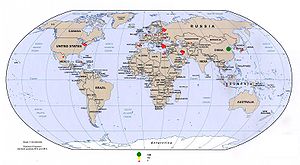 According to the Food and Agriculture Organization of the United Nations
, China produced at least 60% of the global output of cucumber and gherkin in 2005, followed at a distance by Turkey, Russia, Iran and the United States.
, and was probably introduced to other parts of Europe by the Romans. Records of cucumber cultivation appear in France
in the 9th century, England in the 14th century, and in North America by the mid-16th century.
, and the legend of Gilgamesh
describes people eating cucumbers. Some sources also state it was produced in ancient Thrace
, and it is certainly part of modern cuisine in Bulgaria
and Turkey
, parts of which make up that ancient state. From India, it spread to Greece
(where it was called “σίκυον”, síkyon) and Italy
(where the Romans
were especially fond of the crop), and later into China
.
According to Pliny the Elder
(The Natural History, Book XIX, Chapter 23), the Ancient Greeks grew cucumbers, and there were different varieties in Italy, Africa, and modern-day Serbia.
(Book XIX, Chapter 23), the Roman
Emperor Tiberius
had the cucumber on his table daily during summer and winter. The Romans reportedly used artificial methods (similar to the greenhouse system) of growing to have it available for his table every day of the year. To quote Pliny; "Indeed, he was never without it; for he had raised beds made in frames upon wheels, by means of which the cucumbers were moved and exposed to the full heat of the sun; while, in winter, they were withdrawn, and placed under the protection of frames glazed with mirrorstone. Reportedly, they were also cultivated in cucumber houses glazed with oiled cloth known as “specularia
”.
Pliny the Elder describes the Italian fruit as very small, probably like a gherkin
, describing it as a wild cucumber considerably smaller than the cultivated one. Pliny also describes the preparation of a medication known as elaterium, though some scholars believe he was referring to Cucumis silvestris asininus, a species different from the common cucumber. Pliny also writes about several other varieties of cucumber, including the cultivated cucumber, and remedies from the different types (9 from the cultivated, 5 from the "anguine", and 26 from the "wild"). The Romans are reported to have used cucumbers to treat scorpion bites, bad eyesight, and to scare away mice. Wives wishing for children wore them around their waists. They were also carried by the midwives, and thrown away when the child was born.
The Spaniards (through the Italian
Christopher Columbus
) brought cucumbers to Haiti
in 1494. In 1535, Jacques Cartier
, a French explorer, found “very great cucumbers” grown on the site of what is now Montreal
.
hunters, and explorers bartered for the products of American Indian agriculture
. The tribes of the Great Plains
and the Rocky Mountains
learned from the Spanish how to grow European crops. The best farmers on the Great Plains were the Mandan Indians in what is now North
and South Dakota
. They obtained cucumbers and watermelons from the Spanish, and added them to the crops they were already growing, including several varieties of corn
and beans, pumpkins, squash
, and gourd
plants. The Iroquois
were also growing them when the first Europeans visited them.
In 1630, the Reverend Francis Higginson
produced a book called New England’s Plantation in which, describing a garden on Conant’s Island in Boston Harbor
known as “The Governor’s Garden”, he states: “The countrie aboundeth naturally with store of roots of great varietie and good to eat. Our turnips, parsnips, and carrots are here both bigger and sweeter than is ordinary to be found in England. Here are store of pompions, cowcumbers, and other things of that nature which I know not...”
William Wood also published in 1633’s New England Prospect (published in England) observations he made in 1629 in America: “The ground affords very good kitchin gardens, for Turneps, Parsnips, Carrots, Radishes, and Pompions, Muskmillons, Isquoter-squashes, coucumbars, Onyons, and whatever grows well in England grows as well there, many things being better and larger.”
In the later 17th century, a prejudice developed against uncooked vegetables and fruits. A number of articles in contemporary health publications stated that uncooked plants brought on summer diseases and should be forbidden to children. The cucumber kept this vile reputation for an inordinate period of time: “fit only for consumption by cows”, which some believe is why it gained the name, “cowcumber”.
A copper etching made by Maddalena Bouchard between 1772 and 1793 shows this plant to have smaller, almost bean-shaped fruits, and small yellow flowers. The small form of the cucumber is figured in Herbals of the 16th century, but states, ‘if hung in a tube while in blossom, the Cucumber will grow to a most surprising length.’
Samuel Pepys
wrote in his diary on September 22, 1663: “this day Sir W. Batten tells me that Mr. Newhouse is dead of eating cowcumbers, of which the other day I heard of another, I think.” In "The Greenstone Door", William Satchell notes that "Te Moanaroa was dead - of a surfeit of cucumbers...", having eaten four of the "prickly" melons. (Chapter XX, The Storm Cloud).
Fredric Hasselquist
, in his travels in Asia Minor
, Egypt
, Cyprus
and Palestine
in the 18th century, came across the Egyptian or hairy cucumber, Cucumis chate. It is said by Hasselquist to be the “queen of cucumbers, refreshing, sweet, solid, and wholesome.” He also states “they still form a great part of the food of the lower-class people in Egypt serving them for meat, drink and physic.” George E. Post, in Hastings' Dictionary of the Bible
, states, “It is longer and more slender than the common cucumber, being often more than a foot long, and sometimes less than an inch thick, and pointed at both ends.”
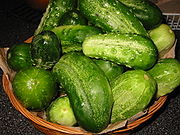
Cucumbers can be pickled
for flavor and longer shelf-life. Although any cucumber can be pickled, commercial pickles are made from cucumbers specially bred for uniformity of length-to-diameter ratio and lack of voids in the flesh. Those cucumbers intended for pickling
, called picklers, grow to about 7 centimetres (2.8 in) to 10 centimetres (3.9 in) long and 2.5 centimetre (0.984251968503937 in) wide. As compared to slicers, picklers tend to be shorter, thicker, less regularly shaped, and have bumpy skin with tiny white or black-dotted spines. They are never waxed. Color can vary from creamy yellow to pale or dark green. Pickling cucumbers are sometimes sold fresh as “Kirby” or “Liberty” cucumbers. The pickling process removes or degrades much of the nutrient content, especially that of vitamin C
. Pickled cucumbers are soaked in brine
or a combination of vinegar
and brine, although not vinegar alone, often along with various spices. Pickled cucumbers are called "pickles" in the US or "gherkins" or "wallies" in the UK, the latter name being more common in the north of England, where it refers to the large vinegar-pickled cucumbers commonly sold in fish and chip shops. (Although the gherkin
is of the same species as the cucumber, it is of a completely different cultivar
.)
Several varietals exist and are sold commercially:
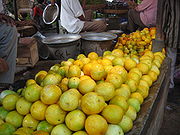
Various practices have arisen with regard to how bitterness may be removed from cucumbers. Among these a very common practice popular in India includes slicing off the ends of a cucumber, sprinkling some salt, and rubbing the now-exposed ends of said cucumber with the sliced-off ends until it appears to froth. Another such urban legend
states that one ought to peel a cucumber away from the end that was once attached to a vine, otherwise one risked spreading the bitterness throughout the cucumber.
.
were claimed to have caused the deaths of at least ten people, leading to some retailers withdrawing cucumbers from sale in Germany, Austria and the Czech Republic. The cucumbers were initially thought to have been sourced from Spain, however subsequent test failed to show contamination in the imported Spanish cucumbers which led to the Spanish Government demanding compensation for Spanish farmers who had been forced to destroy huge quantities of cucumbers.
After the outbreak, the World Health Organization
stated that it was a completely new strain of the bacteria involved.
Gourd
A gourd is a plant of the family Cucurbitaceae. Gourd is occasionally used to describe crops like cucumbers, squash, luffas, and melons. The term 'gourd' however, can more specifically, refer to the plants of the two Cucurbitaceae genera Lagenaria and Cucurbita or also to their hollow dried out shell...
family Cucurbitaceae
Cucurbitaceae
The plant family Cucurbitaceae consists of various squashes, melons, and gourds, including crops such as cucumber, pumpkins, luffas, and watermelons...
, which includes squash, and in the same genus
Genus
In biology, a genus is a low-level taxonomic rank used in the biological classification of living and fossil organisms, which is an example of definition by genus and differentia...
as the muskmelon
Muskmelon
Muskmelon is a species of melon that has been developed into many cultivated varieties. These include smooth skinned varieties such as honeydew, crenshaw and casaba, and different netted cultivars...
. The plant is a creeping vine which bears cylindrical edible fruit
Fruit
In broad terms, a fruit is a structure of a plant that contains its seeds.The term has different meanings dependent on context. In non-technical usage, such as food preparation, fruit normally means the fleshy seed-associated structures of certain plants that are sweet and edible in the raw state,...
when ripe. There are three main varieties of cucumber: "slicing", "pickling", and "burpless". Within these varieties, several different cultivar
Cultivar
A cultivar'Cultivar has two meanings as explained under Formal definition. When used in reference to a taxon, the word does not apply to an individual plant but to all those plants sharing the unique characteristics that define the cultivar. is a plant or group of plants selected for desirable...
s have emerged. The cucumber is originally from India
India
India , officially the Republic of India , is a country in South Asia. It is the seventh-largest country by geographical area, the second-most populous country with over 1.2 billion people, and the most populous democracy in the world...
but is now grown on most continents. Many different varieties are traded on the global market.
Description
The cucumber is a creeping vine that roots in the ground and grows up trellisesTrellis (agriculture)
A trellis is an architectural structure, usually made from interwoven pieces of wood, bamboo or metal that is often made to support climbing plants...
or other supporting frames, wrapping around supports with thin, spiraling tendrils. The plant has large leaves that form a canopy over the fruit. The fruit of the cucumber is roughly cylindrical
Cylinder (geometry)
A cylinder is one of the most basic curvilinear geometric shapes, the surface formed by the points at a fixed distance from a given line segment, the axis of the cylinder. The solid enclosed by this surface and by two planes perpendicular to the axis is also called a cylinder...
, elongated with tapered ends, and may be as large as 60 centimetres (23.6 in) long and 10 centimetres (3.9 in) in diameter. Having an enclosed seed and developing from a flower, botanically speaking, cucumbers are classified as fruits. However, much like tomatoes and squash they are often perceived, prepared and eaten as vegetable
Vegetable
The noun vegetable usually means an edible plant or part of a plant other than a sweet fruit or seed. This typically means the leaf, stem, or root of a plant....
s. Cucumbers are usually more than 90% water.
Flowering and pollination
A few varieties of cucumber are parthenocarpic, the blossoms creating seedless fruit without pollinationPollination
Pollination is the process by which pollen is transferred in plants, thereby enabling fertilisation and sexual reproduction. Pollen grains transport the male gametes to where the female gamete are contained within the carpel; in gymnosperms the pollen is directly applied to the ovule itself...
. Pollination for these varieties degrades the quality. In the United States, these are usually grown in greenhouse
Greenhouse
A greenhouse is a building in which plants are grown. These structures range in size from small sheds to very large buildings...
s, where bees are excluded. In Europe, they are grown outdoors in some regions, and bees are excluded from these areas. Most cucumber varieties, however, are seeded and require pollination. Thousands of hives of honey bee
Honey bee
Honey bees are a subset of bees in the genus Apis, primarily distinguished by the production and storage of honey and the construction of perennial, colonial nests out of wax. Honey bees are the only extant members of the tribe Apini, all in the genus Apis...
s are annually carried to cucumber fields just before bloom for this purpose. Cucumbers may also be pollinated by bumblebee
Bumblebee
A bumble bee is any member of the bee genus Bombus, in the family Apidae. There are over 250 known species, existing primarily in the Northern Hemisphere although they are common in New Zealand and in the Australian state of Tasmania.Bumble bees are social insects that are characterised by black...
s and several other bee species.
Symptoms of inadequate pollination include fruit abortion and misshapen fruit. Partially pollinated flowers may develop fruit which are green and develop normally near the stem end, but pale yellow and withered at the blossom end.
Traditional varieties produce male blossoms first, then female, in about equivalent numbers. New gynoecious hybrid cultivar
Cultivar
A cultivar'Cultivar has two meanings as explained under Formal definition. When used in reference to a taxon, the word does not apply to an individual plant but to all those plants sharing the unique characteristics that define the cultivar. is a plant or group of plants selected for desirable...
s produce almost all female blossoms. However, since these varieties do not provide pollen
Pollen
Pollen is a fine to coarse powder containing the microgametophytes of seed plants, which produce the male gametes . Pollen grains have a hard coat that protects the sperm cells during the process of their movement from the stamens to the pistil of flowering plants or from the male cone to the...
, they must have interplanted a pollenizer variety
Pollenizer
A pollenizer or polleniser, sometimes pollinizer or polliniser is a plant that provides pollen.In American English, the words pollenizer and pollinator are often confused: A pollinator is the biotic agent that moves the pollen, such as bees, moths, bats, and birds...
and the number of beehives per unit area is increased. Insecticide
Insecticide
An insecticide is a pesticide used against insects. They include ovicides and larvicides used against the eggs and larvae of insects respectively. Insecticides are used in agriculture, medicine, industry and the household. The use of insecticides is believed to be one of the major factors behind...
applications for insect pests must be done very carefully to avoid killing off the insect pollinator
Pollinator
A pollinator is the biotic agent that moves pollen from the male anthers of a flower to the female stigma of a flower to accomplish fertilization or syngamy of the female gamete in the ovule of the flower by the male gamete from the pollen grain...
s.
Genome
In 2009, an international team of researchers announced they had sequenced the cucumber genome.Distribution and habitat
Food and Agriculture Organization
The Food and Agriculture Organization of the United Nations is a specialised agency of the United Nations that leads international efforts to defeat hunger. Serving both developed and developing countries, FAO acts as a neutral forum where all nations meet as equals to negotiate agreements and...
, China produced at least 60% of the global output of cucumber and gherkin in 2005, followed at a distance by Turkey, Russia, Iran and the United States.
History
Cucumbers originated in India. Large genetic variety of cucumber has been observed in different parts of India. It has been cultivated for at least 3,000 years in Western AsiaAsia
Asia is the world's largest and most populous continent, located primarily in the eastern and northern hemispheres. It covers 8.7% of the Earth's total surface area and with approximately 3.879 billion people, it hosts 60% of the world's current human population...
, and was probably introduced to other parts of Europe by the Romans. Records of cucumber cultivation appear in France
France
The French Republic , The French Republic , The French Republic , (commonly known as France , is a unitary semi-presidential republic in Western Europe with several overseas territories and islands located on other continents and in the Indian, Pacific, and Atlantic oceans. Metropolitan France...
in the 9th century, England in the 14th century, and in North America by the mid-16th century.
Earliest cultivation
Evidence indicates the cucumber has been cultivated in Western Asia for 3,000 years. It is also listed among the foods of ancient UrUr
Ur was an important city-state in ancient Sumer located at the site of modern Tell el-Muqayyar in Iraq's Dhi Qar Governorate...
, and the legend of Gilgamesh
Gilgamesh
Gilgamesh was the fifth king of Uruk, modern day Iraq , placing his reign ca. 2500 BC. According to the Sumerian king list he reigned for 126 years. In the Tummal Inscription, Gilgamesh, and his son Urlugal, rebuilt the sanctuary of the goddess Ninlil, in Tummal, a sacred quarter in her city of...
describes people eating cucumbers. Some sources also state it was produced in ancient Thrace
Thrace
Thrace is a historical and geographic area in southeast Europe. As a geographical concept, Thrace designates a region bounded by the Balkan Mountains on the north, Rhodope Mountains and the Aegean Sea on the south, and by the Black Sea and the Sea of Marmara on the east...
, and it is certainly part of modern cuisine in Bulgaria
Bulgaria
Bulgaria , officially the Republic of Bulgaria , is a parliamentary democracy within a unitary constitutional republic in Southeast Europe. The country borders Romania to the north, Serbia and Macedonia to the west, Greece and Turkey to the south, as well as the Black Sea to the east...
and Turkey
Turkey
Turkey , known officially as the Republic of Turkey , is a Eurasian country located in Western Asia and in East Thrace in Southeastern Europe...
, parts of which make up that ancient state. From India, it spread to Greece
Greece
Greece , officially the Hellenic Republic , and historically Hellas or the Republic of Greece in English, is a country in southeastern Europe....
(where it was called “σίκυον”, síkyon) and Italy
Italy
Italy , officially the Italian Republic languages]] under the European Charter for Regional or Minority Languages. In each of these, Italy's official name is as follows:;;;;;;;;), is a unitary parliamentary republic in South-Central Europe. To the north it borders France, Switzerland, Austria and...
(where the Romans
Ancient Rome
Ancient Rome was a thriving civilization that grew on the Italian Peninsula as early as the 8th century BC. Located along the Mediterranean Sea and centered on the city of Rome, it expanded to one of the largest empires in the ancient world....
were especially fond of the crop), and later into China
China
Chinese civilization may refer to:* China for more general discussion of the country.* Chinese culture* Greater China, the transnational community of ethnic Chinese.* History of China* Sinosphere, the area historically affected by Chinese culture...
.
According to Pliny the Elder
Pliny the Elder
Gaius Plinius Secundus , better known as Pliny the Elder, was a Roman author, naturalist, and natural philosopher, as well as naval and army commander of the early Roman Empire, and personal friend of the emperor Vespasian...
(The Natural History, Book XIX, Chapter 23), the Ancient Greeks grew cucumbers, and there were different varieties in Italy, Africa, and modern-day Serbia.
Roman Empire
According to The Natural History of Pliny, by Pliny the ElderPliny the Elder
Gaius Plinius Secundus , better known as Pliny the Elder, was a Roman author, naturalist, and natural philosopher, as well as naval and army commander of the early Roman Empire, and personal friend of the emperor Vespasian...
(Book XIX, Chapter 23), the Roman
Roman Empire
The Roman Empire was the post-Republican period of the ancient Roman civilization, characterised by an autocratic form of government and large territorial holdings in Europe and around the Mediterranean....
Emperor Tiberius
Tiberius
Tiberius , was Roman Emperor from 14 AD to 37 AD. Tiberius was by birth a Claudian, son of Tiberius Claudius Nero and Livia Drusilla. His mother divorced Nero and married Augustus in 39 BC, making him a step-son of Octavian...
had the cucumber on his table daily during summer and winter. The Romans reportedly used artificial methods (similar to the greenhouse system) of growing to have it available for his table every day of the year. To quote Pliny; "Indeed, he was never without it; for he had raised beds made in frames upon wheels, by means of which the cucumbers were moved and exposed to the full heat of the sun; while, in winter, they were withdrawn, and placed under the protection of frames glazed with mirrorstone. Reportedly, they were also cultivated in cucumber houses glazed with oiled cloth known as “specularia
Greenhouse
A greenhouse is a building in which plants are grown. These structures range in size from small sheds to very large buildings...
”.
Pliny the Elder describes the Italian fruit as very small, probably like a gherkin
Gherkin
The gherkin is a fruit similar in form and nutritional value to a cucumber. Gherkins and cucumbers belong to the same species , but are from different cultivar groups....
, describing it as a wild cucumber considerably smaller than the cultivated one. Pliny also describes the preparation of a medication known as elaterium, though some scholars believe he was referring to Cucumis silvestris asininus, a species different from the common cucumber. Pliny also writes about several other varieties of cucumber, including the cultivated cucumber, and remedies from the different types (9 from the cultivated, 5 from the "anguine", and 26 from the "wild"). The Romans are reported to have used cucumbers to treat scorpion bites, bad eyesight, and to scare away mice. Wives wishing for children wore them around their waists. They were also carried by the midwives, and thrown away when the child was born.
Middle Ages
Charlemagne had cucumbers grown in his gardens in 9th Century France. They were reportedly introduced into England in the early 14th century, lost, then reintroduced approximately 250 years later.The Spaniards (through the Italian
Italian people
The Italian people are an ethnic group that share a common Italian culture, ancestry and speak the Italian language as a mother tongue. Within Italy, Italians are defined by citizenship, regardless of ancestry or country of residence , and are distinguished from people...
Christopher Columbus
Christopher Columbus
Christopher Columbus was an explorer, colonizer, and navigator, born in the Republic of Genoa, in northwestern Italy. Under the auspices of the Catholic Monarchs of Spain, he completed four voyages across the Atlantic Ocean that led to general European awareness of the American continents in the...
) brought cucumbers to Haiti
Haiti
Haiti , officially the Republic of Haiti , is a Caribbean country. It occupies the western, smaller portion of the island of Hispaniola, in the Greater Antillean archipelago, which it shares with the Dominican Republic. Ayiti was the indigenous Taíno or Amerindian name for the island...
in 1494. In 1535, Jacques Cartier
Jacques Cartier
Jacques Cartier was a French explorer of Breton origin who claimed what is now Canada for France. He was the first European to describe and map the Gulf of Saint Lawrence and the shores of the Saint Lawrence River, which he named "The Country of Canadas", after the Iroquois names for the two big...
, a French explorer, found “very great cucumbers” grown on the site of what is now Montreal
Montreal
Montreal is a city in Canada. It is the largest city in the province of Quebec, the second-largest city in Canada and the seventh largest in North America...
.
Post-enlightenment
Throughout the 16th century, European trappers, traders, bisonBison
Members of the genus Bison are large, even-toed ungulates within the subfamily Bovinae. Two extant and four extinct species are recognized...
hunters, and explorers bartered for the products of American Indian agriculture
Agriculture
Agriculture is the cultivation of animals, plants, fungi and other life forms for food, fiber, and other products used to sustain life. Agriculture was the key implement in the rise of sedentary human civilization, whereby farming of domesticated species created food surpluses that nurtured the...
. The tribes of the Great Plains
Great Plains
The Great Plains are a broad expanse of flat land, much of it covered in prairie, steppe and grassland, which lies west of the Mississippi River and east of the Rocky Mountains in the United States and Canada. This area covers parts of the U.S...
and the Rocky Mountains
Rocky Mountains
The Rocky Mountains are a major mountain range in western North America. The Rocky Mountains stretch more than from the northernmost part of British Columbia, in western Canada, to New Mexico, in the southwestern United States...
learned from the Spanish how to grow European crops. The best farmers on the Great Plains were the Mandan Indians in what is now North
North Dakota
North Dakota is a state located in the Midwestern region of the United States of America, along the Canadian border. The state is bordered by Canada to the north, Minnesota to the east, South Dakota to the south and Montana to the west. North Dakota is the 19th-largest state by area in the U.S....
and South Dakota
South Dakota
South Dakota is a state located in the Midwestern region of the United States. It is named after the Lakota and Dakota Sioux American Indian tribes. Once a part of Dakota Territory, South Dakota became a state on November 2, 1889. The state has an area of and an estimated population of just over...
. They obtained cucumbers and watermelons from the Spanish, and added them to the crops they were already growing, including several varieties of corn
Maize
Maize known in many English-speaking countries as corn or mielie/mealie, is a grain domesticated by indigenous peoples in Mesoamerica in prehistoric times. The leafy stalk produces ears which contain seeds called kernels. Though technically a grain, maize kernels are used in cooking as a vegetable...
and beans, pumpkins, squash
Squash (fruit)
Squashes generally refer to four species of the genus Cucurbita, also called marrows depending on variety or the nationality of the speaker...
, and gourd
Gourd
A gourd is a plant of the family Cucurbitaceae. Gourd is occasionally used to describe crops like cucumbers, squash, luffas, and melons. The term 'gourd' however, can more specifically, refer to the plants of the two Cucurbitaceae genera Lagenaria and Cucurbita or also to their hollow dried out shell...
plants. The Iroquois
Iroquois
The Iroquois , also known as the Haudenosaunee or the "People of the Longhouse", are an association of several tribes of indigenous people of North America...
were also growing them when the first Europeans visited them.
In 1630, the Reverend Francis Higginson
Francis Higginson
Francis Higginson was an early Puritan minister in Colonial New England, and the first minister of Salem, Massachusetts.-Biography:...
produced a book called New England’s Plantation in which, describing a garden on Conant’s Island in Boston Harbor
Boston Harbor
Boston Harbor is a natural harbor and estuary of Massachusetts Bay, and is located adjacent to the city of Boston, Massachusetts. It is home to the Port of Boston, a major shipping facility in the northeast.-History:...
known as “The Governor’s Garden”, he states: “The countrie aboundeth naturally with store of roots of great varietie and good to eat. Our turnips, parsnips, and carrots are here both bigger and sweeter than is ordinary to be found in England. Here are store of pompions, cowcumbers, and other things of that nature which I know not...”
William Wood also published in 1633’s New England Prospect (published in England) observations he made in 1629 in America: “The ground affords very good kitchin gardens, for Turneps, Parsnips, Carrots, Radishes, and Pompions, Muskmillons, Isquoter-squashes, coucumbars, Onyons, and whatever grows well in England grows as well there, many things being better and larger.”
In the later 17th century, a prejudice developed against uncooked vegetables and fruits. A number of articles in contemporary health publications stated that uncooked plants brought on summer diseases and should be forbidden to children. The cucumber kept this vile reputation for an inordinate period of time: “fit only for consumption by cows”, which some believe is why it gained the name, “cowcumber”.
A copper etching made by Maddalena Bouchard between 1772 and 1793 shows this plant to have smaller, almost bean-shaped fruits, and small yellow flowers. The small form of the cucumber is figured in Herbals of the 16th century, but states, ‘if hung in a tube while in blossom, the Cucumber will grow to a most surprising length.’
Samuel Pepys
Samuel Pepys
Samuel Pepys FRS, MP, JP, was an English naval administrator and Member of Parliament who is now most famous for the diary he kept for a decade while still a relatively young man...
wrote in his diary on September 22, 1663: “this day Sir W. Batten tells me that Mr. Newhouse is dead of eating cowcumbers, of which the other day I heard of another, I think.” In "The Greenstone Door", William Satchell notes that "Te Moanaroa was dead - of a surfeit of cucumbers...", having eaten four of the "prickly" melons. (Chapter XX, The Storm Cloud).
Fredric Hasselquist
Fredric Hasselquist
Fredric Hasselquist was a Swedish traveller and naturalist.Hasselquist was born at Törnevalla, which is two kilometers east of Linghem, Östergötland...
, in his travels in Asia Minor
Asia Minor
Asia Minor is a geographical location at the westernmost protrusion of Asia, also called Anatolia, and corresponds to the western two thirds of the Asian part of Turkey...
, Egypt
Egypt
Egypt , officially the Arab Republic of Egypt, Arabic: , is a country mainly in North Africa, with the Sinai Peninsula forming a land bridge in Southwest Asia. Egypt is thus a transcontinental country, and a major power in Africa, the Mediterranean Basin, the Middle East and the Muslim world...
, Cyprus
Cyprus
Cyprus , officially the Republic of Cyprus , is a Eurasian island country, member of the European Union, in the Eastern Mediterranean, east of Greece, south of Turkey, west of Syria and north of Egypt. It is the third largest island in the Mediterranean Sea.The earliest known human activity on the...
and Palestine
Palestine
Palestine is a conventional name, among others, used to describe the geographic region between the Mediterranean Sea and the Jordan River, and various adjoining lands....
in the 18th century, came across the Egyptian or hairy cucumber, Cucumis chate. It is said by Hasselquist to be the “queen of cucumbers, refreshing, sweet, solid, and wholesome.” He also states “they still form a great part of the food of the lower-class people in Egypt serving them for meat, drink and physic.” George E. Post, in Hastings' Dictionary of the Bible
Hastings' Dictionary of the Bible
Hastings' Dictionary of the Bible was a five-volume Biblical encyclopaedia published 1898—1904.-First edition:The full title was A Dictionary of the Bible, dealing with the Language, Literature and Contents, including the Biblical Theology. It was edited by James Hastings, with the assistance...
, states, “It is longer and more slender than the common cucumber, being often more than a foot long, and sometimes less than an inch thick, and pointed at both ends.”
Varieties
In human cultivation, the varieties of cucumbers are classified into three main varieties: "slicing", "pickling", and "burpless".Slicing
Cucumbers which are grown to be eaten fresh are called slicing cucumbers. They are mainly eaten in the unripe, green form. The ripe, yellow form normally becomes too bitter and sour. These cucumbers can also be harvested for pickling when they are smaller. Slicers grown commercially for the North American market are generally longer, smoother, more uniform in color, and have a much tougher skin. Slicers in other countries are smaller and have a thinner, more delicate skin.Pickling
Cucumbers can be pickled
Pickled cucumber
A pickled cucumber is a cucumber that has been pickled in a brine, vinegar, or other solution and left to ferment for a period of time, by either immersing the cucumbers in an acidic solution or through souring by lacto-fermentation.-Gherkin:A gherkin is not only...
for flavor and longer shelf-life. Although any cucumber can be pickled, commercial pickles are made from cucumbers specially bred for uniformity of length-to-diameter ratio and lack of voids in the flesh. Those cucumbers intended for pickling
Pickling
Pickling, also known as brining or corning is the process of preserving food by anaerobic fermentation in brine to produce lactic acid, or marinating and storing it in an acid solution, usually vinegar . The resulting food is called a pickle. This procedure gives the food a salty or sour taste...
, called picklers, grow to about 7 centimetres (2.8 in) to 10 centimetres (3.9 in) long and 2.5 centimetre (0.984251968503937 in) wide. As compared to slicers, picklers tend to be shorter, thicker, less regularly shaped, and have bumpy skin with tiny white or black-dotted spines. They are never waxed. Color can vary from creamy yellow to pale or dark green. Pickling cucumbers are sometimes sold fresh as “Kirby” or “Liberty” cucumbers. The pickling process removes or degrades much of the nutrient content, especially that of vitamin C
Vitamin C
Vitamin C or L-ascorbic acid or L-ascorbate is an essential nutrient for humans and certain other animal species. In living organisms ascorbate acts as an antioxidant by protecting the body against oxidative stress...
. Pickled cucumbers are soaked in brine
Brine
Brine is water, saturated or nearly saturated with salt .Brine is used to preserve vegetables, fruit, fish, and meat, in a process known as brining . Brine is also commonly used to age Halloumi and Feta cheeses, or for pickling foodstuffs, as a means of preserving them...
or a combination of vinegar
Vinegar
Vinegar is a liquid substance consisting mainly of acetic acid and water, the acetic acid being produced through the fermentation of ethanol by acetic acid bacteria. Commercial vinegar is produced either by fast or slow fermentation processes. Slow methods generally are used with traditional...
and brine, although not vinegar alone, often along with various spices. Pickled cucumbers are called "pickles" in the US or "gherkins" or "wallies" in the UK, the latter name being more common in the north of England, where it refers to the large vinegar-pickled cucumbers commonly sold in fish and chip shops. (Although the gherkin
Gherkin
The gherkin is a fruit similar in form and nutritional value to a cucumber. Gherkins and cucumbers belong to the same species , but are from different cultivar groups....
is of the same species as the cucumber, it is of a completely different cultivar
Cultivar
A cultivar'Cultivar has two meanings as explained under Formal definition. When used in reference to a taxon, the word does not apply to an individual plant but to all those plants sharing the unique characteristics that define the cultivar. is a plant or group of plants selected for desirable...
.)
Burpless
Some varieties of cucumber are marketed as burpless, because the seeds and skin of other varieties of cucumbers are said to give some people gas. The burpless variety is reputed to be easy to digest and have a pleasant taste. They can grow as long as 2 foot (0.6096 m). They are nearly seedless, and have a delicate skin which is pleasant to eat. Most commonly grown in greenhouses, these parthenocarpic cucumbers are often found in grocery markets, shrink-wrapped in plastic.Several varietals exist and are sold commercially:
- Lebanese cucumbers are small, smooth-skinned and mild. Like the English cucumber, Lebanese cucumbers are nearly seedless.
- East Asian cucumbers are mild, slender, deep green, and have a bumpy, ridged skin. They can be used for slicing, salads, pickling, etc., and are available year-round. They are usually burpless as well.
- Armenian cucumberArmenian cucumberThe Armenian cucumber, Cucumis melo var. flexuosus, is a type of long, slender fruit which tastes like a cucumber and looks somewhat like a cucumber inside. It is actually a variety of muskmelon , a species closely related to the cucumber...
s (also known as yard long) have very long, ribbed fruit with a thin skin that does not require peeling, but are actually an immature melon. This is the variety sold in Middle Eastern markets as "pickled wild cucumber". In North AmericaNorth AmericaNorth America is a continent wholly within the Northern Hemisphere and almost wholly within the Western Hemisphere. It is also considered a northern subcontinent of the Americas...
, the term “wild cucumber” refers to manrootManrootThe manroots, wild cucumbers, or cucumber gourd are flowering plants in the gourd family , native to western North America. They are also commonly called Old man in the ground. The genus name comes from Hebrew מָרָ֔א The manroots, wild cucumbers, or cucumber gourd (genus Marah) are flowering...
. - Persian cucumber, better known as mini seedless cucumbers, are available from Canada during the summer, and all year-round from the Dominican. Its popularity is increasing 30 to 40% a year. Easy to cut, it is on average 5-8 in. long. Vines are parthenocarpic, requiring no pollinators for fruit set.
- Beit Alpha cucumbers are small, sweet parthenocarpic cucumbers adapted to the dry climate of the Middle East.
- Apple cucumbers are short, round cucumbers grown in New ZealandNew ZealandNew Zealand is an island country in the south-western Pacific Ocean comprising two main landmasses and numerous smaller islands. The country is situated some east of Australia across the Tasman Sea, and roughly south of the Pacific island nations of New Caledonia, Fiji, and Tonga...
and parts of Europe, known for their light yellow-green color and mildly sweet flavor. When mature, the fruit may grow tiny spines, and contains numerous edible green seeds. The fruit is usually eaten raw, with skin. - Dosakai is a yellow cucumber available in parts of IndiaIndiaIndia , officially the Republic of India , is a country in South Asia. It is the seventh-largest country by geographical area, the second-most populous country with over 1.2 billion people, and the most populous democracy in the world...
. These fruits are generally spherical in shape. It is commonly cooked as curry, added in sambar or soup, daal and also in making dosa-aavakaayaAavakaayaAavakaaya is a variety of Indian pickle popular in South India with its origin in Andhra Pradesh. The main ingredients are mangoes and aavalu and a combination of other spices used for pickling.-Preparation:...
(Indian pickleIndian pickleIndian pickles are made from certain individual varieties of vegetables and fruits that are chopped into small pieces and cooked in edible oils like sesame oil or brine with many different Indian spices like asafetida, red chili powder, turmeric, fenugreek and plenty of salt. Some regions also...
) and chutneyChutneyChutney is a a condiment used in South Asian cuisine that usually contains a spice and vegetable mix.Chutneys are wet or dry, having a coarse to fine texture. The Anglo-Indian loan word refers to fresh and pickled preparations indiscriminately, with preserves often sweetened. At least several...
; it is also grown and available through farms in Central CaliforniaCentral CaliforniaCentral California, sometimes referenced as Mid-State, is an area of California south of the San Francisco Bay Area and north of Southern California...
. - Kekiri is a smooth skinned cucumber, relatively hard, and not used for salads. It is cooked as spicy curry. It is found in dry zone of Sri LankaSri LankaSri Lanka, officially the Democratic Socialist Republic of Sri Lanka is a country off the southern coast of the Indian subcontinent. Known until 1972 as Ceylon , Sri Lanka is an island surrounded by the Indian Ocean, the Gulf of Mannar and the Palk Strait, and lies in the vicinity of India and the...
. It becomes orange colored when the fruit is matured. - In May 2008, BritishUnited KingdomThe United Kingdom of Great Britain and Northern IrelandIn the United Kingdom and Dependencies, other languages have been officially recognised as legitimate autochthonous languages under the European Charter for Regional or Minority Languages...
supermarket chain Sainsbury's unveiled the 'c-thru- cumber', a thin-skinned variety which reportedly does not require peeling.
Taste
There appears to be variability in the human olfactory response to cucumbers, with the majority of people reporting a mild, almost watery flavor or a light melon taste, while a small but vocal minority report a highly repugnant taste, some say almost perfume-like.Various practices have arisen with regard to how bitterness may be removed from cucumbers. Among these a very common practice popular in India includes slicing off the ends of a cucumber, sprinkling some salt, and rubbing the now-exposed ends of said cucumber with the sliced-off ends until it appears to froth. Another such urban legend
Urban legend
An urban legend, urban myth, urban tale, or contemporary legend, is a form of modern folklore consisting of stories that may or may not have been believed by their tellers to be true...
states that one ought to peel a cucumber away from the end that was once attached to a vine, otherwise one risked spreading the bitterness throughout the cucumber.
Storage
Cucumbers can best be stored sealed in shrink foil. Sealing a cucumber increases its shelf life considerably.Farming methods
The usual commercial method of cultivating cucumbers involves the use of mineral (manufactured) fertilizerFertilizer
Fertilizer is any organic or inorganic material of natural or synthetic origin that is added to a soil to supply one or more plant nutrients essential to the growth of plants. A recent assessment found that about 40 to 60% of crop yields are attributable to commercial fertilizer use...
.
In the news
In May 2011, cucumbers infected with E.coliEscherichia coli
Escherichia coli is a Gram-negative, rod-shaped bacterium that is commonly found in the lower intestine of warm-blooded organisms . Most E. coli strains are harmless, but some serotypes can cause serious food poisoning in humans, and are occasionally responsible for product recalls...
were claimed to have caused the deaths of at least ten people, leading to some retailers withdrawing cucumbers from sale in Germany, Austria and the Czech Republic. The cucumbers were initially thought to have been sourced from Spain, however subsequent test failed to show contamination in the imported Spanish cucumbers which led to the Spanish Government demanding compensation for Spanish farmers who had been forced to destroy huge quantities of cucumbers.
After the outbreak, the World Health Organization
World Health Organization
The World Health Organization is a specialized agency of the United Nations that acts as a coordinating authority on international public health. Established on 7 April 1948, with headquarters in Geneva, Switzerland, the agency inherited the mandate and resources of its predecessor, the Health...
stated that it was a completely new strain of the bacteria involved.
Reference sources
|
|
|
|
External links
- Plant profile at the Plants Database - shows classification and distribution by US state.
- The Art of Promoting the Growth of the Cucumber and Melon by Thomas Watkins
- Cucumber Nutrition Information from USDA SR22 database