
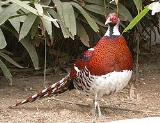
Pheasants refer to some members of the
Phasianinae (
HorsfieldThomas Horsfield M. D. was an American physician and naturalist.Horsfield was born in Bethlehem, Pennsylvania, and studied medicine at the University of Pennsylvania. He was the grandson of Timothy Horsfield, Sr., a colonel and justice of the peace in Bethlehem, and a friend mentioned in Benjamin...
, 1821) subfamily of
PhasianidaeThe Phasianidae is a family of birds which consists of the pheasants and partridges, including the junglefowl , Old World Quail, francolins, monals and peafowl. The family is a large one, and is occasionally broken up into two subfamilies, the Phasianinae, and the Perdicinae...
in the
orderIn scientific classification used in biology, the order is# a taxonomic rank used in the classification of organisms. Other well-known ranks are life, domain, kingdom, phylum, class, family, genus, and species, with order fitting in between class and family...
GalliformesGalliformes are an order of heavy-bodied ground-feeding domestic or game bird, containing turkey, grouse, chicken, New and Old World Quail, ptarmigan, partridge, pheasant, and the Cracidae. Common names are gamefowl or gamebirds, landfowl, gallinaceous birds or galliforms...
.
Pheasants are characterised by strong
sexual dimorphismSexual dimorphism is a phenotypic difference between males and females of the same species. Examples of such differences include differences in morphology, ornamentation, and behavior.-Examples:-Ornamentation / coloration:...
, males being highly ornate with bright colours and adornments such as
wattlesA wattle is a fleshy dewlap or caruncle hanging from various parts of the head or neck in several groups of birds, goats and other animals. In some birds the caruncle is erectile tissue.The wattle is frequently an organ of sexual dimorphism...
and long
tailThe tail is the section at the rear end of an animal's body; in general, the term refers to a distinct, flexible appendage to the torso. It is the part of the body that corresponds roughly to the sacrum and coccyx in mammals, reptiles, and birds...
s. Males are usually larger than females and have longer tails. Males play no part in rearing the young. Pheasants typically eat seeds and some insects.
The best-known is the
Common PheasantThe Common Pheasant , is a bird in the pheasant family . It is native to Georgia and has been widely introduced elsewhere as a game bird. In parts of its range, namely in places where none of its relatives occur such as in Europe , it is simply known as the "pheasant"...
, which is widespread throughout the world in introduced feral populations and in farm operations. Various other pheasant species are popular in aviaries, such as the
Golden PheasantThe Golden Pheasant or "Chinese Pheasant", is a gamebird of the order Galliformes and the family Phasianidae...
(Chrysolophus pictus).
Uses of pheasants
Pheasants were traditionally shot for sport and for the table mostly by the upper class elite (e.g., in
BritainHunting and shooting have been practised for many centuries in the United Kingdom and, in some areas, are a major part of British rural culture...
), and were valued for their attractive appearance. Due to changes in hunting laws this practice has been significantly reduced.
Species in taxonomic order
This list is ordered to show presumed relationships between species
- Blood Pheasant (genus Ithaginis)
- Blood Pheasant
The Blood Pheasant is the only species in genus Ithaginis of the pheasant family. This relatively small, short-tailed pheasant is widespread and fairly common in northern Southasia...
, (I. cruentus)
- Koklass (genus Pucrasia)
- Koklass Pheasant, (P. macrolopha)
- Gallopheasants (genus Lophura)
- Kalij Pheasant
The Kalij Pheasant, Lophura leucomelanos, is a pheasant found in forests and thickets, especially in the Himalayan foothills, from the Northern India to western Thailand. Males are rather variable depending on the subspecies involved, but all have an at least partially glossy bluish-black plumage,...
, (L. leucomelanos)
- White-crested Kalij Pheasant, (L. l. hamiltoni)
- Nepal Kalij Pheasant, (L. l. leucomelanos)
- Black-backed Kalij Pheasant, (L. l. melanota)
- Black Kalij Pheasant, (L. l. moffitti)
- Black-breasted Kalij Pheasant, (L. l. lathami)
- William's Kalij Pheasant, (L. l. williamsi)
- Oates' Kalij Pheasant, (L. l. oatesi)
- Crawfurd's Kalij Pheasant, (L. l. crawfurdi)
- Lineated Kalij Pheasant, (L. l. lineata)
- Silver Pheasant
The Silver Pheasant is a species of pheasant found in forests, mainly in mountains, of mainland Southeast Asia, and eastern and southern China, with introduced populations in Hawaii and various locations in the US mainland. The male is black and white, while the female is mainly brown...
, (L. nycthemera)
-
- Imperial Pheasant
The Imperial Pheasant, Lophura × imperialis is a dark blue medium-sized, up to 75 cm long, pheasant with bare red facial skin, blue crest, crimson legs and glossy plumage. Female is brown with erectile short feather crest, blackish tail and primaries.The Imperial Pheasant is found in the...
, (L. imperialis)
- Edward's Pheasant, (L. edwardsi)
- Vietnamese Pheasant
The Vietnamese Pheasant, or Vietnam Fireback, is a species of gallopheasant. Discovered in 1964, it is endemic to central Vietnam. Its range concentrates around Ke Go Nature Reserve in Ha Tinh Province.-References:*...
, (L. hatinhensis)
- Swinhoe's Pheasant
Swinhoe's Pheasant, Lophura swinhoii, is a bird of the pheasant subfamily of Phasianidae family that is endemic to Taiwan, where it inhabits primary broadleaved forest and mature secondary forest at 200-2,300 m. It was sometimes referred to as the unofficial "national bird" of Taiwan, but the...
, (L. swinhoii)
- Hoogerwerf's Pheasant, (L. hoogerwerfi)
- Salvadori's Pheasant
The Salvadori's Pheasant, Lophura inornata is a bird of genus Lophura, native to Indonesia. It is found in the mountain rainforests of Sumatra. Thus it is also known as the "Sumatran Pheasant." The species name "inornata" means "without ornament."...
, (L. inornata)
- Crestless Fireback
The Crestless Fireback is a species of bird in the Phasianidae family.It is found in Brunei, Indonesia, Malaysia, and Singapore.Its natural habitat is subtropical or tropical moist lowland forests....
, (L. erythrophthalma)
- Malayan Crestless Fireback, (L. e. erythrophthalma)
- Bornean Crestless Fireback, (L. e. pyronota)
- Crested Fireback
The Crested Fireback, Lophura ignita, is a medium-sized, up to 70 cm long, forest pheasant with a peacock-like dark crest, bluish black plumage, reddish brown rump, black outer tail feathers, red iris and bare blue facial skin...
, (L. ignita)
- Lesser Bornean Crested Fireback, (L. i. ignita)
- Greater Bornean Crested Fireback, (L. i. nobilis)
- Vieilott's Crested Fireback, (L. i. rufa)
- Delacour's Crested Fireback, (L. i. macartneyi)
- Siamese Fireback
The Siamese Fireback, Lophura diardi also known as Diard's Fireback is a medium-sized, approximately 80 cm long, pheasant. The male has a grey plumage with an extensive red facial skin, crimson legs and feet, ornamental black crest feathers, reddish brown iris and long curved blackish tail...
, (L. diardi)
- Bulwer's Pheasant
Bulwer's Pheasant is also known as Bulwer's Wattled Pheasant, the Wattled Pheasant, or the White-tailed Wattled Pheasant. It is a Southeast Asian bird in the Phasianidae family; endemic to the forests of Borneo. It is currently listed as Vulnerable by the IUCN.-Description:Bulwer's Pheasant is...
, (L. bulweri)
- Eared Pheasants (genus Crossoptilon
The genus Crossoptilon consists of four species of eared pheasants.All are large, sexually monomorphic and found in China.-Species:* White Eared Pheasant, Crossoptilon crossoptilon* Tibetan Eared Pheasant, Crossoptilon harmani...
)
- White-eared Pheasant
The Genus Crosssoptilon comprises four distinct ecological species of "Eared Pheasants", so named because of their prominent ear tufts.White Eared Pheasants are called Shagga by indigenous Himalayan peoples...
, (C. crossoptilon)
- Tibetan Eared Pheasant
The Tibetan Eared Pheasant is a species of bird in the Phasianidae family. It is found in China and India.Its natural habitats are boreal forests and temperate forests. It is threatened by habitat loss.-Source:...
, (C. harmani)
- Brown Eared Pheasant
The Brown Eared Pheasant, Crossoptilon mantchuricum is a large, up to 100 cm long, dark brown pheasant of mountain forests of northern China. It has stiff white ear coverts behind the eyes, which look like a moustache. The crown is black with red bare facial skin and its tail of twenty-two...
, (C. mantchuricum)
- Blue Eared Pheasant
The Blue Eared Pheasant, Crossoptilon auritum is a large, up to 96 cm long, dark blue-grey pheasant with velvet black crown, red bare facial skin, yellow iris, long white ear coverts behind the eyes and crimson legs. Its tail of twenty-four elongated bluish grey feathers is curved, loose and...
, (C. auritum)
- Cheer Pheasant (genus Catreus
The Cheer Pheasant, Catreus wallichii also known as Wallich's Pheasant is an endangered species of the pheasant family, Phasianidae. It is the only member in monotypic genus Catreus...
)
- Cheer Pheasant
The Cheer Pheasant, Catreus wallichii also known as Wallich's Pheasant is an endangered species of the pheasant family, Phasianidae. It is the only member in monotypic genus Catreus...
, (C. wallichi)
- Long-tailed Pheasants (genus Syrmaticus
The genus Syrmaticus contains the five species of long-tailed pheasants. The males have short spurs and usually red facial wattles, but otherwise differ wildly in appearance...
)
- Reeve's Pheasant, (S. reevesi)
- Elliot's Pheasant
The Elliot's Pheasant, Syrmaticus ellioti also known as Bar-backed Pheasant is a large, up to 80 cm long, brown and white pheasant with a black throat, chestnut brown upperparts plumage, white belly, nape and wingbars, red bare facial skin and long rusty-barred whitish tail...
, (S. ellioti)
- Mrs. Hume's Pheasant, (S. humiae)
- Mikado Pheasant
The Mikado Pheasant, Syrmaticus mikado, is a gamebird in the pheasant family Phasianidae of the order Galliformes, gallinaceous birds.-Distribution and habitat:The Mikado Pheasant is endemic to mountainous regions of Taiwan...
, (S. mikado)
- Copper Pheasant
The Copper Pheasant, Syrmaticus soemmerringii also known as Soemmerring's Pheasant is a large, up to 136cm long, pheasant with a rich coppery chestnut plumage, yellowish bill, brown iris and red facial skin. The female is a brown bird with greyish brown upperparts and buff barred dark brown below...
, (S. soemmerringi)
- Typical Pheasants (genus Phasianus
The "typical" pheasant genus Phasianus in the family Phasianidae consists of at least one species. Both Phasianus and "pheasant" comes from the Greek word phāsiānos, meaning " of the Phasis". Phasis is the ancient name of the main river of western Georgia, currently called the Rioni.The Common...
)
- Green Pheasant
The Green Pheasant, Phasianus versicolor, also known as Japanese Pheasant, is native to the Japanese Archipelago, to which it is endemic. The male is distinguished from that species by its dark green plumage on the breast and mantle. The male also has an iridescent violet neck, red bare facial...
(P. versicolor)
- Common Pheasant
The Common Pheasant , is a bird in the pheasant family . It is native to Georgia and has been widely introduced elsewhere as a game bird. In parts of its range, namely in places where none of its relatives occur such as in Europe , it is simply known as the "pheasant"...
, (P. colchicus)
- Caucasus Pheasants, Phasianus colchicus colchicus group
- White-winged Pheasants, Phasianus colchicus chrysomelas/principalis group
- Prince of Wales Pheasant, Phasianus colchicus principalis
- Mongolian Ring-necked Pheasants or White-winged Ring-necked Pheasants, Phasianus colchicus mongolicus group
- Tarim Pheasants, Phasianus colchicus tarimensis group
- Chinese Ring-necked Pheasants, Phasianus colchicus torquatus group
- Taiwan Pheasant, Phasianus colchicus formosanus
- Ruffed Pheasants (genus Chrysolophus
Chrysolophus is a genus of the pheasant family of birds.These are species which have spectacularly plumaged males. The Golden Pheasant is native to western China, and Lady Amherst's Pheasant to Tibet and westernmost China, but both have been widely introduced elsewhere...
)
- Golden Pheasant
The Golden Pheasant or "Chinese Pheasant", is a gamebird of the order Galliformes and the family Phasianidae...
, (C. pictus)
- Lady Amherst's Pheasant
The Lady Amherst's Pheasant, Chrysolophus amherstiae, is a bird of the order Galliformes and the family Phasianidae.These are native to south western China and Myanmar, but have been introduced elsewhere, and have established a self-supporting, but now declining, feral population in England, the...
, (C. amherstiae)
- Peacock-Pheasants (genus Polyplectron
The peacock-pheasants are a bird genus, Polyplectron, of the family Phasianidae, consisting of eight species. They are colored inconspicuously, relying on heavily on crypsis to avoid detection. When threatened, peacock-pheasants will alter their shapes utilising specialised plumage that when...
)
- Bronze-tailed Peacock-Pheasant, (P. chalcurum)
- Mountain Peacock-Pheasant, (P. inopinatum)
- Germain's Peacock-Pheasant, (P. germaini)
- Grey Peacock-Pheasant
The Grey Peacock-Pheasant, Polyplectron bicalcaratum also known as Burmese Peacock is a large Southeast Asian member of the order Galliformes. It is rather closely related to the peafowl , and like these – and like most other Polyplectron – has brilliant eyespots on its plumage...
(P. bicalcaratum
- Hainan Peacock-Pheasant
The Hainan Peacock-Pheasant is an endangered bird that belongs to the pheasant family Phasianidae. It is endemic to the island of Hainan, China. It is extremely rare.- Description :...
, (Polyplectron katsumatae)
- Malayan Peacock-Pheasant, (P. malacense)
- Bornean Peacock-Pheasant, (P. schleiermacheri)
- Palawan Peacock-Pheasant, (P. emphanum)
- Crested Argus (genus Rheinartia)
- Crested Argus
The Crested Argus is a large and spectacular peacock-like pheasant with dark-brown-spotted black and buff plumage, a pink bill, brown irises and blue skin around the eyes. The head is small. The male has a broad and greatly elongated tail of twelve feathers. He measures from in total length...
, (R. ocellata)
- Great Argus (genus Argusianus
The genus Argusianus G.R. Gray, 1849 consists of two species of spectacularly plumaged pheasant with greatly elongated secondaries and central tail feathers....
)
- Great Argus
The Great Argus, Argusianus argus is a brown-plumaged pheasant with a small blue head and neck, rufous red upper breast, black hair-like feathers on crown and nape, and red legs. The male is among the largest of all pheasants. He measures in total length, including a tail of , and weighs . It has...
, (A. argus)
- Double-banded Argus
A mysterious pheasant, the Double-banded Argus, Argusianus bipunctatus, is known only from the portion of a single primary flight feather...
, (Argusianus bipunctatus )

Previous classifications
Euplocamus and Gennceus are older names more or less corresponding to the current Lophura.
- Euplocamus was used, for example, by Hume
Allan Octavian Hume was a civil servant, political reformer and amateur ornithologist in British India. He was one of the founders of the Indian National Congress, a political party that was later to lead the Indian independence movement...
and MarshallCharles Henry Tilson Marshall was a British Army Officer, serving in the Punjab, India. In his spare time he collected birds in the Punjab and the Himalayas, and sent these to Allan Octavian Hume. He was the brother of George Frederick Leycester Marshall, with whom he published ornithological...
's in their Game Birds of India, Burmah and Ceylon (1879–1881).
- Gennceus, was used, for example, by Frank Finn
Frank Finn FZS, MBOU was an English ornithologist.Finn was born in Maidstone and educated at Maidstone Grammar School and Brasenose College, Oxford. He went on a collecting expedition to East Africa in 1892, and became First Assistant Superintendent of the Indian Museum, Calcutta in 1894, and...
in Indian Sporting Birds (1915) and Game Birds of India and Asia (1911?).
These old genera were used for:
| Vernacular |
Hume & Marshall |
Finn: Sporting Birds |
Finn: Game Birds |
Contemporary |
| Vieilott's Crested Fireback |
E. vielloti |
Lophura rufa (sic) |
|
L. ignita rufa |
| Black-backed Kalij |
E. melanonotus |
G. melanonotus |
|
L. leucomelanos melanota |
| Common or White-crested Kalij |
E. albocristatus |
G. albocristatus |
|
L. leucomelanos hamiltoni |
| Nepal Kalij |
E. leucomelanus |
G. leucomelanus |
|
L. leucomelanos leucomelanos |
| Purple, Horsfield's or Black-breasted Kalij |
E. horsfieldi |
G. horsfieldi |
|
L. leucomelanos lathami |
| Lineated Kalij |
E. lineatus |
G. lineatus also: Burmese Silver Pheasant |
|
L. leucomelanos lineata |
| Anderson's Silver Pheasant |
? |
G. andersoni, considered hybrid of L. nycthemera and L. l. lineata |
|
L. nycthemera andersoni (invalid) |
| Crawfurd's Silver Pheasant (or Crawford's? ) |
E. andersoni |
considered a further cross of Anderson's and L. l. lineata |
|
? |
| Crawfurd's Kalij (same as C.'s Silver Pheasant?) |
? |
|
G. andersoni |
L. leucomelanos crawfurdi |
| Cuvier's Kalij |
? |
|
G. cuvieri |
? |
| Oates's Kalij |
? |
|
G. oatesi |
L. leucomelanos oatesi |
| Whitehead's Silver Pheasant |
? |
|
G. whiteheadi |
? |
| Swinhoe's Kalij |
? |
|
G. swinhoii |
L. swinhoii |
External links