

Dipsacus

Encyclopedia
Dipsacus is a genus
of flowering plant
in the family Dipsacaceae
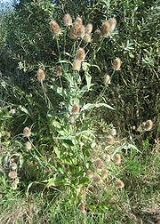
. The members of this genus are known as teasel or teazel or teazle. The genus includes about 15 species of tall herbaceous
biennial plant
s (rarely short-lived perennial plant
s) growing to 1–2.5 m (3.3–8.2 ft) tall. Dipsacus are native to Europe
, Asia
and northern Africa
.
The genus name is derived from the word for thirst and refers to the cup-like formation made where sessile
leaves merge at the stem. Rain water can collect in this receptacle; this may perform the function of preventing sap-sucking insect
s such as aphid
s from climbing the stem. A recent experiment has shown that adding dead insects to these cups increases the seedset of teasels (but not their height), implying partial carnivory. The leaf shape
is lanceolate, 20–40 cm (7.9–15.7 in) long and 3 – broad, with a row of small spines on the underside of the midrib.
Teasels are easily identified with their prickly stem and leaves, and the inflorescence
of purple, dark pink or lavender flower
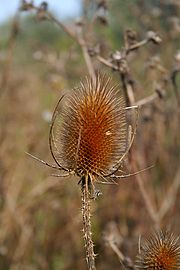
s that form a head on the end of the stem(s). The inflorescence is ovoid, 4 – long and 3 – broad, with a basal whorl of spiny bract
s. The first flowers begin opening in a belt around the middle of the spherical or oval flowerhead, and then open sequentially toward the top and bottom, forming two narrow belts as the flowering progresses. The dried head persists afterwards, with the small (4 –) seed
s maturing in mid autumn.
The seeds are an important winter food resource for some bird
s, notably the European Goldfinch
. Teasels are often grown in garden
s and encouraged on some nature reserve
s to attract them.
Teasel is also considered an invasive species in the United States. It is known to form a monoculture, capable of crowding out all native plant species, and therefore is discouraged and/or eliminated within restored open lands and other conservation areas.
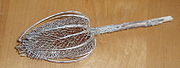 The Fuller's Teasel (the cultivar group
Dipsacus fullonum Sativus Group; syn. D. sativus) was formerly widely used in textile
processing, providing a natural comb
for cleaning, aligning and raising the nap
on fabrics, particularly wool
. It differs from the wild type in having stouter, somewhat recurved spines on the seed heads. The dried flower heads were attached to spindles, wheels, or cylinders, sometimes called teasel frames, to raise the nap on fabrics (that is, to tease the fibres). By the 20th century, teasels were largely replaced by metal cards
, which could be made uniform and do not require constant replacement as the teasel heads wear. However, some people who weave wool still prefer to use teasels for raising the nap, claiming that the result is better; in particular, if a teasel meets serious resistance in the fabric, it will break, whereas a metal tool would rip the cloth.
Teasels are also occasionally grown as ornamental plant
s, and the dried heads are used in floristry
.
 Teasels have been naturalised in many regions away from their native range, partly due to the import of Fuller's Teasel for textile processing, and partly by the seed being a contaminant mixed with crop seeds.
Common Teasel (Dipsacus sylvestris) and Cut-leaved Teasel (Dipsacus laciniatus) have both been observed as invasive species in the United States. Common is more widespread, but Cut-Leaved is more aggressive.
A number of medicinal
properties are claimed for the teasel, though not proven in medical trials:
Genus
In biology, a genus is a low-level taxonomic rank used in the biological classification of living and fossil organisms, which is an example of definition by genus and differentia...
of flowering plant
Flowering plant
The flowering plants , also known as Angiospermae or Magnoliophyta, are the most diverse group of land plants. Angiosperms are seed-producing plants like the gymnosperms and can be distinguished from the gymnosperms by a series of synapomorphies...
in the family Dipsacaceae
Dipsacaceae
The Dipsacaceae, or teasel family, of the order Dipsacales contains 350 species of perennial or biennial herbs and shrubs in eleven genera. Native to most temperate climates, they are found in Europe, Asia and Africa...
. The members of this genus are known as teasel or teazel or teazle. The genus includes about 15 species of tall herbaceous
Herbaceous
A herbaceous plant is a plant that has leaves and stems that die down at the end of the growing season to the soil level. They have no persistent woody stem above ground...
biennial plant
Biennial plant
A biennial plant is a flowering plant that takes two years to complete its biological lifecycle. In the first year the plant grows leaves, stems, and roots , then it enters a period of dormancy over the colder months. Usually the stem remains very short and the leaves are low to the ground, forming...
s (rarely short-lived perennial plant
Perennial plant
A perennial plant or simply perennial is a plant that lives for more than two years. The term is often used to differentiate a plant from shorter lived annuals and biennials. The term is sometimes misused by commercial gardeners or horticulturalists to describe only herbaceous perennials...
s) growing to 1–2.5 m (3.3–8.2 ft) tall. Dipsacus are native to Europe
Europe
Europe is, by convention, one of the world's seven continents. Comprising the westernmost peninsula of Eurasia, Europe is generally 'divided' from Asia to its east by the watershed divides of the Ural and Caucasus Mountains, the Ural River, the Caspian and Black Seas, and the waterways connecting...
, Asia
Asia
Asia is the world's largest and most populous continent, located primarily in the eastern and northern hemispheres. It covers 8.7% of the Earth's total surface area and with approximately 3.879 billion people, it hosts 60% of the world's current human population...
and northern Africa
Africa
Africa is the world's second largest and second most populous continent, after Asia. At about 30.2 million km² including adjacent islands, it covers 6% of the Earth's total surface area and 20.4% of the total land area...
.
The genus name is derived from the word for thirst and refers to the cup-like formation made where sessile
Sessility (botany)
In botany, sessility is a characteristic of plants whose flowers or leaves are borne directly from the stem or peduncle, and thus lack a petiole or pedicel...
leaves merge at the stem. Rain water can collect in this receptacle; this may perform the function of preventing sap-sucking insect
Insect
Insects are a class of living creatures within the arthropods that have a chitinous exoskeleton, a three-part body , three pairs of jointed legs, compound eyes, and two antennae...
s such as aphid
Aphid
Aphids, also known as plant lice and in Britain and the Commonwealth as greenflies, blackflies or whiteflies, are small sap sucking insects, and members of the superfamily Aphidoidea. Aphids are among the most destructive insect pests on cultivated plants in temperate regions...
s from climbing the stem. A recent experiment has shown that adding dead insects to these cups increases the seedset of teasels (but not their height), implying partial carnivory. The leaf shape
Leaf shape
In botany, leaf shape is characterised with the following terms :* Acicular : Slender and pointed, needle-like* Acuminate : Tapering to a long point...
is lanceolate, 20–40 cm (7.9–15.7 in) long and 3 – broad, with a row of small spines on the underside of the midrib.
Teasels are easily identified with their prickly stem and leaves, and the inflorescence
Inflorescence
An inflorescence is a group or cluster of flowers arranged on a stem that is composed of a main branch or a complicated arrangement of branches. Strictly, it is the part of the shoot of seed plants where flowers are formed and which is accordingly modified...
of purple, dark pink or lavender flower
Flower
A flower, sometimes known as a bloom or blossom, is the reproductive structure found in flowering plants . The biological function of a flower is to effect reproduction, usually by providing a mechanism for the union of sperm with eggs...
s that form a head on the end of the stem(s). The inflorescence is ovoid, 4 – long and 3 – broad, with a basal whorl of spiny bract
Bract
In botany, a bract is a modified or specialized leaf, especially one associated with a reproductive structure such as a flower, inflorescence axis, or cone scale. Bracts are often different from foliage leaves. They may be smaller, larger, or of a different color, shape, or texture...
s. The first flowers begin opening in a belt around the middle of the spherical or oval flowerhead, and then open sequentially toward the top and bottom, forming two narrow belts as the flowering progresses. The dried head persists afterwards, with the small (4 –) seed
Seed
A seed is a small embryonic plant enclosed in a covering called the seed coat, usually with some stored food. It is the product of the ripened ovule of gymnosperm and angiosperm plants which occurs after fertilization and some growth within the mother plant...
s maturing in mid autumn.
The seeds are an important winter food resource for some bird
Bird
Birds are feathered, winged, bipedal, endothermic , egg-laying, vertebrate animals. Around 10,000 living species and 188 families makes them the most speciose class of tetrapod vertebrates. They inhabit ecosystems across the globe, from the Arctic to the Antarctic. Extant birds range in size from...
s, notably the European Goldfinch
European Goldfinch
The European Goldfinch or Goldfinch is a small passerine bird in the finch family.-Habitat and range:The goldfinch breeds across Europe, North Africa, and western and central Asia, in open, partially wooded lowlands. It is resident in the milder west of its range, but migrates from colder regions...
. Teasels are often grown in garden
Garden
A garden is a planned space, usually outdoors, set aside for the display, cultivation, and enjoyment of plants and other forms of nature. The garden can incorporate both natural and man-made materials. The most common form today is known as a residential garden, but the term garden has...
s and encouraged on some nature reserve
Nature reserve
A nature reserve is a protected area of importance for wildlife, flora, fauna or features of geological or other special interest, which is reserved and managed for conservation and to provide special opportunities for study or research...
s to attract them.
Teasel is also considered an invasive species in the United States. It is known to form a monoculture, capable of crowding out all native plant species, and therefore is discouraged and/or eliminated within restored open lands and other conservation areas.
Species
Selected Dipsacus species:- Dipsacus ferox - Spiny Teasel
- Dipsacus fullonumDipsacus fullonumDipsacus fullonum, syn. Dipsacus sylvestris, is a species of flowering plant known by the common names Fuller's teasel and wild teasel. It is native to Eurasia and North Africa, but it is known in the Americas, southern Africa, Australia and New Zealand as an introduced species and often a noxious...
- Wild Teasel, Common Teasel, Fuller's Teasel - Dipsacus japonica - Japanese Teasel, Chinese Teasel
- Dipsacus laciniatusDipsacus laciniatusDipsacus laciniatus is a species of flowering plant in the teasel family known by the common name cutleaf teasel. It is native to Europe and Asia. It is present in North America as an introduced species and invasive weed....
- Cut-leaved Teasel - Dipsacus pilosusDipsacus pilosusDipsacus pilosus or Small Teasel is a species of flowering plant in the family Dipsacaceae....
- Small Teasel - Dipsacus sativus - Fuller's Teasel (cultivated form)
- Dipsacus strigosus - Slim Teasel
Cultivation and uses
Cultivar
A cultivar'Cultivar has two meanings as explained under Formal definition. When used in reference to a taxon, the word does not apply to an individual plant but to all those plants sharing the unique characteristics that define the cultivar. is a plant or group of plants selected for desirable...
Dipsacus fullonum Sativus Group; syn. D. sativus) was formerly widely used in textile
Textile
A textile or cloth is a flexible woven material consisting of a network of natural or artificial fibres often referred to as thread or yarn. Yarn is produced by spinning raw fibres of wool, flax, cotton, or other material to produce long strands...
processing, providing a natural comb
Comb
A comb is a toothed device used in hair care for straightening and cleaning hair or other fibres. Combs are among the oldest tools found by archaeologists...
for cleaning, aligning and raising the nap
Nap (textile)
Primarily, nap is the raised surface on certain kinds of cloth, such as velvet. Nap can refer additionally to other surfaces that look like the surface of a napped cloth, such as the surface of a felt or beaver hat....
on fabrics, particularly wool
Wool
Wool is the textile fiber obtained from sheep and certain other animals, including cashmere from goats, mohair from goats, qiviut from muskoxen, vicuña, alpaca, camel from animals in the camel family, and angora from rabbits....
. It differs from the wild type in having stouter, somewhat recurved spines on the seed heads. The dried flower heads were attached to spindles, wheels, or cylinders, sometimes called teasel frames, to raise the nap on fabrics (that is, to tease the fibres). By the 20th century, teasels were largely replaced by metal cards
Carding
Carding is a mechanical process that breaks up locks and unorganised clumps of fibre and then aligns the individual fibres so that they are more or less parallel with each other. The word is derived from the Latin carduus meaning teasel, as dried vegetable teasels were first used to comb the raw wool...
, which could be made uniform and do not require constant replacement as the teasel heads wear. However, some people who weave wool still prefer to use teasels for raising the nap, claiming that the result is better; in particular, if a teasel meets serious resistance in the fabric, it will break, whereas a metal tool would rip the cloth.
Teasels are also occasionally grown as ornamental plant
Ornamental plant
Ornamental plants are plants that are grown for decorative purposes in gardens and landscape design projects, as house plants, for cut flowers and specimen display...
s, and the dried heads are used in floristry
Floristry
Floristry is the general term used to describe production, commerce and trade in flowers. It encompasses flower care and handling, floral design or flower arranging, merchandising, and display and flower delivery. Wholesale florists sell bulk flowers and related supplies to professionals in the trade...
.
Common Teasel (Dipsacus sylvestris) and Cut-leaved Teasel (Dipsacus laciniatus) have both been observed as invasive species in the United States. Common is more widespread, but Cut-Leaved is more aggressive.
A number of medicinal
Herbalism
Herbalism is a traditional medicinal or folk medicine practice based on the use of plants and plant extracts. Herbalism is also known as botanical medicine, medical herbalism, herbal medicine, herbology, herblore, and phytotherapy...
properties are claimed for the teasel, though not proven in medical trials:
- Cure of Lyme DiseaseLyme diseaseLyme disease, or Lyme borreliosis, is an emerging infectious disease caused by at least three species of bacteria belonging to the genus Borrelia. Borrelia burgdorferi sensu stricto is the main cause of Lyme disease in the United States, whereas Borrelia afzelii and Borrelia garinii cause most...
. - Antibiotic.
- Improved circulation.
- Cure for warts.
- Eyewash (water collected in the cup formed by the sessile leaves).