
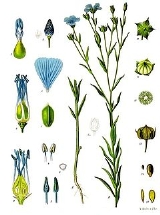
Flax
Flax is a member of the genus
Linum is a genus [i] of about 200 species of flowering plant [i]s in the family Linaceae [i], native ...
in the family
Linaceae. It is probably native to India, though its precise native range is unknown due to extensive ancient cultivation in southwest
Asia and southeastern
Europe.
It is an erect
annual plant growing to 120 cm tall, with slender stems. The
leaves are glaucous green, slender lanceolate, 2-4 cm long and 3 mm broad. The
flowers are pure pale blue, 1.5-2.5 cm diameter, with five petals. The
fruit is a round, dry capsule 5-9 mm diameter, containing several glossy brown
seeds shaped like an
apple pip, 4-7 mm long.
Encyclopedia
Flax is a member of the genus
Linum is a genus [i] of about 200 species of flowering plant [i]s in the family Linaceae [i], native ...
in the family
Linaceae. It is probably native to India, though its precise native range is unknown due to extensive ancient cultivation in southwest
Asia and southeastern
Europe.
It is an erect
annual plant growing to 120 cm tall, with slender stems. The
leaves are glaucous green, slender lanceolate, 2-4 cm long and 3 mm broad. The
flowers are pure pale blue, 1.5-2.5 cm diameter, with five petals. The
fruit is a round, dry capsule 5-9 mm diameter, containing several glossy brown
seeds shaped like an
apple pip, 4-7 mm long.
In addition to the plant itself, flax may refer to the unspun fibres of the flax plant.
Uses
Flax is grown both for
seed and for fibre. Various parts of the plant have been used to make fabric, dye, paper, medicines, fishing nets and soap. It is also grown as an ornamental plant in
gardens, as flax is one of the few plant species that is capable of producing truly
blue flowers , although not all flax varieties produce blue flowers.
Flax seed
The seeds produce a vegetable oil known as linseed oil or flaxseed oil. It is one of the oldest commercial oils and solvent-processed flax seed oil has been used for centuries as a drying oil in painting and varnishing. The seeds are edible, and cold pressed linseed oil is suitable for human consumption. Flax seeds come in two basic varieties; brown and yellow . Although brown flax can be consumed and has been for thousands of years, it is better known as an ingredient in paints, fibre and cattle feed. Brown and yellow flax have similar nutritional values and equal amounts of short-chain omega-3 fatty acids. The exception is a type of yellow flax called solin which is very low in
omega-3 and has a completely different oil profile.
A North Dakota State University research project led to the creation of a new variety of the yellow flax seed called "Omega". This new variety was created primarily as a food source and has a more pleasant nutty-buttery flavour than the brown variety and retains a comparable level of the beneficial
Omega-3 oil.
One tablespoon of ground flax seeds and three tablespoons of water may serve as a replacement for one egg in baking by binding the other ingredients together, and ground flax seeds can also be mixed in with
oatmeal,
yogurt, water , or any other food item where a nutty flavour is appropriate. Flaxseed oil is most commonly consumed with
salads or in capsules. Flax seed owes its nutritional benefits to
lignans and
omega-3 essential fatty acids.
Lignans benefit the heart and possess anti-cancer properties.
Omega-3s, often in short supply in populations with low-fish diets, promote heart health by reducing cholesterol, blood pressure and plaque formation in arteries. In addition, flaxseed oil is often recommended as a galactagogue.
A number of studies have shown that people have a very hard time absorbing the Omega-3 from flaxseed oil compared to oily fish .
Flax seed
sprouts are edible, with a slightly spicy flavour.
Flax fibre
Flax fibres are amongst the oldest fibre crops in the world. The use of flax for the production of
linen goes back 5000 years. Pictures on tombs and temple walls at
Thebes depict flowering flax plants. The use of flax fibre in the manufacturing of
cloth in northern Europe dates back to pre-Roman times. In North America, flax was introduced by the
Pilgrim fathers. Currently most flax produced in the USA and Canada are seed flax types for the production of linseed oil or flaxseeds for human nutrition.
Flax fibre is extracted from the bast or skin of the stem of flax plant. Flax fibre is soft, lustrous and flexible. It is stronger than
cotton fibre but less elastic. The best grades are used for
linen fabrics such as
damasks,
lace and sheeting. Coarser grades are used for the manufacturing of
twine and
rope. Flax fibre is also a raw material for the high-quality paper industry for the use of printed
banknotes and
rolling paper for
cigarettes.
Cultivation
The major fibre flax-producing countries are the former
USSR,
Poland,
France,
Belgium,
Ireland, and the
Czech Republic.
The
soils most suitable for flax, besides the alluvial kind, are deep friable loams, and containing a large proportion of organic matter. Heavy
clays are unsuitable, as are soils of a
gravelly or dry
sandy nature.
Flax is harvested for fibre production when still green, before seed maturation as the fibre starts to degrade later; it is pulled up with the roots , so as to maximise the fibre length. Immediately after harvesting, it is put in water to soak to rot off the non-fibrous material in the stems. Retting takes 7-12 days, depending on temperature.
Flax grown for seed is allowed to mature until the seed capsules are yellow and just starting to split; it is then harvested by
combine harvester and dried to extract the seed.
Threshing flax
The process is divided into two parts: the first part is intended for the farmer, or flax-grower, to bring the flax into a fit state for general or common purposes. This is performed by three machines: one for threshing out the seed, one for breaking and separating the wood from the fibre, and one for further separating the broken wood and matter from the fibre. In some cases the farmers will perhaps thrash out the seed in their own mill and therefore, in such cases, the first machine will be, of course, unnecessary.
The second part of the process is intended for the manufacturer to bring the flax into a state for the very finest purposes, such as
lace, cambric,
damask, and very fine
linen. This second part is performed by the refining machine only.
The threshing process would be conducted as follows:
Take the flax in small bundles, as it comes from the field or stack, and holding it in the left hand, put the seed end between the
threshing machine and the bed or block against which the machine is to strike; then take the handle of the machine in the right hand, and move the machine backward and forward, to strike on the flax, until the seed is all threshed out.
Take the flax in small handfuls in the left hand, spread it flat between the third and little finger, with the seed end downwards, and the root-end above, as near the hand as possible; then put it between the beater of the breaking machine, and beat it gently till the three or four inches, which have been under the operation of the machine, appear to be soft; then remove the flax a little higher in the hand, so as to let the soft part of the flax rest upon the little finger, and continue to beat it till all is soft, and the wood is separated from the fibre, keeping the left hand close to the block and the flax as flat upon the block as possible. The other end of the flax is then to be turned, and the end which has been beaten is to be wrapped round the little finger, the root end flat, and beaten in the machine till the wood is separated, exactly in the same way as the other end was beaten.
Trivia
- Common flax is the national flower of Belarus.
- Flax is the emblem of the Northern Ireland Assembly.
- The flax plant appeared on the reverse of the UK one pound coin to represent Northern Ireland on coins minted in 1986 and 1991.
- In English, blond hair is traditionally referred to as "fair" or "flaxen".
- Flaxseed meal was sometimes used in the 1930s to plug automobile radiator leaks.
References
- The 1881 Household Cyclopedia
See also