

Jerusalem artichoke

Encyclopedia
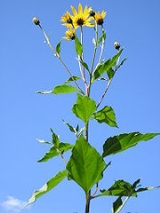
The Jerusalem artichoke (Helianthus tuberosus), also called the sunroot, sunchoke, earth apple or topinambour, is a species of sunflower
native to eastern North America
, and found from Eastern Canada
and Maine
west to North Dakota
, and south to northern Florida
and Texas
. It is also cultivated widely across the temperate zone for its tuber
, which is used as a root vegetable
.
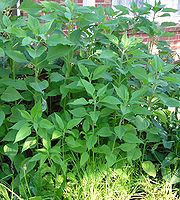
perennial plant
growing to 1.5 – tall with opposite leaves
on the lower part of the stem becoming alternate higher up. The leaves have a rough, hairy texture and the larger leaves on the lower stem are broad ovoid-acute and can be up to 30 centimetres (11.8 in) long and the higher leaves smaller and narrower.
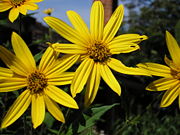
The flower
s are yellow, produced in capitate flowerheads
which are 5 – in diameter, with 10–20 ray florets.
The tuber
s are elongated and uneven, typically 7.5 – long and 3 – thick, and vaguely resembling ginger root, with a crisp texture when raw. They vary in color from pale brown to white, red or purple.
 Despite its name, the Jerusalem artichoke has no relation to Jerusalem, and it is not a type of artichoke
, even though both are members of the daisy
family
. The origin of the name is uncertain. Italian settlers in the USA called the plant girasole, the Italian word for sunflower
because of its resemblance to the garden sunflower (note: both the sunflower and the sunchoke are part of the same genus: Helianthus). Over time the name girasole may have been changed to Jerusalem. To avoid confusion, some people have recently started to refer to it as sunchoke or sunroot.
The artichoke part of the Jerusalem artichoke's name comes from the taste of its edible tuber
. Samuel de Champlain
, the French explorer, sent the first samples of the plant to France, noting that its taste was similar to an artichoke
.
long before the arrival of the Europe
ans; this extensive cultivation obscures the exact native range of the species. The French
explorer Samuel de Champlain
found domestically grown plants at Cape Cod
in 1605. The Jerusalem artichoke was titled 'best soup vegetable' in the 2002 Nice festival for the heritage of the French cuisine.
 Unlike most tubers, but in common with other members of the Asteraceae
(including the artichoke), the tubers store the carbohydrate inulin
(not to be confused with insulin
) instead of starch
. For this reason, Jerusalem artichoke tubers are an important source of fructose
for industry. The crop yields are high, typically 16–20 tonne
s/ha
for tubers, and 18–28 tonnes/ha green weight for foliage. Jerusalem artichoke also has a great deal of unused potential as a producer of ethanol fuel
, using inulin
-adapted strains of yeast
for fermentation.
Jerusalem artichokes are easy to cultivate, which tempts gardeners to simply leave them completely alone to grow. However, the quality of the edible tubers degrades unless the plants are dug up and replanted in fertile soil. This can be a chore, as even a small piece of tuber will grow if left in the ground, making the hardy plant a potential weed.
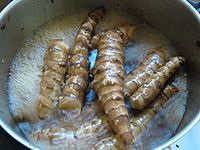 The tubers are sometimes used as a substitute for potatoes: they have a similar consistency, and in their raw form have a similar texture, but a sweeter, nuttier flavor; raw and sliced thinly, they are fit for a salad. The carbohydrates give the tubers a tendency to become soft and mushy if boiled, but they retain their texture better when steamed. The inulin cannot be broken down by the human digestive system, which can cause flatulence and, in some cases, gastric pain. Gerard's Herbal, printed in 1621, quotes the English planter John Goodyer
on Jerusalem artichokes:
Jerusalem artichokes have 650 mg potassium per 1 cup
(150g) serving. They are also high in iron, and contain 10-12% of the US RDA of fiber, niacin, thiamine, phosphorus and copper.
Jerusalem artichokes can be used as animal feed, and, while they must be washed before being fed to most animals, pigs forage and safely eat them directly from the ground. The stalks and leaves can be harvested and used for silage
, though cutting the tops greatly reduces the harvest of the roots.
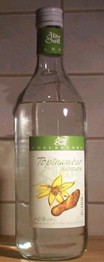
, Germany
, over 90 percent of the Jerusalem artichoke root is used to produce a spirit called "Topinambur" (see German Wikipedia article), "Topi" or "Rossler".
. There was little market for the tuber in that part of the US at the time, but farmers were assured that it would soon appear on the commodities market. Unfortunately, the only profits were realized by the initial distributors and the first few levels of farmers (who sold their seeds to subsequent levels of the pyramid). As a result many of the farms which had planted large quantities of the crop were ruined.
Helianthus
Helianthus L. is a genus of plants comprising 52 species in the Asteraceae family, all of which are native to North America, with some species Helianthus L. is a genus of plants comprising 52 species in the Asteraceae family, all of which are native to North America, with some species Helianthus...
native to eastern North America
North America
North America is a continent wholly within the Northern Hemisphere and almost wholly within the Western Hemisphere. It is also considered a northern subcontinent of the Americas...
, and found from Eastern Canada
Canada
Canada is a North American country consisting of ten provinces and three territories. Located in the northern part of the continent, it extends from the Atlantic Ocean in the east to the Pacific Ocean in the west, and northward into the Arctic Ocean...
and Maine
Maine
Maine is a state in the New England region of the northeastern United States, bordered by the Atlantic Ocean to the east and south, New Hampshire to the west, and the Canadian provinces of Quebec to the northwest and New Brunswick to the northeast. Maine is both the northernmost and easternmost...
west to North Dakota
North Dakota
North Dakota is a state located in the Midwestern region of the United States of America, along the Canadian border. The state is bordered by Canada to the north, Minnesota to the east, South Dakota to the south and Montana to the west. North Dakota is the 19th-largest state by area in the U.S....
, and south to northern Florida
Florida
Florida is a state in the southeastern United States, located on the nation's Atlantic and Gulf coasts. It is bordered to the west by the Gulf of Mexico, to the north by Alabama and Georgia and to the east by the Atlantic Ocean. With a population of 18,801,310 as measured by the 2010 census, it...
and Texas
Texas
Texas is the second largest U.S. state by both area and population, and the largest state by area in the contiguous United States.The name, based on the Caddo word "Tejas" meaning "friends" or "allies", was applied by the Spanish to the Caddo themselves and to the region of their settlement in...
. It is also cultivated widely across the temperate zone for its tuber
Tuber
Tubers are various types of modified plant structures that are enlarged to store nutrients. They are used by plants to survive the winter or dry months and provide energy and nutrients for regrowth during the next growing season and they are a means of asexual reproduction...
, which is used as a root vegetable
Root vegetable
Root vegetables are plant roots used as vegetables. Here "root" means any underground part of a plant.Root vegetables are generally storage organs, enlarged to store energy in the form of carbohydrates. They differ in the concentration and the balance between sugars, starches, and other types of...
.
Description
It is a herbaceousHerbaceous
A herbaceous plant is a plant that has leaves and stems that die down at the end of the growing season to the soil level. They have no persistent woody stem above ground...
perennial plant
Perennial plant
A perennial plant or simply perennial is a plant that lives for more than two years. The term is often used to differentiate a plant from shorter lived annuals and biennials. The term is sometimes misused by commercial gardeners or horticulturalists to describe only herbaceous perennials...
growing to 1.5 – tall with opposite leaves
Leaf
A leaf is an organ of a vascular plant, as defined in botanical terms, and in particular in plant morphology. Foliage is a mass noun that refers to leaves as a feature of plants....
on the lower part of the stem becoming alternate higher up. The leaves have a rough, hairy texture and the larger leaves on the lower stem are broad ovoid-acute and can be up to 30 centimetres (11.8 in) long and the higher leaves smaller and narrower.
The flower
Flower
A flower, sometimes known as a bloom or blossom, is the reproductive structure found in flowering plants . The biological function of a flower is to effect reproduction, usually by providing a mechanism for the union of sperm with eggs...
s are yellow, produced in capitate flowerheads
Inflorescence
An inflorescence is a group or cluster of flowers arranged on a stem that is composed of a main branch or a complicated arrangement of branches. Strictly, it is the part of the shoot of seed plants where flowers are formed and which is accordingly modified...
which are 5 – in diameter, with 10–20 ray florets.
The tuber
Tuber
Tubers are various types of modified plant structures that are enlarged to store nutrients. They are used by plants to survive the winter or dry months and provide energy and nutrients for regrowth during the next growing season and they are a means of asexual reproduction...
s are elongated and uneven, typically 7.5 – long and 3 – thick, and vaguely resembling ginger root, with a crisp texture when raw. They vary in color from pale brown to white, red or purple.
Etymology
Artichoke
-Plants:* Globe artichoke, a partially edible perennial thistle originating in southern Europe around the Mediterranean* Jerusalem artichoke, a species of sunflower with an edible tuber...
, even though both are members of the daisy
Asteraceae
The Asteraceae or Compositae , is an exceedingly large and widespread family of vascular plants. The group has more than 22,750 currently accepted species, spread across 1620 genera and 12 subfamilies...
family
Family (biology)
In biological classification, family is* a taxonomic rank. Other well-known ranks are life, domain, kingdom, phylum, class, order, genus, and species, with family fitting between order and genus. As for the other well-known ranks, there is the option of an immediately lower rank, indicated by the...
. The origin of the name is uncertain. Italian settlers in the USA called the plant girasole, the Italian word for sunflower
Sunflower
Sunflower is an annual plant native to the Americas. It possesses a large inflorescence . The sunflower got its name from its huge, fiery blooms, whose shape and image is often used to depict the sun. The sunflower has a rough, hairy stem, broad, coarsely toothed, rough leaves and circular heads...
because of its resemblance to the garden sunflower (note: both the sunflower and the sunchoke are part of the same genus: Helianthus). Over time the name girasole may have been changed to Jerusalem. To avoid confusion, some people have recently started to refer to it as sunchoke or sunroot.
The artichoke part of the Jerusalem artichoke's name comes from the taste of its edible tuber
Tuber
Tubers are various types of modified plant structures that are enlarged to store nutrients. They are used by plants to survive the winter or dry months and provide energy and nutrients for regrowth during the next growing season and they are a means of asexual reproduction...
. Samuel de Champlain
Samuel de Champlain
Samuel de Champlain , "The Father of New France", was a French navigator, cartographer, draughtsman, soldier, explorer, geographer, ethnologist, diplomat, and chronicler. He founded New France and Quebec City on July 3, 1608....
, the French explorer, sent the first samples of the plant to France, noting that its taste was similar to an artichoke
Globe artichoke
The globe artichoke is a perennial thistle of the Cynara genus originating in Southern Europe around the Mediterranean. It grows to tall, with arching, deeply lobed, silvery, glaucous-green leaves long. The flowers develop in a large head from an edible bud about diameter with numerous...
.
History
Jerusalem artichokes were first cultivated by the Native AmericansIndigenous peoples of the Americas
The indigenous peoples of the Americas are the pre-Columbian inhabitants of North and South America, their descendants and other ethnic groups who are identified with those peoples. Indigenous peoples are known in Canada as Aboriginal peoples, and in the United States as Native Americans...
long before the arrival of the Europe
Europe
Europe is, by convention, one of the world's seven continents. Comprising the westernmost peninsula of Eurasia, Europe is generally 'divided' from Asia to its east by the watershed divides of the Ural and Caucasus Mountains, the Ural River, the Caspian and Black Seas, and the waterways connecting...
ans; this extensive cultivation obscures the exact native range of the species. The French
France
The French Republic , The French Republic , The French Republic , (commonly known as France , is a unitary semi-presidential republic in Western Europe with several overseas territories and islands located on other continents and in the Indian, Pacific, and Atlantic oceans. Metropolitan France...
explorer Samuel de Champlain
Samuel de Champlain
Samuel de Champlain , "The Father of New France", was a French navigator, cartographer, draughtsman, soldier, explorer, geographer, ethnologist, diplomat, and chronicler. He founded New France and Quebec City on July 3, 1608....
found domestically grown plants at Cape Cod
Cape Cod
Cape Cod, often referred to locally as simply the Cape, is a cape in the easternmost portion of the state of Massachusetts, in the Northeastern United States...
in 1605. The Jerusalem artichoke was titled 'best soup vegetable' in the 2002 Nice festival for the heritage of the French cuisine.
Cultivation and uses
Asteraceae
The Asteraceae or Compositae , is an exceedingly large and widespread family of vascular plants. The group has more than 22,750 currently accepted species, spread across 1620 genera and 12 subfamilies...
(including the artichoke), the tubers store the carbohydrate inulin
Inulin
Inulins are a group of naturally occurring polysaccharides produced by many types of plants. They belong to a class of fibers known as fructans. Inulin is used by some plants as a means of storing energy and is typically found in roots or rhizomes...
(not to be confused with insulin
Insulin
Insulin is a hormone central to regulating carbohydrate and fat metabolism in the body. Insulin causes cells in the liver, muscle, and fat tissue to take up glucose from the blood, storing it as glycogen in the liver and muscle....
) instead of starch
Starch
Starch or amylum is a carbohydrate consisting of a large number of glucose units joined together by glycosidic bonds. This polysaccharide is produced by all green plants as an energy store...
. For this reason, Jerusalem artichoke tubers are an important source of fructose
Fructose
Fructose, or fruit sugar, is a simple monosaccharide found in many plants. It is one of the three dietary monosaccharides, along with glucose and galactose, that are absorbed directly into the bloodstream during digestion. Fructose was discovered by French chemist Augustin-Pierre Dubrunfaut in 1847...
for industry. The crop yields are high, typically 16–20 tonne
Tonne
The tonne, known as the metric ton in the US , often put pleonastically as "metric tonne" to avoid confusion with ton, is a metric system unit of mass equal to 1000 kilograms. The tonne is not an International System of Units unit, but is accepted for use with the SI...
s/ha
Hectare
The hectare is a metric unit of area defined as 10,000 square metres , and primarily used in the measurement of land. In 1795, when the metric system was introduced, the are was defined as being 100 square metres and the hectare was thus 100 ares or 1/100 km2...
for tubers, and 18–28 tonnes/ha green weight for foliage. Jerusalem artichoke also has a great deal of unused potential as a producer of ethanol fuel
Ethanol fuel
Ethanol fuel is ethanol , the same type of alcohol found in alcoholic beverages. It is most often used as a motor fuel, mainly as a biofuel additive for gasoline. World ethanol production for transport fuel tripled between 2000 and 2007 from 17 billion to more than 52 billion litres...
, using inulin
Inulin
Inulins are a group of naturally occurring polysaccharides produced by many types of plants. They belong to a class of fibers known as fructans. Inulin is used by some plants as a means of storing energy and is typically found in roots or rhizomes...
-adapted strains of yeast
Yeast
Yeasts are eukaryotic micro-organisms classified in the kingdom Fungi, with 1,500 species currently described estimated to be only 1% of all fungal species. Most reproduce asexually by mitosis, and many do so by an asymmetric division process called budding...
for fermentation.
Jerusalem artichokes are easy to cultivate, which tempts gardeners to simply leave them completely alone to grow. However, the quality of the edible tubers degrades unless the plants are dug up and replanted in fertile soil. This can be a chore, as even a small piece of tuber will grow if left in the ground, making the hardy plant a potential weed.
John Goodyer
John Goodyer was a 17th century botanist who lived in Hampshire, England. He was born in Alton, and evidently received a good education, although it is not known where...
on Jerusalem artichokes:
"which way soever they be dressed and eaten, they stir and cause a filthy loathsome stinking wind within the body, thereby causing the belly to be pained and tormented, and are a meat more fit for swine than men."
Jerusalem artichokes have 650 mg potassium per 1 cup
Cup (unit)
The cup is a customary unit of measurement for volume, used in cooking to measure liquids and bulk foods such as granulated sugar...
(150g) serving. They are also high in iron, and contain 10-12% of the US RDA of fiber, niacin, thiamine, phosphorus and copper.
Jerusalem artichokes can be used as animal feed, and, while they must be washed before being fed to most animals, pigs forage and safely eat them directly from the ground. The stalks and leaves can be harvested and used for silage
Silage
Silage is fermented, high-moisture fodder that can be fed to ruminants or used as a biofuel feedstock for anaerobic digesters. It is fermented and stored in a process called ensiling or silaging, and is usually made from grass crops, including corn , sorghum or other cereals, using the entire...
, though cutting the tops greatly reduces the harvest of the roots.
Liquor
In Baden-WürttembergBaden-Württemberg
Baden-Württemberg is one of the 16 states of Germany. Baden-Württemberg is in the southwestern part of the country to the east of the Upper Rhine, and is the third largest in both area and population of Germany's sixteen states, with an area of and 10.7 million inhabitants...
, Germany
Germany
Germany , officially the Federal Republic of Germany , is a federal parliamentary republic in Europe. The country consists of 16 states while the capital and largest city is Berlin. Germany covers an area of 357,021 km2 and has a largely temperate seasonal climate...
, over 90 percent of the Jerusalem artichoke root is used to produce a spirit called "Topinambur" (see German Wikipedia article), "Topi" or "Rossler".
Pyramid scheme
In the 1980s, the Jerusalem artichoke also gained some notoriety when its seeds were planted by midwestern US farmers at the prodding of an agricultural pyramid schemePyramid scheme
A pyramid scheme is a non-sustainable business model that involves promising participants payment or services, primarily for enrolling other people into the scheme, rather than supplying any real investment or sale of products or services to the public...
. There was little market for the tuber in that part of the US at the time, but farmers were assured that it would soon appear on the commodities market. Unfortunately, the only profits were realized by the initial distributors and the first few levels of farmers (who sold their seeds to subsequent levels of the pyramid). As a result many of the farms which had planted large quantities of the crop were ruined.
External links
- Helianthus tuberosus – Plants for a Future database
- Jerusalem artichoke – Ohio Perennial & Biennial Weed Guide
- Complete nutritional info.
- Alternative Field Crops Manual: Jerusalem Artichoke