

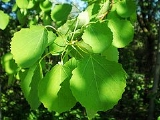
Poplar

Encyclopedia
Populus is a genus of 25–35 species of deciduous
flowering plant
s in the family Salicaceae
, native to most of the Northern Hemisphere
. English
names variously applied to different species include poplar (ˈpɒp.lər), aspen
, and cottonwood.
In the September 2006 issue of Science
, it was announced that the Western Balsam Poplar (P. trichocarpa
) was the first tree to have its full DNA
code sequenced
.
.jpg) The bark
The bark
on young trees is smooth, white to greenish or dark grey, often with conspicuous lenticel
s; on old trees it remains smooth in some species, but becomes rough and deeply fissured in others. The shoots are stout, with (unlike in the related willow
s) the terminal bud present. The leaves
are spirally arranged, and vary in shape from triangular to circular or (rarely) lobed, and with a long petiole
; in species in the sections Populus and Aigeiros, the petioles are laterally flattened, so that breezes easily cause the leaves to wobble back and forth, giving the whole tree a "twinkling" appearance in a breeze. Leaf size is very variable even on a single tree, typically with small leaves on side shoots, and very large leaves on strong-growing lead shoots. The leaves often turn bright gold to yellow before they fall during autumn.
The flower
s are mostly dioecious
(rarely monoecious
) and appear in early spring before the leaves. They are borne in long, drooping, sessile or pedunculate catkin
s produced from buds formed in the axils of the leaves of the previous year. The flowers are each seated in a cup-shaped disk which is borne on the base of a scale which is itself attached to the rachis of the catkin. The scales are obovate, lobed and fringed, membranous, hairy or smooth, usually caducous. The male flowers are without calyx or corolla, and comprise a group of 4–60 stamen
s inserted on a disk; filaments short, pale yellow; anthers oblong, purple or red, introrse, two-celled; cells opening longitudinally. The female flower also has no calyx or corolla, and comprises a single-celled ovary seated in a cup-shaped disk. The style is short, with 2–4 stigmas, variously lobed, and numerous ovules. Pollination is by wind, with the female catkins lengthening considerably between pollination and maturity. The fruit
is a two to four-valved dehiscent
capsule
, green to reddish-brown, mature in mid summer, containing numerous minute light brown seed
s surrounded by tufts of long, soft, white hairs which aid wind dispersal.
broadleaf trees.
Poplars and aspens are important food plants for the larva
e of a large number of Lepidoptera
species - see List of Lepidoptera that feed on poplars. Pleurotus populinus
, the aspen oyster mushroom, is found exclusively on dead wood of Populus trees in North America.
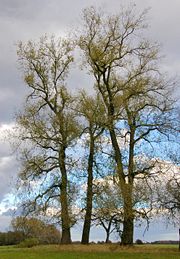
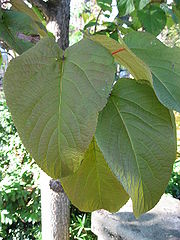
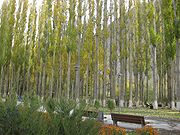 Many poplars are grown as ornamental trees, with numerous cultivar
s used. They have the advantage of growing very big, very fast. Almost all poplars take root readily from cuttings or where broken branches lie on the ground.
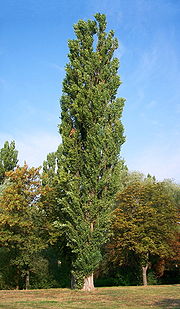
Trees with fastigiate (erect, columnar) branching are particularly popular, and are widely grown across Europe and southwest Asia. However, like willows, poplars have very vigorous and invasive root systems stretching up to 40 m from the trees; planting close to houses or ceramic water pipes may result in damaged foundations and cracked walls and pipes due to their search for moisture.
A simple, reproducible, high frequency micropropagation protocol in Eastern Cottonwood Populus deltoides has been reported by Yadav et al. 2009 http://www.springerlink.com/content/553472252334p7kq/fulltext.pdf
The poplar is grown from "kalam" (cuttings), harvested annually in January and February, and is commercially available up to 15 November.
This most common use of poplar is in plywood. Yamuna Nagar in state of Haryana has a large plywood industry reliant upon poplar. It is graded according in sizes known as "over" (over 24 inches in girth), "under" (18-24 inches), and "sokta" (less than 18 inches).
Punjab Agriculture University in Ludhiana has published a package of practices for poplar cultivation.
 Although the wood from Populus is known as poplar wood, a common high-quality hardwood "poplar" with a greenish colour is actually from an unrelated genus Liriodendron
. Populus wood is a lighter, more porous material.
In modern society poplar is not readily associated with many uses beyond biomass. This poor reputation is undeserved, as its flexibility and close grain give it a balance of properties that have made it highly desirable for a number of applications (similar to those for willow) since antiquity. Notably the Greeks and Etruscans made shields of poplar, and Pliny also recommended poplar for this purpose. Poplar continued to be used for shield construction through the middle ages and was renowned for a durability similar to that of oak, but at a substantial reduction in weight.
for biomass
or biofuel
, in energy forestry
systems, particularly in light of its high energy-in / energy-out ratio, large carbon mitigation potential and fast growth.
In the United Kingdom
poplar (as with fellow energy crop willow
) is typically grown in a short rotation coppice
system for two to five years (with single or multiple stems), then harvested and burned - the yield of some varieties can be as high as 12 oven dry tonnes every year
for panel painting
s; the Mona Lisa
and indeed most famous early renaissance Italian paintings are on poplar. The wood is generally white, often with a slightly yellowish color.
Some stringed instruments are made with one-piece poplar backs; viola
s made in this fashion are said to have a particularly resonant tone. Similarly, though typically it is considered to have a less attractive grain than the traditional sitka spruce
, poplar is beginning to be targeted by some harp
luthier
s as a sustainable and even superior alternative for their soundboard
s: in these cases another hardwood veneer is sometimes applied to the resonant poplar base both for cosmetic reasons, and supposedly to fine-tune the acoustic properties.
around agricultural fields to protect against wind erosion.
Deciduous
Deciduous means "falling off at maturity" or "tending to fall off", and is typically used in reference to trees or shrubs that lose their leaves seasonally, and to the shedding of other plant structures such as petals after flowering or fruit when ripe...
flowering plant
Flowering plant
The flowering plants , also known as Angiospermae or Magnoliophyta, are the most diverse group of land plants. Angiosperms are seed-producing plants like the gymnosperms and can be distinguished from the gymnosperms by a series of synapomorphies...
s in the family Salicaceae
Salicaceae
Salicaceae are a family of flowering plants. Recent genetic studies summarized by the Angiosperm Phylogeny Group has greatly expanded the circumscription of the family to contain 55 genera....
, native to most of the Northern Hemisphere
Northern Hemisphere
The Northern Hemisphere is the half of a planet that is north of its equator—the word hemisphere literally means “half sphere”. It is also that half of the celestial sphere north of the celestial equator...
. English
English language
English is a West Germanic language that arose in the Anglo-Saxon kingdoms of England and spread into what was to become south-east Scotland under the influence of the Anglian medieval kingdom of Northumbria...
names variously applied to different species include poplar (ˈpɒp.lər), aspen
Aspen
Populus section Populus, of the Populus genus, includes the aspen trees and the white poplar Populus alba. The five typical aspens are all native to cold regions with cool summers, in the north of the Northern Hemisphere, extending south at high altitudes in the mountains. The White Poplar, by...
, and cottonwood.
In the September 2006 issue of Science
Science (journal)
Science is the academic journal of the American Association for the Advancement of Science and is one of the world's top scientific journals....
, it was announced that the Western Balsam Poplar (P. trichocarpa
Populus trichocarpa
Populus trichocarpa is a deciduous broadleaf tree species native to western North America. It is used for timber, and is notable as a model organism in plant biology. Its full genome sequence was published in 2006...
) was the first tree to have its full DNA
DNA
Deoxyribonucleic acid is a nucleic acid that contains the genetic instructions used in the development and functioning of all known living organisms . The DNA segments that carry this genetic information are called genes, but other DNA sequences have structural purposes, or are involved in...
code sequenced
DNA sequencing
DNA sequencing includes several methods and technologies that are used for determining the order of the nucleotide bases—adenine, guanine, cytosine, and thymine—in a molecule of DNA....
.
Description
The genus has a large genetic diversity, and can grow from anywhere between 15–50 m (50 to 165 ft) tall, with trunks of up to 2.5 m (8 ft) diameter.Bark
Bark is the outermost layers of stems and roots of woody plants. Plants with bark include trees, woody vines and shrubs. Bark refers to all the tissues outside of the vascular cambium and is a nontechnical term. It overlays the wood and consists of the inner bark and the outer bark. The inner...
on young trees is smooth, white to greenish or dark grey, often with conspicuous lenticel
Lenticel
A lenticel is an airy aggregation of cells within the structural surfaces of the stems, roots, and other parts of vascular plants. It functions as a pore, providing a medium for the direct exchange of gasses between the internal tissues and atmosphere, thereby bypassing the periderm, which would...
s; on old trees it remains smooth in some species, but becomes rough and deeply fissured in others. The shoots are stout, with (unlike in the related willow
Willow
Willows, sallows, and osiers form the genus Salix, around 400 species of deciduous trees and shrubs, found primarily on moist soils in cold and temperate regions of the Northern Hemisphere...
s) the terminal bud present. The leaves
Leaf
A leaf is an organ of a vascular plant, as defined in botanical terms, and in particular in plant morphology. Foliage is a mass noun that refers to leaves as a feature of plants....
are spirally arranged, and vary in shape from triangular to circular or (rarely) lobed, and with a long petiole
Petiole (botany)
In botany, the petiole is the stalk attaching the leaf blade to the stem. The petiole usually has the same internal structure as the stem. Outgrowths appearing on each side of the petiole are called stipules. Leaves lacking a petiole are called sessile, or clasping when they partly surround the...
; in species in the sections Populus and Aigeiros, the petioles are laterally flattened, so that breezes easily cause the leaves to wobble back and forth, giving the whole tree a "twinkling" appearance in a breeze. Leaf size is very variable even on a single tree, typically with small leaves on side shoots, and very large leaves on strong-growing lead shoots. The leaves often turn bright gold to yellow before they fall during autumn.
The flower
Flower
A flower, sometimes known as a bloom or blossom, is the reproductive structure found in flowering plants . The biological function of a flower is to effect reproduction, usually by providing a mechanism for the union of sperm with eggs...
s are mostly dioecious
Plant sexuality
Plant sexuality covers the wide variety of sexual reproduction systems found across the plant kingdom. This article describes morphological aspects of sexual reproduction of plants....
(rarely monoecious
Plant sexuality
Plant sexuality covers the wide variety of sexual reproduction systems found across the plant kingdom. This article describes morphological aspects of sexual reproduction of plants....
) and appear in early spring before the leaves. They are borne in long, drooping, sessile or pedunculate catkin
Catkin
A catkin or ament is a slim, cylindrical flower cluster, with inconspicuous or no petals, usually wind-pollinated but sometimes insect pollinated . They contain many, usually unisexual flowers, arranged closely along a central stem which is often drooping...
s produced from buds formed in the axils of the leaves of the previous year. The flowers are each seated in a cup-shaped disk which is borne on the base of a scale which is itself attached to the rachis of the catkin. The scales are obovate, lobed and fringed, membranous, hairy or smooth, usually caducous. The male flowers are without calyx or corolla, and comprise a group of 4–60 stamen
Stamen
The stamen is the pollen producing reproductive organ of a flower...
s inserted on a disk; filaments short, pale yellow; anthers oblong, purple or red, introrse, two-celled; cells opening longitudinally. The female flower also has no calyx or corolla, and comprises a single-celled ovary seated in a cup-shaped disk. The style is short, with 2–4 stigmas, variously lobed, and numerous ovules. Pollination is by wind, with the female catkins lengthening considerably between pollination and maturity. The fruit
Fruit
In broad terms, a fruit is a structure of a plant that contains its seeds.The term has different meanings dependent on context. In non-technical usage, such as food preparation, fruit normally means the fleshy seed-associated structures of certain plants that are sweet and edible in the raw state,...
is a two to four-valved dehiscent
Dehiscence (botany)
Dehiscence is the opening, at maturity, in a pre-defined way, of a plant structure, such as a fruit, anther, or sporangium, to release its contents. Sometimes this involves the complete detachment of a part. Structures that open in this way are said to be dehiscent...
capsule
Capsule (fruit)
In botany a capsule is a type of simple, dry fruit produced by many species of flowering plants. A capsule is a structure composed of two or more carpels that in most cases is dehiscent, i.e. at maturity, it splits apart to release the seeds within. A few capsules are indehiscent, for example...
, green to reddish-brown, mature in mid summer, containing numerous minute light brown seed
Seed
A seed is a small embryonic plant enclosed in a covering called the seed coat, usually with some stored food. It is the product of the ripened ovule of gymnosperm and angiosperm plants which occurs after fertilization and some growth within the mother plant...
s surrounded by tufts of long, soft, white hairs which aid wind dispersal.
Ecology
Poplars of the cottonwood section are often wetlands or riparian trees. The aspens are among the most important borealBoreal ecosystem
The term boreal is usually applied to ecosystems localized in subarctic and subantarctic zones, although Austral is also used for the latter....
broadleaf trees.
Poplars and aspens are important food plants for the larva
Larva
A larva is a distinct juvenile form many animals undergo before metamorphosis into adults. Animals with indirect development such as insects, amphibians, or cnidarians typically have a larval phase of their life cycle...
e of a large number of Lepidoptera
Lepidoptera
Lepidoptera is a large order of insects that includes moths and butterflies . It is one of the most widespread and widely recognizable insect orders in the world, encompassing moths and the three superfamilies of butterflies, skipper butterflies, and moth-butterflies...
species - see List of Lepidoptera that feed on poplars. Pleurotus populinus
Pleurotus populinus
Pleurotus populinus, the aspen oyster mushroom, is a gilled fungus native to North America. It is found on dead wood of aspen and cottonwood trees . Although morphologically similar to Pleurotus ostreatus and Pleurotus pulmonarius, it has been shown to be a distinct species incapable of...
, the aspen oyster mushroom, is found exclusively on dead wood of Populus trees in North America.
Classification
The genus Populus has traditionally been divided into six sections on the basis of leaf and flower characters; this classification is followed below. Recent genetic studies have largely supported this, confirming some previously suspected reticulate evolution due to past hybridisation and introgression events between the groups. Some species (noted below) had differing relationships indicated by their nuclear DNA (paternally inherited) and chloroplast DNA sequences (maternally inherited), a clear indication of likely hybrid origin. Hybridisation continues to be common in the genus, with several hybrids between species in different sections known.Selected species
- Populus section Populus – aspenAspenPopulus section Populus, of the Populus genus, includes the aspen trees and the white poplar Populus alba. The five typical aspens are all native to cold regions with cool summers, in the north of the Northern Hemisphere, extending south at high altitudes in the mountains. The White Poplar, by...
s and White Poplar. Circumpolar subarctic and cool temperate, and mountains farther south (White Poplar warm temperate)- Populus tremulaPopulus tremulaPopulus tremula, commonly called aspen, common aspen, Eurasian aspen, European aspen, trembling poplar, or quaking aspen, is a species of poplar native to cool temperate regions of Europe and Asia, from the British Isles east to Kamchatka, north to inside the Arctic Circle in Scandinavia and...
– Common Aspen, Trembling Aspen or Eurasian Aspen (Europe, northern Asia) - Populus adenopoda – Chinese Aspen (Eastern Asia)
- Populus alba – White Poplar (Southern Europe to central Asia)
- Populus × canescens (P. alba × P. tremula) – Grey Poplar
- Populus spp. X– Pacific AlbusPacific AlbusPacific Albus is a hybrid Poplar grown in the Pacific Northwest, near Boardman, Oregon. Its name is from the Latin word albus meaning white. It has similar characteristics to Aspen and Cottonwood.-History:...
(North America)
- Populus davidiana – Korean Aspen (Eastern Asia)
- Populus grandidentataPopulus grandidentataPopulus grandidentata — the large-tooth, or big-tooth, aspen — is a deciduous tree native to eastern North America.-Name:...
– Bigtooth Aspen (Eastern North America) - Populus sieboldii – Japanese Aspen (Eastern Asia)
- Populus tremuloidesPopulus tremuloidesPopulus tremuloides is a deciduous tree native to cooler areas of North America, commonly called quaking aspen, trembling aspen, American aspen, and Quakies,. The trees have tall trunks, up to 25 metres, with smooth pale bark, scarred with black. The glossy green leaves, dull beneath, become golden...
– Quaking Aspen or Trembling Aspen (North America)
- Populus tremula
- Populus section Aigeiros – black poplars, some of the cottonwoods. North America, Europe, western Asia; temperate
- Populus deltoides – Eastern Cottonwood (Eastern North America)
- Populus fremontiiPopulus fremontiiPopulus fremontii, the Fremont cottonwood or Alamo cottonwood, is a cottonwood poplar native to western North America, in California and east to Nevada, Utah, Arizona, and New Mexico, and south into Sonora in northwestern Mexico...
– Fremont Cottonwood (Western North America) - Populus nigra – Black Poplar (Europe) Placed here by nuclear DNA; cpDNA places in sect. Populus. (Including Populus afghanica.)
- Populus × canadensis (P. nigra × P. deltoides) – Hybrid Black Poplar
- Populus × inopina (P. nigra × P. fremontii) – Hybrid Black Poplar
- Populus sect. Tacamahaca – balsam poplars. North America, Asia; cool temperate
- Populus angustifoliaPopulus angustifoliaPopulus angustifolia is a species of poplar tree known by the common names Narrowleaf Cottonwood and Willow-leaved Poplar. This tree is native to the Great Basin in the United States where it is most often found by streams and creeks at some elevation.The tree is slim in profile, with yellow-green...
– Willow-leaved Poplar or Narrowleaf Cottonwood (Central North America) - Populus balsamiferaPopulus balsamiferaPopulus balsamifera, commonly called balsam poplar, bamtree, eastern balsam poplar, hackmatack, tacamahac poplar, tacamahaca,...
– Ontario Balsam Poplar (Northern North America) (= P. candicans, P. tacamahaca) - Populus cathayana – (Northeast Asia)
- Populus koreana J.Rehnder – Korean Poplar (Northeast Asia)
- Populus laurifolia – Laurel-leaf Poplar (Central Asia)
- Populus maximowiczii A.Henry – Maximowicz' Poplar, Japanese Poplar (Northeast Asia)
- Populus simonii – Simon's Poplar (Northeast Asia)
- Populus suaveolens Fischer – Mongolian Poplar (Northeast Asia)
- Populus szechuanica – Sichuan Poplar (Northeast Asia) Placed here by nuclear DNA; cpDNA places in sect. Aigeiros.
- Populus trichocarpaPopulus trichocarpaPopulus trichocarpa is a deciduous broadleaf tree species native to western North America. It is used for timber, and is notable as a model organism in plant biology. Its full genome sequence was published in 2006...
– Western Balsam Poplar or Black Cottonwood (Western North America) - Populus tristis (Northeast Asia) Placed here by nuclear DNA; cpDNA places in sect. Aigeiros.
- Populus ussuriensis – Ussuri Poplar (Northeast Asia)
- Populus yunnanensis – Yunnan Poplar (East Asia)
- Populus angustifolia
- Populus section Leucoides – necklace poplars or bigleaf poplars. Eastern North America, eastern Asia; warm temperate
- Populus heterophyllaPopulus heterophyllaPopulus heterophylla, known as the Swamp Cottonwood, also called the River Cottonwood, Downy Poplar, Swamp Poplar, or Black Cottonwood which is actually Populus trichocarpa, is a large deciduous Poplar belonging to section Leucoides of the larger Salindaceae family, found in wet bottom land...
– Swamp Cottonwood (Southeastern North America. - Populus lasiocarpa – Chinese Necklace Poplar (Eastern Asia)
- Populus wilsonii – Wilson's Poplar (Eastern Asia)
- Populus heterophylla
- Populus section Turanga – subtropical poplars. Southwest Asia, east Africa; subtropical to tropical
- Populus euphratica – Euphrates Poplar (Southwest Asia)
- Populus ilicifoliaPopulus ilicifoliaPopulus ilicifolia is a species of poplar in the family Salicaceae. It is found in Kenya and Tanzania from 1°N to 3°S latitude, 37°E to 41°E latitude, at altitudes of 10–1,200 m; it is the southernmost member of its genus in the world. It is threatened by habitat loss.It is an evergreen tree...
– Tana River Poplar (East Africa)
- Populus section Abaso – Mexican poplars. Mexico; subtropical to tropical
- Populus guzmanantlensisPopulus guzmanantlensisPopulus guzmanantlensis is a species of plant in the Salicaceae family. It is endemic to Mexico....
(Mexico) - Populus mexicana – Mexico Poplar (Mexico)
- Populus guzmanantlensis
Cultivation
Cultivar
A cultivar'Cultivar has two meanings as explained under Formal definition. When used in reference to a taxon, the word does not apply to an individual plant but to all those plants sharing the unique characteristics that define the cultivar. is a plant or group of plants selected for desirable...
s used. They have the advantage of growing very big, very fast. Almost all poplars take root readily from cuttings or where broken branches lie on the ground.
Trees with fastigiate (erect, columnar) branching are particularly popular, and are widely grown across Europe and southwest Asia. However, like willows, poplars have very vigorous and invasive root systems stretching up to 40 m from the trees; planting close to houses or ceramic water pipes may result in damaged foundations and cracked walls and pipes due to their search for moisture.
A simple, reproducible, high frequency micropropagation protocol in Eastern Cottonwood Populus deltoides has been reported by Yadav et al. 2009 http://www.springerlink.com/content/553472252334p7kq/fulltext.pdf
The Poplar in India
In India, the poplar is grown commercially by farmers, mainly in the Punjab region. Popular poplar varieties are as follows:- G48 (grown in the plains of Punjab, Haryana, UP)
- w22 (grown in mountainous regions, i.e. Himachal Pradesh, Pathankot, Jammu)
The poplar is grown from "kalam" (cuttings), harvested annually in January and February, and is commercially available up to 15 November.
This most common use of poplar is in plywood. Yamuna Nagar in state of Haryana has a large plywood industry reliant upon poplar. It is graded according in sizes known as "over" (over 24 inches in girth), "under" (18-24 inches), and "sokta" (less than 18 inches).
Punjab Agriculture University in Ludhiana has published a package of practices for poplar cultivation.
Uses
Liriodendron
Liriodendron is a genus of two species of characteristically large deciduous trees in the magnolia family .These trees are widely known by the common name tulip tree or tuliptree for their large flowers superficially resembling tulips, but are closely related to magnolias rather than lilies, the...
. Populus wood is a lighter, more porous material.
In modern society poplar is not readily associated with many uses beyond biomass. This poor reputation is undeserved, as its flexibility and close grain give it a balance of properties that have made it highly desirable for a number of applications (similar to those for willow) since antiquity. Notably the Greeks and Etruscans made shields of poplar, and Pliny also recommended poplar for this purpose. Poplar continued to be used for shield construction through the middle ages and was renowned for a durability similar to that of oak, but at a substantial reduction in weight.
Manufacturing
- In many areas, fast-growing hybrid poplars are grown on plantationPlantationA plantation is a long artificially established forest, farm or estate, where crops are grown for sale, often in distant markets rather than for local on-site consumption...
s for pulpwoodPulpwoodPulpwood refers to timber with the principal use of making wood pulp for paper production.-Applications:* Trees raised specifically for pulp production account for 16% of world pulp production, old growth forests 9% and second- and third- and more generation forests account for the balance... - Poplar is widely used for the manufacture of paperPaperPaper is a thin material mainly used for writing upon, printing upon, drawing or for packaging. It is produced by pressing together moist fibers, typically cellulose pulp derived from wood, rags or grasses, and drying them into flexible sheets....
. - It is also sold as inexpensive hardwood timberTimberTimber may refer to:* Timber, a term common in the United Kingdom and Australia for wood materials * Timber, Oregon, an unincorporated community in the U.S...
, used for palletPalletA pallet , sometimes called a skid, is a flat transport structure that supports goods in a stable fashion while being lifted by a forklift, pallet jack, front loader or other jacking device. A pallet is the structural foundation of a unit load which allows handling and storage efficiencies...
s and cheap plywoodPlywoodPlywood is a type of manufactured timber made from thin sheets of wood veneer. It is one of the most widely used wood products. It is flexible, inexpensive, workable, re-usable, and can usually be locally manufactured...
; more specialised uses include matchMatchA match is a tool for starting a fire under controlled conditions. A typical modern match is made of a small wooden stick or stiff paper. One end is coated with a material that can be ignited by frictional heat generated by striking the match against a suitable surface...
es and the boxes in which camembert cheeseCamembert (cheese)Camembert is a soft, creamy, surface-ripened cow's milk cheese. It was first made in the late 18th century in Normandy in northern France.-Production:...
is sold. - Poplar wood is also widely used in the snowboardSnowboardSnowboards are boards, usually with a width the length of one's foot, with the ability to glide on snow. Snowboards are differentiated from monoskis by the stance of the user...
industry for the snowboard core, because it has exceptional flexibility, and is sometimes used in the bodies of electric guitarElectric guitarAn electric guitar is a guitar that uses the principle of direct electromagnetic induction to convert vibrations of its metal strings into electric audio signals. The signal generated by an electric guitar is too weak to drive a loudspeaker, so it is amplified before sending it to a loudspeaker...
s and drumDrumThe drum is a member of the percussion group of musical instruments, which is technically classified as the membranophones. Drums consist of at least one membrane, called a drumhead or drum skin, that is stretched over a shell and struck, either directly with the player's hands, or with a...
s. - Poplar wood, particularly when seasoned, makes a good hearth for a bow drillBow drillThe bow drill is an ancient tool. While it was usually used to make fire, it was also used for primitive woodworking and dentistry. It consists of a bearing block or handhold, a spindle or drill, a hearth or fireboard, and a simple bow...
. - Due to its high tannic acidTannic acidTannic acid is a specific commercial form of tannin, a type of polyphenol. Its weak acidity is due to the numerous phenol groups in the structure...
content, the bark has been used in Europe for tanning leather. - Poplar wood can be used to produce chopsticksChopsticksChopsticks are small, often tapered, sticks used in pairs of equal length as the traditional eating utensils of China and its diaspora, Japan, Korea, Vietnam and Northern provinces of Laos, Thailand and Burma. Generally believed to have originated in ancient China, they can also be found in some...
.
Energy
There is interest in using poplar as an energy cropEnergy crop
An energy crop is a plant grown as a low cost and low maintenance harvest used to make biofuels, or combusted for its energy content to generate electricity or heat. Energy crops are generally categorized as woody or herbaceous ....
for biomass
Biomass
Biomass, as a renewable energy source, is biological material from living, or recently living organisms. As an energy source, biomass can either be used directly, or converted into other energy products such as biofuel....
or biofuel
Biofuel
Biofuel is a type of fuel whose energy is derived from biological carbon fixation. Biofuels include fuels derived from biomass conversion, as well as solid biomass, liquid fuels and various biogases...
, in energy forestry
Energy forestry
Energy forestry is a form of forestry in which a fast-growing species of tree or woody shrub is grown specifically to provide biomass or biofuel for heating or power generation....
systems, particularly in light of its high energy-in / energy-out ratio, large carbon mitigation potential and fast growth.
In the United Kingdom
United Kingdom
The United Kingdom of Great Britain and Northern IrelandIn the United Kingdom and Dependencies, other languages have been officially recognised as legitimate autochthonous languages under the European Charter for Regional or Minority Languages...
poplar (as with fellow energy crop willow
Willow
Willows, sallows, and osiers form the genus Salix, around 400 species of deciduous trees and shrubs, found primarily on moist soils in cold and temperate regions of the Northern Hemisphere...
) is typically grown in a short rotation coppice
Short rotation coppice
Short Rotation Coppice is coppice grown as an energy crop. This woody solid biomass can be used in applications such as district heating, electric power generating stations, alone or in combination with other fuels.- Species used :...
system for two to five years (with single or multiple stems), then harvested and burned - the yield of some varieties can be as high as 12 oven dry tonnes every year
Art
Poplar was the most common wood used in ItalyItaly
Italy , officially the Italian Republic languages]] under the European Charter for Regional or Minority Languages. In each of these, Italy's official name is as follows:;;;;;;;;), is a unitary parliamentary republic in South-Central Europe. To the north it borders France, Switzerland, Austria and...
for panel painting
Panel painting
A panel painting is a painting made on a flat panel made of wood, either a single piece, or a number of pieces joined together. Until canvas became the more popular support medium in the 16th century, it was the normal form of support for a painting not on a wall or vellum, which was used for...
s; the Mona Lisa
Mona Lisa
Mona Lisa is a portrait by the Italian artist Leonardo da Vinci. It is a painting in oil on a poplar panel, completed circa 1503–1519...
and indeed most famous early renaissance Italian paintings are on poplar. The wood is generally white, often with a slightly yellowish color.
Some stringed instruments are made with one-piece poplar backs; viola
Viola
The viola is a bowed string instrument. It is the middle voice of the violin family, between the violin and the cello.- Form :The viola is similar in material and construction to the violin. A full-size viola's body is between and longer than the body of a full-size violin , with an average...
s made in this fashion are said to have a particularly resonant tone. Similarly, though typically it is considered to have a less attractive grain than the traditional sitka spruce
Sitka Spruce
Picea sitchensis, the Sitka Spruce, is a large coniferous evergreen tree growing to 50–70 m tall, exceptionally to 95 m tall, and with a trunk diameter of up to 5 m, exceptionally to 6–7 m diameter...
, poplar is beginning to be targeted by some harp
Harp
The harp is a multi-stringed instrument which has the plane of its strings positioned perpendicularly to the soundboard. Organologically, it is in the general category of chordophones and has its own sub category . All harps have a neck, resonator and strings...
luthier
Luthier
A luthier is someone who makes or repairs lutes and other string instruments. In the United States, the term is used interchangeably with a term for the specialty of each maker, such as violinmaker, guitar maker, lute maker, etc...
s as a sustainable and even superior alternative for their soundboard
Soundboard
Soundboard or sound board may refer to:*Sound board , a part of a musical instrument*Sounding board, an attachment to a pulpit to assist a human speaker*Alternate name of a mixing console, used to combine electronic audio signals...
s: in these cases another hardwood veneer is sometimes applied to the resonant poplar base both for cosmetic reasons, and supposedly to fine-tune the acoustic properties.
Land management
Lombardy Poplars are used as a windbreakWindbreak
A windbreak or shelterbelt is a plantation usually made up of one or more rows of trees or shrubs planted in such a manner as to provide shelter from the wind and to protect soil from erosion. They are commonly planted around the edges of fields on farms. If designed properly, windbreaks around a...
around agricultural fields to protect against wind erosion.