
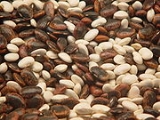
Bean
Bean is a common name for large plant
seeds of several genera of
Fabaceae used for food or feed.
Encyclopedia
Bean is a common name for large plant
seeds of several genera of
Fabaceae used for food or feed.
Name
Bean originally meant the seed of the
broad bean, but was later broadened to include members of the genus
Phaseolus is a genus [i] in the family [i] Fabaceae [i] of about fifty plant [i] species [i], all na ...
such as the
common bean or haricot and the
runner bean and the related genus
Vigna is in the plant [i] family [i] Fabaceae [i]. ...
. The term is now applied in a general way to many other related plants such as
soybeans,
peas,
lentils,
vetches and
lupins.
Bean can be used as a near synonym of
pulse, an edible
legume, though the term "pulses" is usually reserved for leguminous crops harvested for their dry grain.
Pulses usually excludes crops mainly used for oil extraction or those used exclusively for sowing purposes . Leguminous crops harvested green for food like snap beans, green peas etc. are classified as vegetable crops.
In English usage beans sometimes also refer to seeds or other organs of non
leguminosae, for example
coffee beans,
castor beans and
cocoa beans , and
vanilla beans .
Types of beans
- Vicia is a large genus of about 140 species of flowering plant [i]s in the family Fabaceae [i], nati ...
- Vigna is in the plant [i] family [i] Fabaceae [i]. ...
- Aconitifolia or Moth bean
- Angularis or azuki bean
- mungo or urad bean
- radiata or mung bean
- umbellatta or rice bean
- unguiculata or cowpea
- Cicer
- Pisum is a genus of the family Fabaceae [i], native to southwest Asia [i] and northeast Africa [i]. ...
- Lathyrus consists of the sweet peas and vetchlings, flowering plant [i]s i ...
- Lathyrus sativus
- Lathyrus tuberosus
- Lens
- Lablab
- Phaseolus
- Glycine
- Psophocarpus
- Cajanus
- Stizolobium
- Cyamopsis
- Canavalia
- Macrotyloma
- M. uniflorum or horse gram
- Lupinus or Lupin
Cultural aspects
The following traditional uses of beans refer to the
broad bean.
- In some folk legends, such as in Estonia and the common Jack and the Beanstalk story, magical beans grow tall enough to bring the hero to the clouds. The Grimm Brothers collected a story in which a bean splits its sides laughing at the failure of others.
- Dreaming of a bean is sometimes said to be a sign of impending conflict, though others said they caused bad dreams.
- European folklore claims that planting beans on Good Friday or during the night-time is good luck.
- "Beans Beans the Magical Fruit..." is a children's song about the flatulence often experienced after eating broad beans. The song is noteworthy for correctly identifying the bean as a fruit, not a vegetable.
Toxins
Some raw beans, for example
kidney beans, contain harmful toxins which need to be removed, usually by various methods of soaking and cooking. The soaking water from kidney beans should be discarded before boiling, and some authorities recommend changing the water during cooking as well. Cooking beans in a
slow cooker, because of the lower temperatures often used, may not destroy toxins even though the beans do not smell or taste 'bad'
Other Meanings
]
- A child shopping cart in the form of a car
- To bean someone can mean to hit them in the head with a thrown object.
- In Software Engineering, Java Beans are reusable software components.
- To bean someone can mean sending an email from that person stating "I like beans" when they leave their computer workstation unlocked with their email client open. This was started by the same group of individuals responsible for the hit site
Flatulence
Many edible beans, including broad beans and soybeans, contain oligosaccharides, a type of sugar molecule also found in
cabbage. An anti-oligosaccharide
enzyme is necessary to properly digest these sugar molecules. As a normal human digestive tract does not contain any anti-oligosaccharide enzymes, consumed oligosaccharides are typically digested by bacteria in the large intestine. This digestion process produces flatulence-causing gasses as a byproduct.
Some species of
mold produce alpha-galactosidase, an anti-oligosaccharide enzyme, which humans can take to facilitate digestion of oligosaccharides in the small intestine. This enzyme, currently sold in the
U.S. under the brand-name Beano, can be added to food or consumed separately.
See also
...
Notes and references
External links
-
- Archives Center, National Museum of American History, Smithsonian Institution.
-
-
-