

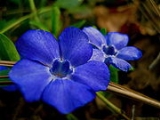
Vinca

Encyclopedia
Vinca is a genus of six species in the family Apocynaceae
, native to Europe
, northwest Africa
and southwest Asia
. The English name periwinkle is shared with the related genus Catharanthus
(and also with the common seashore mollusc, Littorina littorea
).
s or herbaceous
, and have slender trailing stems 1–2 m (3–6 feet) long but not growing more than 20–70 cm (8-30 inches) above ground; the stems frequently take root where they touch the ground, enabling the plant to spread widely. The leaves
are opposite, simple broad lanceolate to ovate, 1–9 cm (0.25–3.5 inches) long and 0.5–6 cm (0.25–2.25 inches) broad; they are evergreen
in four species, but deciduous
in the herbaceous V. herbacea
, which dies back to the root system in winter.
The flower
s, produced through most of the year, are salverform (like those of Phlox
), simple, 2.5–7 cm (1–3 inches) broad, with five usually violet (occasionally white) petals joined together at the base to form a tube. The fruit
consists of a pair of divergent follicles
; a dry fruit which is dehiscent along one rupture site in order to release seeds.
and Vinca minor
, are extensively cultivated as a flowering evergreen ornamental plant
. Because the plants are low and spread quickly, they are often used as a groundcover
in garden
landscapes and container garden
s. Many cultivar
s are available, with different plant, leaf, and flower - colors, sizes, and habits.
, in some regions where they are introduced species
because of the rapid spreading resulting in choking out native plant
species and altering habitat
s. Areas affected include parts of Australia, New Zealand, and the United States, especially coastal California
.. In other cases, Vinca has been recommended as a fire retardant ground cover.
, extracted from Vinca rosea Linn. (Catharanthus
), is a type of chemotherapy
called a vinca alkaloid used to treat some leukemias, lymphomas and childhood cancers, as well as several other types of cancer and some non-cancerous conditions. Vinblastine
is a chemical analogue of Vincristine
and also used to treat various forms of cancer
.
Apocynaceae
The Apocynaceae or dogbane family is a family of flowering plants that includes trees, shrubs, herbs, and lianas.Many species are tall trees found in tropical rainforests, and most are from the tropics and subtropics, but some grow in tropical dry, xeric environments. There are also perennial herbs...
, native to Europe
Europe
Europe is, by convention, one of the world's seven continents. Comprising the westernmost peninsula of Eurasia, Europe is generally 'divided' from Asia to its east by the watershed divides of the Ural and Caucasus Mountains, the Ural River, the Caspian and Black Seas, and the waterways connecting...
, northwest Africa
Africa
Africa is the world's second largest and second most populous continent, after Asia. At about 30.2 million km² including adjacent islands, it covers 6% of the Earth's total surface area and 20.4% of the total land area...
and southwest Asia
Asia
Asia is the world's largest and most populous continent, located primarily in the eastern and northern hemispheres. It covers 8.7% of the Earth's total surface area and with approximately 3.879 billion people, it hosts 60% of the world's current human population...
. The English name periwinkle is shared with the related genus Catharanthus
Catharanthus
Catharanthus is a genus of eight species of herbaceous perennial plants, six endemic to the island of Madagascar, the seventh and eighth native to the Indian subcontinent in southern Asia...
(and also with the common seashore mollusc, Littorina littorea
Common Periwinkle
The common periwinkle or winkle, scientific name Littorina littorea, is a species of small edible sea snail, a marine gastropod mollusk which has gills and an operculum, and is classified within the family Littorinidae, the periwinkles....
).
Description
Vinca plants are subshrubSubshrub
A subshrub or dwarf shrub is a short woody plant. Prostrate shrub is a similar term.It is distinguished from a shrub by its ground-hugging stems and lower height, with overwintering perennial woody growth typically less than 10–20 cm tall, or by being only weakly woody and/or persisting...
s or herbaceous
Herbaceous
A herbaceous plant is a plant that has leaves and stems that die down at the end of the growing season to the soil level. They have no persistent woody stem above ground...
, and have slender trailing stems 1–2 m (3–6 feet) long but not growing more than 20–70 cm (8-30 inches) above ground; the stems frequently take root where they touch the ground, enabling the plant to spread widely. The leaves
Leaf
A leaf is an organ of a vascular plant, as defined in botanical terms, and in particular in plant morphology. Foliage is a mass noun that refers to leaves as a feature of plants....
are opposite, simple broad lanceolate to ovate, 1–9 cm (0.25–3.5 inches) long and 0.5–6 cm (0.25–2.25 inches) broad; they are evergreen
Evergreen
In botany, an evergreen plant is a plant that has leaves in all seasons. This contrasts with deciduous plants, which completely lose their foliage during the winter or dry season.There are many different kinds of evergreen plants, both trees and shrubs...
in four species, but deciduous
Deciduous
Deciduous means "falling off at maturity" or "tending to fall off", and is typically used in reference to trees or shrubs that lose their leaves seasonally, and to the shedding of other plant structures such as petals after flowering or fruit when ripe...
in the herbaceous V. herbacea
Vinca herbacea
Vinca herbacea is a flowering plant native to eastern and southeastern Europe, from Austria south to Greece, and east to the Crimea, and also in southwestern Asia east to the Caucasus and Alborz mountains...
, which dies back to the root system in winter.
The flower
Flower
A flower, sometimes known as a bloom or blossom, is the reproductive structure found in flowering plants . The biological function of a flower is to effect reproduction, usually by providing a mechanism for the union of sperm with eggs...
s, produced through most of the year, are salverform (like those of Phlox
Phlox
Phlox is a genus of 67 species of perennial and annual plants found mostly in North America in diverse habitats from alpine tundra to open woodland and prairie. Some flower in spring, others in summer and autumn....
), simple, 2.5–7 cm (1–3 inches) broad, with five usually violet (occasionally white) petals joined together at the base to form a tube. The fruit
Fruit
In broad terms, a fruit is a structure of a plant that contains its seeds.The term has different meanings dependent on context. In non-technical usage, such as food preparation, fruit normally means the fleshy seed-associated structures of certain plants that are sweet and edible in the raw state,...
consists of a pair of divergent follicles
Follicle (fruit)
In botany, a follicle is a dry unilocular many-seeded fruit formed from one carpel and dehiscing by the ventral suture in order to release seeds, such as in larkspur, magnolia, banksia, peony and milkweed....
; a dry fruit which is dehiscent along one rupture site in order to release seeds.
Gardens
Two of the species, Vinca majorVinca major
Vinca major, with the common names Bigleaf Periwinkle, Large Periwinkle, Greater Periwinkle and Blue Periwinkle, is an herbaceous, perennial, rhizomatous and stoloniferous flowering plant in the genus Vinca belonging to the family Apocynaceae.-Etymology:The genus name probably derives from the...
and Vinca minor
Vinca minor
Vinca minor, Lesser periwinkle and Dwarf periwinkle, is a plant native to central and southern Europe, from Portugal and France north to the Netherlands and the Baltic States, and east to the Caucasus, and also in southwestern Asia in Turkey...
, are extensively cultivated as a flowering evergreen ornamental plant
Ornamental plant
Ornamental plants are plants that are grown for decorative purposes in gardens and landscape design projects, as house plants, for cut flowers and specimen display...
. Because the plants are low and spread quickly, they are often used as a groundcover
Groundcover
Groundcover refers to any plant that grows over an area of ground, used to provide protection from erosion and drought, and to improve its aesthetic appearance .- Ecosystem :...
in garden
Garden
A garden is a planned space, usually outdoors, set aside for the display, cultivation, and enjoyment of plants and other forms of nature. The garden can incorporate both natural and man-made materials. The most common form today is known as a residential garden, but the term garden has...
landscapes and container garden
Container garden
Container gardening is the practice of growing plants exclusively in containers instead of planting them in the ground. Pots, traditionally made of terracotta but now more commonly plastic, and windowboxes have been the most commonly seen. Small pots are commonly called flowerpots. In some cases,...
s. Many cultivar
Cultivar
A cultivar'Cultivar has two meanings as explained under Formal definition. When used in reference to a taxon, the word does not apply to an individual plant but to all those plants sharing the unique characteristics that define the cultivar. is a plant or group of plants selected for desirable...
s are available, with different plant, leaf, and flower - colors, sizes, and habits.
Invasive plant species
Although attractive, both Vinca major and Vinca minor are sometimes considered weeds, and invasive speciesInvasive species
"Invasive species", or invasive exotics, is a nomenclature term and categorization phrase used for flora and fauna, and for specific restoration-preservation processes in native habitats, with several definitions....
, in some regions where they are introduced species
Introduced species
An introduced species — or neozoon, alien, exotic, non-indigenous, or non-native species, or simply an introduction, is a species living outside its indigenous or native distributional range, and has arrived in an ecosystem or plant community by human activity, either deliberate or accidental...
because of the rapid spreading resulting in choking out native plant
Native plant
Native plant is a term to describe plants endemic or naturalized to a given area in geologic time.This includes plants that have developed, occur naturally, or existed for many years in an area...
species and altering habitat
Habitat
* Habitat , a place where a species lives and grows*Human habitat, a place where humans live, work or play** Space habitat, a space station intended as a permanent settlement...
s. Areas affected include parts of Australia, New Zealand, and the United States, especially coastal California
California
California is a state located on the West Coast of the United States. It is by far the most populous U.S. state, and the third-largest by land area...
.. In other cases, Vinca has been recommended as a fire retardant ground cover.
Medicinal use
There are at least 86 alkaloids extracted from plants in the Vinca genus. VincristineVincristine
Vincristine , formally known as leurocristine, sometimes abbreviated "VCR", is a vinca alkaloid from the Catharanthus roseus , formerly Vinca rosea and hence its name. It is a mitotic inhibitor, and is used in cancer chemotherapy.-Mechanism:Tubulin is a structural protein that polymerizes to...
, extracted from Vinca rosea Linn. (Catharanthus
Catharanthus
Catharanthus is a genus of eight species of herbaceous perennial plants, six endemic to the island of Madagascar, the seventh and eighth native to the Indian subcontinent in southern Asia...
), is a type of chemotherapy
Chemotherapy
Chemotherapy is the treatment of cancer with an antineoplastic drug or with a combination of such drugs into a standardized treatment regimen....
called a vinca alkaloid used to treat some leukemias, lymphomas and childhood cancers, as well as several other types of cancer and some non-cancerous conditions. Vinblastine
Vinblastine
Vinblastine is an antimicrotubule drug used to treat certain kinds of cancer, including Hodgkin's lymphoma, non-small cell lung cancer, breast cancer, head and neck cancer, and testicular cancer. It is also used to treat Langerhan cell histiocytosis....
is a chemical analogue of Vincristine
Vincristine
Vincristine , formally known as leurocristine, sometimes abbreviated "VCR", is a vinca alkaloid from the Catharanthus roseus , formerly Vinca rosea and hence its name. It is a mitotic inhibitor, and is used in cancer chemotherapy.-Mechanism:Tubulin is a structural protein that polymerizes to...
and also used to treat various forms of cancer
Cancer
Cancer , known medically as a malignant neoplasm, is a large group of different diseases, all involving unregulated cell growth. In cancer, cells divide and grow uncontrollably, forming malignant tumors, and invade nearby parts of the body. The cancer may also spread to more distant parts of the...
.