
All Topics  
Saffron


   Email Print
   Bookmark   Link


Saffron


Saffron (Persian: ??????????) is a spiceSpice

A spice is a dried seed, fruit, root, bark or vegetative substance used in nutritionally insignificant quantities as a food ...
 derived from the flowerFlower

A flower,rflorem<flos), also known as a bloom or blossom, is the reproductive structure found i...
 of the saffron crocus (Crocus sativus), a species of crocusCrocus

Crocus is a genus of perennial flowering plants that grows from a corm, growing naturally from the Aegean , across Cent...
 in the family IridaceaeIridaceae

Iridaceae is a family of plants in Order Asparagales, taking its name from the Irises....
. The flower has three stigmaCarpel

A carpel is the female reproductive organ of a flower; the basic unit of the gynoecium....
s, which are the distalAnatomical terms of location

In human and zoological anatomy, several terms are used to describe the location of organs and other structures in the body of bil...
 ends of the plant's carpelCarpel

A carpel is the female reproductive organ of a flower; the basic unit of the gynoecium....
s. Together with its style, the stalk connecting the stigmas to the rest of the plant, these components are often driedFood preservation

Food preservation is the process of treating and handling food in such a way as to stop or greatly slow down spoilage to pre...
 and used in cookingCooking

Cooking is an act of preparing food for eating....
 as a seasoningSeasoning

Seasoning is the process of adding or improving flavours of food....
 and colouring agentFood coloring

A food coloring is any substance that is added to food to change its color. ...
. Saffron, which has for decades been the world's most expensive spice by weight, is native to Southwest AsiaSouthwest Asia Summary

Southwest Asia or Southwestern Asia is the southwestern portion of Asia....
. It was first cultivatedAgriculture

Farming redirects here. For Farming in computer games, see Farmer ....
 in the vicinity of GreeceGreece

GreeceGreece lies at the juncture of Europe, Asia, and Africa....
.

Saffron is characterised by a bitter tasteBasic taste

The basic tastes are the commonly recognized types of taste sensed by humans....
 and an iodoformIodoform Overview

The compound iodoform is CHI3. A pale yellow, crystalline, volatile substance, it has a penetrating odor and, analogous to...
- or hayHay

Hay is dried grass or legumes cut and used for animal feed....
-like fragrance; these are caused by the chemicals picrocrocinPicrocrocin

Picrocrocin is a glycoside formed from glucose and safranal....
 and safranalSafranal

Safranal is an organic compound isolated from saffron, the spice consisting of the stigmas of crocus flowers....
. It also contains a carotenoidFacts About Carotenoid

Carotenoids are organic pigments that are naturally occurring in plants and some other photosynthetic organisms like algae, ...
 dye, crocinCrocin

Crocin is a natural carotenoid chemical compound that is found in the flowers crocus and gardenia....
, that gives food a rich golden-yellow hue. These traits make saffron a much-sought ingredient in many foods worldwide. Saffron also has medicinalMedicine

Medicine is the branch of health science and the sector of public life concerned with maintaining or restoring human health ...
 applications.

The word saffron originated from the 12th-century Old FrenchOld French Overview

Old French is a term sometimes used to refer to the langue d'ol, the continuum of varieties of Romance language spoken in te...
 term , which derives from the LatinLatin

Latin is an ancient Indo-European language originally spoken in Latium, the region immediately surrounding Rome....
 word . is also related to the ItalianItalian language

Italian is a Romance language spoken by about 70 million people, primarily in Italy....
  and SpanishSpanish language

Spanish or Castilian is an Iberian Romance language....
 . Safranum comes from the ArabicArabic language

The Arabic language , or simply Arabic , is the largest member of the Semitic branch of the Afro-Asiatic language fami...
 word , which means "yellowFacts About Yellow

Yellow is any color of light that stimulates both the red and green cone cells of the retina, but not the blue cone cells....
," via the Persian paronymParonym

A paronym or paronyme in linguistics may refer to two different things:...
ous .

Biology

Saffron crocus morphology
 ?  StamenStamen

The stamen is the male organ of a flower....
s (male organs).
 ?  Corolla (whorl of petalPetal

A petal, regarded as a highly modified leaf, is one member or part of the corolla of a flower....
s).
 ?  CormCorm

A corm is a short, vertical, swollen underground stem of a plant that serves as a storage organ to enable the plant to survi...
 (propagation organ).


The domesticated saffron crocus C. sativus is an autumn-floweringFlowering plant

The flowering plants are a major group of land plants....
 perennial plantPerennial plant

A perennial plant or perennial is a plant that lives for more than two years....
 unknown in the wild, and is a sterile triploidPolyploidy

Polyploidy is the condition of some biological cells and organisms of containing more than two homologous sets of chromosome...
 mutant of the eastern Mediterranean autumn-flowering Crocus cartwrightianusCrocus cartwrightianus

Crocus cartwrightianus is an eastern Mediterranean autumn-flowering species of crocus, and is of the family Iridaceae....
. According to botanical research, C. cartwrightianus originated in CreteCrete

Crete is the largest of the Greek islands and the fifth largest in the Mediterranean Sea....
, not—as was once generally believed—in Central AsiaCentral Asia

Central Asia is a vast landlocked region of Asia....
. The saffron crocus resulted when C. cartwrightianus was subjected to extensive artificial selectionArtificial selection

In evolution, artificial selection is the process of intentional or unintentional modification of a species through human ac...
 by growers who desired elongated stigmas. Being sterile, the saffron crocus's purple flowers fail to produce viable seeds—thus, reproduction is dependent on human assistance: the cormCorm

A corm is a short, vertical, swollen underground stem of a plant that serves as a storage organ to enable the plant to survi...
s (underground bulb-like starch-storing organs) must be manually dug up, broken apart, and replanted. A corm survives for only one season, reproducing via division into up to ten "cormlets" that eventually give rise to new plants. The corms are small brown globules up to in diameter and are shrouded in a dense mat of parallel fibers.

After a period of aestivationEstivation

Estivation or aestivation is a rare state of dormancy similar to hibernation, but during the months of the summer....
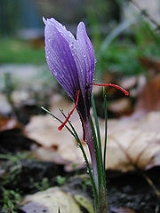
 in summer, five to eleven narrow and nearly vertical green leaves—growing up to in length—emerge from the ground. In autumn, purple buds appear. Only in October, after most other flowering plants have released their seeds, does it develop its brilliantly hued flowers, ranging from a light pastel shade of lilacLilac (color)

Lilac is a color that is a pale shade of violet....
 to a darker and more striated mauveFacts About Mauve

Mauve is a pale grayed pink-lilac color, one of many in the range of purples....
. Upon flowering, it averages less than in height. Inside each flower is a three-pronged style; in turn, each prong terminates with a crimson stigma 25–30 mmMetre

The metre, or meter , is a measure of length....
 in length.

Cultivation

The saffron crocus thrives in climates similar to that of the Mediterranean maquisMaquis shrubland

Maquis or macchia is a shrubland biome in Mediterranean countries, typically consisting of densely-growing evergreen s...
 or the North AmericaNorth America

North America is a continent in the Earth's northern hemisphere and almost fully in the western hemisphere....
n chaparralChaparral

Chaparral is a shrubland biome found primarily in California, USA, that is shaped by a Mediterranean climate and wildfire....
, where hot, dry summer breezes blow across arid and semi-arid lands. Nevertheless, the plant can tolerate cold winters, surviving frosts as cold as and short periods of snow cover. However, if not grown in wet environments like Kashmir (where rainfall averages 1000–1500 mm annually), irrigationIrrigation

Irrigation is the replacement or supplementation of rainfall with water from another source in order to grow crops or plants...
 is needed—this is true in the saffron-growing regions of Greece (500 mm of rainfall annually) and Spain (400 mm). Rainfall timing is also key: generous spring rains followed by relatively dry summers are optimal. In addition, rainfall occurring immediately prior to flowering also boosts saffron yields; nevertheless, rainy or cold weather occurring during flowering promotes disease, thereby reducing yields. Persistently damp and hot conditions also harm yields, as do the digging actions of rabbits, rats, and birds. Parasites such as nematodes, leaf rustsRust (fungus)

Rusts are fungi of the order Uredinales....
, and corm rot also pose significant threats.
Saffron crocus flower yields[*] of smaller producers
Country Yield
SpainSpain

Spain, officially the Kingdom of Spain , is a European parliamentary monarchy....
6–29
ItalyFacts About Italy

Italy, officially the Italian Republic , is a Southern European country....
10–16
GreeceGreece

GreeceGreece lies at the juncture of Europe, Asia, and Africa....
4–7
IndiaIndia

India , officially the Republic of India, is a country in South Asia....
2–7
MoroccoMorocco

The Kingdom of Morocco is a country in North Africa....
2.0–2.5
Source:
[*]—Yields specify flower weight, not final dry saffron weight.


Saffron plants grow best in strong and direct sunlight, and fare poorly in shady conditions. Thus, planting is best done in fields that slope towards the sunlight (i.e. south-sloping in the Northern Hemisphere), maximizing the crocuses' sun exposure. In the Northern HemisphereNorthern Hemisphere

The Northern Hemisphere is the half of a planet's surface that is north of the equator ....
, planting is mostly done in June, with corms planted some 7–15 cm deep. Planting depth and corm spacing—along with climate—are both critical factors impacting plant yields. Thus, mother corms planted more deeply yield higher-quality saffron, although they produce fewer flower buds and daughter corms. With such knowledge, Italian growers have found that planting corms deep and in rows spaced 2–3 cm apart optimizes threads yields, whereas planting depths of 8–10 cm optimizes flower and corm production. Meanwhile, Greek, Moroccan, and Spanish growers have devised different depths and spacings to suit their own climates.

Saffron crocuses grow best in friable, loose, low-density, well-watered, and well-drained clay-calcareousCalcareous

Calcareous refers to a sediment, sedimentary rock, or soil type which is formed from or contains a high proportion of calciu...
 soils with high organic content. Raised beds are traditionally used to promote good drainage. Historically, soil organic content was boosted via application of some 20–30 tonnes of manure per hectareHectare

A hectare is a unit of area, equal to 10,000 square metres, commonly used for measuring land area....
. Afterwards—and with no further manure application—corms were planted. After a period of dormancy through the summer, the corms send up their narrow leaves and begin to bud in early autumn. Only in mid-autumn do the plants begin to flower. Harvesting of flowers is by necessity a speedy affair: after their flowering at dawn, flowers quickly wilt as the day passes. Furthermore, saffron crocuses bloom within a narrow window spanning one or two weeks. Approximately 150 flowers yield 1 gGram

The gram or gramme symbol g, is a unit of mass....
 of dry saffron threads; to produce 12 g of dried saffron (72 g freshly harvested), 1 kg of flowers are needed (1 lb for 0.2 oz of dried saffron). On average, one freshly picked flower yields 0.03 g of fresh saffron, or 0.007 g of dried saffron.

Chemistry

CrocinCrocin

Crocin is a natural carotenoid chemical compound that is found in the flowers crocus and gardenia....
 formation

Esterification reactionEsterification

Esterification is the general name for a chemical reaction in which two chemicals form an ester as the reaction product....
 between crocetinCrocetin

Crocetin is a natural carotenoid dicarboxylic acid that is found in the crocus flower....
 and gentiobioseFacts About Gentiobiose

Gentiobiose is a disaccharide composed of two units of D-glucose....
.
 —  ίAnomer

In sugar chemistry, an anomer is a special type of epimer....
-DMonosaccharide

Monosaccharides are the simplest form of carbohydrates....
-gentiobiose.
 —  Crocetin.

Picrocrocin and safranal

Chemical structure of picrocrocinPicrocrocin

Picrocrocin is a glycoside formed from glucose and safranal....
.
 —  SafranalSafranal

Safranal is an organic compound isolated from saffron, the spice consisting of the stigmas of crocus flowers....
 moietyMoiety

*In chemistry, a moiety is a specific segment of a molecule....
.
 —  ίAnomer Overview

In sugar chemistry, an anomer is a special type of epimer....
-DMonosaccharide

Monosaccharides are the simplest form of carbohydrates....
-glucopyranose derivative.

Saffron contains more than 150 volatile and aroma-yielding compounds. It also has many nonvolatile active components, many of which are carotenoids, including zeaxanthinZeaxanthin

Zeaxanthin is one of the two carotenoids contained within the...
, lycopeneLycopene Summary

Lycopene is a bright red carotenoid pigment, a phytochemical found in tomatoes and other red fruits....
, and various a- and ί-caroteneCarotene

Carotene is an orange photosynthetic pigment important for photosynthesis....
s. However, saffron's golden yellow-orange colour is primarily the result of a-crocin. This crocin is trans-crocetinCrocetin

Crocetin is a natural carotenoid dicarboxylic acid that is found in the crocus flower....
 di-(ί-D-gentiobiosylGentiobiose

Gentiobiose is a disaccharide composed of two units of D-glucose....
) esterEster Overview

In chemistry, esters are organic compounds in which an organic group replaces a hydrogen atom in an oxygen acid....
 name]]: 8,8-diapo-8,8-carotenoic acid). This means that the crocin underlying saffron's aroma is a digentiobiose ester of the carotenoid crocetin. Crocins themselves are a series of hydrophilicHydrophile

Hydrophile, from the Greek ' "water" and f???a ' "friendship," refers to a physical property of a molecule that can tr...
 carotenoids that are either monoglycosylGlycosyl

A glycosyl group is a structure obtained by removing the hydroxyl group from the hemiacetal function of a monosaccharide and...
 or diglycosyl polyenePolyene

Polyenes are poly-unsaturated organic compounds that contain one or more sequences of alternating double and single carbon-c...
 esters of crocetin. Meanwhile, crocetin is a conjugatedConjugated system

A chemically conjugated system is a system of atoms covalently bonded with alternating single and multiple bonds in a molecu...
 polyene dicarboxylic acidCarboxylic acid

Carboxylic acids are organic acids characterized by the presence of a carboxyl group, which has the formula --OH, usua...
 that is hydrophobicHydrophile

Hydrophile, from the Greek ' "water" and f???a ' "friendship," refers to a physical property of a molecule that can tr...
, and thus oil-soluble. When crocetin is esterifiedEsterification

Esterification is the general name for a chemical reaction in which two chemicals form an ester as the reaction product....
 with two water-soluble gentiobioses (which are sugarsCarbohydrate

Carbohydrates are chemical compounds that contain oxygen, hydrogen, and carbon atoms....
), a product results that is itself water-soluble. The resultant a-crocin is a carotenoid pigment that may comprise more than 10% of dry saffron's mass. The two esterified gentiobioses make a-crocin ideal for colouring water-based (non-fatty) foods such as rice dishes.


Chemical composition of saffron
Component Mass %
carbohydrateCarbohydrate

Carbohydrates are chemical compounds that contain oxygen, hydrogen, and carbon atoms....
s
12.0–15.0
waterWater (molecule)

Water is the most abundant molecule on Earth, composing 70-75% of the Earth's surface as liquid and solid state in addition ...
 
9.0–14.0
polypeptidesPeptide

Peptides , are the family of short molecules formed from the linking, in a defined order, of various a-amino acids....
 
11.0–13.0
celluloseFacts About Cellulose

Cellulosenis a long-chain polymeric polysaccharide carbohydrate, of beta-glucose ....
 
4.0–7.0
lipidLipid

Lipids are a class of hydrocarbon-containing organic compounds essential for the structure and function of living cells....
s
3.0–8.0
mineralMineral

Minerals are natural compounds formed through geological processes....
s
1.0–1.5
miscellaneous
non-nitrogenNitrogen

Nitrogen is a chemical element which has the symbol N and atomic number 7 in the periodic table....
ous
40.0
Source:

Proximate analysis of saffron
Component Mass %
Water-soluble components 53.0
  ?  GumsNatural gum

Natural gums are polysaccharides of natural origin, capable of causing a large viscosity increase in solution, even at small...
10.0
  ?  Pentosans 8.0
  ?  PectinPectin

Pectin is a heterosaccharide derived from the cell wall of plants....
s
6.0
  ?  StarchFacts About Starch

Starch is a complex carbohydrate which is insoluble in water; it is used by plants as a way to store excess glucose....
6.0
  ?  a–CrocinCrocin

Crocin is a natural carotenoid chemical compound that is found in the flowers crocus and gardenia....
2.0
  ?  Other carotenoidCarotenoid

Carotenoids are organic pigments that are naturally occurring in plants and some other photosynthetic organisms like algae, ...
s
1.0
LipidLipid

Lipids are a class of hydrocarbon-containing organic compounds essential for the structure and function of living cells....
s
12.0
  ?  Non-volatile oils 6.0
  ?  Volatile oils 1.0
ProteinProtein

Proteins are large organic compounds made of amino acids arranged in a linear chain and joined by peptide bonds....
12.0
Inorganic matter ("ash") 6.0
  ?  HClHydrochloric acid

The chemical compound hydrochloric acid is the aqueous solution of hydrogen chloride gas....
-soluble ash
0.5
WaterWater

Water is a tasteless, odorless substance that is essential to all known forms of life and is known as the universal solve...
10.0
FiberNatural fiber

Fiber or fibre is a class of hair-like materials that are continuous filaments or are in discrete elongated pieces, si...
 (crude)
5.0
Source:


The bitter glucosideGlucoside

A glucoside is a glycoside that is derived from glucose....
 picrocrocin is responsible for saffron's flavour. Picrocrocin-2,6,6- trimethylcyclohex-1-ene-1-carboxaldehyde) is a union of an aldehydeAldehyde

An aldehyde is an organic compound containing...
 sub-element known as safranal (systematic name: 2,6,6-trimethylcyclohexa-1,3-diene-1- carboxaldehyde) and a carbohydrate. It has insecticidal and pesticidal properties, and may comprise up to 4% of dry saffron. Significantly, picrocrocin is a truncated version (produced via oxidativeRedox

Redox reactions include all chemical processes in which atoms have their oxidation number changed....
 cleavage) of the carotenoid zeaxanthinFacts About Zeaxanthin

Zeaxanthin is one of the two carotenoids contained within the...
 and is the glycosideGlycoside

In chemistry, glycosides are certain molecules in which a sugar part is bound to some other part....
 of the terpeneTerpene

Terpenes are a large and varied class of hydrocarbons, produced primarily by a wide variety of plants, particularly conifers...
 aldehydeAldehyde Overview

An aldehyde is an organic compound containing...
 safranal. The reddish-coloured zeaxanthin is, incidentally, one of the carotenoids naturally present within the retinaRetina

The retina is a thin layer of neural cells that lines the back of the eyeball of vertebrates and some cephalopods....
 of the human eyeFacts About Eye

An eye is an organ of vision that detects light....
.

When saffron is dried after its harvest, the heat, combined with enzymatic action, splits picrocrocin to yield DMonosaccharide

Monosaccharides are the simplest form of carbohydrates....
-glucoseGlucose

Glucose , a monosaccharide , is one of the most important carbohydrates in biology....
 and a free safranal molecule. Safranal, a volatileEssential oil

An essential oil is a concentrated, hydrophobic liquid containing volatile aromatic compounds extracted from plants....
 oil, gives saffron much of its distinctive aroma. Safranal is less bitter than picrocrocin and may comprise up to 70% of dry saffron's volatile fraction in some samples. A second element underlying saffron's aroma is 2-hydroxy-4,4,6-trimethyl-2,5-cyclohexadien-1-one, the scent of which has been described as "saffron, dried hay like". Chemists found this to be the most powerful contributor to saffron's fragrance despite its being present in a lesser quantity than safranal. Dry saffron is highly sensitive to fluctuating pHPH

pH is a measure of the acidity of a solution, in terms of activity of hydrogen ions ....
 levels, and rapidly breaks down chemically in the presence of lightLight

Light is electromagnetic radiation with a wavelength that is visible to the eye or, in a technical or scientific context, e...
 and oxidizingRedox

Redox reactions include all chemical processes in which atoms have their oxidation number changed....
 agents. It must therefore be stored away in air-tight containers in order to minimise contact with atmospheric oxygen. Saffron is somewhat more resistant to heat.

Crocus sativus has been shown to have antidepressant effects; two active ingredients are crocinCrocin

Crocin is a natural carotenoid chemical compound that is found in the flowers crocus and gardenia....
 and safranalSafranal

Safranal is an organic compound isolated from saffron, the spice consisting of the stigmas of crocus flowers....
.

History

The history of saffron cultivation reaches back more than 3,000 years. The wild precursor of domesticated saffron crocus was Crocus cartwrightianus. Human cultivators bred wild specimens by selecting for unusually long stigmas. Thus, a sterile mutant form of C. cartwrightianus, C. sativus, emerged in late Bronze AgeBronze Age

The term Bronze Age refers to a period in human cultural development when the most advanced metalworking included technique...
 CreteCrete

Crete is the largest of the Greek islands and the fifth largest in the Mediterranean Sea....
. Experts believe saffron was first documented in a 7th century BC AssyriaAssyria Overview

Assyria in earliest historical times referred to a region on the Upper Tigris river, named for its original capital, the anc...
n botanical reference compiled under AshurbanipalAshurbanipal

Ashurbanipal, Assurbanipal or Sardanapal, in Akkadian Aur-bani-apli,, the son of Esarhaddon and Naqi'a-Zakut...
. Since then, documentation of saffron's use over the span of 4,000 years in the treatment of some 90 illnesses has been uncovered. Saffron has been used as a spice and medicine in the Mediterranean region since then, with usage and cultivation slowly spreading to other parts of Eurasia as well as North AfricaNorth Africa

North Africa or Northern Africa is the northernmost region of the African continent....
 and North AmericaNorth America

North America is a continent in the Earth's northern hemisphere and almost fully in the western hemisphere....
. In the last several decades, saffron cultivation has spread to OceaniaOceania Summary

Oceania is a geographical, often geopolitical, region consisting of numerous lands—mostly islands but usually includi...
.

Mediterranean

MinoansMinoan civilization

The Minoans were a pre-Hellenic Bronze Age civilization in Crete in the Aegean Sea, flourishing from approximately 2600 to 1...
 portrayed saffron in their palace frescoes by 1500–1600 BC, showing saffron's use as a therapeutic drug. Later, Greek legends told of sea voyages to CiliciaCilicia Summary

In Antiquity, Cilicia was the name of a region, now known as ukurova, and often a political unit, on the southeastern coast ...
. There, adventurers hoped to procure what they believed was the world's most valuable saffron. Another legend tells of Crocus and Smilax, whereby Crocus is bewitched and transformed into the original saffron crocus. Ancient Mediterranean peoples—including perfumers in EgyptEgypt

Egypt , officially the Arab Republic of Egypt, is a Middle Eastern country in North Africa....
, physicians in GazaGaza

Gaza is the largest city within the Gaza Strip, part of the Palestinian territories....
, townspeople in RhodesRhodes Summary

Rhodes, is the largest of the Dodecanese islands, and easternmost of the major islands of Greece in the Aegean Sea....
, and the Greek hetaerae courtesans—used saffron in their perfumes, ointments, potpourris, mascaras, divine offerings, and medical treatments.

In late HellenisticHellenistic civilization

The term Hellenistic was established by the German historian Johann Gustav Droysen to refer to the spreading of Greek cultu...
 Egypt, CleopatraCleopatra VII of Egypt

Cleopatra VII Philopator , later Cleopatra Thea Neotera Philopator kai Philopatris, was queen of Ptolemaic Egypt, the la...
 used saffron in her baths so that lovemaking would be more pleasurable. Egyptian healers used saffron as a treatment for all varieties of gastrointestinal ailments. Saffron was also used as a fabric dye in such LevantLevant Summary

'Levant' or in Arabic ?????, Ash-Sham is an imprecise geographical term historically referring to a large area...
 cities as SidonSidon Summary

Sidon, Zidon or Saida, is the third-largest city in Lebanon....
 and Tyre. Aulus Cornelius CelsusFacts About Aulus Cornelius Celsus

Aulus Cornelius Celsus was a Roman encyclopedist and possibly, although not likely, a physician....
 prescribes saffron in medicines for wounds, cough, colic, and scabies, and in the mithridatium. Such was the Romans' love of saffron that Roman colonists took their saffron with them when they settled in southern Gaul, where it was extensively cultivated until Rome's fall. Competing theories state that saffron only returned to France with 8th century AD MoorsMoors

The Moors were the medieval Muslim inhabitants of al-Andalus and the Maghreb and western Africa, whose culture is often cal...
 or with the AvignonAvignon

Avignon is a commune in southern France with an estimated mid-2004 population of 89,300 in the city itself and a popul...
 papacy in the 14th century AD.

Asia


Saffron-based pigments have been found in 50,000 year-old depictions of prehistoric beasts in what is today IraqIraq

The Republic of Iraq, is a Middle Eastern country in southwestern Asia encompassing most of Mesopotamia as well as the north...
. Later, the Sumerians used wild-growing saffron in their remedies and magical potions. Saffron was thus an article of long-distance trade before the Minoan palace culture's 2nd millennium BC peak. Saffron was also honored in the HebrewFacts About Hebrew language

Hebrew is a Semitic language of the Afro-Asiatic language family spoken by more than seven million people in Israel and Jew...
 Song of SolomonSong of Solomon

The Song of Solomon or Song of Songs is a book of...
. Ancient Persians cultivated Persian saffron (Crocus sativus 'Hausknechtii') in Derbena, IsfahanIsfahan (city)

Isfahan or Esfahan, located about 340 km south of Tehran, is the capital of Isfahan Province and Iran's third largest ...
, and KhorasanKhorasan

Khorasan is a region located in eastern Iran....
  by the 10th century BC. At such sites, saffron threads were woven into textiles, ritually offered to divinities, and used in dyes, perfumes, medicines, and body washes. Thus, saffron threads would be scattered across beds and mixed into hot teas as a curative for bouts of melancholy. Non-Persians also feared the Persians' usage of saffron as a drugging agent and aphrodisiacAphrodisiac Summary

An aphrodisiac is an agent which acts on the mind and causes the arousal of the mood of sexual desire....
. During his Asian campaigns, Alexander the GreatAlexander the Great

Alexander the Great , also known as Alexander III, king of Macedon , was one of the most successful military commander...
 used Persian saffron in his infusions, rice, and baths as a curative for battle wounds. Alexander's troops mimicked the practice and brought saffron-bathing back to Greece.

Theories explaining saffron's arrival in South AsiaSouth Asia

South Asia, also Southern Asia, is a southern geopolitical region of the Asian continent comprising territories on and...
 conflict. Traditional KashmirKashmir

For the Led Zeppelin song, see Kashmir ....
i and ChineseChina

China is a cultural region and ancient civilization in East Asia....
 accounts date its arrival anywhere between 900–2500 years ago. Meanwhile, historians studying ancient Persian records date the arrival to sometime prior to 500 BC, attributing it to either Persian transplantation of saffron corms to stock new gardens and parks or to a Persian invasion and colonization of KashmirKashmir

For the Led Zeppelin song, see Kashmir ....
. Phoenicians then marketed Kashmiri saffron as a dye and a treatment for melancholy. From there, saffron use in foods and dyes spread throughout South Asia. For example, Buddhist monks in IndiaIndia

India , officially the Republic of India, is a country in South Asia....
 adopted saffron-coloured robes after the Buddha Siddhartha GautamaGautama Buddha Summary

Gautama Buddha was a spiritual teacher in the ancient Indian subcontinent and the historical founder of Buddhism....
's death. However, the robes were not dyed with costly saffron but turmericTurmeric

Turmeric is a spice commonly used in curries and other South Asian cuisine....
, a less expensive dye, or jackfruitJackfruit

The Jackfruit is a species of tree and its fruit, native to southwestern India, and possibly also east to the Malay Peninsul...
.

Some historians believe that saffron first came to China with Mongol invaders by way of Persia. On the other hand, saffron is mentioned in ancient Chinese medical texts, including the forty-volume Shennong Bencaojing (?????—"Shennong's Great Herbal", also known as Pen Ts'ao or Pun Tsao) pharmacopoeia, a tome dating from 200–300 BC. Traditionally attributed to the legendary Yan ("Fire") Emperor (??) ShennongShennong

Shennong, sometimes known as the Yan Emperor or the Emperor of the five grains, is a legendary Emperor of China ...
, it documents 252 phytochemical-based medical treatments for various disorders. Yet around the 3rd century AD, the Chinese were referring to saffron as having a Kashmiri provenance. For example, Wan Zhen, a Chinese medical expert, reported that "[t]he habitat of saffron is in Kashmir, where people grow it principally to offer it to the Buddha." Wan also reflected on how saffron was used in his time: "The [saffron crocus] flower withers after a few days, and then the saffron is obtained. It is valued for its uniform yellow colour. It can be used to aromatise wineWine

Wine is an alcoholic beverage produced by the fermentation of the juice of fruits, usually grapes....
."

Europe


In EuropeEurope

Europe is one of the seven traditional continents of the Earth....
, saffron cultivation declined steeply following the Roman Empire's fall. Saffron was reintroduced when Moorish civilization spread to SpainAl-Andalus

Al-Andalus was the Arabic name given to those parts of the Iberian Peninsula governed by Muslims from 711 to 1492....
, France, and Italy. During the 14th century Black DeathBlack Death

The Black Death, also known as the Black Plague, was a devastating pandemic that first struck Europe in the mid-late-1...
, demand for saffron-based medicine skyrocketed, and much saffron had to be imported via Venetian and Genoan ships from southern and Mediterranean lands such as RhodesRhodes

Rhodes, is the largest of the Dodecanese islands, and easternmost of the major islands of Greece in the Aegean Sea....
. The theft of one such shipment by noblemen sparked the fourteen-week long "Saffron War". The conflict and resulting fear of rampant saffron piracy spurred significant saffron cultivation in BaselBasel

Basel is Switzerland's third most populous city ....
, which grew prosperous. Cultivation and trade then spread to NurembergNuremberg

Nuremberg is a city in the German state of Bavaria, in the administrative region of Middle Franconia....
, where epidemic levels of saffron adulteration brought on the Safranschou code, under which saffron adulterers were fined, imprisoned, and executed. Soon after, saffron cultivation spread throughout England, especially NorfolkNorfolk

Norfolk is a low-lying county in East Anglia in the east of southern England....
 and SuffolkSuffolk

Suffolk is a large traditional and administrative county in the East Anglia region of eastern England....
. The Essex town of Saffron WaldenSaffron Walden

Saffron Walden is a small market town in the Uttlesford district of Essex, England....
, named for its new specialty crop, emerged as England's prime saffron growing and trading center. However, an influx of more exotic spices such as chocolateChocolate

Chocolate comprises a number of raw and processed foods that originate from the bean of the the tropical cacao tree....
, coffeeCoffee Overview

Coffee is a popular beverage prepared from the roasted seeds of the coffee plant....
, teaTea

Tea is the second most popular beverage in the world ....
, and vanillaVanilla Summary

Vanilla is a flavoring, in its pure form known as vanillin, derived from orchids in the genus Vanilla....
 from newly contacted Eastern and overseas countries caused European cultivation and usage of saffron to decline. Only in southern France, Italy, and Spain, did significant cultivation endure.

Europeans brought saffron to the AmericasAmericas

he Americas are the lands of the Western hemisphere or New World consisting of the continents of North America and South Ame...
 when immigrant members of the Schwenkfelder ChurchSchwenkfelder Church

The Schwenkfelder Church is a small American Christian body rooted in the 16th century reformation teachings of Caspar Schwe...
 left Europe with a trunk containing saffron corms; indeed, many Schwenkfelders had widely grown saffron in Europe. By 1730, the Pennsylvania DutchPennsylvania Dutch

The Pennsylvania Dutch are descendants of German speaking immigrants who came to Pennsylvania in the early 1700s....
 were cultivating saffron throughout eastern PennsylvaniaPennsylvania

The Commonwealth of Pennsylvania is a state in the northeastern part of the United States....
. Spanish colonies in the Caribbean bought large amounts of this new American saffron, and high demand ensured that saffron's list price on the Philadelphia commodities exchange was set equal to that of goldGold

Gold is a highly sought-after precious metal that for many centuries has been used as money, a store of value and in jewelry...
. The trade with the Caribbean later collapsed in the aftermath of the War of 1812War of 1812

The War of 1812 was fought between the United States of America and Britain and its colonies in British North America from ...
, when many saffron-transporting merchant vessels were destroyed. Yet the Pennsylvania Dutch continued to grow lesser amounts of saffron for local trade and use in their cakes, noodles, and chicken or trout dishes. American saffron cultivation survived into modern times mainly in Lancaster County, PennsylvaniaFacts About Lancaster County, Pennsylvania

Lancaster County, Pennsylvania, known as the Garden Spot of America since the 18th century,...
.

Grade

Minimum saffron colour
grading standards
ISO Grade
(category)
Crocin-specific
absorbanceAbsorbance

In spectroscopy, the absorbance A is defined as...
  score
(at ?=440 nm)
I > 190
II 150–190
III 110–150
IV 80–110
Source:


Saffron types are graded by quality according to laboratory measurements of such characteristics as crocin (colour), picrocrocin (taste), and safranal (fragrance) content. Other metrics include floral waste content (i.e. the saffron spice sample's non-stigma floral content) and measurements of other extraneous matter such as inorganic material ("ash"). A uniform set of international standards in saffron grading was established by the International Organization for StandardizationInternational Organization for Standardization

The International Organization for Standardization is an international standard-setting body composed of representatives fr...
, which is an international federation of national standards bodies. Namely, ISO 3632 deals exclusively with saffron. It establishes four empirical grades of colour intensity: IV (poorest), III, II, and I (finest quality). Saffron samples are then assigned to one of these grades by gauging the spice's crocin content, which is revealed by measurements of crocin-specific spectroscopic absorbanceAbsorbance

In spectroscopy, the absorbance A is defined as...
. Absorbance is defined as , with as absorbance. It is a measure of a given substance's transparency (, the ratio of light intensity passing through sample to that of the incident light) to a given wavelength of light.

Spanish federal saffron
grading standards
Grade ISOInternational Organization for Standardization

The International Organization for Standardization is an international standard-setting body composed of representatives fr...
 score
Coupe > 190
La Mancha 180–190
Rνo 150–180
Standard 145–150
Sierra < 110
Source:


For saffron, absorbance is determined for the crocin-specific photonPhoton

In modern physics, the photon is the elementary particle responsible for electromagnetic phenomena....
 wavelengthWavelength

The wavelength is the distance between repeating units of a wave pattern....
 of 440 nm in a given dry sample of spice. Higher absorbances at this wavelength imply greater crocin concentration, and thus a greater colourative intensity. These data are measured through spectrophotometrySpectrophotometry

In physics, spectrophotometry is the quantitative study of electromagnetic spectra....
 reports at certified testing laboratories worldwide. These colour grades proceed from grades with absorbances lower than 80 (for all category IV saffron) up to 190 or greater (for category I). The world's finest samples (the selected most red-maroon tips of stigmas picked from the finest flowers) receive absorbance scores in excess of 250. Market prices for saffron types follow directly from these ISO scores. However, many growers, traders, and consumers reject such lab test numbers. They prefer a more holistic method of sampling batches of thread for taste, aroma, pliability, and other traits in a fashion similar to that practiced by practised wine tasters.

Despite such attempts at quality control and standardisation, an extensive history of saffron adulteration—particularly among the cheapest grades—continues into modern times. Adulteration was first documented in Europe's Middle Ages, when those found selling adulterated saffron were executed under the Safranschou code. Typical methods include mixing in extraneous substances like beetBeet

The beet is a flowering plant in the family Amaranthaceae, native to the coasts of western and southern Europe, from souther...
, pomegranate fibers, red-dyed silkSilk Summary

Silk is a natural protein fibre that can be woven into textiles....
 fibers, or the saffron crocus's tasteless and odorless yellow stamens. Other methods included dousing saffron fibers with viscid substances like honey or vegetable oil. However, powdered saffron is more prone to adulteration, with turmeric, paprika, and other powders used as diluting fillers. Adulteration can also consist of selling mislabeled mixes of different saffron grades. Thus, in India, high-grade Kashmiri saffron is often sold mixed with cheaper Iranian imports; these mixes are then marketed as pure Kashmiri saffron, a development that has cost Kashmiri growers much of their income.

See also

External links