


Ancient Rome and wine

Encyclopedia
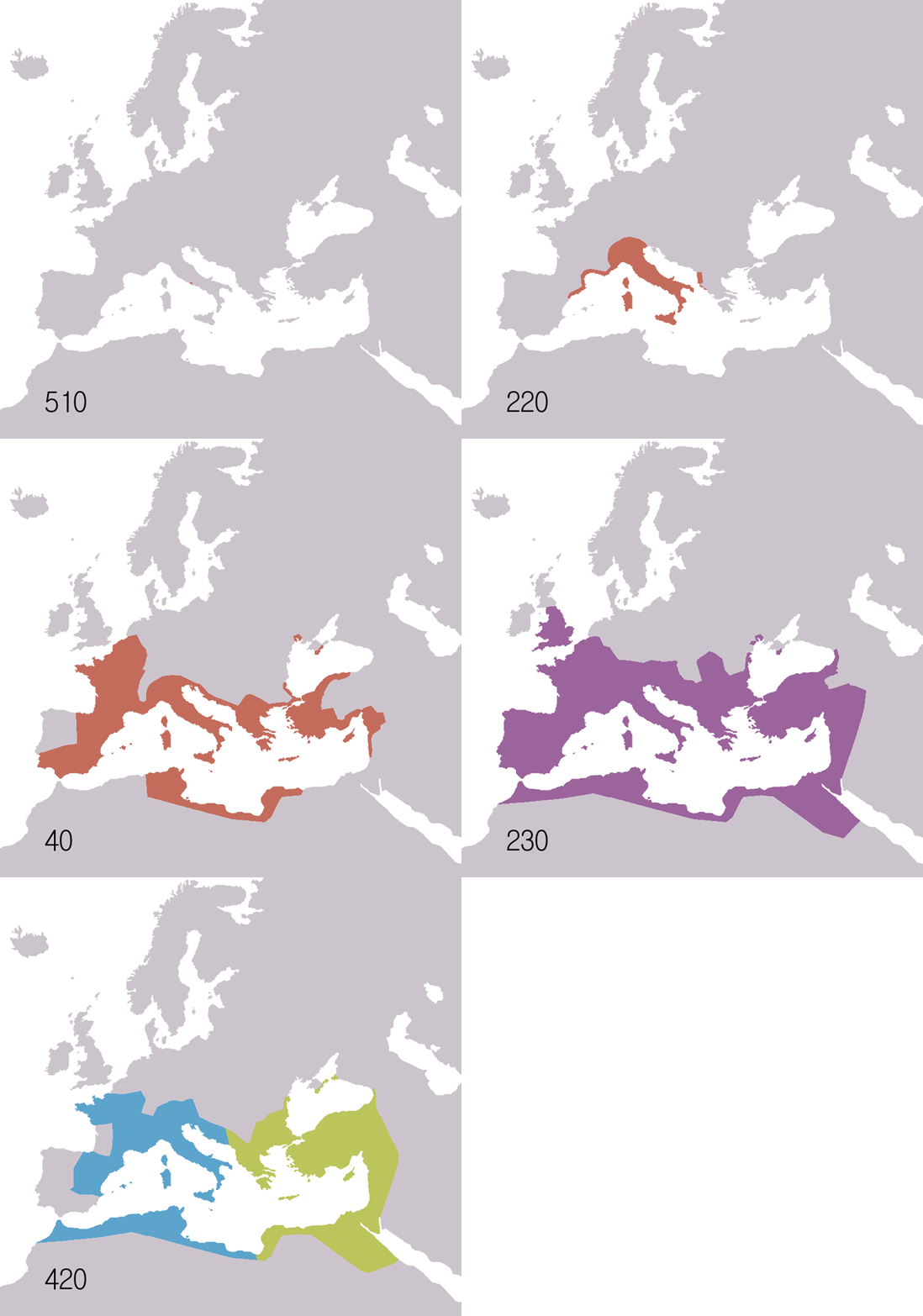
Ancient Rome
Ancient Rome was a thriving civilization that grew on the Italian Peninsula as early as the 8th century BC. Located along the Mediterranean Sea and centered on the city of Rome, it expanded to one of the largest empires in the ancient world....
played a pivotal role in the history
History of wine
The history of wine spans thousands of years and is closely intertwined with the history of agriculture, cuisine, civilization and humanity itself...
of wine
Wine
Wine is an alcoholic beverage, made of fermented fruit juice, usually from grapes. The natural chemical balance of grapes lets them ferment without the addition of sugars, acids, enzymes, or other nutrients. Grape wine is produced by fermenting crushed grapes using various types of yeast. Yeast...
. The earliest influences of viticulture
Viticulture
Viticulture is the science, production and study of grapes which deals with the series of events that occur in the vineyard. When the grapes are used for winemaking, it is also known as viniculture...
on the Italian peninsula
Italian Peninsula
The Italian Peninsula or Apennine Peninsula is one of the three large peninsulas of Southern Europe , spanning from the Po Valley in the north to the central Mediterranean Sea in the south. The peninsula's shape gives it the nickname Lo Stivale...
can be traced to Ancient Greeks
Ancient Greece and wine
The influence of ancient Greece on wine is significant not only to the Greek wine industry but to the development of almost all European wine regions and to the history of wine itself...
and Etruscans
Etruscan civilization
Etruscan civilization is the modern English name given to a civilization of ancient Italy in the area corresponding roughly to Tuscany. The ancient Romans called its creators the Tusci or Etrusci...
. The rise of the Roman Empire
Roman Empire
The Roman Empire was the post-Republican period of the ancient Roman civilization, characterised by an autocratic form of government and large territorial holdings in Europe and around the Mediterranean....
saw an increase in technology and awareness of winemaking
Winemaking
Winemaking, or vinification, is the production of wine, starting with selection of the grapes or other produce and ending with bottling the finished wine. Although most wine is made from grapes, it may also be made from other fruit or non-toxic plant material...
which spread to all parts of the empire. The influence of the Romans has had a profound effect of the histories of today's major winemaking regions of France
French wine
French wine is produced in several regions throughout France, in quantities between 50 and 60 million hectolitres per year, or 7–8 billion bottles. France has the world's second-largest total vineyard area, behind Spain, and is in the position of being the world's largest wine producer...
, Germany
German wine
German wine is primarily produced in the west of Germany, along the river Rhine and its tributaries, with the oldest plantations going back to the Roman era. Approximately 60 percent of the German wine production is situated in the federal state of Rhineland-Palatinate, where 6 of the 13 regions ...
, Italy
Italian wine
Italian wine is wine produced in Italy, a country which is home to some of the oldest wine-producing regions in the world. Italy is the world's largest wine producer, responsible for approximately one-fifth of world wine production in 2005. Italian wine is exported largely around the world and has...
, Portugal
Portuguese wine
Portuguese wine is the result of traditions introduced to the region by ancient civilizations, such as the Phoenicians, Carthaginians, Greeks, and mostly the Romans. Portugal started to export its wines to Rome during the Roman Empire. Modern exports developed with trade to England after the...
and Spain
Spanish wine
Spanish wines are wines produced in the southwestern European country of Spain. Located on the Iberian Peninsula, Spain has over 2.9 million acres planted—making it the most widely planted wine producing nation but it is the third largest producer of wine in the world, the largest...
. In the hands of the Romans, wine became "democratic" and available to all, from the lowly slave to the simple peasant to the aristocrat
Aristocracy (class)
The aristocracy are people considered to be in the highest social class in a society which has or once had a political system of Aristocracy. Aristocrats possess hereditary titles granted by a monarch, which once granted them feudal or legal privileges, or deriving, as in Ancient Greece and India,...
. The Romans' belief that wine was a daily necessity of life promoted its widespread availability among all classes. This led to the desire to spread viticulture and wine production to every part of the Roman empire, to ensure steady supplies for Roman soldiers and colonists. Economics also came into play, as Roman merchants saw opportunities for trade with native tribes such as those from Gaul
Gaul
Gaul was a region of Western Europe during the Iron Age and Roman era, encompassing present day France, Luxembourg and Belgium, most of Switzerland, the western part of Northern Italy, as well as the parts of the Netherlands and Germany on the left bank of the Rhine. The Gauls were the speakers of...
and Germania
Germania
Germania was the Greek and Roman geographical term for the geographical regions inhabited by mainly by peoples considered to be Germani. It was most often used to refer especially to the east of the Rhine and north of the Danube...
, bringing Roman influences to these regions before the arrival of the Roman military . The works of Roman writers—most notably Cato
Cato the Elder
Marcus Porcius Cato was a Roman statesman, commonly referred to as Censorius , Sapiens , Priscus , or Major, Cato the Elder, or Cato the Censor, to distinguish him from his great-grandson, Cato the Younger.He came of an ancient Plebeian family who all were noted for some...
, Columella
Columella
Lucius Junius Moderatus Columella is the most important writer on agriculture of the Roman empire. Little is known of his life. He was probably born in Gades , possibly of Roman parents. After a career in the army , he took up farming...
, Horace
Horace
Quintus Horatius Flaccus , known in the English-speaking world as Horace, was the leading Roman lyric poet during the time of Augustus.-Life:...
, Palladius
Rutilius Taurus Aemilianus Palladius
Rutilius Taurus Aemilianus Palladius, also known as Palladius Rutilius Taurus Aemilianus or just Palladius, was a Roman writer of the 4th century AD. He is principally known for his book on agriculture, Opus agriculturae, sometimes known as De re rustica.-Opus agriculturae:The Opus agriculturae is...
, Pliny
Pliny the Elder
Gaius Plinius Secundus , better known as Pliny the Elder, was a Roman author, naturalist, and natural philosopher, as well as naval and army commander of the early Roman Empire, and personal friend of the emperor Vespasian...
, Varro
Marcus Terentius Varro
Marcus Terentius Varro was an ancient Roman scholar and writer. He is sometimes called Varro Reatinus to distinguish him from his younger contemporary Varro Atacinus.-Biography:...
and Virgil
Virgil
Publius Vergilius Maro, usually called Virgil or Vergil in English , was an ancient Roman poet of the Augustan period. He is known for three major works of Latin literature, the Eclogues , the Georgics, and the epic Aeneid...
—give insights on the role of wine in Roman culture
Culture of ancient Rome
Ancient Roman culture existed throughout the almost 1200-year history of the civilization of Ancient Rome. The term refers to the culture of the Roman Republic, later the Roman Empire, which, at its peak, covered an area from Lowland Scotland and Morocco to the Euphrates.Life in ancient Rome...
and contemporary understanding of winemaking and viticultural practices. Many of the techniques and principles first developed in Roman times can be found in modern winemaking.
_01.jpg)
Early history
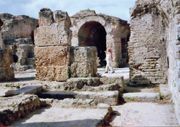
Grapevine
Grapevine is the common name for plants of the genus Vitis. Other meanings include:*Grapevine , a term often used to describe a form of communication by means of gossip or rumor, as in "heard it through the grapevine"...
s have grown on the Italian peninsula since prehistory
Prehistory
Prehistory is the span of time before recorded history. Prehistory can refer to the period of human existence before the availability of those written records with which recorded history begins. More broadly, it refers to all the time preceding human existence and the invention of writing...
and historians have not been able to pinpoint the exact moment in time when domestic viticulture and winemaking first occurred. It is possible that the Mycenaean
Mycenaean Greece
Mycenaean Greece was a cultural period of Bronze Age Greece taking its name from the archaeological site of Mycenae in northeastern Argolis, in the Peloponnese of southern Greece. Athens, Pylos, Thebes, and Tiryns are also important Mycenaean sites...
had some influences with early Greek settlements in southern Italy but the earliest recorded evidence of Greek influence was in 800 BC. Viticulture was widely entrenched in Etruscan civilization which was centered around the modern winemaking region of Tuscany. The Ancient Greeks saw wine as a staple of domestic life as well as a viable economic trade commodity. Throughout the Greek world
Ancient Greece
Ancient Greece is a civilization belonging to a period of Greek history that lasted from the Archaic period of the 8th to 6th centuries BC to the end of antiquity. Immediately following this period was the beginning of the Early Middle Ages and the Byzantine era. Included in Ancient Greece is the...
, settlements were encouraged to plant vineyards for local use and trade with the Greek city states. Southern Italy, with its abundance of indigenous
Indigenous (ecology)
In biogeography, a species is defined as native to a given region or ecosystem if its presence in that region is the result of only natural processes, with no human intervention. Every natural organism has its own natural range of distribution in which it is regarded as native...
vines, was an ideal location for wine production and was known by the Greeks as Oenotria ("land of vines").
As Rome
Rome
Rome is the capital of Italy and the country's largest and most populated city and comune, with over 2.7 million residents in . The city is located in the central-western portion of the Italian Peninsula, on the Tiber River within the Lazio region of Italy.Rome's history spans two and a half...
grew from a collection of settlements to a kingdom
King of Rome
The King of Rome was the chief magistrate of the Roman Kingdom. According to legend, the first king of Rome was Romulus, who founded the city in 753 BC upon the Palatine Hill. Seven legendary kings are said to have ruled Rome until 509 BC, when the last king was overthrown. These kings ruled for...
and then republic
Roman Republic
The Roman Republic was the period of the ancient Roman civilization where the government operated as a republic. It began with the overthrow of the Roman monarchy, traditionally dated around 508 BC, and its replacement by a government headed by two consuls, elected annually by the citizens and...
, the culture of Roman winemaking was influenced by the skills and techniques of the regions that were conquered and became part of the Roman Empire. The Greek settlements of southern Italy were completely under Roman control by 270 BC. The Etruscans, who already had established trade routes into Gaul, were completely conquered by the 1st century BC. The Punic Wars
Punic Wars
The Punic Wars were a series of three wars fought between Rome and Carthage from 264 B.C.E. to 146 B.C.E. At the time, they were probably the largest wars that had ever taken place...
with Carthage
Carthage
Carthage , implying it was a 'new Tyre') is a major urban centre that has existed for nearly 3,000 years on the Gulf of Tunis, developing from a Phoenician colony of the 1st millennium BC...
had a particularly marked effect on Roman viticulture. In addition to broadening the cultural horizons of the Roman citizenry, they also introduced them to the advanced viticultural techniques of the Carthaginians in particular the work of Mago
Mago (agricultural writer)
Mago was a Carthaginian writer, author of an agricultural manual in Punic which was a record of the farming knowledge of Carthage. The Punic text has been lost, but some fragments of Greek and Latin translations survive....
. When the libraries of Carthage were ransacked and burned, one of the few Carthaginian works to survive was the 26 volumes of Mago's work which was translated into Latin
Latin
Latin is an Italic language originally spoken in Latium and Ancient Rome. It, along with most European languages, is a descendant of the ancient Proto-Indo-European language. Although it is considered a dead language, a number of scholars and members of the Christian clergy speak it fluently, and...
and Greek
Greek language
Greek is an independent branch of the Indo-European family of languages. Native to the southern Balkans, it has the longest documented history of any Indo-European language, spanning 34 centuries of written records. Its writing system has been the Greek alphabet for the majority of its history;...
in 146 BC. Mago's work was extensively quoted in the influential Roman works by Pliny, Columella, Varro and Gargilius Martialis.
Golden age
For most of Rome's winemaking history, Greek wineAncient Greece and wine
The influence of ancient Greece on wine is significant not only to the Greek wine industry but to the development of almost all European wine regions and to the history of wine itself...
was the most highly prized with domestic Roman wine fetching far lower prices. The 2nd century BC began the "golden age" of Roman winemaking and the development of Grand cru vineyards (a type of early First Growth
First Growth
First Growth status refers to a classification of wines primarily from the Bordeaux region of France.-Bordeaux reds:The need for a classification of the best Bordeaux wines arose for the 1855 Exposition Universelle de Paris. The result was the Bordeaux Wine Official Classification of 1855, a list...
s in Rome). The vintage
Vintage
Vintage, in wine-making, is the process of picking grapes and creating the finished product . A vintage wine is one made from grapes that were all, or primarily, grown and harvested in a single specified year. In certain wines, it can denote quality, as in Port wine, where Port houses make and...
of 121BC was of legendary fame and became known as the Opimian vintage, named after the consul
Consul
Consul was the highest elected office of the Roman Republic and an appointive office under the Empire. The title was also used in other city states and also revived in modern states, notably in the First French Republic...
at the time—Lucius Opimius
Lucius Opimius
Lucius Opimius was Roman consul in 121 BC, known for ordering the execution of 3,000 supporters of popular leader Gaius Gracchus without trial, using as pretext the state of emergency declared after Gracchus's recent and turbulent death....
. The vintage was noted for its large harvest
Harvest (wine)
The harvesting of wine grapes is one of the most crucial steps in the process of winemaking. The time of harvest is determined primarily by the ripeness of the grape as measured by sugar, acid and tannin levels with winemakers basing their decision to pick based on the style of wine they wish to...
and the unusually high quality of wine that was produced—with some examples still being drunk over 100 years later. Pliny the Elder wrote extensively about the "first growths" of Rome—most notably Falernian, Alban and Caecuban. Other first growth vineyards include Rhaeticum and Hadrianum located along the Po river
Po River
The Po |Ligurian]]: Bodincus or Bodencus) is a river that flows either or – considering the length of the Maira, a right bank tributary – eastward across northern Italy, from a spring seeping from a stony hillside at Pian del Re, a flat place at the head of the Val Po under the northwest face...
in what are now the modern day regions of Lombardy and Venice respectively; Praetutium (not related to the modern Italian city Teramo
Teramo
Teramo is a city and comune in the central Italian region of Abruzzo, the capital of the province of Teramo.The city, from Rome, is situated between the highest mountains of the Apennines and the Adriatic coast...
, historically known as Praetutium) located along the Adriatic coast near the border of Emilia-Romagna
Emilia-Romagna
Emilia–Romagna is an administrative region of Northern Italy comprising the two historic regions of Emilia and Romagna. The capital is Bologna; it has an area of and about 4.4 million inhabitants....
and Marche
Marche
The population density in the region is below the national average. In 2008, it was 161.5 inhabitants per km2, compared to the national figure of 198.8. It is highest in the province of Ancona , and lowest in the province of Macerata...
and Lunense located in modern Tuscany
Tuscany
Tuscany is a region in Italy. It has an area of about 23,000 square kilometres and a population of about 3.75 million inhabitants. The regional capital is Florence ....
. Around Rome itself were the estates of Alban, Sabinum, Tiburtinum, Setinum and Signinum. Going south towards Naples
Naples
Naples is a city in Southern Italy, situated on the country's west coast by the Gulf of Naples. Lying between two notable volcanic regions, Mount Vesuvius and the Phlegraean Fields, it is the capital of the region of Campania and of the province of Naples...
were the estates of Caecuban, Falernian, Caulinum, Trebellicanum, Massicum, Gauranium, and Surrentinum. In Sicily
Sicily
Sicily is a region of Italy, and is the largest island in the Mediterranean Sea. Along with the surrounding minor islands, it constitutes an autonomous region of Italy, the Regione Autonoma Siciliana Sicily has a rich and unique culture, especially with regard to the arts, music, literature,...
was the first growth estate of Mamertinum. At this highpoint, it was estimated that Rome was consuming over 47 million USgals (177,914,364 l) of wine each year, enough for every man, woman and child to have about a bottle of wine each day.
Pompeii
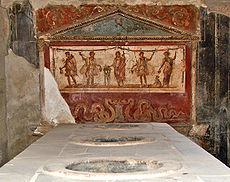
Pompeii
The city of Pompeii is a partially buried Roman town-city near modern Naples in the Italian region of Campania, in the territory of the comune of Pompei. Along with Herculaneum, Pompeii was destroyed and completely buried during a long catastrophic eruption of the volcano Mount Vesuvius spanning...
located south of Naples. The area was home to a vast expanse of vineyards, and served as an important trading city with Roman provinces abroad. It was the principal source of wine for the city of Rome. The Pompeians themselves were notorious for the decadence of their wine thirst. The worship of Bacchus
Dionysus
Dionysus was the god of the grape harvest, winemaking and wine, of ritual madness and ecstasy in Greek mythology. His name in Linear B tablets shows he was worshipped from c. 1500—1100 BC by Mycenean Greeks: other traces of Dionysian-type cult have been found in ancient Minoan Crete...
, the god
Roman mythology
Roman mythology is the body of traditional stories pertaining to ancient Rome's legendary origins and religious system, as represented in the literature and visual arts of the Romans...
of wine, was prevalent with depictions of the god being found on fresco
Fresco
Fresco is any of several related mural painting types, executed on plaster on walls or ceilings. The word fresco comes from the Greek word affresca which derives from the Latin word for "fresh". Frescoes first developed in the ancient world and continued to be popular through the Renaissance...
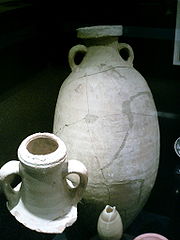
es and archaeological fragments throughout the region. Amphora
Amphora
An amphora is a type of vase-shaped, usually ceramic container with two handles and a long neck narrower than the body...
e stamped with the emblems of Pompeian merchants have been found across the Roman empire including the modern day regions of Bordeaux
Bordeaux
Bordeaux is a port city on the Garonne River in the Gironde department in southwestern France.The Bordeaux-Arcachon-Libourne metropolitan area, has a population of 1,010,000 and constitutes the sixth-largest urban area in France. It is the capital of the Aquitaine region, as well as the prefecture...
, Narbonne
Narbonne
Narbonne is a commune in southern France in the Languedoc-Roussillon region. It lies from Paris in the Aude department, of which it is a sub-prefecture. Once a prosperous port, it is now located about from the shores of the Mediterranean Sea...
, Toulouse
Toulouse
Toulouse is a city in the Haute-Garonne department in southwestern FranceIt lies on the banks of the River Garonne, 590 km away from Paris and half-way between the Atlantic Ocean and the Mediterranean Sea...
and Spain
Spain
Spain , officially the Kingdom of Spain languages]] under the European Charter for Regional or Minority Languages. In each of these, Spain's official name is as follows:;;;;;;), is a country and member state of the European Union located in southwestern Europe on the Iberian Peninsula...
. There is evidence to suggest that the popularity and notoriety of Pompeian wine may have given rise to early wine fraud
Wine fraud
Wine fraud is a form of fraud in which wines are sold to a customer illicitly, usually having the customer spend more money than the product is worth, or causing sickness due to harmful chemicals being mixed into the wine...
with fraudulent stamps being used to mark amphorae of non-Pompeian wine.
The 79 AD eruption of Mount Vesuvius
Mount Vesuvius
Mount Vesuvius is a stratovolcano in the Gulf of Naples, Italy, about east of Naples and a short distance from the shore. It is the only volcano on the European mainland to have erupted within the last hundred years, although it is not currently erupting...
had a devastating effect on the Roman wine industry. Vineyards across the region were destroyed, as well as warehouses storing the recent 78 AD vintage, causing a dramatic shortage of wine. The damage to the trading port also hindered the flow of wines from outside provinces. The wine that was available rose sharply in price, making it unaffordable to all but the most affluent Romans. The wine famine
Famine
A famine is a widespread scarcity of food, caused by several factors including crop failure, overpopulation, or government policies. This phenomenon is usually accompanied or followed by regional malnutrition, starvation, epidemic, and increased mortality. Every continent in the world has...
caused a sense of panic among the Romans who rushed to plant vineyards in the areas near Rome, even uprooting grain
GRAIN
GRAIN is a small international non-profit organisation that works to support small farmers and social movements in their struggles for community-controlled and biodiversity-based food systems. Our support takes the form of independent research and analysis, networking at local, regional and...
fields to have more available areas to plant. While these efforts helped to quickly correct the shortage of wine, the opposite effect of a wine surplus also brought negative consequences. The glut of wine caused a depression in pricing which hurt the commercial entrance of wine producers and traders. The grain fields that were uprooted contributed to a food shortage for the growing Roman population. In 92 AD, Roman Emperor
Roman Emperor
The Roman emperor was the ruler of the Roman State during the imperial period . The Romans had no single term for the office although at any given time, a given title was associated with the emperor...
Domitian
Domitian
Domitian was Roman Emperor from 81 to 96. Domitian was the third and last emperor of the Flavian dynasty.Domitian's youth and early career were largely spent in the shadow of his brother Titus, who gained military renown during the First Jewish-Roman War...
issued an edict
Edict
An edict is an announcement of a law, often associated with monarchism. The Pope and various micronational leaders are currently the only persons who still issue edicts.-Notable edicts:...
that banned the plantings of any new vineyards in Rome and ordered the uprooting of half of the vineyards in Roman provinces. While there is evidence to suggest that Domitian's edict was largely ignored in the Roman provinces, wine historians have debated the effect of the edict on the infant wine industries of Spain
Hispania
Another theory holds that the name derives from Ezpanna, the Basque word for "border" or "edge", thus meaning the farthest area or place. Isidore of Sevilla considered Hispania derived from Hispalis....
and Gaul
Roman Gaul
Roman Gaul consisted of an area of provincial rule in the Roman Empire, in modern day France, Belgium, Luxembourg, and western Germany. Roman control of the area lasted for less than 500 years....
. The expectation of the edict was that the reduced vineyards would supply only enough wine for domestic consumption with sparse amount for trade. While vineyards were already established in these growing wine regions, the lacking impetus of trading consideration may have had a depressing effect on the spread of viticulture and winemaking in these areas. Domitian's edict stayed in effect for 188 years till Emperor Probus repealed the measure in 280 AD.
Expansion of viticulture
One of the lasting legacies of the ancient Roman empire was the foundations that the Romans set in lands that would become world renowned wine regions. Through tradeRoman commerce
Roman trade was the engine that drove the Roman economy of the late Republic and the early Empire. Fashions and trends in historiography and in popular culture have tended to neglect the economic basis of the empire in favor of the lingua franca of Latin and the exploits of the Roman legions...
, military campaigns and settlements—the Roman influence that touched each land brought with it a taste for wine and impetus to plant vines. Trade was the first and farthest reaching arm of Roman influence. From the Carthaginians and southern Spain to the Celtic tribes in Gaul and Germanic tribes of the Rhine and Danube
Danube
The Danube is a river in the Central Europe and the Europe's second longest river after the Volga. It is classified as an international waterway....
, Roman wine merchants were eager to trade with enemy and ally alike. During the Gallic Wars
Gallic Wars
The Gallic Wars were a series of military campaigns waged by the Roman proconsul Julius Caesar against several Gallic tribes. They lasted from 58 BC to 51 BC. The Gallic Wars culminated in the decisive Battle of Alesia in 52 BC, in which a complete Roman victory resulted in the expansion of the...
, when Julius Caesar
Julius Caesar
Gaius Julius Caesar was a Roman general and statesman and a distinguished writer of Latin prose. He played a critical role in the gradual transformation of the Roman Republic into the Roman Empire....
brought his troops to Chalon-sur-Saône
Chalon-sur-Saône
Chalon-sur-Saône is a commune in the Saône-et-Loire department in the region of Bourgogne in eastern France.It is a sub-prefecture of the department. It is the largest city in the department; however, the department capital is the smaller city of Mâcon....
in 59 BC, he found two Roman wine merchants already established in business trading with the local tribes. In places like Bordeaux
Bordeaux wine
A Bordeaux wine is any wine produced in the Bordeaux region of France. Average vintages produce over 700 million bottles of Bordeaux wine, ranging from large quantities of everyday table wine, to some of the most expensive and prestigious wines in the world...
, Trier
Trier
Trier, historically called in English Treves is a city in Germany on the banks of the Moselle. It is the oldest city in Germany, founded in or before 16 BC....
and Colchester
Colchester
Colchester is an historic town and the largest settlement within the borough of Colchester in Essex, England.At the time of the census in 2001, it had a population of 104,390. However, the population is rapidly increasing, and has been named as one of Britain's fastest growing towns. As the...
where Roman garrisons were established, vineyards were planted to supply the needs locally and limit the cost of long distance trading. As Roman settlements were founded and populated by retired soldiers, many of whom had knowledge of Roman viticulture from their families and life before the military, would plant vineyards of their own in their new homelands. While there are possibilities that the Romans imported grapevines from Italy and Greece, there is sufficient evidence to suggest that the Romans cultivated native vines in the provinces that may be the ancestors of the grapes grown there today.
As the Roman Republic grew into an empire, the complexity of the Roman wine trade grew as well. The Roman peninsula was known for its high quality wine. Pompeii was known for its unique and high quality wine. However, as the Republic grew beyond Italy, the trade and the market economy dealing with wine grew as well. The wine trade in Italy consisted of the Romans selling their wine abroad to settlements and provinces around the Mediterranean Sea. Yet, by the end of the 1st century CE/AD, the Romans’ wine exports had competition from its provinces, which began to export their wine to Rome. Because the Roman Empire was very much a market economy, the provinces’ exports were encouraged. This enhanced the supply and demand of the Roman market economy. If there were a high supply of wine, then the price of wine would be lower to the consumer. Because the Empire had a supply and demand economy, the Romans also had an ample supply of coinage, which also suggests that there was a complex market economy surrounding the wine trade of Roman Empire. An ample supply of coins meant that people within the Empire put a great deal of thought into the market economy of wine. Wine clearly was a pivotal part of the Roman Empire, her provinces, and its economy.
Hispania
Iberian Peninsula
The Iberian Peninsula , sometimes called Iberia, is located in the extreme southwest of Europe and includes the modern-day sovereign states of Spain, Portugal and Andorra, as well as the British Overseas Territory of Gibraltar...
wasn't completed till the reign of Caesar Augustus
Augustus
Augustus ;23 September 63 BC – 19 August AD 14) is considered the first emperor of the Roman Empire, which he ruled alone from 27 BC until his death in 14 AD.The dates of his rule are contemporary dates; Augustus lived under two calendars, the Roman Republican until 45 BC, and the Julian...
. Roman colonization of the region led to the development of Tarraconensis in the northern regions of Spain, including what is now the modern winemaking regions
Spanish wine regions
The mainstream quality wine regions in Spain are referred to as Denominaciones de Origen and the wine they produce is regulated for quality according to specific laws....
of Catalonia
Catalan wine
Catalan wine is wine made in the Spanish wine region of Catalonia. More rarely, the term may also be used to refer to some French wines made in the Catalan region of Roussillon, once joint with the southern territories that currently are part of Spain...
, Rioja, Ribera del Duero
Ribera del Duero
Ribera del Duero is a Spanish Denominación de Origen located in the country's northern plateau and is one of eleven 'quality wine' regions within the autonomous community of Castile and León...
, Galicia
Galician wine
Galician wine is Spanish wine made in the autonomous community of Galicia in the northwest corner of Spain. It includes wine made in the provinces of A Coruña, Ourense, Pontevedra and Lugo. Within Galicia are five Denominación de Origen -Monterrei, Rías Baixas, Ribeira Sacra, Ribeiro and Valdeorras...
, and Hispania Baetica
Hispania Baetica
Hispania Baetica was one of three Imperial Roman provinces in Hispania, . Hispania Baetica was bordered to the west by Lusitania, and to the northeast by Hispania Tarraconensis. Baetica was part of Al-Andalus under the Moors in the 8th century and approximately corresponds to modern Andalucia...
which includes modern Andalusia
Andalusia
Andalusia is the most populous and the second largest in area of the autonomous communities of Spain. The Andalusian autonomous community is officially recognised as a nationality of Spain. The territory is divided into eight provinces: Huelva, Seville, Cádiz, Córdoba, Málaga, Jaén, Granada and...
and Sherry
Sherry
Sherry is a fortified wine made from white grapes that are grown near the town of Jerez , Spain. In Spanish, it is called vino de Jerez....
wine making region of Cádiz
Cádiz (province)
Cádiz is a province of southern Spain, in the southwestern part of the autonomous community of Andalusia, the southernmost part of continental Western Europe....
. The Carthaginians and Phoenicians were the first to introduce viticulture to Spain but the Roman influence of new techniques and the development of road networks
Roman road
The Roman roads were a vital part of the development of the Roman state, from about 500 BC through the expansion during the Roman Republic and the Roman Empire. Roman roads enabled the Romans to move armies and trade goods and to communicate. The Roman road system spanned more than 400,000 km...
brought new economic opportunities to the region, elevating winemaking from a private agricultural crop to a viable commercial enterprise. Spanish wine was in Bordeaux before the region was producing its own wine. French
French people
The French are a nation that share a common French culture and speak the French language as a mother tongue. Historically, the French population are descended from peoples of Celtic, Latin and Germanic origin, and are today a mixture of several ethnic groups...
historian Roger Dion has suggested that the Balisca vine which was common in the northern Spanish provinces, particular Rioja
History of Rioja wine
The history of Rioja wine reflects a long and varied winemaking tradition in the Spanish region of La Rioja, starting with the first Phoenician settlers in 11th century BC. As with many of Europe's most well known wine regions, the Ancient Romans founded many of the Rioja vineyards. Throughout the...
, was brought from Rioja to plant the first Roman vineyards of Bordeaux.
Spanish wines were frequently traded in Rome. The poet Martial
Martial
Marcus Valerius Martialis , was a Latin poet from Hispania best known for his twelve books of Epigrams, published in Rome between AD 86 and 103, during the reigns of the emperors Domitian, Nerva and Trajan...
described a highly regarded wine known as Ceretanum from Ceret (modern day Jerez de la Frontera
Jerez de la Frontera
Jerez de la Frontera is a municipality in the province of Cádiz in the autonomous community of Andalusia, in southwestern Spain, situated midway between the sea and the mountains. , the city, the largest in the province, had 208,896 inhabitants; it is the fifth largest in Andalusia...
). Wine historian Hugh Johnson believes that this wine was an early ancestor
History of Sherry
The history of Sherry is closely linked with that of Spanish wine production, particularly the political fortunes of the Cádiz region, where it originated with the early Phoenician settlement of the Iberian peninsular...
of Sherry. Trade in Spanish wines reached further throughout the Roman empire than Italian wines, with amphorae from Spain being found in Aquitaine
Aquitaine
Aquitaine , archaic Guyenne/Guienne , is one of the 27 regions of France, in the south-western part of metropolitan France, along the Atlantic Ocean and the Pyrenees mountain range on the border with Spain. It comprises the 5 departments of Dordogne, :Lot et Garonne, :Pyrénées-Atlantiques, Landes...
, Brittany
Brittany
Brittany is a cultural and administrative region in the north-west of France. Previously a kingdom and then a duchy, Brittany was united to the Kingdom of France in 1532 as a province. Brittany has also been referred to as Less, Lesser or Little Britain...
, Loire Valley
Loire Valley (wine)
The Loire Valley wine region includes the French wine regions situated along the Loire River from the Muscadet region near the city of Nantes on the Atlantic coast to the region of Sancerre and Pouilly-Fumé just southeast of the city of Orléans in north central France. In between are the regions of...
, Normandy
Normandy
Normandy is a geographical region corresponding to the former Duchy of Normandy. It is in France.The continental territory covers 30,627 km² and forms the preponderant part of Normandy and roughly 5% of the territory of France. It is divided for administrative purposes into two régions:...
, Britain
Roman Britain
Roman Britain was the part of the island of Great Britain controlled by the Roman Empire from AD 43 until ca. AD 410.The Romans referred to the imperial province as Britannia, which eventually comprised all of the island of Great Britain south of the fluid frontier with Caledonia...
and the German frontier
Limes Germanicus
The Limes Germanicus was a line of frontier fortifications that bounded the ancient Roman provinces of Germania Inferior, Germania Superior and Raetia, dividing the Roman Empire and the unsubdued Germanic tribes from the years 83 to about 260 AD...
. The historian Strabo
Strabo
Strabo, also written Strabon was a Greek historian, geographer and philosopher.-Life:Strabo was born to an affluent family from Amaseia in Pontus , a city which he said was situated the approximate equivalent of 75 km from the Black Sea...
noted in his work Geographica
Geographica (Strabo)
The Geographica , or Geography, is a 17-volume encyclopedia of geographical knowledge written in Greek by Strabo, an educated citizen of the Roman empire of Greek descent. Work can have begun on it no earlier than 20 BC...
that the vineyards of Baetica were famous for their beauty. The Roman agricultural writer Columella was a native of Cádiz and was duly influenced by the region's viticulture.
Gaul
There is archaeological evidence to suggest that the CeltCelt
The Celts were a diverse group of tribal societies in Iron Age and Roman-era Europe who spoke Celtic languages.The earliest archaeological culture commonly accepted as Celtic, or rather Proto-Celtic, was the central European Hallstatt culture , named for the rich grave finds in Hallstatt, Austria....
s first cultivated the grape vine in Gaul. Grape pips
Seed
A seed is a small embryonic plant enclosed in a covering called the seed coat, usually with some stored food. It is the product of the ripened ovule of gymnosperm and angiosperm plants which occurs after fertilization and some growth within the mother plant...
have been found throughout France, pre-dating the Greeks and Romans with some examples found near Lake Geneva
Lake Geneva
Lake Geneva or Lake Léman is a lake in Switzerland and France. It is one of the largest lakes in Western Europe. 59.53 % of it comes under the jurisdiction of Switzerland , and 40.47 % under France...
being over 12,000 years old. The extent that the Celts and Gallic tribes produced wine is not clearly known but the arrival of the Greeks near Massalia in 600 BC certainly introduced new types styles of winemaking and viticulture. The limit of Greek viticulture was to plant in regions with Mediterranean climates that would also support olive
Olive
The olive , Olea europaea), is a species of a small tree in the family Oleaceae, native to the coastal areas of the eastern Mediterranean Basin as well as northern Iran at the south end of the Caspian Sea.Its fruit, also called the olive, is of major agricultural importance in the...
and fig tree
Common fig
The Common fig is a deciduous tree growing to heights of up to 6 m in the genus Ficus from the family Moraceae known as Common fig tree. It is a temperate species native to the Middle East.-Description:...
plantings. The Romans looked for regions near a river and an important town, with hillside terrain. Roman knowledge of the sciences included the tendency for cold air to travel like water down a hillside, cooling the grapes in the day, and to gather in frost pockets at the bottom. Those areas were to be avoided while a sunny hillside, even in a northernly location, could provide a climate sufficient enough to ripen grapes. When the Romans took over Massalia in 125BC, they pushed farther inland and westward. They founded the city of Narbonne in 118BC, in what is today the Languedoc wine
Languedoc wine
Languedoc - Roussillon wine, including the vin de pays labeled Vin de Pays d'Oc, is produced in southern France. While "Languedoc" can refer to a specific historic region of France and Northern Catalonia, usage since the 20th century has primarily referred to the northern part of the...
region, along the Via Domitia
Via Domitia
The Via Domitia was the first Roman road built in Gaul, to link Italy and Hispania through Gallia Narbonensis, across what is now southern France. The route that the Romans regularised and paved was ancient when they set out to survey it, so old that it traces the mythic route travelled by Heracles...
—the first Roman road in Gaul. The Romans established lucrative trading relations with local tribes of Gaul. Despite having the potential to produce wine of their own, the Gallic tribes paid high prices for Roman wine with a single amphora featuring the entire value of slave.

Oak
An oak is a tree or shrub in the genus Quercus , of which about 600 species exist. "Oak" may also appear in the names of species in related genera, notably Lithocarpus...
trees were still found. The Romans knew from their territories in what is now northeastern Italy
Friuli-Venezia Giulia wine
Friuli-Venezia Giulia wine is wine made in the northeastern Italian region of Friuli-Venezia Giulia. Once part of the Venetian Republic and with sections under the influence of the Austro-Hungarian Empire for some time, The wines of the region have noticeable Slavic and Germanic influences...
that regions where Quercus ilex trees were found had climates that were sufficiently hot enough to allow grapes to ripen fully. In the 1st century AD, Pliny notes that the settlement of Vienne
Vienne, Isère
Vienne is a commune in south-eastern France, located south of Lyon, on the Rhône River. It is the second largest city after Grenoble in the Isère department, of which it is a subprefecture. The city's population was of 29,400 as of the 2001 census....
(near what is now the Côte-Rôtie AOC
Côte-Rôtie AOC
Côte-Rôtie is a French wine Appellation d'Origine Contrôlée in the northern Rhône wine region of France. The vineyards are located just south of Vienne in the communes of Saint-Cyr-sur-le-Rhône, Ampuis, and Tupin-et-Semons. The vineyards are unique because of their vertical slopes and their stone...
) produced a resin
Resin
Resin in the most specific use of the term is a hydrocarbon secretion of many plants, particularly coniferous trees. Resins are valued for their chemical properties and associated uses, such as the production of varnishes, adhesives, and food glazing agents; as an important source of raw materials...
ated wine that fetched high prices in Rome. Wine historian Hanneke Wilson notes that this Rhône wine was the first truly French wine
French wine
French wine is produced in several regions throughout France, in quantities between 50 and 60 million hectolitres per year, or 7–8 billion bottles. France has the world's second-largest total vineyard area, behind Spain, and is in the position of being the world's largest wine producer...
to receive international acclaim. The first mention of Roman interest in the Bordeaux region was in Strabo's report to Augustus that there were no vines down the river Tarn
Tarn River
The Tarn is a long river in southern France , right tributary of the Garonne.The Tarn runs in a roughly westerly direction, from its source at an altitude of 1,550 m on Mont Lozère in the Cévennes mountains , through the deep gorges and canyons of the Gorges du Tarn The Tarn is a long...
towards Garonne
Garonne
The Garonne is a river in southwest France and northern Spain, with a length of .-Source:The Garonne's headwaters are to be found in the Aran Valley in the Pyrenees, though three different locations have been proposed as the true source: the Uelh deth Garona at Plan de Beret , the Ratera-Saboredo...
into the region known as Burdigala. The wine for this seaport was being supplied by the "High country" region of Gaillac
Gaillac
Gaillac is a commune in the Tarn department in southern France.-Geography of Gaillac:Gaillac is a town situated between Toulouse, Albi and Monatauban. It has gained a large amount of recognition due to the wines that bear the towns name. The Tarn river runs along the border of the town by the...
in the Midi-Pyrénées
Midi-Pyrénées
Midi-Pyrénées is the largest region of metropolitan France by area, larger than the Netherlands or Denmark.Midi-Pyrénées has no historical or geographical unity...
region. The Midi had bountiful resources of indigenous vines that the Romans cultivated, many of which are still being used to produce wine today, including—Duras
Duras (grape)
Duras is a traditional French variety of red wine grape that is mostly grown around the Tarn River, northeast of Toulouse. It is usually blended with other traditional varieties, but production has been declining in recent years....
, Fer
Fer
Fer is a red French wine grape variety that is grown primarily in South West France and is most notable for its role in the Appellation d'Origine Contrôlée wines of Gaillac, Marcillac and Béarn but can also be found as minor component in the wines of Madiran, Cabardès and Bergerac...
, Ondenc
Ondenc
Ondenc is a white French wine grape found predominantly in the Gaillac region of southwest France. In the 19th century, it was a popular planting in Bordeaux but fell out of favor following the phylloxera epidemic due to poor yields and sensitive to grape disease, though is still one of the seven...
and Len de l'El
Len de l'El
Len de l'El is a white French wine grape variety native to South West France...
. The location of Bordeaux on the Gironde estuary
Gironde estuary
The Gironde is a navigable estuary , in southwest France and is formed from the meeting of the rivers Dordogne and Garonne just below the centre of Bordeaux...
made it an ideal seaport to transport wine along the Atlantic Coast
Atlantic Ocean
The Atlantic Ocean is the second-largest of the world's oceanic divisions. With a total area of about , it covers approximately 20% of the Earth's surface and about 26% of its water surface area...
and to the British Isles
British Isles
The British Isles are a group of islands off the northwest coast of continental Europe that include the islands of Great Britain and Ireland and over six thousand smaller isles. There are two sovereign states located on the islands: the United Kingdom of Great Britain and Northern Ireland and...
. It wasn't long before Bordeaux became self sufficient with its own vineyards and even exporting its own wine to Roman soldiers stationed in Britain. In the 1st century AD, Pliny the Elder mentions plantings in Bordeaux, including the Balisca vine (previously known in Spain) under the synonym
Synonym
Synonyms are different words with almost identical or similar meanings. Words that are synonyms are said to be synonymous, and the state of being a synonym is called synonymy. The word comes from Ancient Greek syn and onoma . The words car and automobile are synonyms...
of Biturica after the local Bituriges
Bituriges
The Bituriges was a tribe with its capital at Bourges .Early in the 1st century BCE, they had been one of the main tribes, especially in terms of Druids and their political influence. But they soon declined in power as the Druids were an important target for Julius Caesar in his conquest of Gaul...
tribe. Ampelographers note that corruption of the name Biturica is Vidure which is a French synonym of Cabernet Sauvignon
Cabernet Sauvignon
Cabernet Sauvignon is one of the world's most widely recognized red wine grape varieties. It is grown in nearly every major wine producing country among a diverse spectrum of climates from Canada's Okanagan Valley to Lebanon's Beqaa Valley...
and may point to the ancestry of this vine with the Cabernet family that includes—Cabernet Sauvignon, Cabernet Franc
Cabernet Franc
Cabernet Franc is one of the major black grape varieties worldwide. It is principally grown for blending with Cabernet Sauvignon and Merlot in the Bordeaux style, but can also be vinified alone - as in the Loire's Chinon...
, Merlot
Merlot
Merlot is a darkly blue-coloured wine grape, that is used as both a blending grape and for varietal wines. The name Merlot is thought to derive from the Old French word for young blackbird, merlot, a diminutive of merle, the blackbird , probably from the color of the grape. Merlot-based wines...
and Petit Verdot
Petit verdot
Petit Verdot is a variety of red wine grape, principally used in classic Bordeaux blends. It ripens much later than the other varieties in Bordeaux, often too late, so it fell out of favour in its home region. When it does ripen, it is added in small amounts to add tannin, colour and flavour to the...
.
Further up the Rhône, along the Saône
Saône
The Saône is a river of eastern France. It is a right tributary of the River Rhône. Rising at Vioménil in the Vosges department, it joins the Rhône in Lyon....
tributary
Tributary
A tributary or affluent is a stream or river that flows into a main stem river or a lake. A tributary does not flow directly into a sea or ocean...
, the Romans would encounter the areas that would become the modern day wine regions of Beaujolais
Beaujolais
Beaujolais is a French Appellation d'Origine Contrôlée wine generally made of the Gamay grape which has a thin skin and is low in tannins. Like most AOC wines they are not labeled varietally. Whites from the region, which make up only 1% of its production, are made mostly with Chardonnay grapes...
, Mâconnais
Mâconnais
The Mâconnais district lies in the south of the Burgundy wine region in France, west of the River Saône. It takes its name from the town of Mâcon. It is best known as a source of good value white wines made from the Chardonnay grape; the wines from Pouilly-Fuissé are particularly sought-after....
, Côte Chalonnaise
Côte Chalonnaise
Côte Chalonnaise is a subregion of the Burgundy wine region of France. Côte Chalonnaise lies to the south of the Côte d'Or continuing the same geology southward. It is still in the main area of Burgundy wine production but it includes no Grand cru vineyards...
and Côte d'Or
Côte d'Or (escarpment)
The Côte d'Or is a limestone escarpment in Burgundy, France that lends its name to the department which was formed around it...
. Rome's first ally among the tribes of Gaul was the Aedui
Aedui
Aedui, Haedui or Hedui , were a Gallic people of Gallia Lugdunensis, who inhabited the country between the Arar and Liger , in today's France. Their territory thus included the greater part of the modern departments of Saône-et-Loire, Côte-d'Or and Nièvre.-Geography:The country of the Aedui is...
whom they supported by founding the city of Augustodunum in what is now the Burgundy wine
Burgundy wine
Burgundy wine is wine made in the Burgundy region in eastern France, in the valleys and slopes west of the Saône River, a tributary of the Rhône. The most famous wines produced here - those commonly referred to as "Burgundies" - are red wines made from Pinot Noir grapes or white wines made from...
region. While it is possible that vineyards were planted in the 1st century AD, shortly after the founding of Augustodunum, the first definitive evidence of wine production comes from an account of the visit by Emperor Constantine
Constantine I
Constantine the Great , also known as Constantine I or Saint Constantine, was Roman Emperor from 306 to 337. Well known for being the first Roman emperor to convert to Christianity, Constantine and co-Emperor Licinius issued the Edict of Milan in 313, which proclaimed religious tolerance of all...
to the city in 312 AD. The founding of France's other great wine regions are not as clear. The Roman's propensity for planting on hillsides has left archaeological evidences of Gallo-Roman vineyards in the chalk hillsides of Sancerre
Sancerre (wine)
Sancerre is a French wine Appellation d'origine contrôlée for wine produced in the environs of Sancerre in the eastern part of the Loire valley, southeast of Orléans. Almost all of the appellation lies on the left bank of the Loire, opposite Pouilly-Fumé. It is well regarded for and primarily...
. In the 4th century, the Emperor Julian
Julian the Apostate
Julian "the Apostate" , commonly known as Julian, or also Julian the Philosopher, was Roman Emperor from 361 to 363 and a noted philosopher and Greek writer....
had a vineyard near Paris
Paris
Paris is the capital and largest city in France, situated on the river Seine, in northern France, at the heart of the Île-de-France region...
on the hill of Montmartre
Montmartre
Montmartre is a hill which is 130 metres high, giving its name to the surrounding district, in the north of Paris in the 18th arrondissement, a part of the Right Bank. Montmartre is primarily known for the white-domed Basilica of the Sacré Cœur on its summit and as a nightclub district...
. A 5th century villa in what is now Épernay
Épernay
Épernay is a commune in the Marne department in northern France. Épernay is located some 130 km north-east of Paris on the main line of the Eastern railway to Strasbourg...
shows the Roman influence in the Champagne region.
Germania
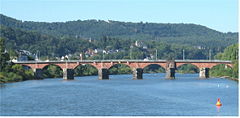
Vitis vinifera
Vitis vinifera is a species of Vitis, native to the Mediterranean region, central Europe, and southwestern Asia, from Morocco and Portugal north to southern Germany and east to northern Iran....
vines have existed along the Rhine since prehistory, the earliest evidence of viticulture dates back to the Roman conquest and settlement of the western territories of Germania
Germania
Germania was the Greek and Roman geographical term for the geographical regions inhabited by mainly by peoples considered to be Germani. It was most often used to refer especially to the east of the Rhine and north of the Danube...
. Agricultural tools, such as pruning knives, have been found near Roman garrison posts in Trier and Cologne
Cologne
Cologne is Germany's fourth-largest city , and is the largest city both in the Germany Federal State of North Rhine-Westphalia and within the Rhine-Ruhr Metropolitan Area, one of the major European metropolitan areas with more than ten million inhabitants.Cologne is located on both sides of the...
but the first definitive record of wine production dates the 370 AD work by Ausonius
Ausonius
Decimius Magnus Ausonius was a Latin poet and rhetorician, born at Burdigala .-Biography:Decimius Magnus Ausonius was born in Bordeaux in ca. 310. His father was a noted physician of Greek ancestry and his mother was descended on both sides from long-established aristocratic Gallo-Roman families...
titled Mosella where he described vibrant vineyards along the Mosel. A native of Bordeaux, Ausonius compared the vineyards favorably to those of his homeland and seems to indicate that viticulture had long been present in this area. The reasons for planting Rhineland were to cater to the growing demand of Roman soldiers along the Limes Germanicus
Limes Germanicus
The Limes Germanicus was a line of frontier fortifications that bounded the ancient Roman provinces of Germania Inferior, Germania Superior and Raetia, dividing the Roman Empire and the unsubdued Germanic tribes from the years 83 to about 260 AD...
(German frontier) and the high costs associated with importing wine from Rome, Spain or Bordeaux. At one point the Romans considered building a canal
Canal
Canals are man-made channels for water. There are two types of canal:#Waterways: navigable transportation canals used for carrying ships and boats shipping goods and conveying people, further subdivided into two kinds:...
that linked the Saône and Mosel in order to facilitate water way trading. The alternative was to drink what Tacitus
Tacitus
Publius Cornelius Tacitus was a senator and a historian of the Roman Empire. The surviving portions of his two major works—the Annals and the Histories—examine the reigns of the Roman Emperors Tiberius, Claudius, Nero and those who reigned in the Year of the Four Emperors...
described as an inferior beer
Beer
Beer is the world's most widely consumed andprobably oldest alcoholic beverage; it is the third most popular drink overall, after water and tea. It is produced by the brewing and fermentation of sugars, mainly derived from malted cereal grains, most commonly malted barley and malted wheat...
-like beverage.
The steep hillsides along the Mosel and Rhine rivers provided an opportunity to extend the cultivation of grapes to a northerly location. A south/southwest facing slope maximizes the amount of sunshine that the vines receive with the degree of angle
Degree (angle)
A degree , usually denoted by ° , is a measurement of plane angle, representing 1⁄360 of a full rotation; one degree is equivalent to π/180 radians...
allowing the vines to receive the sun's rays perpendicular
Perpendicular
In geometry, two lines or planes are considered perpendicular to each other if they form congruent adjacent angles . The term may be used as a noun or adjective...
ly rather than at a low or diffuse angle as vineyards on flatter terrain receive. The hillside offered the added benefit of shielding vines from the cold northern winds and the reflection from the rivers offered additional warmth to add in ripening the grapes. With the right type of grape, perhaps even an early ancestor of the German wine
German wine
German wine is primarily produced in the west of Germany, along the river Rhine and its tributaries, with the oldest plantations going back to the Roman era. Approximately 60 percent of the German wine production is situated in the federal state of Rhineland-Palatinate, where 6 of the 13 regions ...
grape Riesling
Riesling
Riesling is a white grape variety which originated in the Rhine region of Germany. Riesling is an aromatic grape variety displaying flowery, almost perfumed, aromas as well as high acidity. It is used to make dry, semi-sweet, sweet and sparkling white wines. Riesling wines are usually varietally...
, the Romans found that wine could be produced in Germania. From the Rhine, German wine would make its way downriver to the North Sea
North Sea
In the southwest, beyond the Straits of Dover, the North Sea becomes the English Channel connecting to the Atlantic Ocean. In the east, it connects to the Baltic Sea via the Skagerrak and Kattegat, narrow straits that separate Denmark from Norway and Sweden respectively...
and to merchants in Britain where it began to develop a good reputation. Despite military hostilities, the neighboring Germanic tribes like the Alamanni
Alamanni
The Alamanni, Allemanni, or Alemanni were originally an alliance of Germanic tribes located around the upper Rhine river . One of the earliest references to them is the cognomen Alamannicus assumed by Roman Emperor Caracalla, who ruled the Roman Empire from 211 to 217 and claimed thereby to be...
and Franks
Franks
The Franks were a confederation of Germanic tribes first attested in the third century AD as living north and east of the Lower Rhine River. From the third to fifth centuries some Franks raided Roman territory while other Franks joined the Roman troops in Gaul. Only the Salian Franks formed a...
were eager customers of German wine until a 5th century edict forbade the sale of wine outside of Roman settlements. Wine historian Hugh Johnson believes this might have been an added incentive for the barbarian invasions
Migration Period
The Migration Period, also called the Barbarian Invasions , was a period of intensified human migration in Europe that occurred from c. 400 to 800 CE. This period marked the transition from Late Antiquity to the Early Middle Ages...
and sacking
Looting
Looting —also referred to as sacking, plundering, despoiling, despoliation, and pillaging—is the indiscriminate taking of goods by force as part of a military or political victory, or during a catastrophe, such as during war, natural disaster, or rioting...
of Roman settlements like Trier—"an invitation to break down the door".
Britain
Roman Britain
Roman Britain was the part of the island of Great Britain controlled by the Roman Empire from AD 43 until ca. AD 410.The Romans referred to the imperial province as Britannia, which eventually comprised all of the island of Great Britain south of the fluid frontier with Caledonia...
is not so much a viticultural one, as it is a cultural one in the British relationship with wine. Throughout modern history, the British have played a key role in shaping the world of the wine and defining global wine markets. Though evidence of Vitis vinifera vines on the British Isle dates back to the Hoxnian Stage when the climate was much warmer than it is today, the British interest in wine production really took foot following the Roman conquest of Britain
Roman conquest of Britain
The Roman conquest of Britain was a gradual process, beginning effectively in AD 43 under Emperor Claudius, whose general Aulus Plautius served as first governor of Britannia. Great Britain had already frequently been the target of invasions, planned and actual, by forces of the Roman Republic and...
in the 1st century AD. Amphorae from Italy indicate that wine was regularly transported by sea, around the Iberian peninsula to Britain at great expense. The development of wine producing regions in Bordeaux and Germany made supplying the needs of Roman colonists much easier at less cost. The presence of amphora production houses founds in what is now Brockley
Brockley
Brockley is a district of south London, England, located in the London Borough of Lewisham. It is situated south-east of Charing Cross.It is covered by the London postcode districts SE4 and SE14.-History:...
and Middlesex
Middlesex
Middlesex is one of the historic counties of England and the second smallest by area. The low-lying county contained the wealthy and politically independent City of London on its southern boundary and was dominated by it from a very early time...
indicates that the British probably had vineyards of their own as well.
There is clear evidence that the Roman cult of Bacchus
Dionysus
Dionysus was the god of the grape harvest, winemaking and wine, of ritual madness and ecstasy in Greek mythology. His name in Linear B tablets shows he was worshipped from c. 1500—1100 BC by Mycenean Greeks: other traces of Dionysian-type cult have been found in ancient Minoan Crete...
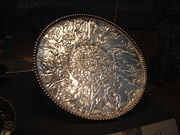
, the wine god, was practiced in Britain with more than 400 artifacts being found throughout Britain with his depiction—including the Mildenhall Treasure
Mildenhall Treasure
The West Row Treasure is a major hoard of highly decorated Roman silver tableware from the fourth-century AD, found at West Row, near Mildenhall in the English county of Suffolk...
which included among the collection a silver dish with engravings of Bacchus having a drinking contest with Hercules
Hercules
Hercules is the Roman name for Greek demigod Heracles, son of Zeus , and the mortal Alcmene...
. In Colchester, excavations have uncovered containers identifying over 60 different types of wines from Italy, Spain, the Rhine and Bordeaux.
Roman writings on wine
The work of the classical Roman writers — most notably Cato, Columella, Horace, Palladius, Pliny, Varro and Virgil — shed light on the role of wine in Roman culture as well as contemporary winemaking and viticultural practices. Some of these techniques have influences that can be seen in modern winemaking today. These include consideration of climateClimate
Climate encompasses the statistics of temperature, humidity, atmospheric pressure, wind, rainfall, atmospheric particle count and other meteorological elemental measurements in a given region over long periods...
and landscape in choose which grape variety to plant, the benefits of different trellising
Trellis (agriculture)
A trellis is an architectural structure, usually made from interwoven pieces of wood, bamboo or metal that is often made to support climbing plants...
and vine training systems
Vine training systems
The use of vine training systems in viticulture is aimed primarily to assist in canopy management with finding the balance in enough foliage to facilitate photosynthesis without excessive shading that could impede grape ripening or promote grape diseases...
, the effects of pruning
Pruning
Pruning is a horticultural practice involving the selective removal of parts of a plant, such as branches, buds, or roots. Reasons to prune plants include deadwood removal, shaping , improving or maintaining health, reducing risk from falling branches, preparing nursery specimens for...
and yield
Yield (wine)
In viticulture, the yield is a measure of the amount of grapes or wine that is produced per unit surface of vineyard, and is therefore a type of crop yield...
s on the quality of wine, as well as winemaking techniques like sur lie aging after fermentation
Fermentation (wine)
The process of fermentation in wine turns grape juice into an alcoholic beverage. During fermentation, yeast interact with sugars in the juice to create ethanol, commonly known as ethyl alcohol, and carbon dioxide...
and the importance of cleanliness throughout the winemaking process to avoid contamination, impurities and spoilage.
Marcus Porcius Cato The Elder
Marcus Porcius CatoCato the Elder
Marcus Porcius Cato was a Roman statesman, commonly referred to as Censorius , Sapiens , Priscus , or Major, Cato the Elder, or Cato the Censor, to distinguish him from his great-grandson, Cato the Younger.He came of an ancient Plebeian family who all were noted for some...
was a Roman statesman who grew up in an agricultural family on a farm in Reate northeast of Rome. He wrote extensively on a variety of subject matters with his work De Agri Cultura
De Agri Cultura
De Agri Cultura , written by Cato the Elder, is the oldest surviving work of Latin prose. Alexander Hugh McDonald, in his article for the Oxford Classical Dictionary, dated this essay's composition to about 160 BC and noted that "for all of its lack of form, its details of old custom and...
("Concerning the cultivation of the land") being the oldest surviving work of Latin prose. In that work, Cato commented in detail on viticulture and winemaking, including details on the management of a vineyard, including the calculations about how much work a slave could do in the vineyard before dropping dead. He believed that grapes produce the best wine when they received the maximum amount of sunshine. To this extent, he recommended that vines be trained in trees as high as they could possibly go and be severely pruned of all leaves once the grapes began to ripen. He advised winemakers to wait until the grapes are fully ripe before harvesting because the quality of the wine would be much better and help maintain the reputation of the wine estate. Cato was an early advocate for the importance of hygiene in winemaking, recommending that wine jars should be wiped clean twice a day with a new broom every time. He also recommended thoroughly sealing the jars after fermentation to prevent the wine from spoiling and turning into vinegar. However, this recommendation also included not filling the amphorae to the top and leaving some head space which leads to some levels of oxidation. Cato's manual was fervently followed and was the textbook of Roman winemaking for centuries.
Columella
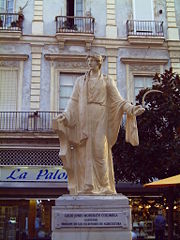
Columella
Lucius Junius Moderatus Columella is the most important writer on agriculture of the Roman empire. Little is known of his life. He was probably born in Gades , possibly of Roman parents. After a career in the army , he took up farming...
was 1st century AD writer whose De Re Rustica is considered one of the most important works on Roman agriculture
Roman agriculture
Agriculture in ancient Rome was not only a necessity, but was idealized among the social elite as a way of life. Cicero considered farming the best of all Roman occupations...
. The 12 volumes are written in prose with the exception of book 10 about gardens which is written in hexameter
Hexameter
Hexameter is a metrical line of verse consisting of six feet. It was the standard epic metre in classical Greek and Latin literature, such as in the Iliad and Aeneid. Its use in other genres of composition include Horace's satires, and Ovid's Metamorphoses. According to Greek mythology, hexameter...
verse. Columella's work delves into the technical aspects of Roman viticulture in the third and fourth books, including advice on which soil types yield the best wine. In the twelfth book, he deals with the various aspects of winemaking. One of the winemaking techniques that Columella described was the boiling of grape must in a lead
Lead
Lead is a main-group element in the carbon group with the symbol Pb and atomic number 82. Lead is a soft, malleable poor metal. It is also counted as one of the heavy metals. Metallic lead has a bluish-white color after being freshly cut, but it soon tarnishes to a dull grayish color when exposed...
vessel. In addition to the concentration of sugars through the reduction
Reduction (cooking)
In cooking, reduction is the process of thickening and intensifying the flavor of a liquid mixture such as a soup, sauce, wine, or juice by boiling....
of the grape must, the lead itself imparted a sweet taste and desirable texture to the wine. He laid out precise details on how a well run vineyard should operate from the optimum breakfast of slaves to the yield of grapes from each jugera
Jugerum
', jugera or ' was a Roman unit of measurement of area, 240 ft or 73 m in length and 120 ft or 37 m in breadth, containing therefore 28,800 square feet...
of land and the pruning practices to ensure those yields. Many modern elements of vine training and trellising can be seen in Columella's description of best practices. In his ideal vineyard, vines were planted two paces apart and fastened with willow
Willow
Willows, sallows, and osiers form the genus Salix, around 400 species of deciduous trees and shrubs, found primarily on moist soils in cold and temperate regions of the Northern Hemisphere...
withies to chestnut
Chestnut
Chestnut , some species called chinkapin or chinquapin, is a genus of eight or nine species of deciduous trees and shrubs in the beech family Fagaceae, native to temperate regions of the Northern Hemisphere. The name also refers to the edible nuts they produce.-Species:The chestnut belongs to the...
stakes that were about the height of a man. Columella also described some of the wines of Roman provinces, noting the potential of wines from Spain and the Bordeaux region. He also mentions the quality of wines made from the ancient grape varieties Balisca and Biturica which ampelographers believe are the ancestors of the Cabernet family.
Pliny the Elder
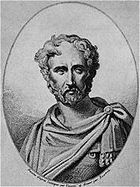
Pliny the Elder
Gaius Plinius Secundus , better known as Pliny the Elder, was a Roman author, naturalist, and natural philosopher, as well as naval and army commander of the early Roman Empire, and personal friend of the emperor Vespasian...
was a 1st century AD naturalist
Naturalist
Naturalist may refer to:* Practitioner of natural history* Conservationist* Advocate of naturalism * Naturalist , autobiography-See also:* The American Naturalist, periodical* Naturalism...
and author of the Roman encyclopedia
Encyclopedia
An encyclopedia is a type of reference work, a compendium holding a summary of information from either all branches of knowledge or a particular branch of knowledge....
Naturalis Historia (Natural History). The 37 books of Natural History was dedicated to the Emperor Titus
Titus
Titus , was Roman Emperor from 79 to 81. A member of the Flavian dynasty, Titus succeeded his father Vespasian upon his death, thus becoming the first Roman Emperor to come to the throne after his own father....
and published posthumously after Pliny's death near Pompeii following the eruption of Mount Vesuvius. While covering a vast array of topics, Natural History does give serious consideration to the topic of wine and viticulture. Book 14 deals exclusively with the subject of wine itself, including a ranking of a "first growths" of Rome. Book 17 includes a discussion of various viticultural techniques and an early formalization of the concept of terroir
Terroir
Terroir comes from the word terre "land". It was originally a French term in wine, coffee and tea used to denote the special characteristics that the geography, geology and climate of a certain place bestowed upon particular varieties...
in that unique places produces unique wine. In his rankings of the best Roman wines, Pliny concludes that the place has more influence on the resulting quality of wine than the particular grape vine. The early sections of Book 23 deals with some of the medicinal properties of wine. Pliny was a strong advocate for training vines up trees in a pergola
Pergola
A pergola, arbor or arbour is a garden feature forming a shaded walkway, passageway or sitting area of vertical posts or pillars that usually support cross-beams and a sturdy open lattice, often upon which woody vines are trained...
and noted that the finest wines in Campania
Campania
Campania is a region in southern Italy. The region has a population of around 5.8 million people, making it the second-most-populous region of Italy; its total area of 13,590 km² makes it the most densely populated region in the country...
all used this practice. Due to the dangers in working and pruning the vines high up in trees, Pliny recommended not using valuable slave labor but rather hired vineyard workers with a stipulation in their contract to pay for a grave and funeral expenses. He described some of the contemporary varieties noting that Aminean and Nomentan were the best. Ampelographers believe that two white wine varieties that he described, Arcelaca and Argitis, may be an early ancestor to the modern grape Riesling.
Pliny is also the source for one of the most famous Latin quotations about wine: in vino veritas
In vino veritas
In vino veritas is a Latin phrase that translates, “in wine [there is the] truth". It is also known as a Greek phrase “Ἐν οἴνῳ ἀλήθεια” En oino álétheia, which has the same meaning. The author of the Latin phrase is Pliny the Elder; the Greek phrase is attributed to the Greek poet Alcaeus.The Greek...
, or "there's truth in wine," referring to the often confessional loquacity produced by getting drunk.
Other writers
Marcus Terentius VarroMarcus Terentius Varro
Marcus Terentius Varro was an ancient Roman scholar and writer. He is sometimes called Varro Reatinus to distinguish him from his younger contemporary Varro Atacinus.-Biography:...
, whom the rhetoric
Rhetoric
Rhetoric is the art of discourse, an art that aims to improve the facility of speakers or writers who attempt to inform, persuade, or motivate particular audiences in specific situations. As a subject of formal study and a productive civic practice, rhetoric has played a central role in the Western...
ian Quintilian
Quintilian
Marcus Fabius Quintilianus was a Roman rhetorician from Hispania, widely referred to in medieval schools of rhetoric and in Renaissance writing...
called "the most learned man among the Romans", wrote extensively on topics including grammar, geography, religion, law and science, but only his agricultural treatise De re rustica (or Rerum rusticarum libri) has survived in its entirety. While there is evidence that he borrowed some of this material from Cato's work, Varro credits the lost multi-volume work of Mago the Carthaginian
Mago (agricultural writer)
Mago was a Carthaginian writer, author of an agricultural manual in Punic which was a record of the farming knowledge of Carthage. The Punic text has been lost, but some fragments of Greek and Latin translations survive....
, as well as the Greek writers Aristotle
Aristotle
Aristotle was a Greek philosopher and polymath, a student of Plato and teacher of Alexander the Great. His writings cover many subjects, including physics, metaphysics, poetry, theater, music, logic, rhetoric, linguistics, politics, government, ethics, biology, and zoology...
, Theophrastus
Theophrastus
Theophrastus , a Greek native of Eresos in Lesbos, was the successor to Aristotle in the Peripatetic school. He came to Athens at a young age, and initially studied in Plato's school. After Plato's death he attached himself to Aristotle. Aristotle bequeathed to Theophrastus his writings, and...
and Xenophon
Xenophon
Xenophon , son of Gryllus, of the deme Erchia of Athens, also known as Xenophon of Athens, was a Greek historian, soldier, mercenary, philosopher and a contemporary and admirer of Socrates...
. Varro's treatise is written as a dialogue
Dialogue
Dialogue is a literary and theatrical form consisting of a written or spoken conversational exchange between two or more people....
and divided into three parts, with the first part containing most of the discussion on wine and viticulture. In this work, Varro defines old wine as wine that is at least a year removed from its vintage. He notes that while some wines are best consumed young, especially fine wines like Falernian are meant to be consumed much older.
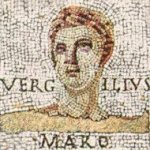
Virgil
Publius Vergilius Maro, usually called Virgil or Vergil in English , was an ancient Roman poet of the Augustan period. He is known for three major works of Latin literature, the Eclogues , the Georgics, and the epic Aeneid...
recalls that of the Greek poet Hesiod
Hesiod
Hesiod was a Greek oral poet generally thought by scholars to have been active between 750 and 650 BC, around the same time as Homer. His is the first European poetry in which the poet regards himself as a topic, an individual with a distinctive role to play. Ancient authors credited him and...
in focusing on the morality and virtue of viticulture, particularly the austerity, integrity and hard work of Roman farmers. The second book of the didactic poem Georgics
Georgics
The Georgics is a poem in four books, likely published in 29 BC. It is the second major work by the Latin poet Virgil, following his Eclogues and preceding the Aeneid. It is a poem that draws on many prior sources and influenced many later authors from antiquity to the present...
deals with viticultural matters. One notable bit of advice that Virgil imparted was the recommendation to leave some grapes on the vine till late November when they become "stiff with frost
Frost
Frost is the solid deposition of water vapor from saturated air. It is formed when solid surfaces are cooled to below the dew point of the adjacent air as well as below the freezing point of water. Frost crystals' size differ depending on time and water vapour available. Frost is also usually...
". This early version of ice wine
Ice wine
Ice wine is a type of dessert wine produced from grapes that have been frozen while still on the vine. The sugars and other dissolved solids do not freeze, but the water does, allowing a more concentrated grape must to be pressed from the frozen grapes, resulting in a smaller amount of more...
would have produced sweet wines without the acidity of wine made from grapes harvested too early.
Horace
Horace
Quintus Horatius Flaccus , known in the English-speaking world as Horace, was the leading Roman lyric poet during the time of Augustus.-Life:...
, the contemporary of Virgil, wrote often of wine, though no one single work of his is devoted entirely to the subject. Horace espoused an Epicurean
Epicureanism
Epicureanism is a system of philosophy based upon the teachings of Epicurus, founded around 307 BC. Epicurus was an atomic materialist, following in the steps of Democritus. His materialism led him to a general attack on superstition and divine intervention. Following Aristippus—about whom...
view of enjoying pleasure, including wine, in moderation
Moderation
Moderation is the process of eliminating or lessening extremes. It is used to ensure normality throughout the medium on which it is being conducted...
. Horace's poems are some of the earliest recorded examples of deliberately choosing a wine for a specific occasion. Examples recorded in his Odes included serving a wine from the birth-year vintage at a celebration of an honored guest, and serving simple wines for everyday occasion while saving celebrated wines like Caecuban to commemorate special events. Horace answered the question posed by the Alexandrian
Alexandrian
Alexandrian is either:* an adjective referring to a place called Alexandria, as in Alexandrian text-type* a person from and/or inhabiting a city called Alexandria...
poet Callimachus
Callimachus
Callimachus was a native of the Greek colony of Cyrene, Libya. He was a noted poet, critic and scholar at the Library of Alexandria and enjoyed the patronage of the Egyptian–Greek Pharaohs Ptolemy II Philadelphus and Ptolemy III Euergetes...
as to whether water or wine was the desired drink of poetic inspiration by enthusiastically siding with Cratinus
Cratinus
Cratinus , Athenian comic poet of the Old Comedy.-Life:Cratinus was victorious six times at the City Dionysia, first probably in the mid- to late 450s BCE , and three times at the Lenaia, first probably in the early 430s...
and the wine drinkers. Horace's affinity for wine was such that while contemplating his death, he expressed more dread at the thought of departing from his beloved wine cellar than from his wife.
Palladius
Rutilius Taurus Aemilianus Palladius
Rutilius Taurus Aemilianus Palladius, also known as Palladius Rutilius Taurus Aemilianus or just Palladius, was a Roman writer of the 4th century AD. He is principally known for his book on agriculture, Opus agriculturae, sometimes known as De re rustica.-Opus agriculturae:The Opus agriculturae is...
was a 4th century writer who composed a 15 volume treatise on agriculture known as Opus agriculturae or De Re Rustica. The first book was an introduction into basic farming principles with the proceeding 12 books dedicated to each month of the calendar year and the specific agricultural tasks that needed to be done in that month. While Palladius deals with a variety of agricultural crops, he spends more time discussing the practices of the vineyard than on any other subjects. The last two books deal with mostly veterinary medicine
Veterinary medicine
Veterinary Medicine is the branch of science that deals with the prevention, diagnosis and treatment of disease, disorder and injury in non-human animals...
for farm animals but does include a detail account of late Roman grafting
Grafting
Grafting is a horticultural technique whereby tissues from one plant are inserted into those of another so that the two sets of vascular tissues may join together. This vascular joining is called inosculation...
practices. Palladius work borrows heavily from Cato, Varro, Pliny and Columella but was one of the few Roman agricultural accounts to still be widely used through the Middle Ages
Middle Ages
The Middle Ages is a periodization of European history from the 5th century to the 15th century. The Middle Ages follows the fall of the Western Roman Empire in 476 and precedes the Early Modern Era. It is the middle period of a three-period division of Western history: Classic, Medieval and Modern...
and into the early Renaissance
Renaissance
The Renaissance was a cultural movement that spanned roughly the 14th to the 17th century, beginning in Italy in the Late Middle Ages and later spreading to the rest of Europe. The term is also used more loosely to refer to the historical era, but since the changes of the Renaissance were not...
period. His writings on viticulture were widely quoted by Vincent of Beauvais
Vincent of Beauvais
The Dominican friar Vincent of Beauvais wrote the Speculum Maius, the main encyclopedia that was used in the Middle Ages.-Early life:...
, Albertus Magnus
Albertus Magnus
Albertus Magnus, O.P. , also known as Albert the Great and Albert of Cologne, is a Catholic saint. He was a German Dominican friar and a bishop, who achieved fame for his comprehensive knowledge of and advocacy for the peaceful coexistence of science and religion. Those such as James A. Weisheipl...
and Pietro Crescenzi
Pietro Crescenzi
Pietro de' Crescenzi was an Italian jurist from Bologna, now known as a writer on agriculture. Educated at the University of Bologna in logic, medicine, the natural sciences and law, Crescenzi practiced as a lawyer and judge from about 1269 until 1299...
.
Roman winemaking
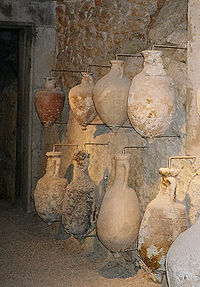
Harvest (wine)
The harvesting of wine grapes is one of the most crucial steps in the process of winemaking. The time of harvest is determined primarily by the ripeness of the grape as measured by sugar, acid and tannin levels with winemakers basing their decision to pick based on the style of wine they wish to...
. This treading was often done by feet in a manner similar to the French
French language
French is a Romance language spoken as a first language in France, the Romandy region in Switzerland, Wallonia and Brussels in Belgium, Monaco, the regions of Quebec and Acadia in Canada, and by various communities elsewhere. Second-language speakers of French are distributed throughout many parts...
pigeage. The juice that was obtained by treading was the most prized and kept separate from the juice that would come from pressing
Wine press
A wine press is a device used to extract juice from crushed grapes during wine making. There are a number of different styles of presses that are used by wine makers but their overall functionality is the same. Each style of press exerts controlled pressure in order to free the juice from the fruit...
the grape. This free run juice was also believed to have the most beneficial medicinal properties. Cato described the process of pressing as taking place in a special room which included an elevated concrete
Concrete
Concrete is a composite construction material, composed of cement and other cementitious materials such as fly ash and slag cement, aggregate , water and chemical admixtures.The word concrete comes from the Latin word...
platform that contained a shallow basin with raised curbs. The basin was shaped with gentle slopes that lead to a run off point. Across the basin was long horizontal beams of wood with the front of the beams being attached by rope to a windlass
Windlass
The windlass is an apparatus for moving heavy weights. Typically, a windlass consists of a horizontal cylinder , which is rotated by the turn of a crank or belt...
apparatus. The crushed grapes were placed between the beams with pressure being applied by winding down the windlass. The pressed juice would run down between the beams into the basin where it was collected. The construction and use of Roman wine presses was labour intensive and expensive. Its use was mostly confined to large estates with smaller wineries relying on the use of treading alone in obtaining grape juice.
If pressing was used, an estate would press the grape skins anywhere from one to three times. The juice that would come from later pressings would be coarser and more tannic with the juice from the third pressing normally being used to make the low quality wine piquette
Piquette
Piquette is a French wine term which commonly refers to a vinous beverage produced by adding water to grape pomace but sometimes refers to a very simple wine or a wine substitute.- Piquette from pomace :...
. After pressing, the grape must
Must
Must is freshly pressed fruit juice that contains the skins, seeds, and stems of the fruit. The solid portion of the must is called pomace; it typically makes up 7%–23% of the total weight of the must. Making must is the first step in winemaking...
was stored in large earthenware
Earthenware
Earthenware is a common ceramic material, which is used extensively for pottery tableware and decorative objects.-Types of earthenware:Although body formulations vary between countries and even between individual makers, a generic composition is 25% ball clay, 28% kaolin, 32% quartz, and 15%...
jars known as dolium. With a capacity up to several thousand liters, these jars were often partially buried into the floors of a barn or warehouse. In these jars fermentation
Fermentation (wine)
The process of fermentation in wine turns grape juice into an alcoholic beverage. During fermentation, yeast interact with sugars in the juice to create ethanol, commonly known as ethyl alcohol, and carbon dioxide...
would take place and would last anywhere from two weeks to 30 days before the wine would be removed and stored in amphora storage vessels. Small holes were drilled into the top to allow the pressure from carbon dioxide
Carbon dioxide
Carbon dioxide is a naturally occurring chemical compound composed of two oxygen atoms covalently bonded to a single carbon atom...
gas to escape. In the case of white wine production, the wine could be exposed to ageing on its lees
Lees (fermentation)
Lees refers to deposits of dead yeast or residual yeast and other particles that precipitate, or are carried by the action of "fining", to the bottom of a vat of wine after fermentation and ageing. The yeast deposits in beer brewing are known as trub...
which would enhance the flavor of the wine. Chalk
Chalk
Chalk is a soft, white, porous sedimentary rock, a form of limestone composed of the mineral calcite. Calcite is calcium carbonate or CaCO3. It forms under reasonably deep marine conditions from the gradual accumulation of minute calcite plates shed from micro-organisms called coccolithophores....
and marble
Marble
Marble is a metamorphic rock composed of recrystallized carbonate minerals, most commonly calcite or dolomite.Geologists use the term "marble" to refer to metamorphosed limestone; however stonemasons use the term more broadly to encompass unmetamorphosed limestone.Marble is commonly used for...
dust was sometimes added to lessen the "bite" or acidity in the wine. The wines were often exposed to high temperatures and "baked" in a manner similar to the process used to make the modern wine Madeira
Madeira wine
Madeira is a fortified Portuguese wine made in the Madeira Islands. Some wines produced in small quantities in California and Texas are also referred to as "Madeira", or "Madera", although those wines do not conform to the EU PDO regulations...
. To enhance sweetness in the wine, a portion of the must would be boiled to concentrate the sugars in process known as defrutum
Defrutum
Defrutum, carenum, and sapa were reductions of must used in Ancient Roman cuisine. They were made by boiling down grape juice or must in large kettles until it had been reduced to two-thirds the original volume, carenum;...
and then added with the rest of the fermenting batch. The writings of Columella suggest that the Romans believed that boiling the must also had preservation
Food preservation
Food preservation is the process of treating and handling food to stop or slow down spoilage and thus allow for longer storage....
benefits. Lead was also sometimes used as a sweetening agent. Other methods to enhance sweetness included the addition of honey
Honey
Honey is a sweet food made by bees using nectar from flowers. The variety produced by honey bees is the one most commonly referred to and is the type of honey collected by beekeepers and consumed by humans...
to the wine-with as much as 3 kilograms (6.6 lb) being recommended to sufficiently sweeten 12 litres (3.2 US gal) of wine to Roman tastes. Another technique developed was to withhold a portion of the sweeter unfermented must and then blend in with the finished wine—a method known today as süssreserve.
Wine styles
Sweetness of wine
The subjective sweetness of a wine is determined by the interaction of several factors, including the amount of sugar in the wine to be sure, but also the relative levels of alcohol, acids, and tannins. Briefly: sugars and alcohol enhance a wine's sweetness; acids and bitter tannins counteract it...
white wine was the most highly prized wine style. The wines were often very alcoholic, with Pliny noting that you could bring a candle flame to a cup of Falernian and it would catch fire. Because of this strength, the wines were often diluted with warm water and sometimes even salty seawater
Seawater
Seawater is water from a sea or ocean. On average, seawater in the world's oceans has a salinity of about 3.5% . This means that every kilogram of seawater has approximately of dissolved salts . The average density of seawater at the ocean surface is 1.025 g/ml...
. The ability to age was a desirable trait in Roman wines, with mature wines from older vintages (regardless of the vintage's overall quality) fetching higher prices than wine from the current vintage. Roman law
Roman law
Roman law is the legal system of ancient Rome, and the legal developments which occurred before the 7th century AD — when the Roman–Byzantine state adopted Greek as the language of government. The development of Roman law comprises more than a thousand years of jurisprudence — from the Twelve...
labeled the distinction between "old" wine and "new" as wine that has been aged for at least a year. Falernian was particularly prized for its aging ability being said to need at 10 years to mature but being at its best between 15–20 years. The white wine from Surrentine was said to need at least 25 years. As with Greek wine, Roman wine was often flavored with herb
Herb
Except in botanical usage, an herb is "any plant with leaves, seeds, or flowers used for flavoring, food, medicine, or perfume" or "a part of such a plant as used in cooking"...
s and spices (similar to modern Vermouth
Vermouth
Vermouth is a fortified wine flavored with various dry ingredients. The modern versions of the beverage were first produced around the late 18th and early 19th centuries in Italy and France...
and mulled wine
Mulled wine
Mulled wine, variations of which are popular in Europe, is wine, usually red, combined with spices and typically served warm. It is a traditional drink during winter, especially around Christmas and Halloween.-Glühwein:...
) and were sometimes stored in resin
Resin
Resin in the most specific use of the term is a hydrocarbon secretion of many plants, particularly coniferous trees. Resins are valued for their chemical properties and associated uses, such as the production of varnishes, adhesives, and food glazing agents; as an important source of raw materials...
coated containers which gave it a flavor similar to modern Retsina
Retsina
Retsina is a Greek white resinated wine that has been made for at least 2000 years. Its unique flavor is said to have originated from the practice of sealing wine vessels, particularly amphorae, with Aleppo Pine resin in ancient times. Before the invention of impermeable glass bottles, oxygen...
. The Romans were very keen on the aroma of wine
Aroma of wine
It is through the aromas of wine that wine is actually tasted. The human tongue is limited to the primary tastes perceived by taste receptors on the tongue-acidity, bitterness, saltiness, sweetness and umami. The wide array of fruit, earthy, floral, herbal, mineral and woodsy flavor perceived in...
and would experiment with different techniques in order to enhance a wine's bouquet. One technique that gained some usage in southern Gaul was planting herbs like lavender
Lavender
The lavenders are a genus of 39 species of flowering plants in the mint family, Lamiaceae. An Old World genus, distributed from Macaronesia across Africa, the Mediterranean, South-West Asia, Arabia, Western Iran and South-East India...
and thyme
Thyme
Thyme is a culinary and medicinal herb of the genus Thymus.-History:Ancient Egyptians used thyme for embalming. The ancient Greeks used it in their baths and burnt it as incense in their temples, believing it was a source of courage...
in the vineyards, believing that the flavors would transfer through the ground into the fruit of the grapevines. Modern Rhône wine often has the aroma descriptors of lavender and thyme as a reflection of the grape varieties used and terroir
Terroir
Terroir comes from the word terre "land". It was originally a French term in wine, coffee and tea used to denote the special characteristics that the geography, geology and climate of a certain place bestowed upon particular varieties...
. Another technique widely practiced was to store amphorae in a smoke chamber called fumarium
Fumarium
A Fumarium was a smoke chamber used in Ancient Rome to enhance the flavor of wine through artificially "aging" the wine. Amphorae were placed in the chamber, which was built on top of a heated hearth, in order to impart a smoky flavor in the wine that also seemed to sharpen the acidity. The wine...
to add smokiness to their flavour.
The term "wine" covered a broad spectrum of wine based drinks. The quality of the beverage depended on the amount of pure grape juice used to make the beverage and how diluted the wine was when it was served. The best quality wine was reserved for the upper classes of Rome. Below that was posca
Posca
Posca is a fictional character in the HBO/BBC2 original television series Rome, played by Nicholas Woodeson. He is the body slave of Julius Caesar, yet is also his friend, aide-de-camp, and confidante in most things personal and professional...
a mixture of water and sour wine that had not yet turned into vinegar
Vinegar
Vinegar is a liquid substance consisting mainly of acetic acid and water, the acetic acid being produced through the fermentation of ethanol by acetic acid bacteria. Commercial vinegar is produced either by fast or slow fermentation processes. Slow methods generally are used with traditional...
. This wine was less acidic than vinegar and still retained some of the aromas and texture of wine. It was the preferred wine to make up the rations of Roman's soldiers due to its low alcohol levels. The use of posca for soldier's rations was codified in the Corpus Juris Civilis
Corpus Juris Civilis
The Corpus Juris Civilis is the modern name for a collection of fundamental works in jurisprudence, issued from 529 to 534 by order of Justinian I, Eastern Roman Emperor...
and amounted to around a liter per day for each soldier. Still lower in quality was lora (modern day piquette) which was made by soaking the pomace
Pomace
Pomace , or marc , is the solid remains of grapes, olives, or other fruit after pressing for juice or oil. It contains the skins, pulp, seeds, and stems of the fruit....
of grape skins that have been pressed twice before in water for a day and pressing them for a third time. This was the style of wine that Cato and Varro recommended for their slaves. Both posca and lora would have been the most commonly available wine for the general Roman populace. These wines also probably would have been mostly red since white wine grapes would have been saved for the use of the upper class.
Grape varieties
The writings of Virgil, Pliny and Columella give the most details about the types of grape varieties used in the production of wine in the Roman empire. The grapes of the Roman empire were varied, with many varieties being lost to antiquity. While Virgil's writings often do not distinguish between a wine's name or the grape variety, he did make frequent mention of the Aminean grape variety which Pliny & Columella rank as the best wine grape in the empire. Pliny describes Aminean has having five sub-varieties that produce similar but distinct wines and claims the grape is native to the Italian peninsula. While Pliny claims that only DemocritusDemocritus
Democritus was an Ancient Greek philosopher born in Abdera, Thrace, Greece. He was an influential pre-Socratic philosopher and pupil of Leucippus, who formulated an atomic theory for the cosmos....
knew of every grape variety that exist, he does endeavor to speak with authority on the grapes that he believe are the only ones worthy of consideration. After Aminean, he describes the Nomentan as the second best wine producing grape followed by Apian and its two sub-varieties which were the preferred grape of Etruria
Etruria
Etruria—usually referred to in Greek and Latin source texts as Tyrrhenia—was a region of Central Italy, an area that covered part of what now are Tuscany, Latium, Emilia-Romagna, and Umbria. A particularly noteworthy work dealing with Etruscan locations is D. H...
. After these grapes, the only other grapes worthy of Pliny's consideration were Greek varieties including the Graecula grape used to make Chian wine
Chian wine
Chian wine is wine from the Greek island of Chios. It was among the most prized wines of classical antiquity, and, according to Theopompus and Greek mythology, was the first red wine, then called "black wine".-Greece:...
. Pliny says that the Eugenia grape has some promise but only if its planted in the Colli Albani region. Columella mentions many of the same grapes that Pliny does but notes that same grape produce different wines in different regions and maybe known under different names making it hard to track. He encourages vine growers to experiment with different plantings to find the best one that grows in their area. Ampelographers debate over the descriptions of grapes and what their modern counterpart or descendant maybe. The Allobrogica grape that was used to produce the Rhône wine of Vienne may have been an early ancestor of the Pinot
Pinot
-Grape varieties:* One of several grape varieties and associated wines** Pinot blanc ** Pinot gris ** Pinot meunier** Pinot noir...
family. Alternative theories state that it was more closely related to Petite Sirah or Mondeuse Noire
Mondeuse Noire
Mondeuse Noire is a red wine grape that is grown primarily in the Savoy region of France. The grape can also be found in Argentina, Australia, and California. The grape was hit hard during the phylloxera epidemic of the 19th century which nearly wiped out the vine from eastern France...
—two grapes that produce vastly different wines. The link between these two is the Mondeuse synonym of Grosse Syrah. The Rhaetic grape that Virgil praises is believed to be related to the modern Refosco
Refosco
Refosco is a very old Italian family of dark-skinned grape varieties native to the northern Italian areas of Friuli, Gavi, Trentino, Istria, and Karst Plateau. It is considered autochthonous in these regions....
grape of northeast Italy.
Wine in Roman culture
The early Roman culture viewed was sharply influenced by the ancient Greeks. Wine had religious, medicinal and societal implications that set it apart from other Roman cuisine. As Rome entered its golden age of winemaking and era of expansion, the "democratic" view of wine started to emerge in Roman culture with wine being viewed as a necessity for everyday life and not just a luxury meant to be enjoyed by a few. In Cato's time, he believed that even slaves should have a weekly ration of over a gallon (5 liters) of wine a week. However his reasons was more for the dietary health of the slaves and maintenance of their strength rather their personal enjoyment. Should a slave become sick and unavailable to work, Cato advises cutting his rations in half to conserve wine for the workforce. It was this view that led to widespread planting in order to serve the need of all classes. Part of this was due to the changing Roman diet. In the 2nd century BC, Romans started moving away from a diet that consisted of the moist porridgePorridge
Porridge is a dish made by boiling oats or other cereal meals in water, milk, or both. It is usually served hot in a bowl or dish...
and gruel
Gruel
Gruel is a food preparation consisting of some type of cereal—oat, wheat or rye flour, or rice—boiled in water or milk. It is a thinner version of porridge that may be more often drunk than eaten and need not even be cooked...
to more bread-based meals. Wine became a necessity to help in eating the drier bread.
Use by women

Ancient Greek comedy
Ancient Greek comedy was one of the final three principal dramatic forms in the theatre of classical Greece . Athenian comedy is conventionally divided into three periods, Old Comedy, Middle Comedy, and New Comedy...
and Roman comedies
Theatre of ancient Rome
The theatre of ancient Rome was a thriving and diverse art form, ranging from festival performances of street theatre, nude dancing, and acrobatics, to the staging of Plautus's broadly appealing situation comedies, to the high-style, verbally elaborate tragedies of Seneca...
, women were often portrayed as drunkards and more persuaded to commit various vice
Vice
Vice is a practice or a behavior or habit considered immoral, depraved, or degrading in the associated society. In more minor usage, vice can refer to a fault, a defect, an infirmity, or merely a bad habit. Synonyms for vice include fault, depravity, sin, iniquity, wickedness, and corruption...
s while under the influence. The poet Juvenal
Juvenal
The Satires are a collection of satirical poems by the Latin author Juvenal written in the late 1st and early 2nd centuries AD.Juvenal is credited with sixteen known poems divided among five books; all are in the Roman genre of satire, which, at its most basic in the time of the author, comprised a...
noted in his Satires that "When she is drunk, what matters to the Goddess of Love? She cannot tell her groin from her head." (6.300–301) Women were also the most noted participants in the cult of Bacchus, which the Roman Senate
Roman Senate
The Senate of the Roman Republic was a political institution in the ancient Roman Republic, however, it was not an elected body, but one whose members were appointed by the consuls, and later by the censors. After a magistrate served his term in office, it usually was followed with automatic...
outlawed in 186 BC for impropriety. Husbands were legally allowed to kill or divorce
Divorce
Divorce is the final termination of a marital union, canceling the legal duties and responsibilities of marriage and dissolving the bonds of matrimony between the parties...
their wives if they caught them committing such an offense. One Roman myth involved a man named Egnatius Mecenius beating his wife to death with a stick for drinking wine and being praised for his virtue by Romulus
Romulus
- People:* Romulus and Remus, the mythical founders of Rome* Romulus Augustulus, the last Western Roman Emperor* Valerius Romulus , deified son of the Roman emperor Maxentius* Romulus , son of the Western Roman emperor Anthemius...
himself. Another myth told the tale of a woman who was sentenced to starve to death by her family for opening the purse that contained the keys to the wine cellars. The last recorded divorce for this offense was granted in 194 BC, and during the 1st century BC attitudes turned more tolerant as wine came to be seen more as a dietary staple.
Medical uses
The Romans believed that wine had both healing and destructive powers. It could heal the mind from depressionDepression (mood)
Depression is a state of low mood and aversion to activity that can affect a person's thoughts, behaviour, feelings and physical well-being. Depressed people may feel sad, anxious, empty, hopeless, helpless, worthless, guilty, irritable, or restless...
, memory loss
Memory loss
Memory loss can be partial or total and it is normal when it comes with aging. Sudden memory loss is usually a result of brain trauma and it may be permanent or temporary. When it is caused by medical conditions such as Alzheimers, the memory loss is gradual and tends to be permanent.Brain trauma...
and grief
Grief
Grief is a multi-faceted response to loss, particularly to the loss of someone or something to which a bond was formed. Although conventionally focused on the emotional response to loss, it also has physical, cognitive, behavioral, social, and philosophical dimensions...
as well as the body from various ailments-including bloat
Bloat
Bloat is a medical condition in which the stomach becomes overstretched by excessive gas content. It is also commonly referred to as torsion, gastric torsion, and gastric dilatation-volvulus when the stomach is also twisted. The word bloat is often used as a general term to cover gas distension...
ing, constipation
Constipation
Constipation refers to bowel movements that are infrequent or hard to pass. Constipation is a common cause of painful defecation...
, diarrhea
Diarrhea
Diarrhea , also spelled diarrhoea, is the condition of having three or more loose or liquid bowel movements per day. It is a common cause of death in developing countries and the second most common cause of infant deaths worldwide. The loss of fluids through diarrhea can cause dehydration and...
, gout
Gout
Gout is a medical condition usually characterized by recurrent attacks of acute inflammatory arthritis—a red, tender, hot, swollen joint. The metatarsal-phalangeal joint at the base of the big toe is the most commonly affected . However, it may also present as tophi, kidney stones, or urate...
, halitosis
Halitosis
Halitosis is a term used to describe noticeably unpleasant odors exhaled in breathing. Halitosis is estimated to be the third most frequent reason for seeking dental aid, following tooth decay and periodontal disease.- General :...
, snakebite
Snakebite
A snakebite is an injury caused by a bite from a snake, often resulting in puncture wounds inflicted by the animal's fangs and sometimes resulting in envenomation. Although the majority of snake species are non-venomous and typically kill their prey with constriction rather than venom, venomous...
s, tapeworms, urinary problems and vertigo
Vertigo (medical)
Vertigo is a type of dizziness, where there is a feeling of motion when one is stationary. The symptoms are due to a dysfunction of the vestibular system in the inner ear...
. Cato wrote extensively on the medical uses of wine, including espousing a recipe for creating wine that could aid as laxative
Laxative
Laxatives are foods, compounds, or drugs taken to induce bowel movements or to loosen the stool, most often taken to treat constipation. Certain stimulant, lubricant, and saline laxatives are used to evacuate the colon for rectal and/or bowel examinations, and may be supplemented by enemas under...
by using grapes whose vines were treated to a mixture of ashes, manure
Manure
Manure is organic matter used as organic fertilizer in agriculture. Manures contribute to the fertility of the soil by adding organic matter and nutrients, such as nitrogen, that are trapped by bacteria in the soil...
and hellebore
Hellebore
Commonly known as hellebores, members of the genus Helleborus comprise approximately 20 species of herbaceous perennial flowering plants in the family Ranunculaceae, within which it gave its name to the tribe of Helleboreae...
. He wrote that the flowers of certain plants like juniper
Juniper
Junipers are coniferous plants in the genus Juniperus of the cypress family Cupressaceae. Depending on taxonomic viewpoint, there are between 50-67 species of juniper, widely distributed throughout the northern hemisphere, from the Arctic, south to tropical Africa in the Old World, and to the...
and myrtle could be soaked in wine to help with snakebites and gout. Cato believed that a mixture of old wine and juniper, boiled in a lead pot could aid in urinary issues and that mixing wines with very acidic pomegranate
Pomegranate
The pomegranate , Punica granatum, is a fruit-bearing deciduous shrub or small tree growing between five and eight meters tall.Native to the area of modern day Iran, the pomegranate has been cultivated in the Caucasus since ancient times. From there it spread to Asian areas such as the Caucasus as...
s would cure tapeworms.
The 2nd century AD Greco-Roman physician Galen
Galen
Aelius Galenus or Claudius Galenus , better known as Galen of Pergamon , was a prominent Roman physician, surgeon and philosopher...
provides several details about how wine was used medicinally in later Roman times. In Pergamon
Pergamon
Pergamon , or Pergamum, was an ancient Greek city in modern-day Turkey, in Mysia, today located from the Aegean Sea on a promontory on the north side of the river Caicus , that became the capital of the Kingdom of Pergamon during the Hellenistic period, under the Attalid dynasty, 281–133 BC...
, Galen was responsible for the diet and care of the gladiator
Gladiator
A gladiator was an armed combatant who entertained audiences in the Roman Republic and Roman Empire in violent confrontations with other gladiators, wild animals, and condemned criminals. Some gladiators were volunteers who risked their legal and social standing and their lives by appearing in the...
. He made liberal use of wine in his practice and boasted that not a single gladiator died in his care. For wounds, he would bath them in wine as an antiseptic
Antiseptic
Antiseptics are antimicrobial substances that are applied to living tissue/skin to reduce the possibility of infection, sepsis, or putrefaction...
. He would also use wine as analgesic
Analgesic
An analgesic is any member of the group of drugs used to relieve pain . The word analgesic derives from Greek an- and algos ....
for surgery. When Galen became the physician of Emperor Marcus Aurelius, he worked on developed pharmaceutical drugs and concoctions made from wine known as theriac
Theriac
Theriac or theriaca was a medical concoction originally formulated by the Greeks in the 1st century AD and became popular throughout the ancient world as far away as China and India via the trading links of the Silk Route...
s. The abilities of the these theriacs developed superstitious beliefs that lasted till the 18th century and revolved around their "miraculous" ability to protect against poisons and cure everything from the plague
Bubonic plague
Plague is a deadly infectious disease that is caused by the enterobacteria Yersinia pestis, named after the French-Swiss bacteriologist Alexandre Yersin. Primarily carried by rodents and spread to humans via fleas, the disease is notorious throughout history, due to the unrivaled scale of death...
to mouth sores. In his work De Antidotis, Galen notes the trend of Roman tastes from thick, sweet wines to lighter, dry wines that were easier to digest.
The Romans were also aware of the negative health affects from wine, particularly the tendency towards "madness" if consumed beyond moderation. Lucretius
Lucretius
Titus Lucretius Carus was a Roman poet and philosopher. His only known work is an epic philosophical poem laying out the beliefs of Epicureanism, De rerum natura, translated into English as On the Nature of Things or "On the Nature of the Universe".Virtually no details have come down concerning...
warned that wine could provoke a fury in one's soul and lead to quarrels. Seneca the Elder
Seneca the Elder
Lucius or Marcus Annaeus Seneca, known as Seneca the Elder and Seneca the Rhetorician , was a Roman rhetorician and writer, born of a wealthy equestrian family of Cordoba, Hispania...
believed that drinking wine magnified the physical and psychological defects in the drinker. Drinking wine in excess was frowned upon and those that did were considered dangerous to society. The Roman politician Cicero
Cicero
Marcus Tullius Cicero , was a Roman philosopher, statesman, lawyer, political theorist, and Roman constitutionalist. He came from a wealthy municipal family of the equestrian order, and is widely considered one of Rome's greatest orators and prose stylists.He introduced the Romans to the chief...
would frequently accuse his rivals of being drunkards and a danger to Rome—most notably Mark Antony
Mark Antony
Marcus Antonius , known in English as Mark Antony, was a Roman politician and general. As a military commander and administrator, he was an important supporter and loyal friend of his mother's cousin Julius Caesar...
who apparently once drank to such excess that he vomited
Vomiting
Vomiting is the forceful expulsion of the contents of one's stomach through the mouth and sometimes the nose...
in the Senate.
Religious uses
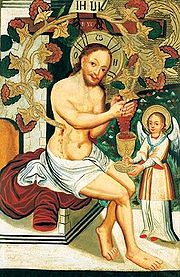
Bacchanalia
The bacchanalia were wild and mystic festivals of the Greco-Roman god Bacchus , the wine god. The term has since come to describe any form of drunken revelry.-History:...
festivals were believed to include animal sacrifice
Animal sacrifice
Animal sacrifice is the ritual killing of an animal as part of a religion. It is practised by many religions as a means of appeasing a god or gods or changing the course of nature...
s and sexual orgies. The Roman Senate viewed these gatherings as a threat against Roman authority, banning the cult and the Bacchanalia in 186 BC.
As Rome assimilated more cultures, they came across two religious groups that viewed wine in generally positive terms—Judaism
Judaism
Judaism ) is the "religion, philosophy, and way of life" of the Jewish people...
and Christianity
Christianity
Christianity is a monotheistic religion based on the life and teachings of Jesus as presented in canonical gospels and other New Testament writings...
. Wine, grapes and the grape make frequent literal and allegorical appearances in both the Hebrew and Christian Bible
Alcohol in the Bible
Alcoholic beverages appear repeatedly in biblical literature, from Noah planting a vineyard and becoming inebriated in the Hebrew Bible, to Jesus in the New Testament miraculously making copious amounts of wine at the marriage at Cana and later incorporating wine as part of the Eucharist...
. In the Torah
Torah
Torah- A scroll containing the first five books of the BibleThe Torah , is name given by Jews to the first five books of the bible—Genesis , Exodus , Leviticus , Numbers and Deuteronomy Torah- A scroll containing the first five books of the BibleThe Torah , is name given by Jews to the first five...
, grape vines were one of the first crops planted after the Great Flood and during the scouting of Canaan
Canaan
Canaan is a historical region roughly corresponding to modern-day Israel, Palestine, Lebanon, and the western parts of Jordan...
, following the Exodus
The Exodus
The Exodus is the story of the departure of the Israelites from ancient Egypt described in the Hebrew Bible.Narrowly defined, the term refers only to the departure from Egypt described in the Book of Exodus; more widely, it takes in the subsequent law-givings and wanderings in the wilderness...
from Egypt
Egypt
Egypt , officially the Arab Republic of Egypt, Arabic: , is a country mainly in North Africa, with the Sinai Peninsula forming a land bridge in Southwest Asia. Egypt is thus a transcontinental country, and a major power in Africa, the Mediterranean Basin, the Middle East and the Muslim world...
, one of the positive reports about the land was that grapevines were abundant. The Jews under Roman rule accepted wine as part of their daily life but viewed negatively the excesses that they associated with Roman impurities. Many of the Jewish views on wine were adopted by the new Christian sect that emerged in the 1st century AD. One of the first miracles that the sect's founder, Jesus
Jesus
Jesus of Nazareth , commonly referred to as Jesus Christ or simply as Jesus or Christ, is the central figure of Christianity...
, was reported to have done was to turn water into wine, and the central Christian sacrament of the Eucharist
Eucharist
The Eucharist , also called Holy Communion, the Sacrament of the Altar, the Blessed Sacrament, the Lord's Supper, and other names, is a Christian sacrament or ordinance...
prominently involved wine. The Romans drew some parallels between the similarities of Bacchus and the Christ of Christianity. Both figures had stories draped in the symbolism of life after death—Bacchus in the yearly harvest and dormancy of the grape and Christ in the death and resurrection
Death and Resurrection of Jesus
The Christian belief in the resurrection of Jesus states that Jesus returned to bodily life on the third day following his death by crucifixion. It is a key element of Christian faith and theology and part of the Nicene Creed: "On the third day he rose again in fulfillment of the Scriptures"...
narratives. The act of the Eucharist in consuming (either metaphysically
Metaphysics
Metaphysics is a branch of philosophy concerned with explaining the fundamental nature of being and the world, although the term is not easily defined. Traditionally, metaphysics attempts to answer two basic questions in the broadest possible terms:...
or metaphor
Metaphor
A metaphor is a literary figure of speech that uses an image, story or tangible thing to represent a less tangible thing or some intangible quality or idea; e.g., "Her eyes were glistening jewels." Metaphor may also be used for any rhetorical figures of speech that achieve their effects via...
ically) Christ by drinking the wine has echoes of rites carried out in festivals dedicated to Bacchus. The influence and importance of wine in the Christian church was unmistakable, and the Church itself would soon take the mantle from Ancient Rome as the dominant influence in the world of wine for the centuries that followed, through the Renaissance.