
All Topics  
Epicureanism


   Email Print
   Bookmark   Link


Epicureanism


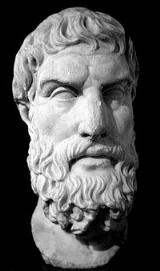
Epicureanism is a system of philosophy
Philosophy

Philosophy is the study of general problems concerning matters such as existence, knowledge, truth, beauty, justice, validity, mind, and language....
 based upon the teachings of Epicurus
Epicurus

Epicurus was an Greek philosophy and the founder of the school of philosophy called Epicureanism.Only a few fragments and letters remain of Epicurus's 300 written works....
 (c. 341–c. 270 BC), founded around 307 BC. Epicurus was an atomic
Atomism

In natural philosophy, atomism is the philosophical theses that was theoryzed by Leucippus in the fifth century BC. For it all the objects in the universe are composed of very small, indestructible building blocks ? atoms ....
 materialist
Materialism

The philosophy of materialism holds that the only thing that can be truly proven to existence is matter, and is considered a form of physicalism....
, following in the steps of Democritus
Democritus

Democritus was an Ancient Greek philosopher born in Abdera in the north of Greece. He was the most prolific, and ultimately the most influential, of the pre-Socratic philosophers; his atomic theory may be regarded as the culmination of early Greek thought....
. His materialism
Materialism

The philosophy of materialism holds that the only thing that can be truly proven to existence is matter, and is considered a form of physicalism....
 led him to a general attack on superstition and divine intervention. Following Aristippus
Aristippus

Aristippus of Cyrene, , was the founder of the Cyrenaics of Philosophy. He was a pupil of Socrates, but adopted a very different philosophical outlook, teaching that the goal of life was to seek pleasure by adapting circumstances to oneself by maintaining proper control over both adversity and prosperity....
—about whom very little is known—Epicurus believed that the greatest good was to seek modest pleasures in order to attain a state of tranquility and freedom from fear (ataraxia
Ataraxia

Ataraxia is a Ancient Greek term used by Pyrrho and Epicurus for a limpid state, characterized by freedom from worry or any other preoccupation....
) as well as absence of bodily pain (aponia
Aponia

Aponia, in Ancient Greek, means the absence of pain, and was regarded by the Epicureans to be the height of bodily pleasure.As with the other Hellenistic philosophy, the Epicureans believed that the goal of human life is happiness....
) through knowledge of the workings of the world and the limits of our desires.


Discussion
Ask a question about 'Epicureanism'
Start a new discussion about 'Epicureanism'
Answer questions from other users
Full Discussion Forum


Encyclopedia


Epicureanism is a system of philosophy
Philosophy

Philosophy is the study of general problems concerning matters such as existence, knowledge, truth, beauty, justice, validity, mind, and language....
 based upon the teachings of Epicurus
Epicurus

Epicurus was an Greek philosophy and the founder of the school of philosophy called Epicureanism.Only a few fragments and letters remain of Epicurus's 300 written works....
 (c. 341–c. 270 BC), founded around 307 BC. Epicurus was an atomic
Atomism

In natural philosophy, atomism is the philosophical theses that was theoryzed by Leucippus in the fifth century BC. For it all the objects in the universe are composed of very small, indestructible building blocks ? atoms ....
 materialist
Materialism

The philosophy of materialism holds that the only thing that can be truly proven to existence is matter, and is considered a form of physicalism....
, following in the steps of Democritus
Democritus

Democritus was an Ancient Greek philosopher born in Abdera in the north of Greece. He was the most prolific, and ultimately the most influential, of the pre-Socratic philosophers; his atomic theory may be regarded as the culmination of early Greek thought....
. His materialism
Materialism

The philosophy of materialism holds that the only thing that can be truly proven to existence is matter, and is considered a form of physicalism....
 led him to a general attack on superstition and divine intervention. Following Aristippus
Aristippus

Aristippus of Cyrene, , was the founder of the Cyrenaics of Philosophy. He was a pupil of Socrates, but adopted a very different philosophical outlook, teaching that the goal of life was to seek pleasure by adapting circumstances to oneself by maintaining proper control over both adversity and prosperity....
—about whom very little is known—Epicurus believed that the greatest good was to seek modest pleasures in order to attain a state of tranquility and freedom from fear (ataraxia
Ataraxia

Ataraxia is a Ancient Greek term used by Pyrrho and Epicurus for a limpid state, characterized by freedom from worry or any other preoccupation....
) as well as absence of bodily pain (aponia
Aponia

Aponia, in Ancient Greek, means the absence of pain, and was regarded by the Epicureans to be the height of bodily pleasure.As with the other Hellenistic philosophy, the Epicureans believed that the goal of human life is happiness....
) through knowledge of the workings of the world and the limits of our desires. The combination of these two states is supposed to constitute happiness in its highest form. Although Epicureanism is a form of hedonism
Hedonism

Hedonism is a school of philosophy which argues that pleasure has an intrinsic value and is the most important pursuit of humanity....
, insofar as it declares pleasure as the sole intrinsic good, its conception of absence of pain as the greatest pleasure and its advocacy of a simple life make it different from "hedonism" as it is commonly understood.

In the Epicurean view, the highest pleasure (tranquility and freedom from fear) was obtained by knowledge, friendship, and living a virtuous and temperate life. He lauded the enjoyment of simple pleasures, by which he meant abstaining from bodily desires, such as sex and appetites, verging on asceticism
Asceticism

Asceticism describes a life-style characterized by abstinence from various sorts of worldly pleasures often with the aim of pursuing religious and spirituality goals....
. He argued that when eating, one should not eat too richly, for it could lead to dissatisfaction later, such as the grim realization that one could not afford such delicacies in the future. Likewise, sex could lead to increased lust and dissatisfaction with the sexual partner. Epicurus did not articulate a broad system of social ethics that has survived.

Epicureanism was originally a challenge to Platonism
Platonism

Platonism is the philosophy of Plato or the name of other philosophical systems considered closely derived from it. In a narrower sense the term might indicate the doctrine of Platonic realism....
, though later it became the main opponent of Stoicism
Stoicism

Stoicism was a school of Hellenistic philosophy founded in Athens by Zeno of Citium in the early third century B.C. The stoics considered passionate emotions to be the result of errors in judgment, and that a Sage , or person of "moral and intellectual perfection," would not have such emotions....
. Epicurus and his followers shunned politics. After the death of Epicurus, his school was headed by Hermarchus; later many Epicurean societies flourished in the Late Hellenistic era and during the Roman era (such as those in Antioch
Antioch

Antioch on the Orontes was an ancient city on the eastern side of the Orontes River. It is near the modern city of Antakya, Turkey.Founded near the end of the 4th century BC by Seleucus I Nicator, one of Alexander the Great's generals, Antioch eventually rivaled Alexandria as the chief city of the nearer East and was a cradle of gentile hi...
ia, Alexandria
Alexandria

Alexandria , with a population of 4.1 million, is the second-largest city in Egypt, and is the country's largest seaport, serving about 80% of Egypt's imports and exports....
, Rhodes
Rhodes

Rhodes is a Greece List of islands of Greece approximately southwest of Turkey in eastern Aegean Sea. It is the largest of the Dodecanese islands in terms of both land area and population, with a population of 117,007 of which 53,709 resided in the Rhodes capital city of the island....
 and Ercolano
Ercolano

Ercolano is a town and commune in the province of Naples, Campania . It lies at the western foot of Mount Vesuvius, on the Gulf of Naples, just southeast of the city of Naples....
). The poet Lucretius
Lucretius

Titus Lucretius Carus was a Roman Republic poet and philosopher. His only known work is the epic philosophical poem on Epicureanism De rerum natura, translated into English as On the Nature of Things....
 is its most known Roman proponent. By the end of the Roman Empire it had all but died out, and would be resurrected in the 17th century by the atomist Pierre Gassendi
Pierre Gassendi

Pierre Gassendi was a France philosopher, Priesthood , scientist, astronomer, and mathematician. With a church position in south-east France, he also spent much time in Paris, where he was a leader of a group of free-thinking intellectuals....
, who adapted it to the Christian doctrine.

Some writings by Epicurus have survived. Some scholars consider the epic poem On the Nature of Things
On the Nature of Things

File:Rutherford atom.svgDe rerum natura is a first century BCE poem by the Roman Republic poet and philosopher Lucretius with the goal of explaining Epicurean philosophy to a Roman audience....
 by Lucretius
Lucretius

Titus Lucretius Carus was a Roman Republic poet and philosopher. His only known work is the epic philosophical poem on Epicureanism De rerum natura, translated into English as On the Nature of Things....
 to present in one unified work the core arguments and theories of Epicureanism. Many of the papyrus scrolls unearthed at the Villa of the Papyri
Villa of the Papyri

The Villa of the Papyri is a private house in the ancient Roman city of Herculaneum . Situated north-west of the township, the residence sits halfway up the slope of the volcano Vesuvius without other buildings to obstruct the view....
 at Herculaneum
Herculaneum

Herculaneum is an ancient Roman Empire town, located in the territory of the current commune of Ercolano. Its ruins can be found at the co-ordinates , in the Italy region of Campania....
 are Epicurean texts. At least some are thought to have belonged to the Epicurean Philodemus
Philodemus

Philodemus of Gadara was an Epicurean philosopher and poet. He studied under Zeno of Sidon in Athens, before moving to Rome, and then to Herculaneum....
.

History

The school of Epicurus
Epicurus

Epicurus was an Greek philosophy and the founder of the school of philosophy called Epicureanism.Only a few fragments and letters remain of Epicurus's 300 written works....
, called "The Garden," was based in Epicurus' home and garden. It had a small but devoted following in his lifetime. Its members included Hermarchus, Idomeneus
Idomeneus of Lampsacus

Idomeneus of Lampsacus was a friend and disciple of Epicurus, flourished about 310 BC-270 BC. We have no particulars of his life, save that he married Batis of Lampsacus, the sister of Metrodorus of Lampsacus ....
, Colotes
Colotes

Colotes of Lampsacus was a 3rd century BC hearer of Epicurus, and one of the most famous of his disciples. He wrote a work to prove That it is impossible even to live according to the doctrines of the other philosophers ....
, Polyaenus
Polyaenus of Lampsacus

Polyaenus of Lampsacus , son of Athenodorus, was an ancient Greek mathematician and a friend of Epicurus. His friendship with Epicurus started after the latter's escape from Mytilene in 307 or 306 BC when he opened a philosophical school at Lampsacus associating himself with other citizens of the town, like Pythocles, Colotes, and Idom...
, and Metrodorus. Epicurus emphasized friendship as an important ingredient of happiness, and the school seems to have been a moderately ascetic community which rejected the political limelight of Athenian philosophy. They were fairly cosmopolitan by Athenian standards, including women and slaves, and were probably vegetarians
Vegetarianism

File:Foods.jpgVegetarianism is the practice of a diet that excludes meat , fish and poultry.There are several variants of the diet, some of which also exclude egg and/or some products produced from animal labour such as dairy products and honey....
 (Stevenson 2005).

The school's popularity grew and it became, along with Stoicism
Stoicism

Stoicism was a school of Hellenistic philosophy founded in Athens by Zeno of Citium in the early third century B.C. The stoics considered passionate emotions to be the result of errors in judgment, and that a Sage , or person of "moral and intellectual perfection," would not have such emotions....
 and Skepticism
Skepticism

In ordinary usage, skepticism or scepticism refers to:* an attitude of doubt or a disposition to incredulity either in general or toward a particular object;...
, one of the three dominant schools of Hellenistic Philosophy, lasting strongly through the later Roman Empire
Roman Empire

The Roman Empire was the Roman Republic phase of the Ancient Rome, characterised by an autocracy form of government and large territorial holdings in Europe and around the Mediterranean....
. In Rome, Lucretius
Lucretius

Titus Lucretius Carus was a Roman Republic poet and philosopher. His only known work is the epic philosophical poem on Epicureanism De rerum natura, translated into English as On the Nature of Things....
 was the school's greatest proponent, composing On the Nature of Things
On the Nature of Things

File:Rutherford atom.svgDe rerum natura is a first century BCE poem by the Roman Republic poet and philosopher Lucretius with the goal of explaining Epicurean philosophy to a Roman audience....
, an epic poem, in six books, designed to recruit new members. The poem mainly deals with Epicurean philosophy of nature. Another major source of information is the Roman politician and amateur philosopher Cicero
Cicero

Marcus Tullius Cicero was a Ancient Rome philosopher, statesman, lawyer, political theorist, and Constitution of the Roman Republic. Cicero is widely considered one of Rome's greatest rhetoric and prose stylists....
, although he was highly critical, denouncing the Epicureans as unbridled hedonists
Hedonism

Hedonism is a school of philosophy which argues that pleasure has an intrinsic value and is the most important pursuit of humanity....
, devoid of a sense of virtue and duty, and guilty of withdrawing from public life. Another ancient source is Diogenes of Oenoanda
Diogenes of Oenoanda

Diogenes of Oenoanda was an Epicurean Greeks from the 2nd century AD who carved a summary of the philosophy of Epicurus onto a portico wall in the ancient city of Oenoanda in Lycia ....
, who composed a large inscription at Oenoanda
Oenoanda

Oenoanda or Oinoanda, in the upper valley of the Xanthus, was the most southerly of the tetrapolis led by Cibyra in the Hellenistic Period, which was dissolved by Murena in 84 BCE, whereupon Oenoanda became part of the Lycia#Lycian league, as its inscriptions abundantly demonstrate....
 in Lycia
Lycia

Lycia was a region in Anatolia in what are now the Provinces of Turkey of Antalya Province and Mugla Province on the southern coast of Turkey. It was a federation of ancient cities in the region and later a Roman province of the Roman Empire....
.

A library, dubbed the Villa of the Papyri
Villa of the Papyri

The Villa of the Papyri is a private house in the ancient Roman city of Herculaneum . Situated north-west of the township, the residence sits halfway up the slope of the volcano Vesuvius without other buildings to obstruct the view....
, in Herculaneum
Herculaneum

Herculaneum is an ancient Roman Empire town, located in the territory of the current commune of Ercolano. Its ruins can be found at the co-ordinates , in the Italy region of Campania....
, owned by Julius Caesar's
Julius Caesar

'Gaius Julius Caesar' , July 13, 100 BC ? March 15, 44 BC,) was a Roman Republic military and political leader. He played a critical role in the transformation of the Roman Republic into the Roman Empire....
 father-in-law, Lucius Calpurnius Piso Caesoninus
Lucius Calpurnius Piso Caesoninus

Lucius Calpurnius Piso Caesoninus was a statesman of ancient Rome and the father-in-law of Julius Caesar through his daughter Calpurnia Pisonis....
, was preserved by the eruption of Vesuvius in 79 CE, and was found to contain a large number of works by Philodemus
Philodemus

Philodemus of Gadara was an Epicurean philosopher and poet. He studied under Zeno of Sidon in Athens, before moving to Rome, and then to Herculaneum....
, a late Hellenistic Epicurean, and Epicurus himself, attesting to the school's enduring popularity. The task of unrolling and deciphering the charred papyrus
Papyrus

Papyrus is a thick paper material produced from the pith of the papyrus plant, Cyperus papyrus, a wetland Cyperaceae that was once abundant in the Nile Delta of Egypt....
 scrolls continues today.

After the official approval of Christianity
Christianity

Christianity is a Monotheistic religion #Christian view religion centered on the life and teachings of Jesus as New Testament view on Jesus' life....
 by Constantine, Epicureanism was repressed. Epicurus' materialist
Materialism

The philosophy of materialism holds that the only thing that can be truly proven to existence is matter, and is considered a form of physicalism....
 theories that the gods were physical beings composed of atoms who were unconcerned with human affairs and had not created the universe, and his general teaching that one's own pleasure, rather than service to God, was the greatest good were essentially irreconcilable with Christian teachings. The school endured a long period of obscurity and decline.

The early Christian writer Lactantius
Lactantius

Lucius Caelius Firmianus Lactantius was an early Christian author ....
 criticizes Epicurus at several points throughout his Divine Institutes. In Dante
DANTE

DANTE is a not-for-profit organisation that plans, builds and operates the international networks that interconnect the various National Research and Education Networks in Europe and surrounding regions....
's Divine Comedy
The Divine Comedy

The Divine Comedy , written by Dante Alighieri between 1308 and his death in 1321, is widely considered the central epic poem of Italian literature, and is seen as one of the greatest works of world literature....
, the Epicureans are depicted as heretics
Heresy

Heresy is an introduced change to some system of belief, especially a religion, that conflicts with the previously established canon of that belief....
 suffering in the sixth circle of hell
Hell

In many religious traditions, Hell is a place of suffering and punishment in the afterlife, often in the underworld. Religions with a linear Divinity history often depict Hell as endless ....
. The word for a heretic
Heresy

Heresy is an introduced change to some system of belief, especially a religion, that conflicts with the previously established canon of that belief....
 in the Talmud
Talmud

The Talmud is a record of rabbinic discussions pertaining to Halakha, Jewish ethics, customs, and history. It is a central text of mainstream Judaism....
ic literature is "Apiqoros" (????????), and Epicurus is titled in Modern Greek idiom as the "Dark Philosopher".

By the 16th century, the works of Lucretius and Diogenes Laertius were being printed in Europe. In the 17th century the French Franciscan priest, scientist and philosopher Pierre Gassendi
Pierre Gassendi

Pierre Gassendi was a France philosopher, Priesthood , scientist, astronomer, and mathematician. With a church position in south-east France, he also spent much time in Paris, where he was a leader of a group of free-thinking intellectuals....
 wrote two books forcefully reviving Epicureanism. Shortly thereafter, and clearly influenced by Gassendi, Walter Charleton
Walter Charleton

Walter Charleton was an English writer. According to Jon Parkin, he was "the main conduit for the transmission of Epicurean ideas to England"....
 published several works on Epicureanism in English. Attacks by Christians continued, most forcefully by the Cambridge Platonists
Cambridge Platonists

The Cambridge Platonists were a group of philosophers at University of Cambridge in the middle of the 17th century ....
.

In the following times, there was a resurgence of Epicurean philosophy: in the Modern Age, scientists adopted atomist
Atomism

In natural philosophy, atomism is the philosophical theses that was theoryzed by Leucippus in the fifth century BC. For it all the objects in the universe are composed of very small, indestructible building blocks ? atoms ....
 theories, while materialist
Materialism

The philosophy of materialism holds that the only thing that can be truly proven to existence is matter, and is considered a form of physicalism....
 philosophers embraced Epicurus' hedonist ethics and restated his objections to natural teleology
Teleology

Teleology is the philosophy study of design and purpose. A teleological school of thought is one that holds all things to be designed for or directed toward a final result, that there is an inherent purpose or final cause for all that exists....
.

Religion


Epicureanism emphasizes the neutrality of the gods, that they do not interfere with human lives. It states that gods, matter and souls are all comprised of atom
Atom

|-! bgcolor=gray | Properties|-||}The atom is a basic unit of matter consisting of a dense, central atomic nucleus surrounded by a electron cloud of electric charge electrons....
s. Souls are made from atoms, and gods possess souls, but their souls adhere to their bodies without escaping. Humans have the same kind of souls, but the forces binding human atoms together do not hold the soul forever. The Epicureans also used the atomist theories of Democritus
Democritus

Democritus was an Ancient Greek philosopher born in Abdera in the north of Greece. He was the most prolific, and ultimately the most influential, of the pre-Socratic philosophers; his atomic theory may be regarded as the culmination of early Greek thought....
 and Leucippus
Leucippus

Leucippus or Leukippos was the first to develop the theory of atomism ? the idea that everything is composed entirely of various imperishable, indivisible elements called atoms ? which was elaborated in far greater detail by his pupil and successor, Democritus....
 to assert that man has free will. They held that all thoughts are merely atoms swerving randomly. This explanation served to satisfy people who wondered anxiously about their role in the universe.

The Riddle of Epicurus or Epicurean paradox
Problem of evil

In the philosophy of religion and theology, the problem of evil is the problem of reconciling the existence of evil or suffering in the world with the existence of God....
 is the earliest known description of the Problem of evil
Problem of evil

In the philosophy of religion and theology, the problem of evil is the problem of reconciling the existence of evil or suffering in the world with the existence of God....
, and is a famous argument against the existence of an all-powerful and providential God or gods. As recorded by Lactantius
Lactantius

Lucius Caelius Firmianus Lactantius was an early Christian author ....
:
God either wants to eliminate bad things and cannot, or can but does not want to, or neither wishes to nor can, or both wants to and can. If he wants to and cannot, then he is weak - and this does not apply to god. If he can but does not want to, then he is spiteful - which is equally foreign to god's nature. If he neither wants to nor can, he is both weak and spiteful, and so not a god. If he wants to and can, which is the only thing fitting for a god, where then do bad things come from? Or why does he not eliminate them?


Epicurus did not, however, deny the existence of gods. Rather, he conceived the gods as blissful and immortal yet material beings made of atoms inhabiting the metakosmia
Metakosmia

The metakosmia , according to Epicurean philosophy were the relatively empty spaces in the infinite void where worlds had not been formed by the joining together of the atoms through their endless motion....
: empty spaces between worlds in the vastness of infinite space. In spite of his nominal recognition of the gods, the practical effect of this materialistic explanation of the gods' existence and their complete non-intervention in human affairs renders his philosophy akin in divine effects to the attitude of Deism
Deism

Deism is a religious and philosophical belief that a supreme natural God exists and created the physical universe, and that religious truths can be arrived at by the application of reason and observation of the natural world....
.

In Dante's Divine Comedy, the flaming tombs of the Epicureans are located within the sixth circle of hell (Inferno, Canto X). Similarly, according to Jewish Mishnah
Mishnah

The Mishnah or Mishna is a major work of Rabbinic literature, and the first major redaction into written form of Jewish oral traditions, called the Oral Torah....
, Epicureans (apiqorsim, people who share the beliefs of the movement) are among the people who do not have a share of the "World-to-Come" (afterlife or the world of the Messianic era).

Parallels may be drawn to Buddhism
Buddhism

Buddhism is a family of beliefs and practices considered by most to be a religionand is based on the teachings attributed to Siddhartha Gautama, commonly known as "The Buddha" , who was born in what is today Nepal....
, which similarly emphasizes a lack of divine interference and aspects of its atomism
Atomism

In natural philosophy, atomism is the philosophical theses that was theoryzed by Leucippus in the fifth century BC. For it all the objects in the universe are composed of very small, indestructible building blocks ? atoms ....
. Buddhism also resembles Epicureanism in its temperateness, including the belief that great excesses lead to great dissatisfaction.

The philosophy originated by Epicurus flourished for seven centuries. It propounded an ethic of individual pleasure as the sole or chief good in life. Hence, Epicurus advocated living in such a way as to derive the greatest amount of pleasure possible during one’s lifetime, yet doing so moderately in order to avoid the suffering incurred by overindulgence in such pleasure. The emphasis was placed on pleasures of the mind rather than on physical pleasures. Therefore, according to Epicurus, with whom a person eats is of greater importance than what is eaten. Unnecessary and, especially, artificially produced desires were to be suppressed. Since learning, culture, and civilization as well as social and political involvements could give rise to desires that are difficult to satisfy and thus result in disturbing one’s peace of mind, they were discouraged. Knowledge was sought only to rid oneself of religious fears and superstitions, the two primary fears to be eliminated being fear of the gods and of death. Viewing marriage and what attends it as a threat to one’s peace of mind, Epicurus lived a celibate life but did not impose this restriction on his followers.

The philosophy was characterized by an absence of divine principle. Lawbreaking was counseled against because of both the shame associated with detection and the punishment it might bring. Living in fear of being found out or punished would take away from pleasure, and this made even secret wrongdoing inadvisable. To the Epicureans, virtue in itself had no value and was beneficial only when it served as a means to gain happiness. Reciprocity was recommended, not because it was divinely ordered or innately noble, but because it was personally beneficial. Friendships rested on the same mutual basis, that is, the pleasure resulting to the possessors. Epicurus laid great emphasis on developing friendships as the basis of a satisfying life.

While the pursuit of pleasure formed the focal point of the philosophy, this was largely directed to the "static pleasures" of minimizing pain, anxiety and suffering. In fact Epicurus referred to life as a “bitter gift”.

The Epicureans believed in the existence of the gods, but believed that the gods were made of atoms just like everything else. It was thought that the gods were too far away from the earth to have any interest in what man was doing; so it did not do any good to pray or to sacrifice to them. The gods, they believed, did not create the universe, nor did they inflict punishment or bestow blessings on anyone, but they were supremely happy; this was the goal to strive for during one’s own human life.

Epicureanism rejects immortality and mysticism; it believes in the soul, but suggests that the soul is as mortal as the body. Epicurus rejected any possibility of an afterlife, while still contending that one need not fear death: "Death is nothing to us; for that which is dissolved, is without sensation, and that which lacks sensation is nothing to us." Bertrand Russell
Bertrand Russell

Bertrand Arthur William Russell, 3rd Earl Russell, Order of Merit , Fellow of the Royal Society , was a British people philosopher, mathematical logic, mathematician, historian, advocate for social reform, and pacifism....
 describes the reception of Epicureanism's conception of death:

Epicurean ethics

Epicurus was an early thinker to develop the notion of justice as a social contract. He defined justice as an agreement "neither to harm nor be harmed." The point of living in a society with laws and punishments is to be protected from harm so that one is free to pursue happiness. Because of this, laws that do not contribute to promoting human happiness are not just. He gave his own unique version of the Ethic of Reciprocity
Ethic of reciprocity

The ethic of reciprocity is an ethical code that states one has a right to just treatment, and a responsibility to ensure justice for others. Reciprocity is arguably the most essential basis for the modern concept of human rights, though it has its critics....
, which differs from other formulations by emphasizing minimizing harm and maximizing happiness for oneself and others:

It is impossible to live a pleasant life without living wisely and well and justly (agreeing 'neither to harm nor be harmed').
And it is impossible to live wisely and well and justly without living a pleasant life.


Epicureanism incorporated a relatively full account of the social contract
Social contract

Social contract describes a broad class of theories that try to explain the ways in which people form nations and maintain social order. The notion of the social contract implies that the people give up some rights to a government or other authority in order to receive or maintain social order....
 theory, following after a vague description of such a society in Plato
Plato

Plato , was a Classical Greece Greeks philosopher, mathematician, writer of philosophical dialogues, and founder of the Platonic Academy in Ancient Athens, the first institution of higher learning in the western world....
's Republic. The social contract theory established by Epicureanism is based on mutual agreement, not divine decree.

Epicurean physics

Epicurus' philosophy of the physical world is found in Letter to Herodotus: Diogenes Laertius 10.34-83.

If a limited form lives within an unlimited void, the form could only wander aimlessly about, because what is unlimited is ungraspable; meaning, the limited form would travel forever, for it does not have any obstacles. The void would have to be limited in quality and the form of an unlimited quality, for an unlimited form can oscillate and seemingly grasp—practically, but not literally—an unlimited number of spots within the limited void. So therefore all living things on Earth are unlimited, and the Earth on which they live and the universe around it, is limited. (Compare the concept of the finite universe
History of the Big Bang

The history of the Big Bang theory began with the Big Bang's development from observations and theoretical considerations. Much of the theoretical work in cosmology now involves extensions and refinements to the basic Big Bang theory....
 in modern cosmology
Cosmology

Cosmology is study of the Universe in its totality, and by extension, humanity's place in it. Though the word cosmology is recent , study of the Universe has a long history involving science, philosophy, esotericism, and religion....
.)

Forms can change, but not their inherent qualities, for change can only affect their shape. Some things can be changed and some things cannot be changed because forms that are unchangeable cannot be destroyed if certain attributes can be removed; for attributes not only have the intention of altering an unchangeable form, but also the inevitable possibility of becoming—in relation to the form’s disposition to its present environment—both an armor and a vulnerability to its stability.

Further proof that there are unchangeable forms and their inability to be destroyed, is the concept of the “non-evident.” A form cannot come into being from the void—which is nothing; it would be as if all forms come into being spontaneously, needless of reproduction. The implied meaning of “destroying” something is to undo its existence, to make it not there anymore, and this cannot be so: if the void is that which does not exist, and if this void is the implied destination of the destroyed, then the thing in reality cannot be destroyed, for the thing (and all things) could not have existed in the first place (as Lucretius said, ex nihilo nihil fit: nothing comes from nothing). This totality of forms is eternal and unchangeable. [Compare the modern Law of Conservation of Mass-Energy.]

Atoms move, in the appropriate way, constantly and for all time. [Compare the modern theory of particle physics
Particle physics

Particle physics is a branch of physics that studies the elementary particle constituents of matter and radiation, and the interactions between them....
.] Forms first come to us in images or “projections”--outlines of their true selves. For an image to be perceived by the human eye, the “atoms” of the image must cross a great distance at enormous speed and must not encounter any conflicting atoms along the way. [Compare the modern theory of light as being composed of subatomic particles called photons.] The presence of atomic resistance equal atomic slowness; whereas, if the path is deficient of atomic resistance, the traversal rate is much faster (and clearer). [Compare the modern concept of the speed of light
Speed of light

The speed of light in an free space is an important physical constant usually written as c, with a value of 299,792,458 metres per second....
 and refraction
Refraction

Refraction is the change in direction of a wave due to a change in its speed. This is most commonly observed when a wave passes from one optical medium to another....
.] Because of resistance, forms must be unlimited (unchangeable and able to grasp any point within the void) because, if they weren't, a form's image would not come from a single place, but fragmented and from several places. This confirms that a single form cannot be at multiple places at the same time. [Compare Heisenberg's Uncertainty Principle.]

And the senses warrant us other means of perception: hearing and smelling. As in the same way an image traverses through the air, the atoms of sound and smell traverse the same way. This perceptive experience is itself the flow of the moving atoms; and like the changeable and unchangeable forms, the form from which the flow traverses is shed and shattered into even smaller atoms, atoms of which still represent the original form, but they are slightly disconnected and of diverse magnitudes. This flow, like that of an echo, reverberates (off one's senses) and goes back to its start; meaning, one’s sensory perception happens in the coming, going, or arch, of the flow; and when the flow retreats back to its starting position, the atomic image is back together again [Compare the modern theory of sound
Sound

Sound is vibration transmitted through a solid, liquid, or gas, composed of frequencies within the range of hearing and of a threshold of hearing to be heard, or the sensation stimulated in organs of hearing by such vibrations....
.]: thus when one smells something one has the ability to see it too [because atoms reach the one who smells or sees from the object.]

And this leads to the question of how atomic speed and motion works. Epicurus says that there are two kinds of motion: the straight motion and the curved motion, and its motion traverse as fast as the speed of thought. [Compare the modern theory of the speed of light
Speed of light

The speed of light in an free space is an important physical constant usually written as c, with a value of 299,792,458 metres per second....
.]

Epicurus proposed the idea of 'the space between worlds' (metakosmia
Metakosmia

The metakosmia , according to Epicurean philosophy were the relatively empty spaces in the infinite void where worlds had not been formed by the joining together of the atoms through their endless motion....
) the relatively empty spaces in the infinite void where worlds had not been formed by the joining together of the atoms through their endless motion. [Compare the modern concepts of interstellar
Interstellar space

Interstellar space may mean:* In astronomy: all the space within a galaxy not occupied by star or their planetary systems. The interstellar medium resides ? by definition ? in interstellar space....
 and intergalactic space.]

Epicurean epistemology

Epicurean epistemology
Epistemology

Epistemology or theory of knowledge is the branch of philosophy concerned with the nature and scope of knowledge. It addresses the questions:...
 has three criteria of truth
Truth

semantic fields for the word truth extend from honesty, good faith, and sincerity in general, to agreement with fact or reality in particular....
: sensations (aesthêsis), preconceptions (prolepsis), and feelings (pathê). Prolepsis is sometimes translated as "basic grasp" but could also be described as "universal ideas": concepts that are understood by all. An example of prolepsis is the word "man" because every person has a preconceived notion of what a man is. Sensations or sense perception is knowledge that is received from the senses alone. Much like modern science, epicurean philosophy posits that empiricism
Empiricism

In philosophy, empiricism is a theory of knowledge which asserts that knowledge arises from experience. Empiricism is one of several competing views about how we know "things," part of the branch of philosophy called epistemology, or "theory of knowledge"....
 can be used to sort truth from falsehood. Feelings are more related to ethics than Epicurean physical theory. Feelings merely tell the individual what brings about pleasure and what brings about pain. This is important for the Epicurean because these are the basis for the entire Epicurean ethical doctrine.

According to Epicurus, the basic means for our understanding of things are the ‘sensations’ (aestheses), 'concepts' (prolepsis
Prolepsis

Prolepsis can be:#A figure of speech in which a future event is referred to in anticipation. For example, a character who is about to die might be described as "the dead man" before he is actually dead....
), ‘emotions’ (pathe) and the ‘focusing of thought into an impression’ (phantastikes epiboles tes dianoias).

Epicureans reject dialectic
Dialectic

Dialectic is a method of argument, which has been central to both Eastern and Western philosophy since ancient times. The word "dialectic" originates in Ancient Greece, and was made popular by Plato's Socratic dialogues....
 as confusing (parelkousa) because for the physical philosophers it is sufficient to use the correct words which refer to the concepts of the world. Epicurus then, in his work On the Canon, says that the criteria of truth are the senses, the preconceptions and the feelings. Epicureans add to these the focusing of thought into an impression. He himself is referring to those in his Epitome to Herodotus and in Principal Doctrines.

The senses are the first criterion of truth, since they create the first impressions and testify the existence of the external world. Sensory input is neither subjective nor deceitful, but the misunderstanding comes when the mind adds to or subtracts something from these impressions through our preconceived notions. Therefore, our sensory input alone cannot lead us to inaccuracy, only the concepts and opinions that come from our interpretations of our sensory input can. Therefore our sensory data is the only truly accurate thing which we have to rely for our understanding of the world around us.


The concepts are the categories which have formed mentally according to our sensory input, for example the concepts "man", "warm", and "sweet", etc. These concepts are directly related to memory and can be recalled at any time, only by the use of the respective word. (Compare the anthropological
Anthropology

Anthropology is the study of humans and humanity in its totality. Anthropology has origins in the natural sciences, and the humanities. In Great Britain it was originally divided into physical anthropology and cultural anthropology, which itself was divided into archaeology, technology, ethnology and sociology ....
 Sapir-Whorf hypothesis). Epicurus also calls them "the meanings that underlie the words" (hypotetagmena tois phthongois: semantic substance of the words) in his letter to Herodotus. The feelings or emotions (pathe) are related to the senses and the concepts. They are the inner impulses that make us feel like or dislike about certain external objects, which we perceive through the senses, and are associated with the preconceptions that are recalled.

Apart from these there is the assumption (hypolepsis), which is either the hypothesis or the opinion about something (matter or action), and which can be correct or incorrect. The assumptions are created by our sensations, concepts and emotions. Since they are produced automatically without any rational analysis and verification (see the modern idea of the subconscious
Subconscious

The term subconscious is used in many different contexts and has no single or precise definition. This greatly limits its significance as a meaning-bearing concept, and in consequence the word tends to be avoided in academic and scientific settings....
) of whether they are correct or not, they need to be confirmed (epimarteresis: confirmation), a process which must follow each assumption.

Referring to the "focusing of thought into an impression" or else "intuitive understandings of the mind", they are the impressions made on the mind that come from our sensations, concepts and emotions and form the basis of our assumptions and beliefs. All this unity (sensation – concept or category – emotion – focusing of thought into an impression) leads to the formation of a certain assumption or belief (hypolepsis). (Compare the modern anthropological
Anthropology

Anthropology is the study of humans and humanity in its totality. Anthropology has origins in the natural sciences, and the humanities. In Great Britain it was originally divided into physical anthropology and cultural anthropology, which itself was divided into archaeology, technology, ethnology and sociology ....
 concept of a "world view
World view

A comprehensive world view is a term calqued from the German language word Weltanschauung Welt is the German word for "world", and Anschauung is the German word for "view" or "outlook." It is a concept fundamental to German philosophy and epistemology and refers to a wide world perception....
".) Following the lead of Aristotle
Aristotle

Aristotle was a Greeks philosopher, a student of Plato and teacher of Alexander the Great. He wrote on many subjects, including physics, metaphysics, Poetics , theater, music, logic, rhetoric, politics, government, ethics, biology and zoology....
, Epicurus also refers to impressions in the form of mental images which are projected on the mind. The "correct use of impressions" was something adopted later by the Stoics. Our assumptions and beliefs have to be ’confirmed', which actually proves if our opinions are either accurate or inaccurate. This verification
Verification

selfref|For Wikipedia's verification policy see...
 and confirmation (epimarteresis) can only be done by means of the "evident reason" (henargeia), which means what is self-evident and obvious through our sensory input.

An example is when we see somebody approaching us, first through the sense of eyesight, we perceive that an object is coming closer to us, then through our preconceptions we understand that it is a human being, afterwards through that assumption we can recognize that he is someone we know, for example Theaetetus. This assumption is associated with pleasant or unpleasant emotions accompanied by the respective mental images and impressions (the focusing of our thoughts into an impression), which are related to our feelings toward each other. When he gets close to us, we can confirm (verify) that he is Socrates and not Theaetetus through the proof of our eyesight. Therefore, we have to use the same method to understand everything, even things which are not observable and obvious (adela, imperceptible), that is to say the confirmation through the evident reason (henargeia). In the same way we have to reduce (reductionism
Reductionism

Reductionism can either mean an approach to understanding the nature of complex things by reducing them to the interactions of their parts, or to simpler or more fundamental things or a philosophical position that a complex system is nothing but the sum of its parts, and that an account of it can be reduced to accounts of individual consti...
) each assumption and belief to something that can be proved through the self-evident reason (empirically verified). Verification theory
Verification theory

The verification theory is a Philosophy theory proposed by the Logical Positivism of the Vienna Circle. A simplified form of the theory states that a proposition's meaning is determined by the method through which it is Empiricism verified....
 and reductionism
Reductionism

Reductionism can either mean an approach to understanding the nature of complex things by reducing them to the interactions of their parts, or to simpler or more fundamental things or a philosophical position that a complex system is nothing but the sum of its parts, and that an account of it can be reduced to accounts of individual consti...
 have been adopted, as we know, by the modern philosophy of science
Philosophy of science

The philosophy of science is concerned with the assumptions, foundations, and implications of science. The field is defined by an interest in one of a set of "traditional" problems or an interest in central or foundational concerns in science....
. In this way, one can get rid of the incorrect assumptions and beliefs (bias
Bias

Bias is a term used to describe a tendency or preference towards a particular perspective , ideology or result, especially when the tendency interferes with the ability to be impartial, unprejudiced, or Objectivity ....
es) and finally settle on the real (confirmed) facts.

All the above mentioned criteria of knowledge form the basic principles of the [scientific] method, that Epicurus followed in order to find the truth. He described this method in his work On the Canon or On the Criteria.

(Based on excerpt from Epicurus' Gnoseology 'Handbook of Greek Philosophy: From Thales to the Stoics Analysis and Fragments', Nikolaos Bakalis, Trafford Publishing 2005, ISBN 1-4120-4843-5.

Tetrapharmakos


Tetrapharmakos, or "The four-part cure", is Epicurus' basic guideline as to how to live the happiest possible life. This poetic doctrine was handed down by an anonymous Epicurean who summed up Epicurus' philosophy on happiness in four simple lines:

Notable Epicureans

One of the earliest Roman
Ancient Rome

Ancient Rome was a civilization that grew out of a small agricultural community founded on the Italian Peninsula as early as the 10th century BC....
 writers espousing Epicureanism was Amafinius. Other adherents to the teachings of Epicurus included the poet Horace
Horace

This article is about the Roman poet Horace. For other uses, see Horace .Quintus Horatius Flaccus, , known in the English language world as Horace, was the leading Roman Empire Lyric poetry during the time of Augustus....
, whose famous statement Carpe Diem ("Seize the Day") illustrates the philosophy, as well as Lucretius
Lucretius

Titus Lucretius Carus was a Roman Republic poet and philosopher. His only known work is the epic philosophical poem on Epicureanism De rerum natura, translated into English as On the Nature of Things....
, as he showed in his De Rerum Natura. The poet Virgil
Virgil

Publius Vergilius Maro was a classical Roman poet, best known for three major works?the Bucolics , the Georgics and the Aeneid?although several Appendix Vergiliana are also attributed to him....
 was another prominent Epicurean (see Lucretius
Lucretius

Titus Lucretius Carus was a Roman Republic poet and philosopher. His only known work is the epic philosophical poem on Epicureanism De rerum natura, translated into English as On the Nature of Things....
 for further details).

Julius Caesar
Julius Caesar

'Gaius Julius Caesar' , July 13, 100 BC ? March 15, 44 BC,) was a Roman Republic military and political leader. He played a critical role in the transformation of the Roman Republic into the Roman Empire....
 leaned considerably toward Epicureanism and rejected the idea of an afterlife, which e.g. led to his plea against the death sentence during the trial against Catiline
Catiline

Lucius Sergius Catilina , known in English language as Catiline, was a Roman Republic politician of the 1st century BC who is best known for the Catiline conspiracy, an attempt to overthrow the Roman Republic, and in particular the power of the aristocratic Roman Senate....
, where he spoke out against the Stoic
STOIC

STOIC was a variant of Forth .It started out at the MIT and Harvard Biomedical Engineering Centre in Boston, and was written in February 1977 by Jonathan Sachs....
 Cato
Cato the Younger

File:Silver_denarius_of_Cato_47_46_BCE.jpgMarcus Porcius Cato Uticensis , known as Cato the Younger to distinguish him from his great-grandfather , was a politician and statesman in the late Roman Republic, and a follower of the Stoicism philosophy....
.

In modern times Thomas Jefferson
Thomas Jefferson

Thomas Jefferson was the List of Presidents of the United States President of the United States , the principal author of the United States Declaration of Independence , and one of the most influential Founding Fathers of the United States for his promotion of the ideals of republicanism in the United States....
 referred to himself as an Epicurean, and the preamble to the United States Declaration of Independence
United States Declaration of Independence

The United States Declaration of Independence is a statement adopted by the Second Continental Congress on July 4, 1776, which announced that the Thirteen Colonies then at war with Kingdom of Great Britain were now independent states, and thus no longer a part of the British Empire....
 demonstrates Epicurean influence by inalienable right of life, liberty, and the pursuit of happiness.

Other modern-day Epicureans were Gassendi
Gassendi

* Pierre Gassendi was a French philosopher, scientist and mathematician* Gassendi is a large crater on the Moon named after him...
, Walter Charleton
Walter Charleton

Walter Charleton was an English writer. According to Jon Parkin, he was "the main conduit for the transmission of Epicurean ideas to England"....
, François Bernier
François Bernier

Fran?ois Bernier was a French people physician and traveler, born at Jou?-Etiau /Anjou. For 12 years he was the personal physician of the Mughal Empire emperor Aurangzeb....
, Saint-Evremond, Ninon de l'Enclos
Ninon de l'Enclos

Anne "Ninon" de l'Enclos also spelled Ninon de Lenclos and Ninon de Lanclos was a France author, courtesan and patron of the arts. At the time of her death, in 1705, Louis de Rouvroy, duc de Saint-Simon primly summed up her career: "A shining example of the triumph of vice, when directed with intelligence and redeemed by a little vir...
, Diderot
Denis Diderot

Denis Diderot was a French philosopher and writer. He was a prominent figure during the Age of Enlightenment and is best known for serving as chief editor and contributor to the Encyclop?die....
, and Jeremy Bentham
Jeremy Bentham

Jeremy Bentham was an England jurist, philosopher, and legal and social reformer. He was the brother of Samuel Bentham. He was a political radical, and a leading theorist in Anglo-American philosophy of law....
. Christopher Hitchens
Christopher Hitchens

Christopher Eric Hitchens is a United Kingdom-born, United Kingdom and United States author, journalist and literary critic. Currently living in Washington, D.C., he has been a columnist at Vanity Fair magazine, The Atlantic, World Affairs , The Nation , Slate , Free Inquiry, and a variety of other media outlets....
 has referred to himself as an Epicurean.

The teachings of Epicurus are still followed by students at Homerton College, Cambridge
Homerton College, Cambridge

Homerton College is one of the constituent colleges of the University of Cambridge. It has a long and complex history dating back to the 17th century....
, who have named a successful social society after him: "The Epicureans". They describe themselves as a select group of men devoted to the pursuit of sensual pleasure.

Anton LaVey
Anton LaVey

Anton Szandor LaVey, born Howard Stanton Levey, was the United States founder and High Priest of the Church of Satan as well as a writer, occultist, and musician....
, the author of The Satanic Bible, as well as a variety of other tomes, and founder of LaVeyan Satanism
LaVeyan Satanism

LaVeyan Satanism is a religion founded in 1966 by Anton Szandor LaVey. Its teachings are based on individualism, hedonism, and "eye for an eye" morality, borrowing philosophically from Friedrich Nietzsche and Ayn Rand, and drawing from the rituals and ceremonies of occultist Aleister Crowley....
, has been widely hailed as creating an "Epicurean" philosophy. But this is a greatly false view due to misinterpretation of Epicurean philosophy which is based on humanistic and friendly values more related to Utilitarianism ("happiness for all") and not on egoistic and vulgar values of Satanism.

Modern usage and misconceptions


In modern popular usage, an epicure is a connoisseur of the arts of life and the refinements of sensual pleasures; epicureanism implies a love or knowledgeable enjoyment especially of good food and drink—see the definition of gourmet at Wiktionary.

This can be attributed to a misunderstanding of the Epicurean doctrine, as promulgated by Christian polemicists. Because Epicureanism posits that pleasure is the ultimate good (telos), it is commonly misunderstood as a doctrine that advocates the partaking in fleeting pleasures such as constant partying, sexual excess and decadent food. This is not the case. Epicurus regarded ataraxia
Ataraxia

Ataraxia is a Ancient Greek term used by Pyrrho and Epicurus for a limpid state, characterized by freedom from worry or any other preoccupation....
 (tranquility, freedom from fear) and aponia
Aponia

Aponia, in Ancient Greek, means the absence of pain, and was regarded by the Epicureans to be the height of bodily pleasure.As with the other Hellenistic philosophy, the Epicureans believed that the goal of human life is happiness....
 (absence of pain) as the height of happiness. He also considered prudence an important virtue and perceived excess and overindulgence to be contrary to the attainment of ataraxia and aponia.

Possible relationship to "Apiqoros" in Judaism

In the Jewish exegetical tradition, the word "Apiqoros" (????????) appears in Rabbinical literature as a reference to those who lack religion or are ostensibly atheistic. Its origins are uncertain, but it may have originally referred specifically to the Epicurean philosophy, although it eventually came to refer to any philosophy lacking a God or a spiritually based morality. It is also occasionally used to describe heretic principles or heretics themselves. The word is still used in modern Hebrew, mainly among religious Jews.

External links


Further reading

  • Zeller, Eduard
    Eduard Zeller

    Eduard Gottlob Zeller , was a Germans philosopher and Theology of the T?bingen School of theology....
    ; Reichel, Oswald J., , Longmans, Green, and Co., 1892