
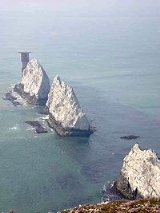
Chalk is a soft, white, porous
sedimentary rockSedimentary rock are types of rock that are formed by the deposition of material at the Earth's surface and within bodies of water. Sedimentation is the collective name for processes that cause mineral and/or organic particles to settle and accumulate or minerals to precipitate from a solution....
, a form of
limestoneLimestone is a sedimentary rock composed largely of the minerals calcite and aragonite, which are different crystal forms of calcium carbonate . Many limestones are composed from skeletal fragments of marine organisms such as coral or foraminifera....
composed of the
mineralA mineral is a naturally occurring solid chemical substance formed through biogeochemical processes, having characteristic chemical composition, highly ordered atomic structure, and specific physical properties. By comparison, a rock is an aggregate of minerals and/or mineraloids and does not...
calciteCalcite is a carbonate mineral and the most stable polymorph of calcium carbonate . The other polymorphs are the minerals aragonite and vaterite. Aragonite will change to calcite at 380-470°C, and vaterite is even less stable.-Properties:...
. Calcite is
calcium carbonateCalcium carbonate is a chemical compound with the formula CaCO3. It is a common substance found in rocks in all parts of the world, and is the main component of shells of marine organisms, snails, coal balls, pearls, and eggshells. Calcium carbonate is the active ingredient in agricultural lime,...
or CaCO
3. It forms under reasonably deep marine conditions from the gradual accumulation of minute
calciteCalcite is a carbonate mineral and the most stable polymorph of calcium carbonate . The other polymorphs are the minerals aragonite and vaterite. Aragonite will change to calcite at 380-470°C, and vaterite is even less stable.-Properties:...
plates (coccoliths) shed from micro-organisms called coccolithophores. It is common to find
chertChert is a fine-grained silica-rich microcrystalline, cryptocrystalline or microfibrous sedimentary rock that may contain small fossils. It varies greatly in color , but most often manifests as gray, brown, grayish brown and light green to rusty red; its color is an expression of trace elements...
or
flintFlint is a hard, sedimentary cryptocrystalline form of the mineral quartz, categorized as a variety of chert. It occurs chiefly as nodules and masses in sedimentary rocks, such as chalks and limestones. Inside the nodule, flint is usually dark grey, black, green, white, or brown in colour, and...
nodules embedded in chalk. Chalk can also refer to other compounds including magnesium silicate and
calcium sulfateCalcium sulfate is a common laboratory and industrial chemical. In the form of γ-anhydrite , it is used as a desiccant. It is also used as a coagulant in products like tofu. In the natural state, unrefined calcium sulfate is a translucent, crystalline white rock...
.
Chalk is more resistant to
weatheringWeathering is the breaking down of rocks, soils and minerals as well as artificial materials through contact with the Earth's atmosphere, biota and waters...
and slumping than the
clayClay is a general term including many combinations of one or more clay minerals with traces of metal oxides and organic matter. Geologic clay deposits are mostly composed of phyllosilicate minerals containing variable amounts of water trapped in the mineral structure.- Formation :Clay minerals...
s with which it is usually associated, thus forming tall steep
cliffIn geography and geology, a cliff is a significant vertical, or near vertical, rock exposure. Cliffs are formed as erosion landforms due to the processes of erosion and weathering that produce them. Cliffs are common on coasts, in mountainous areas, escarpments and along rivers. Cliffs are usually...
s where chalk ridges meet the sea. Chalk
hillA hill is a landform that extends above the surrounding terrain. Hills often have a distinct summit, although in areas with scarp/dip topography a hill may refer to a particular section of flat terrain without a massive summit A hill is a landform that extends above the surrounding terrain. Hills...
s, known as chalk
downlandA downland is an area of open chalk hills. This term is especially used to describe the chalk countryside in southern England. Areas of downland are often referred to as Downs....
, usually form where bands of chalk reach the surface at an angle, so forming a
scarpAn escarpment is a steep slope or long cliff that occurs from erosion or faulting and separates two relatively level areas of differing elevations.-Description and variants:...
slope. Because chalk is porous it can hold a large volume of ground water, providing a natural reservoir that releases water slowly through dry seasons.
Deposits
The Chalk Group is a
EuropeEurope is, by convention, one of the world's seven continents. Comprising the westernmost peninsula of Eurasia, Europe is generally 'divided' from Asia to its east by the watershed divides of the Ural and Caucasus Mountains, the Ural River, the Caspian and Black Seas, and the waterways connecting...
an stratigraphic unit deposited during the late
CretaceousThe Cretaceous , derived from the Latin "creta" , usually abbreviated K for its German translation Kreide , is a geologic period and system from circa to million years ago. In the geologic timescale, the Cretaceous follows the Jurassic period and is followed by the Paleogene period of the...
Period. It forms the famous
White Cliffs of DoverThe White Cliffs of Dover are cliffs which form part of the British coastline facing the Strait of Dover and France. The cliffs are part of the North Downs formation. The cliff face, which reaches up to , owes its striking façade to its composition of chalk accentuated by streaks of black flint...
in
KentKent is a county in southeast England, and is one of the home counties. It borders East Sussex, Surrey and Greater London and has a defined boundary with Essex in the middle of the Thames Estuary. The ceremonial county boundaries of Kent include the shire county of Kent and the unitary borough of...
, England, as well as their counterparts of the
Cap Blanc NezCap Blanc Nez is a cape on the Côte d'Opale, in the Pas-de-Calais département, in northern France. The cliffs of chalk are very similar to the white cliffs of Dover at the other side of the Channel in England...
on the other side of the Dover Strait. The Champagne region of France is mostly underlain by chalk deposits, which contain artificial caves used for wine storage. Some of the highest chalk cliffs in the world occur at
Møns KlintMøns Klint, , is a striking landmark and tourist attraction along the eastern coast of the Danish island of Møn in the Baltic Sea. The bright chalk cliffs stretch some 6 km from the park of in the north to the in the south. Some of the cliffs fall a sheer 120 m to the sea below...
in
DenmarkDenmark is a Scandinavian country in Northern Europe. The countries of Denmark and Greenland, as well as the Faroe Islands, constitute the Kingdom of Denmark . It is the southernmost of the Nordic countries, southwest of Sweden and south of Norway, and bordered to the south by Germany. Denmark...
.
Formation
Ninety million years ago the chalk downland of Northern Europe was ooze accumulating at the bottom of a great sea. Protozoans such as
foraminiferaThe Foraminifera , or forams for short, are a large group of amoeboid protists which are among the commonest plankton species. They have reticulating pseudopods, fine strands of cytoplasm that branch and merge to form a dynamic net...
lived on the marine debris that showered down from the upper layers of the ocean. Their shells were made of calcite extracted from the rich sea-water. As they died a deep layer gradually built up and eventually, through the weight of overlying sediments, became consolidated into rock. Later earth movements related to the formation of the Alps raised these former sea-floor deposits above sea level.
Composition
Chalk is composed mostly of
calcium carbonateCalcium carbonate is a chemical compound with the formula CaCO3. It is a common substance found in rocks in all parts of the world, and is the main component of shells of marine organisms, snails, coal balls, pearls, and eggshells. Calcium carbonate is the active ingredient in agricultural lime,...
with minor amounts of
siltSilt is granular material of a size somewhere between sand and clay whose mineral origin is quartz and feldspar. Silt may occur as a soil or as suspended sediment in a surface water body...
and
clayClay minerals are hydrous aluminium phyllosilicates, sometimes with variable amounts of iron, magnesium, alkali metals, alkaline earths, and other cations. Clays have structures similar to the micas and therefore form flat hexagonal sheets. Clay minerals are common weathering products and low...
. It is normally formed underwater, commonly on the sea bed, then consolidated and compressed during
diagenesisIn geology and oceanography, diagenesis is any chemical, physical, or biological change undergone by a sediment after its initial deposition and during and after its lithification, exclusive of surface alteration and metamorphism. These changes happen at relatively low temperatures and pressures...
into the form commonly seen today. During diagenesis silica accumulates to form
chertChert is a fine-grained silica-rich microcrystalline, cryptocrystalline or microfibrous sedimentary rock that may contain small fossils. It varies greatly in color , but most often manifests as gray, brown, grayish brown and light green to rusty red; its color is an expression of trace elements...
or
flintFlint is a hard, sedimentary cryptocrystalline form of the mineral quartz, categorized as a variety of chert. It occurs chiefly as nodules and masses in sedimentary rocks, such as chalks and limestones. Inside the nodule, flint is usually dark grey, black, green, white, or brown in colour, and...
nodulesA nodule in petrology or mineralogy is a secondary structure, generally spherical or irregularly rounded in shape. Nodules are typically solid replacement bodies of chert or iron oxides formed during diagenesis of a sedimentary rock...
within the
carbonate rockCarbonate rocks are a class of sedimentary rocks composed primarily of carbonate minerals. The two major types are limestone, which is composed of calcite or aragonite and dolostone, which is composed of the mineral dolomite .Calcite can be either dissolved by groundwater or precipitated by...
.
Uses
Chalk is used to make quicklime and slaked lime, mainly used as
lime mortarLime mortar is a type of mortar composed of lime and an aggregate such as sand, mixed with water. It is one of the oldest known types of mortar, dating back to the 4th century BC and widely used in Ancient Rome and Greece, when it largely replaced the clay and gypsum mortars common to Ancient...
in buildings. In southeast England,
DeneholeA Denehole is an underground structure consisting of a number of small chalk caves entered by a vertical shaft. The name is given to certain caves or excavations in England, which have been popularly supposed to be due to the Danes or some other of the early northern invaders of the country...
s are a notable example of ancient chalk pits. Such
bell pitA bell pit is a primitive method of mining coal, iron ore or other minerals where the coal or ore lies near the surface.. A shaft is sunk to reach the mineral which is excavated by miners transported to the surface by a winch and removed by means of a bucket, much like a well. It gets its name...
s may also mark the sites of ancient flint mines, where the prime object was to remove
flintFlint is a hard, sedimentary cryptocrystalline form of the mineral quartz, categorized as a variety of chert. It occurs chiefly as nodules and masses in sedimentary rocks, such as chalks and limestones. Inside the nodule, flint is usually dark grey, black, green, white, or brown in colour, and...
nodulesA nodule in petrology or mineralogy is a secondary structure, generally spherical or irregularly rounded in shape. Nodules are typically solid replacement bodies of chert or iron oxides formed during diagenesis of a sedimentary rock...
for
stone toolA stone tool is, in the most general sense, any tool made either partially or entirely out of stone. Although stone tool-dependent societies and cultures still exist today, most stone tools are associated with prehistoric, particularly Stone Age cultures that have become extinct...
manufacture. The surface remains at
CissburyCissbury is the name of a prehistoric site near the village of Findon around 5 miles north of Worthing in the English county of West Sussex. The site is managed by the National Trust....
are one such example, but perhaps the most famous is the extensive complex at
Grimes GravesGrime's Graves is a large Neolithic flint mining complex near Brandon in England close to the border between Norfolk and Suffolk. It was worked between around circa 3000 BC and circa 1900 BC, although production may have continued well into the Bronze and Iron Ages owing to the low cost of flint...
in
NorfolkNorfolk is a low-lying county in the East of England. It has borders with Lincolnshire to the west, Cambridgeshire to the west and southwest and Suffolk to the south. Its northern and eastern boundaries are the North Sea coast and to the north-west the county is bordered by The Wash. The county...
.
The traditional uses of chalk have in some cases been replaced by other substances, although the word "chalk" is often still applied to the usual replacements.
- Blackboard chalk
A chalkboard or blackboard is a reusable writing surface on which text or drawings are made with sticks of calcium sulfate or calcium carbonate, known, when used for this purpose, as chalk. Chalkboards were originally made of smooth, thin sheets of black or dark grey slate stone...
is a substance used for drawing on rough surfaces, as it readily crumbles leaving particles that stick loosely to these surfaces. Although traditionally composed of natural chalk, modern blackboard chalk is generally made from the mineral gypsumGypsum is a very soft sulfate mineral composed of calcium sulfate dihydrate, with the chemical formula CaSO4·2H2O. It is found in alabaster, a decorative stone used in Ancient Egypt. It is the second softest mineral on the Mohs Hardness Scale...
(calcium sulfateCalcium sulfate is a common laboratory and industrial chemical. In the form of γ-anhydrite , it is used as a desiccant. It is also used as a coagulant in products like tofu. In the natural state, unrefined calcium sulfate is a translucent, crystalline white rock...
), often supplied in sticks of compressed powder about 4 in (10 cm) long.
- Sidewalk chalk
Sidewalk chalk are typically large colored sticks of calcium sulfate mostly used for drawing on pavement or cement sidewalk. It is sometimes used to draw a four square court or a hopscotch board.-Use:...
is similar to blackboard chalk, except that it is formed into larger sticks and often colored. It is used to draw on sidewalks, streets, and driveways, mostly by children, but also by adult artists.
- In agriculture
Agriculture is the cultivation of animals, plants, fungi and other life forms for food, fiber, and other products used to sustain life. Agriculture was the key implement in the rise of sedentary human civilization, whereby farming of domesticated species created food surpluses that nurtured the...
chalk is used for raising pHIn chemistry, pH is a measure of the acidity or basicity of an aqueous solution. Pure water is said to be neutral, with a pH close to 7.0 at . Solutions with a pH less than 7 are said to be acidic and solutions with a pH greater than 7 are basic or alkaline...
in soils with high acidity. The most common forms are CaCO3 (calcium carbonateCalcium carbonate is a chemical compound with the formula CaCO3. It is a common substance found in rocks in all parts of the world, and is the main component of shells of marine organisms, snails, coal balls, pearls, and eggshells. Calcium carbonate is the active ingredient in agricultural lime,...
) and CaO (calcium oxideCalcium oxide , commonly known as quicklime or burnt lime, is a widely used chemical compound. It is a white, caustic, alkaline crystalline solid at room temperature....
).
- In field sports, including grass tennis courts, powdered chalk was used to mark the boundary lines of the playing field or court. This gives the advantage that, if the ball hits the line, a cloud of chalk or pigment dust can be seen. Nowadays the substance used is mostly titanium dioxide
Titanium dioxide, also known as titanium oxide or titania, is the naturally occurring oxide of titanium, chemical formula . When used as a pigment, it is called titanium white, Pigment White 6, or CI 77891. Generally it comes in two different forms, rutile and anatase. It has a wide range of...
.
- In gymnastics
Gymnastics is a sport involving performance of exercises requiring physical strength, flexibility, agility, coordination, and balance. Internationally, all of the gymnastic sports are governed by the Fédération Internationale de Gymnastique with each country having its own national governing body...
, rock-climbing, weight-lifting and tug of warTug of war, also known as tug o' war, tug war, rope war or rope pulling, is a sport that directly pits two teams against each other in a test of strength. The term may also be used as a metaphor to describe a demonstration of brute strength by two opposing groups, such as a rivalry between two...
, chalk—now usually magnesium carbonateMagnesium carbonate, MgCO3, is a white solid that occurs in nature as a mineral. Several hydrated and basic forms of magnesium carbonate also exist as minerals...
—is applied to the hands to remove perspiration and reduce slipping.
- Tailor's chalk is traditionally a hard chalk used to make temporary markings on cloth, mainly by tailors. Nowadays it is usually made from talc
Talc is a mineral composed of hydrated magnesium silicate with the chemical formula H2Mg34 or Mg3Si4O102. In loose form, it is the widely-used substance known as talcum powder. It occurs as foliated to fibrous masses, its crystals being so rare as to be almost unknown...
(magnesium silicate).
- Toothpaste
Toothpaste is a paste or gel dentifrice used with a toothbrush as an accessory to clean and maintain the aesthetics and health of teeth. Toothpaste is used to promote oral hygiene: it serves as an abrasive that aids in removing the dental plaque and food from the teeth, assists in suppressing...
also commonly contains small amounts of chalk, to serve as a mild abrasiveAn abrasive is a material, often a mineral, that is used to shape or finish a workpiece through rubbing which leads to part of the workpiece being worn away...
.
- Polishing chalk is chalk prepared with a carefully controlled grain size, for very fine polishing of metals.
- Chalk is a source of quicklime by thermal decomposition
Thermal decomposition, or thermolysis, is a chemical decomposition caused by heat. The decomposition temperature of a substance is the temperature at which the substance chemically decomposes....
, or slaked lime following quenching with water.
- Builders putty
Putty is a generic term for a plastic material similar in texture to clay or dough typically used in domestic construction and repair as a sealant or filler. Painter's Putty is typically a linseed oil based product used for filling holes, minor cracks and defacements in wood only...
also mainly contains chalk as a filler in linseed oilLinseed oil, also known as flaxseed oil, is a clear to yellowish oil obtained from the dried ripe seeds of the flax plant . The oil is obtained by cold pressing, sometimes followed by solvent extraction...
.
- Woodworking joints
Joinery is a part of woodworking that involves joining together pieces of wood, to create furniture, structures, toys, and other items. Some wood joints employ fasteners, bindings, or adhesives, while others use only wood elements. The characteristics of wooden joints - strength, flexibility,...
may be fitted by chalking one of the mating surfaces. A trial fit will leave a chalk mark on the high spots of the corresponding surface. Chalk transferring to cover the complete surface indicates a good fit.
- Fingerprint powder
Fingerprint powders are fine powders used in dusting for fingerprints by crime scene investigators and others in law enforcement. The process of dusting for fingerprints involves various methods intended to get the particles of the powder to adhere to residue left by friction ridge skin on the...
See also
- Chalk carving
Chalk carving is essentially carving in chalk. This article covers some methods, types of chalk, tools used and the benefits of this material....
- Chalk line
A chalk line or chalk box is a tool for marking long, straight lines on relatively flat surfaces, much farther than is practical by hand or with a straightedge....
- Flint
Flint is a hard, sedimentary cryptocrystalline form of the mineral quartz, categorized as a variety of chert. It occurs chiefly as nodules and masses in sedimentary rocks, such as chalks and limestones. Inside the nodule, flint is usually dark grey, black, green, white, or brown in colour, and...
- French chalk
French chalk is a form of steatite.As an arist's material the term is used by Max Doerner in his book "The Materials of the Artist" where he describes a calcium carbonate used to make traditional gesso primer, to be painted over...
- Hill figure
A hill figure is a large visual representation created by cutting into a steep hillside and revealing the underlying geology. It is a type of geoglyph usually designed to be seen from afar rather than above. In some cases trenches are dug and rubble made from material brighter than the natural...
- Pastel
Pastel is an art medium in the form of a stick, consisting of pure powdered pigment and a binder. The pigments used in pastels are the same as those used to produce all colored art media, including oil paints; the binder is of a neutral hue and low saturation....
- Sanguine
Sanguine is chalk of a reddish color, often called the true colour of blood. tending to brown, used in drawing, The word also describes any drawing done in sanguine.-Technique:...
- Sidewalk chalk
Sidewalk chalk are typically large colored sticks of calcium sulfate mostly used for drawing on pavement or cement sidewalk. It is sometimes used to draw a four square court or a hopscotch board.-Use:...
- List of types of limestone
External links