


Bordeaux wine

Encyclopedia
Wine
Wine is an alcoholic beverage, made of fermented fruit juice, usually from grapes. The natural chemical balance of grapes lets them ferment without the addition of sugars, acids, enzymes, or other nutrients. Grape wine is produced by fermenting crushed grapes using various types of yeast. Yeast...
produced in the Bordeaux
Bordeaux
Bordeaux is a port city on the Garonne River in the Gironde department in southwestern France.The Bordeaux-Arcachon-Libourne metropolitan area, has a population of 1,010,000 and constitutes the sixth-largest urban area in France. It is the capital of the Aquitaine region, as well as the prefecture...
region of France
France
The French Republic , The French Republic , The French Republic , (commonly known as France , is a unitary semi-presidential republic in Western Europe with several overseas territories and islands located on other continents and in the Indian, Pacific, and Atlantic oceans. Metropolitan France...
. Average vintages produce over 700 million bottles of Bordeaux wine, ranging from large quantities of everyday table wine
Table wine
Table wine is a wine term with two different meanings: a wine style; and a quality level within wine classification.In the United States, table wine primarily designates a wine style - ordinary wine which is neither fortified nor sparkling....
, to some of the most expensive and prestigious wines in the world. 89% of wine produced in Bordeaux is red (called "claret
Claret
Claret is a name primarily used in British English for red wine from the Bordeaux region of France.-Usage:Claret derives from the French clairet, a now uncommon dark rosé and the most common wine exported from Bordeaux until the 18th century...
" in Britain), with notable sweet white wines such as Chateau d'Yquem
Château d'Yquem
Château d'Yquem is a Premier Cru Supérieur wine from the Sauternes, Gironde region in the southern part of the Bordeaux vineyards known as Graves. In the Bordeaux Wine Official Classification of 1855, Château d'Yquem was the only Sauternes given this rating, indicating its perceived superiority...
, dry whites, rosé and sparkling wines (Crémant de Bordeaux) all making up the remainder. Bordeaux wine is made by more than 8,500 producers or château
Château
A château is a manor house or residence of the lord of the manor or a country house of nobility or gentry, with or without fortifications, originally—and still most frequently—in French-speaking regions...
x. There are 60 appellations
Appellation d'Origine Contrôlée
Appellation d’origine contrôlée , which translates as "controlled designation of origin", is the French certification granted to certain French geographical indications for wines, cheeses, butters, and other agricultural products, all under the auspices of the government bureau Institut National...
of Bordeaux wine.
History

Roman Empire
The Roman Empire was the post-Republican period of the ancient Roman civilization, characterised by an autocratic form of government and large territorial holdings in Europe and around the Mediterranean....
established vineyards to cultivate wine for the soldiers. However, it is only in 71 AD that Pliny
Pliny the Elder
Gaius Plinius Secundus , better known as Pliny the Elder, was a Roman author, naturalist, and natural philosopher, as well as naval and army commander of the early Roman Empire, and personal friend of the emperor Vespasian...
recorded the first real evidence of vineyards in Bordeaux. France's first extensive vineyards were established by Rome in around 122 BC in today's Languedoc
Languedoc
Languedoc is a former province of France, now continued in the modern-day régions of Languedoc-Roussillon and Midi-Pyrénées in the south of France, and whose capital city was Toulouse, now in Midi-Pyrénées. It had an area of approximately 42,700 km² .-Geographical Extent:The traditional...
, the better part of two hundred years earlier.
Although domestically popular, French wine was seldom exported, as the area covered by vineyards and the volume of wine produced were low. In the 12th century however, the popularity of Bordeaux wines increased dramatically following the marriage of Henry Plantagenet
Henry II of England
Henry II ruled as King of England , Count of Anjou, Count of Maine, Duke of Normandy, Duke of Aquitaine, Duke of Gascony, Count of Nantes, Lord of Ireland and, at various times, controlled parts of Wales, Scotland and western France. Henry, the great-grandson of William the Conqueror, was the...
and Aliénor d’Aquitaine. The marriage made the province of Aquitaine English territory, and thenceforth the majority of Bordeaux was exported. This accounts for the ubiquity of claret
Claret
Claret is a name primarily used in British English for red wine from the Bordeaux region of France.-Usage:Claret derives from the French clairet, a now uncommon dark rosé and the most common wine exported from Bordeaux until the 18th century...
in England.
As the popularity of Bordeaux wine increased, the vineyard
Vineyard
A vineyard is a plantation of grape-bearing vines, grown mainly for winemaking, but also raisins, table grapes and non-alcoholic grape juice...
s expanded to accommodate the demands from abroad. Being the land tax beneficiary, Henry II was in favor of this industry, and to increase it further, abolished export taxes to England from the Aquitaine region. In the 13th and 14th century, a code of business practices called the police des vins
Police des Vins
The police des vins were a set of codes and business practices set up in the 13th and 14th century that govern the wine trade within the region of Bordeaux and the use of its port by neighboring areas...
emerged to give Bordeaux wine a distinct trade advantage over its neighboring regions.
The export of Bordeaux was effectively halted by the outbreak of The Hundred Years' War between France and England in 1337. By the end of the conflict in 1453 France had repossessed the province, thus taking control of wine production in the region.
In 1725, the spread of vineyards throughout Bordeaux was so vast that it was divided into specific areas so that the consumer could tell exactly where each wine was from. The collection of districts was known as the Vignoble de Bordeaux, and bottles were labeled
Wine label
Wine labels are important sources of information for consumers since they tell the type and origin of the wine. The label is often the only resource a buyer has for evaluating the wine before purchasing it...
with both the region and the area from which they originated.
From 1875-1892 almost all Bordeaux vineyards were ruined by Phylloxera
Phylloxera
Grape phylloxera ; originally described in France as Phylloxera vastatrix; equated to the previously described Daktulosphaira vitifoliae, Phylloxera vitifoliae; commonly just called phylloxera is a pest of commercial grapevines worldwide, originally native to eastern North America...
infestations. The region's wine industry was rescued by grafting
Grafting
Grafting is a horticultural technique whereby tissues from one plant are inserted into those of another so that the two sets of vascular tissues may join together. This vascular joining is called inosculation...
native vines on to pest-resistant American rootstock
Rootstock
A rootstock is a plant, and sometimes just the stump, which already has an established, healthy root system, used for grafting a cutting or budding from another plant. The tree part being grafted onto the rootstock is usually called the scion...
and all Bordeaux vines that survive to this day are a product of this action. This is not to say that all contemporary Bordeaux wines are truly American wine
American wine
American wine has been produced for over 300 years. Today, wine production is undertaken in all fifty states, with California producing 89 percent of all US wine...
s, as rootstock does not affect the production of grapes.
Owing to the lucrative nature of this business, other areas in France began growing their own wines and labeling them as Bordeaux products. As profits in the Aquitaine
Aquitaine
Aquitaine , archaic Guyenne/Guienne , is one of the 27 regions of France, in the south-western part of metropolitan France, along the Atlantic Ocean and the Pyrenees mountain range on the border with Spain. It comprises the 5 departments of Dordogne, :Lot et Garonne, :Pyrénées-Atlantiques, Landes...
region declined, the vignerons demanded that the government impose a law declaring that only produce from Bordeaux could be labeled with this name. The Institut National des Appellations d'Origine
Institut National des Appellations d'Origine
The Institut National des Appellations d'Origine is the French organization charged with regulating French agricultural products with Protected Designations of Origin . Controlled by the French government, it forms part of the Ministry of Agriculture...
(INAO) was created for this purpose.
In 1936, the government responded to the appeals from the winemakers and stated that all regions in France had to name their wines by the place in which they had been produced. Labeled with the AOC
Appellation d'Origine Contrôlée
Appellation d’origine contrôlée , which translates as "controlled designation of origin", is the French certification granted to certain French geographical indications for wines, cheeses, butters, and other agricultural products, all under the auspices of the government bureau Institut National...
approved stamp, products were officially confirmed to be from the region that it stated. This law later extended to other goods such as cheese, poultry and vegetables.
The economic problems in the 1970s, in the wake of the 1973 oil crisis
1973 oil crisis
The 1973 oil crisis started in October 1973, when the members of Organization of Arab Petroleum Exporting Countries or the OAPEC proclaimed an oil embargo. This was "in response to the U.S. decision to re-supply the Israeli military" during the Yom Kippur war. It lasted until March 1974. With the...
marked a difficult period for Bordeaux. A series of scandals coincided with a commercial crisis in Bordeaux. The vintage of 1972 had been overpriced as was 1973 and 1974. And when the market crashed the négociants were stuck with overpriced wine that they could not sell. The early 1980s saw a new trend. Inheritance taxes were doubled in 1981 and on top of the crisis in the 1970s, many families found it increasingly difficult to hang on to their châteaux. Enter domestic and foreign insurance companies, banks and other corporate giants. Some of these companies were looking for a quick profit, others were in it as a long-term investment. But the 1980s decade wasn't all bad. It also saw more great vintages in a single decade than ever before and a new era in other respects. First, wine critics (rather than just official classifications) started to have an influence on demand and prices. Wine critic Robert M. Parker, Jr.
Robert M. Parker, Jr.
Robert M. Parker, Jr. is a leading U.S. wine critic with an international influence. His wine ratings on a 100-point scale and his newsletter The Wine Advocate, with his particular stylistic preferences and notetaking vocabulary, have become very influential in American wine buying and are...
reviewed the 1982 Bordeaux vintage as the most sumptuous vintage in decades. Not only was this a turning point for Bordeaux wine economically, it also represented the beginning of an American domination of the reviewing of wine, especially Bordeaux. The result was a broader appeal of Bordeaux wine where the presence of fruit became a much more important factor than previously.
This critical selection of grapes also resulted in many chateaux introducing second wines, so not to waste good but not optimum quality grapes. It was also the introduction of the en primeur concept where traders alongside critics are invited to Bordeaux six months after harvest, to sample the new wine.
Bordeaux used to have a significant production of white wines, with Entre-deux-Mers, a primarily white wine area. Unlike the style of dry white Bordeaux favoured today, with almost 100% Sauvignon Blanc and a heavy influence of new oak, the traditional Entre-deux-Mers whites had a high proportion of Semillion and were made in either old oak barrels or steel tanks. Starting in the 1960s and 1970s, these vineyards were converted to red wine production (of Bordeaux AOC and Bordeaux Supérieur AOC), and the production of white wine has decreased ever since. Today production of white wine has shrunk to about one tenth of Bordeaux's total production, with 11.0% of the vineyard surface in 2007 used for white wines (7.8% for dry, 3.2% for sweet).
Climate and geography
The major reason for the success of winemaking in the Bordeaux region is the excellent environment for growing vines. The geological foundation of the region is limestone, leading to a soil structure that is heavy in calcium. The Gironde estuaryGironde estuary
The Gironde is a navigable estuary , in southwest France and is formed from the meeting of the rivers Dordogne and Garonne just below the centre of Bordeaux...
dominates the regions along with its tributaries, the Garonne
Garonne
The Garonne is a river in southwest France and northern Spain, with a length of .-Source:The Garonne's headwaters are to be found in the Aran Valley in the Pyrenees, though three different locations have been proposed as the true source: the Uelh deth Garona at Plan de Beret , the Ratera-Saboredo...
and the Dordogne
Dordogne
Dordogne is a départment in south-west France. The départment is located in the region of Aquitaine, between the Loire valley and the High Pyrénées named after the great river Dordogne that runs through it...
rivers, and together irrigate the land and provide an Atlantic Climate, also known as an oceanic climate
Oceanic climate
An oceanic climate, also called marine west coast climate, maritime climate, Cascadian climate and British climate for Köppen climate classification Cfb and subtropical highland for Köppen Cfb or Cwb, is a type of climate typically found along the west coasts at the middle latitudes of some of the...
, for the region.
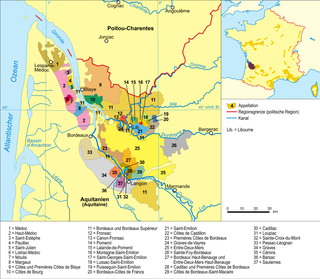
These rivers define the main geographical subdivisions of the region:
- "The right bank", situated on the right bank of Dordogne, in the northern parts of the region, around the city of LibourneLibourneLibourne is a commune in the Gironde department in Aquitaine in southwestern France. It is a sub-prefecture of the department.It is the wine-making capital of northern Gironde and lies near Saint-Émilion and Pomerol.-Geography:...
. - Entre-deux-mers, French for "between two waters", the area between the rivers Dordogne and Garonne, in the centre of the region.
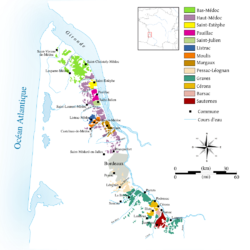
- "The left bank", situated on the left bank of Garonne, in the west and south of the region, around the city of BordeauxBordeauxBordeaux is a port city on the Garonne River in the Gironde department in southwestern France.The Bordeaux-Arcachon-Libourne metropolitan area, has a population of 1,010,000 and constitutes the sixth-largest urban area in France. It is the capital of the Aquitaine region, as well as the prefecture...
itself. The left bank is further subdivided into:- GravesGravesGraves is an important subregion of the Bordeaux wine region. Graves is situated on the left bank of the Garonne river, in the upstream part of the region, southeast of the city Bordeaux and stretch over...
, the area upstream of the city Bordeaux. - MédocMédocThe Médoc is a region of France, well known as a wine growing region, located in the département of Gironde, on the left bank of the Gironde estuary, north of Bordeaux. Its name comes from Medullicus, or "country of the Medulli", the local Celtic tribe...
, the area downstream of the city Bordeaux, situated on a peninsula between Gironde and the Atlantic.
- Graves
In Bordeaux the concept of terroir
Terroir
Terroir comes from the word terre "land". It was originally a French term in wine, coffee and tea used to denote the special characteristics that the geography, geology and climate of a certain place bestowed upon particular varieties...
plays a pivotal role in wine production with the top estates aiming to make terroir driven wines that reflect the place they are from, often from grapes collected from a single vineyard. The soil of Bordeaux is composed of gravel
Gravel
Gravel is composed of unconsolidated rock fragments that have a general particle size range and include size classes from granule- to boulder-sized fragments. Gravel can be sub-categorized into granule and cobble...
, sand
Sand
Sand is a naturally occurring granular material composed of finely divided rock and mineral particles.The composition of sand is highly variable, depending on the local rock sources and conditions, but the most common constituent of sand in inland continental settings and non-tropical coastal...
y stone, and clay. The region's best vineyards are located on the well drained gravel soils that are frequently found near the Gironde river. An old adage
Adage
An adage is a short but memorable saying which holds some important fact of experience that is considered true by many people, or that has gained some credibility through its long use....
in Bordeaux is the best estates can "see the river" from their vineyard and majority of land that face riverside are occupied by classified estates
Bordeaux Wine Official Classification of 1855
The Bordeaux Wine Official Classification of 1855 resulted from the 1855 Exposition Universelle de Paris, when Emperor Napoleon III requested a classification system for France's best Bordeaux wines which were to be on display for visitors from around the world...
.
Grapes
Claret
Claret is a name primarily used in British English for red wine from the Bordeaux region of France.-Usage:Claret derives from the French clairet, a now uncommon dark rosé and the most common wine exported from Bordeaux until the 18th century...
in the United Kingdom
United Kingdom
The United Kingdom of Great Britain and Northern IrelandIn the United Kingdom and Dependencies, other languages have been officially recognised as legitimate autochthonous languages under the European Charter for Regional or Minority Languages...
, is generally made from a blend of grapes. Permitted grapes are Cabernet Sauvignon
Cabernet Sauvignon
Cabernet Sauvignon is one of the world's most widely recognized red wine grape varieties. It is grown in nearly every major wine producing country among a diverse spectrum of climates from Canada's Okanagan Valley to Lebanon's Beqaa Valley...
, Cabernet Franc
Cabernet Franc
Cabernet Franc is one of the major black grape varieties worldwide. It is principally grown for blending with Cabernet Sauvignon and Merlot in the Bordeaux style, but can also be vinified alone - as in the Loire's Chinon...
, Merlot
Merlot
Merlot is a darkly blue-coloured wine grape, that is used as both a blending grape and for varietal wines. The name Merlot is thought to derive from the Old French word for young blackbird, merlot, a diminutive of merle, the blackbird , probably from the color of the grape. Merlot-based wines...
, Petit Verdot
Petit verdot
Petit Verdot is a variety of red wine grape, principally used in classic Bordeaux blends. It ripens much later than the other varieties in Bordeaux, often too late, so it fell out of favour in its home region. When it does ripen, it is added in small amounts to add tannin, colour and flavour to the...
, Malbec
Malbec
Malbec is a purple grape variety used in making red wine. The grapes tend to have an inky dark color and robust tannins, and are long known as one of the six grapes allowed in the blend of red Bordeaux wine. The French plantations of Malbec are now found primarily in Cahors in the South West...
and Carménère
Carmenère
The Carménère grape is a wine grape variety originally planted in the Médoc region of Bordeaux, France, where it was used to produce deep red wines and occasionally used for blending purposes in the same manner as Petit Verdot....
. Today Malbec and Carmenere are rarely used, with Château Clerc Milon
Château Clerc-Milon
Château Clerc-Milon is a winery in the Pauillac appellation of the Bordeaux region of France. The wine produced here was classified as one of eighteen Cinquièmes Crus in the Bordeaux Wine Official Classification of 1855....
, a fifth growth
Bordeaux Wine Official Classification of 1855
The Bordeaux Wine Official Classification of 1855 resulted from the 1855 Exposition Universelle de Paris, when Emperor Napoleon III requested a classification system for France's best Bordeaux wines which were to be on display for visitors from around the world...
Bordeaux, being one of the few to still retain Carménère vines.
As a very broad generalization, Cabernet Sauvignon
Cabernet Sauvignon
Cabernet Sauvignon is one of the world's most widely recognized red wine grape varieties. It is grown in nearly every major wine producing country among a diverse spectrum of climates from Canada's Okanagan Valley to Lebanon's Beqaa Valley...
(Bordeaux's second-most planted grape variety) dominates the blend in red wines produced in the Médoc and the rest of the left bank of the Gironde estuary
Gironde estuary
The Gironde is a navigable estuary , in southwest France and is formed from the meeting of the rivers Dordogne and Garonne just below the centre of Bordeaux...
. Typical top-quality Chateaux blends are 70% Cabernet Sauvignon, 15% Cabernet Franc & 15% Merlot. This is typically referred to as the "Bordeaux Blend." Merlot
Merlot
Merlot is a darkly blue-coloured wine grape, that is used as both a blending grape and for varietal wines. The name Merlot is thought to derive from the Old French word for young blackbird, merlot, a diminutive of merle, the blackbird , probably from the color of the grape. Merlot-based wines...
(Bordeaux's most-planted grape variety) and to a lesser extent Cabernet Franc
Cabernet Franc
Cabernet Franc is one of the major black grape varieties worldwide. It is principally grown for blending with Cabernet Sauvignon and Merlot in the Bordeaux style, but can also be vinified alone - as in the Loire's Chinon...
(Third most planted variety) tend to predominate in Saint-Émilion
Saint-Émilion AOC
Saint-Émilion is an Appellation d'origine contrôlée for wine in the Bordeaux wine region of France, where it is situated in the Libourne subregion on the right bank of the Dordogne...
, Pomerol
Pomerol
Pomerol is a commune in the Gironde department in Aquitaine in southwestern France.It is located near Bordeaux.-Population:-Wine:The mostly small-sized producers in this area of about produce red wines. As in the neighbouring appellation of Saint-Émilion, the predominant grape variety is Merlot,...
and the other right bank appellations. These Right Bank blends from top-quality Chateaux are typically 70% Merlot, 15% Cabernet Franc & 15% Cabernet Sauvignon.
White Bordeaux is predominantly, and exclusively in the case of the sweet Sauternes
Sauternes (wine)
Sauternes is a French sweet wine from the Sauternais region of the Graves section in Bordeaux. Sauternes is made from Sémillon, Sauvignon Blanc, and Muscadelle grapes that have been affected by Botrytis cinerea, also known as noble rot. This causes the grapes to become partially raisined,...
, made from Sémillon
Sémillon
Sémillon is a golden-skinned grape used to make dry and sweet white wines, most notably in France and Australia.-History:The origin of the Sémillon grape is hard to determine. It is known that it first arrived in Australia in the early 19th century and by the 1820s the grape covered over 90 percent...
, Sauvignon Blanc
Sauvignon blanc
Sauvignon Blanc is a green-skinned grape variety which originates from the Bordeaux region of France. The grape most likely gets its name from the French word sauvage and blanc due to its early origins as an indigenous grape in South West France., a possible descendant of savagnin...
and Muscadelle
Muscadelle
Muscadelle is a white wine grape variety. It has a simple aroma of grape juice and raisins like grapes of the Muscat family of grapes, but it is unrelated....
- Typical blends are usually 80% Sémillon
Sémillon
Sémillon is a golden-skinned grape used to make dry and sweet white wines, most notably in France and Australia.-History:The origin of the Sémillon grape is hard to determine. It is known that it first arrived in Australia in the early 19th century and by the 1820s the grape covered over 90 percent...
, 20% Sauvignon Blanc
Sauvignon blanc
Sauvignon Blanc is a green-skinned grape variety which originates from the Bordeaux region of France. The grape most likely gets its name from the French word sauvage and blanc due to its early origins as an indigenous grape in South West France., a possible descendant of savagnin...
. As with the reds, white Bordeaux wines are usually blends, most commonly of Sémillon and a smaller proportion of Sauvignon Blanc. Other permitted grape varieties are Ugni Blanc, Colombard
Colombard
Colombard is an early fruiting white variety of wine grape, better known as French Colombard in North America. It is possibly the offspring of Gouais Blanc and Chenin Blanc....
, Merlot Blanc, Ondenc
Ondenc
Ondenc is a white French wine grape found predominantly in the Gaillac region of southwest France. In the 19th century, it was a popular planting in Bordeaux but fell out of favor following the phylloxera epidemic due to poor yields and sensitive to grape disease, though is still one of the seven...
and Mauzac
Mauzac (grape)
Mauzac or Mauzac Blanc a white variety of grape used for wine, of the species Vitis vinifera. It is mainly grown in the Gaillac and Limoux regions in the southwest of France. Total French plantations of Mauzac stood at in the year 2000....
.
In the late 1960s Sémillon was the most planted grape in Bordeaux. Since then it has been in constant decline although it still is the most common of Bordeaux's white grapes. Sauvignon Blanc's popularity on the other hand has been rising, overtaking Ugni Blanc as the second most planted white Bordeaux grape in the late 1980s and now being grown in an area more than half the size of that of the lower yielding Sémillon.
Wineries all over the world aspire to making wines in a Bordeaux style. In 1988, a group of American vintners formed The Meritage
Meritage
Meritage is a proprietary term used to denote red and white Bordeaux-style wines without infringing on the Bordeaux region's legally protected designation of origin. Winemakers must license the Meritage trademark from its owner, the California-based Meritage Alliance...
Association to identify wines made in this way. Although most Meritage wines come from California, there are members of the Meritage Association in 18 states and five other countries, including Argentina, Australia, Canada, Israel, and Mexico.
Viticulture
Bordeaux is a relatively humid region. Thus it is a place rife with diseases and other problems that afflict vines, compared with many of the world's other wine regions, such as dry Chile or Australia. OïdiumOidium
This article is about a type of fungal spore. For the ascomycete genus, see Oidium . For the fungus that causes powdery mildew on grapes, see Uncinula necator....
, mildew
Mildew
Mildew refers to certain kinds of molds or fungi.In Old English, it meant honeydew , and later came to mean mildew in the modern sense of mold or fungus....
, coulure (failure of the flowers), millerandage (irregular ripening of the grapes), Eutypiose
Dead arm (grapes)
Dead-arm, sometimes grape canker, is a disease of grapes caused by a deep-seated wood rot of the arms or trunk of the grapevine. As the disease progresses over several years, one or more arms may die, hence the name "deadarm". Eventually the whole vine will die...
, Esca, Vers de la grappe and Botrytis
Botrytis cinerea
Botrytis cinerea is a necrotrophic fungus that affects many plant species, although its most notable hosts may be wine grapes. In viticulture, it is commonly known as botrytis bunch rot; in horticulture, it is usually called grey mould or gray mold.The fungus gives rise to two different kinds of...
(can be beneficial – see Sauternes
Sauternes (wine)
Sauternes is a French sweet wine from the Sauternais region of the Graves section in Bordeaux. Sauternes is made from Sémillon, Sauvignon Blanc, and Muscadelle grapes that have been affected by Botrytis cinerea, also known as noble rot. This causes the grapes to become partially raisined,...
) are the most common diseases or problems that occur.
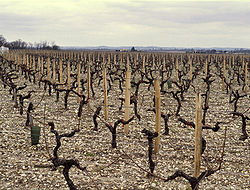
In Bordeaux, the pruning
Pruning
Pruning is a horticultural practice involving the selective removal of parts of a plant, such as branches, buds, or roots. Reasons to prune plants include deadwood removal, shaping , improving or maintaining health, reducing risk from falling branches, preparing nursery specimens for...
of the vine happens almost always as cane-pruning (as opposed to spur-pruning). There are two types of cane-pruning: guyot simple and guyot double. The simple way is seen on the right bank, double most often on the left. Related to pruning is the trellising, where vines are dispersed along wires. It has become increasingly popular to raise the height of the trellis to the benefit of the grapes but to the discomfort for the vigneron.
The use of chemicals and fertilizers has dropped in the recent decades in Bordeaux. 40 years ago, using fertilizers and different herbicides and fungicides were common, and made work easier for the manager. It also lowered the quality of the grapes, however. This use is still taking place in Bordeaux - but less and less so. Fertilizers, if used at all, are now more commonly supplied by compost, rather than chemicals. Ploughing has replaced many pesticides and de-leafing has replaced fungicide use. While a healthier approach to agriculture has certainly come to Bordeaux, the châteaux have not adopted the biodynamic
Biodynamic agriculture
Biodynamic agriculture is a method of organic farming that emphasizes the holistic development and interrelationships of the soil, plants and animals as a self-sustaining system. Biodynamic farming has much in common with other organic approaches, such as emphasizing the use of manures and composts...
trend so popular in other wine regions (though Bordeaux is not entirely unfamiliar with the concept). Instead, the lutte raisonnée method is gaining ground.
Bordeaux has seen a rise in the use of green harvesting, where unripe bunches are cut off in the summer in order to channel more of the plant's strength to the remaining bunches. While it is a popular process, it also has its opponents, such as Jean Gautreau of Château Sociando-Mallet
Château Sociando-Mallet
Château Sociando-Mallet is an unclassed Bordeaux wine producer from the appellation Haut-Médoc. The winery is located on the Left Bank of the Bordeaux wine regions, in the commune of Saint-Seurin-de-Cadourne north of Saint-Estèphe, France...
, Gonzague Lurton of Château Durfort-Vivens
Château Durfort-Vivens
Château Durfort-Vivens is a winery in the Margaux appellation of the Bordeaux region of France. It is also the name of the red wine produced by this property...
and Olivier Bernard of Domaine de Chevalier
Domaine de Chevalier
Domaine de Chevalier is a Bordeaux wine from the Pessac-Léognan appellation, ranked among the Premiers Crus for red and white wine in the Classification of Graves wine of 1953 and 1959. The winery and vineyards are located south of the city of Bordeaux, in the commune of Léognan...
, who claim that the remaining berries simply grow bigger, not better. Green harvesting requires cheap labor, often ignorant of properly cutting vines. Opponents point to vintages 1929 and 1947, which were high-yield and of great quality—and made entirely without green harvest techniques.
Yields in Bordeaux, as is the case in all other French AOCs, are capped by administrative rules. In Bordeaux this cap is 60 hl/ha with the option to raise yields by 20% by permission from the INAO. Any excess wine is sent for distillation. The yield is essential for the quality of the wine along with many other factors such as terroir. When making wine from a mediocre terroir, the producer has to lower his yields more than if it came from a superior terroir if he wants the wine to be of similar quality. In Bordeaux the recent decades have seen more and more focus on low yields. In the 1980s it was common, even for prestigious châteaux, to harvest the legal maximum. The reason is clear: if you have a good (expensive) label it is tempting to harvest 40, 50 or 60 hl/ha rather than 30 hl/ha as it means more money. But hl/ha isn't everything: as Michel Cazes of Château Lynch-Bages
Château Lynch-Bages
Château Lynch-Bages is a winery in the Pauillac appellation of the Bordeaux region of France. Château Lynch-Bages is also the name of the red wine produced by this property...
says:
"When people talk about yields they forget about density. Here in the Médoc we have 10,000 vines per hectare. The crop expressed in hectolitres tells you nothing. Here in Pauillac and St-Julien and St-Estèphe I am sure that fifty to sixty is about right. Latour always had some of the highest yields in the region, but that was because none of their vines were missing"
When harvest time approaches the Bordeaux wine producers start getting anxious. Unlike many other wine regions, weather in Bordeaux is relatively unstable and sudden changes in weather can delay a harvest, force a harvest in bad weather (diluting the wine) or severely damage the harvest. The appellations around Sauternes are even more vulnerable as certain micro-climactic conditions has to arrive plus they are forced to harvest late, risking the entire harvest to bad weather. Today the Bordelais Châteaux focus increasingly on the right time of harvest related to ripeness of the grapes. Cabernet grapes doesn't mature at the same rate as Merlot and thus picking both grapes at the same time rarely makes sense if optimal ripeness is sought. Thierry Manoncourt
Thierry Manoncourt
Thierry Manoncourt was a French winery owner of the Grand Cru estate Château Figeac in Bordeaux, and for many decades a major figure of Bordeaux and the Saint-Émilion appellation....
(Château Figeac) recollects: "In the past the whole vineyard would have been picked in eight days. Today it takes us twenty to thirty days."
In Bordeaux, hand picking is now common among the more prestigious châteaux. But while hand-picking is foremost, some classified châteaux still harvest by machine. Mechanical harvesting also has its advantages, such as flexibility: it makes possible harvesting at night, which is preferable during hot weather. While the harvesting machines today have advanced in technology making them still more attractive, the delicate and selective process of harvesting by hand is still the best way to secure a maximum quality harvest. One problem with manual harvesting is the sheer size of vineyards in Bordeaux (not to mention the labor cost of hand-picking), with tens of thousands of hectares needing harvesting within a few weeks. The flatter geography of Bordeaux also allows for mechanical harvesting, whereas the steep slopes of wine-producing areas such as Côte-Rôtie make machine harvesting nearly impossible.
Winemaking
In Bordeaux, almost all wines are blended. Only a few producers make single-variety wines, though the lack of varietal names on labels masks the fact. The typical blend consists of MerlotMerlot
Merlot is a darkly blue-coloured wine grape, that is used as both a blending grape and for varietal wines. The name Merlot is thought to derive from the Old French word for young blackbird, merlot, a diminutive of merle, the blackbird , probably from the color of the grape. Merlot-based wines...
and Cabernet Sauvignon
Cabernet Sauvignon
Cabernet Sauvignon is one of the world's most widely recognized red wine grape varieties. It is grown in nearly every major wine producing country among a diverse spectrum of climates from Canada's Okanagan Valley to Lebanon's Beqaa Valley...
(and/or Cabernet Franc
Cabernet Franc
Cabernet Franc is one of the major black grape varieties worldwide. It is principally grown for blending with Cabernet Sauvignon and Merlot in the Bordeaux style, but can also be vinified alone - as in the Loire's Chinon...
), with small additions of Petit Verdot
Petit verdot
Petit Verdot is a variety of red wine grape, principally used in classic Bordeaux blends. It ripens much later than the other varieties in Bordeaux, often too late, so it fell out of favour in its home region. When it does ripen, it is added in small amounts to add tannin, colour and flavour to the...
and Malbec
Malbec
Malbec is a purple grape variety used in making red wine. The grapes tend to have an inky dark color and robust tannins, and are long known as one of the six grapes allowed in the blend of red Bordeaux wine. The French plantations of Malbec are now found primarily in Cahors in the South West...
. Merlot
Merlot
Merlot is a darkly blue-coloured wine grape, that is used as both a blending grape and for varietal wines. The name Merlot is thought to derive from the Old French word for young blackbird, merlot, a diminutive of merle, the blackbird , probably from the color of the grape. Merlot-based wines...
is favored on the right bank of the Garonne River, and Cabernet Sauvignon
Cabernet Sauvignon
Cabernet Sauvignon is one of the world's most widely recognized red wine grape varieties. It is grown in nearly every major wine producing country among a diverse spectrum of climates from Canada's Okanagan Valley to Lebanon's Beqaa Valley...
on the left, though Merlot
Merlot
Merlot is a darkly blue-coloured wine grape, that is used as both a blending grape and for varietal wines. The name Merlot is thought to derive from the Old French word for young blackbird, merlot, a diminutive of merle, the blackbird , probably from the color of the grape. Merlot-based wines...
acreage has been increasing on the left bank over the last decade or two. Today, winemaking in Bordeaux is a highly controlled process, with widespread use of stainless steel vats for fermentation, cooling apparatus, and a high degree of hygienic discipline. In 1951, chaptalization
Chaptalization
Chaptalization is the process of adding sugar to unfermented grape must in order to increase the alcohol content after fermentation. The technique is named after its developer, the French chemist Jean-Antoine-Claude Chaptal...
(adding sugar) became legal (it had likely taken place illegally prior to 1951). The use of chaptalization is common in Bordeaux, except in the warmest of vintages, and especially on the left bank, where Cabernet Sauvignon
Cabernet Sauvignon
Cabernet Sauvignon is one of the world's most widely recognized red wine grape varieties. It is grown in nearly every major wine producing country among a diverse spectrum of climates from Canada's Okanagan Valley to Lebanon's Beqaa Valley...
dominates and ripens later than Merlot
Merlot
Merlot is a darkly blue-coloured wine grape, that is used as both a blending grape and for varietal wines. The name Merlot is thought to derive from the Old French word for young blackbird, merlot, a diminutive of merle, the blackbird , probably from the color of the grape. Merlot-based wines...
.
Today, sorting and de-stemming are common techniques in Bordeaux and have been for some time. Great efforts have been made to improve these processes. Technology has also had an impact on the crushing of the grapes, which had been done by treading since ancient times. More recently, machines have made crushing cheaper and safer, but they are less gentle with the grapes—breaking the pips releases unwanted tannins into the must. Today, some châteaux, such as Château Smith-Haut-Lafitte, do not crush the grapes at all, letting the fermentation begin within each grape (a process widely used in the Beaujolais
Beaujolais
Beaujolais is a French Appellation d'Origine Contrôlée wine generally made of the Gamay grape which has a thin skin and is low in tannins. Like most AOC wines they are not labeled varietally. Whites from the region, which make up only 1% of its production, are made mostly with Chardonnay grapes...
region).
To move the grapes, a number of wineries have stopped using pumps. Instead, after the crushing, they raise the grapes by conveyor belt. This is a gentler process, using gravity, rather than a pumping system.
Fermentation usually takes place in stainless steel vats, a technique introduced in the 1960s (lined cement vats were introduced already in the 1920s), to improve hygiene and control over the fermentation process (especially of temperature). During the 1980s, some producers began reintroducing wooden fermentation vats. There are pros and cons with all types of vats, and their role in winemaking seems less important than other elements in the process.
Use of concentrators, where a winemaker can remove water from the must, is common in Bordeaux. Some producers (Christian Moueix of Pétrus
Petrus
Petrus is a Latin name derived from the Greek meaning "rock", and is the common English prefix "petro-" used to describe rock-based substances, like petros-oleum or "rock oil." As the source of Peter, it is a common name for people from antiquity through the medieval era, and may refer to one of...
, Anthony Barton of Château Leoville-Barton
Château Léoville-Barton
Château Léoville-Barton is a vineyard in the Saint-Julien appellation of the Bordeaux region of France. Château Léoville-Barton is also the name of the red wine produced by this property...
, Philippe Dhalluin of Château Mouton-Rothschild) are opposed to concentration, although others (such as Château Pomeaux) are big fans. While this process can certainly improve a wine in mediocre years, it is also open to abuse—with the result being an over-concentrated and poorly balanced wine.
After fermentation comes the pressing. Bordeaux, along with other regions, has switched from horizontal presses to the pneumatic press, where a pneumatic bladder filled with air results in a more gentle pressing of the wine. A third type of press is the vertical or hydraulic press. This is the most traditional, and also a gentle, type of press. However, is a very labour-intensive process.
The modern, and very popular, method of micro-oxygenation, where microscopic amounts of oxygen are added to the wine during fermentation to stabilize (green) tannins and anthocyanins, has also caught on in Bordeaux. The most prestigious châteaux avoid the procedure, preferring to harvest grapes without green tannins. Micro-oxygenation is also used later in the process, during élevage, as a way of avoiding racking and controlling the amount of oxygen applied to the wine. (Racking allows for no such control). In this stage, however, the prestigious châteaux have fewer reservations. Not all producers are fans of micro-oxygenation during élevage.
In Bordeaux, most serious wines undergo barrel-ageing, although white wines can be an exception. Usually, six months of in-barrel ageing is required, but some châteaux barrel-age for as much as 18–20 months. The number of new barrels (usually considered the best) can vary from vintage to vintage, just as the duration of barrel-ageing. Only recently, addition of oak
Oak
An oak is a tree or shrub in the genus Quercus , of which about 600 species exist. "Oak" may also appear in the names of species in related genera, notably Lithocarpus...
chips (to add an oaky flavor to the wine) has been made legal in Bordeaux. During barrel-ageing, the wine needs to be racked in order to clear it of lees
Lees (fermentation)
Lees refers to deposits of dead yeast or residual yeast and other particles that precipitate, or are carried by the action of "fining", to the bottom of a vat of wine after fermentation and ageing. The yeast deposits in beer brewing are known as trub...
. This process is being challenged by some producers, as mentioned above. But ageing on the lees can also add some richness to the wine. (Ageing on lees are common for white wines.) This new approach is also being challenged.
Once the producer decides the wine has aged for the right amount of time, the selection begins. The winemaker (or his/her team) find the right blend for the vintage. This is released as the château's grand vin. Inevitably, there will be some wine left—either of inferior quality or leftovers from the blending. This is usually released as a second-wine (or in some cases even a third-wine). While in theory inferior wine, some châteaux second-wine is of superior quality to other châteaux' grand vin and fetches high prices. Increasing the amount of second-wine can be a very conscious decision on the part of a winemaker, as a way of making a more and more superior grand vin - able to compete with the most prestigious wines in tastings.
In Bordeaux the oenologists play a huge role. Many oenologists work as consultants to different châteaux and carry much weight in major decisions regarding the wine. Amongst the most famous oenologists are Emile Peynaud, Jacques Boissenot, Pascal Chantonnet, Olivier Dauga, Stéphane Derenoncourt, Denis Dubourdieu, Jean-Philippe Fort, Gilles Pauquet, Michel Rolland, Stéphane Toutoundji and Christian Veyry.
Wine styles
The Bordeaux wine region is divided into subregions including Saint-ÉmilionSaint-Émilion AOC
Saint-Émilion is an Appellation d'origine contrôlée for wine in the Bordeaux wine region of France, where it is situated in the Libourne subregion on the right bank of the Dordogne...
, Pomerol
Pomerol
Pomerol is a commune in the Gironde department in Aquitaine in southwestern France.It is located near Bordeaux.-Population:-Wine:The mostly small-sized producers in this area of about produce red wines. As in the neighbouring appellation of Saint-Émilion, the predominant grape variety is Merlot,...
, Médoc
Médoc
The Médoc is a region of France, well known as a wine growing region, located in the département of Gironde, on the left bank of the Gironde estuary, north of Bordeaux. Its name comes from Medullicus, or "country of the Medulli", the local Celtic tribe...
, and Graves
Graves
Graves is an important subregion of the Bordeaux wine region. Graves is situated on the left bank of the Garonne river, in the upstream part of the region, southeast of the city Bordeaux and stretch over...
. The 60 Bordeaux appellations and the wine styles they represent are usually categorized into six main families, four red based on the subregions and two white based on sweetness:
- Red Bordeaux and Red Bordeaux Supérieur. Bordeaux winemakers may use the two regional appellations throughout the entire wine region, however approximately half of the Bordeaux vineyard is specifically designated under Bordeaux and Bordeaux Supérieur AOCs. With the majority of châteaux located on the Right Bank in the Entre-Deux-Mers area, wines are typically Merlot-dominant, often blended with the other classic Bordeaux varietals. There are many small, family-run châteaux, as well as wines blended and sold by wine merchants under commercial brand names. The Bordeaux AOC wines tend to be fruity, with minimal influence of oak, and are produced in a style meant to be drunk young. Bordeaux Superieur AOC wines are produced in the same area, but must follow stricter controls, such as lower yields, and are often aged in oak. For the past 10 years, there has been strong, ongoing investment by the winemakers in both the vineyards and in the cellar, resulting in ever increasing quality. New reforms for the regional appellations were instituted in 2008 by the Bordeaux and Bordeaux Supérieur Winemakers' Association. In 2010, 55% of all Bordeaux wines sold in the world were from Bordeaux and Bordeaux Supérieur AOCs, with 67% sold in France and 33% exported (+9%), representing 14 bottles consumed per second.
- Red Côtes de Bordeaux. Eight appellations are in the hilly outskirts of the region, and produce wines where the blend usually is dominated by Merlot. These wines tend to be intermediate between basic red Bordeaux and the more famous appellations of the left and right bank in both style and quality. However, since none of Bordeaux's stellar names are situated in Côtes de Bordeaux, prices tend to be moderate. There is no official classification in Côtes de Bordeaux. In 2007, 14.7% of the region's vineyard surface was used for wines in this family.
- Red Libourne, or "Right Bank" wines. Around the city of LibourneLibourneLibourne is a commune in the Gironde department in Aquitaine in southwestern France. It is a sub-prefecture of the department.It is the wine-making capital of northern Gironde and lies near Saint-Émilion and Pomerol.-Geography:...
, 10 appellations produce wines dominated by Merlot with very little Cabernet Sauvignon, the two most famous being Saint-ÉmilionSaint-Émilion AOCSaint-Émilion is an Appellation d'origine contrôlée for wine in the Bordeaux wine region of France, where it is situated in the Libourne subregion on the right bank of the Dordogne...
and PomerolPomerolPomerol is a commune in the Gironde department in Aquitaine in southwestern France.It is located near Bordeaux.-Population:-Wine:The mostly small-sized producers in this area of about produce red wines. As in the neighbouring appellation of Saint-Émilion, the predominant grape variety is Merlot,...
. These wines often have great fruit concentration, softer tannins and are long-lived. Saint-Émilion has an official classification. In 2007, 10.5% of the region's vineyard surface was used for wines in this family.
- Red Graves and Médoc or "Left Bank" wines. North and south of the city of Bordeaux, which are the classic areas, produce wines dominated by Cabernet Sauvignon, but often with a significant portion of Merlot. These wines are concentrated, tannic, long-lived and most of them meant to be cellared before drinking. The five First Growths are situated here. There are official classifications for both Médoc and Graves. In 2007, 17.1% of the region's vineyard surface was used for wines in this family.
- Dry white wines. Dry white wines are made throughout the region, using the regional appellation Bordeaux Blanc, often from 100% Sauvignon Blanc or a blend dominated by Sauvignon Blanc and Sémillon. The Bordeaux Blanc AOC is used for wines made in appellations that only allow red wines. Dry whites from Graves is the most well-known and the only subregion with a classification for dry white wines. The better versions tend to have a significant oak influence. The In 2007, 7.8% of the region's vineyard surface was used for wines in this family.
- Sweet white wines. In several locations and appellations throughout the region, sweet white wine is made from Sémillon, Sauvignon Blanc and Muscadelle grapes affected by noble rot. The best-known of these appellations is Sauternes, which also has an official classification, and where some of the world's most famous sweet wines are produced. There are also appellations neighboring Sauternes, on both sides of the Garonne river, where similar wines are made. The regional appellation for sweet white wines is Bordeaux Supérieur Blanc. In 2007, 3.2% of the region's vineyard surface was used for wines in this family.
The vast majority of Bordeaux wine is red, with red wine production outnumbering white wine production six to one.
Wine classification
There are four different classifications of Bordeaux, covering different parts of the region:- The Bordeaux Wine Official Classification of 1855Bordeaux Wine Official Classification of 1855The Bordeaux Wine Official Classification of 1855 resulted from the 1855 Exposition Universelle de Paris, when Emperor Napoleon III requested a classification system for France's best Bordeaux wines which were to be on display for visitors from around the world...
, covering (with one exception) red wines of Médoc, and sweet wines of Sauternes-Barsac. - The 1955 Official Classification of St.-ÉmilionClassification of Saint-Émilion wineIn 1955 the wines of Saint-Émilion in the wine-growing region of Bordeaux were classified. Unlike the Bordeaux Wine Official Classification of 1855 covering wines from the Medoc and Graves regions, the Saint-Émilion list is updated every 10 years or so. Following the initial classification, the...
, which is updated approximately once every ten years, and last in 2006. - The 1959 Official Classification of GravesClassification of Graves wineThe wines of Graves in the wine-growing region of Bordeaux were classified in 1953 by a jury appointed by Institute Nacional des Appellations d'Origine, and approved by the Minister of Agriculture in August of that year. The selection was revised with a few additions in February 1959...
, initially classified in 1953 and revised in 1959. - The Cru BourgeoisCru BourgeoisThe Cru Bourgeois classification lists some of the high quality wines from the Left Bank Bordeaux wine regions that were not included in the 1855 Classification of Classed Growths, or Grands Crus Classés...
Classification, which began as an unofficial classification, but came to enjoy official status and was last updated in 2003. However, after various legal turns, the classification was annulled in 2007. As of 2007, plans exist to revive it as an unofficial classification.
The 1855 classification system was made at the request of Emperor Napoleon III for the Exposition Universelle de Paris
Exposition Universelle (1855)
The Exposition Universelle of 1855 was an International Exhibition held on the Champs-Elysées in Paris from May 15 to November 15, 1855. Its full official title was the Exposition Universelle des produits de l'Agriculture, de l'Industrie et des Beaux-Arts de Paris 1855.The exposition was a major...
. This came to be known as the Bordeaux Wine Official Classification of 1855, which ranked the wines into five categories according to price. The first growth
First Growth
First Growth status refers to a classification of wines primarily from the Bordeaux region of France.-Bordeaux reds:The need for a classification of the best Bordeaux wines arose for the 1855 Exposition Universelle de Paris. The result was the Bordeaux Wine Official Classification of 1855, a list...
red wines (four from Médoc and one, Château Haut-Brion, from Graves), are among the most expensive wines in the world.
The first growths are:
- Château Lafite-RothschildChâteau Lafite-RothschildChâteau Lafite Rothschild is a wine estate in France, owned by members of the Rothschild family since the 19th century. The name Lafite comes from the Gascon term "la hite" meaning "small hill"....
, in the appellation PauillacPauillacPauillac is a commune in the Gironde department in Aquitaine in southwestern France.-Population:-Wine:The commune consists of only 3000 acres of vineyards in the Haut-Médoc between the villages of Saint-Julien to the south and Saint-Estèphe to the north, but is home to three of Bordeaux's five... - Château MargauxChâteau MargauxChâteau Margaux, archaically La Mothe de Margaux, is a wine estate of Bordeaux wine, and was one of four wines to achieve Premier cru status in the Bordeaux Classification of 1855. The estate's best wines are very expensive...
, in the appellation Margaux - Château LatourChâteau LatourChâteau Latour is a French wine estate, rated as a First Growth under the 1855 Bordeaux Classification. Latour lies at the very southeastern tip of the commune of Pauillac in the Médoc region to the north-west of Bordeaux, at its border with Saint-Julien, and only a few hundred metres from the...
, in the appellation Pauillac - Château Haut-BrionChâteau Haut-BrionChâteau Haut-Brion is a French wine, rated a Premier Cru Classé , produced in the Gironde region. It differs from the other wines on the list in its geographic location in the north of the wine-growing region of Graves...
, in the appellation Péssac-Leognan - Château Mouton RothschildChâteau Mouton RothschildChâteau Mouton Rothschild is a wine estate located in the village of Pauillac in the Médoc, 50 km north-west of the city of Bordeaux, France. Its red wine of the same name is regarded as one of the world's greatest clarets. Originally known as Château Brane-Mouton it was renamed by Nathaniel...
, in the appellation Pauillac, promoted from second to first growth in 1973.
At the same time, the sweet white wines of Sauternes and Barsac were classified into three categories, with only Château d'Yquem
Château d'Yquem
Château d'Yquem is a Premier Cru Supérieur wine from the Sauternes, Gironde region in the southern part of the Bordeaux vineyards known as Graves. In the Bordeaux Wine Official Classification of 1855, Château d'Yquem was the only Sauternes given this rating, indicating its perceived superiority...
being classified as a superior first growth.
In 1955, St. Émilion AOC were classified into three categories, the highest being Premier Grand Cru Classé A with two members:
- Château AusoneChâteau AusoneChâteau Ausone is a Bordeaux wine from Saint-Émilion appellation, one of only two wines, along with Château Cheval Blanc, to be ranked Premier Grand Cru Classé in the Classification of Saint-Émilion wine...
- Château Cheval BlancChâteau Cheval BlancChâteau Cheval Blanc , is a wine producer in Saint-Émilion in the Bordeaux wine region of France. Its wine is one of only two to receive the highest rank of Premier Grand Cru Classé status in the Classification of Saint-Émilion wine of 1955, along with Château Ausone.The estate's second wine is...
There is no official classification applied to Pomerol
Pomerol
Pomerol is a commune in the Gironde department in Aquitaine in southwestern France.It is located near Bordeaux.-Population:-Wine:The mostly small-sized producers in this area of about produce red wines. As in the neighbouring appellation of Saint-Émilion, the predominant grape variety is Merlot,...
. However some Pomerol wines, notably Château Pétrus
Château Pétrus
Pétrus is a Bordeaux wine estate located in the Pomerol appellation near its eastern border to Saint-Émilion. An estate of limited size, it produces a limited production red wine almost entirely from Merlot grapes, on occasion with small amounts of Cabernet Franc, and produces no second wine...
and Château Le Pin
Château Le Pin
Château Le Pin, or simply Le Pin, is an unclassed Bordeaux wine from the appellation Pomerol. The unusually small estate is located on the Right Bank of France’s Gironde estuary in the commune of Pomerol near the hamlet of Catusseau, and its wine is periodically one of the world's most expensive...
, are often considered as being equivalent to the first growths of the 1855 classification, and often sell for even higher prices.
Commercial aspects
Many of the top Bordeaux wines are primarily sold as futures contractFutures contract
In finance, a futures contract is a standardized contract between two parties to exchange a specified asset of standardized quantity and quality for a price agreed today with delivery occurring at a specified future date, the delivery date. The contracts are traded on a futures exchange...
s, called selling en primeur
En Primeur
En primeur or "wine futures", is a method of purchasing wines early while a vintage is still in a barrel, offering the customer the opportunity to invest in a particular wine before it is bottled. Payment is made at an early stage, a year or 18 months prior to the official release of a vintage...
. Because of the combination of longevity, fairly large production, and an established reputation, Bordeaux wines tend to be the most common wines at wine auctions.
The latest market reports released in February 2009 shows that the market has increased in buying power by 128% while the prices have lowered for the very best Bordeaux wines.
Wine label
Bordeaux wine labelWine label
Wine labels are important sources of information for consumers since they tell the type and origin of the wine. The label is often the only resource a buyer has for evaluating the wine before purchasing it...
s generally include:
- The name of estate -(Image example: Château Haut-Batailley)
- The estate's classification -(Image example: Grand Cru Classé en 1855) This can be in reference to the 1855 Bordeaux classification or one of the Cru BourgeoisCru BourgeoisThe Cru Bourgeois classification lists some of the high quality wines from the Left Bank Bordeaux wine regions that were not included in the 1855 Classification of Classed Growths, or Grands Crus Classés...
. - The appellation -(Image example: Pauillac) Appellation d'origine contrôléeAppellation d'Origine ContrôléeAppellation d’origine contrôlée , which translates as "controlled designation of origin", is the French certification granted to certain French geographical indications for wines, cheeses, butters, and other agricultural products, all under the auspices of the government bureau Institut National...
laws dictate that all grapes must be harvested from a particular appellationAppellationAn appellation is a legally defined and protected geographical indication used to identify where the grapes for a wine were grown; other types of food often have appellations as well...
in order for that appellation to appear on the label. The appellation is a key indicator of the type of wine in the bottle. With the image example, Pauillac wines are always red, and usually Cabernet Sauvignon is the dominant grape. - Whether or not the wine is bottled at the chateau (Image example: Mis en Bouteille au Chateau) or assembled by a NégociantNégociantA négociant is the French term for a wine merchant who assembles the produce of smaller growers and winemakers and sells the result under its own name....
. - The vintage -(Image example: 2000)
- Alcohol content - (Image example: 13% vol)
Plan Bordeaux
Plan Bordeaux is an initiative introduced in 2005 by ONIVINS, the French vintnerVintner
A vintner is a wine merchant. You pronounce it like this In some modern use, in particular in American English, the term is alsoused as a synonym for winemaker....
s association, designed to reduce France's wine glut and improve sales. Part of the plan is to uproot 17,000 hectares of the 124,000 hectares of vineyards in Bordeaux. http://72.14.209.104/search?q=cache:f1IzDrp2p4gJ:www.vitisphere.com/dossier--49575-51254.htm+%22Plan+Bordeaux%22+Onivins&hl=en&gl=us&ct=clnk&cd=4 The wine industry in Bordeaux has been experiencing economic problems in the face of strong international competition from New World wines and declining wine consumption in France. http://72.14.209.104/search?q=cache:Y3ELJa7ByWoJ:thescotsman.scotsman.com/index.cfm%3Fid%3D21642006+%22Plan+Bordeaux%22&hl=en&gl=us&ct=clnk&cd=13
In 2004, exports to the U.S. plummeted 59% in value over the previous year. Sales in Britain dropped 33% in value during the same period. The UK, a major market, now imports more wine from Australia than from France. Amongst the possible causes for this economic crisis are that many consumers tend to prefer wine labels that state the variety of grape from which the wine is made, and often find the required French AOC labels difficult to understand.
Christian Delpeuch
Christian Delpeuch
Christian Delpeuch is president emeritus of the French Conseil Interprofessionel du Vin de Bordeaux . He won support for Plan Bordeaux, an effort to save the wine industry of Bordeaux...
, president emeritus of Plan Bordeaux hoped to reduce production, improve quality, and sell more wine in the United States. However, two years after the beginning of the program, Mr Delpeuch http://www.wineint.com/story.asp?sectioncode=1&storyCode=2089 resigned, "citing the failure of the French government to address properly the wine crisis in Bordeaux." Delpeuch told journalists assembled at the Bordeaux Press Club “I refuse to countenance this continual putting off of decisions which can only end in failure.” http://www.wineint.com/story.asp?sectioncode=1&storyCode=2089 "Delpeuch said he was shocked and disappointed by the failure of his efforts – and by the lack of co-operation from winemakers and négociant
Négociant
A négociant is the French term for a wine merchant who assembles the produce of smaller growers and winemakers and sells the result under its own name....
s themselves - to achieve anything concrete in terms of reforms to the Bordeaux wine industry over the last 24 months." http://www.wineint.com/story.asp?sectioncode=1&storyCode=2089 The future of Plan Bordeaux is uncertain.
Syndicat des AOC de Bordeaux et Bordeaux Supérieur
Syndicate des Vins de Bordeaux et Bordeaux Supérieur is an organization representing the economic interests of 6,700 wine producers in Bordeaux, France. The wine lake and other economic problems have increased the salience of the winemakers' association, whose members are facing increasing costs and decreasing demand for their product.As the largest appellation producing fine wines, and the strong foundation of the pyramid of Bordeaux wines, Bordeaux AOC & Bordeaux Supérieur AOC today account for 55% of all Bordeaux wines consumed in the world.
See also
- GaragistesGaragistesThe garagistes refers to a group of innovative winemakers in the Bordeaux region, producing "Vins de garage", "Garage wine". A group emerged in the mid 1990s in reaction to the traditional style of red Bordeaux wine, which is highly tannic and requires long ageing in the bottle to become drinkable...
- Globalization of wineGlobalization of wine"Globalization is the expansion of brands across nations and into other continents. In food and wine it refers to the whole problem of making the product global. The primary issue is scaling production while reducing the costs of goods with processes. In marketing it refers to wearing the mantle of...
- Judgment of Paris
- MeritageMeritageMeritage is a proprietary term used to denote red and white Bordeaux-style wines without infringing on the Bordeaux region's legally protected designation of origin. Winemakers must license the Meritage trademark from its owner, the California-based Meritage Alliance...
Further reading
- Echikson, William. Noble Rot: A Bordeaux Wine Revolution. NY: Norton, 2004.
- Teichgraeber. Bordeaux for less dough. San Francisco Chronicle, June 8, 2006 http://www.sfgate.com/cgi-bin/article.cgi?f=/c/a/2006/06/08/WIGQ5J6C3Q1.DTL