

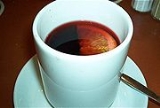
Mulled wine

Encyclopedia
Mulled wine, variations of which are popular in Europe, is wine
, usually red, combined with spices and typically served warm. It is a traditional drink during winter, especially around Christmas
and Halloween
.
in France
. It is the traditional beverage offered and drunk during the Christmas
holidays. It is usually prepared from red wine, heated and spiced with cinnamon
sticks, vanilla pods, cloves, citrus and sugar
. Fruit wine
s such as blueberry wine and cherry wine are rarely used instead of grape wine in Germany. Glühwein is drunk pure or "mit Schuss" (with a shot), which means there is rum or liqueur added. The French name is vin chaud (hot wine).
The oldest documented Glühwein tankard is attributed to the German nobleman and first Riesling
grower of the world, Count John IV. of Katzenelnbogen
around 1420. This gold-plated lockable silver tankard imitating the traditional wine woven wooden can is called Welcome.
In Bulgaria
, it is called greyano vino ("heated wine"), and consists of red wine, honey
and peppercorn
. Sometimes apples and/or citrus fruits, such as lemon or oranges, can be added.
In Slovenia
, Croatia
, Serbia
and Montenegro
, kuhano vino ("cooked wine"), is made from red wine and various combinations of nutmeg
, cloves, cinnamon
, sugar and orange zest, often served with slices of orange or lemon.
In the Czech Republic
, particularly the mountains such as the Giant Mountains, the popular mulled wine is called svařené víno ("boiled wine").
In Hungary
, forralt bor ("boiled wine") is typically made from a cheap version of the country's popular Egri Bikavér
.
In Italy
, mulled wine is typical in the northern part of the country and is called vin brulé ("burned wine").
In Latvia
, it is called karstvīns ("hot wine"). When out of wine, it is prepared using grape (or currant) juice and Riga Black Balsam.
In Moldova
, the izvar is made from red wine with black pepper
and honey
.
In Poland
, grzane wino ("heated wine") is very similar to the Czech variant, especially in the southern regions. There is also a similar method for preparing mulled beer or "grzane piwo" which is popular with Belgian beers because of the sweet flavor of that particular type of beer, which uses the same spices as mulled wine and is heated.
In Romania
, it is called vin fiert ("boiled wine"), and can be made using either red or white wine, sometimes adding sugar
and cinnamon
.
In Russia
, Глинтвейн ("Glintwein") is a popular drink during winters and has same recipe as the German Glühwein.
In Turkiye, it is called Sıcak Şarap ("hot wine") and can be made using red wine, adding sugar
and fruits such as lemon
and orange
.
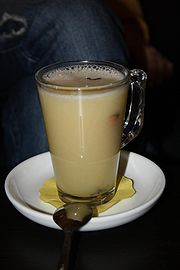 Glögg is the term for mulled wine in the Nordic countries
(sometimes misspelled as glog or glug); (in Swedish
and Icelandic
: Glögg, Norwegian
and Danish
: Gløgg, Estonian
and Finnish
: Glögi). Non-alcoholic glögg can be bought ready-made or prepared with fruit juices instead of wine. The main classic ingredients are (usually) red wine
, sugar, spices such as cinnamon
, cardamom
, ginger
, cloves and bitter orange
, and optionally also stronger spirits such as vodka
, akvavit
or brandy
. In Norway, Sweden and Finland, glögg spice extract and ready-mixed spices can be purchased in grocery stores. To prepare glögg, spices and/or spice extract are mixed into the wine, which is then heated to 60-70 °C (140-158 °F). The temperature should not be allowed to rise above 78.4 °C (173.12 °F) in order to avoid evaporation of the alcohol. When preparing home-made glögg using spices, the hot mixture is allowed to infuse for at least an hour, often longer, and then reheated before serving. In Sweden
, ready-made wine glögg is normally sold at Systembolaget
ready to heat and serve, and not in concentrate or extract form. Glögg is generally served with raisins, blanched almonds and Ginger biscuits
(Ginger Snaps), and is a popular hot drink during the Christmas season.
In Sweden, ginger bread and lussebullar (also called lussekatter), a type of sweet bun with saffron
and raisins, are typically served. It is also traditionally served at Julbord, the Christmas buffet. In Denmark
, gløgg parties typically include æbleskiver
sprinkled with powdered sugar
and accompanied with strawberry
marmalade
. In Norway
, gløgg parties with gløgg and rice pudding (Norwegian: riskrem) are common. In such cases, the word graut-/grøtfest is more precise, taking the name from the rice pudding which is served as a course. Typically, the gløgg is drunk before eating the rice pudding, which is often served with cold, red cordial
(saus).
Glögg recipes vary widely; variations with white wine or sweet wines such as Madeira, or spirits such as brandy are also popular. Glögg can also be made alcohol-free by replacing the wine with fruit or berry juices (often blackcurrant
) or by boiling the glögg to evaporate the alcohol. Glögg is similar in taste to modern Wassail
or mulled cider
.
 A traditional recipe can be found in Mrs Beeton's Book of Household Management
at paragraph 1961 on page 929 to 930 of the revised edition dated 1869:
Wine
Wine is an alcoholic beverage, made of fermented fruit juice, usually from grapes. The natural chemical balance of grapes lets them ferment without the addition of sugars, acids, enzymes, or other nutrients. Grape wine is produced by fermenting crushed grapes using various types of yeast. Yeast...
, usually red, combined with spices and typically served warm. It is a traditional drink during winter, especially around Christmas
Christmas
Christmas or Christmas Day is an annual holiday generally celebrated on December 25 by billions of people around the world. It is a Christian feast that commemorates the birth of Jesus Christ, liturgically closing the Advent season and initiating the season of Christmastide, which lasts twelve days...
and Halloween
Halloween
Hallowe'en , also known as Halloween or All Hallows' Eve, is a yearly holiday observed around the world on October 31, the night before All Saints' Day...
.
Glühwein
Glühwein is popular in German-speaking countries and the region of AlsaceAlsace
Alsace is the fifth-smallest of the 27 regions of France in land area , and the smallest in metropolitan France. It is also the seventh-most densely populated region in France and third most densely populated region in metropolitan France, with ca. 220 inhabitants per km²...
in France
France
The French Republic , The French Republic , The French Republic , (commonly known as France , is a unitary semi-presidential republic in Western Europe with several overseas territories and islands located on other continents and in the Indian, Pacific, and Atlantic oceans. Metropolitan France...
. It is the traditional beverage offered and drunk during the Christmas
Christmas
Christmas or Christmas Day is an annual holiday generally celebrated on December 25 by billions of people around the world. It is a Christian feast that commemorates the birth of Jesus Christ, liturgically closing the Advent season and initiating the season of Christmastide, which lasts twelve days...
holidays. It is usually prepared from red wine, heated and spiced with cinnamon
Cinnamon
Cinnamon is a spice obtained from the inner bark of several trees from the genus Cinnamomum that is used in both sweet and savoury foods...
sticks, vanilla pods, cloves, citrus and sugar
Sugar
Sugar is a class of edible crystalline carbohydrates, mainly sucrose, lactose, and fructose, characterized by a sweet flavor.Sucrose in its refined form primarily comes from sugar cane and sugar beet...
. Fruit wine
Fruit wine
Fruit wines are fermented alcoholic beverages made from a variety of base ingredients ; they may also have additional flavours taken from fruits, flowers, and herbs. This definition is sometimes broadened to include any fermented alcoholic beverage except beer...
s such as blueberry wine and cherry wine are rarely used instead of grape wine in Germany. Glühwein is drunk pure or "mit Schuss" (with a shot), which means there is rum or liqueur added. The French name is vin chaud (hot wine).
The oldest documented Glühwein tankard is attributed to the German nobleman and first Riesling
Riesling
Riesling is a white grape variety which originated in the Rhine region of Germany. Riesling is an aromatic grape variety displaying flowery, almost perfumed, aromas as well as high acidity. It is used to make dry, semi-sweet, sweet and sparkling white wines. Riesling wines are usually varietally...
grower of the world, Count John IV. of Katzenelnbogen
Katzenelnbogen
Katzenelnbogen is the name of a castle and small city in the district of Rhein-Lahn-Kreis in Rhineland-Palatinate, Germany. Katzenelnbogen is the seat of the Verbandsgemeinde Katzenelnbogen.-History:...
around 1420. This gold-plated lockable silver tankard imitating the traditional wine woven wooden can is called Welcome.
In Bulgaria
Bulgaria
Bulgaria , officially the Republic of Bulgaria , is a parliamentary democracy within a unitary constitutional republic in Southeast Europe. The country borders Romania to the north, Serbia and Macedonia to the west, Greece and Turkey to the south, as well as the Black Sea to the east...
, it is called greyano vino ("heated wine"), and consists of red wine, honey
Honey
Honey is a sweet food made by bees using nectar from flowers. The variety produced by honey bees is the one most commonly referred to and is the type of honey collected by beekeepers and consumed by humans...
and peppercorn
Peppercorn
The original meaning of peppercorn is the fruit of black pepper.It may also refer to:* Peppercorn , a very small payment used to satisfy the requirements for the creation of a legal contractOther plants:*Peppercorn tree*Sichuan peppercorn...
. Sometimes apples and/or citrus fruits, such as lemon or oranges, can be added.
In Slovenia
Slovenia
Slovenia , officially the Republic of Slovenia , is a country in Central and Southeastern Europe touching the Alps and bordering the Mediterranean. Slovenia borders Italy to the west, Croatia to the south and east, Hungary to the northeast, and Austria to the north, and also has a small portion of...
, Croatia
Croatia
Croatia , officially the Republic of Croatia , is a unitary democratic parliamentary republic in Europe at the crossroads of the Mitteleuropa, the Balkans, and the Mediterranean. Its capital and largest city is Zagreb. The country is divided into 20 counties and the city of Zagreb. Croatia covers ...
, Serbia
Serbia
Serbia , officially the Republic of Serbia , is a landlocked country located at the crossroads of Central and Southeast Europe, covering the southern part of the Carpathian basin and the central part of the Balkans...
and Montenegro
Montenegro
Montenegro Montenegrin: Crna Gora Црна Гора , meaning "Black Mountain") is a country located in Southeastern Europe. It has a coast on the Adriatic Sea to the south-west and is bordered by Croatia to the west, Bosnia and Herzegovina to the northwest, Serbia to the northeast and Albania to the...
, kuhano vino ("cooked wine"), is made from red wine and various combinations of nutmeg
Nutmeg
The nutmeg tree is any of several species of trees in genus Myristica. The most important commercial species is Myristica fragrans, an evergreen tree indigenous to the Banda Islands in the Moluccas of Indonesia...
, cloves, cinnamon
Cinnamon
Cinnamon is a spice obtained from the inner bark of several trees from the genus Cinnamomum that is used in both sweet and savoury foods...
, sugar and orange zest, often served with slices of orange or lemon.
In the Czech Republic
Czech Republic
The Czech Republic is a landlocked country in Central Europe. The country is bordered by Poland to the northeast, Slovakia to the east, Austria to the south, and Germany to the west and northwest....
, particularly the mountains such as the Giant Mountains, the popular mulled wine is called svařené víno ("boiled wine").
In Hungary
Hungary
Hungary , officially the Republic of Hungary , is a landlocked country in Central Europe. It is situated in the Carpathian Basin and is bordered by Slovakia to the north, Ukraine and Romania to the east, Serbia and Croatia to the south, Slovenia to the southwest and Austria to the west. The...
, forralt bor ("boiled wine") is typically made from a cheap version of the country's popular Egri Bikavér
Egri Bikavér
Egri Bikavér is Hungary's most famous red wine. It comes from the Eger wine region of northern Hungary; the Szekszárd region produces a similar wine with similar name but with different character.-Blend:...
.
In Italy
Italy
Italy , officially the Italian Republic languages]] under the European Charter for Regional or Minority Languages. In each of these, Italy's official name is as follows:;;;;;;;;), is a unitary parliamentary republic in South-Central Europe. To the north it borders France, Switzerland, Austria and...
, mulled wine is typical in the northern part of the country and is called vin brulé ("burned wine").
In Latvia
Latvia
Latvia , officially the Republic of Latvia , is a country in the Baltic region of Northern Europe. It is bordered to the north by Estonia , to the south by Lithuania , to the east by the Russian Federation , to the southeast by Belarus and shares maritime borders to the west with Sweden...
, it is called karstvīns ("hot wine"). When out of wine, it is prepared using grape (or currant) juice and Riga Black Balsam.
In Moldova
Moldova
Moldova , officially the Republic of Moldova is a landlocked state in Eastern Europe, located between Romania to the West and Ukraine to the North, East and South. It declared itself an independent state with the same boundaries as the preceding Moldavian Soviet Socialist Republic in 1991, as part...
, the izvar is made from red wine with black pepper
Black pepper
Black pepper is a flowering vine in the family Piperaceae, cultivated for its fruit, which is usually dried and used as a spice and seasoning. The fruit, known as a peppercorn when dried, is approximately in diameter, dark red when fully mature, and, like all drupes, contains a single seed...
and honey
Honey
Honey is a sweet food made by bees using nectar from flowers. The variety produced by honey bees is the one most commonly referred to and is the type of honey collected by beekeepers and consumed by humans...
.
In Poland
Poland
Poland , officially the Republic of Poland , is a country in Central Europe bordered by Germany to the west; the Czech Republic and Slovakia to the south; Ukraine, Belarus and Lithuania to the east; and the Baltic Sea and Kaliningrad Oblast, a Russian exclave, to the north...
, grzane wino ("heated wine") is very similar to the Czech variant, especially in the southern regions. There is also a similar method for preparing mulled beer or "grzane piwo" which is popular with Belgian beers because of the sweet flavor of that particular type of beer, which uses the same spices as mulled wine and is heated.
In Romania
Romania
Romania is a country located at the crossroads of Central and Southeastern Europe, on the Lower Danube, within and outside the Carpathian arch, bordering on the Black Sea...
, it is called vin fiert ("boiled wine"), and can be made using either red or white wine, sometimes adding sugar
Sugar
Sugar is a class of edible crystalline carbohydrates, mainly sucrose, lactose, and fructose, characterized by a sweet flavor.Sucrose in its refined form primarily comes from sugar cane and sugar beet...
and cinnamon
Cinnamon
Cinnamon is a spice obtained from the inner bark of several trees from the genus Cinnamomum that is used in both sweet and savoury foods...
.
In Russia
Russia
Russia or , officially known as both Russia and the Russian Federation , is a country in northern Eurasia. It is a federal semi-presidential republic, comprising 83 federal subjects...
, Глинтвейн ("Glintwein") is a popular drink during winters and has same recipe as the German Glühwein.
In Turkiye, it is called Sıcak Şarap ("hot wine") and can be made using red wine, adding sugar
Sugar
Sugar is a class of edible crystalline carbohydrates, mainly sucrose, lactose, and fructose, characterized by a sweet flavor.Sucrose in its refined form primarily comes from sugar cane and sugar beet...
and fruits such as lemon
Lemon
The lemon is both a small evergreen tree native to Asia, and the tree's ellipsoidal yellow fruit. The fruit is used for culinary and non-culinary purposes throughout the world – primarily for its juice, though the pulp and rind are also used, mainly in cooking and baking...
and orange
Orange (fruit)
An orange—specifically, the sweet orange—is the citrus Citrus × sinensis and its fruit. It is the most commonly grown tree fruit in the world....
.
Nordic Gløgg or Glögg
Nordic countries
The Nordic countries make up a region in Northern Europe and the North Atlantic which consists of Denmark, Finland, Iceland, Norway and Sweden and their associated territories, the Faroe Islands, Greenland and Åland...
(sometimes misspelled as glog or glug); (in Swedish
Swedish language
Swedish is a North Germanic language, spoken by approximately 10 million people, predominantly in Sweden and parts of Finland, especially along its coast and on the Åland islands. It is largely mutually intelligible with Norwegian and Danish...
and Icelandic
Icelandic language
Icelandic is a North Germanic language, the main language of Iceland. Its closest relative is Faroese.Icelandic is an Indo-European language belonging to the North Germanic or Nordic branch of the Germanic languages. Historically, it was the westernmost of the Indo-European languages prior to the...
: Glögg, Norwegian
Norwegian language
Norwegian is a North Germanic language spoken primarily in Norway, where it is the official language. Together with Swedish and Danish, Norwegian forms a continuum of more or less mutually intelligible local and regional variants .These Scandinavian languages together with the Faroese language...
and Danish
Danish language
Danish is a North Germanic language spoken by around six million people, principally in the country of Denmark. It is also spoken by 50,000 Germans of Danish ethnicity in the northern parts of Schleswig-Holstein, Germany, where it holds the status of minority language...
: Gløgg, Estonian
Estonian language
Estonian is the official language of Estonia, spoken by about 1.1 million people in Estonia and tens of thousands in various émigré communities...
and Finnish
Finnish language
Finnish is the language spoken by the majority of the population in Finland Primarily for use by restaurant menus and by ethnic Finns outside Finland. It is one of the two official languages of Finland and an official minority language in Sweden. In Sweden, both standard Finnish and Meänkieli, a...
: Glögi). Non-alcoholic glögg can be bought ready-made or prepared with fruit juices instead of wine. The main classic ingredients are (usually) red wine
Wine
Wine is an alcoholic beverage, made of fermented fruit juice, usually from grapes. The natural chemical balance of grapes lets them ferment without the addition of sugars, acids, enzymes, or other nutrients. Grape wine is produced by fermenting crushed grapes using various types of yeast. Yeast...
, sugar, spices such as cinnamon
Cinnamon
Cinnamon is a spice obtained from the inner bark of several trees from the genus Cinnamomum that is used in both sweet and savoury foods...
, cardamom
Cardamom
Cardamom refers to several plants of the genera Elettaria and Amomum in the ginger family Zingiberaceae. Both genera are native to India and Bhutan; they are recognised by their small seed pod, triangular in cross-section and spindle-shaped, with a thin papery outer shell and small black seeds...
, ginger
Ginger
Ginger is the rhizome of the plant Zingiber officinale, consumed as a delicacy, medicine, or spice. It lends its name to its genus and family . Other notable members of this plant family are turmeric, cardamom, and galangal....
, cloves and bitter orange
Bitter orange
The name "bitter orange", also known as Seville orange, sour orange, bigarade orange, and marmalade orange, refers to a citrus tree and its fruit. Many varieties of bitter orange are used for their essential oil, which is used in perfume and as a flavoring...
, and optionally also stronger spirits such as vodka
Vodka
Vodka , is a distilled beverage. It is composed primarily of water and ethanol with traces of impurities and flavorings. Vodka is made by the distillation of fermented substances such as grains, potatoes, or sometimes fruits....
, akvavit
Akvavit
Akvavit or aquavit is a traditional flavoured spirit that is principally produced in Scandinavia, where it has been produced since the 15th century....
or brandy
Cognac (drink)
Cognac , named after the town of Cognac in France, is a variety of brandy. It is produced in the wine-growing region surrounding the town from which it takes its name, in the French Departements of Charente and Charente-Maritime....
. In Norway, Sweden and Finland, glögg spice extract and ready-mixed spices can be purchased in grocery stores. To prepare glögg, spices and/or spice extract are mixed into the wine, which is then heated to 60-70 °C (140-158 °F). The temperature should not be allowed to rise above 78.4 °C (173.12 °F) in order to avoid evaporation of the alcohol. When preparing home-made glögg using spices, the hot mixture is allowed to infuse for at least an hour, often longer, and then reheated before serving. In Sweden
Sweden
Sweden , officially the Kingdom of Sweden , is a Nordic country on the Scandinavian Peninsula in Northern Europe. Sweden borders with Norway and Finland and is connected to Denmark by a bridge-tunnel across the Öresund....
, ready-made wine glögg is normally sold at Systembolaget
Systembolaget
Systembolaget is a government owned chain of liquor stores in Sweden. It is the only retail store allowed to sell alcoholic beverages that contain more than 3.5% alcohol. Systembolaget also sells non-alcoholic beverages. To buy alcoholic beverages at Systembolaget one has to be 20 years of age or...
ready to heat and serve, and not in concentrate or extract form. Glögg is generally served with raisins, blanched almonds and Ginger biscuits
Ginger biscuits
A ginger biscuit, ginger nut or ginger snap is a globally popular biscuit based snack food, flavoured with ginger.These hard twice-baked biscuits are flavoured with powdered ginger, cinnamon, nutmeg, and other spices...
(Ginger Snaps), and is a popular hot drink during the Christmas season.
In Sweden, ginger bread and lussebullar (also called lussekatter), a type of sweet bun with saffron
Saffron
Saffron is a spice derived from the flower of Crocus sativus, commonly known as the saffron crocus. Crocus is a genus in the family Iridaceae. Each saffron crocus grows to and bears up to four flowers, each with three vivid crimson stigmas, which are each the distal end of a carpel...
and raisins, are typically served. It is also traditionally served at Julbord, the Christmas buffet. In Denmark
Denmark
Denmark is a Scandinavian country in Northern Europe. The countries of Denmark and Greenland, as well as the Faroe Islands, constitute the Kingdom of Denmark . It is the southernmost of the Nordic countries, southwest of Sweden and south of Norway, and bordered to the south by Germany. Denmark...
, gløgg parties typically include æbleskiver
Æbleskiver
Æbleskiver are traditional Danish pancakes in a distinctive shape of a sphere. Somewhat similar in texture to American pancakes crossed with a popover, æbleskiver are solid like a pancake but light and fluffy like a popover...
sprinkled with powdered sugar
Powdered sugar
Powdered sugar, also known as confectioners' sugar or icing sugar, is very fine sugar. When intended for home use, it typically contains a small amount of anti-caking agent....
and accompanied with strawberry
Strawberry
Fragaria is a genus of flowering plants in the rose family, Rosaceae, commonly known as strawberries for their edible fruits. Although it is commonly thought that strawberries get their name from straw being used as a mulch in cultivating the plants, the etymology of the word is uncertain. There...
marmalade
Marmalade
Marmalade is a fruit preserve made from the juice and peel of citrus fruits, boiled with sugar and water. The benchmark citrus fruit for marmalade production in Britain is the "Seville orange" from Spain, Citrus aurantium var...
. In Norway
Norway
Norway , officially the Kingdom of Norway, is a Nordic unitary constitutional monarchy whose territory comprises the western portion of the Scandinavian Peninsula, Jan Mayen, and the Arctic archipelago of Svalbard and Bouvet Island. Norway has a total area of and a population of about 4.9 million...
, gløgg parties with gløgg and rice pudding (Norwegian: riskrem) are common. In such cases, the word graut-/grøtfest is more precise, taking the name from the rice pudding which is served as a course. Typically, the gløgg is drunk before eating the rice pudding, which is often served with cold, red cordial
Liqueur
A liqueur is an alcoholic beverage that has been flavored with fruit, herbs, nuts, spices, flowers, or cream and bottled with added sugar. Liqueurs are typically quite sweet; they are usually not aged for long but may have resting periods during their production to allow flavors to marry.The...
(saus).
Glögg recipes vary widely; variations with white wine or sweet wines such as Madeira, or spirits such as brandy are also popular. Glögg can also be made alcohol-free by replacing the wine with fruit or berry juices (often blackcurrant
Blackcurrant
Blackcurrant, Ribes nigrum, is a species of Ribes berry native to central and northern Europe and northern Asia, and is a perennial....
) or by boiling the glögg to evaporate the alcohol. Glögg is similar in taste to modern Wassail
Wassail
The word Wassail refers to several related traditions; first and foremost wassailing is an ancient southern English tradition that is performed with the intention of ensuring a good crop of cider apples for the next year's harvest...
or mulled cider
Apple cider
Apple cider is the name used in the United States and parts of Canada for an unfiltered, unsweetened, non-alcoholic beverage made from apples...
.
British mulled wine
Mrs Beeton's Book of Household Management
Mrs Beeton's Book of Household Management was a guide to all aspects of running a household in Victorian Britain, edited by Isabella Beeton. It was originally entitled "Beeton's Book of Household Management", in line with the other guide-books published by Beeton.Previously published as a part...
at paragraph 1961 on page 929 to 930 of the revised edition dated 1869: