


Vitis vinifera

Encyclopedia
Vitis vinifera is a species of Vitis
, native to the Mediterranean region
, central Europe
, and southwestern Asia
, from Morocco
and Portugal
north to southern Germany
and east to northern Iran
.
It is a liana
growing to 35 m tall, with flaky bark
. The leaves
are alternate, palmately lobed, 5–20 cm long and broad. The fruit
is a berry
, known as a grape
; in the wild species it is 6 mm diameter and ripens dark purple to blackish with a pale wax bloom; in cultivated plants it is usually much larger, up to 3 cm long, and can be green, red, or purple. The species typically occurs in humid forests and streamsides.
The wild grape is often classified as V. vinifera subsp. sylvestris (in some classifications considered Vitis sylvestris), with V. vinifera subsp. vinifera restricted to cultivated forms. Domesticated vines have hermaphrodite flowers, but subsp. sylvestris is dioecious
(male
and female
flowers on separate plants) and pollination is required for fruit to develop.
Cultivars of Vitis vinifera form the basis of the majority of wines produced around the world. All of the familiar wine varieties belong to Vitis vinifera, which is cultivated on every continent except for Antarctica, and in all the major wine regions of the world.
Wild grapes were harvested
by foragers and early farmers. For thousands of years, the fruit
has been harvested for both medicinal and nutritional value; its history is intimately entwined with the history of wine
.
Changes in pip shape (narrower in domesticated forms) and distribution point to domestication occurring about 3500–3000 BC, in southwest Asia, South Caucasus
(Armenia
and Georgia
), or the Western Black Sea shore region (Bulgaria
). Cultivation of the domesticated grape spread to other parts of the Old World
in pre-historic or early historic times.
The first written accounts of grapes and wine can be found in the Epic of Gilgamesh
, an ancient Sumer
ian text from the third millennium BC. There are also numerous hieroglyphic references from ancient Egypt, according to which wine was reserved exclusively for priests, state functionaries and the pharaoh.
 The ancient Greeks introduced grape growing and wine making to Europe in the Minoan age. Hesiod
in his Works and Days
gives detailed descriptions of grape harvests and wine making techniques, and there are also many references in Homer
. Greek colonists then introduced these practices in their colonies, especially in southern Italy (Magna Grecia), which was even known as Enotria due to its propitious climate.
The Etruscans improved wine making techniques and developed an export trade even beyond the Mediterranean basin.
The ancient Romans further developed the techniques learnt from the Etruscans, as shown by numerous works of literature containing information that is still valid today: De Agri Cultura
(around 160 BC) by Cato the Elder
, De re rustica by Marcus Terentius Varro
, the Georgics
by Virgil
and De re rustica by Columella
.
During the 3rd and 4th centuries AD, the long crisis of the Roman Empire generated instability in the countryside which led to a reduction of viticulture in general, which was mainly sustained only close to towns and cities and along coastlines.
Between the 5th and 10th centuries, viticulture was sustained almost exclusively by the different religious orders in monasteries. The Benedictines and others extended the grape growing limit northwards and also planted new vineyards at higher altitudes than was customary before. Apart from ‘ecclesiastical’ viticulture, there also developed, especially in France, a ‘noble’ viticulture, practiced by the aristocracy as a symbol of prestige.
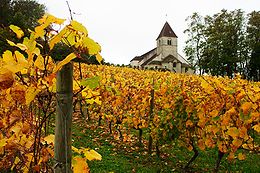 Grape growing was a significant economic activity in the Middle east up to the 7th century, when the expansion of Islam caused it to decline.
Between the Low Middle Ages and the Renaissance, viticulture began to flourish again. Demographic pressure, population concentration in towns and cities, and the increased spending power of artisans and merchants gave rise to increased investment in viticulture, which became economically feasible once more.
Much was written during the Renaissance on grape growing and wine production, favouring a more scientific approach. This literature can be considered the origin of modern ampelography
.
Grapes followed European colonies around the world, coming to North America
around the 17th century, and to Africa
, South America
and Australia
. In North America it formed hybrids with native species from the Vitis genus; some of these were intentional hybrids created to combat phylloxera
, an insect
pest which affected the European grapevine to a much greater extent than North American ones and in fact managed to devastate European wine production in a matter of years. Later, North American rootstocks became widely used to graft V. vinifera cultivars so as to withstand the presence of phylloxera.
V. vinifera accounts for the majority of world wine production; all of the most familiar grape varieties used for wine production belong to V. vinifera.
In Europe
, Vitis vinifera is concentrated in the central and southern regions; in Asia
, in the western regions such as Anatolia
, the Caucasus
, the Middle east
, and in China
; in Africa
, along the northern Mediterranean coast and in South Africa
; in North America
, in California
and also other areas like New Mexico
, New York
, Oregon
, Washington State, British Columbia
, Ontario
and Québec
; in South America
in Chile
, Argentina
, Uruguay
, Peru
and Brazil
; and in Oceania
in Australia
and New Zealand
.
In the second half of the 20th century there was a shift in attitude in viticulture from traditional techniques to the scientific method based on fields such as microbiology, chemistry and ampelography. This change came about also due to changes in economic and cultural aspects and in the way of life and in the consumption habits of wide sectors of the population starting to demand quality products.
Nature magazine published the genome sequence of V. vinifera. This work was a collaboration between Italian researchers (Consorzio Interuniversitario Nazionale per la Biologia Molecolare delle Piante, Istituto di Genomica Applicata) and French researchers (Genoscope
e Institut National de la Recherche Agronomique). Vitis vinifera is the fourth angiosperm species whose genome has been completely sequenced. The results of this analysis contribute significantly to understanding the evolution of plants over time and of the genes involved in the aromatic characteristics of wine.
In March 2007, scientists from Australia
's Commonwealth Scientific and Industrial Research Organisation
(CSIRO), working in the Cooperative Research Centre for Viticulture, reported that their "research suggests that extremely rare and independent mutations in two genes [VvMYBA1 and VvMYBA2 of red grapes] produced a single white grapevine that was the parent of almost all of the world's white grape varieties. If only one gene had been mutated, most grapes would still be red and we would not have the more than 3000 white grape cultivars available today."
s is known to date back to Neolithic
times, following the discovery in 1996 of 7,000 year-old wine
storage jars in present-day northern Iran
. Further evidence shows the Mesopotamia
ns and Ancient Egypt
ians had vine plantations and winemaking skills. Greek philosophers
praised the healing powers of grapes both whole and in the form of wine. Vitis vinifera cultivation and winemaking
in China
began during the Han Dynasty
in the 2nd century with the importation of the species from Ta-Yuan. However, wild vine "mountain grapes" like Vitis thunbergii were being used for wine making before that time.
Using the sap of grapevines, European folk healers sought to cure skin and eye diseases.{2011 University of Maryland Medical Center }} Other historical uses include the leaves
being used to stop bleeding, pain and inflammation of hemorrhoids. Unripe grapes were used for treating sore throats, and raisins were given as treatments for consumption (tuberculosis
), constipation
and thirst
. Ripe grapes were used for the treatment of cancer
, cholera
, smallpox
, nausea
, skin and eye infections as well as kidney
and liver
diseases.
Seedless grape varieties were developed to appeal to consumers, but researchers are now discovering that many of the healthful properties of grapes may actually come from the seeds themselves, thanks to their enriched phytochemical
content.
Grapevine leaves are filled with minced meat (such as lamb or beef), rice and onions in the making of Balkan traditional dolma
.
A grapevine is depicted on the reverse of the Croatian 2 lipa
coin, minted since 1993.
Vitis
Vitis is a genus of about 60 species of vining plants in the flowering plant family Vitaceae. The genus is made up of species predominantly from the Northern hemisphere. It is economically important as the source of grapes, both for direct consumption of the fruit and for fermentation to produce...
, native to the Mediterranean region
Mediterranean Basin
In biogeography, the Mediterranean Basin refers to the lands around the Mediterranean Sea that have a Mediterranean climate, with mild, rainy winters and hot, dry summers, which supports characteristic Mediterranean forests, woodlands, and scrub vegetation...
, central Europe
Europe
Europe is, by convention, one of the world's seven continents. Comprising the westernmost peninsula of Eurasia, Europe is generally 'divided' from Asia to its east by the watershed divides of the Ural and Caucasus Mountains, the Ural River, the Caspian and Black Seas, and the waterways connecting...
, and southwestern Asia
Asia
Asia is the world's largest and most populous continent, located primarily in the eastern and northern hemispheres. It covers 8.7% of the Earth's total surface area and with approximately 3.879 billion people, it hosts 60% of the world's current human population...
, from Morocco
Morocco
Morocco , officially the Kingdom of Morocco , is a country located in North Africa. It has a population of more than 32 million and an area of 710,850 km², and also primarily administers the disputed region of the Western Sahara...
and Portugal
Portugal
Portugal , officially the Portuguese Republic is a country situated in southwestern Europe on the Iberian Peninsula. Portugal is the westernmost country of Europe, and is bordered by the Atlantic Ocean to the West and South and by Spain to the North and East. The Atlantic archipelagos of the...
north to southern Germany
Germany
Germany , officially the Federal Republic of Germany , is a federal parliamentary republic in Europe. The country consists of 16 states while the capital and largest city is Berlin. Germany covers an area of 357,021 km2 and has a largely temperate seasonal climate...
and east to northern Iran
Iran
Iran , officially the Islamic Republic of Iran , is a country in Southern and Western Asia. The name "Iran" has been in use natively since the Sassanian era and came into use internationally in 1935, before which the country was known to the Western world as Persia...
.
It is a liana
Liana
A liana is any of various long-stemmed, woody vines that are rooted in the soil at ground level and use trees, as well as other means of vertical support, to climb up to the canopy to get access to well-lit areas of the forest. Lianas are especially characteristic of tropical moist deciduous...
growing to 35 m tall, with flaky bark
Bark
Bark is the outermost layers of stems and roots of woody plants. Plants with bark include trees, woody vines and shrubs. Bark refers to all the tissues outside of the vascular cambium and is a nontechnical term. It overlays the wood and consists of the inner bark and the outer bark. The inner...
. The leaves
Leaf
A leaf is an organ of a vascular plant, as defined in botanical terms, and in particular in plant morphology. Foliage is a mass noun that refers to leaves as a feature of plants....
are alternate, palmately lobed, 5–20 cm long and broad. The fruit
Fruit
In broad terms, a fruit is a structure of a plant that contains its seeds.The term has different meanings dependent on context. In non-technical usage, such as food preparation, fruit normally means the fleshy seed-associated structures of certain plants that are sweet and edible in the raw state,...
is a berry
Berry
The botanical definition of a berry is a fleshy fruit produced from a single ovary. Grapes are an example. The berry is the most common type of fleshy fruit in which the entire ovary wall ripens into an edible pericarp. They may have one or more carpels with a thin covering and fleshy interiors....
, known as a grape
Grape
A grape is a non-climacteric fruit, specifically a berry, that grows on the perennial and deciduous woody vines of the genus Vitis. Grapes can be eaten raw or they can be used for making jam, juice, jelly, vinegar, wine, grape seed extracts, raisins, molasses and grape seed oil. Grapes are also...
; in the wild species it is 6 mm diameter and ripens dark purple to blackish with a pale wax bloom; in cultivated plants it is usually much larger, up to 3 cm long, and can be green, red, or purple. The species typically occurs in humid forests and streamsides.
The wild grape is often classified as V. vinifera subsp. sylvestris (in some classifications considered Vitis sylvestris), with V. vinifera subsp. vinifera restricted to cultivated forms. Domesticated vines have hermaphrodite flowers, but subsp. sylvestris is dioecious
Plant sexuality
Plant sexuality covers the wide variety of sexual reproduction systems found across the plant kingdom. This article describes morphological aspects of sexual reproduction of plants....
(male
Male
Male refers to the biological sex of an organism, or part of an organism, which produces small mobile gametes, called spermatozoa. Each spermatozoon can fuse with a larger female gamete or ovum, in the process of fertilization...
and female
Female
Female is the sex of an organism, or a part of an organism, which produces non-mobile ova .- Defining characteristics :The ova are defined as the larger gametes in a heterogamous reproduction system, while the smaller, usually motile gamete, the spermatozoon, is produced by the male...
flowers on separate plants) and pollination is required for fruit to develop.
Cultivars of Vitis vinifera form the basis of the majority of wines produced around the world. All of the familiar wine varieties belong to Vitis vinifera, which is cultivated on every continent except for Antarctica, and in all the major wine regions of the world.
History
The appearance of Vitis vinifera has been dated to between 130 and 200 million years ago, with the human relationship to the plant dating from the Neolithic period.Wild grapes were harvested
Harvest (wine)
The harvesting of wine grapes is one of the most crucial steps in the process of winemaking. The time of harvest is determined primarily by the ripeness of the grape as measured by sugar, acid and tannin levels with winemakers basing their decision to pick based on the style of wine they wish to...
by foragers and early farmers. For thousands of years, the fruit
Fruit
In broad terms, a fruit is a structure of a plant that contains its seeds.The term has different meanings dependent on context. In non-technical usage, such as food preparation, fruit normally means the fleshy seed-associated structures of certain plants that are sweet and edible in the raw state,...
has been harvested for both medicinal and nutritional value; its history is intimately entwined with the history of wine
Wine
Wine is an alcoholic beverage, made of fermented fruit juice, usually from grapes. The natural chemical balance of grapes lets them ferment without the addition of sugars, acids, enzymes, or other nutrients. Grape wine is produced by fermenting crushed grapes using various types of yeast. Yeast...
.
Changes in pip shape (narrower in domesticated forms) and distribution point to domestication occurring about 3500–3000 BC, in southwest Asia, South Caucasus
South Caucasus
The South Caucasus is a geopolitical region located on the border of Eastern Europe and Southwest Asia also referred to as Transcaucasia, or The Trans-Caucasus...
(Armenia
Armenia
Armenia , officially the Republic of Armenia , is a landlocked mountainous country in the Caucasus region of Eurasia...
and Georgia
Georgia (country)
Georgia is a sovereign state in the Caucasus region of Eurasia. Located at the crossroads of Western Asia and Eastern Europe, it is bounded to the west by the Black Sea, to the north by Russia, to the southwest by Turkey, to the south by Armenia, and to the southeast by Azerbaijan. The capital of...
), or the Western Black Sea shore region (Bulgaria
Bulgaria
Bulgaria , officially the Republic of Bulgaria , is a parliamentary democracy within a unitary constitutional republic in Southeast Europe. The country borders Romania to the north, Serbia and Macedonia to the west, Greece and Turkey to the south, as well as the Black Sea to the east...
). Cultivation of the domesticated grape spread to other parts of the Old World
Old World
The Old World consists of those parts of the world known to classical antiquity and the European Middle Ages. It is used in the context of, and contrast with, the "New World" ....
in pre-historic or early historic times.
The first written accounts of grapes and wine can be found in the Epic of Gilgamesh
Epic of Gilgamesh
Epic of Gilgamesh is an epic poem from Mesopotamia and is among the earliest known works of literature. Scholars believe that it originated as a series of Sumerian legends and poems about the protagonist of the story, Gilgamesh king of Uruk, which were fashioned into a longer Akkadian epic much...
, an ancient Sumer
Sumer
Sumer was a civilization and historical region in southern Mesopotamia, modern Iraq during the Chalcolithic and Early Bronze Age....
ian text from the third millennium BC. There are also numerous hieroglyphic references from ancient Egypt, according to which wine was reserved exclusively for priests, state functionaries and the pharaoh.
Hesiod
Hesiod was a Greek oral poet generally thought by scholars to have been active between 750 and 650 BC, around the same time as Homer. His is the first European poetry in which the poet regards himself as a topic, an individual with a distinctive role to play. Ancient authors credited him and...
in his Works and Days
Works and Days
Works and Days is a didactic poem of some 800 verses written by the ancient Greek poet Hesiod around 700 BC. At its center, the Works and Days is a farmer's almanac in which Hesiod instructs his brother Perses in the agricultural arts...
gives detailed descriptions of grape harvests and wine making techniques, and there are also many references in Homer
Homer
In the Western classical tradition Homer , is the author of the Iliad and the Odyssey, and is revered as the greatest ancient Greek epic poet. These epics lie at the beginning of the Western canon of literature, and have had an enormous influence on the history of literature.When he lived is...
. Greek colonists then introduced these practices in their colonies, especially in southern Italy (Magna Grecia), which was even known as Enotria due to its propitious climate.
The Etruscans improved wine making techniques and developed an export trade even beyond the Mediterranean basin.
The ancient Romans further developed the techniques learnt from the Etruscans, as shown by numerous works of literature containing information that is still valid today: De Agri Cultura
De Agri Cultura
De Agri Cultura , written by Cato the Elder, is the oldest surviving work of Latin prose. Alexander Hugh McDonald, in his article for the Oxford Classical Dictionary, dated this essay's composition to about 160 BC and noted that "for all of its lack of form, its details of old custom and...
(around 160 BC) by Cato the Elder
Cato the Elder
Marcus Porcius Cato was a Roman statesman, commonly referred to as Censorius , Sapiens , Priscus , or Major, Cato the Elder, or Cato the Censor, to distinguish him from his great-grandson, Cato the Younger.He came of an ancient Plebeian family who all were noted for some...
, De re rustica by Marcus Terentius Varro
Marcus Terentius Varro
Marcus Terentius Varro was an ancient Roman scholar and writer. He is sometimes called Varro Reatinus to distinguish him from his younger contemporary Varro Atacinus.-Biography:...
, the Georgics
Georgics
The Georgics is a poem in four books, likely published in 29 BC. It is the second major work by the Latin poet Virgil, following his Eclogues and preceding the Aeneid. It is a poem that draws on many prior sources and influenced many later authors from antiquity to the present...
by Virgil
Virgil
Publius Vergilius Maro, usually called Virgil or Vergil in English , was an ancient Roman poet of the Augustan period. He is known for three major works of Latin literature, the Eclogues , the Georgics, and the epic Aeneid...
and De re rustica by Columella
Columella
Lucius Junius Moderatus Columella is the most important writer on agriculture of the Roman empire. Little is known of his life. He was probably born in Gades , possibly of Roman parents. After a career in the army , he took up farming...
.
During the 3rd and 4th centuries AD, the long crisis of the Roman Empire generated instability in the countryside which led to a reduction of viticulture in general, which was mainly sustained only close to towns and cities and along coastlines.
Between the 5th and 10th centuries, viticulture was sustained almost exclusively by the different religious orders in monasteries. The Benedictines and others extended the grape growing limit northwards and also planted new vineyards at higher altitudes than was customary before. Apart from ‘ecclesiastical’ viticulture, there also developed, especially in France, a ‘noble’ viticulture, practiced by the aristocracy as a symbol of prestige.
Between the Low Middle Ages and the Renaissance, viticulture began to flourish again. Demographic pressure, population concentration in towns and cities, and the increased spending power of artisans and merchants gave rise to increased investment in viticulture, which became economically feasible once more.
Much was written during the Renaissance on grape growing and wine production, favouring a more scientific approach. This literature can be considered the origin of modern ampelography
Ampelography
Ampelography is the field of botany concerned with the identification and classification of grapevines, Vitis spp. Traditionally this has been done by comparing the shape and colour of the vine leaves and grape berries; more recently the study of vines has been revolutionised by DNA...
.
Grapes followed European colonies around the world, coming to North America
North America
North America is a continent wholly within the Northern Hemisphere and almost wholly within the Western Hemisphere. It is also considered a northern subcontinent of the Americas...
around the 17th century, and to Africa
Africa
Africa is the world's second largest and second most populous continent, after Asia. At about 30.2 million km² including adjacent islands, it covers 6% of the Earth's total surface area and 20.4% of the total land area...
, South America
South America
South America is a continent situated in the Western Hemisphere, mostly in the Southern Hemisphere, with a relatively small portion in the Northern Hemisphere. The continent is also considered a subcontinent of the Americas. It is bordered on the west by the Pacific Ocean and on the north and east...
and Australia
Australia
Australia , officially the Commonwealth of Australia, is a country in the Southern Hemisphere comprising the mainland of the Australian continent, the island of Tasmania, and numerous smaller islands in the Indian and Pacific Oceans. It is the world's sixth-largest country by total area...
. In North America it formed hybrids with native species from the Vitis genus; some of these were intentional hybrids created to combat phylloxera
Phylloxera
Grape phylloxera ; originally described in France as Phylloxera vastatrix; equated to the previously described Daktulosphaira vitifoliae, Phylloxera vitifoliae; commonly just called phylloxera is a pest of commercial grapevines worldwide, originally native to eastern North America...
, an insect
Insect
Insects are a class of living creatures within the arthropods that have a chitinous exoskeleton, a three-part body , three pairs of jointed legs, compound eyes, and two antennae...
pest which affected the European grapevine to a much greater extent than North American ones and in fact managed to devastate European wine production in a matter of years. Later, North American rootstocks became widely used to graft V. vinifera cultivars so as to withstand the presence of phylloxera.
V. vinifera accounts for the majority of world wine production; all of the most familiar grape varieties used for wine production belong to V. vinifera.
In Europe
Europe
Europe is, by convention, one of the world's seven continents. Comprising the westernmost peninsula of Eurasia, Europe is generally 'divided' from Asia to its east by the watershed divides of the Ural and Caucasus Mountains, the Ural River, the Caspian and Black Seas, and the waterways connecting...
, Vitis vinifera is concentrated in the central and southern regions; in Asia
Asia
Asia is the world's largest and most populous continent, located primarily in the eastern and northern hemispheres. It covers 8.7% of the Earth's total surface area and with approximately 3.879 billion people, it hosts 60% of the world's current human population...
, in the western regions such as Anatolia
Anatolia
Anatolia is a geographic and historical term denoting the westernmost protrusion of Asia, comprising the majority of the Republic of Turkey...
, the Caucasus
Caucasus
The Caucasus, also Caucas or Caucasia , is a geopolitical region at the border of Europe and Asia, and situated between the Black and the Caspian sea...
, the Middle east
Middle East
The Middle East is a region that encompasses Western Asia and Northern Africa. It is often used as a synonym for Near East, in opposition to Far East...
, and in China
China
Chinese civilization may refer to:* China for more general discussion of the country.* Chinese culture* Greater China, the transnational community of ethnic Chinese.* History of China* Sinosphere, the area historically affected by Chinese culture...
; in Africa
Africa
Africa is the world's second largest and second most populous continent, after Asia. At about 30.2 million km² including adjacent islands, it covers 6% of the Earth's total surface area and 20.4% of the total land area...
, along the northern Mediterranean coast and in South Africa
South Africa
The Republic of South Africa is a country in southern Africa. Located at the southern tip of Africa, it is divided into nine provinces, with of coastline on the Atlantic and Indian oceans...
; in North America
North America
North America is a continent wholly within the Northern Hemisphere and almost wholly within the Western Hemisphere. It is also considered a northern subcontinent of the Americas...
, in California
California
California is a state located on the West Coast of the United States. It is by far the most populous U.S. state, and the third-largest by land area...
and also other areas like New Mexico
New Mexico
New Mexico is a state located in the southwest and western regions of the United States. New Mexico is also usually considered one of the Mountain States. With a population density of 16 per square mile, New Mexico is the sixth-most sparsely inhabited U.S...
, New York
New York
New York is a state in the Northeastern region of the United States. It is the nation's third most populous state. New York is bordered by New Jersey and Pennsylvania to the south, and by Connecticut, Massachusetts and Vermont to the east...
, Oregon
Oregon
Oregon is a state in the Pacific Northwest region of the United States. It is located on the Pacific coast, with Washington to the north, California to the south, Nevada on the southeast and Idaho to the east. The Columbia and Snake rivers delineate much of Oregon's northern and eastern...
, Washington State, British Columbia
British Columbia
British Columbia is the westernmost of Canada's provinces and is known for its natural beauty, as reflected in its Latin motto, Splendor sine occasu . Its name was chosen by Queen Victoria in 1858...
, Ontario
Ontario
Ontario is a province of Canada, located in east-central Canada. It is Canada's most populous province and second largest in total area. It is home to the nation's most populous city, Toronto, and the nation's capital, Ottawa....
and Québec
Quebec
Quebec or is a province in east-central Canada. It is the only Canadian province with a predominantly French-speaking population and the only one whose sole official language is French at the provincial level....
; in South America
South America
South America is a continent situated in the Western Hemisphere, mostly in the Southern Hemisphere, with a relatively small portion in the Northern Hemisphere. The continent is also considered a subcontinent of the Americas. It is bordered on the west by the Pacific Ocean and on the north and east...
in Chile
Chile
Chile ,officially the Republic of Chile , is a country in South America occupying a long, narrow coastal strip between the Andes mountains to the east and the Pacific Ocean to the west. It borders Peru to the north, Bolivia to the northeast, Argentina to the east, and the Drake Passage in the far...
, Argentina
Argentina
Argentina , officially the Argentine Republic , is the second largest country in South America by land area, after Brazil. It is constituted as a federation of 23 provinces and an autonomous city, Buenos Aires...
, Uruguay
Uruguay
Uruguay ,officially the Oriental Republic of Uruguay,sometimes the Eastern Republic of Uruguay; ) is a country in the southeastern part of South America. It is home to some 3.5 million people, of whom 1.8 million live in the capital Montevideo and its metropolitan area...
, Peru
Peru
Peru , officially the Republic of Peru , is a country in western South America. It is bordered on the north by Ecuador and Colombia, on the east by Brazil, on the southeast by Bolivia, on the south by Chile, and on the west by the Pacific Ocean....
and Brazil
Brazil
Brazil , officially the Federative Republic of Brazil , is the largest country in South America. It is the world's fifth largest country, both by geographical area and by population with over 192 million people...
; and in Oceania
Oceania
Oceania is a region centered on the islands of the tropical Pacific Ocean. Conceptions of what constitutes Oceania range from the coral atolls and volcanic islands of the South Pacific to the entire insular region between Asia and the Americas, including Australasia and the Malay Archipelago...
in Australia
Australia
Australia , officially the Commonwealth of Australia, is a country in the Southern Hemisphere comprising the mainland of the Australian continent, the island of Tasmania, and numerous smaller islands in the Indian and Pacific Oceans. It is the world's sixth-largest country by total area...
and New Zealand
New Zealand
New Zealand is an island country in the south-western Pacific Ocean comprising two main landmasses and numerous smaller islands. The country is situated some east of Australia across the Tasman Sea, and roughly south of the Pacific island nations of New Caledonia, Fiji, and Tonga...
.
In the second half of the 20th century there was a shift in attitude in viticulture from traditional techniques to the scientific method based on fields such as microbiology, chemistry and ampelography. This change came about also due to changes in economic and cultural aspects and in the way of life and in the consumption habits of wide sectors of the population starting to demand quality products.
Nature magazine published the genome sequence of V. vinifera. This work was a collaboration between Italian researchers (Consorzio Interuniversitario Nazionale per la Biologia Molecolare delle Piante, Istituto di Genomica Applicata) and French researchers (Genoscope
Genoscope
The French National Sequencing Center was created in 1996 in Evry, France. It has been involved in the sequencing of the Human genome....
e Institut National de la Recherche Agronomique). Vitis vinifera is the fourth angiosperm species whose genome has been completely sequenced. The results of this analysis contribute significantly to understanding the evolution of plants over time and of the genes involved in the aromatic characteristics of wine.
In March 2007, scientists from Australia
Australia
Australia , officially the Commonwealth of Australia, is a country in the Southern Hemisphere comprising the mainland of the Australian continent, the island of Tasmania, and numerous smaller islands in the Indian and Pacific Oceans. It is the world's sixth-largest country by total area...
's Commonwealth Scientific and Industrial Research Organisation
Commonwealth Scientific and Industrial Research Organisation
The Commonwealth Scientific and Industrial Research Organisation is the national government body for scientific research in Australia...
(CSIRO), working in the Cooperative Research Centre for Viticulture, reported that their "research suggests that extremely rare and independent mutations in two genes [VvMYBA1 and VvMYBA2 of red grapes] produced a single white grapevine that was the parent of almost all of the world's white grape varieties. If only one gene had been mutated, most grapes would still be red and we would not have the more than 3000 white grape cultivars available today."
Uses
Use of grapeGrape
A grape is a non-climacteric fruit, specifically a berry, that grows on the perennial and deciduous woody vines of the genus Vitis. Grapes can be eaten raw or they can be used for making jam, juice, jelly, vinegar, wine, grape seed extracts, raisins, molasses and grape seed oil. Grapes are also...
s is known to date back to Neolithic
Neolithic
The Neolithic Age, Era, or Period, or New Stone Age, was a period in the development of human technology, beginning about 9500 BC in some parts of the Middle East, and later in other parts of the world. It is traditionally considered as the last part of the Stone Age...
times, following the discovery in 1996 of 7,000 year-old wine
Wine
Wine is an alcoholic beverage, made of fermented fruit juice, usually from grapes. The natural chemical balance of grapes lets them ferment without the addition of sugars, acids, enzymes, or other nutrients. Grape wine is produced by fermenting crushed grapes using various types of yeast. Yeast...
storage jars in present-day northern Iran
Iran
Iran , officially the Islamic Republic of Iran , is a country in Southern and Western Asia. The name "Iran" has been in use natively since the Sassanian era and came into use internationally in 1935, before which the country was known to the Western world as Persia...
. Further evidence shows the Mesopotamia
Mesopotamia
Mesopotamia is a toponym for the area of the Tigris–Euphrates river system, largely corresponding to modern-day Iraq, northeastern Syria, southeastern Turkey and southwestern Iran.Widely considered to be the cradle of civilization, Bronze Age Mesopotamia included Sumer and the...
ns and Ancient Egypt
Ancient Egypt
Ancient Egypt was an ancient civilization of Northeastern Africa, concentrated along the lower reaches of the Nile River in what is now the modern country of Egypt. Egyptian civilization coalesced around 3150 BC with the political unification of Upper and Lower Egypt under the first pharaoh...
ians had vine plantations and winemaking skills. Greek philosophers
Greek philosophy
Ancient Greek philosophy arose in the 6th century BCE and continued through the Hellenistic period, at which point Ancient Greece was incorporated in the Roman Empire...
praised the healing powers of grapes both whole and in the form of wine. Vitis vinifera cultivation and winemaking
Winemaking
Winemaking, or vinification, is the production of wine, starting with selection of the grapes or other produce and ending with bottling the finished wine. Although most wine is made from grapes, it may also be made from other fruit or non-toxic plant material...
in China
China
Chinese civilization may refer to:* China for more general discussion of the country.* Chinese culture* Greater China, the transnational community of ethnic Chinese.* History of China* Sinosphere, the area historically affected by Chinese culture...
began during the Han Dynasty
Han Dynasty
The Han Dynasty was the second imperial dynasty of China, preceded by the Qin Dynasty and succeeded by the Three Kingdoms . It was founded by the rebel leader Liu Bang, known posthumously as Emperor Gaozu of Han. It was briefly interrupted by the Xin Dynasty of the former regent Wang Mang...
in the 2nd century with the importation of the species from Ta-Yuan. However, wild vine "mountain grapes" like Vitis thunbergii were being used for wine making before that time.
Using the sap of grapevines, European folk healers sought to cure skin and eye diseases.{2011 University of Maryland Medical Center }} Other historical uses include the leaves
Leaf
A leaf is an organ of a vascular plant, as defined in botanical terms, and in particular in plant morphology. Foliage is a mass noun that refers to leaves as a feature of plants....
being used to stop bleeding, pain and inflammation of hemorrhoids. Unripe grapes were used for treating sore throats, and raisins were given as treatments for consumption (tuberculosis
Tuberculosis
Tuberculosis, MTB, or TB is a common, and in many cases lethal, infectious disease caused by various strains of mycobacteria, usually Mycobacterium tuberculosis. Tuberculosis usually attacks the lungs but can also affect other parts of the body...
), constipation
Constipation
Constipation refers to bowel movements that are infrequent or hard to pass. Constipation is a common cause of painful defecation...
and thirst
Thirst
Thirst is the craving for fluids, resulting in the basic instinct of animals to drink. It is an essential mechanism involved in fluid balance. It arises from a lack of fluids and/or an increase in the concentration of certain osmolites, such as salt...
. Ripe grapes were used for the treatment of cancer
Cancer
Cancer , known medically as a malignant neoplasm, is a large group of different diseases, all involving unregulated cell growth. In cancer, cells divide and grow uncontrollably, forming malignant tumors, and invade nearby parts of the body. The cancer may also spread to more distant parts of the...
, cholera
Cholera
Cholera is an infection of the small intestine that is caused by the bacterium Vibrio cholerae. The main symptoms are profuse watery diarrhea and vomiting. Transmission occurs primarily by drinking or eating water or food that has been contaminated by the diarrhea of an infected person or the feces...
, smallpox
Smallpox
Smallpox was an infectious disease unique to humans, caused by either of two virus variants, Variola major and Variola minor. The disease is also known by the Latin names Variola or Variola vera, which is a derivative of the Latin varius, meaning "spotted", or varus, meaning "pimple"...
, nausea
Nausea
Nausea , is a sensation of unease and discomfort in the upper stomach with an involuntary urge to vomit. It often, but not always, precedes vomiting...
, skin and eye infections as well as kidney
Kidney
The kidneys, organs with several functions, serve essential regulatory roles in most animals, including vertebrates and some invertebrates. They are essential in the urinary system and also serve homeostatic functions such as the regulation of electrolytes, maintenance of acid–base balance, and...
and liver
Liver
The liver is a vital organ present in vertebrates and some other animals. It has a wide range of functions, including detoxification, protein synthesis, and production of biochemicals necessary for digestion...
diseases.
Seedless grape varieties were developed to appeal to consumers, but researchers are now discovering that many of the healthful properties of grapes may actually come from the seeds themselves, thanks to their enriched phytochemical
Phytochemical
Phytochemicals are biologically active chemical compounds that occur naturally in plants . Phytochemicals are the molecules responsible for the color and organoleptic properties . For example, the deep purple color of blueberries and the smell of garlic...
content.
Grapevine leaves are filled with minced meat (such as lamb or beef), rice and onions in the making of Balkan traditional dolma
Dolma
Dolma is a family of stuffed vegetable dishes in the cuisines of the former Ottoman Empire and surrounding regions such as Russia, Middle East and the Caucasus and Central and South Asia. Perhaps the best-known is the grape-leaf dolma. Common vegetables to stuff include onion, zucchini, eggplant,...
.
A grapevine is depicted on the reverse of the Croatian 2 lipa
Croatian kuna
The kuna is the currency of Croatia since 1994 . It is subdivided into 100 lipa. The kuna is issued by the Croatian National Bank and the coins are minted by the Croatian Monetary Institute....
coin, minted since 1993.
See also
- List of grape varieties
- Annual growth cycle of grapevinesAnnual growth cycle of grapevinesThe annual growth cycle of grapevines is the process that takes place in the vineyard each year, beginning with bud break in the spring and culminating in leaf fall in autumn followed by winter dormancy. From a winemaking perspective, each step in the process plays a vital role in the development...
- Canopy (vine)Canopy (vine)In viticulture, the canopy of a grapevine includes the parts of the vine visible aboveground - the trunk, cordon, stems, leaves, flowers, and fruit. The canopy plays a key role in light energy capture via photosynthesis, water use as regulated by transpiration, and microclimate of ripening grapes...
Further reading
- Manzi Luigi, La viticoltura e l'enologia al tempo dei romani, Er. Botta, Roma 1883
- Marescalchi Arturo, Dalmasso Giovanni, Storia della vite e del vino in Italia, 3 voll., Unione Italiana Vini, Milano 1931-33-37