

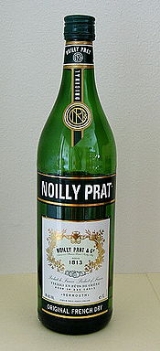
Vermouth

Encyclopedia
Fortified wine
Fortified wine is wine to which a distilled beverage has been added. Fortified wine is distinguished from spirits made from wine in that spirits are produced by means of distillation, while fortified wine is simply wine that has had a spirit added to it...
flavored with various dry ingredients. The modern versions of the beverage were first produced around the late 18th and early 19th centuries in Italy
Italy
Italy , officially the Italian Republic languages]] under the European Charter for Regional or Minority Languages. In each of these, Italy's official name is as follows:;;;;;;;;), is a unitary parliamentary republic in South-Central Europe. To the north it borders France, Switzerland, Austria and...
and France
France
The French Republic , The French Republic , The French Republic , (commonly known as France , is a unitary semi-presidential republic in Western Europe with several overseas territories and islands located on other continents and in the Indian, Pacific, and Atlantic oceans. Metropolitan France...
. Vermouth was consumed as a medicinal libation until the latter 19th century when it became an important ingredient in many of the first classic cocktail
Cocktail
A cocktail is an alcoholic mixed drink that contains two or more ingredients—at least one of the ingredients must be a spirit.Cocktails were originally a mixture of spirits, sugar, water, and bitters. The word has come to mean almost any mixed drink that contains alcohol...
s, such as the martini
Martini (cocktail)
The martini is a cocktail made with gin and vermouth, and garnished with an olive or a lemon twist. Over the years, the martini has become one of the best-known mixed alcoholic beverages. H. L. Mencken called the martini "the only American invention as perfect as the sonnet" and E. B...
.
Grape wine
Wine
Wine is an alcoholic beverage, made of fermented fruit juice, usually from grapes. The natural chemical balance of grapes lets them ferment without the addition of sugars, acids, enzymes, or other nutrients. Grape wine is produced by fermenting crushed grapes using various types of yeast. Yeast...
is used as the base ingredient for vermouth. Each manufacturer adds additional alcohol
Ethanol
Ethanol, also called ethyl alcohol, pure alcohol, grain alcohol, or drinking alcohol, is a volatile, flammable, colorless liquid. It is a psychoactive drug and one of the oldest recreational drugs. Best known as the type of alcohol found in alcoholic beverages, it is also used in thermometers, as a...
and a proprietary mixture of dry ingredients, consisting of aromatic herb
Herb
Except in botanical usage, an herb is "any plant with leaves, seeds, or flowers used for flavoring, food, medicine, or perfume" or "a part of such a plant as used in cooking"...
s, root
Root
In vascular plants, the root is the organ of a plant that typically lies below the surface of the soil. This is not always the case, however, since a root can also be aerial or aerating . Furthermore, a stem normally occurring below ground is not exceptional either...
s, and bark
Bark
Bark is the outermost layers of stems and roots of woody plants. Plants with bark include trees, woody vines and shrubs. Bark refers to all the tissues outside of the vascular cambium and is a nontechnical term. It overlays the wood and consists of the inner bark and the outer bark. The inner...
s, to the base wine, which is then bottled and sold. Two main types of vermouth, sweet and dry, are produced, and it comes in various colors, but primarily pale or red. In addition to being consumed as a drink or cocktail
Cocktail
A cocktail is an alcoholic mixed drink that contains two or more ingredients—at least one of the ingredients must be a spirit.Cocktails were originally a mixture of spirits, sugar, water, and bitters. The word has come to mean almost any mixed drink that contains alcohol...
ingredient, vermouth is sometimes used as a substitute for white wine in cooking. French and Italian companies produce most of the vermouth consumed throughout the world.
Etymology and history
The name "vermouth" comes from the GermanGerman language
German is a West Germanic language, related to and classified alongside English and Dutch. With an estimated 90 – 98 million native speakers, German is one of the world's major languages and is the most widely-spoken first language in the European Union....
word Wermut for wormwood
Artemisia absinthium
Artemisia absinthium is a species of wormwood, native to temperate regions of Eurasia and northern Africa....
that has been used as an ingredient in the drink over its history. Fortified wines containing wormwood as a principal ingredient existed in Germany
Germany
Germany , officially the Federal Republic of Germany , is a federal parliamentary republic in Europe. The country consists of 16 states while the capital and largest city is Berlin. Germany covers an area of 357,021 km2 and has a largely temperate seasonal climate...
around the 16th century. An Italian merchant, named D'Alessio, around the same time began producing a similar product in Piedmont
Piedmont
Piedmont is one of the 20 regions of Italy. It has an area of 25,402 square kilometres and a population of about 4.4 million. The capital of Piedmont is Turin. The main local language is Piedmontese. Occitan is also spoken by a minority in the Occitan Valleys situated in the Provinces of...
as a "wormwood wine." By the mid-17th century, the drink was popular in England
England
England is a country that is part of the United Kingdom. It shares land borders with Scotland to the north and Wales to the west; the Irish Sea is to the north west, the Celtic Sea to the south west, with the North Sea to the east and the English Channel to the south separating it from continental...
under the name "vermouth" which has been the common name for the beverage until the present day.
Consumption of wines fortified with herbs and/or roots is believed to have begun in ancient Greece
Ancient Greece
Ancient Greece is a civilization belonging to a period of Greek history that lasted from the Archaic period of the 8th to 6th centuries BC to the end of antiquity. Immediately following this period was the beginning of the Early Middle Ages and the Byzantine era. Included in Ancient Greece is the...
around 400 BC
Anno Domini
and Before Christ are designations used to label or number years used with the Julian and Gregorian calendars....
. The extra ingredients were added to wine to make it a medicinal drink, but may have also had the purpose of masking foul odors and flavors as the wine spoiled over time. A popular ingredient was wormwood, based on the belief that it was effective at treating stomach disorders and intestinal parasite
Intestinal parasite
Intestinal parasites are parasites that populate the gastro-intestinal tract in humans and other animals. They can live throughout the body, but most prefer the intestinal wall. Means of exposure include: ingestion of undercooked meat, drinking infected water, and skin absorption...
s. D'Alessio's version of the libation contained other botanical ingredients in addition to wormwood. Competing brands developed shortly thereafter in eastern and southeastern France contained their own, proprietary mix of ingredients, including herbs, roots, and spices.
Over time, two distinct versions of vermouth became established, one pale, dry, and bitter, and the other red and sweeter. Merchant Antonio Benedetto Carpano
Antonio Benedetto Carpano
Antonio Benedetto Carpano was an Italian distiller, famous for having invented Vermouth and consequently the apéritif....
introduced the first sweet vermouth in 1786 in Turin
Turin
Turin is a city and major business and cultural centre in northern Italy, capital of the Piedmont region, located mainly on the left bank of the Po River and surrounded by the Alpine arch. The population of the city proper is 909,193 while the population of the urban area is estimated by Eurostat...
, Italy
Italy
Italy , officially the Italian Republic languages]] under the European Charter for Regional or Minority Languages. In each of these, Italy's official name is as follows:;;;;;;;;), is a unitary parliamentary republic in South-Central Europe. To the north it borders France, Switzerland, Austria and...
. The drink reportedly quickly became popular with the royal court of Turin
House of Savoy
The House of Savoy was formed in the early 11th century in the historical Savoy region. Through gradual expansion, it grew from ruling a small county in that region to eventually rule the Kingdom of Italy from 1861 until the end of World War II, king of Croatia and King of Armenia...
. Around 1800 to 1813, the first pale, dry vermouth was produced in France by Joseph Noilly. However, not all pale vermouths produced over time have been dry, and not all red vermouths have been sweet.
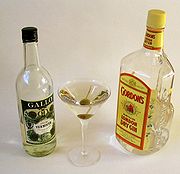
Martini (cocktail)
The martini is a cocktail made with gin and vermouth, and garnished with an olive or a lemon twist. Over the years, the martini has become one of the best-known mixed alcoholic beverages. H. L. Mencken called the martini "the only American invention as perfect as the sonnet" and E. B...
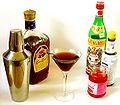
(beginning in the 1860s) and the Manhattan
Manhattan (cocktail)
A Manhattan is a cocktail made with whiskey, sweet vermouth, and bitters. Commonly used whiskeys include rye , Canadian whisky , bourbon, blended whiskey and Tennessee whiskey. The cocktail is often stirred with ice and strained into a cocktail glass, where it is garnished with a Maraschino cherry...
(beginning around 1874). In addition, the popular Vermouth Cocktail, first appearing in 1869, consisted of chilled vermouth and a twist of lemon peel with the occasional addition of small amounts of bitters
Bitters
A bitters is an alcoholic beverage that is flavored with herbal essences and has a bitter or bittersweet flavor. There are numerous brands of bitters that were formerly marketed as patent medicines but are now considered to be digestifs, rather than medicines...
or maraschino
Maraschino
Maraschino .The liqueur's distinctive flavor comes from the Marasca cherries, and the crushed cherry pits lend an almond-like flavor to Maraschino...
. The popularity of vermouth-heavy cocktails, often using twice as much vermouth as gin or whiskey, continued through the 1880s and 1890s. Although the amount of vermouth used in cocktail recipes has somewhat declined, it is still used today as an ingredient in many popular cocktails, and for that reason demand for the beverage has remained fairly steady through the 20th and into the 21st centuries.
Production, ingredients, and flavors
Several wine grapes, including Clairette blanche, PiquepoulPiquepoul
Piquepoul or Picpoul is a variety of wine grape grown primarily in the Rhone Valley and Languedoc regions of France. It exists both in dark-skinned and light-skinned versions, as well as a very little grown Piquepoul gris...
, Catarratto
Catarratto
Catarratto is a white Italian wine grape planted primarily in Sicily where it is the most widely planted grape. Overproduction in recent years has led to this grape being a substantial contributor to the European wine lake problem...
and Trebbiano
Trebbiano
Trebbiano is the second most widely planted grape in the world. It gives good yields, but makes undistinguished wine at best. It can be fresh and fruity, but does not keep long. Its high acidity makes it important in Cognac production...
, are generally used as the base ingredients for vermouths. From these grapes, a low-alcohol white wine is produced by vermouth manufacturers. The wine may be aged for a short while before the addition of other ingredients. For sweet vermouths, sugar syrup is added before the wine is fortified with extra alcohol. The added alcohol is usually grape spirit, but may also come from vegetable sources such as sugar beet
Sugar beet
Sugar beet, a cultivated plant of Beta vulgaris, is a plant whose tuber contains a high concentration of sucrose. It is grown commercially for sugar production. Sugar beets and other B...
s. The wine is then placed in large barrels or tanks to which the dry ingredients have already been added. The mixture is stirred off-and-on until the dry ingredients have been absorbed and the drink is ready for bottling. Caramel color is added to make red vermouths. Most vermouths are bottled at 17% ABV
ABV
ABV is a three-letter acronym that may refer to:* Alcohol by volume, a measure of the alcohol content of alcoholic drinks* Nnamdi Azikiwe International Airport, Abuja, Nigeria, from its IATA airport code...
, as compared with the 9–12% ABV of most unfortified wines.
Dry ingredients often used in vermouths include cloves, cinnamon
Cinnamon
Cinnamon is a spice obtained from the inner bark of several trees from the genus Cinnamomum that is used in both sweet and savoury foods...
, quinine
Quinine
Quinine is a natural white crystalline alkaloid having antipyretic , antimalarial, analgesic , anti-inflammatory properties and a bitter taste. It is a stereoisomer of quinidine which, unlike quinine, is an anti-arrhythmic...
, citrus peel
Zest (ingredient)
Zest is a food ingredient that is prepared by scraping or cutting from the outer, colorful skin of citrus fruits such as lemon, orange, citron, and lime. Zest is used to add flavor to foods....
, cardamom
Cardamom
Cardamom refers to several plants of the genera Elettaria and Amomum in the ginger family Zingiberaceae. Both genera are native to India and Bhutan; they are recognised by their small seed pod, triangular in cross-section and spindle-shaped, with a thin papery outer shell and small black seeds...
, marjoram
Marjoram
Marjoram is a somewhat cold-sensitive perennial herb or undershrub with sweet pine and citrus flavours...
, chamomile
Chamomile
Chamomile or camomile is a common name for several daisy-like plants of the family Asteraceae. These plants are best known for their ability to be made into an infusion which is commonly used to help with sleep and is often served with either honey or lemon. Because chamomile can cause uterine...
, coriander
Coriander
Coriander is an annual herb in the family Apiaceae. Coriander is native to southern Europe and North Africa to southwestern Asia. It is a soft, hairless plant growing to tall. The leaves are variable in shape, broadly lobed at the base of the plant, and slender and feathery higher on the...
, juniper
Juniper
Junipers are coniferous plants in the genus Juniperus of the cypress family Cupressaceae. Depending on taxonomic viewpoint, there are between 50-67 species of juniper, widely distributed throughout the northern hemisphere, from the Arctic, south to tropical Africa in the Old World, and to the...
, hyssop
Hyssop
Hyssop is a genus of about 10-12 species of herbaceous or semi-woody plants in the family Lamiaceae, native from the east Mediterranean to central Asia. They are aromatic, with erect branched stems up to 60 cm long covered with fine hairs at the tips. The leaves are narrow oblong, 2–5 cm...
, and ginger
Ginger
Ginger is the rhizome of the plant Zingiber officinale, consumed as a delicacy, medicine, or spice. It lends its name to its genus and family . Other notable members of this plant family are turmeric, cardamom, and galangal....
. The prohibition of wormwood as a drink ingredient in the early 20th century in some countries sharply reduced its use in vermouth, but small amounts of the herb are still sometimes included. Vermouth brand recipes vary, with most manufacturers marketing their own unique flavor and version of the beverage. Vermouth manufacturers keep their recipes for the drink secret.
Sweet vermouths usually contain 10–15% sugar. The sugar content in dry vermouths generally does not exceed 4%. Dry vermouths usually are lighter in body than sweet vermouths.
In addition to pale and red vermouths, there exists golden and rosé versions, but these are not as internationally popular. The region of Chambéry
Chambéry
Chambéry is a city in the department of Savoie, located in the Rhône-Alpes region in southeastern France.It is the capital of the department and has been the historical capital of the Savoy region since the 13th century, when Amadeus V of Savoy made the city his seat of power.-Geography:Chambéry...
in France has received an appellation d'origine contrôlée
Appellation d'Origine Contrôlée
Appellation d’origine contrôlée , which translates as "controlled designation of origin", is the French certification granted to certain French geographical indications for wines, cheeses, butters, and other agricultural products, all under the auspices of the government bureau Institut National...
for its vermouths, which include a strawberry-flavored version called Chambéryzette. Lillet
Lillet
Lillet is a brand of French aperitif wine. It is a blend of 85% Bordeaux wines and 15% macerated liqueurs, mostly citrus liqueurs from the peels of sweet oranges from Spain and Morocco and the peels of bitter green oranges from Haiti...
and Dubonnet
Dubonnet
Dubonnet is a sweet, wine-based aperitif. It is a blend of fortified wine, herbs, and spices , with fermentation being stopped by the addition of alcohol....
are fortified wines similar to vermouth, but are usually considered separate products.
The term "Italian vermouth" is often used to refer to red-colored, mildly bitter, and slightly sweet vermouths. These types of vermouths have also been called "rosso." The label "French vermouth" generally refers to pale, dry vermouths that are bitterer than sweet vermouths. The extra bitterness is often obtained by using nutmeg
Nutmeg
The nutmeg tree is any of several species of trees in genus Myristica. The most important commercial species is Myristica fragrans, an evergreen tree indigenous to the Banda Islands in the Moluccas of Indonesia...
and/or bitter orange peel in the drink recipe. Bianco is a name given to a type of pale, sweeter vermouth.
According to Stuart Walton and Brian Glover, vermouth "is as far removed from the natural produce of the vine as it is possible for a fortified wine to get." They add that there is no special connoisseur
Connoisseur
A connoisseur is a person who has a great deal of knowledge about the fine arts, cuisines, or an expert judge in matters of taste.Modern connoisseurship must be seen along with museums, art galleries and "the cult of originality"...
ship of vermouth, as it is an "everyday product made to a consistent and unchanging recipe by each manufacturer."
Beverage
Most cocktails using vermouth, and when drinking vermouth by itself, are apéritifApéritif and digestif
Apéritifs and digestifs are alcoholic drinks that are normally served with meals.-Apéritifs:An apéritif is usually served before a meal to stimulate the appetite. This contrasts with digestifs, which are served after a meal for the purpose of aiding digestion...
s, although sometimes drunk as a digestif. Vermouth is used as an ingredient in many different cocktails, as people found it ideal for lowering the alcohol content of cocktails with strong spirits as their base, for providing a pleasant herbal flavor and aroma, and for accentuating the flavors in the base liquor. As previously stated, vermouth is an ingredient in the martini, one of the most popular and well-known cocktails. At first, martinis used sweet vermouth. Around 1904, however, dryer French vermouths began to be used in the cocktail. The term "dry martini" originally meant using a dryer vermouth as a mixer, not using less vermouth, as the term is used today.
Sharon Tyler Herbst
Sharon K. Herbst was an American cookbook and culinary books author.Born as Sharon Tyler in Chicago, she was raised in Denver, Colorado...
's book, The Ultimate A-To-Z Bar Guide, lists 112 cocktails using dry vermouth and 82 containing sweet vermouth. Cocktails using either dry or sweet vermouth or both include the Americano
Americano (cocktail)
The Americano is a cocktail composed of Campari, sweet vermouth, and club soda. The cocktail was first served in creator Gaspare Campari's bar, Caffè Campari, in the 1860s. It was originally known as the "Milano-Torino" because of its ingredients: Campari, the bitter liqueur, is from Milan and...
, Bronx, Gibson
Gibson (cocktail)
The Gibson is a cocktail made with gin and vermouth, and garnished with a pickled onion. The drink bears great similarity to another cocktail, the martini, with the onion garnish being the only differentiating factor.-History:The exact origin of the Gibson is unclear, with numerous popular tales...
, Manhattan
Manhattan (cocktail)
A Manhattan is a cocktail made with whiskey, sweet vermouth, and bitters. Commonly used whiskeys include rye , Canadian whisky , bourbon, blended whiskey and Tennessee whiskey. The cocktail is often stirred with ice and strained into a cocktail glass, where it is garnished with a Maraschino cherry...
, Negroni
Negroni
The Negroni cocktail is made of one part gin, one part sweet vermouth, and one part bitters, traditionally Campari. It is considered an apéritif.-History:...
, Rob Roy, and Rose
Rose (cocktail)
Rose is a cocktail made of vermouth and cherry eau de vie....
. Variations of cocktail recipes using equal portions of dry and sweet vermouths are called perfect, as in a Perfect Manhattan.
The popularity of vermouth in the United States and Great Britain has declined since the mid-20th century, but is still used in those countries in many classic cocktails such as the Manhattan, albeit in smaller amounts. The drink is more popular in other parts of Europe, such as Italy and France, where it is often consumed by itself as an apéritif.
Cooking
Vermouth can be used as a substitute for white wine in food recipes. The herbs in dry vermouth reportedly make it an attractive ingredient in sauces for fish dishes or as a marinade for other meats, including pork and chicken.Because vermouth is fortified, an opened bottle will not sour as quickly as white wine. Opened vermouth, however, will gradually deteriorate over time. Gourmand
Gourmand
A gourmand is a person who takes great pleasure in food. The word has different connotations from the similar word gourmet, which emphasises an individual with a highly refined discerning palate, but in practice the two terms are closely linked, as both imply the enjoyment of good food.An older...
s recommend that opened bottles of vermouth be consumed within one to three months and should be kept refrigerated to slow oxidation
Redox
Redox reactions describe all chemical reactions in which atoms have their oxidation state changed....
.
Major brands
The Carpano family continues to operate as a producer of vermouth. Their Punt e MesPunt e Mes
Punt e Mes is an Italian vermouth. It is dark brown in color and has a bitter flavour. Punt e Mes literally means "point and a half" in Piedmontese. It has been said that it owes its name to a sudden raise of the stock market which greatly benefitted the Carpano distilleries, which then created...
is a deep red vermouth with sweet and bitter flavors. The company also produces the Antica Formula brand, a bitter, fuller-flavored version of vermouth. Other Italian producers are Riccadonna, Boissiere, Gallo, and Gancia
Gancia
Gancia is an Italian wine-making company. It was founded in 1850 by Carlo Gancia in the Piemonte region of Italy, and was a pioneer in creating the first Italian sparkling wine...
.
The Cinzano
Cinzano
Cinzano is an Italian brand of vermouth, a brand owned since 1999 by Gruppo Campari. It comes in four versions:*Cinzano Rosso, which is amber-coloured;*Cinzano Bianco, which is white and drier than Rosso, yet still considered a sweet vermouth;...
family began production in 1816 in Turin. Their Bianco product is a sweet, pale vermouth. Other offerings from Cinzano include a sweet Rouge and a pale Extra Dry. Also based in Turin is Martini & Rossi
Martini & Rossi
Martini & Rossi is an Italian multinational alcoholic beverage company primarily associated with the Martini brand of vermouth and also with sparkling wine . It also produces the French vermouth, Noilly Prat.-History:...
, the top-selling international brand of vermouth, which started in 1863 and produces both dry and sweet vermouths, but is most known for its Rosso. Cinzano and Martini & Rossi also produce rose′ vermouths, which are mainly distributed in Italy and France.
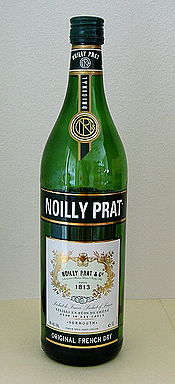
Noilly Prat
Noilly Prat
Noilly Prat was originally a dry, straw-hued vermouth from Marseillan, in the Hérault département of southern France. Joseph Noilly, a herbalist, developed the first formula in 1813. It was the first example of a dry vermouth and is among the golden, straw and white vermouths generally known as...
, based in southern France, is primarily known for its dry, pale vermouths, but also produces a sweeter version. The company was founded by Joseph Noilly in 1813. By 1855, Joseph's son, Louis, and his brother-in-law, Claudius Prat, were producing Noilly Prat dry vermouth in Marseillan, Hérault
Marseillan, Hérault
Marseillan is a commune in the Hérault department in southern France.It lies some west of Montpellier.Marseillan sits on a large salt-water lake, the Étang de Thau and is the southern Entreport for the Canal du Midi....
. Another French producer is Dolin, known for lighter vermouths.
Vya, established in 1999, is an American vermouth produced in Madera County, California
Madera County, California
Madera County is a county of the U.S. state of California, located in the Central Valley and the Sierra Nevada north of Fresno County. It comprises the Madera-Chowchilla, CA Metropolitan Statistical Area. As of the 2010 census the population was 150,865...
. Vya's drink is made from orange muscat
Muscat (grape and wine)
The Muscat variety of grapes of the species Vitis vinifera is widely grown for wine, raisins and table grapes. Their color ranges from white to near black. Muscat almost always has a pronounced sweet floral aroma. Muscat grapes are grown around the world...
grapes combined with port wine
Port wine
Port wine is a Portuguese fortified wine produced exclusively in the Douro Valley in the northern provinces of Portugal. It is typically a sweet, red wine, often served as a dessert wine, and comes in dry, semi-dry, and white varieties...
and dry ingredients to make a rich, spicy vermouth. Two other California vermouth producers include Sutton Cellars and King Eider.
Imbue, established in 2010, is an American vermouth produced in Portland, Oregon
Portland, Oregon
Portland is a city located in the Pacific Northwest, near the confluence of the Willamette and Columbia rivers in the U.S. state of Oregon. As of the 2010 Census, it had a population of 583,776, making it the 29th most populous city in the United States...
. Imbue's recipe is made from Pinot gris
Pinot gris
Pinot gris is a white wine grape variety of the species Vitis vinifera. Thought to be a mutant clone of the Pinot noir grape, it normally has a grayish-blue fruit, accounting for its name but the grape can have a brownish pink to black and even white appearance...
grapes and Eau de vie
Eau de vie
An eau de vie is a clear, colorless fruit brandy that is produced by means of fermentation and double distillation...
brandy.