
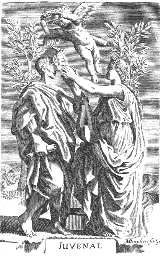
| |
The Satires are a collection of satirical poems by the Latin author Juvenal written in the late 1st and early 2nd centuries A.D.
Juvenal is credited with sixteen known poems divided among five books; all are in the Roman genre of Satire, which, at its most basic in the time of the author, comprised a wide-ranging discussion of society and social mores in dactylic hexameter.

Discussion
Ask a question about 'Juvenal'
Start a new discussion about 'Juvenal'
Answer questions from other users
|
Quotations
Cantabit vacuus coram latrone viator.
Translation: The traveller with empty pockets will sing in the thief's face., X, line 22
Dat veniam corvis, vexat censura columbas.
Translation: Censure pardons the raven, but is visited upon the dove., II, line 63
Difficile est saturam non scribere.
Translation: It is difficult not to write satire., I, line 30
Hic vivimus ambitiosa paupertate omnes.
We all live in a state of ambitious poverty., III, line 182
Maxima debetur puero reverentia.
Translation: The greatest reverence is due the young., XIV, line 47
Nobilitas sola est atque unica virtus.
Translation: Nobility is the one and only virtue., VIII, line 20

Encyclopedia
The Satires are a collection of satirical poems by the Latin author Juvenal written in the late 1st and early 2nd centuries A.D.
Juvenal is credited with sixteen known poems divided among five books; all are in the Roman genre of Satire, which, at its most basic in the time of the author, comprised a wide-ranging discussion of society and social mores in dactylic hexameter. These five books were discrete works, and there is no reason to assume that they were published at the same time or that they are identical in theme or in approach. The poems are not individually titled, but translators have often added titles for the convenience of readers.
- Book I: Satires 1-5
- Book II: Satire 6
- Book III: Satires 7-9
- Book IV: Satires 10-12
- Book V: Satires 13-16 (Satire 16 is incompletely preserved)
Roman Satura was a formal literary genre rather than being simply clever, humorous critique in no particular format. Juvenal wrote in this tradition, which originated with Lucilius and included the Sermones of Horace and the Satires of Persius. In a tone and manner ranging from irony to apparent rage, Juvenal criticizes the actions and beliefs of many of his contemporaries, providing insight more into value systems and questions of morality and less into the realities of Roman life. The author employs outright obscenity less frequently than Martial or Catullus, but the scenes painted in his text are no less vivid or lurid for that discretion.
The author makes constant allusion to history and myth as a source of object lessons or exemplars of particular vices and virtues. Coupled with his dense and elliptical Latin, these tangential references indicate that the intended reader of the Satires was highly educated. The Satires are concerned with perceived threats to the social continuity of the Roman citizens: social-climbing foreigners, unfaithfulness, and other more extreme excesses of their own class. The intended audience of the Satires constituted a subset of the Roman elite, primarily adult males of a more conservative social stance.
Synopsis of the Satires
Book I
Satire I: It is Hard not to Write Satire
171 lines. This so-called "Programmatic Satire" lays out for the reader a catalogue of ills and annoyances that prompt the narrator to write satire. Some examples cited by Juvenal include eunuchs getting married, elite women performing in a beast hunt, and the dregs of society suddenly becoming wealthy by gross acts of sycophancy. To the extent that it is programmatic, this satire concerns the first book rather than the satires of the other four known books. The narrator explicitly marks the writings of Lucilius as the model for his book of poems (lines 19-20), although he claims that to attack the living as his model did incur great risk (lines 165-67). The narrator contends that traditional Roman virtues, such as fides and virtus, had disappeared from society to the extent that "Rome was no longer Roman":
- lines 1.1-19 – Since there are so many poets wasting paper and everyone’s time anyway – why not write?
- lines 1.20-80 – The narrator recites a catalogue of social deviants and criminals that demand Satire be written.
- lines 1.81-126 – Since the dawn of history, greed and fiscal corruption have never been worse.
- lines 1.127-146 – The narrator contrasts a typical day in the life of poor clients with that of their self-indulgent patron.
- lines 1.147-171 – The future cannot be worse than the present, yet only the dead better be satirized - if you want to live in safety.
Satire II: Hypocrites are Intolerable
170 lines. The narrator claims to want to flee civilization (i.e. Roma) to beyond the world’s end when confronted by moral hypocrisy. Although the broad theme of this poem is the process of gender inversion, it would be an error to take is as simple invective against pathic men. Juvenal is concerned with gender deviance
- lines 2.1-35 – Pathic men that pretend to be moral exemplars are much worse than those who are open about their proclivities. The pot should not call the kettle black.
- lines 2.36-65 – When criticized for her morals, Laronia turns on one of these hypocrites and mocks their open effeminacy.
- lines 2.65-81 – Criticism of the effeminate dress of Creticus as he practices law. This moral plague (contagio) spreads like disease passes through an entire herd of livestock or a bunch of grapes.
- lines 2.82-116 – Effeminate dress is the gateway to complete gender inversion.
- lines 2.117-148 – A noble man, Gracchus, gets married to another man – but such brides are infertile no matter what drugs they try or how much they are whipped in the Lupercalia.
- lines 2.149-170 – The ghosts of great Romans of the past would feel themselves contaminated when such Romans descend to the underworld.
Satire III: There is no Room in Roma for a Roman
322 lines. In the place where Numa Pompilius (the legendary second king of Rome) received a nymph’s advice on creating Roman law, the narrator has a final conversation with his Roman friend Umbricius, who is emigrating to Cumae. Umbricius claims that slick and immoral foreigners have shut a real Roman out of all opportunity to prosper. Only the first 20 lines are in the voice of the narrator; the remainder of the poem is cast as the words of Umbricius.
In 1738, Samuel Johnson was inspired by this text to write his "London: A Poem in Imitation of the Third Satire of Juvenal". The archetypal question of whether an urban life of hectic ambition is to be preferred to a pastoral fantasy retreat to the country is posed by the narrator:
- lines 3.1-20 – The narrator’s old friend Umbricius is about to depart Roma for Cumae. The narrator says he would himself prefer Prochyta to the Suburra, and he describes the ancient shrine of Egeria being put up for rent to Jews and polluted by marble.
- lines 3.21-57 – Umbricius: There is no opportunity in Roma for an honest man.
- lines 3.58-125 – Umbricius: The Greeks and their ways are flowing like pollution into Roma, and they are so adept at lying flattery that they are achieving more social advancement that real Romans.
- lines 3.126-163 – Umbricius: The dregs of society so long as they are wealthy lord it over real Romans; there is no hope for an honest man in court if he is poor.
- lines 3.164-189 – Umbricius: Virtue and lack of pretension is only to be found outside the City; at Roma everything is expensive, pretentious, and bought on credit.
- lines 3.190-231 – Umbricius contrasts the perils and degradation of living in Roma with the easy and cheap life outside the City.
- lines 3.232-267 – Umbricius: The streets of Roma are annoying and dangerous if you are not rich enough to ride in a litter.
- lines 3.268-314 – Umbricius: Travel by night in Roma is fraught with danger from falling tiles, thugs, and robbers.
- lines 3.315-322 – Umbricius takes his leave of the narrator, and promises to visit him in his native Aquinum.
Satire IV: The Emperor’s Fish
154 lines. The narrator makes the emperor Domitian and his court the objects of his ridicule in this mock-epic tale of a fish so prodigious that it was fit for the emperor alone. The council of state is called to deal with the crisis of how to cook it. The main themes of this poem are the corruption and incompetence of sycophantic courtiers and the inability or unwillingness to speak truth to power.
Jean-Jacques Rousseau's motto, vitam impendere vero (to pay his life for the truth) is taken from the passage below, a description of the qualifications of an imperial courtier in the reign of Domitian:
- lines 4.1-10 – Criticism of the courtier Crispinus.
- lines 4.11-33 – Crispinus bought a mullet for six thousand sesterces - more expensive than the fisherman that caught him.
- lines 4.34-56 – Mock-epic narrative of the crisis of state caused by a giant turbot begins with the catch.
- lines 4.56-72 – The fisherman rushes to get the fish to the emperor.
- lines 4.72-93 – Crispinus and other councilors begin to arrive.
- lines 4.94-143 – More councilors arrive and one prophesizes that the fish is an omen of a future victory. The question of what to do with it is raised, and Montanus advises that a vessel be manufactured at once suitable for its size.
- lines 4.144-154 – The council break up, and the narrator voices his wish that all the actions of Domitian had been so meaningless.
Satire V: Patronizing Patronage
173 lines. The narrative frame of this poem is a dinner party where many potential dysfunctions in the ideal of the patron-client relationship are put on display. Rather than being a performance of faux-equality, the patron (Virro as in 9.35) emphasizes the superiority of himself and his peers (amici) over his clients (viles amici) by offering food and drink of unequal quality to each. Juvenal concludes with the observation that the clients who put up with this treatment deserve it.
- lines 5.1-11 – Begging is better than being treated disrespectfully at a patron's dinner.
- lines 5.12-23 – An invitation to dinner is a social exchange for your services as a client.
- lines 5.24-48 – Different wines and goblets for different social ranks.
- lines 5.49-106 – Different water is served by different grades of slaves - and different breads served by arrogant slaves. The patron gets a lobster, and you get a crayfish; he gets a Corsican mullet, and you get a sewer-fish.
- lines 5.107-113 – Seneca and others were known for their generosity. The elite should dine as equals with their friends - clients.
- lines 5.114-124 – The patron gets a goose liver and boar meat, but you get to watch the meat carver perform.
- lines 5.125-155 – If you had a fortune the patron would respect you; it is the cash that he really respects. Different mushrooms and apples.
- lines 5.156-173 – Clients who will not resist this kind of treatment deserve it and worse.
Book II
Satire VI: Death is Better than Marriage
c. 695 lines. For the discussion and synopsis, see Satire VI.
Book III
Satire VII: Fortuna (or the Emperor) is the Best Patron
243 lines. Juvenal returns to his theme of distorted economic values among the Roman elite – in this instance centered on their unwillingness to provide appropriate support for poets, lawyers, and teachers. It is the capricious whims of fate that determine the variables of a human life.
- lines 7.1-21 – The emperor is the only remaining patron of letters.
- lines 7.22-35 – Other patrons have learned to offer their admiration only.
- lines 7.36-52 – The urge to write is an addictive disease.
- lines 7.53-97 – Money and leisure are required to be a really great poet (vatis); hunger and discomfort would have hobbled even Virgil.
- lines 7.98-105 – Historians (scriptores historiarum) do not have it any better.
- lines 7.106-149 – Lawyers (causidici) get only as much respect as the quality of their dress can buy.
- lines 7.150-177 – No one is willing to pay teachers of rhetoric (magistri) appropriately.
- lines 7.178-214 – Rich men restrain only their spending on a teacher of rhetoric (rhetor) for their sons. Quintilian was rich, he was the lucky exception to the rule.
- lines 7.215-243 – The qualifications and efforts required of a teacher (grammaticus) are totally out of proportion to their pay.
Satire VIII: True Nobility
275 lines. The narrator takes issue with the idea that pedigree ought to be taken as evidence of a person’s worth.
- lines 8.1-38 – What is the value of a pedigree, if you are inferior to your ancestors?
- lines 8.39-55 – Many nobles have done nothing to makes themselves noble.
- lines 8.56-70 – Racehorses are valued for their speed not their ancestors; if they are slow they will end up pulling a cart.
- lines 8.71-86 – It is vile to rely on the reputations of others; one should be noble even in the face of danger.
- lines 8.87-126 – Govern your province honestly. When everything else is stolen from those you rule, weapons and desperation remain.
- lines 8.127-162 – If you live wickedly, your good ancestors are a reproach to you.
- lines 8.163-182 – Bad behavior should be ceased in youth. The nobles make excuses for behavior that would not be tolerated in slaves.
- lines 8.183-210 – When they bankrupt themselves, the nobles may sink to the level of the stage or the arena.
- lines 8.211-230 – The emperor Nero utterly debased himself in these ways.
- lines 8.231-275 – Many people without famous ancestors have served Roma with great distinction. Indeed, everyone is descended from peasants or worse if you go back far enough.
Satire IX: Flattering your Patron is Hard Work
150 lines. This satire is in the form of a dialogue between the narrator and Naevolus – the disgruntled client of a pathic patron.
- lines 9.1-26 – Narrator: Why do you look so haggard Naevolus?
- lines 9.27-46 – Naevolus: The life of serving the needs of pathic rich men is not paying off.
- lines 9.46-47 – Nar: Buy you used to think you were really sexy to men.
- lines 9.48-69 – Nae: Rich pathics are not willing to spend on their sickness, but I have bills to pay.
- lines 9.70-90 – Nae: I saved his marriage by doing his job for him with a wife that was about to get a divorce.
- lines 9.90-91 – Nar: You are justified in complaining Naevius. What did he say?
- lines 9.92-101 – Nae: He is looking for another two-legged donkey, but don’t repeat any of this, he might try to kill me.
- lines 9.102-123 – Nar: Rich men have no secrets.
- lines 9.124-129 – Nae: But what should I do now; youth is fleeting.
- lines 9.130-134 – Nar: You will never lack a pathic patron, don’t worry.
- lines 9.134-150 – Nae: But I want so little. Fortuna must have her ears plugged when I pray.
Book IV
Satire X: Wrong Desire is the Source of Suffering
366 lines. The theme of this poem encompasses the myriad objects of prayer unwisely sought from the gods: wealth, power, beauty, children, long life, etcetera. The narrator argues that each of these is a false Good; each desired thing is shown to be not good in itself, but only good so long as other factors do not intervene. This satire is the source of the well-known phrase "mens sana in corpore sano" (a healthy mind in a healthy body), which appears in the passage above. It is also the source of the phrase "panem et circenses" (bread and circuses) - the only remaining cares of a Roman populace which has given up its birthright of political freedom (10.81).
- lines 10.1-27—Few know what is really Good. Wealth often destroys.
- lines 10.28-55—One can either cry like Heraclitus or laugh like Democritus at the state of things. But what should men pray for?
- lines 10.56-89—It is all too easy to fall from power - like Sejanus. The mob follows Fortuna and cares for nothing but bread and circuses.
- lines 10.90-113—By seeking ever more honors and power, Sejanus just made his eventual fall that much more terrible.
- lines 10.114-132—Being a great orator like Demosthenes or Cicero may get one killed.
- lines 10.133-146—Lust for military glory has ruined countries, and time will destroy even the graves of famous generals.
- lines 10.147-167—What did Hannibal ultimately accomplish? He dies of poison in exile.
- lines 10.168-187—The world was not big enough for Alexander the Great, but a coffin was. Xerxes I crawled back to Persia after his misadventure in Greece.
- lines 10.188-209—Long life just means ugliness, helplessness, impotence, and the loss of all pleasure.
- lines 10.209-239—Old people are deaf and full of diseases. Dementia is the worst affliction of all.
- lines 10.240-272—Old people just live to see the funerals of their children and loved ones, like Nestor or Priam.
- lines 10.273-288—Many men would have been thought fortunate if they had died before a late disaster overtook them: e.g. Croesus, Marius, and Pompey.
- lines 10.289-309—Beauty is inimical to a person’s virtue. Even if they remain untouched by corruption, it makes them objects of lust for perverts.
- lines 10.310-345—Beautiful men tend to become noted adulterers, risking their lives. Even if they are unwilling like Hippolytus, the wrath of scorned women may destroy them.
- lines 10.346-366—Is there nothing to pray for then? Trust the gods to choose what is best; they love humans more than we do ourselves, but if you must pray for something, see the translation above.
Satire XI: Dinner and a Moral
208 lines. The main themes of this poem are self-awareness and moderation. The poem explicitly mentions one apothegm ????? sea?t?? (know thyself) from the temple of Apollo at Delphi, while its theme calls to mind another µ?d?? ??a? (nothing in excess). The subject, in this instance, is the role of food and the cena (formal dinner) in Roman society. The narrator contrasts the ruinous spending habits of gourmands with the moderation of a simple meal of home-grown foods in the manner of the mythical ancient Romans.
- lines 11.1-55 – People that refuse to limit their gourmet habits, even in the face of having to do so on credit, soon endure poverty and consequently inferior food. The advice of Apollo to know thyself should be heeded - not just for ambitions and endeavors, but also for what should be spent on a fish.
- lines 11.56-89 – The narrator invites a Persicus to come to his house for dinner to see whether his actions match his rhetoric. The dinner will include only home-grown foods from the narrator’s Tiburtine land. Long ago, the noble Curius cooked things for himself that a slave on a chain-gang would reject now.
- lines 11.90-119 – The ancient Romans did not care for luxuries and Greek art. A Jupiter made of terracotta saved the city from the Gauls.
- lines 11.120-135 – Now rich people get no enjoyment from delicacies unless they eat from tables decorated with ivory. The narrator claims that his food is unharmed, despite owning no ivory.
- lines 11.136-161 – The narrator promises no professional meat carver or exotic slave servers, nor are his slave boys destined for emasculation and use as sexual toys.
- lines 11.162-182 – In place of a pornographic Spanish dance show, there will be poetry.
- lines 11.183-208 – Rather than endure the annoyance of all Roma at the Circus Maximus during the Megalensian Games, the narrator invites his addressee to shake off his cares and come to a simple dinner.
Satire XII: True Friendship
130 lines. The narrator describes to his addressee Corvinus the sacrificial vows that he has made for the salvation of his friend Catullus from shipwreck. These vows are to the primary Roman gods - Jupiter, Juno, and Minerva (the Capitoline Triad)- but other shipwrecked sailors are said to make offerings to Isis. In the passage quoted above, the narrator asserts that his sacrifices are not to curry favor or gain an inheritance, common reasons for making vows among those who would not hesitate to sacrifice their slaves or even children if it would bring them an inheritance.
- lines 12.1-29 – Description of the sacrificial preparations.
- lines 12.30-51 – Description of a storm: this friend had been willing to cast overboard items of great value to save his own life – who else would prefer his life to his treasures.
- lines 12.52-82 – They had to cut the mast due to the ferocity of the storm, but then the weather calmed and they limped their ship into the port at Ostia.
- lines 12.83-92 – The narrator orders that the altar and sacrifice be made ready. He says that he will propitiate his Lares (family gods) as well.
- lines 12.93-130 – Catullus has heirs, so the narrator is acting as a friend not a legacy-hunter (captator). Legacy hunters would sacrifice one hundred cattle, elephants, slaves, or even their own child if it secured an inheritance for them.
Book V (incomplete)
Satire XIII: Don’t Obsess over Liars and Crooks
249 lines. This poem is a dissuasion from excessive rage and the desire for revenge when one is defrauded. The narrator recommends a philosophical moderation and the perspective that comes from realizing that there are many things worse than financial loss.
- lines 13.1-18 – Guilt is its own punishment. One should not overreact to ill-use.
- lines 13.19-70 – Philosophy and life-experience offer a defense against Fortuna. There are hardly as many good people as the gates of Egyptian Thebes (100) or even as the mouths of the Nile (9). The Golden Age was infinitely superior to the present age, an age so corrupt there is not even an appropriate metal to name it.
- lines 13.71-85 – Perjurers will swear on the arms of all the gods to deny their debts.
- lines 13.86-119 – Some believe that everything is a product of chance, and so do not fear to perjure themselves on the altars of the gods. Others rationalize that the wrath of the gods, though great, is very slow in coming.
- lines 13.120-134 – It takes no philosopher to realize that there are many worse wrongs than being defrauded. A financial loss is mourned more than a death, and it is mourned with real tears.
- lines 13.135-173 – It is silly to be surprised by the number and magnitude of the crimes put to trial at Roma, as silly as to be surprised by a German having blue eyes.
- lines 13.174-209 – Even execution of a criminal would not undo their crime; only the uneducated think that revenge is a Good. That is not what the philosophers Chrysippos, Thales, or Socrates would say. The narrator makes an extended reference to the story of a corrupt Spartan’s consultation of the Oracle of Apollo at Delphi from Herodotus (6.86). The mere intention to do evil is guilt.
- lines 13.210-249 – Consciousness of one’s guilt is its own punishment, with anxiety and fear of divine retribution. The natura (nature) of criminals is fixa (stuck) and mutari nescia (unable to be changed), and it rushes back to ways they have admitted are wrong (239-40). Thus, criminals tend to repeat their crimes, and eventually end up facing execution or exile.
Satire XIV: Avarice is not a Family Value
331 lines. The narrator stresses that children most readily learn all forms of vice from their parents. Avarice must actually be taught since it runs counter to nature. This vice is particularly pernicious, since it has the appearance of a virtue and is the source of a myriad of crimes and cruelties.
- lines 14.1-37 – The greatest danger to the morals of children comes from the vices of their parents.
- lines 14.38-58 – People should restrain themselves from vice for the sake of their children. It is unjust for a father to criticize and punish a son who takes after himself.
- lines 14.59-85 – People are more concerned to present a clean atrium to outsiders than to keep their house free of vice for their children. The tastes acquired in childhood persist into adulthood.
- lines 14.86-95 – Caetronius squandered much of his wealth by building many fine houses; his son squandered the rest by doing the same.
- lines 14.96-106 – People learn to be Jewish from their parents.
- lines 14.107-134 – Avarice has the appearance of a virtue, but it leads to cruel deprivation of one’s slaves and one’s own self.
- lines 14.135-188 – It is madness to live like an indigent just to die rich. There is no amount of money or land that will satisfy greed, but ancient Romans veterans of the Punic wars or of the war against Pyrrhus were content with only two iugera (acres) of land in return for all their wounds. Impatient greed leads to crime.
- lines 14.189-209 – Become a lawyer, join the army, or become a merchant. Profit smells good, wherever it’s from. Nobody inquires into where you got it, but you have to have it.
- lines 14.210-255 – The greedy son will surpass his father as much as Achilles did Peleus. Instilling avarice is the same as teaching a child every form of crime. A son whom you have taught to have no mercy will have no mercy on you either.
- lines 14.256-283 – Those who take risks to increase their fortunes are like tightrope walkers. Fleets sail wherever there is hope of profit.
- lines 14.284-302 – Avaricious men are willing to risk their lives and fortunes just to have a few more pieces of silver with someone’s face and inscription on them.
- lines 14.303-316 – The anxiety of protecting wealth and possessions is a misery. Alexander the Great realized that the cynic Diogenes was happier than himself while living in his pottery home, since Alexander’s anxieties and dangers matched his ambitions, while Diogenes was content with what he had and could easily replace.
- lines 14.316-331 – How much is enough then? As much as Epicurus or Socrates was content to possess is best, or - in the Roman manner - a fortune equal to the equestrian order. If twice or three times that does not suffice, then not even the wealth of Croesus or of Persia will suffice.
Satire XV: People without Compassion are Worse than Animals
174 lines. The narrator discusses the centrality of compassion for other people to the preservation of civilization. While severe circumstances have at times called for desperate measures to preserve life, even the most savage tribes have refrained from cannibalism. We were given minds to allow us to live together in mutual assistance and security. Without limits on rage against our enemies, we are worse than animals.
- lines 15.1-26 – In Egypt they worship bizarre animal-headed gods, but not the familiar Roman ones. Similarly, they wont eat normal things, but do practice cannibalism. Ulysses must have been though a liar for his tale of the Laestrygonians or the Cyclopes.
- lines 15.27-32 – Recently in upper Egypt, an entire people was guilty of this crime.
- lines 15.33-92 – Two neighboring cities hated each other. One attacked while the other held a feast. Fists gave way to stones and then to arrows; as one side fled, one man slipped and was caught. He was ripped to pieces and eaten raw.
- lines 15.93-131 – The Vascones, however, were blameless, because they were compelled to cannibalism by the siege of Pompey the Great. Even at the altar of Artemis in Taurus, humans are only sacrificed, not eaten.
- lines 15.131-158 – Compassion is what separates humans from animals. The creator gave humans mind (animus) as well as life (vita), so that people could live together in a civil society.
Satire XVI: Soldiers are above the Law
60 lines preserved. The primary theme of the preserved lines is the advantages of soldiers over mere citizens.
- lines 16.1-6 – The narrator wishes that he could join the legions, since soldiers have many advantages over civilians.
- lines 16.7-34 – Soldiers are immune to justice since they have to be tried in the camp among other soldiers, where a plaintiff will get no help prosecuting them, and may get a beating in addition for their trouble.
- lines 16.35-50 – Soldiers do not have to wait for legal action like civilians
- lines 16.51-60 – Only soldiers have the right to make a will while their father lives – leading to an inversion of power with the soldier son being above his father.
External links
- , at The Latin Library
- in Latin and English (translation G. G. Ramsay) at the Internet Ancient History Sourcebook
- in Latin and English, at Vroma
|