
All Topics  
Metaphysics

 
Metaphysics

   Email Print
   Bookmark   Link


Metaphysics


Metaphysics investigates principles of reality transcending those of any particular science. Cosmology
Cosmology (metaphysics)

Cosmology is the branch of philosophy and metaphysics that deals with the world as the totality of all phenomena in space and time. Pre-socratic philosophers from the Ionian School are sometimes called cosmologists....
 and ontology
Ontology

Ontology in philosophy is the study of the nature of being, existence or reality in general, as well as of the basic category of being and their relations....
 are traditional branches of metaphysics. It is concerned with explaining the ultimate nature of being
Being

In ontology being is anything that can be said to be, either Transcendence or Immanence.The nature of being varies by philosophy, given different interpretations in the frameworks of Parmenides, Leucippus, Plato, Aristotle, Plotinus, Descartes, Spinoza, Leibniz, Hegel, Heidegger, and Sartre....
 and the world
World (philosophy)

In philosophy, the World is everything that makes up reality. While clarifying the concept of world has arguably always been among the basic tasks of Western philosophy, this theme appears to have been raised explicitly only at the start of the twentieth century and has been the subject of continuous debate....
.


Discussion
Ask a question about 'Metaphysics'
Start a new discussion about 'Metaphysics'
Answer questions from other users
Full Discussion Forum


Quotations


Metaphysics is bullshit is a metaphysical statement.

Steve Martano

Metaphysics it is the science that studies a black cat, inside a dark room... that is not there.

To think:this is the aim of the life.

I was thrown out of college for cheating on the metaphysics exam; I looked into the soul of the boy sitting next to me.


Encyclopedia


Sanzio 01 Plato Aristotle
Metaphysics investigates principles of reality transcending those of any particular science. Cosmology
Cosmology (metaphysics)

Cosmology is the branch of philosophy and metaphysics that deals with the world as the totality of all phenomena in space and time. Pre-socratic philosophers from the Ionian School are sometimes called cosmologists....
 and ontology
Ontology

Ontology in philosophy is the study of the nature of being, existence or reality in general, as well as of the basic category of being and their relations....
 are traditional branches of metaphysics. It is concerned with explaining the ultimate nature of being
Being

In ontology being is anything that can be said to be, either Transcendence or Immanence.The nature of being varies by philosophy, given different interpretations in the frameworks of Parmenides, Leucippus, Plato, Aristotle, Plotinus, Descartes, Spinoza, Leibniz, Hegel, Heidegger, and Sartre....
 and the world
World (philosophy)

In philosophy, the World is everything that makes up reality. While clarifying the concept of world has arguably always been among the basic tasks of Western philosophy, this theme appears to have been raised explicitly only at the start of the twentieth century and has been the subject of continuous debate....
. Someone who studies metaphysics can be called either a "metaphysician" or a "metaphysicist".

The word derives from the Greek
Greek language

Greek is an Indo-European languages native to the southern Balkan peninsula, the language of the Greek people. It forms an independent branch within Indo-European....
 words µet? (metá
Meta

Meta , is a prefix used in English language in order to indicate a concept which is an abstraction from another concept, used to complete or add to the latter....
)
(meaning "beyond" or "after") and f?s??? (physiká) (meaning "physical"), "physical" referring to those works on matter
Matter

In common usage, matter is anything that has both mass and volume . A more rigorous definition is used in science: matter is what atoms and molecules are made of....
 by Aristotle
Aristotle

Aristotle was a Greeks philosopher, a student of Plato and teacher of Alexander the Great. He wrote on many subjects, including physics, metaphysics, Poetics , theater, music, logic, rhetoric, politics, government, ethics, biology and zoology....
 in antiquity. The prefix meta- ("beyond") was attached to the chapters in Aristotle's work that physically followed after the chapters on "physics", in posthumously edited collections. Aristotle himself did not call these works Metaphysics. Aristotle called some of the subjects treated there "first philosophy".

A central branch of metaphysics is ontology
Ontology

Ontology in philosophy is the study of the nature of being, existence or reality in general, as well as of the basic category of being and their relations....
, the investigation into what types of things
Category of being

In metaphysics , the different kinds or ways of being are called categories of being or simply categories. According to the Aristotle tradition, a being is anything that can be said to be in the various senses of this word....
 there are in the world and what relations these things bear to one another. The metaphysician also attempts to clarify the notions by which people understand the world, including existence
Existence

In common usage, existence is the world of which we are aware through our senses, but in philosophy the word has a more specialized meaning, and is often contrasted with essence....
, objecthood
Object (philosophy)

In philosophy, an object is a thing, an entity, or a being. This may be taken in several senses.In its weakest sense, the word object is the most all-purpose of nouns, and can replace a noun in any sentence at all....
, property
Property (philosophy)

In modern philosophy, mathematics, and logic, a property is an attribute of an Object ; thus a red object is said to have the property of redness....
, space
Space

Space is the boundless, three-dimensional extent in which Physical body and events occur and have relative position and direction. Physical space is often conceived in three linear dimensions, although modern physics usually consider it, with time, to be part of the boundless four-dimensional continuum known as spacetime....
, time
Time

Time is a component of the measurement used to sequence events, to compare the durations of events and the intervals between them, and to quantify the motions of objects....
, causality
Causality

Causality denotes a necessary relationship between one event and another event which is the direct consequence of the first.While this informal understanding suffices in everyday use, the Philosophy analysis of how best to characterize causality extends over millennia....
, and possibility
Possibility

Possibility is the condition or fact of being possible. The Latin origins of the word hint at ability. Possibility also refers to something that "could happen", that is not precluded by the facts, but usually not probability....
.

Before the development of modern science, scientific questions were addressed as a part of metaphysics known as "natural philosophy
Natural philosophy

Natural philosophy or the philosophy of nature , is a term applied to the Objectivity study of nature and the physical universe that was dominant before the development of modern science....
"; the term "science" itself meant "knowledge" of epistemological origin. The scientific method
Scientific method

Scientific method refers to techniques for investigating phenomenon, acquiring new knowledge, or correcting and integrating previous knowledge. To be termed scientific, a method of inquiry must be based on gathering observable, empirical and Measure evidence subject to specific principles of reasoning....
, however, made natural philosophy an empirical
Empirical

The word empirical denotes information gained by means of observation, experience, or experiment, as opposed to theory. A central concept in science and the scientific method is that all evidence must be empirical, or empirically based, that is, dependent on evidence or Logical consequence that are observable by the senses....
 and experiment
Experiment

In scientific inquiry, an experiment is a method of investigating causal relationships among variables. An experiment is a cornerstone of the empiricism approach to acquiring data about the world and is used in both natural sciences and social sciences....
al activity unlike the rest of philosophy, and by the end of the eighteenth century it had begun to be called "science" in order to distinguish it from philosophy. Thereafter, metaphysics became the philosophical enquiry of a non-empirical character into the nature of existence. Thus the original situation of metaphysics being integral with (Aristotelian) physics and science, has, in the West, become reversed so that scientists often consider metaphysics antithetical to the empirical sciences.

History of metaphysics

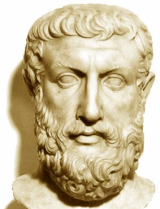
One of the first metaphysicians is Parmenides
Parmenides

Parmenides of Elea was an ancient Greek philosopher born in Elea, a Greek city on the southern coast of Italy. He was the founder of the Eleatic school of philosophy....
 of Elea. He held that the multiplicity of existing things, their changing forms and motion, are but an appearance of a single eternal reality (“Being”), thus giving rise to the Parmenidean principle that “all is one”. From this concept of Being, he went on to say that all claims of change or of non-Being are illogical. Because he introduced the method of basing claims about appearances on a logical concept of Being, he is considered one of the founders of metaphysics.

Metaphysics is called the "first philosophy" by Aristotle
Aristotle

Aristotle was a Greeks philosopher, a student of Plato and teacher of Alexander the Great. He wrote on many subjects, including physics, metaphysics, Poetics , theater, music, logic, rhetoric, politics, government, ethics, biology and zoology....
. The editor of his works, Andronicus of Rhodes
Andronicus of Rhodes

Andronicus of Rhodes , was an ancient Greek philosopher from Rhodes who was also the eleventh scholarch of the Peripatetics.He was at the head of the Peripatetic school at Rome, about 58 BC, and was the teacher of Boethus of Sidon, with whom Strabo studied....
, is thought to have placed the books on first philosophy right after another work, Physics, and called them (ta meta ta physika biblia) or "the books that come after the [books on] physics". This was misread by Latin scholiasts, who thought it meant "the science of what is beyond the physical". In the English language, the word comes by way of the Medieval Latin
Medieval Latin

Medieval Latin was the form of Latin used in the Middle Ages, primarily as a medium of scholarly exchange and as the liturgical language of the medieval Roman Catholic Church, but also as a language of science, literature, law, and administration....
 metaphysica, the neuter plural of Medieval Greek
Medieval Greek

Medieval Greek, also known as Byzantine Greek , is a cover term for all forms of the Greek language that were spoken and written during the time of the Byzantine Empire....
 metaphysika. While its Greek and Latin origins are clear, various dictionaries trace its first appearance in English to the mid-sixteenth century, although in some cases as early as 1387.

Aristotle's Metaphysics
Metaphysics (Aristotle)

Metaphysics is one of the principal works of Aristotle and the first major work of the Metaphysics with the same name. The principal subject is "being qua being", or being understood as being....
 was divided into three parts, in addition to some smaller sections related to a philosophical lexicon and some reprinted extracts from the Physics
Physics (Aristotle)

Physics is a key text in the philosophy of Aristotle. It stands at the head of the current Andronicus of Rhodes order, the long series of Aristotle's physical, cosmological and biological works, and is foundational to them....
, which are now regarded as the proper branches of traditional Western metaphysics:

Ontology
Ontology

Ontology in philosophy is the study of the nature of being, existence or reality in general, as well as of the basic category of being and their relations....
 : The study of Being
Being

In ontology being is anything that can be said to be, either Transcendence or Immanence.The nature of being varies by philosophy, given different interpretations in the frameworks of Parmenides, Leucippus, Plato, Aristotle, Plotinus, Descartes, Spinoza, Leibniz, Hegel, Heidegger, and Sartre....
 and existence
Existence

In common usage, existence is the world of which we are aware through our senses, but in philosophy the word has a more specialized meaning, and is often contrasted with essence....
; includes the definition and classification of entities
Entity

An entity is something that has a distinct, separate existence, though it need not be a material existence. In particular, abstractions and legal fictions are usually regarded as entities....
, physical or mental, the nature of their properties, and the nature of change.

Natural Theology
Natural theology

Natural theology is a branch of theology based on reason and ordinary experience. Thus it is distinguished from revealed theology which is based on scripture and religious experiences of various kinds; and also from transcendental theology, theology from a priori reasoning ....
 : The study of a God
God

God is a deity in theism and deism religions and other belief systems, representing either the sole deity in monotheism, or a principal deity in polytheism....
 or Gods
Gods

Gods as the plural of god , is a synonym of "deity", indicating a context of polytheism.* God * Goddess* List of deitiesproper names...
; involves many topics, including among others the nature of religion and the world, existence of the divine
Divinity

Divinity and divine are broadly applied but loosely defined terms, used variously within different faiths and belief systems ? and even by different individuals within a given faith ? to refer to some transcendent or transcendental power, or its attributes or manifestations in the world....
, questions about Creation, and the numerous religious or spiritual
Spirituality

Spirituality, in a narrow sense, concerns itself with matters of the spirit, a concept closely tied to religion and faith, transcendence , or one or more Deity....
 issues that concern humankind in general.

Universal science
Universal science

Universal Science is a branch of Metaphysics. Originally, the idea of Universal Science came from Plato's system of idealism, formulated using the teachings of Socrates....
 : The study of first principles, which Aristotle believed to be the foundation of all other inquiries. An example of such a principle is the law of noncontradiction and the status it holds in non-paraconsistent
Paraconsistent logic

A paraconsistent logic is a logical system that attempts to deal with contradictions in a discriminating way. Alternatively, paraconsistent logic is the subfield of logic that is concerned with studying and developing paraconsistent systems of logic....
 logics.

Universal science or first philosophy treats of "being qua being"—that is, what is basic to all science before one adds the particular details of any one science. Essentially "being qua being" may be translated as "being insofar as being goes" or as "being in terms of being". This includes topics such as causality, substance, species and elements, as well as the notions of relation, interaction, and finitude.

Metaphysics as a discipline
Discipline

In its most general sense, discipline refers to systematic instruction given to a disciple. This sense also preserves the origin of the word, which is Latin disciplina "instruction", from the root discere "to learn," and from which discipulus "disciple, pupil" also derives....
 was a central part of academic inquiry and scholarly education even before the age of Aristotle
Aristotle

Aristotle was a Greeks philosopher, a student of Plato and teacher of Alexander the Great. He wrote on many subjects, including physics, metaphysics, Poetics , theater, music, logic, rhetoric, politics, government, ethics, biology and zoology....
, who considered it "the Queen of Sciences". Its issues were considered no less important than the other main formal subjects of physical science
Physical science

Physical science is an encompassing term for the branches of natural science and science that study non-living systems, in contrast to the biology sciences....
, medicine
Medicine

Medicine is the art and science of healing. It encompasses a range of health care practices evolved to maintain and restore health by the prevention and treatment of illness....
, mathematics
Mathematics

Mathematics is the study of quantity, structure, space, change, and related topics of pattern and form. Mathematicians seek out patterns whether found in numbers, space, natural science, computers, imaginary abstractions, or elsewhere....
, poetics
Poetics

Aristotle's Poetics aims to give an account of what he calls 'poetry' . Aristotle attempts to explain 'poetry' through 'first principles' and by discerning its different genres and component elements....
 and music
Music

Music is an art form whose media is sound organized in time. Common elements of music are pitch , rhythm , dynamics , and the sonic qualities of timbre and texture ....
. Since the beginning of modern philosophy
17th-century philosophy

17th century philosophy in the Western world is generally regarded as being the start of modern philosophy, and a departure from the Medieval philosophy, especially Scholasticism....
 during the seventeenth century, problems that were not originally considered within the bounds of metaphysics have been added to its purview, while other problems considered metaphysical for centuries are now typically relegated to their own separate regions in philosophy, such as philosophy of religion
Philosophy of religion

Philosophy of religion' is a branch of philosophy that is concerned with the philosophical study of religion, including arguments over the nature and existence of God, religious language, miracles, prayer, the problem of evil, and the relationship between religion and other value-systems such as ethics.'...
, philosophy of mind
Philosophy of mind

Philosophy of mind is the branch of philosophy that studies the nature of the mind, mental events, mental functions, mental property, consciousness and their relationship to the physical body, particularly the brain....
, philosophy of perception
Philosophy of perception

The philosophy of perception concerns how mental processes and symbols depend on the world internal and external to the perceiver.Our perception of the external world begins with the senses, which lead us to generate empirical concepts representing the world around us, within a mental framework relating new concepts to preexisting ones....
, philosophy of language
Philosophy of language

Philosophy of language is the reasoned inquiry into the nature, origins, and usage of language. As a topic, the philosophy of language for Analytic philosophys is concerned with four central problems: the nature of Meaning , language use, language cognition, and the relationship between language and reality....
, and philosophy of science
Philosophy of science

The philosophy of science is concerned with the assumptions, foundations, and implications of science. The field is defined by an interest in one of a set of "traditional" problems or an interest in central or foundational concerns in science....
.

In some cases, subjects of metaphysical scholarship have been found to be entirely physical and natural, thus making them part of physics
Physics

Physics is the natural science which examines basic concepts such as energy, force, and spacetime and all that derives from these, such as mass, charge, matter and its Motion ....
 proper (cf. Albert Einstein
Albert Einstein

Albert Einstein was a Germany-born theoretical physics. He is best known for his theory of relativity and specifically mass?energy equivalence, expressed by the equation E = mc2....
's Theory of Relativity
Theory of relativity

File:spacetime curvature.pngThe theory of relativity, or simply relativity, generally refers specifically to two theories of Albert Einstein: special relativity and general relativity....
).

Central questions of metaphysics

Most positions that can be taken with regards to any of the following questions are endorsed by one or another notable philosopher. It is often difficult to frame the questions in a non-controversial manner.

Abstract objects and mathematics

Some philosophers endorse views according to which there are abstract object
Abstract object

An abstract object is an object which does not exist at any particular time or place, but rather exists as a Type_ of thing . In philosophy, an important distinction is whether an object is considered abstract or concrete....
s such as numbers, or Universals. (Universals are properties that can be instantiated by multiple objects, such as redness or squareness.) Abstract objects are generally regarded as being outside of space
Space

Space is the boundless, three-dimensional extent in which Physical body and events occur and have relative position and direction. Physical space is often conceived in three linear dimensions, although modern physics usually consider it, with time, to be part of the boundless four-dimensional continuum known as spacetime....
 and time
Time

Time is a component of the measurement used to sequence events, to compare the durations of events and the intervals between them, and to quantify the motions of objects....
, and/or as being causally
Causality

Causality denotes a necessary relationship between one event and another event which is the direct consequence of the first.While this informal understanding suffices in everyday use, the Philosophy analysis of how best to characterize causality extends over millennia....
 inert. Mathematical objects
Philosophy of mathematics

The philosophy of mathematics is the branch of philosophy that studies the philosophical assumptions, foundations, and implications of mathematics....
 and fictional entities and worlds are often given as examples of abstract objects. The view that there really are no abstract objects is called nominalism
Nominalism

Nominalism is a Metaphysics view in philosophy according to which general or abstract terms and Predicate exist but that either Universal or abstract objects, which are sometimes thought to correspond to these terms, do not exist....
. Realism
Philosophical realism

Contemporary philosophical realism is the belief in a reality that is completely ontologically independent of our conceptual schemes, linguistic practices, beliefs, etc....
 about such objects is exemplified by Platonism
Platonism

Platonism is the philosophy of Plato or the name of other philosophical systems considered closely derived from it. In a narrower sense the term might indicate the doctrine of Platonic realism....
. Other positions include moderate realism
Moderate realism

Moderate realism as a position in the debate on the metaphysics of universal holds that there is no realm in which universals exist It is opposed to both full-blooded realism , such as the theory of Platonic forms, and nominalism....
, as espoused by Aristotle
Aristotle

Aristotle was a Greeks philosopher, a student of Plato and teacher of Alexander the Great. He wrote on many subjects, including physics, metaphysics, Poetics , theater, music, logic, rhetoric, politics, government, ethics, biology and zoology....
, and conceptualism
Conceptualism

Conceptualism is a doctrine in philosophy intermediate between nominalism and Philosophical realism that says Universal s exist only within the mind and have no external or substantial reality....
.

The philosophy of mathematics
Philosophy of mathematics

The philosophy of mathematics is the branch of philosophy that studies the philosophical assumptions, foundations, and implications of mathematics....
 overlaps with metaphysics because some positions are realistic
Philosophy of mathematics

The philosophy of mathematics is the branch of philosophy that studies the philosophical assumptions, foundations, and implications of mathematics....
 in the sense that they hold that mathematical objects really exist, whether transcendentally, physically, or mentally. Platonic realism
Platonic realism

Platonic realism is a philosophy term usually used to refer to the idea of Philosophical realism regarding the existence of universals after the Greek philosophy philosopher Plato , a student of Socrates, and the teacher of Aristotle....
 holds that mathematical entities are a transcendent realm of non-physical objects. The simplest form of mathematical empiricism claims that mathematical objects are just ordinary physical objects, i.e. that squares and the like physically exist. Plato
Plato

Plato , was a Classical Greece Greeks philosopher, mathematician, writer of philosophical dialogues, and founder of the Platonic Academy in Ancient Athens, the first institution of higher learning in the western world....
 rejected this view, among other reasons, because geometrical figures in mathematics have a perfection that no physical instantiation can capture. Modern mathematicians have developed many strange and complex mathematical structures with no counterparts in observable reality, further supporting Plato's view. The third main form of realism holds that mathematical entities exist in the mind. However, given a materialistic
Materialism

The philosophy of materialism holds that the only thing that can be truly proven to existence is matter, and is considered a form of physicalism....
 conception of the mind, it does not have the capacity to literally contain the many infinities of objects in mathematics. Intuitionism
Intuitionism

In the philosophy of mathematics, intuitionism, or neointuitionism , is an approach to mathematics as the constructive mental activity of humans....
, inspired by Kant
KANT

KANT is a computer algebra system for mathematicians interested in algebraic number theory, performing sophisticated computations in algebraic number fields, in Global field function fields, and in local fields....
, sticks with the idea that "there are no non-experienced mathematical truths". This involves rejecting as intuitionistically unacceptable anything that cannot be held in the mind or explicitly constructed
Constructivism (mathematics)

In the philosophy of mathematics, constructivism asserts that it is necessary to find a mathematical object to prove that it exists. When one assumes that an object does not exist and reductio ad absurdum, one still has not found the object and therefore not proved its existence, according to constructivists....
. Intuitionists reject the law of the excluded middle and are suspicious of infinity, particularly of transfinite number
Transfinite number

Transfinite numbers are cardinal numbers or ordinal numbers that are larger than all finite set numbers, yet not necessarily absolutely infinite....
s.

Other positions such as formalism and fictionalism that do not attribute any existence to mathematical entities are anti-realist
Anti-realism

In philosophy, the term anti-realism is used to describe anyposition involving either the denial of an Objectivity reality of entities of a certain type or the denial that verification-transcendent statements about a type of entity are either true or false....
.

Cosmology and cosmogony

Cosmology is the branch of metaphysics that deals with the world
World

World is a common name for the planet Earth seen from a human worldview, as a place inhabited by human beings. It is often used to signify the sum of human experience and history, or the 'human condition' in general....
 as the totality of all phenomena in space
Space

Space is the boundless, three-dimensional extent in which Physical body and events occur and have relative position and direction. Physical space is often conceived in three linear dimensions, although modern physics usually consider it, with time, to be part of the boundless four-dimensional continuum known as spacetime....
 and time
Time

Time is a component of the measurement used to sequence events, to compare the durations of events and the intervals between them, and to quantify the motions of objects....
. Historically, it has had quite a broad scope, and in many cases was founded in religion. The ancient Greeks did not draw a distinction between this use and their model for the cosmos. However, in modern use it addresses questions about the Universe which are beyond the scope of physical science. It is distinguished from religious cosmology in that it approaches these questions using philosophical methods (e.g. dialectic
Dialectic

Dialectic is a method of argument, which has been central to both Eastern and Western philosophy since ancient times. The word "dialectic" originates in Ancient Greece, and was made popular by Plato's Socratic dialogues....
s). Cosmogony
Cosmogony

Cosmogony, or cosmogeny, is any theory concerning the coming into existence or origin of the universe, or about how reality came to be. The word comes from the Greek ??s??????a , from ??s??? "cosmos, the world", and the root of ?????a? / ?????a "to be born, come about"....
 deals specifically with the origin of the universe.

Modern metaphysical cosmology and cosmogony try to address questions such as:
  • What is the origin of the Universe? What is its first cause? Is its existence necessary? (see monism
    Monism

    Monism is any philosophical view which holds that there is unity in a given field of inquiry, where this is not to be expected. Thus, some philosophers may hold that the Universe is really just one thing, despite its many appearances and diversities; or theology may support the view that there is one God, with many manifestations in different...
    , pantheism
    Pantheism

    Pantheism is the view that everything is part of an all-encompassing Immanence abstract God. In pantheism the Universe, or nature, and God are equivalent....
    , emanationism
    Emanationism

    Emanationism is Platonic monism, and an idea in the cosmology or cosmogony of certain religion or philosophy systems. Emanation from the Latin 'emanare' meaning "to flow from", is the mode by which all things are derived from the First Reality, or Principle....
     and creationism
    Creationism

    Creationism is the religious belief that humanity, life, the Earth, and the universe were Creation myth in their original form by a deity or deities....
    )
  • What are the ultimate material components of the Universe? (see mechanism
    Mechanism (philosophy)

    In philosophy, mechanism is a theory that all natural phenomena can be explained by physical causes. It can be contrasted with vitalism, the philosophical theory that vital forces are active in life, so that life cannot be explained solely by mechanism....
    , dynamism
    Dynamism (metaphysics)

    Dynamism is a metaphysical concept conceived by Gottfried Leibniz and developed into a full system of cosmology. Dynamism in cosmology explains the material world in terms of active, pointlike forces, with no extension but with action at a distance ....
    , hylomorphism
    Hylomorphism

    'Hylomorphism' is the philosophical theory, originating with Socrates, which conceptually identifies substance theory as matter and form. More exactly, substances are conceived as forms Inherence in matter....
    , atomism
    Atomism

    In natural philosophy, atomism is the philosophical theses that was theoryzed by Leucippus in the fifth century BC. For it all the objects in the universe are composed of very small, indestructible building blocks ? atoms ....
    )
  • What is the ultimate reason for the existence of the Universe? Does the cosmos have a purpose? (see teleology
    Teleology

    Teleology is the philosophy study of design and purpose. A teleological school of thought is one that holds all things to be designed for or directed toward a final result, that there is an inherent purpose or final cause for all that exists....
    )


Determinism and free will

Determinism
Determinism

Determinism is the philosophy proposition that every event, including human cognition and behavior, decision and action, is causality determined by an unbroken chain of prior occurrences. With numerous historical debates, many varieties and philosophical positions on the subject of determinism exist from traditions throughout...
 is the philosophical
Philosophy

Philosophy is the study of general problems concerning matters such as existence, knowledge, truth, beauty, justice, validity, mind, and language....
 proposition
Proposition

This article is about the term proposition in logic and philosophy; for other uses see PropositionIn logic and philosophy, proposition refers to either the "content" or Meaning of a meaningful declarative sentence or the pattern of symbols, marks, or sounds that make up a meaningful declarative sentence....
 that every event, including human cognition, decision and action, is causally
Causality

Causality denotes a necessary relationship between one event and another event which is the direct consequence of the first.While this informal understanding suffices in everyday use, the Philosophy analysis of how best to characterize causality extends over millennia....
 determined by an unbroken chain of prior occurrences. It holds that no random
Randomness

Randomness is a lack of order, purpose, Causality, or predictability. Randomness as defined by Aristotle is the situation, when a choice is to be made which has no logical component by which to determine or make the choice ....
, spontaneous
Spontaneous

Spontaneous means a self-generated event, typically requiring no outside influence or help.The word spontaneous may also refer to:* Miscarriage...
, mysterious, or miraculous
Miracle

File:Folio 171r - The Raising of Lazarus.jpgA miracle is a sensibly perceptible interruption of the laws of nature, such that can only be explained by divine intervention, and is sometimes associated with a miracle-worker....
 events occur. The principal consequence of the deterministic claim is that it poses a challenge to the existence of free will
Free will

The question of free will is whether, and in what sense, rational agents exercise control over their actions and decisions. Addressing this question requires understanding the relationship between freedom and Causality, and determining whether the laws of nature are causally deterministic....
.

The problem of free will
Free will

The question of free will is whether, and in what sense, rational agents exercise control over their actions and decisions. Addressing this question requires understanding the relationship between freedom and Causality, and determining whether the laws of nature are causally deterministic....
 is the problem of whether rational agents exercise control over their own actions and decisions. Addressing this problem requires understanding the relation between freedom and causation, and determining whether the laws of nature are causally deterministic. Some philosophers, known as Incompatibilists, view determinism and free will as mutually exclusive
Mutually exclusive

In simple terms, two events are mutually exclusive if they cannot occur at the same time ....
. If they believe in determinism, they will therefore believe free will to be an illusion, a position known as Hard Determinism. Proponents range from Baruch Spinoza
Baruch Spinoza

Baruch or Benedict de Spinoza was a Netherlands Philosophy of Iberian Jews origin. Revealing considerable scientific aptitude, the breadth and importance of Spinoza's work was not fully realized until years after his death....
 to Ted Honderich
Ted Honderich

Ted Honderich is a British philosopher, Grote Professor Emeritus of the Philosophy of Mind and Logic, University College London and Visiting Professor, University of Bath....
.

Others, labeled Compatibilists (or "Soft Determinists"), believe that the two ideas can be coherently reconciled. Adherents of this view include Thomas Hobbes
Thomas Hobbes

Thomas Hobbes was an English philosophy, remembered today for his work on political philosophy. His 1651 book Leviathan established the foundation for most of Western political philosophy from the perspective of social contract theory....
 and many modern philosophers.

Incompatibilists who accept free will
Free will

The question of free will is whether, and in what sense, rational agents exercise control over their actions and decisions. Addressing this question requires understanding the relationship between freedom and Causality, and determining whether the laws of nature are causally deterministic....
 but reject determinism are called Libertarians
Libertarianism (metaphysics)

Libertarianism is a philosophical position in metaphysics with respect to free will and determinism. It entails the belief that human beings possess free will, that free will is incompatible with determinism, and that determinism is false....
, a term not to be confused with the political sense. Robert Kane
Robert Kane (philosopher)

Robert Hilary Kane is an American philosopher. He is Distinguished Teaching Professor of Philosophy at the University of Texas at Austin, and is currently on phased retirement....
 is a modern defender of this theory.

It is a popular misconception that determinism necessarily entails that humanity or individual humans have no influence on the future and its events ( a position known as Fatalism
Fatalism

Fatalism is a philosophical doctrine emphasizing the subjugation of all events or actions to destiny or inevitable predetermination.Fatalism generally refers to several of the following ideas:...
). Determinists, however, believe that the level to which human beings have influence over their future is itself dependent on present and past.

Identity and change

The Greeks took some extreme positions on the nature of change: Parmenides
Parmenides

Parmenides of Elea was an ancient Greek philosopher born in Elea, a Greek city on the southern coast of Italy. He was the founder of the Eleatic school of philosophy....
 denied that change occurs at all, while Heraclitus
Heraclitus

Heraclitus of Ephesus was a Pre-Socratic philosophy Greeks philosopher, a native of Ephesus, Ionia, on the coast of Asia Minor.Heraclitus is known for his doctrine of change being central to the universe, and that the Logos is the fundamental order of all....
 thought change was ubiquitous: "[Y]ou cannot step into the same river twice".

Identity, sometimes called Numerical Identity, is the relation that a "thing" bears to itself, and which no "thing" bears to anything other than itself (cf. sameness). According to Leibniz
Gottfried Leibniz

Gottfried Wilhelm Leibniz was a Germany polymath who wrote primarily in Latin and French language.He occupies an equally grand place in both the history of philosophy and the history of mathematics....
, if some object x is identical to some object y, then any property that x has, y will have as well. However, it seems, too, that objects can change over time. If one were to look at a tree one day, and the tree later lost a leaf, it would seem that one could still be looking at that same tree. Two rival theories to account for the relationship between change and identity
Identity and change

The relationship between identity and change in the philosophy field of metaphysics seems, at first glance, deceptively simple, and belies the complexity of the issues involved....
 are Perdurantism
Perdurantism

Perdurantism or perdurance theory is a philosophical theory of persistence and psychological identity. The perdurantist view is often defined as being the claim that objects have distinct temporal parts as opposed to endurantism ....
, which treats the tree as a series of tree-stages, and Endurantism
Endurantism

Endurantism or endurance theory is a philosophical theory of persistence and psychological identity. According to the endurantist view material objects are persisting three-dimensional individuals wholly present at every moment of their existence....
 which maintains that the tree -- the same tree -- is present at every stage in its history.

Mind and matter

The nature of matter
Hyle

In philosophy, hyle refers to materialism or stuff. It can also be the material cause underlying a change in Aristotelian philosophy. The Greeks originally had no word for matter in general, as opposed to raw material suitable for some specific purpose or other, so Aristotle adapted the word for "lumber" for this purpose....
 was a problem in its own right in early philosophy. Aristotle himself introduced the idea of matter in general to the Western world, adapting the term hyle
Hyle

In philosophy, hyle refers to materialism or stuff. It can also be the material cause underlying a change in Aristotelian philosophy. The Greeks originally had no word for matter in general, as opposed to raw material suitable for some specific purpose or other, so Aristotle adapted the word for "lumber" for this purpose....
 which originally meant "lumber". Early debates centered on identifying a single underlying principle. Water was claimed by Thales
Thales

Thales of Miletus , was a Pre-Socratic philosophy Greek philosophy from Miletus in Asia Minor, and one of the Seven Sages of Greece. Many, most notably Aristotle, regard him as the first philosopher in the Greek philosophy....
, Air by Anaximenes
Anaximenes of Miletus

Anaximenes of Miletus was a Greece Pre-Socratic philosopher from the latter half of the 6th century BC, probably a younger contemporary of Anaximander, whose pupil or friend he is said to have been....
, Apeiron (the Boundless) by Anaximander, Fire by Heraclitus
Heraclitus

Heraclitus of Ephesus was a Pre-Socratic philosophy Greeks philosopher, a native of Ephesus, Ionia, on the coast of Asia Minor.Heraclitus is known for his doctrine of change being central to the universe, and that the Logos is the fundamental order of all....
. Democritus
Democritus

Democritus was an Ancient Greek philosopher born in Abdera in the north of Greece. He was the most prolific, and ultimately the most influential, of the pre-Socratic philosophers; his atomic theory may be regarded as the culmination of early Greek thought....
, in conjunction with his mentor, Leucippus
Leucippus

Leucippus or Leukippos was the first to develop the theory of atomism ? the idea that everything is composed entirely of various imperishable, indivisible elements called atoms ? which was elaborated in far greater detail by his pupil and successor, Democritus....
, conceived of an atomic
Atomic

An atom is the smallest particle of a chemical element that retains its chemical properties.Also is1)of or employing atomic energy2)of or relating to an atom or atoms...
 theory many centuries before it was accepted by modern science. It is worth noting, however, that the grounds necessary to ensure validity to the proposed theory's veridical nature were not scientific, but just as philosophical as those traditions espoused by Thales and Anaximander.

Philosophers now look to empirical
Empirical

The word empirical denotes information gained by means of observation, experience, or experiment, as opposed to theory. A central concept in science and the scientific method is that all evidence must be empirical, or empirically based, that is, dependent on evidence or Logical consequence that are observable by the senses....
 science
Science

In its broadest sense, science refers to any systematic knowledge or practice. In its more usual restricted sense, science refers to a system of acquiring knowledge based on scientific method, as well as to the organized body of knowledge gained through such research....
 for insights into the nature of matter
Matter

In common usage, matter is anything that has both mass and volume . A more rigorous definition is used in science: matter is what atoms and molecules are made of....
.

The nature of the mind
Mind

Mind refers to the aspects of intellect and consciousness manifested as combinations of thought, perception, memory, emotion, free will and imagination, including all of the brain's conscious and unconscious cognitive processes....
 and its relation to the body has been seen as more of a problem as science has progressed in its mechanistic
Mechanism

Mechanism may refer to:*Mechanism , explaining how a feature is created.*Reaction_mechanism , explaining a reaction pathway.*Mechanism , a theory that all natural phenomena can be explained by physical causes...
 understanding of the brain and body. Proposed solutions often have ramifications about the nature of mind as a whole. René Descartes
René Descartes

Ren? Descartes , , also known as Renatus Cartesius , was a French philosophy, mathematician, scientist, and writer who spent most of his adult life in the Dutch Republic....
 proposed substance dualism, a theory in which mind and body are essentially quite different, with the mind having some of the attributes traditionally assigned to the soul
Soul

In many religions and parts of philosophy, the soul is the immaterial part of a person. It is usually thought to consist of one's thoughts and Personality psychology, and can be synonymous with the spirit, mind or self....
, in the seventeenth century. This creates a conceptual puzzle about how the two interact (which has received some strange answers, such as occasionalism
Occasionalism

Occasionalism is a philosophy theory about Causality which says that created substances cannot be efficient causes of events. Instead, all events are taken to be caused directly by God Himself....
). Evidence of a close relationship between brain and mind, such as the Phineas Gage
Phineas Gage

Phineas P. Gage was a railroad construction foreman now remembered for his incredible survival of an accident which drove a large iron rod through his head, destroying one or both of his frontal lobes, and for that injury's reported effects on his personality psychology and social functioning?effects said to be so profound that friends saw h...
 case, have made this form of dualism increasingly unpopular.

Another proposal discussing the mind-body problem is idealism
Idealism

Idealism is the philosophical theory which maintains that the ultimate nature of reality is based on mind or ideas. It holds that the so-called external or "real world" is inseparable from mind, consciousness, or perception....
, in which the material is sweepingly eliminated in favor of the mental. Idealists, such as George Berkeley
George Berkeley

George Berkeley , also known as Bishop Berkeley, was an Irish people philosopher. His primary philosophical achievement was the advancement of a theory he called "immaterialism" ....
, claim that material objects do not exist unless perceived and only as perceptions. The "German idealists" such as Fichte, Hegel and Schopenhauer took Kant
KANT

KANT is a computer algebra system for mathematicians interested in algebraic number theory, performing sophisticated computations in algebraic number fields, in Global field function fields, and in local fields....
 as their starting-point, although it is debatable how much of an idealist Kant himself was. Idealism is also a common theme in Eastern philosophy. Related ideas are panpsychism
Panpsychism

Panpsychism, in philosophy, is either the view that all parts of matter involve mind, or the more holism view that the whole universe is an organism that possesses a mind ....
 and panexperientialism which say everything has a mind rather than everything exists in a mind. Alfred North Whitehead
Alfred North Whitehead

Alfred North Whitehead, Order of Merit was an England mathematician who became a philosopher. He wrote on algebra, logic, foundations of mathematics, philosophy of science, physics, metaphysics, and education....
 was a twentieth-century exponent of this approach.

Idealism
Idealism

Idealism is the philosophical theory which maintains that the ultimate nature of reality is based on mind or ideas. It holds that the so-called external or "real world" is inseparable from mind, consciousness, or perception....
 is a monistic
Monism

Monism is any philosophical view which holds that there is unity in a given field of inquiry, where this is not to be expected. Thus, some philosophers may hold that the Universe is really just one thing, despite its many appearances and diversities; or theology may support the view that there is one God, with many manifestations in different...
 theory, in which there is a single universal substance or principles. Neutral monism
Neutral monism

Neutral monism, in philosophy, is the metaphysics view that the mental and the physical are two ways of organizing or describing the very same elements, which are themselves "neutral," that is, neither physical nor mental....
, associated in different forms with Baruch Spinoza
Baruch Spinoza

Baruch or Benedict de Spinoza was a Netherlands Philosophy of Iberian Jews origin. Revealing considerable scientific aptitude, the breadth and importance of Spinoza's work was not fully realized until years after his death....
 and Bertrand Russell
Bertrand Russell

Bertrand Arthur William Russell, 3rd Earl Russell, Order of Merit , Fellow of the Royal Society , was a British people philosopher, mathematical logic, mathematician, historian, advocate for social reform, and pacifism....
 is a theory which seeks to be less extreme than idealism, and to avoid the problems of substance dualism. It claims that existence consists of a single substance, which in itself is neither mental nor physical, but is capable of mental and physical aspects or attributes thus it implies a dual-aspect theory.

For the last one hundred years, the dominant metaphysics has without a doubt been materialistic monism
Materialism

The philosophy of materialism holds that the only thing that can be truly proven to existence is matter, and is considered a form of physicalism....
. Type identity theory, token identity theory, functionalism
Functionalism (philosophy of mind)

Functionalism is a theory of the mind in contemporary philosophy, developed largely as an alternative to both the identity theory of mind and behaviourism....
, reductive physicalism, nonreductive physicalism, eliminative materialism
Eliminative materialism

Eliminative materialism is a materialism position in the philosophy of mind. Its primary claim is that people's common-sense understanding of the mind is false and that certain Class of mental states that most people believe in do not Existence....
, anomalous monism
Anomalous monism

Anomalous monism is a philosophy thesis about the mind-body problem. It was first proposed by Donald Davidson in his 1970 paper Mental events....
, property dualism
Property dualism

Property dualism describes a category of positions in the philosophy of mind which holds that while the world is constituted of just one kind of substance - the physical kind - there exist two distinct kinds of properties: physical properties and mental properties....
, epiphenomenalism
Epiphenomenalism

In philosophy of mind, epiphenomenalism, also known as 'Type-E Dualism' is a view according to which some or all Intentionalitys are mere epiphenomena of physical states of the world....
 and emergence
Emergence

In philosophy, systems theory and science, emergence is the way complex systems and patterns arise out of a Multiplicity of relatively simple interactions....
 are just some of the candidates for a scientifically-informed account of the mind. (It should be noted that while many of these positions are dualisms, none of them are substance dualism.)

Prominent recent philosophers of mind include David Armstrong
David Malet Armstrong

David Malet Armstrong , often D. M. Armstrong, is an Australian philosopher. He is well-known for his work on metaphysics and the philosophy of mind, and for his defence of a state of affairs ontology, a Functionalism theory of the mind, and a modal logic conception of the Physical law....
, Ned Block
Ned Block

Ned Block is a Philosophy of mind who has made important contributions to matters of consciousness and cognitive science. He obtained his Doctor of Philosophy from Harvard University under Hilary Putnam and was a professor of philosophy at the Massachusetts Institute of Technology for many years, and now teaches at New York University ....
, David Chalmers
David Chalmers

David John Chalmers is an Australian philosopher specializing in the area of philosophy of mind. He is Professor of Philosophy and Director of the Centre for Consciousness at the Australian National University....
, Patricia
Patricia Churchland

Patricia Smith Churchland is a Canadian-American philosopher working at the University of California, San Diego since 1984. She is currently a professor at the UCSD Philosophy Department, an adjunct professor at the Salk Institute, and an associate of the Computational Neuroscience Laboratory at the Salk Institute....
 and Paul Churchland
Paul Churchland

Paul Churchland is a philosopher noted for his studies in neurophilosophy and the philosophy of mind. He is currently a Professor at the University of California, San Diego, where he holds the Valtz Chair of Philosophy....
, Donald Davidson
Donald Davidson (philosopher)

Donald Herbert Davidson was an United States philosopher, who served as Slusser Professor of Philosophy at the University of California, Berkeley, from 1981 to 2003, after having also held substantive teaching appointments at Stanford University, Rockefeller University, Princeton University and the University of Chicago....
, Daniel Dennett
Daniel Dennett

Daniel Clement Dennett is a prominent United States Philosophy whose research centers on philosophy of mind, philosophy of science and philosophy of biology, particularly as those fields relate to evolutionary biology and cognitive science....
, Douglas Hofstadter
Douglas Hofstadter

Douglas Richard Hofstadter is an United States academic whose research focuses on consciousness, thinking and creativity. He is best known for G?del, Escher, Bach, first published in 1979, for which he was awarded the 1980 Pulitzer Prize for general non-fiction....
, Jerry Fodor
Jerry Fodor

Jerry Alan Fodor is an United States Philosophy and Cognitive science. He is the State of New Jersey Professor of Philosophy at Rutgers University and is also the author of many works in the fields of philosophy of mind and cognitive science, in which he has laid the groundwork for the modularity of mind and the language of thought hypothese...
, David Lewis
David Kellogg Lewis

David Kellogg Lewis was a 20th century philosopher. Lewis taught briefly at UCLA and then at Princeton University from 1970 until his death. He is also closely associated with Australia, whose philosophical community he visited almost annually for more than thirty years....
, Thomas Nagel
Thomas Nagel

Thomas Nagel is an United States philosopher, currently University Professor of Philosophy and Law at New York University, where he has taught since 1980....
, Hilary Putnam
Hilary Putnam

Hilary Whitehall Putnam is an American philosopher who has been a central figure in analytic philosophy since the 1960s, especially in philosophy of mind, philosophy of language, and philosophy of science....
, John Searle
John Searle

John Rogers Searle is an American philosopher and the Slusser Professor of Philosophy and Mills Professor of Philosophy of Mind and Language at the University of California, Berkeley ....
, John Smart
J. J. C. Smart

John Jamieson Carswell "Jack" Smart Order of Australia , often referred to as J.J.C. Smart, is an Australian emeritus professor of philosophy at Monash University, Australia....
 and Ludwig Wittgenstein
Ludwig Wittgenstein

Ludwig Josef Johann Wittgenstein was an Austrian-United Kingdom philosopher who worked primarily in logic, the philosophy of mathematics, the philosophy of mind, and the philosophy of language....
.

Necessity and possibility

Metaphysicians investigate questions about the ways the world could have been. David Lewis
David Kellogg Lewis

David Kellogg Lewis was a 20th century philosopher. Lewis taught briefly at UCLA and then at Princeton University from 1970 until his death. He is also closely associated with Australia, whose philosophical community he visited almost annually for more than thirty years....
, in "On the Plurality of Worlds," endorsed a view called Concrete Modal realism
Modal realism

Modal realism is the view, notably propounded by David Lewis , that all possible worlds are as real as the actual world. It is based on the following tenets: possible worlds existence; possible worlds are not different in kind from the actual world; possible worlds are Reduction entity; the term actual in actual world is indexicality...
, according to which facts about how things could have been are made true by other concrete worlds, just like ours, in which things are different. Other philosophers, such as Gottfried Leibniz
Gottfried Leibniz

Gottfried Wilhelm Leibniz was a Germany polymath who wrote primarily in Latin and French language.He occupies an equally grand place in both the history of philosophy and the history of mathematics....
, have dealt with the idea of possible worlds as well. The idea of necessity is that any necessary fact is true across all possible world
Possible world

In philosophy and logic, the concept of possible worlds is used to express modal logic. In philosophy, the term "modality" covers such notions as "possibility", "necessity", and "contingency"....
s; that is, we could not imagine it to be otherwise. A possible fact is true in some possible world, even if not in the actual world. For example, it is possible that cats could have had two tails, or that any particular apple could have not existed. By contrast, certain propositions seem necessarily true, such as analytic propositions, e.g. "All bachelors are unmarried." The particular example of analytic truth being necessary is not universally held among philosophers. A less controversial view might be that self-identity is necessary, as it seems fundamentally incoherent to claim that for any x, it is not identical to itself; this is known as the law of identity, a putative "first principle". Aristotle describes the principle of non-contradiction, "It is impossible that the same quality should both belong and not belong to the same thing . . . This is the most certain of all principles . . . Wherefore they who demonstrate refer to this as an ultimate opinion. For it is by nature the source of all the other axioms."

Objects and their properties

The world seems to contain many individual things, both physical, like apples, and abstract such as love and the number 3; the former objects are called particular
Particular

In philosophy, particulars are concrete entitles existing in space and time as opposed to abstractions. There are, however, theories of abstract particulars or Trope ....
s. Particulars are said to have attributes, e.g. size, shape, color, location and two particulars may have some such attributes in common. Such attributes, are also termed Universals or Properties
Property (philosophy)

In modern philosophy, mathematics, and logic, a property is an attribute of an Object ; thus a red object is said to have the property of redness....
; the nature of these, and whether they have any real existence and if so of what kind, is a long-standing issue, realism
Realism

Realism, Realist or Realistic may refer to:*Realism , the depiction of subjects as they appear in everyday life*Realism , a movement towards greater fidelity to real life...
 and nominalism
Nominalism

Nominalism is a Metaphysics view in philosophy according to which general or abstract terms and Predicate exist but that either Universal or abstract objects, which are sometimes thought to correspond to these terms, do not exist....
 representing opposing views.

Metaphysicians concerned with questions about universals or particulars are interested in the nature of objects
Object (philosophy)

In philosophy, an object is a thing, an entity, or a being. This may be taken in several senses.In its weakest sense, the word object is the most all-purpose of nouns, and can replace a noun in any sentence at all....
 and their properties, and the relationship between the two. Some, e.g. Plato, argue that properties are abstract objects, existing outside of space
Space

Space is the boundless, three-dimensional extent in which Physical body and events occur and have relative position and direction. Physical space is often conceived in three linear dimensions, although modern physics usually consider it, with time, to be part of the boundless four-dimensional continuum known as spacetime....
 and time
Time

Time is a component of the measurement used to sequence events, to compare the durations of events and the intervals between them, and to quantify the motions of objects....
, to which particular objects bear special relations. David Armstrong holds that universals exist in time and space but only at their instantiation and their discovery is a function of science. Others maintain that what particulars are is a bundle
Bundle theory

Bundle theory, originated by the 18th century Scottish philosopher David Hume, is the ontology theory about Object in which an object consists only of a collection of properties, relations or trope #Trope theory in metaphysics....
 or collection of properties (specifically, a bundle of properties they have).

Religion and spirituality

Theology
Theology

Theology is the study of the existence or attributes of a deity or gods, or more generally the study of religion or spirituality. It is sometimes contrasted with religious studies: theology is understood as the study of religion from an internal perspective , and religious studies as the study of religion from an external perspective....
 is the study of a God or gods and the nature of the divine. Whether there is a God (monotheism
Monotheism

In theology, monotheism is the belief that only one god exists. The concept of "monotheism" tends to be dominated by the concept of God in the Abrahamic religions, such as Judaism, Christianity and Islam, and the Neoplatonism concept of God as put forward by Pseudo-Dionysius the Areopagite....
), many gods (polytheism
Polytheism

Polytheism is the belief in or worship of multiple deities, such as gods and goddesses. These are usually assembled into a Pantheon , along with their own mythology and rituals....
) or no gods (atheism
Atheism

Atheism is the absence or rejection of belief in deity, or the explicit view that Existence of God.Many list of atheists are Skepticism of all supernatural beings and cite a lack of empiricism evidence for the existence of deities....
), or whether it is unknown or unknowable whether any gods exist (agnosticism
Agnosticism

Agnosticism is the philosophy view that the logical value of certain claims ? particularly metaphysics claims regarding theology, afterlife or the existence of deity, ghosts, or even ultimate reality ? is unknown or, depending on the form of agnosticism, inherently impossible to prove or disprove....
), and whether the Divine intervenes directly in the world (theism
Theism

Theism, in its most inclusive usage, is the belief in at least one deity. Less inclusive usages specify that the deity believed in be a distinct identifiable entity, thereby contrasted with pantheism....
), or its sole function is to be the first cause of the universe (deism
Deism

Deism is a religious and philosophical belief that a supreme natural God exists and created the physical universe, and that religious truths can be arrived at by the application of reason and observation of the natural world....
); these and whether a God or gods and the World are different (as in panentheism
Panentheism

Panentheism is a belief system which posits that God exists and interpenetrates every part of nature, and timelessly extends beyond as well. Panentheism is distinguished from pantheism, which holds that God is synonymous with the material universe....
 and dualism
Dualism

Dualism denotes a state of two parts. The word's origin is the Latin duo, "two" . The term 'dualism' was originally coined to denote co-eternal binary opposition, a meaning that is preserved in metaphysical and philosophical duality discourse but has been diluted in general usage....
), or are identical (as in pantheism
Pantheism

Pantheism is the view that everything is part of an all-encompassing Immanence abstract God. In pantheism the Universe, or nature, and God are equivalent....
), are some of the primary metaphysical questions concerning philosophy of religion.

Within the standard Western philosophical tradition, theology reached its peak under the medieval school of thought known as scholasticism
Scholasticism

Scholasticism was the dominant form of theology and philosophy in the Western Europe in the Middle Ages, particularly in the 12th, 13th, and 14th centuries....
, which focused primarily on the metaphysical aspects of Christianity
Christianity

Christianity is a Monotheistic religion #Christian view religion centered on the life and teachings of Jesus as New Testament view on Jesus' life....
. While the work of the scholastics has been largely eclipsed in the wake of modern philosophy, key figures such as Thomas Aquinas
Thomas Aquinas

Saint Thomas Aquinas, Dominican Order was a priest of the Roman Catholic Church in the Dominican Order from Italy, and an immensely influential philosopher and theologian in the tradition of scholasticism, known as Doctor Angelicus and Doctor Communis....
 still play an important role in the philosophy of religion
Philosophy of religion

Philosophy of religion' is a branch of philosophy that is concerned with the philosophical study of religion, including arguments over the nature and existence of God, religious language, miracles, prayer, the problem of evil, and the relationship between religion and other value-systems such as ethics.'...
.

Space and time


In the Middle Ages, Saint Augustine of Hippo asked the fundamental question about the nature of time. A traditional realist
Philosophical realism

Contemporary philosophical realism is the belief in a reality that is completely ontologically independent of our conceptual schemes, linguistic practices, beliefs, etc....
 position in ontology is that time and space have existence apart from the human mind. Idealists, including Kant
KANT

KANT is a computer algebra system for mathematicians interested in algebraic number theory, performing sophisticated computations in algebraic number fields, in Global field function fields, and in local fields....
 claim that space and time are mental constructs used to organise perceptions, or are otherwise unreal.

Suppose that one is sitting at a table, with an apple in front of him or her; the apple exists in space
Space

Space is the boundless, three-dimensional extent in which Physical body and events occur and have relative position and direction. Physical space is often conceived in three linear dimensions, although modern physics usually consider it, with time, to be part of the boundless four-dimensional continuum known as spacetime....
 and in time
Time

Time is a component of the measurement used to sequence events, to compare the durations of events and the intervals between them, and to quantify the motions of objects....
, but what does this statement indicate? Could it be said, for example, that space is like an invisible three-dimensional grid in which the apple is positioned? Suppose the apple, and all physical objects in the universe, were removed from existence entirely. Would space as an "invisible grid" still exist? René Descartes
René Descartes

Ren? Descartes , , also known as Renatus Cartesius , was a French philosophy, mathematician, scientist, and writer who spent most of his adult life in the Dutch Republic....
 and Leibniz believed it would not, arguing that without physical objects, "space" would be meaningless because space is the framework upon which we understand how physical objects are related to each other. Newton
Isaac Newton

Sir Isaac Newton, Fellow of the Royal Society was an English people physicist, mathematician, Astronomy, Natural philosophy, Alchemy, and Theology and one of the the 100 in human history....
, on the other hand, argued for an absolute
Absolute time and space

In physics, the concept of absolute time and absolute space are hypothetical concepts closely tied to the thought of Isaac Newton:In Philosophiae Naturalis Principia Mathmetica See the Principia on line at ...
 "container" space
Container space

The container theory of space is a metaphysical theory according to which space is a background against which objects rest and move, with the implication that it can continue to exist in the absence of matter....
. The pendulum swung back to relational space
Relational space

The relational theory of space is a metaphysical theory according to which space is composed of relations between objects, with the implication that it cannot exist in the absence of matter....
 with Einstein and Ernst Mach
Ernst Mach

Ernst Mach was an Austrians physicist and philosopher and is the namesake for the Mach number and the optical illusion known as Mach bands....
.

While the absolute/relative debate, and the realism debate are equally applicable to time and space, time presents some special problems of its own. The flow of time has been denied in ancient times by Parmenides
Parmenides

Parmenides of Elea was an ancient Greek philosopher born in Elea, a Greek city on the southern coast of Italy. He was the founder of the Eleatic school of philosophy....
 and more recently by J. M. E. McTaggart
J. M. E. McTaggart

John McTaggart Ellis McTaggart was an Idealism metaphysics. For most of his life McTaggart was a lecturer at Trinity College, Cambridge. He was considered one of England's leading Hegel scholars at the beginning of the 20th century and among the most notable of the British Idealism....
 in his paper The Unreality of Time
The Unreality of Time

In the philosophy of space and time, "The Unreality of Time" is the following article:J. M. E. McTaggart, 1908, "The Unreality of Time," Mind: A Quarterly Review of Psychology and Philosophy 17: 456-73....
.

The direction of time, also known as "time's arrow
Time's Arrow

Time's Arrow may refer to:* Arrow of time, a direction of time on a four-dimensional relativistic map of the world* Time's Arrow , a novel by Martin Amis...
", is also a puzzle, although physics is now driving the debate rather than philosophy. It appears that fundamental laws are time-reversible and the arrow of time must be an "emergent
Emergentism

In philosophy, emergentism is the belief in emergence, particularly as it involves consciousness and the philosophy of mind, and as it contrasts with reductionism....
" phenomenon, perhaps explained by a statistical understanding of thermodynamic entropy
Entropy (arrow of time)

Entropy is the only quantity in the physical sciences that "picks" a particular direction for time, sometimes called an arrow of time. As one goes "forward" in time, the second law of thermodynamics says that the entropy of an isolated system can only increase or remain the same; it cannot decrease....
.

Common-sense tells us that objects persist across time, that there is some sense in which you are the same person you were yesterday, in which the oak is the same as the acorn, in which you perhaps even can step into the same river twice. Philosophers have developed two rival theories for how this happens, called "endurantism
Endurantism

Endurantism or endurance theory is a philosophical theory of persistence and psychological identity. According to the endurantist view material objects are persisting three-dimensional individuals wholly present at every moment of their existence....
" and "perdurantism
Perdurantism

Perdurantism or perdurance theory is a philosophical theory of persistence and psychological identity. The perdurantist view is often defined as being the claim that objects have distinct temporal parts as opposed to endurantism ....
". Broadly speaking, endurantists hold that a whole object exists at each moment of its history, and the same object exists at each moment. Perdurantists believe that objects are four-dimensional entities made up of a series of temporal parts
Temporal parts

Temporal parts are used in contemporary metaphysics in the debate over persistence of material objects. Some metaphysicians believe objects have temporal parts as objects usually have spatial parts ....
 like the frames of a movie.

Criticism

Metaphysics has been continuously contended in history as vague or untrue.

David Hume
David Hume

David Hume was a Scotland philosopher, economist, historian and a key figure in the history of Western philosophy and the Scottish Enlightenment....
 argued with his empiricist principle that all knowledge involves either relations of ideas or matters of fact:

Hume's assertion, it has been argued, is self-defeating if it itself is not self-evident or empirically verifiable.

Immanuel Kant
Immanuel Kant

Immanuel Kant was an 18th-century German Philosophy from the Kingdom of Prussia city of K?nigsberg . He is regarded as one of the most influential thinkers of modern Europe and of the late Age of Enlightenment....
 prescribed a limited role to the subject and argued against knowledge progressing beyond the world of our representations, except to knowledge that the noumena
Noumenon

The noumenon is a posited object or event as it is in itself, independent of the senses. It classically refers to an object of human inquiry, understanding or cognition....
 exist:

A.J. Ayer
Alfred Ayer

Sir Alfred Jules Ayer , better known as A. J. Ayer or "Freddie" to friends, was a British philosopher known for his promotion of logical positivism, particularly in his books Language, Truth and Logic and The Problem of Knowledge ....
 in "Language, Truth and Logic" using the verifiability theory of meaning concluded that metaphysical propositions were neither true nor false but strictly meaningless, as were religious views.

Karl Popper
Karl Popper

Knight Bachelor Karl Raimund Popper Order of the Companions of Honour, Fellow of the Royal Society, Fellow of the British Academy was an Austrian and British philosopher and a professor at the London School of Economics....
 argued that metaphysical statements are not meaningless statements, but rather not fallible, testable or provable statements i.e. neither empirical observations nor logical arguments could prove metaphysical statements to be true or false. Hence, a metaphysical statement usually implies an idea about the world or about the universe, which may seem reasonable but is ultimately not empirically testable.

Disciplines, topics and problems

Disciplines
  • Natural philosophy
    Natural philosophy

    Natural philosophy or the philosophy of nature , is a term applied to the Objectivity study of nature and the physical universe that was dominant before the development of modern science....
  • Ontology
    Ontology

    Ontology in philosophy is the study of the nature of being, existence or reality in general, as well as of the basic category of being and their relations....
  • Philosophy of religion
    Philosophy of religion

    Philosophy of religion' is a branch of philosophy that is concerned with the philosophical study of religion, including arguments over the nature and existence of God, religious language, miracles, prayer, the problem of evil, and the relationship between religion and other value-systems such as ethics.'...
  • Philosophy of mind
    Philosophy of mind

    Philosophy of mind is the branch of philosophy that studies the nature of the mind, mental events, mental functions, mental property, consciousness and their relationship to the physical body, particularly the brain....
  • Philosophy of perception
    Philosophy of perception

    The philosophy of perception concerns how mental processes and symbols depend on the world internal and external to the perceiver.Our perception of the external world begins with the senses, which lead us to generate empirical concepts representing the world around us, within a mental framework relating new concepts to preexisting ones....
Topics and problems
  • Identity and change
    Identity and change

    The relationship between identity and change in the philosophy field of metaphysics seems, at first glance, deceptively simple, and belies the complexity of the issues involved....
  • Problem of free will
  • The nature of time
    Time

    Time is a component of the measurement used to sequence events, to compare the durations of events and the intervals between them, and to quantify the motions of objects....
  • The nature of the mind
    Mind

    Mind refers to the aspects of intellect and consciousness manifested as combinations of thought, perception, memory, emotion, free will and imagination, including all of the brain's conscious and unconscious cognitive processes....


See also

  • Advaita
  • Avicennism
    Avicennism

    Avicennism is a school of early Islamic philosophy which began during the middle of the Islamic Golden Age. The school was founded by Avicenna , an 11th-century Iranian philosophy who attempted to redefine the course of Islamic philosophy and channel it into new directions....
  • Dvaita
    Dvaita

    Dvaita is a dualist school of Vedanta Hindu philosophy. The Sanskrit word dvaita means "dualism". This school was established as a new development in the Vedanta exegetical tradition in the thirteenth century CE with the south Indian Vaishnavism theologian Madhvacharya, who wrote commentaries on a number of Hindu scriptures....
  • Buddhist philosophy
    Buddhist philosophy

    Buddhist philosophy deals extensively with problems in metaphysics, Phenomenology , ethics, and epistemology.The Buddha rejected certain precepts of Indian philosophy that were prominent during his lifetime....
  • Cosmology
    Cosmology (metaphysics)

    Cosmology is the branch of philosophy and metaphysics that deals with the world as the totality of all phenomena in space and time. Pre-socratic philosophers from the Ionian School are sometimes called cosmologists....
  • Common-sense metaphysics
  • Dualism
    Dualism

    Dualism denotes a state of two parts. The word's origin is the Latin duo, "two" . The term 'dualism' was originally coined to denote co-eternal binary opposition, a meaning that is preserved in metaphysical and philosophical duality discourse but has been diluted in general usage....
  • The elimination of metaphysics (Vienna Circle)
    Vienna Circle

    The Vienna Circle was a group of philosophers who gathered around Moritz Schlick when he was called to the Vienna University in 1922, organized in a philosophical association, of which Schlick was chairman, named the Ernst Mach Society in honour of Ernst Mach....
  • Epistemology
    Epistemology

    Epistemology or theory of knowledge is the branch of philosophy concerned with the nature and scope of knowledge. It addresses the questions:...
  • Idealism
    Idealism

    Idealism is the philosophical theory which maintains that the ultimate nature of reality is based on mind or ideas. It holds that the so-called external or "real world" is inseparable from mind, consciousness, or perception....
  • Logical positivism
    Logical positivism

    Logical positivism is a school of philosophy that combines empiricism, the idea that observational evidence is indispensable for knowledge of the world, with a version of rationalism incorporating mathematical and logico-linguistic constructs and deductions in epistemology.See, e.g., : in Stanford Encyclopedia of Philosophy
  • Materialism
    Materialism

    The philosophy of materialism holds that the only thing that can be truly proven to existence is matter, and is considered a form of physicalism....
  • Metaethics
  • Metaphysics of Quality
  • Metaphysics (Aristotle)
    Metaphysics (Aristotle)

    Metaphysics is one of the principal works of Aristotle and the first major work of the Metaphysics with the same name. The principal subject is "being qua being", or being understood as being....
  • Monism
    Monism

    Monism is any philosophical view which holds that there is unity in a given field of inquiry, where this is not to be expected. Thus, some philosophers may hold that the Universe is really just one thing, despite its many appearances and diversities; or theology may support the view that there is one God, with many manifestations in different...
  • Netism
  • New Age
    New Age

    New Age is a decentralized western culture social movement and new religious movement that seeks universality Truth and the attainment of the highest individual human potential....
  • New Thought Movement
  • Nihilism
    Nihilism

    Nihilism is the philosophy position that value_theory do not exist but rather are falsely invented. Most commonly, nihilism is presented in the form of Nihilism#Existential_nihilism which argues that life is without meaning, purpose or intrinsic value ....
  • Ontology
    Ontology

    Ontology in philosophy is the study of the nature of being, existence or reality in general, as well as of the basic category of being and their relations....
  • Personal Identity
  • Philosophy
    Philosophy

    Philosophy is the study of general problems concerning matters such as existence, knowledge, truth, beauty, justice, validity, mind, and language....


  • Philosophy of Language
    Philosophy of language

    Philosophy of language is the reasoned inquiry into the nature, origins, and usage of language. As a topic, the philosophy of language for Analytic philosophys is concerned with four central problems: the nature of Meaning , language use, language cognition, and the relationship between language and reality....
  • Philosophy of Mathematics
    Philosophy of mathematics

    The philosophy of mathematics is the branch of philosophy that studies the philosophical assumptions, foundations, and implications of mathematics....
  • Philosophy of Mind
    Philosophy of mind

    Philosophy of mind is the branch of philosophy that studies the nature of the mind, mental events, mental functions, mental property, consciousness and their relationship to the physical body, particularly the brain....
  • Philosophy of physics
    Philosophy of physics

    In philosophy, the philosophy of physics studies the fundamental philosophy questions underlying modern physics, the study of matter and energy and how they interaction....
  • Philosophy of Religion
    Philosophy of religion

    Philosophy of religion' is a branch of philosophy that is concerned with the philosophical study of religion, including arguments over the nature and existence of God, religious language, miracles, prayer, the problem of evil, and the relationship between religion and other value-systems such as ethics.'...
  • Pluralism
    Pluralism (philosophy of mind)

    Pluralism is the name of entirely unrelated positions in monism of metaphysics and epistemology. In metaphysics, pluralism claims a plurality of basic substances making up the world; in epistemology, pluralism claims that there are several conflicting but still true descriptions of the world....
  • Pratitya-samutpada
    Pratitya-samutpada

    The doctrine of pratityasamutpada , often translated as "dependent arising," is an important part of Buddhist Phenomenology and, some argue, metaphysics....
  • Realism
    Philosophical realism

    Contemporary philosophical realism is the belief in a reality that is completely ontologically independent of our conceptual schemes, linguistic practices, beliefs, etc....
  • Quantum metaphysics
  • Reason
    Reason

    Reason may refer to Mind#Mental faculties that consciously create explanations in order to judge, decide, solve problems, generalize, and give examples, among other activities....
  • Simulated reality
    Simulated reality

    Simulated reality is the proposition that reality could be simulated?perhaps by computer simulation?to a degree indistinguishable from "true" reality....
  • Substance
    Substance theory

    Substance theory, or substance attribute theory, is an ontology theory about Object , positing that a substance is distinct from its property ....
  • Taoism
    Taoism

    Taoism refers to a variety of related philosophical and religious traditions and concepts. These traditions have influenced East Asia for over two thousand years and some have spread to the West....
  • Theology
    Theology

    Theology is the study of the existence or attributes of a deity or gods, or more generally the study of religion or spirituality. It is sometimes contrasted with religious studies: theology is understood as the study of religion from an internal perspective , and religious studies as the study of religion from an external perspective....
  • Theory of everything
    Theory of everything (philosophy)

    In philosophy, a theory of everything or TOE is an ultimate, all-encompassing explanation of nature or reality. Adopting the term from physics, where the search for a theory of everything is ongoing, philosophers have discussed the viability of the concept and analyzed its properties and implications....
  • Time
    Time

    Time is a component of the measurement used to sequence events, to compare the durations of events and the intervals between them, and to quantify the motions of objects....
  • Time Travel
    Time travel

    Time travel is the concept of moving between different moments in time in a manner analogous to moving between different points in space, either sending objects backwards in time to a moment before the present, or sending objects forward from the present to the future without the need to experience the intervening period ....
  • Transcendence
    Transcendence (philosophy)

    In philosophy, the adjective transcendental and the noun transcendence convey three different but related primary meanings, all of them derived from the word's literal meaning , of climbing or going beyond: one sense that originated in Ancient philosophy, one in Medieval philosophy, and one in modern philosophy....
  • Transcendental Phenomenology


Further reading

  • offers many suggestions on what to read, depending on the student's familiarity with the subject:


Bibliography

  • Butchvarov, Panayot
    Panayot Butchvarov

    Panayot Butchvarov left Syracuse University in 1968 as a full professor to move to the University of Iowa, where he was at the time of his retirement in 2005 the University of Iowa Foundation Distinguished Professor of Philosophy....
     (1979). Being Qua Being: A Theory of Identity, Existence and Predication. Bloomington and London: Indiana University Press.
  • Harris, E. E. (1965). The Foundations of Metaphysics in Science. London: George Allen and Unwin.
  • Harris, E. E. (2000). The Restitution of Metaphysics. New York: Humanity Books.
  • Kant, I
    Immanuel Kant

    Immanuel Kant was an 18th-century German Philosophy from the Kingdom of Prussia city of K?nigsberg . He is regarded as one of the most influential thinkers of modern Europe and of the late Age of Enlightenment....
     (1781). Critique of Pure Reason
    Critique of Pure Reason

    The Critique of Pure Reason by Immanuel Kant, first published in 1781, second edition 1787, is one of the most influential works in the history of philosophy....
    .
  • Gale, Richard M. (2002). The Blackwell Guide to Metaphysics. Oxford: Blackwell.
  • Lowe, E. J. (2002). A Survey of Metaphysics. Oxford: Oxford University Press.
  • Loux, M. J. (2006). Metaphysics: A Contemporary Introduction (3rd ed.). London: Routledge.
  • Kim, J. and Ernest Sosa
    Ernest Sosa

    Ernest Sosa is currently Board of Governors Professor of Philosophy at Rutgers University. He has been at Rutgers full-time since January, 2007; previously, he had been at Brown University since 1964....
     Ed. (1999). Metaphysics: An Anthology. Blackwell Philosophy Anthologies.
  • Kim, J. and Ernest Sosa
    Ernest Sosa

    Ernest Sosa is currently Board of Governors Professor of Philosophy at Rutgers University. He has been at Rutgers full-time since January, 2007; previously, he had been at Brown University since 1964....
    , Ed. (2000). A Companion to Metaphysics. Malden Massachusetts, Blackwell, Publishers.


External links

  • Stanford Encyclopedia of Philosophy. (by Peter van Inwagen).
  • (The Norman Kemp Smith
    Norman Kemp Smith

    Norman Kemp Smith was a philosopher who lectured at Princeton University and was Professor of Logic and Metaphysics at the University of Edinburgh....
     translation of Kant's Critique of Pure Reason)