
Home      Discussion      Topics      Dictionary      Almanac
Signup       Login
Martial

Martial

Overview
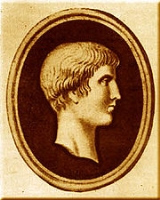
Marcus Valerius Martialis (known in English
English language
English is a West Germanic language that arose in the Anglo-Saxon kingdoms of England and spread into what was to become south-east Scotland under the influence of the Anglian medieval kingdom of Northumbria...

 as Martial) (March 1, between 38 and 41 AD – between 102 and 104 AD), was a Latin poet from Hispania
Hispania
Another theory holds that the name derives from Ezpanna, the Basque word for "border" or "edge", thus meaning the farthest area or place. Isidore of Sevilla considered Hispania derived from Hispalis....

 (the Iberian Peninsula
Iberian Peninsula
The Iberian Peninsula , sometimes called Iberia, is located in the extreme southwest of Europe and includes the modern-day sovereign states of Spain, Portugal and Andorra, as well as the British Overseas Territory of Gibraltar...

) best known for his twelve books of Epigram
Epigram
An epigram is a brief, interesting, usually memorable and sometimes surprising statement. Derived from the epigramma "inscription" from ἐπιγράφειν epigraphein "to write on inscribe", this literary device has been employed for over two millennia....

s
, published in Rome
Ancient Rome
Ancient Rome was a thriving civilization that grew on the Italian Peninsula as early as the 8th century BC. Located along the Mediterranean Sea and centered on the city of Rome, it expanded to one of the largest empires in the ancient world....

 between AD 86 and 103, during the reigns of the emperors
Roman Emperor
The Roman emperor was the ruler of the Roman State during the imperial period . The Romans had no single term for the office although at any given time, a given title was associated with the emperor...

 Domitian
Domitian
Domitian was Roman Emperor from 81 to 96. Domitian was the third and last emperor of the Flavian dynasty.Domitian's youth and early career were largely spent in the shadow of his brother Titus, who gained military renown during the First Jewish-Roman War...

, Nerva
Nerva
Nerva , was Roman Emperor from 96 to 98. Nerva became Emperor at the age of sixty-five, after a lifetime of imperial service under Nero and the rulers of the Flavian dynasty. Under Nero, he was a member of the imperial entourage and played a vital part in exposing the Pisonian conspiracy of 65...

 and Trajan
Trajan
Trajan , was Roman Emperor from 98 to 117 AD. Born into a non-patrician family in the province of Hispania Baetica, in Spain Trajan rose to prominence during the reign of emperor Domitian. Serving as a legatus legionis in Hispania Tarraconensis, in Spain, in 89 Trajan supported the emperor against...

. In these short, witty poems he cheerfully satirises
Satire
Satire is primarily a literary genre or form, although in practice it can also be found in the graphic and performing arts. In satire, vices, follies, abuses, and shortcomings are held up to ridicule, ideally with the intent of shaming individuals, and society itself, into improvement...

 city life and the scandalous activities of his acquaintances, and romanticises his provincial upbringing. He wrote a total of 1,561, of which 1,235 are in elegiac
Elegiac
Elegiac refers either to those compositions that are like elegies or to a specific poetic meter used in Classical elegies. The Classical elegiac meter has two lines, making it a couplet: a line of dactylic hexameter, followed by a line of dactylic pentameter...

 couplets. He is considered to be the creator of the modern epigram.
Discussion
Ask a question about 'Martial'
Start a new discussion about 'Martial'
Answer questions from other users
Full Discussion Forum
 
Quotations

Lasciva est nobis pagina, vita proba.

My poems are naughty, but my life is pure. - Liber I, iv.

Sera nimis vita est crastina: vive hodie.

Translation: Tomorrow's life is too late. Live today.

Stop abusing my verses, or publish some of your own.

I, 91

You complain, friend Swift, of the length of my epigrams, but you yourself write nothing. Yours are shorter.

I, 110

I do not love thee, Sabidius, nor can I say why; this only I can say, I do not love thee.

I, 32, reported in Bartlett's Familiar Quotations, 10th ed. (1919). Compare "I do not love thee, Doctor Fell, The reason why I cannot tell; But this alone I know full well, I do not love thee, Doctor Fell", Tom Brown, Laconics.

Conceal a flaw, and the world will imagine the worst.

III, 42

The bee enclosed and through the amber shownSeems buried in the juice which was his own.

IV, 32, reported in Bartlett's Familiar Quotations, 10th ed. (1919). Compare "Whence we see spiders, flies, or ants entombed and preserved forever in amber, a more than royal tomb", Francis Bacon,Historia Vitæ et Mortis; Sylva Sylvarum, Cent. i. experiment 100.

You ask what a nice girl will do? She won't give an inch, but she won't say no.

IV, 71

Nullos esse deos, inane caelum Adfirmat Segius: probatque, quod se Factum, dum negat haec, videt beatum.

Selius affirms, in heav'n no gods there are: And while he thrives, and they their thunder spare, His daring tenet to the world seems fair. -Anon, 1695
Encyclopedia
Marcus Valerius Martialis (known in English
English language
English is a West Germanic language that arose in the Anglo-Saxon kingdoms of England and spread into what was to become south-east Scotland under the influence of the Anglian medieval kingdom of Northumbria...

 as Martial) (March 1, between 38 and 41 AD – between 102 and 104 AD), was a Latin poet from Hispania
Hispania
Another theory holds that the name derives from Ezpanna, the Basque word for "border" or "edge", thus meaning the farthest area or place. Isidore of Sevilla considered Hispania derived from Hispalis....

 (the Iberian Peninsula
Iberian Peninsula
The Iberian Peninsula , sometimes called Iberia, is located in the extreme southwest of Europe and includes the modern-day sovereign states of Spain, Portugal and Andorra, as well as the British Overseas Territory of Gibraltar...

) best known for his twelve books of Epigram
Epigram
An epigram is a brief, interesting, usually memorable and sometimes surprising statement. Derived from the epigramma "inscription" from ἐπιγράφειν epigraphein "to write on inscribe", this literary device has been employed for over two millennia....

s
, published in Rome
Ancient Rome
Ancient Rome was a thriving civilization that grew on the Italian Peninsula as early as the 8th century BC. Located along the Mediterranean Sea and centered on the city of Rome, it expanded to one of the largest empires in the ancient world....

 between AD 86 and 103, during the reigns of the emperors
Roman Emperor
The Roman emperor was the ruler of the Roman State during the imperial period . The Romans had no single term for the office although at any given time, a given title was associated with the emperor...

 Domitian
Domitian
Domitian was Roman Emperor from 81 to 96. Domitian was the third and last emperor of the Flavian dynasty.Domitian's youth and early career were largely spent in the shadow of his brother Titus, who gained military renown during the First Jewish-Roman War...

, Nerva
Nerva
Nerva , was Roman Emperor from 96 to 98. Nerva became Emperor at the age of sixty-five, after a lifetime of imperial service under Nero and the rulers of the Flavian dynasty. Under Nero, he was a member of the imperial entourage and played a vital part in exposing the Pisonian conspiracy of 65...

 and Trajan
Trajan
Trajan , was Roman Emperor from 98 to 117 AD. Born into a non-patrician family in the province of Hispania Baetica, in Spain Trajan rose to prominence during the reign of emperor Domitian. Serving as a legatus legionis in Hispania Tarraconensis, in Spain, in 89 Trajan supported the emperor against...

. In these short, witty poems he cheerfully satirises
Satire
Satire is primarily a literary genre or form, although in practice it can also be found in the graphic and performing arts. In satire, vices, follies, abuses, and shortcomings are held up to ridicule, ideally with the intent of shaming individuals, and society itself, into improvement...

 city life and the scandalous activities of his acquaintances, and romanticises his provincial upbringing. He wrote a total of 1,561, of which 1,235 are in elegiac
Elegiac
Elegiac refers either to those compositions that are like elegies or to a specific poetic meter used in Classical elegies. The Classical elegiac meter has two lines, making it a couplet: a line of dactylic hexameter, followed by a line of dactylic pentameter...

 couplets. He is considered to be the creator of the modern epigram.

Early life


Knowledge of his origins and early life are derived almost entirely from his works, which can be more or less dated according to the well-known events to which they refer. In Book X of his Epigrams, composed between 95 and 98, he mentions celebrating his fifty-seventh birthday; hence he was born on March 1 (x. 24) 38, 39, 40 or 41 AD, under Caligula
Caligula
Caligula , also known as Gaius, was Roman Emperor from 37 AD to 41 AD. Caligula was a member of the house of rulers conventionally known as the Julio-Claudian dynasty. Caligula's father Germanicus, the nephew and adopted son of Emperor Tiberius, was a very successful general and one of Rome's most...

 or Claudius
Claudius
Claudius , was Roman Emperor from 41 to 54. A member of the Julio-Claudian dynasty, he was the son of Drusus and Antonia Minor. He was born at Lugdunum in Gaul and was the first Roman Emperor to be born outside Italy...

. His place of birth was Augusta Bilbilis
Augusta Bilbilis
Augusta Bilbilis was a city founded by the Romans in the province of Hispania Tarraconensis. It was the birthplace of Martial c. 40 AD...

 (now Calatayud
Calatayud
Calatayud is a city and municipality in the province of Zaragoza in Aragón, Spain lying on the river Jalón, in the midst of the Sistema Ibérico mountain range. It is the second-largest city in the province after the capital, Zaragoza, and the largest town in Aragón other than the three provincial...

) in Hispania Tarraconensis
Hispania Tarraconensis
Hispania Tarraconensis was one of three Roman provinces in Hispania. It encompassed much of the Mediterranean coast of Spain along with the central plateau. Southern Spain, the region now called Andalusia, was the province of Hispania Baetica...

. His parents, Fronto and Flaccilla, appear to have died in his youth.

His name seems to imply that he was born a Roman citizen, but he speaks of himself as "sprung from the Celts and Iberia
Hispania
Another theory holds that the name derives from Ezpanna, the Basque word for "border" or "edge", thus meaning the farthest area or place. Isidore of Sevilla considered Hispania derived from Hispalis....

ns, and a countryman of the Tagus
Tagus
The Tagus is the longest river on the Iberian Peninsula. It is long, in Spain, along the border between Portugal and Spain and in Portugal, where it empties into the Atlantic Ocean at Lisbon. It drains an area of . The Tagus is highly utilized for most of its course...

;" and, in contrasting his own masculine appearance with that of an effeminate Greek, he draws particular attention to "his stiff Hispania
Hispania
Another theory holds that the name derives from Ezpanna, the Basque word for "border" or "edge", thus meaning the farthest area or place. Isidore of Sevilla considered Hispania derived from Hispalis....

n hair" (x. 65, 7).

His home was evidently one of rude comfort and plenty, sufficiently in the country to afford him the amusements of hunting
Hunting
Hunting is the practice of pursuing any living thing, usually wildlife, for food, recreation, or trade. In present-day use, the term refers to lawful hunting, as distinguished from poaching, which is the killing, trapping or capture of the hunted species contrary to applicable law...

 and fishing
Fishing
Fishing is the activity of trying to catch wild fish. Fish are normally caught in the wild. Techniques for catching fish include hand gathering, spearing, netting, angling and trapping....

, which he often recalls with keen pleasure, and sufficiently near the town to afford him the companionship of many comrades, the few survivors of whom he looks forward to meeting again after his thirty-four years' absence (x. 104). The memories of this old home, and of other spots, the rough names and local associations which he delights to introduce into his verse, attest to the simple pleasures of his early life and were among the influences which kept his spirit alive in the stultifying routines of upper-crust social life in Rome.

He was educated in Hispania, a country which in the 1st century produced several notable Latin writers, including Seneca the Elder
Seneca the Elder
Lucius or Marcus Annaeus Seneca, known as Seneca the Elder and Seneca the Rhetorician , was a Roman rhetorician and writer, born of a wealthy equestrian family of Cordoba, Hispania...

 and Seneca the Younger
Seneca the Younger
Lucius Annaeus Seneca was a Roman Stoic philosopher, statesman, dramatist, and in one work humorist, of the Silver Age of Latin literature. He was tutor and later advisor to emperor Nero...

, Lucan and Quintilian
Quintilian
Marcus Fabius Quintilianus was a Roman rhetorician from Hispania, widely referred to in medieval schools of rhetoric and in Renaissance writing...

, and Martial's contemporaries Licinianus of Bilbilis, Decianus of Emerita
Emerita
Emerita may refer to:*Emerita , a genus of crustacean*Emerita Augusta, an ancient city of Spain* Saint Emerita, 3rd century martyr. See Digna and Emerita...

 and Canius
Cania (gens)
The gens Cania was a Roman family during the late Republic and in imperial times. None of its members obtained any important magistracies.-Members of the gens:...

 of Gades. Martial professes to be of the school of Catullus
Catullus
Gaius Valerius Catullus was a Latin poet of the Republican period. His surviving works are still read widely, and continue to influence poetry and other forms of art.-Biography:...

, Pedo
Albinovanus Pedo
Albinovanus Pedo, Roman poet, flourished during the Augustan age.He wrote Theseis, referred to in a letter from his friend Ovid, epigrams which are commended by Martial and an epic poem on the exploits of Germanicus...

, and Marsus, and he admits his inferiority only to the first. The epigram bears to this day the form impressed upon it by his unrivalled skill.

Life in Rome


The success of his countrymen may have been what motivated Martial to move to Rome
Rome
Rome is the capital of Italy and the country's largest and most populated city and comune, with over 2.7 million residents in . The city is located in the central-western portion of the Italian Peninsula, on the Tiber River within the Lazio region of Italy.Rome's history spans two and a half...

, from Hispania, once he had completed his education. This move occurred in AD 64, in which Seneca the Younger and Lucan may have served as his first patrons.

Not much is known of the details of his life for the first twenty years or so after he came to Rome. He published some juvenile poems of which he thought very little in his later years, and he laughs at a foolish bookseller who would not allow them to die a natural death (I. 113). Martial had neither youthful passion nor youthful enthusiasm to precociously make him a poet. His faculty ripened with experience and with the knowledge of that social life which was both his theme and his inspiration; many of his best epigrams are among those written in his last years. From many answers which he makes to the remonstrances of friends—among others to those of Quintilian—it may be inferred that he was urged to practice at the bar, but that he preferred his own lazy Bohemian
Bohemianism
Bohemianism is the practice of an unconventional lifestyle, often in the company of like-minded people, with few permanent ties, involving musical, artistic or literary pursuits...

 kind of life. He made many influential friends and patrons and secured the favor of both Titus
Titus
Titus , was Roman Emperor from 79 to 81. A member of the Flavian dynasty, Titus succeeded his father Vespasian upon his death, thus becoming the first Roman Emperor to come to the throne after his own father....

 and Domitian
Domitian
Domitian was Roman Emperor from 81 to 96. Domitian was the third and last emperor of the Flavian dynasty.Domitian's youth and early career were largely spent in the shadow of his brother Titus, who gained military renown during the First Jewish-Roman War...

. From them he obtained various privileges, among others the semestris tribunatus, which conferred on him equestrian
Equestrian (Roman)
The Roman equestrian order constituted the lower of the two aristocratic classes of ancient Rome, ranking below the patricians , a hereditary caste that monopolised political power during the regal era and during the early Republic . A member of the equestrian order was known as an eques...

 rank. Martial failed, however, in his application to Domitian for more substantial advantages, although he commemorates the glory of having been invited to dinner by him, and also the fact that he procured the privilege of citizenship for many persons on whose behalf he appealed to him.

The earliest of his extant works, known as Liber spectaculorum, was first published at the opening
Inaugural games of the Flavian Amphitheatre
The inaugural games of the Flavian Amphitheatre were held in AD 80, on the orders of the Roman Emperor Titus, to celebrate the completion of the Colosseum, then known as the Flavian Amphitheatre . Vespasian began construction of the amphitheatre around AD 70, and it was completed by Titus...

 of the Colosseum
Colosseum
The Colosseum, or the Coliseum, originally the Flavian Amphitheatre , is an elliptical amphitheatre in the centre of the city of Rome, Italy, the largest ever built in the Roman Empire...

 in the reign of Titus. It relates to the theatrical performances given by him, but the book as it now stands was presented to the world in or about the first year of Domitian, i.e. about the year 81. The favour of the emperor procured him the countenance of some of the worst creatures at the imperial court—among them of the notorious Crispinus, and probably of Paris, the supposed author of Juvenal
Juvenal
The Satires are a collection of satirical poems by the Latin author Juvenal written in the late 1st and early 2nd centuries AD.Juvenal is credited with sixteen known poems divided among five books; all are in the Roman genre of satire, which, at its most basic in the time of the author, comprised a...

's exile, for whose monument Martial afterwards wrote a eulogistic epitaph. The two books, numbered by editors xiii. and xiv., and known by the names of Xenia and Apophoreta—inscriptions in two lines each for presents—were published at the Saturnalia
Saturnalia
Saturnalia is an Ancient Roman festival/ celebration held in honour of Saturn , the youngest of the Titans, father of the major gods of the Greeks and Romans, and son of Uranus and Gaia...

 of 84. In 86 he gave to the world the first two of the twelve books on which his reputation rests.

From that time till his return to Hispania in 98 he published a volume almost every year. The first nine books and the first edition of Book X. appeared in the reign of Domitian; Book XI. appeared at the end of 96, shortly after the accession of Nerva
Nerva
Nerva , was Roman Emperor from 96 to 98. Nerva became Emperor at the age of sixty-five, after a lifetime of imperial service under Nero and the rulers of the Flavian dynasty. Under Nero, he was a member of the imperial entourage and played a vital part in exposing the Pisonian conspiracy of 65...

. A revised edition of book X., that which we now possess, appeared in 98, about the time of Trajan
Trajan
Trajan , was Roman Emperor from 98 to 117 AD. Born into a non-patrician family in the province of Hispania Baetica, in Spain Trajan rose to prominence during the reign of emperor Domitian. Serving as a legatus legionis in Hispania Tarraconensis, in Spain, in 89 Trajan supported the emperor against...

's entrance into Rome. The last book was written after three years' absence in Hispania, shortly before his death, which happened about the year 102 or 103.

These twelve books bring Martial's ordinary mode of life between the age of forty-five and sixty very fully before us. His regular home for thirty-five years was Rome. He lived at first up three flights of stairs, and his "garret" overlooked the laurels in front of the portico of Agrippa. He had a small villa and unproductive farm near Nomentum, in the Sabine
Sabine
The Sabines were an Italic tribe that lived in the central Appennines of ancient Italy, also inhabiting Latium north of the Anio before the founding of Rome...

 territory, to which he occasionally retired from the boors and noises of the city (ii. 38, xii. 57). In his later years he had also a small house on the Quirinal
Quirinal Hill
The Quirinal Hill is one of the Seven Hills of Rome, at the north-east of the city center. It is the location of the official residence of the Italian Head of State, who resides in the Quirinal Palace; by metonymy "the Quirinal" has come to stand for the Italian President.- History :It was...

, near the temple of Quirinus
Quirinus
In Roman mythology, Quirinus was an early god of the Roman state. In Augustan Rome, Quirinus was also an epithet of Janus, as Janus Quirinus. His name is derived from Quiris meaning "spear."-History:...

.

At the time when his third book was brought out he had retired for a short time to Cisalpine Gaul
Cisalpine Gaul
Cisalpine Gaul, in Latin: Gallia Cisalpina or Citerior, also called Gallia Togata, was a Roman province until 41 BC when it was merged into Roman Italy.It bore the name Gallia, because the great body of its inhabitants, after the expulsion of the Etruscans, consisted of Gauls or Celts...

, in weariness, as he tells us, of his unprofitable attendance to the bigwigs of Rome. For a time he seems to have felt the charm of the new scenes which he visited, and in a later book (iv. 25) he contemplates the prospect of retiring to the neighbourhood of Aquileia
Aquileia
Aquileia is an ancient Roman city in what is now Italy, at the head of the Adriatic at the edge of the lagoons, about 10 km from the sea, on the river Natiso , the course of which has changed somewhat since Roman times...

 and the Timavus. But the spell exercised over him by Rome and Roman society was too great; even the epigrams sent from Forum Corneli and the Aemilian Way ring much more of the Roman forum, and of the streets, baths, porticos and clubs of Rome, than of the places from which they are dated.

His final departure from Rome was motivated by a weariness of the burdens imposed on him by his social position, and apparently the difficulties of meeting the ordinary expenses of living in the metropolis (x. 96); and he looks forward to a return to the scenes familiar to his youth. The well-known epigram addressed to Juvenal (xii. I 8) shows that for a time his ideal was realized; but the more trustworthy evidence of the prose epistle prefixed to Book XII. proves and that he could not live happily away from the literary and social pleasures of Rome for long. The one consolation of his exile was a lady, Marcella, of whom he writes rather as if she were his patroness—and it seems to have been a necessity of his being to have always a patron or patroness—than his wife or mistress.

During his life at Rome, although he never rose to a position of real independence, and had always a hard struggle with poverty, he seems to have known everybody, especially every one of any eminence at the bar or in literature. In addition to Lucan and Quintilian, he numbered among his friends or more intimate acquaintances Silius Italicus
Silius Italicus
Silius Italicus, in full Tiberius Catius Asconius Silius Italicus , was a Roman consul, orator, and Latin epic poet of the 1st century CE,...

, Juvenal
Juvenal
The Satires are a collection of satirical poems by the Latin author Juvenal written in the late 1st and early 2nd centuries AD.Juvenal is credited with sixteen known poems divided among five books; all are in the Roman genre of satire, which, at its most basic in the time of the author, comprised a...

, the younger Pliny
Pliny the Younger
Gaius Plinius Caecilius Secundus, born Gaius Caecilius or Gaius Caecilius Cilo , better known as Pliny the Younger, was a lawyer, author, and magistrate of Ancient Rome. Pliny's uncle, Pliny the Elder, helped raise and educate him...

; and there were many others of high position whose society and patronage he enjoyed. The silence which he and Statius
Statius
Publius Papinius Statius was a Roman poet of the 1st century CE . Besides his poetry in Latin, which include an epic poem, the Thebaid, a collection of occasional poetry, the Silvae, and the unfinished epic, the Achilleid, he is best known for his appearance as a major character in the Purgatory...

, although authors writing at the same time, having common friends and treating often of the same subjects, maintain in regard to one another may be explained by mutual dislike or want of sympathy. Martial in many places shows an undisguised contempt for the artificial kind of epic on which Statius's reputation chiefly rests; and it seems quite natural that the respectable author of the Thebaid and the Silvae should feel little admiration for either the life or the works of the bohemian epigrammatist.

Martial and his patrons


Martial was dependent on his wealthy friends and patrons for gifts of money, for his dinner, and even for his dress, but the relation of client to patron had been recognized as an honourable one by the best Roman traditions. No blame had attached to Virgil
Virgil
Publius Vergilius Maro, usually called Virgil or Vergil in English , was an ancient Roman poet of the Augustan period. He is known for three major works of Latin literature, the Eclogues , the Georgics, and the epic Aeneid...

 or Horace
Horace
Quintus Horatius Flaccus , known in the English-speaking world as Horace, was the leading Roman lyric poet during the time of Augustus.-Life:...

 on account of the favours which they received from Augustus and Maecenas, or of the return which they made for these favours in their verse. That old honourable relationship, however, greatly changed between Augustus and Domitian. Men of good birth and education, and sometimes even of high official position (Juv. i. 117), accepted the dole (sportula). Martial was merely following a general fashion in paying his court to "a lord," and he made the best of the custom. In his earlier career he used to accompany his patrons to their villas at Baiae
Baiae
Baiae , a frazione of the comune of Bacoli) in the Campania region of Italy was a Roman seaside resort on the Bay of Naples. It was said to have been named after Baius, who was supposedly buried there. Baiae was for several hundred years a fashionable resort, especially towards the end of the Roman...

 or Tibur
Tivoli, Italy
Tivoli , the classical Tibur, is an ancient Italian town in Lazio, about 30 km east-north-east of Rome, at the falls of the Aniene river where it issues from the Sabine hills...

, and to attend their morning levees. Later on, he went to his own small country house, near Nomentum, and sent a poem, or a small volume of his poems, as his representative at the early visit.

Martial's character


Pliny the Younger
Pliny the Younger
Gaius Plinius Caecilius Secundus, born Gaius Caecilius or Gaius Caecilius Cilo , better known as Pliny the Younger, was a lawyer, author, and magistrate of Ancient Rome. Pliny's uncle, Pliny the Elder, helped raise and educate him...

, in the short tribute which he pays to him on hearing of his death, wrote, "He had as much good-nature as wit and pungency in his writings" (Ep. iii. 21). Martial professes to avoid personalities in his satire, and honour and sincerity (fides and simplicitas) seem to have been the qualities which he most admires in his friends. Some have found distasteful his apparent servile flattery to the worst of the many bad emperors of Rome in the 1st century. These were emperors Martial would later censure immediately after their death (xii. 6). However, he seems to have disliked hypocrisy
Hypocrisy
Hypocrisy is the state of pretending to have virtues, moral or religious beliefs, principles, etc., that one does not actually have. Hypocrisy involves the deception of others and is thus a kind of lie....

 in its many forms, and seems to be free from cant
Hypocrisy
Hypocrisy is the state of pretending to have virtues, moral or religious beliefs, principles, etc., that one does not actually have. Hypocrisy involves the deception of others and is thus a kind of lie....

, pedantry, or affectation of any kind.

Though many of his epigrams indicate a cynical disbelief in the character of women, yet others prove that he could respect and almost revere a refined and courteous lady. His own life in Rome afforded him no experience of domestic virtue; but his epigrams show that, even in the age which is known to modern readers chiefly from the Satires of Juvenal
Juvenal
The Satires are a collection of satirical poems by the Latin author Juvenal written in the late 1st and early 2nd centuries AD.Juvenal is credited with sixteen known poems divided among five books; all are in the Roman genre of satire, which, at its most basic in the time of the author, comprised a...

, virtue was recognized as the purest source of happiness. The tenderest element in Martial's nature seems, however, to have been his affection for children and for his dependents.

Martial's Epigrams


Martial's keen curiosity and power of observation are manifested in his epigrams. The enduring literary interest of Martial's epigrams arises as much from their literary quality as from the colorful references to human life that they contain. Martial's epigrams bring to life the spectacle and brutality of daily life in imperial Rome, with which he was intimately connected.

From Martial, for example, we have a glimpse of living conditions
Quality of life
The term quality of life is used to evaluate the general well-being of individuals and societies. The term is used in a wide range of contexts, including the fields of international development, healthcare, and politics. Quality of life should not be confused with the concept of standard of...

 in the city of Rome:
"I live in a little cell, with a window that won't even close,
In which Boreas himself would not want to live."
Book VIII, No. 14. 5–6.


As Jo-Ann Shelton has written, "fire was a constant threat in ancient cities because wood was a common building material and people often used open fires and oil lamp
Oil lamp
An oil lamp is an object used to produce light continuously for a period of time using an oil-based fuel source. The use of oil lamps began thousands of years ago and is continued to this day....

s. However, some people may have deliberately set fire to their property in order to collect insurance money." Martial makes this accusation in one of his epigrams:
"Tongilianus, you paid two hundred for your house;
An accident much common in this city destroyed it.
You collected ten times more. Doesn't it seem, I pray,
That you set fire to your own house, Tongilianus?"
Book III, No. 52


Martial also pours scorn on the doctors of his day:
"I felt a little ill and called Dr. Symmachus.
Well, you came, Symmachus, but you brought 100 medical students with you.
One hundred ice-cold hands poked and jabbed me.
I didn't have a fever
Fever
Fever is a common medical sign characterized by an elevation of temperature above the normal range of due to an increase in the body temperature regulatory set-point. This increase in set-point triggers increased muscle tone and shivering.As a person's temperature increases, there is, in...

, Symmachus, when I called you –but now I do.
Book V, No. 9


Martial's epigrams also refer to the extreme cruelty shown to slaves
Slavery in antiquity
Slavery in the ancient world, specifically, in Mediterranean cultures, comprised a mixture of debt-slavery, slavery as a punishment for crime, and the enslavement of prisoners of war....

 in Roman society. Below, he chides a man named Rufus for flogging his cook for a minor mistake:
"You say that the rabbit isn't cooked, and ask for the whip;
Rufus, you prefer to carve up your cook than your rabbit."
Book III, No. 94


Martial's epigrams are also characterized by their biting and often scathing sense of wit as well as for their lewdness; this has earned him a place in literary history as the original insult comic. Below is a sample of his more insulting work:
"You feign youth, Laetinus, with your dyed hair
So suddenly you are a raven
Raven
Raven is the common name given to several larger-bodied members of the genus Corvus—but in Europe and North America the Common Raven is normally implied...

, but just now you were a swan
Swan
Swans, genus Cygnus, are birds of the family Anatidae, which also includes geese and ducks. Swans are grouped with the closely related geese in the subfamily Anserinae where they form the tribe Cygnini. Sometimes, they are considered a distinct subfamily, Cygninae...

.
You do not deceive everyone. Proserpina
Proserpina
Proserpina or Proserpine is an ancient Roman goddess whose story is the basis of a myth of Springtime. Her Greek goddess' equivalent is Persephone. The probable origin of her name comes from the Latin, "proserpere" or "to emerge," in respect to the growing of grain...

 knows you are grey-haired;
She will remove the mask from your head."
Book III, No. 43

"Rumor tells, Chiona, that you are a virgin,
and that nothing is purer than your fleshy delights.
Nevertheless, you do not bathe with the correct part covered:
if you have the decency, move your panties onto your face."
Book III, No. 87

"'You are a frank man', you are always telling me, Cerylus.
Anyone who speaks against you, Cerylus, is a frank man."
Book I, No. 67

"Eat lettuce and soft apples eat:
For you, Phoebus, have the harsh face of a defecating man."
Book III, No. 89


Or the following two examples (in rather less stilted translations by Mark Ynys-Mon):
Fabullus' wife Bassa frequently totes
A friend's baby, on which she loudly dotes.
Why does she take on this childcare duty?
It explains farts that are somewhat fruity.
Book IV, No. 87

With your giant nose and cock
I bet you can with ease
When you get excited
check the end for cheese.
Book VI, No. 36

Reception


The works of Martial became highly valued on their discovery by the Renaissance
Renaissance
The Renaissance was a cultural movement that spanned roughly the 14th to the 17th century, beginning in Italy in the Late Middle Ages and later spreading to the rest of Europe. The term is also used more loosely to refer to the historical era, but since the changes of the Renaissance were not...

, whose writers often saw them as sharing an eye for the urban vices of their own times. The poet's influence is seen in Juvenal
Juvenal
The Satires are a collection of satirical poems by the Latin author Juvenal written in the late 1st and early 2nd centuries AD.Juvenal is credited with sixteen known poems divided among five books; all are in the Roman genre of satire, which, at its most basic in the time of the author, comprised a...

, late classical literature, the Carolingian revival, the Renaissance in France and Italy, the Siglo de Oro, and early modern English and German poetry, until with the growth of the Romantic Movement
Romanticism
Romanticism was an artistic, literary and intellectual movement that originated in the second half of the 18th century in Europe, and gained strength in reaction to the Industrial Revolution...

 he became unfashionable.

Works


Other links