


Sherry

Encyclopedia
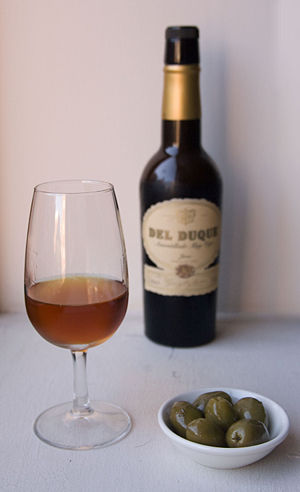
Fortified wine
Fortified wine is wine to which a distilled beverage has been added. Fortified wine is distinguished from spirits made from wine in that spirits are produced by means of distillation, while fortified wine is simply wine that has had a spirit added to it...
made from white grapes that are grown near the town of Jerez
Jerez de la Frontera
Jerez de la Frontera is a municipality in the province of Cádiz in the autonomous community of Andalusia, in southwestern Spain, situated midway between the sea and the mountains. , the city, the largest in the province, had 208,896 inhabitants; it is the fifth largest in Andalusia...
(Jerez de la Frontera
Jerez de la Frontera
Jerez de la Frontera is a municipality in the province of Cádiz in the autonomous community of Andalusia, in southwestern Spain, situated midway between the sea and the mountains. , the city, the largest in the province, had 208,896 inhabitants; it is the fifth largest in Andalusia...
), Spain
Spain
Spain , officially the Kingdom of Spain languages]] under the European Charter for Regional or Minority Languages. In each of these, Spain's official name is as follows:;;;;;;), is a country and member state of the European Union located in southwestern Europe on the Iberian Peninsula...
. In Spanish
Spanish language
Spanish , also known as Castilian , is a Romance language in the Ibero-Romance group that evolved from several languages and dialects in central-northern Iberia around the 9th century and gradually spread with the expansion of the Kingdom of Castile into central and southern Iberia during the...
, it is called vino de Jerez.
The word "sherry" is an anglicization of Jerez. In earlier times, sherry was known as sack
Sack (wine)
Sack is an antiquated wine term referring to white fortified wine imported from mainland Spain or the Canary Islands. There were sack of different origins such as:* Canary sack from the Canary Islands,* Malaga sack from Málaga,...
(from the Spanish saca, meaning "a removal from the solera
Solera
Solera is a process for aging liquids such as wine, beer, vinegar, and brandy, by fractional blending in such a way that the finished product is a mixture of ages, with the average age gradually increasing as the process continues over many years. A solera is literally the set of barrels or other...
"). In Europe, "Sherry" is a protected designation of origin
Protected designation of origin
Protected Geographical Status is a legal framework defined in European Union law to protect the names of regional foods. Protected Designation of Origin , Protected Geographical Indication and Traditional Speciality Guaranteed are distinct regimes of geographical indications within the framework...
; in Spanish law, all wine labeled as "sherry" must legally come from the Sherry Triangle, which is an area in the province of Cádiz
Cádiz (province)
Cádiz is a province of southern Spain, in the southwestern part of the autonomous community of Andalusia, the southernmost part of continental Western Europe....
between Jerez de la Frontera
Jerez de la Frontera
Jerez de la Frontera is a municipality in the province of Cádiz in the autonomous community of Andalusia, in southwestern Spain, situated midway between the sea and the mountains. , the city, the largest in the province, had 208,896 inhabitants; it is the fifth largest in Andalusia...
, Sanlúcar de Barrameda
Sanlúcar de Barrameda
Sanlúcar de Barrameda is a city in the northwest of Cádiz province, part of the autonomous community of Andalucía in southern Spain. Sanlúcar is located on the left bank at the mouth of the Guadalquivir River opposite the Doñana National Park, 52 km from the provincial capital Cádiz and...
, and El Puerto de Santa María
El Puerto de Santa María
El Puerto de Santa María is a municipality located on the banks of the Guadalete River in the province of Cádiz, Spain. , the city has a population of c...
. In 1933 the Jerez Denominación de Origen
Denominación de Origen
Denominación de Origen is part of a regulatory classification system primarily for Spanish wines but also for other foodstuffs like honey, meats and condiments. In wines it parallels the hierarchical system of France and Italy although Rioja and Sherry preceded the full system...
was the first Spanish denominación to be officially recognized in this way, officially named D.O. Jerez-Xeres-Sherry and sharing the same governing council as D.O. Manzanilla Sanlúcar de Barrameda
Sanlúcar de Barrameda
Sanlúcar de Barrameda is a city in the northwest of Cádiz province, part of the autonomous community of Andalucía in southern Spain. Sanlúcar is located on the left bank at the mouth of the Guadalquivir River opposite the Doñana National Park, 52 km from the provincial capital Cádiz and...
.
After fermentation
Fermentation (wine)
The process of fermentation in wine turns grape juice into an alcoholic beverage. During fermentation, yeast interact with sugars in the juice to create ethanol, commonly known as ethyl alcohol, and carbon dioxide...
is complete, sherry is fortified with brandy
Brandy
Brandy is a spirit produced by distilling wine. Brandy generally contains 35%–60% alcohol by volume and is typically taken as an after-dinner drink...
. Because the fortification takes place after fermentation, most sherries are initially dry, with any sweetness being added later. In contrast, port wine
Port wine
Port wine is a Portuguese fortified wine produced exclusively in the Douro Valley in the northern provinces of Portugal. It is typically a sweet, red wine, often served as a dessert wine, and comes in dry, semi-dry, and white varieties...
(for example) is fortified halfway through its fermentation, which stops the process so that not all of the sugar is turned into alcohol.
Sherry is produced in a variety of styles, ranging from dry, light versions such as fino
Fino
Fino is the driest and palest of the traditional varieties of sherry. They are drunk comparatively young, and unlike the sweeter varieties should be drunk soon after the bottle is opened as exposure to air can cause them to lose their flavour within hours.-Flor:The defining component of Fino...
s to darker and heavier versions known as oloroso
Oloroso
Oloroso is a variety of sherry produced by oxidative aging. It is normally darker than amontillado and has a higher glycerine content, which makes it smoother and less dry. Oloroso is usually dark and nutty....
s, all made from the Palomino
Palomino (grape)
Palomino is a white grape widely grown in Spain and South Africa, and best known for its use in the manufacture of sherry.-Wine regions:In Spain, the grape is split into the sub-varieties Palomino Fino, Palomino Basto, and Palomino de Jerez, of which Palomino Fino is by far the most important,...
grape. Sweet dessert wines are also made, from Pedro Ximenez
Pedro Ximénez
Pedro Ximénez is the name of a white grape grown in certain regions of Spain, and also a varietal wine, an intensely sweet, dark, dessert sherry...
or Moscatel grapes. Sherry is regarded by many wine writers as "underappreciated" and a "neglected wine treasure".
History
Jerez has been a centre of viniculture since wine-making was introduced to Spain by the Phoenicians in 1100 BC. The practice was carried on by the RomansAncient Rome
Ancient Rome was a thriving civilization that grew on the Italian Peninsula as early as the 8th century BC. Located along the Mediterranean Sea and centered on the city of Rome, it expanded to one of the largest empires in the ancient world....
when they took control of Iberia around 200 BC. The Moors
Moors
The description Moors has referred to several historic and modern populations of the Maghreb region who are predominately of Berber and Arab descent. They came to conquer and rule the Iberian Peninsula for nearly 800 years. At that time they were Muslim, although earlier the people had followed...
conquered the region in AD 711 and introduced distillation
Distillation
Distillation is a method of separating mixtures based on differences in volatilities of components in a boiling liquid mixture. Distillation is a unit operation, or a physical separation process, and not a chemical reaction....
, which led to the development of brandy and fortified wine.
During the Moorish
Moors
The description Moors has referred to several historic and modern populations of the Maghreb region who are predominately of Berber and Arab descent. They came to conquer and rule the Iberian Peninsula for nearly 800 years. At that time they were Muslim, although earlier the people had followed...
period, the town was called Sherish (a transliteration of the Arabic
Arabic language
Arabic is a name applied to the descendants of the Classical Arabic language of the 6th century AD, used most prominently in the Quran, the Islamic Holy Book...
شريش), from which both Sherry and Jerez are derived. Wines similar in style to sherry have traditionally been made in the city of Shiraz
Shiraz
Shiraz may refer to:* Shiraz, Iran, a city in Iran* Shiraz County, an administrative subdivision of Iran* Vosketap, Armenia, formerly called ShirazPeople:* Hovhannes Shiraz, Armenian poet* Ara Shiraz, Armenian sculptor...
in mid-southern Iran, but it is thought unlikely that the name derives from there.
Wine production continued through five centuries of Arab Empire's rule. In 966, Al-Hakam II
Al-Hakam II
Al-Hakam II was the second Caliph of Cordoba, in Al-Andalus , and son of Abd-ar-rahman III . He ruled from 961 to 976....
, the second Caliph of Córdoba
Caliphate of Córdoba
The Caliphate of Córdoba ruled the Iberian peninsula and part of North Africa, from the city of Córdoba, from 929 to 1031. This period was characterized by remarkable success in trade and culture; many of the masterpieces of Islamic Iberia were constructed in this period, including the famous...
, ordered the destruction of the vineyards, but the inhabitants of Jerez appealed on the grounds that the vineyards also produced raisins to feed the empire's soldiers, and the Caliph spared two-thirds of the vineyards.
In 1264 Alfonso X of Castile
Alfonso X of Castile
Alfonso X was a Castilian monarch who ruled as the King of Castile, León and Galicia from 1252 until his death...
took the city and it was renamed Xeres. (Over time the spelling was adjusted to Xerez, and finally Jerez). From this point on, the production of sherry and its export throughout Europe increased significantly. By the end of the 16th century, sherry had a reputation in Europe as the world's finest wine.
Christopher Columbus
Christopher Columbus
Christopher Columbus was an explorer, colonizer, and navigator, born in the Republic of Genoa, in northwestern Italy. Under the auspices of the Catholic Monarchs of Spain, he completed four voyages across the Atlantic Ocean that led to general European awareness of the American continents in the...
, brought sherry on his voyage to the New World and when Ferdinand Magellan
Ferdinand Magellan
Ferdinand Magellan was a Portuguese explorer. He was born in Sabrosa, in northern Portugal, and served King Charles I of Spain in search of a westward route to the "Spice Islands" ....
prepared to sail around the world in 1519, he spent more on sherry than on weapons.
Sherry wine became very popular in Great Britain, especially after Francis Drake
Francis Drake
Sir Francis Drake, Vice Admiral was an English sea captain, privateer, navigator, slaver, and politician of the Elizabethan era. Elizabeth I of England awarded Drake a knighthood in 1581. He was second-in-command of the English fleet against the Spanish Armada in 1588. He also carried out the...
sacked Cadiz in 1587. At that time Cadiz was one of the most important Spanish sea ports, and Spain was preparing an armada there to invade England. Among the spoils Drake brought back after destroying the fleet were 2,900 barrels of sherry that had been on shore waiting to be loaded aboard Spanish ships. This helped to popularize sherry in the British Isles.
Because sherry was a major wine export to the United Kingdom
United Kingdom
The United Kingdom of Great Britain and Northern IrelandIn the United Kingdom and Dependencies, other languages have been officially recognised as legitimate autochthonous languages under the European Charter for Regional or Minority Languages...
, many English companies and styles developed. Many of the Jerez cellars were founded by British families.
In 1894 the Jerez region was devastated by the insect phylloxera
Phylloxera
Grape phylloxera ; originally described in France as Phylloxera vastatrix; equated to the previously described Daktulosphaira vitifoliae, Phylloxera vitifoliae; commonly just called phylloxera is a pest of commercial grapevines worldwide, originally native to eastern North America...
. Whereas larger vineyards were replanted with resistant vines, most smaller producers were unable to fight the infestation and abandoned their vineyards entirely.
Styles
- FinoFinoFino is the driest and palest of the traditional varieties of sherry. They are drunk comparatively young, and unlike the sweeter varieties should be drunk soon after the bottle is opened as exposure to air can cause them to lose their flavour within hours.-Flor:The defining component of Fino...
('fine' in SpanishSpanish languageSpanish , also known as Castilian , is a Romance language in the Ibero-Romance group that evolved from several languages and dialects in central-northern Iberia around the 9th century and gradually spread with the expansion of the Kingdom of Castile into central and southern Iberia during the...
) is the driest and palest of the traditional varieties of sherry. The wine is aged in barrels under a cap of florFlorFlor is a winemaking term referring to a film of yeast on the surface of wine and which is important in the manufacture of certain styles of sherry. The flor is formed naturally under certain winemaking conditions, from indigenous yeasts found in the region of Andalucía in southern Spain...
yeast to prevent contact with the air. - Manzanilla is an especially light variety of fino Sherry made around the port of Sanlúcar de BarramedaSanlúcar de BarramedaSanlúcar de Barrameda is a city in the northwest of Cádiz province, part of the autonomous community of Andalucía in southern Spain. Sanlúcar is located on the left bank at the mouth of the Guadalquivir River opposite the Doñana National Park, 52 km from the provincial capital Cádiz and...
. - Manzanilla Pasada is a Manzanilla that has undergone extended aging or has been partially oxidised, giving a richer, nuttier flavour.
- AmontilladoAmontilladoAmontillado is a variety of sherry, characterized by being darker than fino but lighter than oloroso. It is named for the Montilla region of Spain, where the style originated in the 18th century, although the name 'amontillado' is sometimes used commercially as a simple measure of colour to label...
is a variety of Sherry that is first aged under flor but which is then exposed to oxygen, producing a sherry that is darker than a fino but lighter than an oloroso. Naturally dry, they are sometimes sold lightly to medium sweetened. - OlorosoOlorosoOloroso is a variety of sherry produced by oxidative aging. It is normally darker than amontillado and has a higher glycerine content, which makes it smoother and less dry. Oloroso is usually dark and nutty....
('scented' in SpanishSpanish languageSpanish , also known as Castilian , is a Romance language in the Ibero-Romance group that evolved from several languages and dialects in central-northern Iberia around the 9th century and gradually spread with the expansion of the Kingdom of Castile into central and southern Iberia during the...
) is a variety of Sherry aged oxidatively for a longer time than a fino or amontillado, producing a darker and richer wine. With alcohol levels between 18 and 20%, olorosos are the most alcoholic sherries in the bottle. Again naturally dry, they are often also sold in sweetened versions (Amoroso). - Palo CortadoPalo CortadoPalo Cortado is a rare variety of sherry that is initially aged under flor to become a fino or amontillado, but inexplicably loses its veil of flor and begins aging oxidatively as an oloroso. The result is a wine with some of the richness of oloroso and some of the crispness of amontillado...
is a variety of Sherry that is initially aged like an amontillado, typically for three or four years, but which subsequently develops a character closer to an oloroso. This either happens by accident when the flor dies, or commonly the flor is killed by fortification or filtration. - Jerez Dulce (Sweet Sherries) are made either by fermenting dried Pedro XiménezPedro XiménezPedro Ximénez is the name of a white grape grown in certain regions of Spain, and also a varietal wine, an intensely sweet, dark, dessert sherry...
(PX) or MoscatelMuscat of AlexandriaMuscat of Alexandria is a white wine grape that is a member of the Muscat family of Vitis vinifera. It is considered an "ancient vine", and wine experts believe it is one of the oldest genetically unmodified vines still in existence...
grapes, which produces an intensely sweet dark brown or black wine, or by blending sweeter wines or grape must with a drier variety. Cream Sherry is a common type of sweet sherry made by blending different wines, such as oloroso sweetened with PX.
The "Sherry" brand
Spanish producers have registered the names Jerez / Xérès / Sherry and will prosecute producers of similar fortified wines from other places using the same name. In 1933, Article 34 of the Spanish Estatuto del Vino (Wine Law) established the boundaries of sherry production as the first Spanish wineSpanish wine
Spanish wines are wines produced in the southwestern European country of Spain. Located on the Iberian Peninsula, Spain has over 2.9 million acres planted—making it the most widely planted wine producing nation but it is the third largest producer of wine in the world, the largest...
denominación. Today, sherry's official status is further recognized by wider EU legislation. Sherry must come from the triangular area of the province of Cádiz
Cádiz (province)
Cádiz is a province of southern Spain, in the southwestern part of the autonomous community of Andalusia, the southernmost part of continental Western Europe....
between Jerez, Sanlúcar de Barrameda
Sanlúcar de Barrameda
Sanlúcar de Barrameda is a city in the northwest of Cádiz province, part of the autonomous community of Andalucía in southern Spain. Sanlúcar is located on the left bank at the mouth of the Guadalquivir River opposite the Doñana National Park, 52 km from the provincial capital Cádiz and...
, and El Puerto de Santa María
El Puerto de Santa María
El Puerto de Santa María is a municipality located on the banks of the Guadalete River in the province of Cádiz, Spain. , the city has a population of c...
. However the name 'sherry' is used as a semi-generic
Semi-generic
Semi-generic is a legal term used in by the United States Alcohol and Tobacco Tax and Trade Bureau to refer to a specific type of wine designation. The majority of these were originally based on the names of well-known European wine-producing regions...
in the United States where it must be labeled with a region of origin such as American sherry or California sherry.
Australia wine makers now uses the term apera
Apera
Apera is a small genus of annual grasses, known commonly as silkybent grass or windgrass. They are native to Europe and western Asia but have been introduced and naturalized elsewhere, especially A. interrupta and A...
instead of sherry.
Climate
The Jerez district has a predictable climate, with approximately 70 days of rainfall and almost 300 days of sun per year. The rain mostly falls between the months of October and May, averaging 600 l/m². The summer is dry and hot, with temperatures as high as 40 °C (104 °F), but winds from the ocean bring moisture to the vineyards in the early morning and the clays in the soil retain water below the surface. The average temperature across the year is approximately 18 °C (64 °F).Soil
There are three types of soil in the Jerez district for growing the grapes for Sherry:- Albariza: the lightest soil, almost white, and best for growing Palomino grapes. It is approximately 40-50 per cent chalk, the rest being a blend of limestone, clay and sand. Albariza preserves moisture well during the hot summer months.
- Barros: a dark brown soil, 10 per cent chalk with a high clay content.
- Arenas: a yellowish soil, also 10 per cent chalk but with a high sand content.
The albariza soil is the best for growing the Palomino grape, and by law 40 per cent of the grapes making up a Sherry must come from albariza soil. The barros and arenas soil are mostly used for Pedro Ximénez and Moscatel grapes.
The benefits of the albariza soil is that it can reflect sunlight back up to the vine, aiding it in photosynthesis
Photosynthesis
Photosynthesis is a chemical process that converts carbon dioxide into organic compounds, especially sugars, using the energy from sunlight. Photosynthesis occurs in plants, algae, and many species of bacteria, but not in archaea. Photosynthetic organisms are called photoautotrophs, since they can...
. The nature of the soil is very absorbent and compact so that it can retain and maximize the use of the little rainfall that the Jerez region receives.
Grapes
Before the phylloxeraPhylloxera
Grape phylloxera ; originally described in France as Phylloxera vastatrix; equated to the previously described Daktulosphaira vitifoliae, Phylloxera vitifoliae; commonly just called phylloxera is a pest of commercial grapevines worldwide, originally native to eastern North America...
infestation in 1894, there were estimated to be over 100 varieties of grape used in Spain for the production of Sherry, but now there are only three white grapes grown for Sherry-making:
- PalominoPalomino (grape)Palomino is a white grape widely grown in Spain and South Africa, and best known for its use in the manufacture of sherry.-Wine regions:In Spain, the grape is split into the sub-varieties Palomino Fino, Palomino Basto, and Palomino de Jerez, of which Palomino Fino is by far the most important,...
: the dominant grape used for the dry sherries. Approximately 90 per cent of the grapes grown for Sherry are Palomino. As varietalVarietal"Varietal" describes wines made primarily from a single named grape variety, and which typically displays the name of that variety on the wine label. Examples of grape varieties commonly used in varietal wines are Cabernet Sauvignon, Chardonnay and Merlot...
table wineTable wineTable wine is a wine term with two different meanings: a wine style; and a quality level within wine classification.In the United States, table wine primarily designates a wine style - ordinary wine which is neither fortified nor sparkling....
, the Palomino grape produces a wine of very bland and neutral characteristics. This neutrality is actually what makes Palomino an ideal grape because it is so easily enhanced by the Sherry winemaking style. - Pedro XiménezPedro XiménezPedro Ximénez is the name of a white grape grown in certain regions of Spain, and also a varietal wine, an intensely sweet, dark, dessert sherry...
: used to produce sweet wines. When harvested these grapes are typically dried in the sun for two days to concentrate their sugars. - MoscatelMuscat (grape and wine)The Muscat variety of grapes of the species Vitis vinifera is widely grown for wine, raisins and table grapes. Their color ranges from white to near black. Muscat almost always has a pronounced sweet floral aroma. Muscat grapes are grown around the world...
: used similarly to Pedro Ximénez, but it is less common.
Sherry-style wines made in other countries often use other grape varieties.
Fermentation
The Palomino grapes are harvested in early September, and pressed lightly to extract the mustMust
Must is freshly pressed fruit juice that contains the skins, seeds, and stems of the fruit. The solid portion of the must is called pomace; it typically makes up 7%–23% of the total weight of the must. Making must is the first step in winemaking...
. The must from the first pressing, the primera yema, is used to produce Fino and Manzanilla and the must from the second pressing, the segunda yema will be used for Oloroso ; the product of additional pressings is used for lesser wines, distillation and vinegar
Vinegar
Vinegar is a liquid substance consisting mainly of acetic acid and water, the acetic acid being produced through the fermentation of ethanol by acetic acid bacteria. Commercial vinegar is produced either by fast or slow fermentation processes. Slow methods generally are used with traditional...
. The must is then fermented in stainless steel vats until the end of November, producing a dry white wine with 11-12 percent alcohol content.
Fortification
Immediately after fermentation, the wine is sampled and the first classification is performed. The casks are marked with the following symbols according to the potential of the wine:| / | a single stroke indicates a wine with the finest flavour and aroma, suitable for fino or amontillado. These wines are fortified to about 15 percent alcohol to allow the growth of flor. |
|---|---|
| /. | a single stroke with a dot indicates a heavier, more full-bodied wine. These wines are fortified to about 17.5 percent alcohol to prevent the growth of flor, and the wines are aged oxidatively to produce oloroso. |
| // | a double stroke indicates a wine which will be allowed to develop further before determining whether to use the wine for amontillado or oloroso. These wines are fortified to about 15 percent alcohol. |
| /// | a triple stroke indicates a wine that has developed poorly, and will be distilled Distillation Distillation is a method of separating mixtures based on differences in volatilities of components in a boiling liquid mixture. Distillation is a unit operation, or a physical separation process, and not a chemical reaction.... . |
The Sherry is fortified
Fortified wine
Fortified wine is wine to which a distilled beverage has been added. Fortified wine is distinguished from spirits made from wine in that spirits are produced by means of distillation, while fortified wine is simply wine that has had a spirit added to it...
using destilado, made by distilling wine, usually from La Mancha
La Mancha
La Mancha is a natural and historical region or greater comarca located on an arid, fertile, elevated plateau of central Spain, south of Madrid, stretching between the Montes de Toledo and the western spurs of the Serrania de Cuenca. It is bounded on the south by the Sierra Morena and on the north...
. The distilled spirit is first mixed with mature Sherry to make a 50/50 blend known as mitad y mitad (half and half), and then the mitad y mitad is mixed with the younger Sherry to the proper proportions. This two-stage procedure is performed so the strong alcohol will not shock the young Sherry and spoil it.
Aging
The fortified wine is stored in 500-litre casks that are made of North American oak, which is less porous than French or Spanish oak. The casks, or butts, are filled five-sixths full, leaving "the space of two fists" empty at the top to allow florFlor
Flor is a winemaking term referring to a film of yeast on the surface of wine and which is important in the manufacture of certain styles of sherry. The flor is formed naturally under certain winemaking conditions, from indigenous yeasts found in the region of Andalucía in southern Spain...
to develop on top of the wine.
Sherry is then aged in the solera
Solera
Solera is a process for aging liquids such as wine, beer, vinegar, and brandy, by fractional blending in such a way that the finished product is a mixture of ages, with the average age gradually increasing as the process continues over many years. A solera is literally the set of barrels or other...
system where new wine is put into wine barrel
Wine barrel
The use of oak plays a significant role in winemaking and can have a profound effect on the resulting wine, affecting the color, flavor, tannin profile and texture of the wine. Oak can come into contact with wine in the form of a barrel during the fermentation or aging periods...
s at the beginning of a series of three to nine barrels. Periodically, a portion of the wine in a barrel is moved into the next barrel down, using tools called the canoa (canoe) and rociador (sprinkler) to move the wine gently and avoid damaging the layer of flor in each barrel. At the end of the series only a portion of the final barrel is bottled and sold. Depending on the type of wine, the portion moved may be between five and thirty percent of each barrel. This process is called "running the scales" because each barrel in the series is called a scale.
So the age of the youngest wine going into the bottle is determined by the number of barrels in the series, and every bottle also contains some much older wine. Sherry is aged in the solera for a minimum of 3 years.
Storing and drinking
Once bottled, sherry does not benefit from further aging and may be consumed immediately, though the sherries that have been aged oxidatively may be stored for years without losing their flavor. Bottles should be stored upright to minimize the wine's exposed surface area. As with other wines, sherry should be stored in a cool, dark place.Fino and Manzanilla are the most fragile types of sherry and should usually be drunk soon after opening. In Spain, finos are often sold in half bottles, with any remaining wine being thrown out if it is not drunk the same day it is opened. Amontillados and olorosos will keep for longer, while sweeter versions such as PX, and blended cream Sherries, are able to last several weeks or even months after opening, since the sugar content acts as a preservative.
Sherry is traditionally drunk from a copita, a special tulip-shaped Sherry glass. Sampling wine directly from a Sherry butt may be performed with characteristic flourish by a venenciador, named after the special cup (the venencia) traditionally made of silver
Silver
Silver is a metallic chemical element with the chemical symbol Ag and atomic number 47. A soft, white, lustrous transition metal, it has the highest electrical conductivity of any element and the highest thermal conductivity of any metal...
and fastened to a long whalebone handle. The cup, narrow enough to pass though the bung hole, withdraws a measure of sherry which is then ceremoniously poured from head height into a copita held in the other hand.
Recently, young people drink it mixed with lemonade soft-drink and ice. It is called Rebujito
Rebujito
Rebujito is a cocktail that mixes Sherry and soft drinks.- External links :*...
, although it was popular in the Victorian age, known as sherry-cobbler.
Sherry in culture
There are many literary figures who wrote about Sherry: William ShakespeareWilliam Shakespeare
William Shakespeare was an English poet and playwright, widely regarded as the greatest writer in the English language and the world's pre-eminent dramatist. He is often called England's national poet and the "Bard of Avon"...
, Benito Pérez Galdós
Benito Pérez Galdós
Benito Pérez Galdós was a Spanish realist novelist. Considered second only to Cervantes in stature, he was the leading Spanish realist novelist....
, Alexander Fleming
Alexander Fleming
Sir Alexander Fleming was a Scottish biologist and pharmacologist. He wrote many articles on bacteriology, immunology, and chemotherapy...
and Edgar Allan Poe
Edgar Allan Poe
Edgar Allan Poe was an American author, poet, editor and literary critic, considered part of the American Romantic Movement. Best known for his tales of mystery and the macabre, Poe was one of the earliest American practitioners of the short story and is considered the inventor of the detective...
(in his story The Cask of Amontillado
The Cask of Amontillado
"The Cask of Amontillado" is a short story by Edgar Allan Poe, first published in the November 1846 issue of Godey's Lady's Book....
).
Some images are also part of Spanish tradition, like the shape of the Toro de Osborne, or the bottle of Tío Pepe
Tio Pepe
Tío Pepe is a brand of Sherry, the best selling brand in the world. It is best known for its fino style of dry sherry made from the palomino grape...
.
In Walt Disney's movie "Mary Poppins
Mary Poppins
Mary Poppins is a series of children's books written by P. L. Travers and originally illustrated by Mary Shepard. The books centre on a magical English nanny, Mary Poppins. She is blown by the East wind to Number Seventeen Cherry Tree Lane, London and into the Banks' household to care for their...
", Mr. Banks enjoys a sherry every evening alongside his pipe at precisely 6:02 every evening.
On the popular sitcom Frasier
Frasier
Frasier is an American sitcom that was broadcast on NBC for eleven seasons, from September 16, 1993, to May 13, 2004. The program was created and produced by David Angell, Peter Casey, and David Lee in association with Grammnet and Paramount Network Television.A spin-off of Cheers, Frasier stars...
, the show's namesake character and his brother Niles are often seen drinking sherry as an after-work treat. The drinking of sherry became so iconic of the series and indicative of the relationship of Frasier and Niles, that it was used as a metaphor to hark the end of the series: when sherry ran out in the series, it became obvious that the way of life that grew in the series was about to die.
Related products
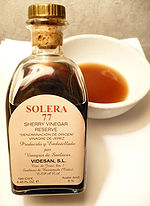
- Brandy de JerezBrandy de JerezBrandy de Jerez is a brandy that is produced only in the Jerez area of Andalusia, Spain . Besides being sold as a brandy, it is also an ingredient of some sherries...
- Sherry VinegarSherry VinegarSherry vinegar is a gourmet wine vinegar made from Sherry. It is produced in the Spanish province of Cádiz and inside the triangular area between the city of Jerez de la Frontera and towns of Sanlúcar de Barrameda and El Puerto de Santa María, known as the "sherry triangle".To be called vinagre de...
See also
- Cooking sherry
- Ratonero Bodeguero AndaluzRatonero Bodeguero AndaluzThe Ratonero Bodeguero Andaluz is a Spanish breed of dog of the terrier type. Its name reflects its main occupation: hunting rats and mice hidden between barrels in the wineries of Andalusia in Spain...
- Harvey's Bristol Cream
- The Cask of AmontilladoThe Cask of Amontillado"The Cask of Amontillado" is a short story by Edgar Allan Poe, first published in the November 1846 issue of Godey's Lady's Book....
For further reading
External links
- Sherry official site
- Information about the town of Jerez de la Frontera in Andalucia, southern Spain
- Sherry Institute of Spain's promotional website for cooking with sherry
- Basic Juice's postings: "Very Simply Sherry I", "Very Simply Sherry II" and "Very Simply Sherry III"
- Sherry 101 an explanation of styles with audio vocabulary examples.