
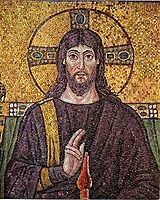
Jesus of Nazareth commonly referred to as
Jesus Christ or simply as
Jesus or
Christ, is the central figure of
ChristianityChristianity is a monotheistic religion based on the life and teachings of Jesus as presented in canonical gospels and other New Testament writings...
. Most
Christian denominationA Christian denomination is an identifiable religious body under a common name, structure, and doctrine within Christianity. In the Orthodox tradition, Churches are divided often along ethnic and linguistic lines, into separate churches and traditions. Technically, divisions between one group and...
s
venerate him as
God the SonGod the Son is the second person of the Trinity in Christian theology. The doctrine of the Trinity identifies Jesus of Nazareth as God the Son, united in essence but distinct in person with regard to God the Father and God the Holy Spirit...
incarnatedThe Incarnation in traditional Christianity is the belief that Jesus Christ the second person of the Trinity, also known as God the Son or the Logos , "became flesh" by being conceived in the womb of a woman, the Virgin Mary, also known as the Theotokos .The Incarnation is a fundamental theological...
and believe that he
rose from the deadThe Christian belief in the resurrection of Jesus states that Jesus returned to bodily life on the third day following his death by crucifixion. It is a key element of Christian faith and theology and part of the Nicene Creed: "On the third day he rose again in fulfillment of the Scriptures"...
after being
crucifiedThe crucifixion of Jesus and his ensuing death is an event that occurred during the 1st century AD. Jesus, who Christians believe is the Son of God as well as the Messiah, was arrested, tried, and sentenced by Pontius Pilate to be scourged, and finally executed on a cross...
.
The principal sources of information regarding Jesus are the four canonical gospels,
and most
biblical scholarsBiblical criticism is the scholarly "study and investigation of Biblical writings that seeks to make discerning judgments about these writings." It asks when and where a particular text originated; how, why, by whom, for whom, and in what circumstances it was produced; what influences were at work...
find them useful for reconstructing Jesus' life and teachings. Scholars have correlated the
New TestamentThe New Testament is the second major division of the Christian biblical canon, the first such division being the much longer Old Testament....
accounts with non-Christian historical records to arrive at an
estimated chronologyThe chronology of Jesus aims to establish a historical order for some of the events of the life of Jesus in the four canonical gospels. The Christian gospels were primarily written as theological documents rather than historical chronicles and their authors showed little interest in an absolute...
for the major episodes in the life of Jesus.
Most critical historians agree that Jesus was a
GalileanGalilee , is a large region in northern Israel which overlaps with much of the administrative North District of the country. Traditionally divided into Upper Galilee , Lower Galilee , and Western Galilee , extending from Dan to the north, at the base of Mount Hermon, along Mount Lebanon to the...
Jewish
RabbiIn Judaism, a rabbi is a teacher of Torah. This title derives from the Hebrew word רבי , meaning "My Master" , which is the way a student would address a master of Torah...
who was regarded as a teacher and
healerFaith healing is healing through spiritual means. The healing of a person is brought about by religious faith through prayer and/or rituals that, according to adherents, stimulate a divine presence and power toward correcting disease and disability. Belief in divine intervention in illness or...
in
JudaeaJudaea or Iudaea are terms used by historians to refer to the Roman province that extended over parts of the former regions of the Hasmonean and Herodian kingdoms of Israel...
,
that he
was baptizedThe baptism of Jesus marks the beginning of Jesus Christ's public ministry. This event is recorded in the Canonical Gospels of Matthew, Mark and Luke. In John 1:29-33 rather than a direct narrative, the Baptist bears witness to the episode...
by
John the BaptistJohn the Baptist was an itinerant preacher and a major religious figure mentioned in the Canonical gospels. He is described in the Gospel of Luke as a relative of Jesus, who led a movement of baptism at the Jordan River...
, and that he was
crucifiedThe crucifixion of Jesus and his ensuing death is an event that occurred during the 1st century AD. Jesus, who Christians believe is the Son of God as well as the Messiah, was arrested, tried, and sentenced by Pontius Pilate to be scourged, and finally executed on a cross...
in
Jerusalem on the orders of the
Roman PrefectA Roman governor was an official either elected or appointed to be the chief administrator of Roman law throughout one or more of the many provinces constituting the Roman Empire...
,
Pontius PilatePontius Pilatus , known in the English-speaking world as Pontius Pilate , was the fifth Prefect of the Roman province of Judaea, from AD 26–36. He is best known as the judge at Jesus' trial and the man who authorized the crucifixion of Jesus...
, on the charge of
seditionIn law, sedition is overt conduct, such as speech and organization, that is deemed by the legal authority to tend toward insurrection against the established order. Sedition often includes subversion of a constitution and incitement of discontent to lawful authority. Sedition may include any...
against the
Roman EmpireThe Roman Empire was the post-Republican period of the ancient Roman civilization, characterised by an autocratic form of government and large territorial holdings in Europe and around the Mediterranean....
.
Critical
BiblicalThe Bible refers to any one of the collections of the primary religious texts of Judaism and Christianity. There is no common version of the Bible, as the individual books , their contents and their order vary among denominations...
scholars and historians have offered competing descriptions of Jesus as a self-described
MessiahA messiah is a redeemer figure expected or foretold in one form or another by a religion. Slightly more widely, a messiah is any redeemer figure. Messianic beliefs or theories generally relate to eschatological improvement of the state of humanity or the world, in other words the World to...
, as the leader of an apocalyptic movement, as an itinerant sage, as a charismatic healer, and as the founder of an independent religious movement. Most contemporary scholars of the
historical JesusThe term historical Jesus refers to scholarly reconstructions of the 1st-century figure Jesus of Nazareth. These reconstructions are based upon historical methods including critical analysis of gospel texts as the primary source for his biography, along with consideration of the historical and...
consider him to have been an independent, charismatic founder of a Jewish restoration movement, anticipating a future apocalypse. Other prominent scholars, however, contend that Jesus' "
Kingdom of GodThe Kingdom of God or Kingdom of Heaven is a foundational concept in the Abrahamic religions: Judaism, Christianity and Islam.The term "Kingdom of God" is found in all four canonical gospels and in the Pauline epistles...
" meant radical personal and social transformation instead of a future apocalypse.
Christians traditionally believe that Jesus was born of a virgin, performed
miraclesThe miracles of Jesus are the supernatural deeds of Jesus, as recorded in Gospels, in the course of his ministry. According to the Gospel of John, only some of these were recorded. states that "Jesus did many other things as well...
, founded
the ChurchThe Christian Church is the assembly or association of followers of Jesus Christ. The Greek term ἐκκλησία that in its appearances in the New Testament is usually translated as "church" basically means "assembly"...
,
rose from the deadThe Christian belief in the resurrection of Jesus states that Jesus returned to bodily life on the third day following his death by crucifixion. It is a key element of Christian faith and theology and part of the Nicene Creed: "On the third day he rose again in fulfillment of the Scriptures"...
, and ascended into
heavenHeaven, the Heavens or Seven Heavens, is a common religious cosmological or metaphysical term for the physical or transcendent place from which heavenly beings originate, are enthroned or inhabit...
, from which he
will returnIn Christian doctrine, the Second Coming of Christ, the Second Advent, or the Parousia, is the anticipated return of Jesus Christ from Heaven, where he sits at the Right Hand of God, to Earth. This prophecy is found in the canonical gospels and in most Christian and Islamic eschatologies...
. The majority of Christians worship Jesus as the incarnation of God the Son, and "the Second Person of the
Blessed TrinityThe Christian doctrine of the Trinity defines God as three divine persons : the Father, the Son , and the Holy Spirit. The three persons are distinct yet coexist in unity, and are co-equal, co-eternal and consubstantial . Put another way, the three persons of the Trinity are of one being...
".
A few Christian groups, however,
reject TrinitarianismNontrinitarianism includes all Christian belief systems that disagree with the doctrine of the Trinity, namely, the teaching that God is three distinct hypostases and yet co-eternal, co-equal, and indivisibly united in one essence or ousia...
, wholly or partly, believing it to be non-scriptural.
Most Christian scholars today present Jesus as the awaited Messiah promised in the
Old TestamentThe Old Testament, of which Christians hold different views, is a Christian term for the religious writings of ancient Israel held sacred and inspired by Christians which overlaps with the 24-book canon of the Masoretic Text of Judaism...
and as God, arguing that he fulfilled many Messianic prophecies of the Old Testament.
JudaismJudaism ) is the "religion, philosophy, and way of life" of the Jewish people...
rejects assertions that Jesus was the awaited Messiah, arguing that he did not fulfill the
Messianic propheciesMessiah, ; mashiah, moshiah, mashiach, or moshiach, is a term used in the Hebrew Bible to describe priests and kings, who were traditionally anointed with holy anointing oil as described in Exodus 30:22-25...
in the
TanakhThe Tanakh is a name used in Judaism for the canon of the Hebrew Bible. The Tanakh is also known as the Masoretic Text or the Miqra. The name is an acronym formed from the initial Hebrew letters of the Masoretic Text's three traditional subdivisions: The Torah , Nevi'im and Ketuvim —hence...
. In Islam, Jesus (in in Islamic usage, commonly transliterated as ) is considered one of
God'sIn Islamic theology, God is the all-powerful and all-knowing creator, sustainer, ordainer, and judge of the universe. Islam puts a heavy emphasis on the conceptualization of God as strictly singular . God is unique and inherently One , all-merciful and omnipotent. According to the Islamic...
important
prophetsMuslims identify the Prophets of Islam as those humans chosen by God and given revelation to deliver to mankind. Muslims believe that every prophet was given a belief to worship God and their respective followers believed it as well...
, a bringer of
scriptureThe Injil is the Arabic name for the original Gospel of Jesus, and one of the four Islamic Holy Books the Qur'an records as revealed by God, the others being the Zabur, Tawrat and Qur'an. The word Injil is derived from the Greek word and means 'good news'. Muslims believe this original Gospel...
, and the product of a virgin birth, but not the victim of crucifixion. Islam and the
Bahá'í FaithThe Bahá'í Faith is a monotheistic religion founded by Bahá'u'lláh in 19th-century Persia, emphasizing the spiritual unity of all humankind. There are an estimated five to six million Bahá'ís around the world in more than 200 countries and territories....
use the title "Messiah" for Jesus, but do not teach that he was God incarnate.
Etymology of name
"Jesus" is a
transliterationTransliteration is a subset of the science of hermeneutics. It is a form of translation, and is the practice of converting a text from one script into another...
, occurring in a number of languages and based on the Latin
Iesus, of the
GreekGreek is an independent branch of the Indo-European family of languages. Native to the southern Balkans, it has the longest documented history of any Indo-European language, spanning 34 centuries of written records. Its writing system has been the Greek alphabet for the majority of its history;...
(
), itself a
hellenizationHellenization is a term used to describe the spread of ancient Greek culture, and, to a lesser extent, language. It is mainly used to describe the spread of Hellenistic civilization during the Hellenistic period following the campaigns of Alexander the Great of Macedon...
of the
HebrewHebrew is a Semitic language of the Afroasiatic language family. Culturally, is it considered by Jews and other religious groups as the language of the Jewish people, though other Jewish languages had originated among diaspora Jews, and the Hebrew language is also used by non-Jewish groups, such...
(
Yĕhōšuă‘,
JoshuaJoshua , is a minor figure in the Torah, being one of the spies for Israel and in few passages as Moses's assistant. He turns to be the central character in the Hebrew Bible's Book of Joshua...
) or Hebrew-
AramaicAramaic is a group of languages belonging to the Afroasiatic language phylum. The name of the language is based on the name of Aram, an ancient region in central Syria. Within this family, Aramaic belongs to the Semitic family, and more specifically, is a part of the Northwest Semitic subfamily,...
(
Yēšûă‘), both meaning "
YahwehYahweh is the name of God in the Bible, the God of Abraham, Isaac, Jacob, Jews and Christians.The word Yahweh is a modern scholarly convention for the Hebrew , transcribed into Roman letters as YHWH and known as the Tetragrammaton, for which the original pronunciation is unknown...
delivers" or "Yahweh rescues".
The etymology of the name Jesus is generally expressed by Christians as "God's salvation" usually expressed as "
YahwehYahweh is the name of God in the Bible, the God of Abraham, Isaac, Jacob, Jews and Christians.The word Yahweh is a modern scholarly convention for the Hebrew , transcribed into Roman letters as YHWH and known as the Tetragrammaton, for which the original pronunciation is unknown...
saves", "Yahweh is salvation" and at times as "
JehovahJehovah is an anglicized representation of Hebrew , a vocalization of the Tetragrammaton , the proper name of the God of Israel in the Hebrew Bible....
is salvation". The name Jesus appears to have been in use in
JudaeaJudaea or Iudaea are terms used by historians to refer to the Roman province that extended over parts of the former regions of the Hasmonean and Herodian kingdoms of Israel...
at the time of the birth of Jesus.
PhiloPhilo , known also as Philo of Alexandria , Philo Judaeus, Philo Judaeus of Alexandria, Yedidia, "Philon", and Philo the Jew, was a Hellenistic Jewish Biblical philosopher born in Alexandria....
's reference (
Mutatione Nominum item 121) indicates that the etymology of Joshua was known outside Judaea at the time.
In the
New TestamentThe New Testament is the second major division of the Christian biblical canon, the first such division being the much longer Old Testament....
, in Luke 1:26-33, the angel Gabriel tells Mary to name her child "Jesus", and in Matthew 1:21 an angel tells Joseph to name the child "Jesus". The statement in Matthew 1:21 "you are to give him the name Jesus, because he will save his people from their sins" associates salvific attributes to the name Jesus in Christian theology.
"
ChristChrist is the English term for the Greek meaning "the anointed one". It is a translation of the Hebrew , usually transliterated into English as Messiah or Mashiach...
" (icon) is derived from the
GreekGreek is an independent branch of the Indo-European family of languages. Native to the southern Balkans, it has the longest documented history of any Indo-European language, spanning 34 centuries of written records. Its writing system has been the Greek alphabet for the majority of its history;...
(
Khrīstos), meaning "
the anointedTo anoint is to pour or smear with perfumed oil, milk, water, melted butter or other substances, a process employed ritually by many religions. People and things are anointed to symbolize the introduction of a sacramental or divine influence, a holy emanation, spirit, power or God...
" or "the anointed one", a translation of the Hebrew (
), usually transliterated into
EnglishEnglish is a West Germanic language that arose in the Anglo-Saxon kingdoms of England and spread into what was to become south-east Scotland under the influence of the Anglian medieval kingdom of Northumbria...
as "
MessiahA messiah is a redeemer figure expected or foretold in one form or another by a religion. Slightly more widely, a messiah is any redeemer figure. Messianic beliefs or theories generally relate to eschatological improvement of the state of humanity or the world, in other words the World to...
" (icon). In the
Septuagint version of the
Hebrew BibleThe Hebrew Bible is a term used by biblical scholars outside of Judaism to refer to the Tanakh , a canonical collection of Jewish texts, and the common textual antecedent of the several canonical editions of the Christian Old Testament...
(written well over a century before the time of Jesus), the word "Christ" was used to translate into Greek the Hebrew word "Messiah" . In Matthew 16:16, the apostle
PeterSaint Peter or Simon Peter was an early Christian leader, who is featured prominently in the New Testament Gospels and the Acts of the Apostles. The son of John or of Jonah and from the village of Bethsaida in the province of Galilee, his brother Andrew was also an apostle...
's profession "You are the Christ" identifies Jesus as the Messiah. In postbiblical usage, "Christ" became viewed as a name, one part of "Jesus Christ", but originally it was a title ("Jesus the Anointed").
Chronology
Although a few scholars have questioned the existence of Jesus as an actual historical figure, most scholars involved with historical Jesus research believe his existence, but not the supernatural claims associated with him, can be established using documentary and other evidence. As discussed in the sections immediately below, the estimation of the year of death of Jesus places his lifespan around the beginning of the 1st century AD/CE, in the geographic region of
Roman JudaeaJudaea or Iudaea are terms used by historians to refer to the Roman province that extended over parts of the former regions of the Hasmonean and Herodian kingdoms of Israel...
. The New Testament also refers to the
Sea of GalileeThe Sea of Galilee, also Kinneret, Lake of Gennesaret, or Lake Tiberias , is the largest freshwater lake in Israel, and it is approximately in circumference, about long, and wide. The lake has a total area of , and a maximum depth of approximately 43 m...
which is about 75 miles north of
Jerusalem.
Roman involvement in Judaea began around 63 BC/BCE and by 6 AD/CE Judaea had become a Roman province. From 26-37 AD/CE
Pontius PilatePontius Pilatus , known in the English-speaking world as Pontius Pilate , was the fifth Prefect of the Roman province of Judaea, from AD 26–36. He is best known as the judge at Jesus' trial and the man who authorized the crucifixion of Jesus...
was the governor of Roman Judaea. In this time period, although Roman Judaea was strategically positioned between Asia and Africa, it was not viewed as a critically important province by the Romans. The Romans were highly tolerant of other religions and allowed the local populations such as the Jews to practice their own faiths.
Year of birth estimates
Two independent approaches have been used to estimate the year of the birth of Jesus, one by analyzing the
NativityThe Nativity of Jesus, or simply The Nativity, refers to the accounts of the birth of Jesus in two of the Canonical gospels and in various apocryphal texts....
accounts in the Gospels of Luke and Matthew along with other historical data, the other by working backwards from the estimation of the start of the
ministry of JesusIn the Christian gospels, the Ministry of Jesus begins with his Baptism in the countryside of Judea, near the River Jordan and ends in Jerusalem, following the Last Supper with his disciples. The Gospel of Luke states that Jesus was "about 30 years of age" at the start of his ministry...
, as also discussed in the section below.
In its
NativityThe Nativity of Jesus, or simply The Nativity, refers to the accounts of the birth of Jesus in two of the Canonical gospels and in various apocryphal texts....
account, the Gospel of Matthew associates the birth of Jesus with the reign of
Herod the GreatHerod , also known as Herod the Great , was a Roman client king of Judea. His epithet of "the Great" is widely disputed as he is described as "a madman who murdered his own family and a great many rabbis." He is also known for his colossal building projects in Jerusalem and elsewhere, including his...
, who is generally believed to have died around 4 BC/BCE. Matthew 2:1 states that: "Jesus was born in Bethlehem of Judaea in the days of Herod the king" and Luke 1:5 mentions the reign of Herod shortly before the birth of Jesus. Matthew also suggests that Jesus may have been as much as two years old at the time of the visit of the
MagiThe Magi Greek: μάγοι, magoi), also referred to as the Wise Men, Kings, Astrologers, or Kings from the East, were a group of distinguished foreigners who were said to have visited Jesus after his birth, bearing gifts of gold, frankincense and myrrh...
and hence even older at the time of Herod's death. But the author of Luke also describes the birth as taking place during the
first censusThe Census of Quirinius refers to the enrollment of the Roman Provinces of Syria and Iudaea for tax purposes taken in the year 6/7 during the reign of Emperor Augustus , when Publius Sulpicius Quirinius was appointed governor of Syria, after the banishment of Herod Archelaus from the Tetrarchy of...
of the Roman provinces of
SyriaThe history of Syria:*Prehistory and Ancient Near East: see Pre-history of the Southern Levant, Fertile Crescent, Ebla, Mitanni*Antiquity: see Syro-Hittite states, Greater Syria, Roman Syria...
and
IudaeaJudaea or Iudaea are terms used by historians to refer to the Roman province that extended over parts of the former regions of the Hasmonean and Herodian kingdoms of Israel...
, which is generally believed to have occurred in 6 AD/CE. Most scholars generally assume a date of birth between 6 and 4 BC/BCE. Other scholars assume that Jesus was born sometime between 7–2 BC/BCE.
The year of birth of Jesus has also been estimated in a manner that is independent of the Nativity accounts, by using information in the
Gospel of JohnThe Gospel According to John , commonly referred to as the Gospel of John or simply John, and often referred to in New Testament scholarship as the Fourth Gospel, is an account of the public ministry of Jesus...
to work backwards from the statement in Luke 3:23 that Jesus was "about 30 years of age" at the start of his ministry. As discussed in the section below, by combining information from John 2:13 and John 2:20 with the writings of
JosephusTitus Flavius Josephus , also called Joseph ben Matityahu , was a 1st-century Romano-Jewish historian and hagiographer of priestly and royal ancestry who recorded Jewish history, with special emphasis on the 1st century AD and the First Jewish–Roman War, which resulted in the Destruction of...
, it has been estimated that around 27-29 AD/CE, Jesus was "about thirty years of age". Some scholars thus estimate the year 28 AD/CE to be roughly the 32nd birthday of Jesus and the birth year of Jesus to be around 6-4 BC/BCE.
However, the common
Gregorian calendarThe Gregorian calendar, also known as the Western calendar, or Christian calendar, is the internationally accepted civil calendar. It was introduced by Pope Gregory XIII, after whom the calendar was named, by a decree signed on 24 February 1582, a papal bull known by its opening words Inter...
method for numbering years, in which the current year is , is based on the decision of a monk
DionysiusDionysius Exiguus was a 6th-century monk born in Scythia Minor, modern Dobruja shared by Romania and Bulgaria. He was a member of the Scythian monks community concentrated in Tomis, the major city of Scythia Minor...
in the six century, to
count the years and Before Christ are designations used to label or number years used with the Julian and Gregorian calendars....
from a point of reference (namely, Jesus’ birth) which he placed sometime between 2 BC and 1
AD and Before Christ are designations used to label or number years used with the Julian and Gregorian calendars....
. Although Christian feasts related to the
NativityThe Nativity of Jesus, or simply The Nativity, refers to the accounts of the birth of Jesus in two of the Canonical gospels and in various apocryphal texts....
have had specific dates (e.g. December 25 for
ChristmasChristmas or Christmas Day is an annual holiday generally celebrated on December 25 by billions of people around the world. It is a Christian feast that commemorates the birth of Jesus Christ, liturgically closing the Advent season and initiating the season of Christmastide, which lasts twelve days...
) there is no historical evidence for the exact day or month of the birth of Jesus.
Years of ministry estimates
There have been different approaches to estimating the date of the start of the ministry of Jesus. One approach, based on combining information from the
Gospel of LukeThe Gospel According to Luke , commonly shortened to the Gospel of Luke or simply Luke, is the third and longest of the four canonical Gospels. This synoptic gospel is an account of the life and ministry of Jesus of Nazareth. It details his story from the events of his birth to his Ascension.The...
with historical data about Emperor
TiberiusTiberius , was Roman Emperor from 14 AD to 37 AD. Tiberius was by birth a Claudian, son of Tiberius Claudius Nero and Livia Drusilla. His mother divorced Nero and married Augustus in 39 BC, making him a step-son of Octavian...
yields a date around 28-29 AD/CE, while a second independent approach based on statements in the
Gospel of JohnThe Gospel According to John , commonly referred to as the Gospel of John or simply John, and often referred to in New Testament scholarship as the Fourth Gospel, is an account of the public ministry of Jesus...
along with historical information from
JosephusTitus Flavius Josephus , also called Joseph ben Matityahu , was a 1st-century Romano-Jewish historian and hagiographer of priestly and royal ancestry who recorded Jewish history, with special emphasis on the 1st century AD and the First Jewish–Roman War, which resulted in the Destruction of...
about the Temple in Jerusalem leads to a date around 27-29 AD/CE. A third method uses the date of the death of John the Baptist and the marriage of
Herod AntipasHerod Antipater , known by the nickname Antipas, was a 1st-century AD ruler of Galilee and Perea, who bore the title of tetrarch...
to
HerodiasHerodias was a Jewish princess of the Herodian Dynasty. Asteroid 546 Herodias is named after her.-Family relationships:*Daughter of Aristobulus IV...
based on the writings of
JosephusTitus Flavius Josephus , also called Joseph ben Matityahu , was a 1st-century Romano-Jewish historian and hagiographer of priestly and royal ancestry who recorded Jewish history, with special emphasis on the 1st century AD and the First Jewish–Roman War, which resulted in the Destruction of...
, and correlates it to Matthew 14:4.
The estimation of the date based on the Gospel of Luke relies on the statement in Luke 3:1-2 that the ministry of
John the BaptistJohn the Baptist was an itinerant preacher and a major religious figure mentioned in the Canonical gospels. He is described in the Gospel of Luke as a relative of Jesus, who led a movement of baptism at the Jordan River...
which preceded that of Jesus began "in the fifteenth year of the reign of Tiberius Caesar". Given that
TiberiusTiberius , was Roman Emperor from 14 AD to 37 AD. Tiberius was by birth a Claudian, son of Tiberius Claudius Nero and Livia Drusilla. His mother divorced Nero and married Augustus in 39 BC, making him a step-son of Octavian...
began his reign in 14 AD/CE, this yields a date about 28-29 AD/CE.
The estimation of the date based on the Gospel of John uses the statements in John 2:13 that Jesus went to the Temple in Jerusalem around the start of his ministry and in John 2:20 that "Forty and six years was this temple in building" at that time. According to
JosephusTitus Flavius Josephus , also called Joseph ben Matityahu , was a 1st-century Romano-Jewish historian and hagiographer of priestly and royal ancestry who recorded Jewish history, with special emphasis on the 1st century AD and the First Jewish–Roman War, which resulted in the Destruction of...
(
AntAntiquities of the Jews is a twenty volume historiographical work composed by the Jewish historian Flavius Josephus in the thirteenth year of the reign of Roman emperor Flavius Domitian which was around 93 or 94 AD. Antiquities of the Jews contains an account of history of the Jewish people,...
15.380) the temple reconstruction was started by
Herod the GreatHerod , also known as Herod the Great , was a Roman client king of Judea. His epithet of "the Great" is widely disputed as he is described as "a madman who murdered his own family and a great many rabbis." He is also known for his colossal building projects in Jerusalem and elsewhere, including his...
in the 15th-18th year of his reign at about the time that
AugustusAugustus ;23 September 63 BC – 19 August AD 14) is considered the first emperor of the Roman Empire, which he ruled alone from 27 BC until his death in 14 AD.The dates of his rule are contemporary dates; Augustus lived under two calendars, the Roman Republican until 45 BC, and the Julian...
arrived in Syria (Ant 15.354). Temple expansion and reconstruction was ongoing, and it was in constant reconstruction until it was destroyed in 70 AD/CE by the Romans. Given that it took 46 years of construction, the Temple visit in the Gospel of John has been estimated at around 27-29 AD/CE.
Although both the gospels and
JosephusTitus Flavius Josephus , also called Joseph ben Matityahu , was a 1st-century Romano-Jewish historian and hagiographer of priestly and royal ancestry who recorded Jewish history, with special emphasis on the 1st century AD and the First Jewish–Roman War, which resulted in the Destruction of...
refer to Herod Antipas killing John the Baptist, they differ on the details, e.g. whether this act was a consequence of the marriage of Herod Antipas and Herodias, as indicated in Matthew 14:4, or a pre-emptive measure by Herod which possibly took place before the marriage, as Josephus suggests in Ant 18.5.2. The exact year of the marriage of
Herod AntipasHerod Antipater , known by the nickname Antipas, was a 1st-century AD ruler of Galilee and Perea, who bore the title of tetrarch...
and
HerodiasHerodias was a Jewish princess of the Herodian Dynasty. Asteroid 546 Herodias is named after her.-Family relationships:*Daughter of Aristobulus IV...
is subject to debate among scholars. In his analysis of Herod's life,
Harold HoehnerHarold Walter Hoehner was an American biblical scholar who served as distinguished professor of New Testament studies at Dallas Theological Seminary.-Family and education:...
estimates that John the Baptist's imprisonment probably occurred around AD 30-31. The International Standard Bible Encyclopedia estimates the death of the Baptist to have occurred about AD 31-32. The death of John the Baptist relates to the end of the
major Galilean ministry of Jesus, just before the half way point in the gospel narratives, before the start of Jesus' final journey to Jerusalem through Judea.