


Winemaking

Encyclopedia
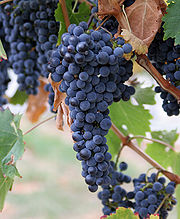
Wine
Wine is an alcoholic beverage, made of fermented fruit juice, usually from grapes. The natural chemical balance of grapes lets them ferment without the addition of sugars, acids, enzymes, or other nutrients. Grape wine is produced by fermenting crushed grapes using various types of yeast. Yeast...
, starting with selection of the grape
Grape
A grape is a non-climacteric fruit, specifically a berry, that grows on the perennial and deciduous woody vines of the genus Vitis. Grapes can be eaten raw or they can be used for making jam, juice, jelly, vinegar, wine, grape seed extracts, raisins, molasses and grape seed oil. Grapes are also...
s or other produce and ending with bottling the finished wine. Although most wine is made from grapes, it may also be made from other fruit or non-toxic plant material. Mead
Mead
Mead , also called honey wine, is an alcoholic beverage that is produced by fermenting a solution of honey and water. It may also be produced by fermenting a solution of water and honey with grain mash, which is strained immediately after fermentation...
is a wine that is made with honey being the primary ingredient after water.
Winemaking can be divided into two general categories: still wine production (without carbonation) and sparkling wine
Sparkling wine
Sparkling wine is a wine with significant levels of carbon dioxide in it making it fizzy. The carbon dioxide may result from natural fermentation, either in a bottle, as with the méthode champenoise, in a large tank designed to withstand the pressures involved , or as a result of carbon dioxide...
production (with carbonation).
The science of wine and winemaking is known as oenology
Oenology
Oenology,[p] œnology , or enology is the science and study of all aspects of wine and winemaking except vine-growing and grape-harvesting, which is a subfield called viticulture. “Viticulture & oenology” is a common designation for training programmes and research centres that include both the...
. A person who makes wine is traditionally called a winemaker
Winemaker
A winemaker or vintner is a person engaged in winemaking. They are generally employed by wineries or wine companies, where their work includes:*Cooperating with viticulturists...
or vintner.
Process
Fermentation (wine)
The process of fermentation in wine turns grape juice into an alcoholic beverage. During fermentation, yeast interact with sugars in the juice to create ethanol, commonly known as ethyl alcohol, and carbon dioxide...
. At this stage red wine making diverges from white wine making.
Red wine is made from the must
Must
Must is freshly pressed fruit juice that contains the skins, seeds, and stems of the fruit. The solid portion of the must is called pomace; it typically makes up 7%–23% of the total weight of the must. Making must is the first step in winemaking...
(pulp) of red or black grapes that undergo fermentation together with the grape skins.
White wine is made by fermenting juice
Juice
Juice is the liquid that is naturally contained in fruit or vegetable tissue.Juice is prepared by mechanically squeezing or macerating fruit or vegetable flesh without the application of heat or solvents. For example, orange juice is the liquid extract of the fruit of the orange tree...
which is made by pressing crushed grapes to extract a juice; the skins are removed and play no further role. Occasionally white wine is made from red grapes, this is done by extracting their juice with minimal contact with the grapes' skins.
Rosé
Rosé
A rosé is a type of wine that has some of the color typical of a red wine, but only enough to turn it pink. The pink color can range from a pale orange to a vivid near-purple, depending on the grapes and wine making techniques.- Production techniques :There are three major ways to produce rosé...
wines are either made from red grapes where the juice is allowed to stay in contact with the dark skins long enough to pick up a pinkish color (blanc de noir) or by blending red wine and white wine. White and rosé wines extract little of the tannins contained in the skins.
To start primary fermentation yeast is added to the must for red wine or juice for white wine. During this fermentation, which often takes between one and two weeks, the yeast
Yeast
Yeasts are eukaryotic micro-organisms classified in the kingdom Fungi, with 1,500 species currently described estimated to be only 1% of all fungal species. Most reproduce asexually by mitosis, and many do so by an asymmetric division process called budding...
converts most of the sugar
Sugar
Sugar is a class of edible crystalline carbohydrates, mainly sucrose, lactose, and fructose, characterized by a sweet flavor.Sucrose in its refined form primarily comes from sugar cane and sugar beet...
s in the grape juice into ethanol
Ethanol
Ethanol, also called ethyl alcohol, pure alcohol, grain alcohol, or drinking alcohol, is a volatile, flammable, colorless liquid. It is a psychoactive drug and one of the oldest recreational drugs. Best known as the type of alcohol found in alcoholic beverages, it is also used in thermometers, as a...
(alcohol) and carbon dioxide. The carbon dioxide is lost to the atmosphere.
After the primary fermentation of red grapes the free run wine is pumped off into tanks and the skins are pressed to extract the remaining juice and wine, the press wine blended with the free run wine at the wine maker's discretion. The wine is kept warm and the remaining sugars
Sugars in wine
The sugars in wine grapes are what make winemaking possible. During the process of fermentation, sugars are broken down and converted by yeasts into alcohol and carbon dioxide. Grapes accumulate sugars as they grow on the grapevine through the translocation of sucrose molecules that are produced...
are converted into alcohol and carbon dioxide. The next process in the making of red wine is secondary fermentation. This is a bacterial fermentation which converts malic acid to lactic acid. This process decreases the acid in the wine and softens the taste of the wine. Red wine is sometimes transferred to oak barrels to mature for a period of weeks or months, this practice imparts oak aromas to the wine. The wine must be settled or clarified and adjustments made prior to filtration and bottling.
The time from harvest to drinking can vary from a few months for Beaujolais nouveau
Beaujolais nouveau
Beaujolais nouveau is a red wine made from Gamay grapes produced in the Beaujolais region of France. It is the most popular vin de primeur, fermented for just a few weeks before being released for sale on the third Thursday of November...
wines to over twenty years for top wines. However, only about 10% of all red and 5% of white wine will taste better after five years than it will after just one year.
Depending on the quality of grape and the target wine style, some of these steps may be combined or omitted to achieve the particular goals of the winemaker. Many wines of comparable quality are produced using similar but distinctly different approaches to their production; quality is dictated by the attributes of the starting material and not necessarily the steps taken during vinification.
Variations on the above procedure exist. With sparkling wines such as Champagne, an additional fermentation takes place inside the bottle, trapping carbon dioxide and creating the characteristic bubbles. Sweet wines
Sweetness of wine
The subjective sweetness of a wine is determined by the interaction of several factors, including the amount of sugar in the wine to be sure, but also the relative levels of alcohol, acids, and tannins. Briefly: sugars and alcohol enhance a wine's sweetness; acids and bitter tannins counteract it...
are made by ensuring that some residual sugar remains after fermentation is completed. This can be done by harvesting late (late harvest wine
Late harvest wine
Late harvest is a term applied to wines made from grapes left on the vine longer than usual. Late harvest is usually an indication of a sweet dessert wine, such as late harvest Riesling. Late harvest grapes are often more similar to raisins, but have been naturally dehydrated while on the vine...
), freezing the grapes to concentrate the sugar (ice wine
Ice wine
Ice wine is a type of dessert wine produced from grapes that have been frozen while still on the vine. The sugars and other dissolved solids do not freeze, but the water does, allowing a more concentrated grape must to be pressed from the frozen grapes, resulting in a smaller amount of more...
), or adding a substance to kill the remaining yeast before fermentation is completed; for example, high proof
Proof (alcohol)
Alcohol proof is a measure of how much alcohol is contained in an alcoholic beverage. The term was originally used in the United Kingdom and was defined as 7/4 times the alcohol by volume . The UK now uses the abv standard instead of alcohol proof. In the United States, alcoholic proof is defined...
brandy
Brandy
Brandy is a spirit produced by distilling wine. Brandy generally contains 35%–60% alcohol by volume and is typically taken as an after-dinner drink...
is added when making port wine
Port wine
Port wine is a Portuguese fortified wine produced exclusively in the Douro Valley in the northern provinces of Portugal. It is typically a sweet, red wine, often served as a dessert wine, and comes in dry, semi-dry, and white varieties...
. In other cases the winemaker may choose to hold back some of the sweet grape juice and add it to the wine after the fermentation is done, a technique known as süssreserve.
The process produces wastewater, pomace
Pomace
Pomace , or marc , is the solid remains of grapes, olives, or other fruit after pressing for juice or oil. It contains the skins, pulp, seeds, and stems of the fruit....
, and lees
Lees (fermentation)
Lees refers to deposits of dead yeast or residual yeast and other particles that precipitate, or are carried by the action of "fining", to the bottom of a vat of wine after fermentation and ageing. The yeast deposits in beer brewing are known as trub...
that require collection, treatment, and disposal or beneficial use.
Home Winemaking
As with the rise of brewing your own beer, many have taken on the rewarding hobby of amateur winemaking. Winemaking equipment can be purchased from homebrew and wine shops for around $100, and winemaking kits derived from fruit juice concentrates range from $70-$200, depending on the varietal and region of the grape. These kits will make about 24 bottles of wine, at a price of about $3-$8 per bottle.Juices can be purchased in six gallon pails for Forty five to sixty dollars a pail. Five pound bags of sugar can cost several dollars and yeast for about one dollar. Five gallon glass jugs can cost about thirty dollars along with a stopper and air lock.
The grapes
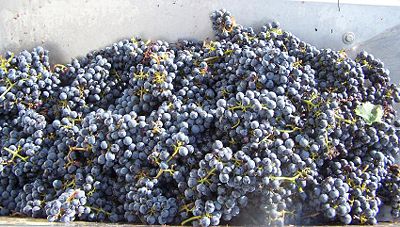
Terroir
Terroir comes from the word terre "land". It was originally a French term in wine, coffee and tea used to denote the special characteristics that the geography, geology and climate of a certain place bestowed upon particular varieties...
.
Grapes are usually harvested from the vineyard
Vineyard
A vineyard is a plantation of grape-bearing vines, grown mainly for winemaking, but also raisins, table grapes and non-alcoholic grape juice...
from early September until early November in the northern hemisphere, and mid February until early March in the southern hemisphere. In some cool areas in the southern hemisphere, for example Tasmania, harvesting extends into May.
The most common species of wine grape is Vitis vinifera
Vitis vinifera
Vitis vinifera is a species of Vitis, native to the Mediterranean region, central Europe, and southwestern Asia, from Morocco and Portugal north to southern Germany and east to northern Iran....
, which includes nearly all varieties of European origin.
Harvesting and destemming
HarvestHarvest
Harvest is the process of gathering mature crops from the fields. Reaping is the cutting of grain or pulse for harvest, typically using a scythe, sickle, or reaper...
is the picking of the grapes and in many ways the first step in wine production. Grapes are either harvested mechanically or by hand. The decision to harvest grapes is typically made by the winemaker and informed by the level of sugar (called °Brix), acid
Acids in wine
The acids in wine are an important component in both winemaking and the finished product of wine. They are present in both grapes and wine, having direct influences on the color, balance and taste of the wine as well as the growth and vitality of yeasts during fermentation and protecting the wine...
(TA or Titratable Acidity as expressed by tartaric acid
Tartaric acid
Tartaric acid is a white crystalline diprotic organic acid. It occurs naturally in many plants, particularly grapes, bananas, and tamarinds; is commonly combined with baking soda to function as a leavening agent in recipes, and is one of the main acids found in wine. It is added to other foods to...
equivalents) and pH
PH
In chemistry, pH is a measure of the acidity or basicity of an aqueous solution. Pure water is said to be neutral, with a pH close to 7.0 at . Solutions with a pH less than 7 are said to be acidic and solutions with a pH greater than 7 are basic or alkaline...
of the grapes. Other considerations include phenological ripeness, berry flavor, tannin development (seed color and taste). Overall disposition of the grapevine and weather forecasts are taken into account.
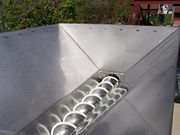
Rachis
Rachis is a biological term for a main axis or "shaft".-In zoology:In vertebrates a rachis can refer to the series of articulated vertebrae, which encase the spinal cord. In this case the rachis usually form the supporting axis of the body and is then called the spine or vertebral column...
. Mechanical harvesters have the advantage of being able to cover a large area of vineyard land in a relatively short period of time, and with a minimum investment of manpower per harvested ton. A disadvantage of mechanical harvesting is the indiscriminate inclusion of foreign non-grape material in the product, especially leaf stems and leaves, but also, depending on the trellis system and grapevine canopy management, may include moldy grapes,canes, metal debris, rocks and even small animals and bird nests. Some winemakers remove leaves and loose debris from the grapevine before mechanical harvesting to avoid such material being included in the harvested fruit. In the United States mechanical harvesting is seldom used for premium winemaking because of the indiscriminate picking and increased oxidation of the grape juice. In other countries (such as Australia and New Zealand), mechanical harvesting of premium winegrapes is more common because of general labor shortages.

Vitis
Vitis is a genus of about 60 species of vining plants in the flowering plant family Vitaceae. The genus is made up of species predominantly from the Northern hemisphere. It is economically important as the source of grapes, both for direct consumption of the fruit and for fermentation to produce...
s. In the United States, grapes are traditionally picked into 30 pound boxes, and in many cases these boxes are consolidated into ½ ton bins or two-ton bins for transport to the winery. Manual harvesting has the advantage of using knowledgeable labor to not only pick the ripe clusters but also to leave behind the clusters that are not ripe or contain bunch rot or other defects. This can be an effective first line of defense to prevent inferior quality fruit from contaminating a lot or tank of wine.
Destemming is the process of separating stems from the grapes. Depending on the winemaking procedure, this process may be undertaken before crushing with the purpose of lowering the development of tannins and vegetal flavors in the resulting wine. Single berry harvesting, as is done with some German Trockenbeerenauslese
Trockenbeerenauslese
Trockenbeerenauslese is a German language wine term for an intensely sweet dessert wine-style wine....
, avoids this step altogether with the grapes being individually selected.
Crushing and primary (alcoholic) fermentation
Crushing is the process when gently squeezing the berries and breaking the skins to start to liberate the contents of the berries. Destemming is the process of removing the grapes from the rachis (the stem which holds the grapes). In traditional and smaller-scale wine making, the harvested grapes are sometimes crushed by trampling them barefoot or by the use of inexpensive small scale crushers. These can also destem at the same time. However, in larger wineries, a mechanical crusher/destemmer is used.The decision about destemming is different for red and white wine making. Generally when making white wine the fruit is only crushed, the stems are then placed in the press with the berries. The presence of stems in the mix facilitates pressing by allowing juice to flow past flattened skins. These accumulate at the edge of the press.
For red winemaking, stems of the grapes are usually removed before fermentation since the stems have a relatively high tannin content; in addition to tannin they can also give the wine a vegetal aroma (due to extraction of 2-methoxy
Methoxy
In chemistry , methoxy refers to the functional group consisting of a methyl group bound to oxygen. This alkoxy group has the formula O–CH3.The word is used in organic nomenclature usually to describe an ether...
-3-isopropylpyrazine which has an aroma reminiscent of green bell pepper
Bell pepper
Bell pepper, also known as sweet pepper or a pepper and capsicum , is a cultivar group of the species Capsicum annuum . Cultivars of the plant produce fruits in different colors, including red, yellow, orange and green. Bell peppers are sometimes grouped with less pungent pepper varieties as...
s.) On occasion, the winemaker may decide to leave them in if the grapes themselves contain less tannin than desired. This is more acceptable if the stems have 'ripened' and started to turn brown.
If increased skin extraction is desired, a winemaker might choose to crush the grapes after destemming. Removal of stems first means no stem tannin can be extracted. In these cases the grapes pass between two rollers which squeeze the grapes enough to separate the skin and pulp, but not so much as to cause excessive shearing or tearing of the skin tissues. In some cases, notably with "delicate" red varietals such as Pinot noir or Syrah, all or part of the grapes might be left uncrushed (called "whole berry") to encourage the retention of fruity aromas through partial carbonic maceration
Carbonic maceration
Carbonic maceration is a winemaking technique, often associated with the French wine region of Beaujolais, in which whole grapes are fermented in a carbon dioxide rich environment prior to crushing. Conventional alcoholic fermentation involves crushing the grapes to free the juice and pulp from the...
.
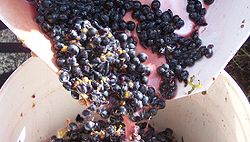
Anthocyanin
Anthocyanins are water-soluble vacuolar pigments that may appear red, purple, or blue according to pH...
) and therefore contact between the juice and skins is essential for color extraction.
Red wines are produced by destemming and crushing the grapes into a tank and leaving the skins in contact with the juice throughout the fermentation (maceration
Maceration (wine)
Maceration is the winemaking process where the phenolic materials of the grape— tannins, coloring agents and flavor compounds— are leached from the grape skins, seeds and stems into the must. Maceration is the process by which the red wine receives its red color, since 99% of all grape juice is...
). It is possible to produce white (colorless) wines from red grapes by the fastidious pressing of uncrushed fruit. This minimizes contact between grape juice and skins (as in the making of Blanc de noirs sparkling wine, which is derived from Pinot noir, a red vinifera grape.)
Most white wines are processed without destemming or crushing and are transferred from picking bins directly to the press. This is to avoid any extraction of tannin from either the skins or grapeseeds, as well as maintaining proper juice flow through a matrix of grape clusters rather than loose berries. In some circumstances winemakers choose to crush white grapes for a short period of skin contact, usually for three to 24 hours. This serves to extract flavor and tannin from the skins (the tannin being extracted to encourage protein precipitation without excessive Bentonite
Bentonite
Bentonite is an absorbent aluminium phyllosilicate, essentially impure clay consisting mostly of montmorillonite. There are different types of bentonite, each named after the respective dominant element, such as potassium , sodium , calcium , and aluminum . Experts debate a number of nomenclatorial...
addition) as well as Potassium
Potassium
Potassium is the chemical element with the symbol K and atomic number 19. Elemental potassium is a soft silvery-white alkali metal that oxidizes rapidly in air and is very reactive with water, generating sufficient heat to ignite the hydrogen emitted in the reaction.Potassium and sodium are...
ions, which participate in bitartrate precipitation (cream of tartar). It also results in an increase in the pH of the juice which may be desirable for overly acidic grapes. This was a practice more common in the 1970s than today, though still practiced by some Sauvignon blanc and Chardonnay producers in California.
In the case of rosé wines, the fruit is crushed and the dark skins are left in contact with the juice just long enough to extract the color that the winemaker desires. The must is then pressed, and fermentation continues as if the wine maker was making a white wine.
Yeast is normally already present on the grapes, often visible as a powdery appearance of the grapes. The primary, or alcoholic fermentation can be done with this natural yeast, but since this can give unpredictable results depending on the exact types of yeast that are present, cultured yeast is often added to the must. One of the main problems with the use of wild ferments is the failure for the fermentation to go to completion, that is some sugar remains unfermented. This can make the wine sweet when a dry wine is desired. Frequently wild ferments lead to the production of unpleasant acetic acid (vinegar) production as a by product.

Alcohol
In chemistry, an alcohol is an organic compound in which the hydroxy functional group is bound to a carbon atom. In particular, this carbon center should be saturated, having single bonds to three other atoms....
. The temperature during the fermentation affects both the taste of the end product, as well as the speed of the fermentation. For red wines, the temperature is typically 22 to 25 °C, and for white wines 15 to 18 °C.
For every gram of sugar that is converted, about half a gram of alcohol is produced, so to achieve a 12% alcohol concentration, the must should contain about 24% sugars. The sugar percentage of the must is calculated from the measured density, the must weight
Must weight
Must weight is a measure of the amount of sugar in grape juice , and hence indicates the amount of alcohol that could be produced if it is all fermented to alcohol, rather than left as residual sugar...
, with the help of a specialized type of hydrometer
Hydrometer
A hydrometer is an instrument used to measure the specific gravity of liquids; that is, the ratio of the density of the liquid to the density of water....
called a saccharometer. If the sugar content of the grapes is too low to obtain the desired alcohol percentage, sugar can be added (chaptalization
Chaptalization
Chaptalization is the process of adding sugar to unfermented grape must in order to increase the alcohol content after fermentation. The technique is named after its developer, the French chemist Jean-Antoine-Claude Chaptal...
). In commercial winemaking, chaptalization is subject to local regulations.
Alcohol of more than 12% can be achieved by using yeast that can withstand high alcohol. Some yeasts can produce 18% alcohol in the wine however extra sugar is added to produce a high alcohol content.
During or after the alcoholic fermentation, a secondary, or malolactic fermentation malolactic fermentation
Malolactic fermentation
Malolactic fermentation is a process in winemaking where tart-tasting malic acid, naturally present in grape must, is converted to softer-tasting lactic acid. Malolactic fermentation tends to create a rounder, fuller mouthfeel. It has been said that malic acid tastes of green apples...
can also take place, during which specific strains of bacteria (lactobacter) convert malic acid
Malic acid
Malic acid is an organic compound with the formula HO2CCH2CHOHCO2H. It is a dicarboxylic acid which is made by all living organisms, contributes to the pleasantly sour taste of fruits, and is used as a food additive. Malic acid has two stereoisomeric forms , though only the L-isomer exists...
into the milder lactic acid
Lactic acid
Lactic acid, also known as milk acid, is a chemical compound that plays a role in various biochemical processes and was first isolated in 1780 by the Swedish chemist Carl Wilhelm Scheele. Lactic acid is a carboxylic acid with the chemical formula C3H6O3...
. This fermentation is often initiated by inoculation with desired bacteria.
Pressing
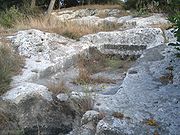
Presses act by positioning the grape skins or whole grape clusters between a rigid surface and a moveable surface and slowly decrease the volume between the two surfaces. Modern presses dictate the duration and pressure at each press cycle, usually ramping from 0 Bar
Bar (unit)
The bar is a unit of pressure equal to 100 kilopascals, and roughly equal to the atmospheric pressure on Earth at sea level. Other units derived from the bar are the megabar , kilobar , decibar , centibar , and millibar...
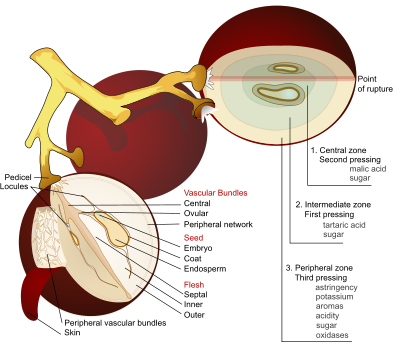
to 2.0 Bar. Sometimes winemakers choose pressures which separate the streams of pressed juice, called making "press cuts." As the pressure increases the amount of tannin extracted from the skins into the juice increases, often rendering the pressed juice excessively tannic or harsh. Because of the location of grape juice constituents in the berry (water and acid are found primarily in the mesocarp or pulp, whereas tannins are found primarily in the pericarp, or skin
Skin
-Dermis:The dermis is the layer of skin beneath the epidermis that consists of connective tissue and cushions the body from stress and strain. The dermis is tightly connected to the epidermis by a basement membrane. It also harbors many Mechanoreceptors that provide the sense of touch and heat...
, and seed
Seed
A seed is a small embryonic plant enclosed in a covering called the seed coat, usually with some stored food. It is the product of the ripened ovule of gymnosperm and angiosperm plants which occurs after fertilization and some growth within the mother plant...
s), pressed juice or wine tends to be lower in acidity with a higher pH than the free-run juice.
Before the advent of modern winemaking, most presses were basket press
Wine press
A wine press is a device used to extract juice from crushed grapes during wine making. There are a number of different styles of presses that are used by wine makers but their overall functionality is the same. Each style of press exerts controlled pressure in order to free the juice from the fruit...
es made of wood and operated manually. Basket presses are composed of a cylinder of wooden slats on top of a fixed plate, with a moveable plate that can be forced downward (usually by a central ratcheting threaded screw.) The press operator would load the grapes or pomace into the wooden cylinder, put the top plate in place and lower it until juice flowed from the wooden slats. As the juice flow decreased, the plate was ratcheted down again. This process continued until the press operator determined that the quality of the pressed juice or wine was below standard, or all liquids had been pressed. Since the early 1990s, modern mechanical basket presses have been revived through higher-end producers seeking to replicate the gentle pressing of the historical basket presses. Because basket presses have a relatively compact design, the press cake offers a relatively longer pathway for the juice to travel before leaving the press. It is believed by advocates of basket presses that this relatively long pathway through the grape or pomace cake serves as a filter to solids that would otherwise affect the quality of the press juice.
With red wines, the must is pressed after primary fermentation, which separates the skins and other solid matter from the liquid. With white wine, the liquid is separated from the must before fermentation . With rose, the skins may be kept in contact for a shorter period to give color to the wine, in that case the must may be pressed as well. After a period in which the wine stands or ages, the wine is separated from the dead yeast and any solids that remained (called lees
Lees (fermentation)
Lees refers to deposits of dead yeast or residual yeast and other particles that precipitate, or are carried by the action of "fining", to the bottom of a vat of wine after fermentation and ageing. The yeast deposits in beer brewing are known as trub...
), and transferred to a new container where any additional fermentation may take place.
Pigeage
Pigeage is a FrenchFrench language
French is a Romance language spoken as a first language in France, the Romandy region in Switzerland, Wallonia and Brussels in Belgium, Monaco, the regions of Quebec and Acadia in Canada, and by various communities elsewhere. Second-language speakers of French are distributed throughout many parts...
winemaking term for the traditional stomping of grapes in open fermentation
Fermentation (food)
Fermentation in food processing typically is the conversion of carbohydrates to alcohols and carbon dioxide or organic acids using yeasts, bacteria, or a combination thereof, under anaerobic conditions. Fermentation in simple terms is the chemical conversion of sugars into ethanol...
tanks. To make certain types of wine, grapes are put through a crusher and then poured into open fermentation tanks. Once fermentation begins, the grape skins are pushed to the surface by carbon dioxide gases released in the fermentation process. This layer of skins and other solids is known as the cap. As the skins are the source of the tannins, the cap needs to be mixed through the liquid each day, or "punched," which traditionally is done by stomping through the vat.
Cold and heat stabilization
Cold stabilization is a process used in winemaking to reduce tartrateTartrate
A tartrate is a salt or ester of the organic compound tartaric acid, a dicarboxylic acid. Its formula is O−OC-CH-CH-COO− or C4H4O62−.As food additives, tartrates are used as antioxidants, acidity regulators, and emulsifiers...
crystals (generally potassium bitartrate
Potassium bitartrate
Potassium hydrogen tartrate, also known as Potassium bitartrate, has formula KC4H5O6, is a byproduct of winemaking. In cooking it is known as cream of tartar. It is the potassium acid salt of tartaric acid, a carboxylic acid.-Occurrence:...
) in wine. These tartrate crystals look like grains of clear sand, and are also known as "wine crystals" or "wine diamonds". They are formed by the union of tartaric acid and potassium, and may appear to be sediment
Sediment
Sediment is naturally occurring material that is broken down by processes of weathering and erosion, and is subsequently transported by the action of fluids such as wind, water, or ice, and/or by the force of gravity acting on the particle itself....
in the wine, though they are not. During the cold stabilizing process after fermentation, the temperature of the wine is dropped to close to freezing for 1–2 weeks. This will cause the crystals to separate from the wine and stick to the sides of the holding vessel. When the wine is drained from the vessels, the tartrates are left behind. They may also form in wine bottles that have been stored under very cold conditions.
During "heat stabilization", unstable proteins are removed by adsorption
Adsorption
Adsorption is the adhesion of atoms, ions, biomolecules or molecules of gas, liquid, or dissolved solids to a surface. This process creates a film of the adsorbate on the surface of the adsorbent. It differs from absorption, in which a fluid permeates or is dissolved by a liquid or solid...
onto bentonite
Bentonite
Bentonite is an absorbent aluminium phyllosilicate, essentially impure clay consisting mostly of montmorillonite. There are different types of bentonite, each named after the respective dominant element, such as potassium , sodium , calcium , and aluminum . Experts debate a number of nomenclatorial...
, preventing them from precipitating
Precipitation (chemistry)
Precipitation is the formation of a solid in a solution or inside anothersolid during a chemical reaction or by diffusion in a solid. When the reaction occurs in a liquid, the solid formed is called the precipitate, or when compacted by a centrifuge, a pellet. The liquid remaining above the solid...
in the bottled wine.
Secondary (Malolactic) fermentation and bulk aging
Fermentation lock
The fermentation lock or airlock is a device used in beer brewing and wine making that allows carbon dioxide released by the beer to escape the fermenter, while not allowing air to enter the fermenter, thus avoiding oxidation....
to protect the wine from oxidation. Protein
Protein
Proteins are biochemical compounds consisting of one or more polypeptides typically folded into a globular or fibrous form, facilitating a biological function. A polypeptide is a single linear polymer chain of amino acids bonded together by peptide bonds between the carboxyl and amino groups of...
s from the grape are broken down and the remaining yeast cells and other fine particles from the grapes are allowed to settle. Potassium bitartrate
Potassium bitartrate
Potassium hydrogen tartrate, also known as Potassium bitartrate, has formula KC4H5O6, is a byproduct of winemaking. In cooking it is known as cream of tartar. It is the potassium acid salt of tartaric acid, a carboxylic acid.-Occurrence:...
will also precipitate, a process which can be enhanced by cold stabilization to prevent the appearance of (harmless) tartrate crystals after bottling. The result of these processes is that the originally cloudy wine becomes clear. The wine can be racked
Racking
Racking is the process of siphoning the wine or beer off the lees into a new, clean barrel or in the case of beer off the trub. Racking allows clarification and aids in stabilization. Wine that is allowed to age on the lees often develops "off-tastes". A racking hose or tubing is used and can be...
during this process to remove the lees
Lees (fermentation)
Lees refers to deposits of dead yeast or residual yeast and other particles that precipitate, or are carried by the action of "fining", to the bottom of a vat of wine after fermentation and ageing. The yeast deposits in beer brewing are known as trub...
.
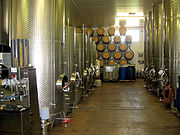
The secondary fermentation usually takes place in either large stainless steel
Stainless steel
In metallurgy, stainless steel, also known as inox steel or inox from French "inoxydable", is defined as a steel alloy with a minimum of 10.5 or 11% chromium content by mass....
vessels with a volume of several cubic meters, or oak barrels, depending on the goals of the winemakers. Unoaked wine is fermented in a barrel made of stainless steel or other material having no influence in the final taste of the wine. Depending on the desired taste, it could be fermented mainly in stainless steel to be briefly put in oak, or have the complete fermentation done in stainless steel. Oak could be added as chips used with a non-wooden barrel instead of a fully wooden barrel. This process is mainly used in cheaper wine.
Amateur winemakers often use glass carboys in the production of their wine; these vessels (sometimes called demijohns) have a capacity of 4.5 to 54 liters (1.2–14.3 US gallons). The kind of vessel used depends on the amount of wine that is being made, the grapes being used, and the intentions of the winemaker.
Malolactic fermentation
Malolactic fermentationMalolactic fermentation
Malolactic fermentation is a process in winemaking where tart-tasting malic acid, naturally present in grape must, is converted to softer-tasting lactic acid. Malolactic fermentation tends to create a rounder, fuller mouthfeel. It has been said that malic acid tastes of green apples...
occurs when lactic acid bacteria
Lactic acid bacteria
The lactic acid bacteria comprise a clade of Gram-positive, low-GC, acid-tolerant, generally non-sporulating, non-respiring rod or cocci that are associated by their common metabolic and physiological characteristics. These bacteria, usually found in decomposing plants and lactic products, produce...
metabolize malic acid
Malic acid
Malic acid is an organic compound with the formula HO2CCH2CHOHCO2H. It is a dicarboxylic acid which is made by all living organisms, contributes to the pleasantly sour taste of fruits, and is used as a food additive. Malic acid has two stereoisomeric forms , though only the L-isomer exists...
and produce lactic acid
Lactic acid
Lactic acid, also known as milk acid, is a chemical compound that plays a role in various biochemical processes and was first isolated in 1780 by the Swedish chemist Carl Wilhelm Scheele. Lactic acid is a carboxylic acid with the chemical formula C3H6O3...
and carbon dioxide. This is carried out either as an intentional procedure in which specially cultivated strains of such bacteria are introduced into the maturing wine, or it can happen by chance if uncultivated lactic acid bacteria are present.
Malolactic fermentation can improve the taste of wine that has high levels of malic acid, because malic acid in higher concentration generally causes an often unpleasant harsh and bitter taste sensation, whereas lactic acid is perceived as more gentle and less sour. Lactic acid is an acid found in dairy products. This is the reason why some chardonnays can taste "buttery". All red wines go through 100% malolactic fermentation, due to the fact that red wines have a higher acidity that needs to be softened. White wines are at the discretion of the winemaker, depending on the desired final product. If a malolactic fermentation is used on white wines, it is usually not 100%, but mostly likely somewhere less than 50%.
Anwar
Laboratory tests
Whether the wine is aging in tanks or barrels, tests are run periodically in a laboratoryLaboratory
A laboratory is a facility that provides controlled conditions in which scientific research, experiments, and measurement may be performed. The title of laboratory is also used for certain other facilities where the processes or equipment used are similar to those in scientific laboratories...
to check the status of the wine. Common tests include °Brix
Brix
Degrees Brix is the sugar content of an aqueous solution.One degree Brix is 1 gram of sucrose in 100 grams of solution and represents the strength of the solution as percentage by weight . If the solution contains dissolved solids other than pure sucrose, then the °Bx is only approximate the...
, pH
PH
In chemistry, pH is a measure of the acidity or basicity of an aqueous solution. Pure water is said to be neutral, with a pH close to 7.0 at . Solutions with a pH less than 7 are said to be acidic and solutions with a pH greater than 7 are basic or alkaline...
, titratable acidity, residual sugar, free or available sulfur, total sulfur, volatile acidity and percent alcohol. Additional tests include those for the crystallization of cream of tartar (potassium hydrogen tartrate) and the precipitation of heat unstable protein; this last test is limited to white wines. These tests are often performed throughout the making of the wine as well as prior to bottling. In response to the results of these tests, a winemaker can then decide on appropriate remedial action, for example the addition of more sulfur dioxide.
Sensory tests will also be performed and again in response to these a wine maker may take remedial action such as the addition of a protein to soften the taste of the wine.
°Brix is one measure of the soluble solids in the grape juice and represents not only the sugars but also includes many other soluble substances such as salts, acids and tannins, sometimes called Total Soluble Solids (TSS). However, sugar is by far the compound in greatest quantity and so for all practical purposes these units are a measure of sugar level. The level of sugar in the grapes is important not only because it will determine the final alcohol content of the wine, but also because it is an indirect index of grape maturity. Brix (Bx for short) is measured in grams per hundred grams of solution, so 20 Bx means that 100 grams of juice contains 20gm of dissolved compounds. There are other common measures of sugar content of grapes, Specific gravity, Oechsle (Germany) and Beaume (France). The French Baumé
Baumé scale
The Baumé scale is a pair of hydrometer scales developed by French pharmacist Antoine Baumé in 1768 to measure density of various liquids. The unit of the Baumé scale has been notated variously as degrees Baumé, B°, Bé° and simply Baumé . One scale measures the density of liquids heavier than water...
(Be° or Bé° for short) has the benefit that one Be° gives approximately one percent alcohol. Also one Be° is equal to 1.8 Brix, that is 1.8 grams of sugar per one hundred grams. This helps with deciding how much sugar to add if the juice is low in sugar: to achieve one percent alcohol add 1.8 grams per 100 ml or 18 grams per liter. This process is called chaptalization and is illegal in some countries (but perfectly acceptable for the home winemaker.) Generally, for the making of dry table wines a Bx of between 20 and 25 is desirable (equivalent to Be° of 11 to 14.)
A Brix test can be run either in the lab or in the field for a quick reference number to see what the sugar content is. Brix is usually measured with a refractometer while the other methods use a hydrometer. Generally, hydrometers are a cheaper alternative. For more accurate use of sugar measurement it should be remembered that all measurements are affected by the temperature at which the reading is made. Suppliers of equipment generally will supply correction charts.
Volatile acidity test verifies if there is any steam distillable acids in the wine. Mainly present is acetic acid
Acetic acid
Acetic acid is an organic compound with the chemical formula CH3CO2H . It is a colourless liquid that when undiluted is also called glacial acetic acid. Acetic acid is the main component of vinegar , and has a distinctive sour taste and pungent smell...
but lactic
Lactic acid
Lactic acid, also known as milk acid, is a chemical compound that plays a role in various biochemical processes and was first isolated in 1780 by the Swedish chemist Carl Wilhelm Scheele. Lactic acid is a carboxylic acid with the chemical formula C3H6O3...
, butyric
Butyric acid
Butyric acid , also known under the systematic name butanoic acid, is a carboxylic acid with the structural formula CH3CH2CH2-COOH. Salts and esters of butyric acid are known as butyrates or butanoates...
, propionic
Propionic acid
Propanoic acid is a naturally occurring carboxylic acid with chemical formula CH3CH2COOH. It is a clear liquid with a pungent odor...
, and formic acid
Formic acid
Formic acid is the simplest carboxylic acid. Its chemical formula is HCOOH or HCO2H. It is an important intermediate in chemical synthesis and occurs naturally, most notably in the venom of bee and ant stings. In fact, its name comes from the Latin word for ant, formica, referring to its early...
s can also be found. Usually the test checks for these acids in a cash still, but there are new methods available such as HPLC, gas chromatography and enzymatic methods. The amount of volatile acidity found in sound grapes is negligible, since it is a by-product of microbial metabolism. It's important to remember that acetic acid bacteria require oxygen to grow. Eliminating any air in wine containers as well as a sulfur dioxide addition will limit their growth. Rejecting moldy grapes will also prevent possible problems associated with acetic acid bacteria. Use of sulfur dioxide and inoculation with a low-V.A. producing strain of Saccharomyces may deter acetic acid producing yeast. A relatively new method for removal of volatile acidity from a wine is reverse osmosis. Blending may also help—a wine with high V.A. can be filtered (to remove the microbe responsible) and blended with a low V.A. wine, so that the acetic acid level is below the sensory threshold.
Blending and fining
Different batches of wine can be mixed before bottling in order to achieve the desired taste. The winemaker can correct perceived inadequacies by mixing wines from different grapes and batches that were produced under different conditions. These adjustments can be as simple as adjusting acid or tannin levels, to as complex as blending different varieties or vintages to achieve a consistent taste.Fining agents are used during winemaking to remove tannins, reduce astringency and remove microscopic particles that could cloud the wines. The winemakers decide on which fining agents are used and these may vary from product to product and even batch to batch (usually depending on the grapes of that particular year).
Gelatin
Gelatin
Gelatin is a translucent, colorless, brittle , flavorless solid substance, derived from the collagen inside animals' skin and bones. It is commonly used as a gelling agent in food, pharmaceuticals, photography, and cosmetic manufacturing. Substances containing gelatin or functioning in a similar...
has been used in winemaking for centuries and is recognized as a traditional method for wine fining, or clarifying. It is also the most commonly used agent to reduce the tannin content. Generally no gelatin remains in the wine because it reacts with the wine components, as it clarifies, and forms a sediment
Sediment
Sediment is naturally occurring material that is broken down by processes of weathering and erosion, and is subsequently transported by the action of fluids such as wind, water, or ice, and/or by the force of gravity acting on the particle itself....
which is removed by filtration prior to bottling.
Besides gelatin, other fining agents for wine are often derived from animal and fish products, such as micronized potassium casseinate (casein
Casein
Casein is the name for a family of related phosphoprotein proteins . These proteins are commonly found in mammalian milk, making up 80% of the proteins in cow milk and between 60% and 65% of the proteins in human milk....
is milk protein), egg white
Egg white
Egg white is the common name for the clear liquid contained within an egg. In chickens it is formed from the layers of secretions of the anterior section of the hen's oviduct during the passage of the egg. It forms around either fertilized or unfertilized egg yolks...
s, egg albumin
Albumin
Albumin refers generally to any protein that is water soluble, which is moderately soluble in concentrated salt solutions, and experiences heat denaturation. They are commonly found in blood plasma, and are unique to other blood proteins in that they are not glycosylated...
, bone char
Bone char
Bone char, also known as bone black, ivory black, animal charcoal, or abaiser, is a granular material produced by charring animal bones. To prevent the spread of mad-cow disease, the skull and spine are never used...
, bull
Bull
Bull usually refers to an uncastrated adult male bovine.Bull may also refer to:-Entertainment:* Bull , an original show on the TNT Network* "Bull" , an episode of television series CSI: Crime Scene Investigation...
's blood, isinglass
Isinglass
Isinglass is a substance obtained from the dried swim bladders of fish. It is a form of collagen used mainly for the clarification of wine and beer. It can also be cooked into a paste for specialized gluing purposes....
(Sturgeon bladder), PVPP
Polyvinylpolypyrrolidone
Polyvinylpolypyrrolidone is a highly cross-linked modification of polyvinylpyrrolidone ....
(a synthetic compound), lysozyme
Lysozyme
Lysozyme, also known as muramidase or N-acetylmuramide glycanhydrolase, are glycoside hydrolases, enzymes that damage bacterial cell walls by catalyzing hydrolysis of 1,4-beta-linkages between N-acetylmuramic acid and N-acetyl-D-glucosamine residues in a peptidoglycan and between...
, and skim milk powder
Powdered milk
Powdered milk is a manufactured dairy product made by evaporating milk to dryness. One purpose of drying milk is to preserve it; milk powder has a far longer shelf life than liquid milk and does not need to be refrigerated, due to its low moisture content. Another purpose is to reduce its bulk for...
.
Some aromatized wines contain honey
Honey
Honey is a sweet food made by bees using nectar from flowers. The variety produced by honey bees is the one most commonly referred to and is the type of honey collected by beekeepers and consumed by humans...
or egg-yolk extract.
Non-animal-based
Animal product
Animal product, or animal by-product, is a term used to describe material taken from the body of a non-human animal. Examples are fat, flesh, blood, milk, eggs, and lesser known products such as isinglass and rennet....
filtering agents are also often used, such as bentonite
Bentonite
Bentonite is an absorbent aluminium phyllosilicate, essentially impure clay consisting mostly of montmorillonite. There are different types of bentonite, each named after the respective dominant element, such as potassium , sodium , calcium , and aluminum . Experts debate a number of nomenclatorial...
(a volcanic clay-based filter), diatomaceous earth
Diatomaceous earth
Diatomaceous earth also known as diatomite or kieselgur/kieselguhr, is a naturally occurring, soft, siliceous sedimentary rock that is easily crumbled into a fine white to off-white powder. It has a particle size ranging from less than 1 micrometre to more than 1 millimetre, but typically 10 to...
, cellulose
Cellulose
Cellulose is an organic compound with the formula , a polysaccharide consisting of a linear chain of several hundred to over ten thousand β linked D-glucose units....
pads, paper filters and membrane filters (thin films of plastic polymer
Polymer
A polymer is a large molecule composed of repeating structural units. These subunits are typically connected by covalent chemical bonds...
material having uniformly sized holes).
Preservatives
The most common preservative used in winemaking is sulfur dioxideSulfur dioxide
Sulfur dioxide is the chemical compound with the formula . It is released by volcanoes and in various industrial processes. Since coal and petroleum often contain sulfur compounds, their combustion generates sulfur dioxide unless the sulfur compounds are removed before burning the fuel...
, achieved by adding sodium or potassium metabisulphite. Another useful preservative is potassium sorbate
Potassium sorbate
Potassium sorbate is the potassium salt of sorbic acid, chemical formula C6H7KO2. Its primary use is as a food preservative . Potassium sorbate is effective in a variety of applications including food, wine, and personal care products....
.
Sulfur dioxide has two primary actions, firstly it is an anti microbial agent and secondly an anti oxidant. In the making of white wine it can be added prior to fermentation and immediately after alcoholic fermentation is complete. If added after alcoholic ferment it will have the effect of preventing or stopping malolactic fermentation
Malolactic fermentation
Malolactic fermentation is a process in winemaking where tart-tasting malic acid, naturally present in grape must, is converted to softer-tasting lactic acid. Malolactic fermentation tends to create a rounder, fuller mouthfeel. It has been said that malic acid tastes of green apples...
, bacterial spoilage and help protect against the damaging effects of oxygen. Additions of up to 100 mg per liter (of sulfur dioxide) can be added, but the available or free sulfur dioxide should be measured by the aspiration method and adjusted to 30 mg per liter. Available sulfur dioxide should be maintained at this level until bottling. For rose wines smaller additions should be made and the available level should be no more than 30 mg per liter.
In the making of red wine sulfur dioxide may be used at high levels (100 mg per liter) prior to ferment to assist stabilize color otherwise it is used at the end of malolactic ferment and performs the same functions as in white wine. However, small additions (say 20 mg per liter) should be used to avoid bleaching red pigments and the maintenance level should be about 20 mg per liter. Furthermore, small additions (say 20 mg per liter) may be made to red wine after alcoholic ferment and before malolactic ferment to overcome minor oxidation and prevent the growth of acetic acid bacteria.
Without the use of sulfur dioxide, wines can readily suffer bacterial spoilage no matter how hygienic the winemaking practice.
Potassium sorbate is effective for the control of fungal growth, including yeast
Yeast
Yeasts are eukaryotic micro-organisms classified in the kingdom Fungi, with 1,500 species currently described estimated to be only 1% of all fungal species. Most reproduce asexually by mitosis, and many do so by an asymmetric division process called budding...
, especially for sweet wines in bottle. However, one potential hazard is the metabolism of sorbate to geraniol
Geraniol
Geraniol is a monoterpenoid and an alcohol. It is the primary part of rose oil, palmarosa oil, and citronella oil . It also occurs in small quantities in geranium, lemon, and many other essential oils. It appears as a clear to pale-yellow oil that is insoluble in water, but soluble in most common...
a potent and very unpleasant by-product. To avoid this, either the wine must be sterile bottled or contain enough sulfur dioxide to inhibit the growth of bacteria. Sterile bottling includes the use of filtration
Filtration
Filtration is commonly the mechanical or physical operation which is used for the separation of solids from fluids by interposing a medium through which only the fluid can pass...
.
Some wine makers practice natural wine making where no preservative is added. Once the wine is bottled and corked, the bottles are put into refrigeration with temperatures near forty degrees or five degrees centigrade.
Filtration
Filtration in winemaking is used to accomplish two objectives, clarification and microbial stabilization. In clarification, large particles that affect the visual appearance of the wine are removed. In microbial stabilization, organisms that affect the stability of the wine are removed therefore reducing the likelihood of re-fermentation or spoilage.The process of clarification is concerned with the removal of particles; those larger than 5–10 micrometers for coarse polishing, particles larger than 1–4 micrometers for clarifying or polishing. Microbial stabilization requires a filtration of at least 0.65 micrometers. However, filtration at this level may lighten a wine's color and body. Microbial stabilization does not imply sterility. It simply means that a significant amount of yeast and bacteria have been removed.
Clarification of the wine can take place naturally by putting the wine into refrigeration at thirty five degrees or two degrees centigrade. The wine takes a month to settle and it is clear. No chemicals are needed.
Bottling
A final dose of sulfiteSodium metabisulfite
Sodium metabisulfite or sodium pyrosulfite is an inorganic compound of chemical formula Na2S2O5. The substance is sometimes referred to as disodium...
is added to help preserve the wine and prevent unwanted fermentation in the bottle. The wine bottles then are traditionally sealed with a cork
Cork (material)
Cork is an impermeable, buoyant material, a prime-subset of bark tissue that is harvested for commercial use primarily from Quercus suber , which is endemic to southwest Europe and northwest Africa...
, although alternative wine closures
Alternative wine closures
Alternative wine closures are substitute closures used in the wine industry for sealing wine bottles in place of traditional cork closures. The emergence of these alternatives has grown in response to quality control efforts by winemakers to protect against "cork taint" caused by the presence of...
such as synthetic corks and screwcaps, which are less subject to cork taint
Cork taint
Cork taint is a broad term referring to a wine fault characterized by a set of undesirable smells or tastes found in a bottle of wine, especially spoilage that can only be detected after bottling, aging and opening...
, are becoming increasingly popular. The final step is adding a capsule to the top of the bottle which is then heated for a tight seal.
Winemakers
Traditionally known as a vintner, a winemakerWinemaker
A winemaker or vintner is a person engaged in winemaking. They are generally employed by wineries or wine companies, where their work includes:*Cooperating with viticulturists...
is a person engaged in making wine. They are generally employed by wineries
Winery
A winery is a building or property that produces wine, or a business involved in the production of wine, such as a wine company. Some wine companies own many wineries. Besides wine making equipment, larger wineries may also feature warehouses, bottling lines, laboratories, and large expanses of...
or wine companies.
See also
- Glossary of wine termsGlossary of wine termsThe glossary of wine terms lists the definitions of many general terms used within the wine industry. For terms specific to viticulture, winemaking, grape varieties, and wine tasting, see the topic specific list in the "See also" section below.-A:...
- Acids in wineAcids in wineThe acids in wine are an important component in both winemaking and the finished product of wine. They are present in both grapes and wine, having direct influences on the color, balance and taste of the wine as well as the growth and vitality of yeasts during fermentation and protecting the wine...
- Champagne production
- GovernoGovernoGoverno is a winemaking technique reportedly invented in Tuscany in 14th century to help complete fermentation and stabilize the wine. The technique involves saving a batch of harvested grape and allowing them to partially dry...
- Sugars in wineSugars in wineThe sugars in wine grapes are what make winemaking possible. During the process of fermentation, sugars are broken down and converted by yeasts into alcohol and carbon dioxide. Grapes accumulate sugars as they grow on the grapevine through the translocation of sucrose molecules that are produced...
- History of wineHistory of wineThe history of wine spans thousands of years and is closely intertwined with the history of agriculture, cuisine, civilization and humanity itself...