

History of the British Army

Encyclopedia
The history of the British Army spans over three and a half centuries and numerous European wars, colonial war
s and world wars. From the early 19th century until 1914, the United Kingdom
was the greatest economic and imperial power
in the world
, and although this dominance was principally achieved through the strength of the British Royal Navy
, the British Army
played a significant role.
In peacetime, Britain has generally maintained only a small professional volunteer army, expanding this as required in time of war
, due to Britain's traditional role as a sea power. Since the suppression of Jacobitism
in 1745, the army has played little role in British domestic politics (except for the Curragh mutiny), and, other than in Ireland
, has seldom been deployed against internal threats to the state (one notorious exception being the Peterloo Massacre
).
The Army has been involved in many global international conflicts, including the Napoleonic Wars
, the Crimean War
and the two World War
s. Historically, it contributed to the expansion and retention of the British Empire
.
The British Army has long been at the forefront of new military developments. It was the first in the world to develop and deploy the tank
, and what is now the Royal Air Force
(RAF) had its origins within the British Army as the Royal Flying Corps
(RFC). At the same time the Army emphasises the continuity and longevity of several of its institutions and military tradition
s.
, following the Acts of Union 1707
and the creation of the Kingdom of Great Britain
in 1707. The new British Army incorporated existing English and Scottish regiment
s, and was controlled from London
. Before this event, the essential nature of the British army as a body which was entirely at the service of the Government and not involved in the appointment of that Government, had been determined by prolonged conflict and argument within both countries.
in 1642, there was effectively no standing army
in Scotland
. In England
, the monarch
maintained a personal Bodyguard
of Yeomen of the Guard and the Honourable Corps of Gentlemen at Arms
or 'gentlemen pensioners', and a few locally raised companies to garrison important places such as Berwick on Tweed or Portsmouth
(or Calais
before it was recaptured by France
in 1558). Troops for foreign expeditions were raised upon an ad-hoc basis in either country by its King, when required. This was a development of the feudal concept of fief (in which a lord was obliged to raise a certain quota of knights, men-at-arms and yeomanry
, in return for his right to occupy land).
In practice, noblemen and professional
regular soldier
s were commissioned by the monarch to supply troops, raising their quotas by indenture
from a variety of sources. A Commission of Array
would be used to raise troops for a foreign expedition, while various Militia Act
s directed that (in theory) the entire male population who owned property
over a certain amount in value, was required to keep arms at home and periodically train or report to musters. The musters were usually chaotic affairs, used mainly by the Lord Lieutenant
s and other officers to draw their pay and allowances, and by the troops as an excuse for a drink after perfunctory drill.
After the English Tudor
queen, Elizabeth I, died childless, the Scottish Stuart
, King James VI, found himself also King James I of England, and moved to London. His heir, Charles I
, became embroiled in war over his attempt to rule England without a Parliament. Ultimately, the quarrel led to the English Civil War
, and war in Scotland and Ireland. Initially, both King and Parliament attempted to make use of the existing Militia or Trained bands, but except for the London Trained Bands which Parliament could usually count upon as an important trained reserve, these pre-existing organisations were superseded by regiments raised and organised on the pattern of the Dutch
or Swedish
military system as used in the Thirty Years War on the Continent.
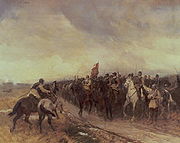 After two years of ruinous but indecisive military campaigning, Parliament created the New Model Army
, the first professional standing army in British history. An experienced soldier, Sir Thomas Fairfax, was appointed its Lord General. From its foundation, the Army adopted social and religious policies which were increasingly at odds with those of Parliament. The Army's senior officers (the "Grandees") formed another faction, opposed both to Parliament and to the more extreme radicals (Levellers
and dissenting Nonconformist sects) within the lower ranks. (To an extent, Parliament had caused this situation by enacting the Self-denying Ordinance
, by which members of both Houses of Parliament were deprived of military office, a measure originally introduced to replace some high-ranking officers who were suspected of disloyalty or defeatism.)
After the English Civil War ended with the defeat of the Royalists, Parliament tried to reassert its control over the Army but could not sustain its authority. The Army mutinied
, and started to march on London, the seat of power. Parliament had also alienated the Scottish Covenanters and some of its former supporters. King Charles attempted to take advantage of the unrest and the Second English Civil War
began in 1648. The New Model Army's officers had reasserted control over their troops, and the Army routed English royalist insurrections in Surrey
, Kent
and Wales
, before crushing a Scottish invasion force at the Battle of Preston
.
In the aftermath of the war, Parliament was made subservient to the wishes of the Army Council whose leading political figure was Oliver Cromwell
. In an episode known as Pride's Purge
, troops used force to prevent members of the House of Commons opposed to the Army Council from attending Parliament. The resulting Rump Parliament
passed the necessary legislation to have King Charles I tried and executed by beheading, and to declare England a commonwealth
.
When the Scots proclaimed his son, also named Charles Stuart, King of Scots on 4 February 1649, the Third Civil War
broke out. The New Model Army under the command of Cromwell invaded Scotland in an attempt to depose Charles. The Scots were beaten at the Dunbar
but while the New Model Army was subduing Scotland north of the River Forth
, Charles II led a Scottish army south into England. Cromwell left some forces in Scotland, to continue to pacify the country, and followed Charles South. Both armies gained reinforcements as they moved south. Charles gained only a fraction of the Royalists he had hoped for and when Cromwell attacked him at the Battle of Worcester
his army was decisively beaten. Those Scots who surrendered were shipped to English colonies in America, effectively as slaves, and Charles himself escaped to France
only after several weeks as a fugitive in England.
Scotland was annexed into the English Commonwealth under the terms of the Tender of Union
. On 20 April 1653, Cromwell dissolved the Rump Parliament, ending the first English Commonwealth and ushering in the Protectorate
. Scotland and Ireland remained under military occupation. From August 1655 to January 1657 Cromwell instituted the Rule of the Major Generals for England and Wales. The impact of military rule under the Major-Generals varied from region to region. They were successful in curbing security threats to the Protectorate, but the repressiveness of enforced moral reform was widely unpopular.
Following Cromwell's death, the Restoration
of Charles II saw the immediate reconstitution of England, Scotland and Ireland as separate realms, and the disbandment of the New Model Army. Both factions in the Cavalier Parliament
expressed a distaste and distrust of a standing army. The Whigs
(the descendants of the parliamentarians) feared that the monarch might use it as an instrument of tyranny while the Tories (the descendants of the cavaliers) remembered that the New Model Army had forced through a social revolution and had confiscated their property. It was felt that there was no need for a standing army, for the first line of defence was surely the Royal Navy
, and the second the militia
. These prejudices dominated domestic politics until the early 19th century.
After Charles II died, he was succeeded by his brother James
. The Army defeated the Monmouth Rebellion
against James, which was followed by harsh repression, especially in the West Country
. James increased the size of the Army, and it was feared that he was attempting to use it to retain power in the face of Parliamentary opposition, and even impose Roman Catholicism
. In the event, the Army's officers sided with the common feeling, and took no action to prevent the accession of William of Orange
.
To control the powers of the monarch, the English Parliament passed the Bill of Rights 1689
to prevent a standing army in peacetime without the consent of Parliament. (To this day, annual continuation notices are required for the British Army to remain legal. On paper, this also guarantees representative government, as Parliament must meet at least once a year to ratify the Order in Council renewing the Army Act (1955) for a further year).
The effect of these constitutional developments was to ensure that the Army was under the control of the Government. The Monarch might be titular Commander in Chief, but could not order the army to perform any unconstitutional act. (The last King to lead his troops into battle was George II
at the Battle of Dettingen
in 1743.) As another measure to avoid a dangerous concentration of power in the hands of any one person, responsibility for the various branches of the army and its administration were deliberately assigned to different high officials.
None of these bodies were usually represented in the Cabinet, nor were they responsible for overall strategy, which was in the hands of the Secretary of State for War (an office later merged into the Secretary of State for War and the Colonies
). The resulting tangled lines of control often greatly hampered efficient operation through and beyond the Napoleonic Wars
.
In the field, a commander's staff consisted of an Adjutant General
(who handled finance, troop returns and legal matters), and a Quartermaster General
(who was responsible for billeting and organising movements). There were separate commanders of the Artillery, and Commissary Officers who handled the supplies. The commander of an Army might also have a Military Secretary, responsible for appointments, courts martial and official correspondence. In the field as in peacetime, the conflicting lines of responsibility often caused problems.
Infantry and cavalry units had originally been known by the names of their colonels, such as "Sir John Mordaunt's Regiment of Foot". This could be confusing if Colonels succeeded each other rapidly; and two regiments (the Buffs and the Green Howards) had to be distinguished by their facing colour in official correspondence because for several years, both had Colonels named Howard. In time, these became the official names of the regiments. In 1751 a numeral system was adopted, with each regiment gaining a number according to their rank in the order of precedence
, so John Mordaunt's Regiment became the 47th Regiment of Foot
.
The later Jacobite rising
s were centred in the Scottish Highlands
. From the late 17th century, the Government had organised independent companies in the area from clans which supported the Hanoverian monarchs or the Whig governments, to maintain order or influence in the Highlands. In 1739 the first full regiment, the 42nd Regiment of Foot
, was formed in the region. More were subsequently raised. For many years, highland regiments were to be the most colourful and distinctive units in the British Army, retaining much of the traditional highland dress such as the kilt
.
Towards the end of the 18th century, the battalion became the major tactical unit of the army. On the continent of Europe, where large field formations were usual, a regiment was a formation of two or more battalions, under a colonel who was a field commander. The British Army, increasingly compelled to disperse units in far-flung colonial outposts, made the battalion the basic unit, under a lieutenant colonel. The function of the Regiment became administrative rather than tactical. The Colonel of a regiment remained an influential figure but rarely commanded any of its battalions in the field. Many regiments consisted of one battalion only, plus a depot and recruiting parties in Britain or Ireland if the unit was serving overseas. Where more troops were required for a war or garrison duties, second, third and even subsequent battalions of a regiment were raised, but it was rare for more than one battalion of a regiment to serve in the same brigade or division.
in 1746. The major theatre was often the continent of Europe. Not only did Britain's monarchs have dynastic ties with Holland
or Hanover
, but Britain's foreign policy often required intervention to maintain a balance of power
in Europe (usually at the expense of France
).
Within England and especially Scotland, there were repeated attempts by the deposed House of Stewart to regain the throne, leading to severe uprisings. These were often related to European conflict, as the Stuart Pretenders were aided and encouraged by Britain's continental enemies for their own ends. After the Battle of Culloden
in 1746, these rebellions were crushed.
Finally, as the British empire expanded, the army was increasingly involved in service in the West Indies, North America and India. Troops were often recruited locally, to lessen the burden on the Army. Sometimes these were part of the British army, for example the 60th (Royal American) Regiment of Foot. On other occasions (as in the case of troops raised by the British East India Company
), the local forces were administered separately from the British Army, but cooperated with it.
Troops sent to serve overseas could expect to serve there for years, in an unhealthy climate far removed from the comforts of British society. This led to the army being recruited from the elements of society with the least stake in it; the very poorest or worst-behaved. The red-coated soldier
, "Thomas Lobster", was a much-derided figure.
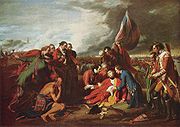 The Seven Years' War
, which took place from 1755 to 1763, has sometimes been described as the first true world war, in that conflict took place in almost every continent and on almost all the oceans. Although there were early setbacks, British troops eventually were victorious in every theatre.
Britain's main enemy was France
, as was usual. The war can be said to have started in North America, where it was known as the French and Indian War
. The early years saw several British defeats. The British units first despatched to the Continent were untrained in the bush warfare they met. To provide light infantry, several corps such as Rogers' Rangers
were raised from the colonists. (A light infantry regiment, the 80th Regiment of Light Armed Foot, was raised by Colonel Thomas Gage
, but subsequently disbanded). During the war, General James Wolfe
amalgamated companies from several regiments into an ad hoc
unit, the Louisbourg Grenadiers
.
There were also disagreements between high-ranking British officers and the North American colonists. It was laid down that even the most senior Provincial officers were subordinate to comparatively junior officers in the British Army. The first concern of the colonists' representatives was the protection of the settlers from raids by Indian
war parties, while the British generals often had different strategic priorities. Partly through the naval superiority gained by the Royal Navy
, Britain was eventually able to deploy superior strength in North America, winning a decisive battle at Quebec
.
Similarly in India
, the French armies and those of the most powerful Indian rulers were defeated after a prolonged struggle, allowing the steady expansion of British-controlled territory.
In Europe, although Britain's allies (chiefly Prussia
) carried the main burden of the struggle, British troops eventually played an important role at the decisive Battle of Minden
.
in North America after the war. For the first time, the British Army would be garrisoned in North America in significant numbers in a time of peace.
With the defeat of France, the British government no longer sought actively to curry the favour of Native Americans
. Urged by his superiors to cut costs, Commander in Chief General Jeffrey Amherst initiated policy changes that helped prompt Pontiac's War
in 1763, an uprising against the British military occupation of the former New France
. Amherst was recalled during the war and replaced as commander in chief by Thomas Gage.
of 1770, but outright warfare did not begin until 1775, when an army detachment was sent to seize colonial munitions at Lexington and Concord
.
Reinforcements were sent to America to put down what was initially expected to be a short-lived rebellion. Because the British army was understrength at the outset of the war, the British government hired the armed forces of several German states, referred to generically as "Hessians", to fight in North America. As the war dragged on, the ministry also sought to recruit Loyalist
soldiers. Five American units (known as the American Establishment, formed in 1779) were placed on the regular army roster, though there were many other Loyalist units.
When the war ended in 1783 with defeat and the independence of the United States, many of the Loyalists fled north to Canada, where many subsequently served with the British Army. The Army itself had established many British units during the war to serve in North America or provide replacements for garrisons. All but three (the 23rd Regiment of (Light) Dragoons and two Highland infantry regiments, the 71st and 78th Foot
) were disbanded immediately after the war.
The Army was forced to adapt its tactics to the poor communications and forested terrain of North America. Large numbers of light infantry (detached from line units) were organised, and the formerly rigid drills of the line infantry were modified to a style known as "loose files and an American scramble". While the British defeated the colonists in most of the set-piece battles of the war, none of these had any decisive result, whereas the British defeats at the Battle of Saratoga
and Siege of Yorktown
adversely affected British morale, prestige and manpower.
experienced a time of rapid change. At the beginning of the French Revolutionary Wars
in 1793, the army was a small, awkwardly administered force of barely 40,000 men. By the end of the period, the numbers had vastly increased. At its peak, in 1813, the regular army contained over 250,000 men. The British infantry was "the only military force not to suffer a major reverse at the hands of Napoleonic France."
, British society underwent great changes such as industrialisation
and the enactment of liberal reforms (by both Liberal
and Conservative
governments) within Britain. The period was also marked by the steady expansion and consolidation of the British Empire
.
Until the Crimean War
, the Army's senior officers (mostly veterans of Wellington's campaigns) made few changes to the Army. The War, and the Indian Rebellion of 1857
, demonstrated that reforms were urgently needed to guarantee that the Army could protect both the home nation and the Empire. Nevertheless, they did not take place until Liberal governments enacted wide-ranging reforms (the Cardwell Reforms
and Childers Reforms
) from 1870 to 1881. These gave the army the form it would take until the outbreak of the First World War.
The Industrial Revolution had changed the Army's weapons, transport and equipment, and social changes such as better education had prompted changes to the terms of service and outlook of many soldiers. Nevertheless, it retained many features inherited from the Duke of Wellington's
army, and since its prime function was to maintain the expanding British Empire
, it differed in many ways from the conscripted armies of continental Europe. For example it did not undertake large-scale manoeuvres. Indeed the Chobham Manoeuvres of 1853 involving 7,000 troops were the first such manoeuvres since the Napoleonic Wars.
could trace its origins to the increasing demands of imperial expansion together with inefficiencies highlighted during the Crimean War
, which led to the Cardwell
and Childers Reforms
of the late 19th century. These gave the British Army its modern shape, and defined its regimental system. The Esher Report
in 1904, recommended radical reform of the British Army, such as the creation of an Army Council, a General Staff and the abolition of the office of Commander in Chief of the Forces and the creation of a Chief of the General Staff. The Haldane Reforms
in 1907, created an expeditionary force of seven divisions
, it also reorganized the volunteers into a new Territorial Force
of fourteen cavalry
brigade
s and fourteen infantry
divisions, and changed the old militia
into the special reserve to reinforce the expeditionary force.
The British Army was different from the French
and German
Armies at the beginning of the conflict in that it was made up from volunteers not conscripts. It was also considerably smaller than its French and German counterparts. The outbreak of the First World War in August 1914 saw the bulk of the changes in the Haldane reforms put to the test. The British Expeditionary Force (BEF) of six divisions was quickly sent to the Continent, while the Territorial Forces fourteen divisions and Reserves were mobilised as planned to provide a second line.
During the war there were three distinct British Armies. The 'first' army was the small volunteer force of about 400,000 soldiers (comprising the Regular Army of 247,000 and Territorial Force of 145,000), over half of which were posted overseas to garrison the British Empire
. This total included the Regular Army and reservists in the Territorial Force. Together they formed the BEF, for service in France and became known as the Old Contemptibles. The 'second' army was Kitchener's Army
, formed from the volunteers in 1914–1915 destined to go into action at the Battle of the Somme. The 'third' was formed after the introduction of conscription
in January 1916 and by the end of 1918 the army had reached its peak of strength of four million men and could field over seventy divisions.
The war also saw the introduction of new weapons and equipment. The Maxim machine gun was replaced by the improved and lighter Vickers
and Lewis machine guns, the Brodie helmet
was supplied for better personnel protection against shrapnel and the Mark I tank
was invented to try to end the stalemate of trench warfare
.
The vast majority of the army fought in France
and Belgium
on the Western Front
but some units were engaged in the Mediterranean, the Middle East
, Africa
and Mesopotamia
, mainly against the Ottoman Empire
. One battalion also fought in China
during the Siege of Tsingtao.
" after Sir Eric Geddes. The Government introduced the Ten Year Rule
, stating its belief that Britain would not be involved in another major war for 10 years from the date of review. This ten-year rule was continually extended until it was abandoned in 1932.
The Royal Tank Corps (which later became the Royal Tank Regiment
) was the only corps formed in World War I that survived the cuts. Corps such as the Machine Gun Corps
were disbanded, their functions being taken by specialists within infantry units. One new corps was the Royal Signals, formed in 1920 from within the Royal Engineers
to take over the role of providing communications.
Within the cavalry, sixteen regiments were amalgamated into eight, producing the "Fraction Cavalry"; units with unwieldy titles combining two regimental numbers. There was a substantial reduction in the number of infantry battalions and the size of the Territorial Force, which was renamed the Territorial Army. On 31 July 1922, the Army also lost six Irish regiments (5 infantry and 1 cavalry) on the creation of the Irish Free State
. Many Irishmen from the south nevertheless continued to join the British Army.
Until the early 1930s, the Army was effectively reduced to the role of imperial policeman, concentrated on responding to the small imperial conflicts that rose up across the Empire. It was unfortunate that certain of the officers who rose to high rank and positions of influence within the army during the 1930s, such as Archibald Armar Montgomery-Massingberd
, were comparatively backward-looking. This meant that trials such as the Experimental Mechanized Force
of 1927-28 did not go as far as they might have.
s during their Civil War
. The British Army was also maintaining occupation forces in the defeated powers of World War I. In Germany, a British Army of the Rhine
(BAOR) was established. The BAOR would remain in existence until 1929 when British forces were withdrawn. Another British occupation force was based in Constantinople
in Turkey
, and a number of British units fought against Turkish rebels during the Turkish War of Independence
. A small British Military Mission
was also advising the Polish Army during the Polish-Soviet War
(1919–1921).
The Army, throughout the inter-war period, also had to deal with quelling paramilitary organisations seeking the removal of the British. In British Somaliland
, Sayyid Mohammed Abdullah Hassan
(known to the British Army as 'The Mad Mullah', although he was neither mad nor a mullah) resumed his campaign against the British, a campaign he had first begun in 1900. The operations against him were prominent due to the newly-formed RAF being instrumental in his defeat. The Army also took part in operations in Ireland against the IRA
during the Anglo-Irish War. Both sides committed atrocities, some units becoming infamous, such as the paramilitary Black and Tans
that were recruited from veterans of the First World War. The British Army was also supporting Indian Army
operations in the North-West Frontier
of British India against numerous tribes, known collectively as the Pathans
, hostile to the British. The Army had been operating in the volatile North-West Frontier area since the mid-19th century. The last major uprising that the Army had to deal with before the start of the Second World War, was the uprising in Palestine
that began in 1936.
Nazi Party and was becoming increasingly aggressive and expansionist. Another war with Germany appeared certain. The Army was not properly prepared for such a war, lagging behind the technologically advanced and potentially much larger Heer
of the German Wehrmacht
. With each armed service vying for a share of the defence budget, the Army came last behind the Royal Navy and Royal Air Force in allocation of funds.
During the years after the First World War, the Army's strategic concepts had stagnated. Whereas Germany, when it began rearming following Hitler's rise to power, eagerly embraced concepts of mechanised warfare as advocated by individuals such as Heinz Guderian
, many high-ranking officers in Britain had little enthusiasm for armoured warfare, and the ideas of Basil Liddell Hart
and J.F.C. Fuller
were largely ignored.
One step to which the Army was committed was the mechanisation of the cavalry, which had begun in 1929. This first proceeded at a slow pace, having little priority. By the mid-1930s, mechanisation in the British Army was gaining momentum and on 4 April 1939, with the mechanisation process nearing completion, the Royal Armoured Corps
was formed to administer the cavalry regiments and Royal Tank Regiment
(except for the Household Cavalry
). The mechanisation process was finally completed in 1941 when the Royal Scots Greys abandoned their horses.
After the Munich Crisis in 1938, a serious effort was undertaken to expand the Army, including the doubling in size of the Territorial Army, helped by the reintroduction of conscription in April 1939. By mid-1939 the Army consisted of 230,000 Regulars and 453,000 Territorials and Reservists. Most Territorial formations were understrength and badly equipped. Even this army was dwarfed, yet again, by its continental counterparts. Just before the war broke out, a new British Expeditionary Force
was formed. By the end of the year, over 1 million had been conscripted into the Army. Conscription was administered on a better planned basis than in the First World War. People in certain reserved occupation
s, such as dockers and miner
s, were exempt from being called up as their skills and labour were necessary for the war effort.
Between 1938 and 1939, with the a substantial expansion in the Army, a number of new organisations were formed, including the Auxiliary Territorial Service
for women in September 1938; its duties were vast, and helped release men for front-line service.
it deployed. With mass conscription the expansion of the army was reflected in the creation of more army corps, armies and army groups
. From 1943, the army's fortunes turned and it hardly suffered a strategic defeat.
The pre-war British Army was trained and equipped to garrison
and police the British Empire
and, as became evident during the war, was woefully unprepared and ill-equipped to conduct a war against multiple enemies on multiple fronts.
At the start of the war the army was small in comparison to its enemies', and remained an all-volunteer force until 1939. By the end of the war it had grown to number over 3.5 million.
The army fought around the world, with campaigns in Belgium
and France
in 1940 and, after the collapse of both countries, in Africa
, the Mediterranean and the Far East
. After a series of setbacks, retreats and evacuations the British Army and its Allies eventually gained the upper hand. This started with victory over the Italian and German forces in Africa. Italy was then forced to surrender after the invasions of Sicily and mainland Italy. Then in the last years of the war, the army returned to France, driving the German Army back into Germany and in the Far East forced the Japanese back from the Indian border into Burma. Both the Germans and Japanese were defeated by 1945, and surrendered within months of each other.
With the expansion of the British Army to fight a World War, new armies had to be formed, and eventually army groups were created to control even larger formations. In command of these new armies, eight Generals would be promoted to Field Marshal rank. The army commanders not only had to manage the new armies, but also a new type of soldier in formations that had been created for special service, which included the Special Air Service
, Army Commandos and the Parachute Regiment.
 The United Nations
(UN) was formed on 24 October 1945, with Britain one of five permanent members of the UN Security Council. Britain was still considered as a global power, despite it having been eclipsed by the two superpower
s -- the USA and Soviet Union—and the efforts by many colonies of the Empire to gain independence. Another global organisation, known as the North Atlantic Treaty Organisation (NATO), was established on 4 April 1949 with Britain one of its founding members. The creation of NATO signified the beginning of the "Cold War
" between the ideologically divided "Western Allies" and the Eastern Communist powers, controlled by the Soviet Union; they created their own NATO equivalent in 1955, known as the Warsaw Pact
. An integral part of NATO's defences in the now divided Europe was the British Army of the Rhine (BAOR) in West Germany
, the British Army's new overseas 'home' that replaced independent India. The British Army, just as in the aftermath of World War I, had established BAOR in the immediate aftermath of the war which was centred on I Corps (upon its re-establishment in 1951), at its peak reaching about 80,000 troops. At home, there were five regional commands: Eastern
, Western
, Northern
, Scottish
, and Southern Command
, which all eventually merged to became HQ UK Land Forces or UKLF in 1972.
The Army was beginning to draw down its forces, beginning demobilisation shortly after the end of the war. The Territorial units were placed in 'suspended animation', being reconstituted upon the reformation of the TA in 1947. On 1 January 1948, National Service
, the new name for conscription, formally came into effect. The Army was, however, being reduced in size upon the end of British rule in India, including the second battalions of every Line Infantry regiment either amalgamating with the 1st Battalions to maintain the 2nd Battalion's history and traditions, or simply disband, thus ending the two-battalion policy implemented by Childers in 1881. This proved too severe a decision for the overstretched Army, and a number of regiments reformed their second battalion in the 1950s. The year 1948 also saw the Army receive four Gurkha regiments (eight battalions in total) transferred to them from the Indian Army and were formed into the Brigade of Gurkhas
, initially based in Malaya.
More reforms of the armed forces took place with the 1957 Defence White Paper
, which saw further reductions implemented; the Government realised after the debacle of the Suez War that Britain was no longer a global superpower and decided to withdraw from most of its commitments in the world, limiting the armed forces to concentrating on NATO, with an increased reliance upon nuclear weapon
s. The White Paper announced that the Army would be reduced in size from about 330,000 to 165,000, with National Service ending by 1963 (it officially ended on 31 December 1960, with the last conscript being discharged in May 1963) with the intention of making the Army into an entirely professional force. This enormous reduction in manpower led to, between 1958 and 1962, eight cavalry and thirty infantry regiments being amalgamated, the latter amalgamations producing fifteen single-battalion regiments. Brigade cap badge
s superseded the regimental cap badge in 1959.
Many of the regiments created during the 1957 White Paper would have only a brief existence, most being amalgamated into new 'large' regiments -- The Queen's
, Royal Fusiliers
, Royal Anglian
, Light Infantry
, Royal Irish Rangers
, and the Royal Green Jackets -- all of whose 'junior' battalions were disbanded by the mid-1970s. Two regiments -- The Cameronians (Scottish Rifles)
and The York and Lancaster Regiment-- opted to be disbanded rather than amalgamated. The fourteen administrative brigades (created in 1948) were replaced by six administrative divisions in 1968, with regimental cap badges being re-introduced the following year. The Conservative Government came to power in 1970, one of its pledges included the saving of the Argyll and Sutherland Highlanders
after a popular campaign to save it had been provoked by the announcement of its intended demise. The Government also decided to stop the planned amalgamation of The Gloucestershire Regiment
with The Royal Hampshire Regiment. Further cavalry and infantry regiments were, however, amalgamated between 1969 and 1971, with six cavalry (into three) and six infantry (also into three) regiments doing so.
For the structure of the Army during this period, see List of British Army regiments (1962).
HQ UK Land Forces
was formed in 1972, and the previous home commands were effectively downgraded to districts.
For example, British and Indian Army forces were sent to the island of Java in the Dutch East Indies
in September 1945 to disarm and help repatriate the Japanese occupation forces. It was a month after the local nationalists—who had been provided with arms by the Japanese—had declared an independent Indonesia
. The situation in Java was quite chaotic with much violence taking place. The British and Indian forces experienced fierce resistance from the nationalists; the former Japanese occupation force was also employed by the British to help maintain order, and fought alongside the British and Indian forces. Dutch forces gradually arrived in number and the British and Indians left by November 1946.
A similar situation existed in French Indochina
after Vietnamese leader Ho Chi Minh
declared the independence of Vietnam on September 2, 1945. British and Indian troops, commanded by Major-General Douglas Gracey, were deployed to occupy the south of the country shortly afterwards, while Nationalist Chinese attempted to occupy the northern areas of Vietnam. Vietnam was at this time in chaos and the population did not want French rule restored. The British military decided to rearm a large number of French POWs—who then went on a rampage—and British forces also re-armed Japanese troops to help maintain order. The British and Indians departed by February 1946 and the First Indochina War
began shortly afterwards. War in Vietnam would continue for more than twenty years.
In 1947 the British government announced India would become independent on 15 August, after being separated into two countries, one mostly Muslim (Pakistan) and the other mostly Hindu (India). The last British Army unit to leave active service in the Indian subcontinent was the 1st Battalion, The Somerset Light Infantry (Prince Albert's)
on 28 February 1948.
In Palestine, there was a surge in attacks against the British mandate and occupation by Zionist organisations such as Irgun
and the Stern Gang after the British attempted to limit Jewish immigration into Palestine. British military and other forces eventually withdrew in 1948 and the State of Israel was established on 14 May.
Elsewhere within British territories, Communist guerrillas launched an uprising in Malaya, starting the Malayan Emergency
.
In the early 1950s, trouble began in Cyprus, and in Kenya—the Mau Mau uprising
. In Cyprus, an organisation known as EOKA
sought unity with Greece
, the situation being stabilised just before Cyprus was given independence in 1960. Kenya was one of many deployments for the Army in Africa during the 1950s, most of the others being former Italian colonies placed in the temporary control of Britain and the British Army.
(1950–53), fighting in battles such as Imjin River
which included Gloster Hill
.
nationalised the Suez Canal
which privately owned businesses in Britain and France owned shares in. The British Army contributed forces to the amphibious assault on Suez and British paratroopers took part in the airborne assault. This brief war was a military success. However, international pressure, especially from the US government, soon forced the British government to withdraw all their military forces soon afterwards. British military forces were replaced by UN peacekeeping troops.
In the 1960s two conflicts featured heavily with the Army, the Aden Emergency
and the Indonesia-Malaysia confrontation
in Borneo
.
in Northern Ireland
against Catholic
s by Protestants, loyalists
and the RUC
in which seven people were killed, hundreds more wounded and thousands of Catholic families were driven from their homes led to British troops being sent into Northern Ireland to try and stop the violence. This became Operation Banner
. Among those killed in the attacks by the RUC was Trooper Hugh McCabe, the first British soldier to die in the conflict. The troops were initially welcomed by the Catholic community as they believed the troops would protect them; however, this developed into opposition as the troops began to support the RUC, and the Provisional Irish Republican Army
(PIRA), a militant break-away from the IRA which had been quiet since the 1962 cessation of the Border Campaign
, began to target British troops. The British Army's operations in the early phase of its deployment had it placed in a policing role, for which, in many cases, it was ill suited. This involved seeking to prevent confrontations between the Catholics and Protestants, as well as putting down riots and stopping Republican
and Loyalist
paramilitary
groups from committing terrorist attacks.
However, as the Provisional IRA campaign 1969-1997 grew in ferocity in the early 1970s, the Army was increasingly caught in a situation where its actions were directed against the IRA and the Catholic Irish nationalist community which harboured it. In the early period of the conflict, British troops mounted several major field operations. The first of these was the Falls Curfew
of 1971, when over 3,000 troops imposed a 3 day curfew
on the Falls Road area of Belfast
and fought a sustained gun battle with local IRA men. In Operation Demetrius
in June 1971, 300 paramilitary suspects were interned
without trial, an action which provoked a major upsurge in violence. The largest single British operation of the period was Operation Motorman
in 1972, when about 21,000 troops were used to restore state control over areas of Belfast and Derry
, which were then controlled by republican paramilitaries. The British Army's reputation suffered further from an incident in Derry on 30 January 1972, Bloody Sunday
in which 13 Catholic civilians were murdered by The Parachute Regiment. The biggest single loss of life for British troops in the conflict came at Narrow Water, where eighteen British soldiers were killed in a PIRA bomb attack on 27 August 1979, on the same day Lord Mountbatten of Burma
was assassinated by the PIRA in a separate attack. In all almost 500 British troops died in Northern Ireland between 1969-1997. Most of these deaths however occurred in the early 1970s, when British troops were placed at the forefront of the conflict and had little experience in dealing with a low intensity conflict in a predominantly urban, heavily populated area.
By the late 1970s, the British Army was replaced to some degree as "frontline" security service, in preference for the local Royal Ulster Constabulary
and the Ulster Defence Regiment
(raised 1970) as part of the Ulsterisation
policy. By the 1980s and early 1990s, British Army casualties in the conflict had dropped. Moreover, British Special Forces
had some successes against the PIRA - see Operation Flavius
and the Loughgall Ambush
. Nevertheless, the conflict tied up over 12,000 British troops on a continuous basis until the late 1990s and was ended with the Good Friday Agreement which detailed a path to a political solution to the conflict.
Operation Banner came to an end in 2007 making it the longest continuous operation in the British Army's history, lasting over thirty-eight years. Troop numbers where reduced to 5,000.
emerged from its secretive world when its most high-profile operation, the ending of the Iranian Embassy Siege
in London
, was broadcast live on television. By the 1980s, even though the Army was being increasingly deployed abroad, most of its permanent overseas garrisons were gone, with the largest remaining being the BAOR in Germany, while others included Belize
, Brunei
, Gibraltar
, and Hong Kong
.
was the Falkland Islands
in the South Atlantic, 6,000 to 8000 miles (12,874.7 km) (11,000 to 15,000 km) from Britain. The Argentinians invaded the Falklands in April 1982. The British quickly responded and the Army had an active involvement in the campaign to liberate the Falklands upon the landings at San Carlos
, taking part in a series of battles that led to them reaching the outskirts of the capital, Stanley
. The Falklands War
ending with the formal surrender of the Argentinian forces on 14 June.
produced. This saw inevitable reductions in the British armed forces. The Army experienced a substantial cut in its manpower (reduced to about 120,000), which included yet more regimental amalgamations, including two of the large regiments of the 1960s—the Queen's Regiment and Royal Irish Rangers—and the third battalions of the remaining large regiments being cut. The British Army in Germany was also affected, with the British Army of the Rhine replaced by British Forces Germany
and personnel numbers being reduced from about 55,000 to 25,000; the replacement of German-based I Corps by the British-led Headquarters Allied Rapid Reaction Corps also took place. Nine of the Army's administrative corps were amalgamated to form the Royal Logistic Corps
and the Adjutant General's Corps
). One major development was the disbandment of the Women's Royal Army Corps (though the largest elements were absorbed by the AGC) and their integration into services that had previously been restricted to men; however, women were still prohibited from joining armoured and infantry units. The four Gurkha regiments were amalgamated to form the three-battalion Royal Gurkha Rifles
, reduced to two in 1996 just before the handover of Hong Kong to the People's Republic of China
in 1997.
The Labour Party
became the country's new government and after their election victory in 1997 a new defence white paper was prepared, known as the Strategic Defence Review
(1998). Some of the Army's reforms included the creation of two deployable divisions -- 1st (UK) Armoured Division and 3rd Mechanised Division
, with the 1st Division being based in Germany—and three 'regenerative' divisions -- 2nd
, 4th
, and 5th Division
s. The 16 Air Assault Brigade
was formed from 24 Airmobile Brigade and elements of 5 Airborne Brigade to provide the Army with increased mobility, and would include the Westland WAH-64 Apache
attack helicopter. Other attempts to make the Army more mobile was the creation of the Joint Rapid Reaction Force, intended to provide a corps-sized force capable of reacting quickly to situations similar to Bosnia. The Army Air Corps's helicopters also helped form the multi-service Joint Helicopter Command
.
For the structure of the British Army during this period, see List of British Army regiments (1994).
Another defence review was published in 2004, known as Delivering Security in a Changing World
. The defence white paper stated that the Army's manpower would be reduced by 1,000, with four infantry battalions being cut and the manpower being redistributed elsewhere. One of the most radical aspects of the reforms was the announcement that most single-battalion regiments would amalgamate into large regiments, with most of the battalions retaining their previous regimental titles in their battalion names. The TA would also be further integrated into the Army, with battalions being numbered into the regiment's structure. These are reminiscent, in some respects, to the Cardwell-Childers reforms and the 1960s reforms.
The elite units of the Army are also playing an increasingly prominent role in the Army's operations and the SAS was allocated further funds in the 2004 defence paper, conveying the SAS's increasing importance in the War on Terror. The 1st Battalion of the Parachute Regiment, meanwhile, is to become part of a new tri-service unit to support the SAS and the Navy's SBS
, being acclaimed as the Army's equivalent to the U.S. Army Rangers. Another élite unit, which became operational on 6 April 2005, is the Special Reconnaissance Regiment
.
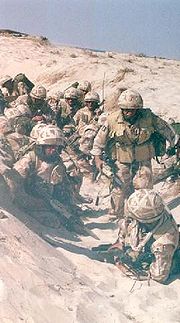 The end of the Cold War did not provide the British Army with any respite, and the political vacuum left by the Soviet Union
has seen a surge of instability in the world. Saddam Hussain's Iraq
invaded Kuwait, one of its neighbours, in 1990, provoking condemnation from the United Nations
, primarily led by the United States. The Gulf War
and the British contribution, known as Operation Granby
, was large, with the Army providing about 28,000 troops and 13,000 vehicles, mostly centred around 1 (UK) Armoured Division. After air operations ended, the land campaign against Iraq began on 24 February. 1st Armoured Division took part in the left-hook attack that helped destroy many Iraqi units. The ground campaign had lasted just 100-hours, Kuwait being officially liberated on 27 February.
The British Army has also played an increasingly prominent role in peacekeeping operation, gaining much respect for its comparative expertise in the area. In 1992, during the wars in the Balkans provoked by the gradual disintegration of Yugoslavia
, UN forces intervened in Croatia
and later Bosnia
. British forces contributed as part of UNPROFOR (United Nations Protection Force). The force was a peacekeeping one, but with no peace to keep, it proved ineffective and was replaced by the NATO IFOR
though this was in turn replaced the following year by SFOR
. As of 2005, Britain's contribution numbers about 3,000 troops. In 1999 the UK took a lead role in the NATO war against Slobodan Milošević
's forces in Kosovo
. After the air war ended, the Parachute Regiment and Royal Gurkha Rifles provided the spearhead for ground forces entering Kosovo. In 2000, British forces, as part of Operation Palliser
, intervened in a civil war ravaged Sierra Leone
, with the intention of evacuating British, Commonwealth and EU citizens. The SAS also played a prominent role when they, along with the Paras, launched the successful Operation Barras
to rescue 6 soldiers of the Royal Irish Regiment being held by the rebels. The British force remained and provided the catalyst for the stabilisation of the country.
The early 21st century saw the world descend into a new war after the 9/11 terrorist attacks
on the World Trade Center
in New York
by Al Qaida: the War on Terrorism
. A US-led invasion of Taliban-ruled Afghanistan followed, with the British contribution led by the RN and RAF; the most important Army element being the SAS. The British later took part in the invasion of invasion of Iraq in 2003, Britain's contribution being known as Operation Telic
, The Army played a more significant role in Iraq than Afghanistan, deploying a substantial force, centred around 1 (UK) Armoured Division with, again, around 28,000 troops. The war began in March and the British fought in the southern area of Iraq, eventually capturing the second largest city, Basra
, in April. The Army remained in Iraq upon the end of the war and subsequently led the Multi-National Division (South East)
, with the Army presence in Iraq numbering about 5,000 soldiers.
The British army has mixed extreme conservatism, 'penny-pinching', and extraordinarily exacting standards in its rifles. For example the move to percussion-caps was not made until 1842, while an 1866 trial examined 104 weapons and declined to award a first prize, or that the specifications for an SLR in the 1930s were so stiff "it is doubtful if any... rifle of the present day could meet it in its entirety."
Changes were usually forced on the Army as a result of conflict or the actions of other armies. Note the rapid pace of change in the period 1850-1895 as the Crimean War forced changes and then the foreign demonstrations of the needle-gun, the Chassepot
, and the Mannlicher-Mauser designs frightened the Army.
In the 19th century the change-overs were not instant, many colonial units soldiered on with older weapons - some units missing two cycles of change - while some weapons (italicized in the list below) were only issued to specialist rifle brigades or in very limited numbers.
As happens, the Army's men often had the weapons to fight the last war by the time of the following conflict. Most of the 19th century weapons were technologically obsolete at their introduction or within five years, and despite the apparently exhaustive testing many inadequate weapons were issued.
Colonial war
Colonial war is a blanket term relating to the various conflicts that arose as the result of overseas territories being settled by foreignpowers creating a colony...
s and world wars. From the early 19th century until 1914, the United Kingdom
United Kingdom of Great Britain and Ireland
The United Kingdom of Great Britain and Ireland was the formal name of the United Kingdom during the period when what is now the Republic of Ireland formed a part of it....
was the greatest economic and imperial power
Imperialism
Imperialism, as defined by Dictionary of Human Geography, is "the creation and/or maintenance of an unequal economic, cultural, and territorial relationships, usually between states and often in the form of an empire, based on domination and subordination." The imperialism of the last 500 years,...
in the world
World
World is a common name for the whole of human civilization, specifically human experience, history, or the human condition in general, worldwide, i.e. anywhere on Earth....
, and although this dominance was principally achieved through the strength of the British Royal Navy
Royal Navy
The Royal Navy is the naval warfare service branch of the British Armed Forces. Founded in the 16th century, it is the oldest service branch and is known as the Senior Service...
, the British Army
British Army
The British Army is the land warfare branch of Her Majesty's Armed Forces in the United Kingdom. It came into being with the unification of the Kingdom of England and Scotland into the Kingdom of Great Britain in 1707. The new British Army incorporated Regiments that had already existed in England...
played a significant role.
In peacetime, Britain has generally maintained only a small professional volunteer army, expanding this as required in time of war
War
War is a state of organized, armed, and often prolonged conflict carried on between states, nations, or other parties typified by extreme aggression, social disruption, and usually high mortality. War should be understood as an actual, intentional and widespread armed conflict between political...
, due to Britain's traditional role as a sea power. Since the suppression of Jacobitism
Jacobitism
Jacobitism was the political movement in Britain dedicated to the restoration of the Stuart kings to the thrones of England, Scotland, later the Kingdom of Great Britain, and the Kingdom of Ireland...
in 1745, the army has played little role in British domestic politics (except for the Curragh mutiny), and, other than in Ireland
Ireland
Ireland is an island to the northwest of continental Europe. It is the third-largest island in Europe and the twentieth-largest island on Earth...
, has seldom been deployed against internal threats to the state (one notorious exception being the Peterloo Massacre
Peterloo Massacre
The Peterloo Massacre occurred at St Peter's Field, Manchester, England, on 16 August 1819, when cavalry charged into a crowd of 60,000–80,000 that had gathered to demand the reform of parliamentary representation....
).
The Army has been involved in many global international conflicts, including the Napoleonic Wars
Napoleonic Wars
The Napoleonic Wars were a series of wars declared against Napoleon's French Empire by opposing coalitions that ran from 1803 to 1815. As a continuation of the wars sparked by the French Revolution of 1789, they revolutionised European armies and played out on an unprecedented scale, mainly due to...
, the Crimean War
Crimean War
The Crimean War was a conflict fought between the Russian Empire and an alliance of the French Empire, the British Empire, the Ottoman Empire, and the Kingdom of Sardinia. The war was part of a long-running contest between the major European powers for influence over territories of the declining...
and the two World War
World war
A world war is a war affecting the majority of the world's most powerful and populous nations. World wars span multiple countries on multiple continents, with battles fought in multiple theaters....
s. Historically, it contributed to the expansion and retention of the British Empire
British Empire
The British Empire comprised the dominions, colonies, protectorates, mandates and other territories ruled or administered by the United Kingdom. It originated with the overseas colonies and trading posts established by England in the late 16th and early 17th centuries. At its height, it was the...
.
The British Army has long been at the forefront of new military developments. It was the first in the world to develop and deploy the tank
Tank
A tank is a tracked, armoured fighting vehicle designed for front-line combat which combines operational mobility, tactical offensive, and defensive capabilities...
, and what is now the Royal Air Force
Royal Air Force
The Royal Air Force is the aerial warfare service branch of the British Armed Forces. Formed on 1 April 1918, it is the oldest independent air force in the world...
(RAF) had its origins within the British Army as the Royal Flying Corps
Royal Flying Corps
The Royal Flying Corps was the over-land air arm of the British military during most of the First World War. During the early part of the war, the RFC's responsibilities were centred on support of the British Army, via artillery co-operation and photographic reconnaissance...
(RFC). At the same time the Army emphasises the continuity and longevity of several of its institutions and military tradition
Tradition
A tradition is a ritual, belief or object passed down within a society, still maintained in the present, with origins in the past. Common examples include holidays or impractical but socially meaningful clothes , but the idea has also been applied to social norms such as greetings...
s.
Origins
The British Army came into being with the merger of the Scottish Army and the English ArmyEnglish Army
The English Army existed while England was an independent state and was at war with other states, but it was not until the Interregnum and the New Model Army that England acquired a peace time professional standing army...
, following the Acts of Union 1707
Acts of Union 1707
The Acts of Union were two Parliamentary Acts - the Union with Scotland Act passed in 1706 by the Parliament of England, and the Union with England Act passed in 1707 by the Parliament of Scotland - which put into effect the terms of the Treaty of Union that had been agreed on 22 July 1706,...
and the creation of the Kingdom of Great Britain
Kingdom of Great Britain
The former Kingdom of Great Britain, sometimes described as the 'United Kingdom of Great Britain', That the Two Kingdoms of Scotland and England, shall upon the 1st May next ensuing the date hereof, and forever after, be United into One Kingdom by the Name of GREAT BRITAIN. was a sovereign...
in 1707. The new British Army incorporated existing English and Scottish regiment
Regiment
A regiment is a major tactical military unit, composed of variable numbers of batteries, squadrons or battalions, commanded by a colonel or lieutenant colonel...
s, and was controlled from London
London
London is the capital city of :England and the :United Kingdom, the largest metropolitan area in the United Kingdom, and the largest urban zone in the European Union by most measures. Located on the River Thames, London has been a major settlement for two millennia, its history going back to its...
. Before this event, the essential nature of the British army as a body which was entirely at the service of the Government and not involved in the appointment of that Government, had been determined by prolonged conflict and argument within both countries.
Tudor and Stuart organisation
Prior to the English Civil WarEnglish Civil War
The English Civil War was a series of armed conflicts and political machinations between Parliamentarians and Royalists...
in 1642, there was effectively no standing army
Standing army
A standing army is a professional permanent army. It is composed of full-time career soldiers and is not disbanded during times of peace. It differs from army reserves, who are activated only during wars or natural disasters...
in Scotland
Scotland
Scotland is a country that is part of the United Kingdom. Occupying the northern third of the island of Great Britain, it shares a border with England to the south and is bounded by the North Sea to the east, the Atlantic Ocean to the north and west, and the North Channel and Irish Sea to the...
. In England
England
England is a country that is part of the United Kingdom. It shares land borders with Scotland to the north and Wales to the west; the Irish Sea is to the north west, the Celtic Sea to the south west, with the North Sea to the east and the English Channel to the south separating it from continental...
, the monarch
Monarch
A monarch is the person who heads a monarchy. This is a form of government in which a state or polity is ruled or controlled by an individual who typically inherits the throne by birth and occasionally rules for life or until abdication...
maintained a personal Bodyguard
Bodyguard
A bodyguard is a type of security operative or government agent who protects a person—usually a famous, wealthy, or politically important figure—from assault, kidnapping, assassination, stalking, loss of confidential information, terrorist attack or other threats.Most important public figures such...
of Yeomen of the Guard and the Honourable Corps of Gentlemen at Arms
Honourable Corps of Gentlemen at Arms
Her Majesty's Bodyguard of the Honourable Corps of Gentlemen at Arms is a bodyguard to the British Monarch. Until 17 March 1834 they were known as The Honourable Band of Gentlemen Pensioners.-Formation:...
or 'gentlemen pensioners', and a few locally raised companies to garrison important places such as Berwick on Tweed or Portsmouth
Portsmouth
Portsmouth is the second largest city in the ceremonial county of Hampshire on the south coast of England. Portsmouth is notable for being the United Kingdom's only island city; it is located mainly on Portsea Island...
(or Calais
Calais
Calais is a town in Northern France in the department of Pas-de-Calais, of which it is a sub-prefecture. Although Calais is by far the largest city in Pas-de-Calais, the department's capital is its third-largest city of Arras....
before it was recaptured by France
France
The French Republic , The French Republic , The French Republic , (commonly known as France , is a unitary semi-presidential republic in Western Europe with several overseas territories and islands located on other continents and in the Indian, Pacific, and Atlantic oceans. Metropolitan France...
in 1558). Troops for foreign expeditions were raised upon an ad-hoc basis in either country by its King, when required. This was a development of the feudal concept of fief (in which a lord was obliged to raise a certain quota of knights, men-at-arms and yeomanry
Yeomanry
Yeomanry is a designation used by a number of units or sub-units of the British Territorial Army, descended from volunteer cavalry regiments. Today, Yeomanry units may serve in a variety of different military roles.-History:...
, in return for his right to occupy land).
In practice, noblemen and professional
Professional
A professional is a person who is paid to undertake a specialised set of tasks and to complete them for a fee. The traditional professions were doctors, lawyers, clergymen, and commissioned military officers. Today, the term is applied to estate agents, surveyors , environmental scientists,...
regular soldier
Soldier
A soldier is a member of the land component of national armed forces; whereas a soldier hired for service in a foreign army would be termed a mercenary...
s were commissioned by the monarch to supply troops, raising their quotas by indenture
Indenture
An indenture is a legal contract reflecting a debt or purchase obligation, specifically referring to two types of practices: in historical usage, an indentured servant status, and in modern usage, an instrument used for commercial debt or real estate transaction.-Historical usage:An indenture is a...
from a variety of sources. A Commission of Array
Commission of Array
A Commission of Array was a commission given by English royalty to officers or gentry in a given territory to muster and array the inhabitants and to see them in a condition for war, or to put soldiers of a country in a condition for military service...
would be used to raise troops for a foreign expedition, while various Militia Act
Militia Act
There have been many statutes known as Militia Act.* The King's Sole Right over the Militia Act 1661 - England* Militia Act of 1757, creating a militia to defend Britain during the Seven Years War...
s directed that (in theory) the entire male population who owned property
Property
Property is any physical or intangible entity that is owned by a person or jointly by a group of people or a legal entity like a corporation...
over a certain amount in value, was required to keep arms at home and periodically train or report to musters. The musters were usually chaotic affairs, used mainly by the Lord Lieutenant
Lord Lieutenant
The title Lord Lieutenant is given to the British monarch's personal representatives in the United Kingdom, usually in a county or similar circumscription, with varying tasks throughout history. Usually a retired local notable, senior military officer, peer or business person is given the post...
s and other officers to draw their pay and allowances, and by the troops as an excuse for a drink after perfunctory drill.
After the English Tudor
Tudor dynasty
The Tudor dynasty or House of Tudor was a European royal house of Welsh origin that ruled the Kingdom of England and its realms, including the Lordship of Ireland, later the Kingdom of Ireland, from 1485 until 1603. Its first monarch was Henry Tudor, a descendant through his mother of a legitimised...
queen, Elizabeth I, died childless, the Scottish Stuart
House of Stuart
The House of Stuart is a European royal house. Founded by Robert II of Scotland, the Stewarts first became monarchs of the Kingdom of Scotland during the late 14th century, and subsequently held the position of the Kings of Great Britain and Ireland...
, King James VI, found himself also King James I of England, and moved to London. His heir, Charles I
Charles I of England
Charles I was King of England, King of Scotland, and King of Ireland from 27 March 1625 until his execution in 1649. Charles engaged in a struggle for power with the Parliament of England, attempting to obtain royal revenue whilst Parliament sought to curb his Royal prerogative which Charles...
, became embroiled in war over his attempt to rule England without a Parliament. Ultimately, the quarrel led to the English Civil War
English Civil War
The English Civil War was a series of armed conflicts and political machinations between Parliamentarians and Royalists...
, and war in Scotland and Ireland. Initially, both King and Parliament attempted to make use of the existing Militia or Trained bands, but except for the London Trained Bands which Parliament could usually count upon as an important trained reserve, these pre-existing organisations were superseded by regiments raised and organised on the pattern of the Dutch
Netherlands
The Netherlands is a constituent country of the Kingdom of the Netherlands, located mainly in North-West Europe and with several islands in the Caribbean. Mainland Netherlands borders the North Sea to the north and west, Belgium to the south, and Germany to the east, and shares maritime borders...
or Swedish
Sweden
Sweden , officially the Kingdom of Sweden , is a Nordic country on the Scandinavian Peninsula in Northern Europe. Sweden borders with Norway and Finland and is connected to Denmark by a bridge-tunnel across the Öresund....
military system as used in the Thirty Years War on the Continent.
Civil War, Commonwealth and Restoration
New Model Army
The New Model Army of England was formed in 1645 by the Parliamentarians in the English Civil War, and was disbanded in 1660 after the Restoration...
, the first professional standing army in British history. An experienced soldier, Sir Thomas Fairfax, was appointed its Lord General. From its foundation, the Army adopted social and religious policies which were increasingly at odds with those of Parliament. The Army's senior officers (the "Grandees") formed another faction, opposed both to Parliament and to the more extreme radicals (Levellers
Levellers
The Levellers were a political movement during the English Civil Wars which emphasised popular sovereignty, extended suffrage, equality before the law, and religious tolerance, all of which were expressed in the manifesto "Agreement of the People". They came to prominence at the end of the First...
and dissenting Nonconformist sects) within the lower ranks. (To an extent, Parliament had caused this situation by enacting the Self-denying Ordinance
Self-denying Ordinance
The first Self-denying Ordinance was a bill moved on 9 December 1644 to deprive members of the Parliament of England from holding command in the army or the navy during the English Civil War. It failed to pass the House of Lords. A second Self-denying Ordinance was agreed to on 3 April 1645,...
, by which members of both Houses of Parliament were deprived of military office, a measure originally introduced to replace some high-ranking officers who were suspected of disloyalty or defeatism.)
After the English Civil War ended with the defeat of the Royalists, Parliament tried to reassert its control over the Army but could not sustain its authority. The Army mutinied
Mutiny
Mutiny is a conspiracy among members of a group of similarly situated individuals to openly oppose, change or overthrow an authority to which they are subject...
, and started to march on London, the seat of power. Parliament had also alienated the Scottish Covenanters and some of its former supporters. King Charles attempted to take advantage of the unrest and the Second English Civil War
Second English Civil War
The Second English Civil War was the second of three wars known as the English Civil War which refers to the series of armed conflicts and political machinations which took place between Parliamentarians and Royalists from 1642 until 1652 and also include the First English Civil War and the...
began in 1648. The New Model Army's officers had reasserted control over their troops, and the Army routed English royalist insurrections in Surrey
Surrey
Surrey is a county in the South East of England and is one of the Home Counties. The county borders Greater London, Kent, East Sussex, West Sussex, Hampshire and Berkshire. The historic county town is Guildford. Surrey County Council sits at Kingston upon Thames, although this has been part of...
, Kent
Kent
Kent is a county in southeast England, and is one of the home counties. It borders East Sussex, Surrey and Greater London and has a defined boundary with Essex in the middle of the Thames Estuary. The ceremonial county boundaries of Kent include the shire county of Kent and the unitary borough of...
and Wales
Wales
Wales is a country that is part of the United Kingdom and the island of Great Britain, bordered by England to its east and the Atlantic Ocean and Irish Sea to its west. It has a population of three million, and a total area of 20,779 km²...
, before crushing a Scottish invasion force at the Battle of Preston
Battle of Preston (1648)
The Battle of Preston , fought largely at Walton-le-Dale near Preston in Lancashire, resulted in a victory by the troops of Oliver Cromwell over the Royalists and Scots commanded by the Duke of Hamilton...
.
In the aftermath of the war, Parliament was made subservient to the wishes of the Army Council whose leading political figure was Oliver Cromwell
Oliver Cromwell
Oliver Cromwell was an English military and political leader who overthrew the English monarchy and temporarily turned England into a republican Commonwealth, and served as Lord Protector of England, Scotland, and Ireland....
. In an episode known as Pride's Purge
Pride's Purge
Pride’s Purge is an event in December 1648, during the Second English Civil War, when troops under the command of Colonel Thomas Pride forcibly removed from the Long Parliament all those who were not supporters of the Grandees in the New Model Army and the Independents...
, troops used force to prevent members of the House of Commons opposed to the Army Council from attending Parliament. The resulting Rump Parliament
Rump Parliament
The Rump Parliament is the name of the English Parliament after Colonel Pride purged the Long Parliament on 6 December 1648 of those members hostile to the Grandees' intention to try King Charles I for high treason....
passed the necessary legislation to have King Charles I tried and executed by beheading, and to declare England a commonwealth
Commonwealth
Commonwealth is a traditional English term for a political community founded for the common good. Historically, it has sometimes been synonymous with "republic."More recently it has been used for fraternal associations of some sovereign nations...
.
When the Scots proclaimed his son, also named Charles Stuart, King of Scots on 4 February 1649, the Third Civil War
Third English Civil War
The Third English Civil War was the last of the English Civil Wars , a series of armed conflicts and political machinations between Parliamentarians and Royalists....
broke out. The New Model Army under the command of Cromwell invaded Scotland in an attempt to depose Charles. The Scots were beaten at the Dunbar
Battle of Dunbar (1650)
The Battle of Dunbar was a battle of the Third English Civil War. The English Parliamentarian forces under Oliver Cromwell defeated a Scottish army commanded by David Leslie which was loyal to King Charles II, who had been proclaimed King of Scots on 5 February 1649.-Background:The English...
but while the New Model Army was subduing Scotland north of the River Forth
River Forth
The River Forth , long, is the major river draining the eastern part of the central belt of Scotland.The Forth rises in Loch Ard in the Trossachs, a mountainous area some west of Stirling...
, Charles II led a Scottish army south into England. Cromwell left some forces in Scotland, to continue to pacify the country, and followed Charles South. Both armies gained reinforcements as they moved south. Charles gained only a fraction of the Royalists he had hoped for and when Cromwell attacked him at the Battle of Worcester
Battle of Worcester
The Battle of Worcester took place on 3 September 1651 at Worcester, England and was the final battle of the English Civil War. Oliver Cromwell and the Parliamentarians defeated the Royalist, predominantly Scottish, forces of King Charles II...
his army was decisively beaten. Those Scots who surrendered were shipped to English colonies in America, effectively as slaves, and Charles himself escaped to France
Escape of Charles II
The Escape of Charles II from England in 1651 is a key episode in his life. Although it took only six weeks, it had a major effect on his attitudes for the rest of his life.-The fugitive king:...
only after several weeks as a fugitive in England.
Scotland was annexed into the English Commonwealth under the terms of the Tender of Union
Tender of Union
The Tender of Union was a declaration of the Parliament of England during the Interregnum following the War of the Three Kingdoms stating that Scotland would cease to have an independent parliament and would join England in its emerging Commonwealth republic....
. On 20 April 1653, Cromwell dissolved the Rump Parliament, ending the first English Commonwealth and ushering in the Protectorate
The Protectorate
In British history, the Protectorate was the period 1653–1659 during which the Commonwealth of England was governed by a Lord Protector.-Background:...
. Scotland and Ireland remained under military occupation. From August 1655 to January 1657 Cromwell instituted the Rule of the Major Generals for England and Wales. The impact of military rule under the Major-Generals varied from region to region. They were successful in curbing security threats to the Protectorate, but the repressiveness of enforced moral reform was widely unpopular.
Following Cromwell's death, the Restoration
English Restoration
The Restoration of the English monarchy began in 1660 when the English, Scottish and Irish monarchies were all restored under Charles II after the Interregnum that followed the Wars of the Three Kingdoms...
of Charles II saw the immediate reconstitution of England, Scotland and Ireland as separate realms, and the disbandment of the New Model Army. Both factions in the Cavalier Parliament
Cavalier Parliament
The Cavalier Parliament of England lasted from 8 May 1661 until 24 January 1679. It was the longest English Parliament, enduring for nearly 18 years of the quarter century reign of Charles II of England...
expressed a distaste and distrust of a standing army. The Whigs
British Whig Party
The Whigs were a party in the Parliament of England, Parliament of Great Britain, and Parliament of the United Kingdom, who contested power with the rival Tories from the 1680s to the 1850s. The Whigs' origin lay in constitutional monarchism and opposition to absolute rule...
(the descendants of the parliamentarians) feared that the monarch might use it as an instrument of tyranny while the Tories (the descendants of the cavaliers) remembered that the New Model Army had forced through a social revolution and had confiscated their property. It was felt that there was no need for a standing army, for the first line of defence was surely the Royal Navy
Royal Navy
The Royal Navy is the naval warfare service branch of the British Armed Forces. Founded in the 16th century, it is the oldest service branch and is known as the Senior Service...
, and the second the militia
Militia
The term militia is commonly used today to refer to a military force composed of ordinary citizens to provide defense, emergency law enforcement, or paramilitary service, in times of emergency without being paid a regular salary or committed to a fixed term of service. It is a polyseme with...
. These prejudices dominated domestic politics until the early 19th century.
From the Restoration to the "Glorious Revolution"
However, some kind of professional force soon reappeared. On 26 January 1661, Charles II issued the Royal Warrant that created the first units of what would become the British Army, although the Scottish and English Armies would remain two separate organisations until the unification of England and Scotland in 1707. One new unit was the Royal Scots (now part of the Royal Regiment of Scotland), which was recruited from Scots soldiers formerly in service with the French. This was the oldest infantry regiment in the British army (known as "Pontius Pilate's Bodygard"). Other regiments were raised to garrison Tangiers, which was the Queen's dowry.After Charles II died, he was succeeded by his brother James
James II of England
James II & VII was King of England and King of Ireland as James II and King of Scotland as James VII, from 6 February 1685. He was the last Catholic monarch to reign over the Kingdoms of England, Scotland, and Ireland...
. The Army defeated the Monmouth Rebellion
Monmouth Rebellion
The Monmouth Rebellion,The Revolt of the West or The West Country rebellion of 1685, was an attempt to overthrow James II, who had become King of England, King of Scots and King of Ireland at the death of his elder brother Charles II on 6 February 1685. James II was a Roman Catholic, and some...
against James, which was followed by harsh repression, especially in the West Country
West Country
The West Country is an informal term for the area of south western England roughly corresponding to the modern South West England government region. It is often defined to encompass the historic counties of Cornwall, Devon, Dorset and Somerset and the City of Bristol, while the counties of...
. James increased the size of the Army, and it was feared that he was attempting to use it to retain power in the face of Parliamentary opposition, and even impose Roman Catholicism
Roman Catholic Church
The Catholic Church, also known as the Roman Catholic Church, is the world's largest Christian church, with over a billion members. Led by the Pope, it defines its mission as spreading the gospel of Jesus Christ, administering the sacraments and exercising charity...
. In the event, the Army's officers sided with the common feeling, and took no action to prevent the accession of William of Orange
William II of England
William II , the third son of William I of England, was King of England from 1087 until 1100, with powers over Normandy, and influence in Scotland. He was less successful in extending control into Wales...
.
To control the powers of the monarch, the English Parliament passed the Bill of Rights 1689
Bill of Rights 1689
The Bill of Rights or the Bill of Rights 1688 is an Act of the Parliament of England.The Bill of Rights was passed by Parliament on 16 December 1689. It was a re-statement in statutory form of the Declaration of Right presented by the Convention Parliament to William and Mary in March 1689 ,...
to prevent a standing army in peacetime without the consent of Parliament. (To this day, annual continuation notices are required for the British Army to remain legal. On paper, this also guarantees representative government, as Parliament must meet at least once a year to ratify the Order in Council renewing the Army Act (1955) for a further year).
The effect of these constitutional developments was to ensure that the Army was under the control of the Government. The Monarch might be titular Commander in Chief, but could not order the army to perform any unconstitutional act. (The last King to lead his troops into battle was George II
George II of Great Britain
George II was King of Great Britain and Ireland, Duke of Brunswick-Lüneburg and Archtreasurer and Prince-elector of the Holy Roman Empire from 11 June 1727 until his death.George was the last British monarch born outside Great Britain. He was born and brought up in Northern Germany...
at the Battle of Dettingen
Battle of Dettingen
The Battle of Dettingen took place on 27 June 1743 at Dettingen in Bavaria during the War of the Austrian Succession. It was the last time that a British monarch personally led his troops into battle...
in 1743.) As another measure to avoid a dangerous concentration of power in the hands of any one person, responsibility for the various branches of the army and its administration were deliberately assigned to different high officials.
Organisation
By the middle of the century, the army's administration had developed the form which it would retain for more than a hundred years. Ultimately, the main bodies responsible for the army were:- The War OfficeWar OfficeThe War Office was a department of the British Government, responsible for the administration of the British Army between the 17th century and 1964, when its functions were transferred to the Ministry of Defence...
was responsible for day-to-day administration of the army, and for the cavalry and infantry; - The Board of OrdnanceBoard of OrdnanceThe Board of Ordnance was a British government body responsible for the supply of armaments and munitions to the Royal Navy and British Army. It was also responsible for providing artillery trains for armies and maintaining coastal fortresses and, later, management of the artillery and engineer...
was responsible for the supply of weapons and ammunition, and administered the Royal ArtilleryRoyal ArtilleryThe Royal Regiment of Artillery, commonly referred to as the Royal Artillery , is the artillery arm of the British Army. Despite its name, it comprises a number of regiments.-History:...
and Royal EngineersRoyal EngineersThe Corps of Royal Engineers, usually just called the Royal Engineers , and commonly known as the Sappers, is one of the corps of the British Army....
; - The CommissariatCommissariatA commissariat is the department of an army charged with the provision of supplies, both food and forage, for the troops. The supply of military stores such as ammunition is not included in the duties of a commissariat. In almost every army the duties of transport and supply are performed by the...
was responsible for the supply of rations and transport. It occasionally raised its own fighting units, such as "battoemen" (armed watermen and pioneers in North America).
None of these bodies were usually represented in the Cabinet, nor were they responsible for overall strategy, which was in the hands of the Secretary of State for War (an office later merged into the Secretary of State for War and the Colonies
Secretary of State for War and the Colonies
The Secretary of State for War and the Colonies was a British cabinet level position responsible for the army and the British colonies . The Department was created in 1801...
). The resulting tangled lines of control often greatly hampered efficient operation through and beyond the Napoleonic Wars
Napoleonic Wars
The Napoleonic Wars were a series of wars declared against Napoleon's French Empire by opposing coalitions that ran from 1803 to 1815. As a continuation of the wars sparked by the French Revolution of 1789, they revolutionised European armies and played out on an unprecedented scale, mainly due to...
.
In the field, a commander's staff consisted of an Adjutant General
Adjutant general
An Adjutant General is a military chief administrative officer.-Imperial Russia:In Imperial Russia, the General-Adjutant was a Court officer, who was usually an army general. He served as a personal aide to the Tsar and hence was a member of the H. I. M. Retinue...
(who handled finance, troop returns and legal matters), and a Quartermaster General
Quartermaster general
A Quartermaster general is the staff officer in charge of supplies for a whole army.- The United Kingdom :In the United Kingdom, the Quartermaster-General to the Forces is one of the most senior generals in the British Army...
(who was responsible for billeting and organising movements). There were separate commanders of the Artillery, and Commissary Officers who handled the supplies. The commander of an Army might also have a Military Secretary, responsible for appointments, courts martial and official correspondence. In the field as in peacetime, the conflicting lines of responsibility often caused problems.
Infantry and cavalry units had originally been known by the names of their colonels, such as "Sir John Mordaunt's Regiment of Foot". This could be confusing if Colonels succeeded each other rapidly; and two regiments (the Buffs and the Green Howards) had to be distinguished by their facing colour in official correspondence because for several years, both had Colonels named Howard. In time, these became the official names of the regiments. In 1751 a numeral system was adopted, with each regiment gaining a number according to their rank in the order of precedence
Order of precedence
An order of precedence is a sequential hierarchy of nominal importance of items. Most often it is used in the context of people by many organizations and governments...
, so John Mordaunt's Regiment became the 47th Regiment of Foot
47th Regiment of Foot
The 47th Regiment of Foot was an infantry regiment of the British Army. First raised in 1741 in Scotland, the regiment saw service over a period of 140 years, before it was amalgamated with another regiment to become The Loyal North Lancashire Regiment in 1881...
.
The later Jacobite rising
Jacobite rising
The Jacobite Risings were a series of uprisings, rebellions, and wars in Great Britain and Ireland occurring between 1688 and 1746. The uprisings were aimed at returning James VII of Scotland and II of England, and later his descendants of the House of Stuart, to the throne after he was deposed by...
s were centred in the Scottish Highlands
Scottish Highlands
The Highlands is an historic region of Scotland. The area is sometimes referred to as the "Scottish Highlands". It was culturally distinguishable from the Lowlands from the later Middle Ages into the modern period, when Lowland Scots replaced Scottish Gaelic throughout most of the Lowlands...
. From the late 17th century, the Government had organised independent companies in the area from clans which supported the Hanoverian monarchs or the Whig governments, to maintain order or influence in the Highlands. In 1739 the first full regiment, the 42nd Regiment of Foot
42nd Regiment of Foot
The 42nd Regiment of Foot was an infantry regiment of the British Army. Originally the 43rd Highlanders they were renumbered the 42nd in 1748.- Early history :...
, was formed in the region. More were subsequently raised. For many years, highland regiments were to be the most colourful and distinctive units in the British Army, retaining much of the traditional highland dress such as the kilt
Kilt
The kilt is a knee-length garment with pleats at the rear, originating in the traditional dress of men and boys in the Scottish Highlands of the 16th century. Since the 19th century it has become associated with the wider culture of Scotland in general, or with Celtic heritage even more broadly...
.
Towards the end of the 18th century, the battalion became the major tactical unit of the army. On the continent of Europe, where large field formations were usual, a regiment was a formation of two or more battalions, under a colonel who was a field commander. The British Army, increasingly compelled to disperse units in far-flung colonial outposts, made the battalion the basic unit, under a lieutenant colonel. The function of the Regiment became administrative rather than tactical. The Colonel of a regiment remained an influential figure but rarely commanded any of its battalions in the field. Many regiments consisted of one battalion only, plus a depot and recruiting parties in Britain or Ireland if the unit was serving overseas. Where more troops were required for a war or garrison duties, second, third and even subsequent battalions of a regiment were raised, but it was rare for more than one battalion of a regiment to serve in the same brigade or division.
Strategy and Role
From the late 17th century onwards, the British army was to be deployed in three main areas of conflict (America, Europe and Scotland), one of which (Scotland) was effectively ended at the Battle of CullodenBattle of Culloden
The Battle of Culloden was the final confrontation of the 1745 Jacobite Rising. Taking place on 16 April 1746, the battle pitted the Jacobite forces of Charles Edward Stuart against an army commanded by William Augustus, Duke of Cumberland, loyal to the British government...
in 1746. The major theatre was often the continent of Europe. Not only did Britain's monarchs have dynastic ties with Holland
Netherlands
The Netherlands is a constituent country of the Kingdom of the Netherlands, located mainly in North-West Europe and with several islands in the Caribbean. Mainland Netherlands borders the North Sea to the north and west, Belgium to the south, and Germany to the east, and shares maritime borders...
or Hanover
Kingdom of Hanover
The Kingdom of Hanover was established in October 1814 by the Congress of Vienna, with the restoration of George III to his Hanoverian territories after the Napoleonic era. It succeeded the former Electorate of Brunswick-Lüneburg , and joined with 38 other sovereign states in the German...
, but Britain's foreign policy often required intervention to maintain a balance of power
Balance of power in international relations
In international relations, a balance of power exists when there is parity or stability between competing forces. The concept describes a state of affairs in the international system and explains the behavior of states in that system...
in Europe (usually at the expense of France
France
The French Republic , The French Republic , The French Republic , (commonly known as France , is a unitary semi-presidential republic in Western Europe with several overseas territories and islands located on other continents and in the Indian, Pacific, and Atlantic oceans. Metropolitan France...
).
Within England and especially Scotland, there were repeated attempts by the deposed House of Stewart to regain the throne, leading to severe uprisings. These were often related to European conflict, as the Stuart Pretenders were aided and encouraged by Britain's continental enemies for their own ends. After the Battle of Culloden
Battle of Culloden
The Battle of Culloden was the final confrontation of the 1745 Jacobite Rising. Taking place on 16 April 1746, the battle pitted the Jacobite forces of Charles Edward Stuart against an army commanded by William Augustus, Duke of Cumberland, loyal to the British government...
in 1746, these rebellions were crushed.
Finally, as the British empire expanded, the army was increasingly involved in service in the West Indies, North America and India. Troops were often recruited locally, to lessen the burden on the Army. Sometimes these were part of the British army, for example the 60th (Royal American) Regiment of Foot. On other occasions (as in the case of troops raised by the British East India Company
British East India Company
The East India Company was an early English joint-stock company that was formed initially for pursuing trade with the East Indies, but that ended up trading mainly with the Indian subcontinent and China...
), the local forces were administered separately from the British Army, but cooperated with it.
Troops sent to serve overseas could expect to serve there for years, in an unhealthy climate far removed from the comforts of British society. This led to the army being recruited from the elements of society with the least stake in it; the very poorest or worst-behaved. The red-coated soldier
Red coat (British army)
Red coat or Redcoat is a historical term used to refer to soldiers of the British Army because of the red uniforms formerly worn by the majority of regiments. From the late 17th century to the early 20th century, the uniform of most British soldiers, , included a madder red coat or coatee...
, "Thomas Lobster", was a much-derided figure.
Seven Years War
Seven Years' War
The Seven Years' War was a global military war between 1756 and 1763, involving most of the great powers of the time and affecting Europe, North America, Central America, the West African coast, India, and the Philippines...
, which took place from 1755 to 1763, has sometimes been described as the first true world war, in that conflict took place in almost every continent and on almost all the oceans. Although there were early setbacks, British troops eventually were victorious in every theatre.
Britain's main enemy was France
France
The French Republic , The French Republic , The French Republic , (commonly known as France , is a unitary semi-presidential republic in Western Europe with several overseas territories and islands located on other continents and in the Indian, Pacific, and Atlantic oceans. Metropolitan France...
, as was usual. The war can be said to have started in North America, where it was known as the French and Indian War
French and Indian War
The French and Indian War is the common American name for the war between Great Britain and France in North America from 1754 to 1763. In 1756, the war erupted into the world-wide conflict known as the Seven Years' War and thus came to be regarded as the North American theater of that war...
. The early years saw several British defeats. The British units first despatched to the Continent were untrained in the bush warfare they met. To provide light infantry, several corps such as Rogers' Rangers
Rogers' Rangers
Rogers' Rangers was an independent company of colonial militia, attached to the British Army during the Seven Years War . The unit was informally trained by Major Robert Rogers as a rapidly deployable light infantry force tasked with reconnaissance and conducting special operations against distant...
were raised from the colonists. (A light infantry regiment, the 80th Regiment of Light Armed Foot, was raised by Colonel Thomas Gage
Thomas Gage
Thomas Gage was a British general, best known for his many years of service in North America, including his role as military commander in the early days of the American War of Independence....
, but subsequently disbanded). During the war, General James Wolfe
James Wolfe
Major General James P. Wolfe was a British Army officer, known for his training reforms but remembered chiefly for his victory over the French in Canada...
amalgamated companies from several regiments into an ad hoc
Ad hoc
Ad hoc is a Latin phrase meaning "for this". It generally signifies a solution designed for a specific problem or task, non-generalizable, and not intended to be able to be adapted to other purposes. Compare A priori....
unit, the Louisbourg Grenadiers
Louisbourg Grenadiers
The Louisbourg Grenadiers was a temporary unit of grenadiers formed by General James Wolfe in 1759 to serve with British Army forces in the Quebec campaign of the Seven Years' War....
.
There were also disagreements between high-ranking British officers and the North American colonists. It was laid down that even the most senior Provincial officers were subordinate to comparatively junior officers in the British Army. The first concern of the colonists' representatives was the protection of the settlers from raids by Indian
Native Americans in the United States
Native Americans in the United States are the indigenous peoples in North America within the boundaries of the present-day continental United States, parts of Alaska, and the island state of Hawaii. They are composed of numerous, distinct tribes, states, and ethnic groups, many of which survive as...
war parties, while the British generals often had different strategic priorities. Partly through the naval superiority gained by the Royal Navy
Royal Navy
The Royal Navy is the naval warfare service branch of the British Armed Forces. Founded in the 16th century, it is the oldest service branch and is known as the Senior Service...
, Britain was eventually able to deploy superior strength in North America, winning a decisive battle at Quebec
Battle of the Plains of Abraham
The Battle of the Plains of Abraham, also known as the Battle of Quebec, was a pivotal battle in the Seven Years' War...
.
Similarly in India
India
India , officially the Republic of India , is a country in South Asia. It is the seventh-largest country by geographical area, the second-most populous country with over 1.2 billion people, and the most populous democracy in the world...
, the French armies and those of the most powerful Indian rulers were defeated after a prolonged struggle, allowing the steady expansion of British-controlled territory.
In Europe, although Britain's allies (chiefly Prussia
Prussia
Prussia was a German kingdom and historic state originating out of the Duchy of Prussia and the Margraviate of Brandenburg. For centuries, the House of Hohenzollern ruled Prussia, successfully expanding its size by way of an unusually well-organized and effective army. Prussia shaped the history...
) carried the main burden of the struggle, British troops eventually played an important role at the decisive Battle of Minden
Battle of Minden
The Battle of Minden—or Thonhausen—was fought on 1 August 1759, during the Seven Years' War. An army fielded by the Anglo-German alliance commanded by Field Marshal Ferdinand, Duke of Brunswick, defeated a French army commanded by Marshal of France Louis, Marquis de Contades...
.
Aftermath
The result of this war was to leave Britain as the dominant imperial power in North America, and the only European power east of the Mississippi (although it would return southern Florida to Spain). There was increasing tension between the British government and the American colonists, especially when it was decided to maintain a standing armyStanding army
A standing army is a professional permanent army. It is composed of full-time career soldiers and is not disbanded during times of peace. It differs from army reserves, who are activated only during wars or natural disasters...
in North America after the war. For the first time, the British Army would be garrisoned in North America in significant numbers in a time of peace.
With the defeat of France, the British government no longer sought actively to curry the favour of Native Americans
Indigenous peoples of the Americas
The indigenous peoples of the Americas are the pre-Columbian inhabitants of North and South America, their descendants and other ethnic groups who are identified with those peoples. Indigenous peoples are known in Canada as Aboriginal peoples, and in the United States as Native Americans...
. Urged by his superiors to cut costs, Commander in Chief General Jeffrey Amherst initiated policy changes that helped prompt Pontiac's War
Pontiac's Rebellion
Pontiac's War, Pontiac's Conspiracy, or Pontiac's Rebellion was a war that was launched in 1763 by a loose confederation of elements of Native American tribes primarily from the Great Lakes region, the Illinois Country, and Ohio Country who were dissatisfied with British postwar policies in the...
in 1763, an uprising against the British military occupation of the former New France
New France
New France was the area colonized by France in North America during a period beginning with the exploration of the Saint Lawrence River by Jacques Cartier in 1534 and ending with the cession of New France to Spain and Great Britain in 1763...
. Amherst was recalled during the war and replaced as commander in chief by Thomas Gage.
American War of Independence
For the British Army, the American War of Independence had its origins in the military occupation of Boston in 1768. Tensions between the army and local civilians helped contribute to the Boston MassacreBoston Massacre
The Boston Massacre, called the Boston Riot by the British, was an incident on March 5, 1770, in which British Army soldiers killed five civilian men. British troops had been stationed in Boston, capital of the Province of Massachusetts Bay, since 1768 in order to protect and support...
of 1770, but outright warfare did not begin until 1775, when an army detachment was sent to seize colonial munitions at Lexington and Concord
Battles of Lexington and Concord
The Battles of Lexington and Concord were the first military engagements of the American Revolutionary War. They were fought on April 19, 1775, in Middlesex County, Province of Massachusetts Bay, within the towns of Lexington, Concord, Lincoln, Menotomy , and Cambridge, near Boston...
.
Reinforcements were sent to America to put down what was initially expected to be a short-lived rebellion. Because the British army was understrength at the outset of the war, the British government hired the armed forces of several German states, referred to generically as "Hessians", to fight in North America. As the war dragged on, the ministry also sought to recruit Loyalist
Loyalist (American Revolution)
Loyalists were American colonists who remained loyal to the Kingdom of Great Britain during the American Revolutionary War. At the time they were often called Tories, Royalists, or King's Men. They were opposed by the Patriots, those who supported the revolution...
soldiers. Five American units (known as the American Establishment, formed in 1779) were placed on the regular army roster, though there were many other Loyalist units.
When the war ended in 1783 with defeat and the independence of the United States, many of the Loyalists fled north to Canada, where many subsequently served with the British Army. The Army itself had established many British units during the war to serve in North America or provide replacements for garrisons. All but three (the 23rd Regiment of (Light) Dragoons and two Highland infantry regiments, the 71st and 78th Foot
78th Regiment of Foot
The 78th Regiment of Foot was a Highland Infantry Regiment of the Line raised in late 18th Century Scotland for service against the French during the Napoleonic Wars.- History :The original 78th Foot was raised by the Earl of Seaforth in 1778...
) were disbanded immediately after the war.
The Army was forced to adapt its tactics to the poor communications and forested terrain of North America. Large numbers of light infantry (detached from line units) were organised, and the formerly rigid drills of the line infantry were modified to a style known as "loose files and an American scramble". While the British defeated the colonists in most of the set-piece battles of the war, none of these had any decisive result, whereas the British defeats at the Battle of Saratoga
Battle of Saratoga
The Battles of Saratoga conclusively decided the fate of British General John Burgoyne's army in the American War of Independence and are generally regarded as a turning point in the war. The battles were fought eighteen days apart on the same ground, south of Saratoga, New York...
and Siege of Yorktown
Siege of Yorktown
The Siege of Yorktown, Battle of Yorktown, or Surrender of Yorktown in 1781 was a decisive victory by a combined assault of American forces led by General George Washington and French forces led by the Comte de Rochambeau over a British Army commanded by Lieutenant General Lord Cornwallis...
adversely affected British morale, prestige and manpower.
Napoleonic Wars
The British Army during the Napoleonic WarsNapoleonic Wars
The Napoleonic Wars were a series of wars declared against Napoleon's French Empire by opposing coalitions that ran from 1803 to 1815. As a continuation of the wars sparked by the French Revolution of 1789, they revolutionised European armies and played out on an unprecedented scale, mainly due to...
experienced a time of rapid change. At the beginning of the French Revolutionary Wars
French Revolutionary Wars
The French Revolutionary Wars were a series of major conflicts, from 1792 until 1802, fought between the French Revolutionary government and several European states...
in 1793, the army was a small, awkwardly administered force of barely 40,000 men. By the end of the period, the numbers had vastly increased. At its peak, in 1813, the regular army contained over 250,000 men. The British infantry was "the only military force not to suffer a major reverse at the hands of Napoleonic France."
The later nineteenth century
During the long reign of Queen VictoriaVictoria of the United Kingdom
Victoria was the monarch of the United Kingdom of Great Britain and Ireland from 20 June 1837 until her death. From 1 May 1876, she used the additional title of Empress of India....
, British society underwent great changes such as industrialisation
Industrial Revolution
The Industrial Revolution was a period from the 18th to the 19th century where major changes in agriculture, manufacturing, mining, transportation, and technology had a profound effect on the social, economic and cultural conditions of the times...
and the enactment of liberal reforms (by both Liberal
Liberal Party (UK)
The Liberal Party was one of the two major political parties of the United Kingdom during the 19th and early 20th centuries. It was a third party of negligible importance throughout the latter half of the 20th Century, before merging with the Social Democratic Party in 1988 to form the present day...
and Conservative
Conservative Party (UK)
The Conservative Party, formally the Conservative and Unionist Party, is a centre-right political party in the United Kingdom that adheres to the philosophies of conservatism and British unionism. It is the largest political party in the UK, and is currently the largest single party in the House...
governments) within Britain. The period was also marked by the steady expansion and consolidation of the British Empire
British Empire
The British Empire comprised the dominions, colonies, protectorates, mandates and other territories ruled or administered by the United Kingdom. It originated with the overseas colonies and trading posts established by England in the late 16th and early 17th centuries. At its height, it was the...
.
Until the Crimean War
Crimean War
The Crimean War was a conflict fought between the Russian Empire and an alliance of the French Empire, the British Empire, the Ottoman Empire, and the Kingdom of Sardinia. The war was part of a long-running contest between the major European powers for influence over territories of the declining...
, the Army's senior officers (mostly veterans of Wellington's campaigns) made few changes to the Army. The War, and the Indian Rebellion of 1857
Indian Rebellion of 1857
The Indian Rebellion of 1857 began as a mutiny of sepoys of the British East India Company's army on 10 May 1857, in the town of Meerut, and soon escalated into other mutinies and civilian rebellions largely in the upper Gangetic plain and central India, with the major hostilities confined to...
, demonstrated that reforms were urgently needed to guarantee that the Army could protect both the home nation and the Empire. Nevertheless, they did not take place until Liberal governments enacted wide-ranging reforms (the Cardwell Reforms
Cardwell Reforms
The Cardwell Reforms refer to a series of reforms of the British Army undertaken by Secretary of State for War Edward Cardwell between 1868 and 1874.-Background:...
and Childers Reforms
Childers Reforms
The Childers Reforms restructured the infantry regiments of the British army. The reforms were undertaken by Secretary of State for War Hugh Childers in 1881, and were a continuation of the earlier Cardwell reforms....
) from 1870 to 1881. These gave the army the form it would take until the outbreak of the First World War.
The Industrial Revolution had changed the Army's weapons, transport and equipment, and social changes such as better education had prompted changes to the terms of service and outlook of many soldiers. Nevertheless, it retained many features inherited from the Duke of Wellington's
Arthur Wellesley, 1st Duke of Wellington
Field Marshal Arthur Wellesley, 1st Duke of Wellington, KG, GCB, GCH, PC, FRS , was an Irish-born British soldier and statesman, and one of the leading military and political figures of the 19th century...
army, and since its prime function was to maintain the expanding British Empire
British Empire
The British Empire comprised the dominions, colonies, protectorates, mandates and other territories ruled or administered by the United Kingdom. It originated with the overseas colonies and trading posts established by England in the late 16th and early 17th centuries. At its height, it was the...
, it differed in many ways from the conscripted armies of continental Europe. For example it did not undertake large-scale manoeuvres. Indeed the Chobham Manoeuvres of 1853 involving 7,000 troops were the first such manoeuvres since the Napoleonic Wars.
First World War (1914-18)
The British Army during World War IWorld War I
World War I , which was predominantly called the World War or the Great War from its occurrence until 1939, and the First World War or World War I thereafter, was a major war centred in Europe that began on 28 July 1914 and lasted until 11 November 1918...
could trace its origins to the increasing demands of imperial expansion together with inefficiencies highlighted during the Crimean War
Crimean War
The Crimean War was a conflict fought between the Russian Empire and an alliance of the French Empire, the British Empire, the Ottoman Empire, and the Kingdom of Sardinia. The war was part of a long-running contest between the major European powers for influence over territories of the declining...
, which led to the Cardwell
Cardwell Reforms
The Cardwell Reforms refer to a series of reforms of the British Army undertaken by Secretary of State for War Edward Cardwell between 1868 and 1874.-Background:...
and Childers Reforms
Childers Reforms
The Childers Reforms restructured the infantry regiments of the British army. The reforms were undertaken by Secretary of State for War Hugh Childers in 1881, and were a continuation of the earlier Cardwell reforms....
of the late 19th century. These gave the British Army its modern shape, and defined its regimental system. The Esher Report
Esher Report
The Esher Report of 1904, chaired by Lord Esher, recommended radical reform of the British Army, such as the creation of an Army Council, a General Staff and the abolition of the office of Commander-in-Chief of the Forces and the creation of a Chief of the General Staff, laid down the character of...
in 1904, recommended radical reform of the British Army, such as the creation of an Army Council, a General Staff and the abolition of the office of Commander in Chief of the Forces and the creation of a Chief of the General Staff. The Haldane Reforms
Haldane Reforms
The Haldane Reforms were a series of far-ranging reforms of the British Army made from 1906 to 1912, and named after the Secretary of State for War, Richard Burdon Haldane...
in 1907, created an expeditionary force of seven divisions
Division (military)
A division is a large military unit or formation usually consisting of between 10,000 and 20,000 soldiers. In most armies, a division is composed of several regiments or brigades, and in turn several divisions typically make up a corps...
, it also reorganized the volunteers into a new Territorial Force
Territorial Force
The Territorial Force was the volunteer reserve component of the British Army from 1908 to 1920, when it became the Territorial Army.-Origins:...
of fourteen cavalry
Cavalry
Cavalry or horsemen were soldiers or warriors who fought mounted on horseback. Cavalry were historically the third oldest and the most mobile of the combat arms...
brigade
Brigade
A brigade is a major tactical military formation that is typically composed of two to five battalions, plus supporting elements depending on the era and nationality of a given army and could be perceived as an enlarged/reinforced regiment...
s and fourteen infantry
Infantry
Infantrymen are soldiers who are specifically trained for the role of fighting on foot to engage the enemy face to face and have historically borne the brunt of the casualties of combat in wars. As the oldest branch of combat arms, they are the backbone of armies...
divisions, and changed the old militia
Militia (United Kingdom)
The Militia of the United Kingdom were the military reserve forces of the United Kingdom after the Union in 1801 of the former Kingdom of Great Britain and Kingdom of Ireland....
into the special reserve to reinforce the expeditionary force.
The British Army was different from the French
French Army
The French Army, officially the Armée de Terre , is the land-based and largest component of the French Armed Forces.As of 2010, the army employs 123,100 regulars, 18,350 part-time reservists and 7,700 Legionnaires. All soldiers are professionals, following the suspension of conscription, voted in...
and German
German Army
The German Army is the land component of the armed forces of the Federal Republic of Germany. Following the disbanding of the Wehrmacht after World War II, it was re-established in 1955 as the Bundesheer, part of the newly formed West German Bundeswehr along with the Navy and the Air Force...
Armies at the beginning of the conflict in that it was made up from volunteers not conscripts. It was also considerably smaller than its French and German counterparts. The outbreak of the First World War in August 1914 saw the bulk of the changes in the Haldane reforms put to the test. The British Expeditionary Force (BEF) of six divisions was quickly sent to the Continent, while the Territorial Forces fourteen divisions and Reserves were mobilised as planned to provide a second line.
During the war there were three distinct British Armies. The 'first' army was the small volunteer force of about 400,000 soldiers (comprising the Regular Army of 247,000 and Territorial Force of 145,000), over half of which were posted overseas to garrison the British Empire
British Empire
The British Empire comprised the dominions, colonies, protectorates, mandates and other territories ruled or administered by the United Kingdom. It originated with the overseas colonies and trading posts established by England in the late 16th and early 17th centuries. At its height, it was the...
. This total included the Regular Army and reservists in the Territorial Force. Together they formed the BEF, for service in France and became known as the Old Contemptibles. The 'second' army was Kitchener's Army
Kitchener's Army
The New Army, often referred to as Kitchener's Army or, disparagingly, Kitchener's Mob, was an all-volunteer army formed in the United Kingdom following the outbreak of hostilities in the First World War...
, formed from the volunteers in 1914–1915 destined to go into action at the Battle of the Somme. The 'third' was formed after the introduction of conscription
Conscription
Conscription is the compulsory enlistment of people in some sort of national service, most often military service. Conscription dates back to antiquity and continues in some countries to the present day under various names...
in January 1916 and by the end of 1918 the army had reached its peak of strength of four million men and could field over seventy divisions.
The war also saw the introduction of new weapons and equipment. The Maxim machine gun was replaced by the improved and lighter Vickers
Vickers machine gun
Not to be confused with the Vickers light machine gunThe Vickers machine gun or Vickers gun is a name primarily used to refer to the water-cooled .303 inch machine gun produced by Vickers Limited, originally for the British Army...
and Lewis machine guns, the Brodie helmet
Brodie helmet
The Brodie helmet, called Helmet, steel, Mark I helmet in Britain and the M1917 Helmet in the U.S., was a steel combat helmet designed and patented in 1915 by the Briton John Leopold Brodie...
was supplied for better personnel protection against shrapnel and the Mark I tank
Mark I tank
The British Mark I was a tracked vehicle developed by the British Army during the First World War and the world's first combat tank. The Mark I entered service in August 1916, and was first used in action on the morning of 15 September 1916 during the Battle of Flers-Courcelette, of the Somme...
was invented to try to end the stalemate of trench warfare
Trench warfare
Trench warfare is a form of occupied fighting lines, consisting largely of trenches, in which troops are largely immune to the enemy's small arms fire and are substantially sheltered from artillery...
.
The vast majority of the army fought in France
France
The French Republic , The French Republic , The French Republic , (commonly known as France , is a unitary semi-presidential republic in Western Europe with several overseas territories and islands located on other continents and in the Indian, Pacific, and Atlantic oceans. Metropolitan France...
and Belgium
Belgium
Belgium , officially the Kingdom of Belgium, is a federal state in Western Europe. It is a founding member of the European Union and hosts the EU's headquarters, and those of several other major international organisations such as NATO.Belgium is also a member of, or affiliated to, many...
on the Western Front
Western Front (World War I)
Following the outbreak of World War I in 1914, the German Army opened the Western Front by first invading Luxembourg and Belgium, then gaining military control of important industrial regions in France. The tide of the advance was dramatically turned with the Battle of the Marne...
but some units were engaged in the Mediterranean, the Middle East
Middle East
The Middle East is a region that encompasses Western Asia and Northern Africa. It is often used as a synonym for Near East, in opposition to Far East...
, Africa
Africa
Africa is the world's second largest and second most populous continent, after Asia. At about 30.2 million km² including adjacent islands, it covers 6% of the Earth's total surface area and 20.4% of the total land area...
and Mesopotamia
Mesopotamia
Mesopotamia is a toponym for the area of the Tigris–Euphrates river system, largely corresponding to modern-day Iraq, northeastern Syria, southeastern Turkey and southwestern Iran.Widely considered to be the cradle of civilization, Bronze Age Mesopotamia included Sumer and the...
, mainly against the Ottoman Empire
Ottoman Empire
The Ottoman EmpireIt was usually referred to as the "Ottoman Empire", the "Turkish Empire", the "Ottoman Caliphate" or more commonly "Turkey" by its contemporaries...
. One battalion also fought in China
China
Chinese civilization may refer to:* China for more general discussion of the country.* Chinese culture* Greater China, the transnational community of ethnic Chinese.* History of China* Sinosphere, the area historically affected by Chinese culture...
during the Siege of Tsingtao.
Organisation
In the immediate aftermath of the First World War, Britain faced serious economic woes. Heavy defence cuts were consequently imposed by the British Government in the early 1920s as part of a reduction in public expenditure known as the "Geddes AxeGeddes Axe
The Geddes Axe was the drive for public economy and retrenchment in UK government expenditure recommended in the 1920s by a Committee on National Expenditure chaired by Sir Eric Geddes and with Lord Inchcape, Lord Faringdon, Lord Maclay and Sir Guy Granet also members.-Background:During and after...
" after Sir Eric Geddes. The Government introduced the Ten Year Rule
Ten Year Rule
The Ten Year Rule was a British government guideline, first adopted in August 1919, that the armed forces should draft their estimates "on the assumption that the British Empire would not be engaged in any great war during the next ten years"....
, stating its belief that Britain would not be involved in another major war for 10 years from the date of review. This ten-year rule was continually extended until it was abandoned in 1932.
The Royal Tank Corps (which later became the Royal Tank Regiment
Royal Tank Regiment
The Royal Tank Regiment is an armoured regiment of the British Army. It was formerly known as the Tank Corps and the Royal Tank Corps. It is part of the Royal Armoured Corps and is made up of two operational regiments, the 1st Royal Tank Regiment and the 2nd Royal Tank Regiment...
) was the only corps formed in World War I that survived the cuts. Corps such as the Machine Gun Corps
Machine Gun Corps
The Machine Gun Corps was a corps of the British Army, formed in October 1915 in response to the need for more effective use of machine guns on the Western Front in World War I. The Heavy Branch of the MGC was the first to use tanks in combat, and the branch was subsequently turned into the Tank...
were disbanded, their functions being taken by specialists within infantry units. One new corps was the Royal Signals, formed in 1920 from within the Royal Engineers
Royal Engineers
The Corps of Royal Engineers, usually just called the Royal Engineers , and commonly known as the Sappers, is one of the corps of the British Army....
to take over the role of providing communications.
Within the cavalry, sixteen regiments were amalgamated into eight, producing the "Fraction Cavalry"; units with unwieldy titles combining two regimental numbers. There was a substantial reduction in the number of infantry battalions and the size of the Territorial Force, which was renamed the Territorial Army. On 31 July 1922, the Army also lost six Irish regiments (5 infantry and 1 cavalry) on the creation of the Irish Free State
Irish Free State
The Irish Free State was the state established as a Dominion on 6 December 1922 under the Anglo-Irish Treaty, signed by the British government and Irish representatives exactly twelve months beforehand...
. Many Irishmen from the south nevertheless continued to join the British Army.
Until the early 1930s, the Army was effectively reduced to the role of imperial policeman, concentrated on responding to the small imperial conflicts that rose up across the Empire. It was unfortunate that certain of the officers who rose to high rank and positions of influence within the army during the 1930s, such as Archibald Armar Montgomery-Massingberd
Archibald Armar Montgomery-Massingberd
Field Marshal Sir Archibald Armar Montgomery-Massingberd GCB, GCVO, KCMG was a Chief of the Imperial General Staff.-Name and personal life:...
, were comparatively backward-looking. This meant that trials such as the Experimental Mechanized Force
Experimental Mechanized Force
The Experimental Mechanized Force was a brigade-sized formation of the British Army. It was officially formed on 27 August 1927, and was intended to investigate and develop the techniques and equipment required for armoured warfare. It was renamed the Experimental Armoured Force the following year...
of 1927-28 did not go as far as they might have.
Operations
One of the first post-war campaigns that the Army took part in was the Allied intervention in Russia in 1919 to assist the "White Army" against the Communist BolshevikBolshevik
The Bolsheviks, originally also Bolshevists , derived from bol'shinstvo, "majority") were a faction of the Marxist Russian Social Democratic Labour Party which split apart from the Menshevik faction at the Second Party Congress in 1903....
s during their Civil War
Russian Civil War
The Russian Civil War was a multi-party war that occurred within the former Russian Empire after the Russian provisional government collapsed to the Soviets, under the domination of the Bolshevik party. Soviet forces first assumed power in Petrograd The Russian Civil War (1917–1923) was a...
. The British Army was also maintaining occupation forces in the defeated powers of World War I. In Germany, a British Army of the Rhine
British Army of the Rhine
There have been two formations named British Army of the Rhine . Both were originally occupation forces in Germany, one after the First World War, and the other after the Second World War.-1919–1929:...
(BAOR) was established. The BAOR would remain in existence until 1929 when British forces were withdrawn. Another British occupation force was based in Constantinople
Constantinople
Constantinople was the capital of the Roman, Eastern Roman, Byzantine, Latin, and Ottoman Empires. Throughout most of the Middle Ages, Constantinople was Europe's largest and wealthiest city.-Names:...
in Turkey
Turkey
Turkey , known officially as the Republic of Turkey , is a Eurasian country located in Western Asia and in East Thrace in Southeastern Europe...
, and a number of British units fought against Turkish rebels during the Turkish War of Independence
Turkish War of Independence
The Turkish War of Independence was a war of independence waged by Turkish nationalists against the Allies, after the country was partitioned by the Allies following the Ottoman Empire's defeat in World War I...
. A small British Military Mission
British Military Mission to Poland
The British Military Mission to Poland was an effort by Britain to aid the nascent Second Polish Republic after it achieved its independence in November, 1918, at the end of the First World War....
was also advising the Polish Army during the Polish-Soviet War
Polish-Soviet War
The Polish–Soviet War was an armed conflict between Soviet Russia and Soviet Ukraine and the Second Polish Republic and the Ukrainian People's Republic—four states in post–World War I Europe...
(1919–1921).
The Army, throughout the inter-war period, also had to deal with quelling paramilitary organisations seeking the removal of the British. In British Somaliland
British Somaliland
British Somaliland was a British protectorate in the northern part of present-day Somalia. For much of its existence, British Somaliland was bordered by French Somaliland, Ethiopia, and Italian Somaliland. From 1940 to 1941, it was occupied by the Italians and was part of Italian East Africa...
, Sayyid Mohammed Abdullah Hassan
Mohammed Abdullah Hassan
Sayyīd Muhammad `Abd Allāh al-Hasan was a Somali religious and patriotic leader...
(known to the British Army as 'The Mad Mullah', although he was neither mad nor a mullah) resumed his campaign against the British, a campaign he had first begun in 1900. The operations against him were prominent due to the newly-formed RAF being instrumental in his defeat. The Army also took part in operations in Ireland against the IRA
Irish Republican Army
The Irish Republican Army was an Irish republican revolutionary military organisation. It was descended from the Irish Volunteers, an organisation established on 25 November 1913 that staged the Easter Rising in April 1916...
during the Anglo-Irish War. Both sides committed atrocities, some units becoming infamous, such as the paramilitary Black and Tans
Black and Tans
The Black and Tans was one of two newly recruited bodies, composed largely of British World War I veterans, employed by the Royal Irish Constabulary as Temporary Constables from 1920 to 1921 to suppress revolution in Ireland...
that were recruited from veterans of the First World War. The British Army was also supporting Indian Army
British Indian Army
The British Indian Army, officially simply the Indian Army, was the principal army of the British Raj in India before the partition of India in 1947...
operations in the North-West Frontier
North-West Frontier (military history)
The North-West Frontier was the most difficult area, from a military point of view, of the former British India in the Indian sub-continent. It remains the frontier of present-day Pakistan, extending from the Pamir Knot in the north to the Koh-i-Malik Siah in the west, and separating the...
of British India against numerous tribes, known collectively as the Pathans
Pashtun people
Pashtuns or Pathans , also known as ethnic Afghans , are an Eastern Iranic ethnic group with populations primarily between the Hindu Kush mountains in Afghanistan and the Indus River in Pakistan...
, hostile to the British. The Army had been operating in the volatile North-West Frontier area since the mid-19th century. The last major uprising that the Army had to deal with before the start of the Second World War, was the uprising in Palestine
Great Uprising
The 1936–1939 Arab revolt in Palestine or Great Arab Revolt was a nationalist uprising by Palestinian Arabs in Mandate Palestine against British colonial rule and mass Jewish immigration.The revolt consisted of two distinct phases...
that began in 1936.
Rearmament and development
By the mid-1930s, Germany was controlled by Hitler'sAdolf Hitler
Adolf Hitler was an Austrian-born German politician and the leader of the National Socialist German Workers Party , commonly referred to as the Nazi Party). He was Chancellor of Germany from 1933 to 1945, and head of state from 1934 to 1945...
Nazi Party and was becoming increasingly aggressive and expansionist. Another war with Germany appeared certain. The Army was not properly prepared for such a war, lagging behind the technologically advanced and potentially much larger Heer
German Army
The German Army is the land component of the armed forces of the Federal Republic of Germany. Following the disbanding of the Wehrmacht after World War II, it was re-established in 1955 as the Bundesheer, part of the newly formed West German Bundeswehr along with the Navy and the Air Force...
of the German Wehrmacht
Wehrmacht
The Wehrmacht – from , to defend and , the might/power) were the unified armed forces of Nazi Germany from 1935 to 1945. It consisted of the Heer , the Kriegsmarine and the Luftwaffe .-Origin and use of the term:...
. With each armed service vying for a share of the defence budget, the Army came last behind the Royal Navy and Royal Air Force in allocation of funds.
During the years after the First World War, the Army's strategic concepts had stagnated. Whereas Germany, when it began rearming following Hitler's rise to power, eagerly embraced concepts of mechanised warfare as advocated by individuals such as Heinz Guderian
Heinz Guderian
Heinz Wilhelm Guderian was a German general during World War II. He was a pioneer in the development of armored warfare, and was the leading proponent of tanks and mechanization in the Wehrmacht . Germany's panzer forces were raised and organized under his direction as Chief of Mobile Forces...
, many high-ranking officers in Britain had little enthusiasm for armoured warfare, and the ideas of Basil Liddell Hart
Basil Liddell Hart
Sir Basil Henry Liddell Hart , usually known before his knighthood as Captain B. H. Liddell Hart, was an English soldier, military historian and leading inter-war theorist.-Life and career:...
and J.F.C. Fuller
J.F.C. Fuller
Major-General John Frederick Charles Fuller, CB, CBE, DSO was a British Army officer, military historian and strategist, notable as an early theorist of modern armoured warfare, including categorising principles of warfare...
were largely ignored.
One step to which the Army was committed was the mechanisation of the cavalry, which had begun in 1929. This first proceeded at a slow pace, having little priority. By the mid-1930s, mechanisation in the British Army was gaining momentum and on 4 April 1939, with the mechanisation process nearing completion, the Royal Armoured Corps
Royal Armoured Corps
The Royal Armoured Corps is currently a collection of ten regular regiments, mostly converted from old horse cavalry regiments, and four Yeomanry regiments of the Territorial Army...
was formed to administer the cavalry regiments and Royal Tank Regiment
Royal Tank Regiment
The Royal Tank Regiment is an armoured regiment of the British Army. It was formerly known as the Tank Corps and the Royal Tank Corps. It is part of the Royal Armoured Corps and is made up of two operational regiments, the 1st Royal Tank Regiment and the 2nd Royal Tank Regiment...
(except for the Household Cavalry
Household Cavalry
The term Household Cavalry is used across the Commonwealth to describe the cavalry of the Household Divisions, a country’s most elite or historically senior military groupings or those military groupings that provide functions associated directly with the Head of state.Canada's Governor General's...
). The mechanisation process was finally completed in 1941 when the Royal Scots Greys abandoned their horses.
After the Munich Crisis in 1938, a serious effort was undertaken to expand the Army, including the doubling in size of the Territorial Army, helped by the reintroduction of conscription in April 1939. By mid-1939 the Army consisted of 230,000 Regulars and 453,000 Territorials and Reservists. Most Territorial formations were understrength and badly equipped. Even this army was dwarfed, yet again, by its continental counterparts. Just before the war broke out, a new British Expeditionary Force
British Expeditionary Force (World War II)
The British Expeditionary Force was the British force in Europe from 1939–1940 during the Second World War. Commanded by General Lord Gort, the BEF constituted one-tenth of the defending Allied force....
was formed. By the end of the year, over 1 million had been conscripted into the Army. Conscription was administered on a better planned basis than in the First World War. People in certain reserved occupation
Reserved occupation
A reserved occupation is an occupation considered important enough to a country that those serving in such occupations are exempt - in fact forbidden - from military service....
s, such as dockers and miner
Miner
A miner is a person whose work or business is to extract ore or minerals from the earth. Mining is one of the most dangerous trades in the world. In some countries miners lack social guarantees and in case of injury may be left to cope without assistance....
s, were exempt from being called up as their skills and labour were necessary for the war effort.
Between 1938 and 1939, with the a substantial expansion in the Army, a number of new organisations were formed, including the Auxiliary Territorial Service
Auxiliary Territorial Service
The Auxiliary Territorial Service was the women's branch of the British Army during the Second World War...
for women in September 1938; its duties were vast, and helped release men for front-line service.
Second World War (1939-1945)
The British Army in 1939 was a volunteer army that introduced conscription shortly after the declaration of war with Germany. During the early years of the war, the army suffered defeat in almost every theatreTheater (warfare)
In warfare, a theater, is defined as an area or place within which important military events occur or are progressing. The entirety of the air, land, and sea area that is or that may potentially become involved in war operations....
it deployed. With mass conscription the expansion of the army was reflected in the creation of more army corps, armies and army groups
Army group
An army group is a military organization consisting of several field armies, which is self-sufficient for indefinite periods. It is usually responsible for a particular geographic area...
. From 1943, the army's fortunes turned and it hardly suffered a strategic defeat.
The pre-war British Army was trained and equipped to garrison
Garrison
Garrison is the collective term for a body of troops stationed in a particular location, originally to guard it, but now often simply using it as a home base....
and police the British Empire
British Empire
The British Empire comprised the dominions, colonies, protectorates, mandates and other territories ruled or administered by the United Kingdom. It originated with the overseas colonies and trading posts established by England in the late 16th and early 17th centuries. At its height, it was the...
and, as became evident during the war, was woefully unprepared and ill-equipped to conduct a war against multiple enemies on multiple fronts.
At the start of the war the army was small in comparison to its enemies', and remained an all-volunteer force until 1939. By the end of the war it had grown to number over 3.5 million.
The army fought around the world, with campaigns in Belgium
Belgium
Belgium , officially the Kingdom of Belgium, is a federal state in Western Europe. It is a founding member of the European Union and hosts the EU's headquarters, and those of several other major international organisations such as NATO.Belgium is also a member of, or affiliated to, many...
and France
France
The French Republic , The French Republic , The French Republic , (commonly known as France , is a unitary semi-presidential republic in Western Europe with several overseas territories and islands located on other continents and in the Indian, Pacific, and Atlantic oceans. Metropolitan France...
in 1940 and, after the collapse of both countries, in Africa
Africa
Africa is the world's second largest and second most populous continent, after Asia. At about 30.2 million km² including adjacent islands, it covers 6% of the Earth's total surface area and 20.4% of the total land area...
, the Mediterranean and the Far East
Far East
The Far East is an English term mostly describing East Asia and Southeast Asia, with South Asia sometimes also included for economic and cultural reasons.The term came into use in European geopolitical discourse in the 19th century,...
. After a series of setbacks, retreats and evacuations the British Army and its Allies eventually gained the upper hand. This started with victory over the Italian and German forces in Africa. Italy was then forced to surrender after the invasions of Sicily and mainland Italy. Then in the last years of the war, the army returned to France, driving the German Army back into Germany and in the Far East forced the Japanese back from the Indian border into Burma. Both the Germans and Japanese were defeated by 1945, and surrendered within months of each other.
With the expansion of the British Army to fight a World War, new armies had to be formed, and eventually army groups were created to control even larger formations. In command of these new armies, eight Generals would be promoted to Field Marshal rank. The army commanders not only had to manage the new armies, but also a new type of soldier in formations that had been created for special service, which included the Special Air Service
Special Air Service
Special Air Service or SAS is a corps of the British Army constituted on 31 May 1950. They are part of the United Kingdom Special Forces and have served as a model for the special forces of many other countries all over the world...
, Army Commandos and the Parachute Regiment.
Organisation
United Nations
The United Nations is an international organization whose stated aims are facilitating cooperation in international law, international security, economic development, social progress, human rights, and achievement of world peace...
(UN) was formed on 24 October 1945, with Britain one of five permanent members of the UN Security Council. Britain was still considered as a global power, despite it having been eclipsed by the two superpower
Superpower
A superpower is a state with a dominant position in the international system which has the ability to influence events and its own interests and project power on a worldwide scale to protect those interests...
s -- the USA and Soviet Union—and the efforts by many colonies of the Empire to gain independence. Another global organisation, known as the North Atlantic Treaty Organisation (NATO), was established on 4 April 1949 with Britain one of its founding members. The creation of NATO signified the beginning of the "Cold War
Cold War
The Cold War was the continuing state from roughly 1946 to 1991 of political conflict, military tension, proxy wars, and economic competition between the Communist World—primarily the Soviet Union and its satellite states and allies—and the powers of the Western world, primarily the United States...
" between the ideologically divided "Western Allies" and the Eastern Communist powers, controlled by the Soviet Union; they created their own NATO equivalent in 1955, known as the Warsaw Pact
Warsaw Pact
The Warsaw Treaty Organization of Friendship, Cooperation, and Mutual Assistance , or more commonly referred to as the Warsaw Pact, was a mutual defense treaty subscribed to by eight communist states in Eastern Europe...
. An integral part of NATO's defences in the now divided Europe was the British Army of the Rhine (BAOR) in West Germany
West Germany
West Germany is the common English, but not official, name for the Federal Republic of Germany or FRG in the period between its creation in May 1949 to German reunification on 3 October 1990....
, the British Army's new overseas 'home' that replaced independent India. The British Army, just as in the aftermath of World War I, had established BAOR in the immediate aftermath of the war which was centred on I Corps (upon its re-establishment in 1951), at its peak reaching about 80,000 troops. At home, there were five regional commands: Eastern
Eastern Command (United Kingdom)
-History:The Command was established in 1905 from the Fourth Army Corps and was based in London. Among the formations raised under its supervision in World War I was the 12th Division. Its headquarters was initially located at Horseguards in London. During World War II the Command relocated to...
, Western
Western Command (United Kingdom)
-History:The Command was established in 1905 and was originally called the Welsh & Midland Command before changing its name in 1906. In 1907 Western Command relocated to Watergate House in Chester...
, Northern
Northern Command (United Kingdom)
-Nineteenth century:The District Commands of the British Army in Great Britain and Ireland first appear in print in 1840, at which time Northern Command was held by Maj-Gen Charles James Napier, appointed in 1838. During his time the troops stationed within Northern Command were frequently deployed...
, Scottish
Scottish Command
-History:The Command was established in 1905 at Edinburgh Castle but moved to Craigiehall in the early 1950s.Since 1936 the General Officer Commanding Scottish Command has also always been appointed Governor of Edinburgh Castle....
, and Southern Command
Southern Command (United Kingdom)
-History:The Command was established in 1905 from the Second Army Corps and was initially based at Tidworth but in 1949 moved to Fugglestone Farm near Wilton in Wiltshire....
, which all eventually merged to became HQ UK Land Forces or UKLF in 1972.
The Army was beginning to draw down its forces, beginning demobilisation shortly after the end of the war. The Territorial units were placed in 'suspended animation', being reconstituted upon the reformation of the TA in 1947. On 1 January 1948, National Service
National service
National service is a common name for mandatory government service programmes . The term became common British usage during and for some years following the Second World War. Many young people spent one or more years in such programmes...
, the new name for conscription, formally came into effect. The Army was, however, being reduced in size upon the end of British rule in India, including the second battalions of every Line Infantry regiment either amalgamating with the 1st Battalions to maintain the 2nd Battalion's history and traditions, or simply disband, thus ending the two-battalion policy implemented by Childers in 1881. This proved too severe a decision for the overstretched Army, and a number of regiments reformed their second battalion in the 1950s. The year 1948 also saw the Army receive four Gurkha regiments (eight battalions in total) transferred to them from the Indian Army and were formed into the Brigade of Gurkhas
Brigade of Gurkhas
The Brigade of Gurkhas is the collective term for units of the current British Army that are composed of Nepalese soldiers. The brigade, which is 3,640 strong, draws its heritage from Gurkha units that originally served in the British Indian Army prior to Indian independence, and prior to that of...
, initially based in Malaya.
More reforms of the armed forces took place with the 1957 Defence White Paper
1957 Defence White Paper
The 1957 White Paper on Defence was a British white paper setting forth the perceived future of the British military. It had profound effects on all aspects of the defence industry but probably the most affected was the British aircraft industry...
, which saw further reductions implemented; the Government realised after the debacle of the Suez War that Britain was no longer a global superpower and decided to withdraw from most of its commitments in the world, limiting the armed forces to concentrating on NATO, with an increased reliance upon nuclear weapon
Nuclear weapon
A nuclear weapon is an explosive device that derives its destructive force from nuclear reactions, either fission or a combination of fission and fusion. Both reactions release vast quantities of energy from relatively small amounts of matter. The first fission bomb test released the same amount...
s. The White Paper announced that the Army would be reduced in size from about 330,000 to 165,000, with National Service ending by 1963 (it officially ended on 31 December 1960, with the last conscript being discharged in May 1963) with the intention of making the Army into an entirely professional force. This enormous reduction in manpower led to, between 1958 and 1962, eight cavalry and thirty infantry regiments being amalgamated, the latter amalgamations producing fifteen single-battalion regiments. Brigade cap badge
Cap badge
A cap badge, also known as head badge or hat badge, is a badge worn on uniform headgear and distinguishes the wearer's nationality and/or organisation. The wearing of cap badges is a convention commonly found among military and police forces, as well as uniformed civilian groups such as the Boy...
s superseded the regimental cap badge in 1959.
Many of the regiments created during the 1957 White Paper would have only a brief existence, most being amalgamated into new 'large' regiments -- The Queen's
The Queen's Regiment
The Queen's Regiment was an infantry regiment of the British Army formed in 1966 through the amalgamation of the four regiments of the Home Counties Division...
, Royal Fusiliers
The Royal Regiment of Fusiliers
The Royal Regiment of Fusiliers is an infantry regiment of the British Army, part of the Queen's Division.The regiment was formed on April 23, 1968, as part of the reforms of the army that saw the creation of the first 'large infantry regiments', by the amalgamation of the four English fusilier...
, Royal Anglian
Royal Anglian Regiment
The Royal Anglian Regiment is an infantry regiment of the British Army, part of the Queen's Division.The regiment was formed on 1 September 1964 as the first of the new large infantry regiments, through the amalgamation of the four regiments of the East Anglian Brigade.* 1st Battalion from the...
, Light Infantry
The Light Infantry
The Light Infantry was an infantry regiment of the British Army, part of the Light Division. It was formed on 10 July 1968 as a "large regiment" by the amalgamation of the four remaining light infantry regiments of the Light Infantry Brigade:...
, Royal Irish Rangers
Royal Irish Rangers
The Royal Irish Rangers was a regular infantry regiment of the British Army.-Creation:...
, and the Royal Green Jackets -- all of whose 'junior' battalions were disbanded by the mid-1970s. Two regiments -- The Cameronians (Scottish Rifles)
The Cameronians (Scottish Rifles)
The Cameronians was an infantry regiment of the British Army, the only regiment of rifles amongst the Scottish regiments of infantry...
and The York and Lancaster Regiment-- opted to be disbanded rather than amalgamated. The fourteen administrative brigades (created in 1948) were replaced by six administrative divisions in 1968, with regimental cap badges being re-introduced the following year. The Conservative Government came to power in 1970, one of its pledges included the saving of the Argyll and Sutherland Highlanders
Argyll and Sutherland Highlanders
The Argyll and Sutherland Highlanders, 5th Battalion The Royal Regiment of Scotland is an infantry battalion of the Royal Regiment of Scotland....
after a popular campaign to save it had been provoked by the announcement of its intended demise. The Government also decided to stop the planned amalgamation of The Gloucestershire Regiment
The Gloucestershire Regiment
The Gloucestershire Regiment was an infantry regiment of the British Army. Nicknamed "The Glorious Glosters", the regiment carried more battle honours on their regimental colours than any other British Army line regiment.-Origins and early history:...
with The Royal Hampshire Regiment. Further cavalry and infantry regiments were, however, amalgamated between 1969 and 1971, with six cavalry (into three) and six infantry (also into three) regiments doing so.
For the structure of the Army during this period, see List of British Army regiments (1962).
HQ UK Land Forces
Land Command
Commander Land Forces is a senior British Army officer who has reponsibility for the leadership of the Land Forces of the United Kingdom. He reports to the Chief of the General Staff who has executive responsibility for the higher command of the British Army. The Commander Land Force's...
was formed in 1972, and the previous home commands were effectively downgraded to districts.
The Far East
In the immediate aftermath of the war in the Far East, the Army was tasked with reoccupying former British territories such as Malaya, Singapore, and Hong Kong. The British Army also played an active part, if only briefly, in the military actions by other European nations in their attempts to restore their pre–World War II governance, occupation, and control of South-Eastern Asian countries.For example, British and Indian Army forces were sent to the island of Java in the Dutch East Indies
Dutch East Indies
The Dutch East Indies was a Dutch colony that became modern Indonesia following World War II. It was formed from the nationalised colonies of the Dutch East India Company, which came under the administration of the Netherlands government in 1800....
in September 1945 to disarm and help repatriate the Japanese occupation forces. It was a month after the local nationalists—who had been provided with arms by the Japanese—had declared an independent Indonesia
Indonesia
Indonesia , officially the Republic of Indonesia , is a country in Southeast Asia and Oceania. Indonesia is an archipelago comprising approximately 13,000 islands. It has 33 provinces with over 238 million people, and is the world's fourth most populous country. Indonesia is a republic, with an...
. The situation in Java was quite chaotic with much violence taking place. The British and Indian forces experienced fierce resistance from the nationalists; the former Japanese occupation force was also employed by the British to help maintain order, and fought alongside the British and Indian forces. Dutch forces gradually arrived in number and the British and Indians left by November 1946.
A similar situation existed in French Indochina
French Indochina
French Indochina was part of the French colonial empire in southeast Asia. A federation of the three Vietnamese regions, Tonkin , Annam , and Cochinchina , as well as Cambodia, was formed in 1887....
after Vietnamese leader Ho Chi Minh
Ho Chi Minh
Hồ Chí Minh , born Nguyễn Sinh Cung and also known as Nguyễn Ái Quốc, was a Vietnamese Marxist-Leninist revolutionary leader who was prime minister and president of the Democratic Republic of Vietnam...
declared the independence of Vietnam on September 2, 1945. British and Indian troops, commanded by Major-General Douglas Gracey, were deployed to occupy the south of the country shortly afterwards, while Nationalist Chinese attempted to occupy the northern areas of Vietnam. Vietnam was at this time in chaos and the population did not want French rule restored. The British military decided to rearm a large number of French POWs—who then went on a rampage—and British forces also re-armed Japanese troops to help maintain order. The British and Indians departed by February 1946 and the First Indochina War
First Indochina War
The First Indochina War was fought in French Indochina from December 19, 1946, until August 1, 1954, between the French Union's French Far East...
began shortly afterwards. War in Vietnam would continue for more than twenty years.
British De-colonialisation and the British Army
The latter part of the 1940s saw the British state begin to withdraw from the Empire, the Army playing a prominent role in its dismantlement. The first colony the British withdrew from was India, the largest British possession as measured by population, though not the largest by geographical area.In 1947 the British government announced India would become independent on 15 August, after being separated into two countries, one mostly Muslim (Pakistan) and the other mostly Hindu (India). The last British Army unit to leave active service in the Indian subcontinent was the 1st Battalion, The Somerset Light Infantry (Prince Albert's)
The Somerset Light Infantry (Prince Albert's)
The Somerset Light Infantry was an infantry regiment of the British Army, which served under various titles from 1685 to 1959. Its lineage is continued today by The Rifles.-Formation:...
on 28 February 1948.
In Palestine, there was a surge in attacks against the British mandate and occupation by Zionist organisations such as Irgun
Irgun
The Irgun , or Irgun Zevai Leumi to give it its full title , was a Zionist paramilitary group that operated in Mandate Palestine between 1931 and 1948. It was an offshoot of the earlier and larger Jewish paramilitary organization haHaganah...
and the Stern Gang after the British attempted to limit Jewish immigration into Palestine. British military and other forces eventually withdrew in 1948 and the State of Israel was established on 14 May.
Elsewhere within British territories, Communist guerrillas launched an uprising in Malaya, starting the Malayan Emergency
Malayan Emergency
The Malayan Emergency was a guerrilla war fought between Commonwealth armed forces and the Malayan National Liberation Army , the military arm of the Malayan Communist Party, from 1948 to 1960....
.
In the early 1950s, trouble began in Cyprus, and in Kenya—the Mau Mau uprising
Mau Mau Uprising
The Mau Mau Uprising was a military conflict that took place in Kenya between 1952 and 1960...
. In Cyprus, an organisation known as EOKA
EOKA
EOKA was an anticolonial, antiimperialist nationalist organisation with the ultimate goal of "The liberation of Cyprus from the British yoke". Although not stated in its initial declaration of existence which was printed and distributed on the 1st of April 1955, EOKA also had a target of achieving...
sought unity with Greece
Greece
Greece , officially the Hellenic Republic , and historically Hellas or the Republic of Greece in English, is a country in southeastern Europe....
, the situation being stabilised just before Cyprus was given independence in 1960. Kenya was one of many deployments for the Army in Africa during the 1950s, most of the others being former Italian colonies placed in the temporary control of Britain and the British Army.
Korea
The British Army also took part in the Korean WarKorean War
The Korean War was a conventional war between South Korea, supported by the United Nations, and North Korea, supported by the People's Republic of China , with military material aid from the Soviet Union...
(1950–53), fighting in battles such as Imjin River
Battle of the Imjin River
The Battle of the Imjin River, also known as the Battle of Kumgul-san, P'ap'yong-san and Solma-ri or the Battle of Xuemali , took place 22–25 April 1951 during the Korean War. Forces from People’s Republic of China attacked UN positions on the lower Imjin River in an attempt to achieve a...
which included Gloster Hill
Gloster Hill
The Gloucester Valley Battle Monument is a memorial in South Korea that commemorates the actions of the Gloucestershire Regiment during the Battle of the Imjin River in 1951.-Hill 235:...
.
More British De-colonialisation
Elsewhere, the Army withdrew from the Suez Canal Zone in Egypt in 1955. The following year, along with France and Israel, the British invaded Egypt in a conflict known as the Suez War, after the Egyptian leader, President NasserGamal Abdel Nasser
Gamal Abdel Nasser Hussein was the second President of Egypt from 1956 until his death. A colonel in the Egyptian army, Nasser led the Egyptian Revolution of 1952 along with Muhammad Naguib, the first president, which overthrew the monarchy of Egypt and Sudan, and heralded a new period of...
nationalised the Suez Canal
Suez Canal
The Suez Canal , also known by the nickname "The Highway to India", is an artificial sea-level waterway in Egypt, connecting the Mediterranean Sea and the Red Sea. Opened in November 1869 after 10 years of construction work, it allows water transportation between Europe and Asia without navigation...
which privately owned businesses in Britain and France owned shares in. The British Army contributed forces to the amphibious assault on Suez and British paratroopers took part in the airborne assault. This brief war was a military success. However, international pressure, especially from the US government, soon forced the British government to withdraw all their military forces soon afterwards. British military forces were replaced by UN peacekeeping troops.
In the 1960s two conflicts featured heavily with the Army, the Aden Emergency
Aden Emergency
The Aden Emergency was an insurgency against the British crown forces in the British controlled territories of South Arabia which now form part of the Yemen. Partly inspired by Nasser's pan Arab nationalism, it began on 10 December 1963 with the throwing of a grenade at a gathering of British...
and the Indonesia-Malaysia confrontation
Indonesia-Malaysia confrontation
Indonesia–Malaysia confrontation during 1962–1966 was Indonesia’s political and armed opposition to the creation of Malaysia. It is also known by its Indonesian/Malay name Konfrontasi...
in Borneo
Borneo
Borneo is the third largest island in the world and is located north of Java Island, Indonesia, at the geographic centre of Maritime Southeast Asia....
.
Northern Ireland
In 1969 a surge of sectarian violence and attacks1969 Northern Ireland Riots
During 12–17 August 1969, Northern Ireland was rocked by intense political and sectarian rioting. There had been sporadic violence throughout the year arising from the civil rights campaign, which was demanding an end to government discrimination against Irish Catholics and nationalists...
in Northern Ireland
Northern Ireland
Northern Ireland is one of the four countries of the United Kingdom. Situated in the north-east of the island of Ireland, it shares a border with the Republic of Ireland to the south and west...
against Catholic
Catholic
The word catholic comes from the Greek phrase , meaning "on the whole," "according to the whole" or "in general", and is a combination of the Greek words meaning "about" and meaning "whole"...
s by Protestants, loyalists
Ulster loyalism
Ulster loyalism is an ideology that is opposed to a united Ireland. It can mean either support for upholding Northern Ireland's status as a constituent part of the United Kingdom , support for Northern Ireland independence, or support for loyalist paramilitaries...
and the RUC
Royal Ulster Constabulary
The Royal Ulster Constabulary was the name of the police force in Northern Ireland from 1922 to 2000. Following the awarding of the George Cross in 2000, it was subsequently known as the Royal Ulster Constabulary GC. It was founded on 1 June 1922 out of the Royal Irish Constabulary...
in which seven people were killed, hundreds more wounded and thousands of Catholic families were driven from their homes led to British troops being sent into Northern Ireland to try and stop the violence. This became Operation Banner
Operation Banner
Operation Banner was the operational name for the British Armed Forces' operation in Northern Ireland from August 1969 to July 2007. It was initially deployed at the request of the Unionist government of Northern Ireland to support the Royal Ulster Constabulary . After the 1998 Belfast Agreement,...
. Among those killed in the attacks by the RUC was Trooper Hugh McCabe, the first British soldier to die in the conflict. The troops were initially welcomed by the Catholic community as they believed the troops would protect them; however, this developed into opposition as the troops began to support the RUC, and the Provisional Irish Republican Army
Provisional Irish Republican Army
The Provisional Irish Republican Army is an Irish republican paramilitary organisation whose aim was to remove Northern Ireland from the United Kingdom and bring about a socialist republic within a united Ireland by force of arms and political persuasion...
(PIRA), a militant break-away from the IRA which had been quiet since the 1962 cessation of the Border Campaign
Border Campaign (IRA)
The Border Campaign was a campaign of guerrilla warfare carried out by the Irish Republican Army against targets in Northern Ireland, with the aim of overthrowing British rule there and creating a united Ireland.Popularly referred to as the Border Campaign, it was also referred to as the...
, began to target British troops. The British Army's operations in the early phase of its deployment had it placed in a policing role, for which, in many cases, it was ill suited. This involved seeking to prevent confrontations between the Catholics and Protestants, as well as putting down riots and stopping Republican
Irish Republicanism
Irish republicanism is an ideology based on the belief that all of Ireland should be an independent republic.In 1801, under the Act of Union, the Kingdom of Great Britain and the Kingdom of Ireland merged to form the United Kingdom of Great Britain and Ireland...
and Loyalist
Ulster loyalism
Ulster loyalism is an ideology that is opposed to a united Ireland. It can mean either support for upholding Northern Ireland's status as a constituent part of the United Kingdom , support for Northern Ireland independence, or support for loyalist paramilitaries...
paramilitary
Paramilitary
A paramilitary is a force whose function and organization are similar to those of a professional military, but which is not considered part of a state's formal armed forces....
groups from committing terrorist attacks.
However, as the Provisional IRA campaign 1969-1997 grew in ferocity in the early 1970s, the Army was increasingly caught in a situation where its actions were directed against the IRA and the Catholic Irish nationalist community which harboured it. In the early period of the conflict, British troops mounted several major field operations. The first of these was the Falls Curfew
Falls Curfew
The Falls Curfew was a British Army operation during 3–5 July 1970 in an area along the Falls Road in Belfast, Northern Ireland. The operation started with a weapons search but quickly developed into rioting and gun battles between British soldiers and the Official Irish Republican Army...
of 1971, when over 3,000 troops imposed a 3 day curfew
Curfew
A curfew is an order specifying a time after which certain regulations apply. Examples:# An order by a government for certain persons to return home daily before a certain time...
on the Falls Road area of Belfast
Belfast
Belfast is the capital of and largest city in Northern Ireland. By population, it is the 14th biggest city in the United Kingdom and second biggest on the island of Ireland . It is the seat of the devolved government and legislative Northern Ireland Assembly...
and fought a sustained gun battle with local IRA men. In Operation Demetrius
Operation Demetrius
Operation Demetrius began in Northern Ireland on the morning of Monday 9 August 1971. Operation Demetrius was launched by the British Army and Royal Ulster Constabulary and involved arresting and interning people accused of being paramilitary members...
in June 1971, 300 paramilitary suspects were interned
Internment
Internment is the imprisonment or confinement of people, commonly in large groups, without trial. The Oxford English Dictionary gives the meaning as: "The action of 'interning'; confinement within the limits of a country or place." Most modern usage is about individuals, and there is a distinction...
without trial, an action which provoked a major upsurge in violence. The largest single British operation of the period was Operation Motorman
Operation Motorman
Operation Motorman was a large operation carried out by the British Army in Northern Ireland during the Troubles. The operation took place in the early hours of 31 July 1972 with the aim of retaking the "no-go areas" that had been established in Belfast, Derry and other large towns.-Background:The...
in 1972, when about 21,000 troops were used to restore state control over areas of Belfast and Derry
Derry
Derry or Londonderry is the second-biggest city in Northern Ireland and the fourth-biggest city on the island of Ireland. The name Derry is an anglicisation of the Irish name Doire or Doire Cholmcille meaning "oak-wood of Colmcille"...
, which were then controlled by republican paramilitaries. The British Army's reputation suffered further from an incident in Derry on 30 January 1972, Bloody Sunday
Bloody Sunday (1972)
Bloody Sunday —sometimes called the Bogside Massacre—was an incident on 30 January 1972 in the Bogside area of Derry, Northern Ireland, in which twenty-six unarmed civil rights protesters and bystanders were shot by soldiers of the British Army...
in which 13 Catholic civilians were murdered by The Parachute Regiment. The biggest single loss of life for British troops in the conflict came at Narrow Water, where eighteen British soldiers were killed in a PIRA bomb attack on 27 August 1979, on the same day Lord Mountbatten of Burma
Louis Mountbatten, 1st Earl Mountbatten of Burma
Admiral of the Fleet Louis Francis Albert Victor Nicholas George Mountbatten, 1st Earl Mountbatten of Burma, KG, GCB, OM, GCSI, GCIE, GCVO, DSO, PC, FRS , was a British statesman and naval officer, and an uncle of Prince Philip, Duke of Edinburgh...
was assassinated by the PIRA in a separate attack. In all almost 500 British troops died in Northern Ireland between 1969-1997. Most of these deaths however occurred in the early 1970s, when British troops were placed at the forefront of the conflict and had little experience in dealing with a low intensity conflict in a predominantly urban, heavily populated area.
By the late 1970s, the British Army was replaced to some degree as "frontline" security service, in preference for the local Royal Ulster Constabulary
Royal Ulster Constabulary
The Royal Ulster Constabulary was the name of the police force in Northern Ireland from 1922 to 2000. Following the awarding of the George Cross in 2000, it was subsequently known as the Royal Ulster Constabulary GC. It was founded on 1 June 1922 out of the Royal Irish Constabulary...
and the Ulster Defence Regiment
Ulster Defence Regiment
The Ulster Defence Regiment was an infantry regiment of the British Army which became operational in 1970, formed on similar lines to other British reserve forces but with the operational role of defence of life or property in Northern Ireland against armed attack or sabotage...
(raised 1970) as part of the Ulsterisation
Ulsterisation
Ulsterisation refers to one part 'primacy of the police' of a three part strategy by the British Government to pacify Northern Ireland during the conflict known as The Troubles...
policy. By the 1980s and early 1990s, British Army casualties in the conflict had dropped. Moreover, British Special Forces
Special forces
Special forces, or special operations forces are terms used to describe elite military tactical teams trained to perform high-risk dangerous missions that conventional units cannot perform...
had some successes against the PIRA - see Operation Flavius
Operation Flavius
Operation Flavius was the name given to an operation by a Special Air Service team in Gibraltar on 6 March 1988 tasked to prevent a Provisional Irish Republican Army bomb attack...
and the Loughgall Ambush
Loughgall Ambush
The Loughgall ambush took place on 8 May 1987 in the village of Loughgall, Northern Ireland. An eight-man Provisional Irish Republican Army group launched an attack on the village's Royal Ulster Constabulary station, but was ambushed by a British Army Special Air Service unit of twenty-five. The...
. Nevertheless, the conflict tied up over 12,000 British troops on a continuous basis until the late 1990s and was ended with the Good Friday Agreement which detailed a path to a political solution to the conflict.
Operation Banner came to an end in 2007 making it the longest continuous operation in the British Army's history, lasting over thirty-eight years. Troop numbers where reduced to 5,000.
England
In 1980, the Special Air ServiceSpecial Air Service
Special Air Service or SAS is a corps of the British Army constituted on 31 May 1950. They are part of the United Kingdom Special Forces and have served as a model for the special forces of many other countries all over the world...
emerged from its secretive world when its most high-profile operation, the ending of the Iranian Embassy Siege
Iranian Embassy Siege
The Iranian Embassy siege took place from 30 April to 5 May 1980, after a group of six armed men stormed the Iranian embassy in South Kensington, London. The gunmen took 26 people hostage—mostly embassy staff, but several visitors and a police officer, who had been guarding the embassy, were also...
in London
London
London is the capital city of :England and the :United Kingdom, the largest metropolitan area in the United Kingdom, and the largest urban zone in the European Union by most measures. Located on the River Thames, London has been a major settlement for two millennia, its history going back to its...
, was broadcast live on television. By the 1980s, even though the Army was being increasingly deployed abroad, most of its permanent overseas garrisons were gone, with the largest remaining being the BAOR in Germany, while others included Belize
Belize
Belize is a constitutional monarchy and the northernmost country in Central America. Belize has a diverse society, comprising many cultures and languages. Even though Kriol and Spanish are spoken among the population, Belize is the only country in Central America where English is the official...
, Brunei
Brunei
Brunei , officially the State of Brunei Darussalam or the Nation of Brunei, the Abode of Peace , is a sovereign state located on the north coast of the island of Borneo, in Southeast Asia...
, Gibraltar
Gibraltar
Gibraltar is a British overseas territory located on the southern end of the Iberian Peninsula at the entrance of the Mediterranean. A peninsula with an area of , it has a northern border with Andalusia, Spain. The Rock of Gibraltar is the major landmark of the region...
, and Hong Kong
Hong Kong
Hong Kong is one of two Special Administrative Regions of the People's Republic of China , the other being Macau. A city-state situated on China's south coast and enclosed by the Pearl River Delta and South China Sea, it is renowned for its expansive skyline and deep natural harbour...
.
Falklands War
One remaining garrison provided by the Royal MarinesRoyal Marines
The Corps of Her Majesty's Royal Marines, commonly just referred to as the Royal Marines , are the marine corps and amphibious infantry of the United Kingdom and, along with the Royal Navy and Royal Fleet Auxiliary, form the Naval Service...
was the Falkland Islands
Falkland Islands
The Falkland Islands are an archipelago in the South Atlantic Ocean, located about from the coast of mainland South America. The archipelago consists of East Falkland, West Falkland and 776 lesser islands. The capital, Stanley, is on East Falkland...
in the South Atlantic, 6,000 to 8000 miles (12,874.7 km) (11,000 to 15,000 km) from Britain. The Argentinians invaded the Falklands in April 1982. The British quickly responded and the Army had an active involvement in the campaign to liberate the Falklands upon the landings at San Carlos
San Carlos, Falkland Islands
San Carlos is a settlement in northwestern East Falkland, lying south of Port San Carlos on San Carlos Water. It is sometimes nicknamed "JB" after a former owner, Jack Bonner.-History:...
, taking part in a series of battles that led to them reaching the outskirts of the capital, Stanley
Stanley, Falkland Islands
Stanley is the capital and only true cityin the Falkland Islands. It is located on the isle of East Falkland, on a north-facing slope in one of the wettest parts of the islands. At the 2006 census, the city had a population of 2,115...
. The Falklands War
Falklands War
The Falklands War , also called the Falklands Conflict or Falklands Crisis, was fought in 1982 between Argentina and the United Kingdom over the disputed Falkland Islands and South Georgia and the South Sandwich Islands...
ending with the formal surrender of the Argentinian forces on 14 June.
Organisation
The collapse of the Soviet Union, ending the Cold War, saw a new defence white paper, Options for ChangeOptions for Change
Options for Change was a restructuring of the British Armed Forces in 1990, aimed at cutting defence spending following the end of the Cold War....
produced. This saw inevitable reductions in the British armed forces. The Army experienced a substantial cut in its manpower (reduced to about 120,000), which included yet more regimental amalgamations, including two of the large regiments of the 1960s—the Queen's Regiment and Royal Irish Rangers—and the third battalions of the remaining large regiments being cut. The British Army in Germany was also affected, with the British Army of the Rhine replaced by British Forces Germany
British Forces Germany
British Forces Germany , is the name for British Armed Forces service personnel and civilians based in Germany. It was first established following the Second World War as the British Army of the Rhine ....
and personnel numbers being reduced from about 55,000 to 25,000; the replacement of German-based I Corps by the British-led Headquarters Allied Rapid Reaction Corps also took place. Nine of the Army's administrative corps were amalgamated to form the Royal Logistic Corps
Royal Logistic Corps
The Royal Logistic Corps provides logistic support functions to the British Army. It is the largest Corps in the Army, comprising around 17% of its strength...
and the Adjutant General's Corps
Adjutant General's Corps
The Adjutant General's Corps is a corps in the British Army responsible for many of its general administrative services. As of 2002, the AGC had a staff of 7,000 people...
). One major development was the disbandment of the Women's Royal Army Corps (though the largest elements were absorbed by the AGC) and their integration into services that had previously been restricted to men; however, women were still prohibited from joining armoured and infantry units. The four Gurkha regiments were amalgamated to form the three-battalion Royal Gurkha Rifles
Royal Gurkha Rifles
The Royal Gurkha Rifles is a regiment of the British Army, forming part of the Brigade of Gurkhas. The Royal Gurkha Rifles are now the sole infantry regiment of the British Army Gurkhas...
, reduced to two in 1996 just before the handover of Hong Kong to the People's Republic of China
People's Republic of China
China , officially the People's Republic of China , is the most populous country in the world, with over 1.3 billion citizens. Located in East Asia, the country covers approximately 9.6 million square kilometres...
in 1997.
The Labour Party
Labour Party (UK)
The Labour Party is a centre-left democratic socialist party in the United Kingdom. It surpassed the Liberal Party in general elections during the early 1920s, forming minority governments under Ramsay MacDonald in 1924 and 1929-1931. The party was in a wartime coalition from 1940 to 1945, after...
became the country's new government and after their election victory in 1997 a new defence white paper was prepared, known as the Strategic Defence Review
Strategic Defence Review
The Strategic Defence Review was a British policy document produced by the Labour Government that came to power in 1997. Then Secretary of State for Defence, George Robertson, set out the initial defence policy of the new government, with a series of key decisions designed to enhance the United...
(1998). Some of the Army's reforms included the creation of two deployable divisions -- 1st (UK) Armoured Division and 3rd Mechanised Division
British 3rd Infantry Division
The 3rd Mechanised Division, known at various times as the Iron Division, 3rd Division or as Iron Sides; is a regular army division of the British Army...
, with the 1st Division being based in Germany—and three 'regenerative' divisions -- 2nd
British 2nd Infantry Division
The 2nd Division is a regular division of the British army, with a long history. It dates its existence as a permanently embodied formation from 1809, when it was established by Lieutenant General Sir Arthur Wellesley , as part of the Anglo-Portuguese Army, for service in the Peninsular War...
, 4th
British 4th Infantry Division
The 4th Infantry Division is a regular British Army division with a long history having been present at the Peninsular War the Crimean War , the First World War , and during the Second World War.- Napoleonic Wars :...
, and 5th Division
British 5th Infantry Division
The 5th Infantry Division is a regular army division of the British Army. It was established by Arthur Wellesley, 1st Duke of Wellington for service in the Peninsula War, as part of the Anglo-Portuguese Army, and has been active for most of the period since, including the First World War and the...
s. The 16 Air Assault Brigade
British 16 Air Assault Brigade
16 Air Assault Brigade is a formation of the British Army based in Colchester in the county of Essex. It is the Army's rapid response airborne formation and is the only Operational Brigade in the British Army capable of delivering Air Manoeuvre, Air Assault and Airborne operations.It was formed as...
was formed from 24 Airmobile Brigade and elements of 5 Airborne Brigade to provide the Army with increased mobility, and would include the Westland WAH-64 Apache
Westland WAH-64 Apache
The AgustaWestland Apache is a licence-built version of the Boeing AH-64D Apache Longbow attack helicopter for the British Army's Army Air Corps. The first eight helicopters were built by Boeing; the remaining 59 were assembled by Westland Helicopters at Yeovil, Somerset in England from...
attack helicopter. Other attempts to make the Army more mobile was the creation of the Joint Rapid Reaction Force, intended to provide a corps-sized force capable of reacting quickly to situations similar to Bosnia. The Army Air Corps's helicopters also helped form the multi-service Joint Helicopter Command
Joint Helicopter Command
Joint Helicopter Command is a tri-service organisation uniting military helicopters of the British Armed Forces for command and coordination purposes...
.
For the structure of the British Army during this period, see List of British Army regiments (1994).
Another defence review was published in 2004, known as Delivering Security in a Changing World
Delivering Security in a Changing World
The 2003 Defence White Paper, titled Delivering Security in a Changing World, set out the future structure of the British military, and was preceded by the 1998 Strategic Defence Review and the 2002 SDR New Chapter, which responded to the immediate challenges to security in the aftermath of the...
. The defence white paper stated that the Army's manpower would be reduced by 1,000, with four infantry battalions being cut and the manpower being redistributed elsewhere. One of the most radical aspects of the reforms was the announcement that most single-battalion regiments would amalgamate into large regiments, with most of the battalions retaining their previous regimental titles in their battalion names. The TA would also be further integrated into the Army, with battalions being numbered into the regiment's structure. These are reminiscent, in some respects, to the Cardwell-Childers reforms and the 1960s reforms.
The elite units of the Army are also playing an increasingly prominent role in the Army's operations and the SAS was allocated further funds in the 2004 defence paper, conveying the SAS's increasing importance in the War on Terror. The 1st Battalion of the Parachute Regiment, meanwhile, is to become part of a new tri-service unit to support the SAS and the Navy's SBS
Special Boat Service
The Special Boat Service is the special forces unit of the British Royal Navy. Together with the Special Air Service, Special Reconnaissance Regiment and the Special Forces Support Group they form the United Kingdom Special Forces and come under joint control of the same Director Special...
, being acclaimed as the Army's equivalent to the U.S. Army Rangers. Another élite unit, which became operational on 6 April 2005, is the Special Reconnaissance Regiment
Special Reconnaissance Regiment
The Special Reconnaissance Regiment or SRR is a Special Forces regiment of the British Armed Forces. It was established on 6 April 2005 and is part of the United Kingdom Special Forces under command Director Special Forces, alongside the Special Air Service , Special Boat Service and the Special...
.
Operations
Soviet Union
The Soviet Union , officially the Union of Soviet Socialist Republics , was a constitutionally socialist state that existed in Eurasia between 1922 and 1991....
has seen a surge of instability in the world. Saddam Hussain's Iraq
Iraq
Iraq ; officially the Republic of Iraq is a country in Western Asia spanning most of the northwestern end of the Zagros mountain range, the eastern part of the Syrian Desert and the northern part of the Arabian Desert....
invaded Kuwait, one of its neighbours, in 1990, provoking condemnation from the United Nations
United Nations
The United Nations is an international organization whose stated aims are facilitating cooperation in international law, international security, economic development, social progress, human rights, and achievement of world peace...
, primarily led by the United States. The Gulf War
Gulf War
The Persian Gulf War , commonly referred to as simply the Gulf War, was a war waged by a U.N.-authorized coalition force from 34 nations led by the United States, against Iraq in response to Iraq's invasion and annexation of Kuwait.The war is also known under other names, such as the First Gulf...
and the British contribution, known as Operation Granby
Operation Granby
Operation Granby was the name given to the British military operations during the Gulf War. 53,462 troops were deployed during the conflict. The total cost of operations was £2.434 billion of which at least £2.049 billion was paid for by other nations such as Kuwait and Saudi Arabia; £200...
, was large, with the Army providing about 28,000 troops and 13,000 vehicles, mostly centred around 1 (UK) Armoured Division. After air operations ended, the land campaign against Iraq began on 24 February. 1st Armoured Division took part in the left-hook attack that helped destroy many Iraqi units. The ground campaign had lasted just 100-hours, Kuwait being officially liberated on 27 February.
The British Army has also played an increasingly prominent role in peacekeeping operation, gaining much respect for its comparative expertise in the area. In 1992, during the wars in the Balkans provoked by the gradual disintegration of Yugoslavia
Yugoslavia
Yugoslavia refers to three political entities that existed successively on the western part of the Balkans during most of the 20th century....
, UN forces intervened in Croatia
Croatia
Croatia , officially the Republic of Croatia , is a unitary democratic parliamentary republic in Europe at the crossroads of the Mitteleuropa, the Balkans, and the Mediterranean. Its capital and largest city is Zagreb. The country is divided into 20 counties and the city of Zagreb. Croatia covers ...
and later Bosnia
Bosnia and Herzegovina
Bosnia and Herzegovina , sometimes called Bosnia-Herzegovina or simply Bosnia, is a country in Southern Europe, on the Balkan Peninsula. Bordered by Croatia to the north, west and south, Serbia to the east, and Montenegro to the southeast, Bosnia and Herzegovina is almost landlocked, except for the...
. British forces contributed as part of UNPROFOR (United Nations Protection Force). The force was a peacekeeping one, but with no peace to keep, it proved ineffective and was replaced by the NATO IFOR
IFOR
The Implementation Force was a NATO-led multinational peacekeeping force in Bosnia and Herzegovina under a one-year mandate from 20 December 1995 to 20 December 1996 under the codename Operation Joint Endeavour. Its task was to implement the military Annexes of The General Framework Agreement for...
though this was in turn replaced the following year by SFOR
SFOR
The Stabilisation Force was a NATO-led multinational peacekeeping force in Bosnia and Herzegovina which was tasked with upholding the Dayton Agreement. It replaced the previous force IFOR...
. As of 2005, Britain's contribution numbers about 3,000 troops. In 1999 the UK took a lead role in the NATO war against Slobodan Milošević
Slobodan Milošević
Slobodan Milošević was President of Serbia and Yugoslavia. He served as the President of Socialist Republic of Serbia and Republic of Serbia from 1989 until 1997 in three terms and as President of the Federal Republic of Yugoslavia from 1997 to 2000...
's forces in Kosovo
Kosovo
Kosovo is a region in southeastern Europe. Part of the Ottoman Empire for more than five centuries, later the Autonomous Province of Kosovo and Metohija within Serbia...
. After the air war ended, the Parachute Regiment and Royal Gurkha Rifles provided the spearhead for ground forces entering Kosovo. In 2000, British forces, as part of Operation Palliser
Operation Palliser
Operation Palliser was a British Armed forces operation in Sierra Leone in 2000 under the command of Brigadier David Richards.Initially, its scope was limited to evacuation of non-combatants only....
, intervened in a civil war ravaged Sierra Leone
Sierra Leone
Sierra Leone , officially the Republic of Sierra Leone, is a country in West Africa. It is bordered by Guinea to the north and east, Liberia to the southeast, and the Atlantic Ocean to the west and southwest. Sierra Leone covers a total area of and has an estimated population between 5.4 and 6.4...
, with the intention of evacuating British, Commonwealth and EU citizens. The SAS also played a prominent role when they, along with the Paras, launched the successful Operation Barras
Operation Barras
Operation Barras was the name given to a hostage rescue operation by the British Special Air Service, Special Boat Service, and Parachute Regiment in Sierra Leone on 10 September 2000...
to rescue 6 soldiers of the Royal Irish Regiment being held by the rebels. The British force remained and provided the catalyst for the stabilisation of the country.
The early 21st century saw the world descend into a new war after the 9/11 terrorist attacks
September 11, 2001 attacks
The September 11 attacks The September 11 attacks The September 11 attacks (also referred to as September 11, September 11th or 9/119/11 is pronounced "nine eleven". The slash is not part of the pronunciation...
on the World Trade Center
World Trade Center
The original World Trade Center was a complex with seven buildings featuring landmark twin towers in Lower Manhattan, New York City, United States. The complex opened on April 4, 1973, and was destroyed in 2001 during the September 11 attacks. The site is currently being rebuilt with five new...
in New York
New York
New York is a state in the Northeastern region of the United States. It is the nation's third most populous state. New York is bordered by New Jersey and Pennsylvania to the south, and by Connecticut, Massachusetts and Vermont to the east...
by Al Qaida: the War on Terrorism
War on Terrorism
The War on Terror is a term commonly applied to an international military campaign led by the United States and the United Kingdom with the support of other North Atlantic Treaty Organisation as well as non-NATO countries...
. A US-led invasion of Taliban-ruled Afghanistan followed, with the British contribution led by the RN and RAF; the most important Army element being the SAS. The British later took part in the invasion of invasion of Iraq in 2003, Britain's contribution being known as Operation Telic
Operation Telic
Operation TELIC was the codename under which all British military operations in Iraq were conducted between the start of the Invasion of Iraq on 19 March 2003 and the withdrawal of the last remaining British forces on 22 May 2011...
, The Army played a more significant role in Iraq than Afghanistan, deploying a substantial force, centred around 1 (UK) Armoured Division with, again, around 28,000 troops. The war began in March and the British fought in the southern area of Iraq, eventually capturing the second largest city, Basra
Basra
Basra is the capital of Basra Governorate, in southern Iraq near Kuwait and Iran. It had an estimated population of two million as of 2009...
, in April. The Army remained in Iraq upon the end of the war and subsequently led the Multi-National Division (South East)
Multi-National Division (South-East) (Iraq)
Multi-National Division was a British commanded division responsible for security in the south east of Iraq from 2003 to 2009. It was responsible for the large city of Basra and its headquarters were located at Basra Airport. The division was initially responsible for the governorates of Al...
, with the Army presence in Iraq numbering about 5,000 soldiers.
Terminology
- Army - Consists of 2 or more corps.
- Corps - Operationally, it comprises 2 or more divisions. In the British Army it is used to administrate units that perform the same function, such as the Corps of Royal Engineers.
- Division - About 10 to 20,000 personnel, comprising about 4 brigades and other units.
- Brigade - Consists of a number of regiments and supporting units, numbering about 2,000 to 5,000 personnel.
- Battalion/Regiment - Made up of companies and squadrons, numbering about 300 to 1,000 personnel. Can consist of multiple battalions.
- Battery, Company, or Squadron - Consists of about 100 to 200 personnel.
- Platoon/Troop Consists of about 30 personnel.
- Section - Consists of about 8 personnel.
Official rifle of the Army 1722-2005
See British military riflesBritish military rifles
The origins of the modern British military rifle are within its predecessor the Brown Bess musket. While a musket was largely inaccurate over 80 yards due to a lack of rifling and a generous tolerance to allow for muzzle-loading, it was cheaper to produce and could be loaded quickly. The use in...
The British army has mixed extreme conservatism, 'penny-pinching', and extraordinarily exacting standards in its rifles. For example the move to percussion-caps was not made until 1842, while an 1866 trial examined 104 weapons and declined to award a first prize, or that the specifications for an SLR in the 1930s were so stiff "it is doubtful if any... rifle of the present day could meet it in its entirety."
Changes were usually forced on the Army as a result of conflict or the actions of other armies. Note the rapid pace of change in the period 1850-1895 as the Crimean War forced changes and then the foreign demonstrations of the needle-gun, the Chassepot
Chassepot
The Chassepot, officially known as Fusil modèle 1866, was a bolt action military breechloading rifle, famous as the arm of the French forces in the Franco-Prussian War of 1870 and 1871. It replaced an assortment of Minie muzzleloading rifles many of which were converted in 1867 to breech loading...
, and the Mannlicher-Mauser designs frightened the Army.
In the 19th century the change-overs were not instant, many colonial units soldiered on with older weapons - some units missing two cycles of change - while some weapons (italicized in the list below) were only issued to specialist rifle brigades or in very limited numbers.
As happens, the Army's men often had the weapons to fight the last war by the time of the following conflict. Most of the 19th century weapons were technologically obsolete at their introduction or within five years, and despite the apparently exhaustive testing many inadequate weapons were issued.
- Brown BessBrown BessBrown Bess is a nickname of uncertain origin for the British Army's Land Pattern Musket and its derivatives. This musket was used in the era of the expansion of the British Empire and acquired symbolic importance at least as significant as its physical importance. It was in use for over a hundred...
1722-1838- Long Land Pattern 1722-1802
- Short Land Pattern 1777-1802
- New Land Pattern Musket 1802-1842
- Baker rifleBaker rifleThe Baker rifle was a flintlock rifle used by the Rifle regiments of the British Army during the Napoleonic Wars. It was the first standard-issue, British-made rifle accepted by the British armed forces....
1800-1835 - Pattern 1836 Brunswick rifleBrunswick rifleThe Brunswick rifle was a large caliber muzzle-loading percussion rifle manufactured for the British Army at the Royal Small Arms Factory at Enfield in the early 19th century.-History:...
1836-1851 - Pattern 1851 Minié rifleMinié rifleThe Minié rifle was an important rifle in the 19th century, developed in 1849 following the invention of the Minié ball in 1847 by the French Army captains Claude-Étienne Minié of the Chasseurs d'Orléans and Henri-Gustave Delvigne. The rifle was designed to allow rapid muzzle loading of rifles, an...
1851-1855 - Enfield
- Pattern 1853 1855-1860
- Pattern 1860 1860-1864
- Snider-EnfieldSnider-EnfieldThe British .577 Snider-Enfield was a type of breech loading rifle. The firearm action was invented by the American Jacob Snider, and the Snider-Enfield was one of the most widely used of the Snider varieties. It was adopted by British Army as a conversion system for its ubiquitous Pattern 1853...
(or Converted Enfield) 1864-1871 - Martini-HenryMartini-HenryThe Martini-Henry was a breech-loading single-shot lever-actuated rifle adopted by the British, combining an action worked on by Friedrich von Martini , with the rifled barrel designed by Scotsman Alexander Henry...
1871-1888- Enfield-Martini 1884-1888
- Lee-MetfordLee-MetfordThe Lee-Metford rifle was a bolt action British army service rifle, combining James Paris Lee's rear-locking bolt system and ten-round magazine with a seven groove rifled barrel designed by William Ellis Metford...
1888-1895 - Lee-EnfieldLee-EnfieldThe Lee-Enfield bolt-action, magazine-fed, repeating rifle was the main firearm used by the military forces of the British Empire and Commonwealth during the first half of the 20th century...
1895-1956- SMLE 1903-1956
- L1A1 SLRFN FALThe Fusil Automatique Léger or FAL is a self-loading, selective fire battle rifle produced by the Belgian armaments manufacturer Fabrique Nationale de Herstal . During the Cold War it was adopted by many North Atlantic Treaty Organization countries, with the notable exception of the United States...
1957-1985 - L85SA80The SA80 is a British family of 5.56mm small arms. It is a selective fire, gas-operated assault rifle. SA80 prototypes were trialled in 1976 and production was completed in 1994....
1985-
See also
- History of British light infantryHistory of British light infantryThe History of British light infantry goes back to the early days of the British Army, when irregular troops and mercenaries added skills in light infantry fighting. From the beginning of the nineteenth century, the Army dedicated some line regiments as specific light infantry troops, were trained...
- British military historyBritish military historyThe Military history of Britain, including the military history of the United Kingdom and the military history of the island of Great Britain, is discussed in the following articles:...
- British Army UniformBritish Army UniformBritish Army uniform currently exists in several grades, which are worn depending on the requirements of a unit or individual, ranging from ceremonial uniforms to combat dress.-History:...
- History of EnglandHistory of EnglandThe history of England concerns the study of the human past in one of Europe's oldest and most influential national territories. What is now England, a country within the United Kingdom, was inhabited by Neanderthals 230,000 years ago. Continuous human habitation dates to around 12,000 years ago,...
- History of IrelandHistory of IrelandThe first known settlement in Ireland began around 8000 BC, when hunter-gatherers arrived from continental Europe, probably via a land bridge. Few archaeological traces remain of this group, but their descendants and later Neolithic arrivals, particularly from the Iberian Peninsula, were...
- History of ScotlandHistory of ScotlandThe history of Scotland begins around 10,000 years ago, when humans first began to inhabit what is now Scotland after the end of the Devensian glaciation, the last ice age...
- History of WalesHistory of WalesThe history of Wales begins with the arrival of human beings in the region thousands of years ago. Neanderthals lived in what is now Wales, or Cymru in Welsh, at least 230,000 years ago, while Homo sapiens arrived by about 29,000 years ago...
- Military history of the United Kingdom during World War IIMilitary history of the United Kingdom during World War IIBritain along with most of its dominions and Crown colonies, and British India, declared war on Nazi Germany in 1939. War with Japan began in 1941, after it attacked British colonies in Asia...
- Recruitment in the British ArmyRecruitment in the British ArmyThe British Army came into being with the unification of the Kingdoms of England and Scotland into the Kingdom of Great Britain in 1707. The new British Army incorporated Regiments that had already existed in England and Scotland...
- RegimentRegimentA regiment is a major tactical military unit, composed of variable numbers of batteries, squadrons or battalions, commanded by a colonel or lieutenant colonel...
- For more detailed information on the British regimental system.
Further reading
- David ChandlerDavid G. ChandlerDavid G. Chandler was a British historian whose study focused on the Napoleonic era.As a young man he served briefly in the army, reaching the rank of captain, and in later life he taught at the Royal Military Academy Sandhurst. Oxford University awarded him the D. Litt. in 1991...
, Ian Beckett, The Oxford History of the British Army, Oxford Paperbacks ISBN 0-19-280311-5 - The British Army Handbook: The Definitive Guide by the MoD, Brassey's (UK) Ltd ISBN 1-85753-393-3
- Arthur S. White, Bibliography of Regimental Histories of the British Army, Naval and Military Press ISBN 1-84342-155-0
- Richard Holmes, Tommy: The British Soldier on the Western Front, Perennial ISBN 0-00-713752-4
- Richard Holmes, Redcoat: The British Soldier in the Age of Horse and Musket, HarperCollins ISBN 0-00-653152-0
External links
- The National Archives of Scotland: Doing research. Guides. Military records.
- Regiments. Org Regiments and Corps of the British Army: An Introductory Overview.
- The Age of George III: Ireland in the American War (1776-83). Mentions Anglo-Irish militarism, & enlistment of Catholics.
- History In Focus:The British Isles and the War of American Independence
- Britain's Small Wars
- National Army Museum
- The Long, Long Trail
- Royal Engineers Museum - Royal Engineers History
- Anne S. K. Brown Military Collection, Brown University Library Military history and graphics
- SaBRE