
In Depth
See Also

French and Indian War

The French and Indian War was the nine-year North American chapter of the Seven Years' War Seven Years' War

The Seven Years' War, some of the theatres [i] of which are called the Pomeranian War and ... 

. The conflict resulted in the British acquiring Canada Canada

Canada is the world's second-largest [i] country by total area, occupying most ... 

, while Spain Spain

Spain, officially the Kingdom of Spain , is a Europe [i]an parliamentary monarchy [i]. ... 

 gained Louisiana Louisiana

cellpadding="2" cellspacing="2"> ... 

 in compensation for its loss of Florida Florida

Florida is a U.S. state [i] located in the southeastern [i] United States [i] ... 

 to the British. French administrative presence in North America was almost completely removed and the Aboriginal people of North America were decimated, pacified, or moved farther west.

Discussions

  Discussion Features

   Ask a question about 'French and Indian War'

   Start a new discussion about 'French and Indian War'

   Answer questions about 'French and Indian War'

   'French and Indian War' discussion forum

Timeline

1754   Beginning of the French and Indian War in North Ameri

1755   French and Indian War: Braddock Expedition Braddock expedition

The Braddock expedition was a failed British [i] attempt to capture the French [i] ... 

 - British United Kingdom

The United Kingdom of Great Britain and Northern Ireland is a country and sovereign state [i] tha ... 

 troops and colonial militiamen are ambushed and suffer a devastating defeat inflicted by French France

France, officially the French Republic, is a country [i] whose metropolitan territory [i] ... 

 and Indian forces. During the battle, British General Edward Braddock Edward Braddock

General Edward Braddock was a British soldier and commander-in-chief for North America during the action... 

 is mortally wounded. Colonel George Washington George Washington

George Washington commanded the American colonies' [i] Continental Army [i] during th ... 

 survives.

1756   Seven Years' War: French and Indian War: Fort Oswego falls to the French.

1758   Seven Years' War Seven Years' War

The Seven Years' War, some of the theatres [i] of which are called the Pomeranian War and ... 

: French and Indian War: Mary Campbell Mary Campbell

Mary Campbell was an American [i] colonial [i] settler [i], taken captive by Native Americans [i] ... 

 is abducted from her home in Pennsylvania Pennsylvania

The Commonwealth of Pennsylvania is a state [i] in the northeastern [i] ... 

 by Lenape.

1759   Seven Years' War Seven Years' War

The Seven Years' War, some of the theatres [i] of which are called the Pomeranian War and ... 

 (French and Indian War): In Canada Canada

Canada is the world's second-largest [i] country by total area, occupying most ... 

, British forces capture Fort Niagara Fort Niagara

Fort Niagara is a three hundred-year-old fortification originally built to protect the interests of New France [i] ... 

 from French, who subsequently abandon Fort Rouillé Fort Rouillé

... 

.

1760   Seven Years' War Seven Years' War

The Seven Years' War, some of the theatres [i] of which are called the Pomeranian War and ... 

: French and Indian War: Cherokee Cherokee

The Cherokee, or in the Cherokee language [i], are a people native to North America [i], who at the ti ... 

 natives allied with French France

France, officially the French Republic, is a country [i] whose metropolitan territory [i] ... 

 forces attack a North Carolina North Carolina

North Carolina is a state [i] in the Southeastern [i] United States [i] ... 

 militia stationed at Fort Dobbs in the western part of the provin The attack is repelled by the militia.

1763   The Treaty of Paris signed by Great Britain Great Britain

Great Britain is an island lying off the northwestern coast of mainland Europe [i] and to the east of Ireland [i] ... 

, France France

France, officially the French Republic, is a country [i] whose metropolitan territory [i] ... 

 and Spain Spain

Spain, officially the Kingdom of Spain , is a Europe [i]an parliamentary monarchy [i]. ... 

 brings an end to the Seven Years' War Seven Years' War

The Seven Years' War, some of the theatres [i] of which are called the Pomeranian War and ... 

 (also called the French and Indian War in the United States United States

The United States of America, also known as the United States, the U.S., the U.S.A., a... 

 and the War of the Conquest French and Indian War

The French and Indian War was the nine-year North American chapter of the Seven Years' War [i]. ... 

 in Quebec Quebec

Quebec, or Qubec in French [i], In 1898, the Canadian Parliament passed the first ... 

)

1763   French and Indian War: The 1763 Treaty of Paris ends the war and France France

France, officially the French Republic, is a country [i] whose metropolitan territory [i] ... 

 cedes Canada Canada

Canada is the world's second-largest [i] country by total area, occupying most ... 

 to Great Britain Great Britain

Great Britain is an island lying off the northwestern coast of mainland Europe [i] and to the east of Ireland [i] ... 

.

1764   Mary Campbell Mary Campbell

Mary Campbell was an American [i] colonial [i] settler [i], taken captive by Native Americans [i] ... 

, a captive of the Lenape during the French and Indian War, is turned over to forces commanded by Colonel Henry Bouquet Henry Bouquet

Henry Bouquet was a prominent British Army [i] officer in the French and Indian War [i] and Pontiac's War [i] ... 

.


Encyclopedia

The French and Indian War was the nine-year North American chapter of the Seven Years' War Seven Years' War

The Seven Years' War, some of the theatres [i] of which are called the Pomeranian War and ... 

. The conflict resulted in the British acquiring Canada Canada

Canada is the world's second-largest [i] country by total area, occupying most ... 

, while Spain Spain

Spain, officially the Kingdom of Spain , is a Europe [i]an parliamentary monarchy [i].... 

 gained Louisiana Louisiana

cellpadding="2" cellspacing="2">
... 

 in compensation for its loss of Florida Florida

Florida is a U.S. state [i] located in the southeastern [i] United States [i] ... 

 to the British. French administrative presence in North America was almost completely removed and the Aboriginal people of North America were decimated, pacified, or moved farther west.

Nomenclature for the North American conflict

  • French and Indian War in the United States United States

    The United States of America, also known as the United States, the U.S., the U.S.A., a... 

  • The British Conquest or War of the Conquest in Quebec Quebec

    Quebec, or Qubec in French [i], In 1898, the Canadian Parliament passed the first ... 

     and Ontario Ontario

    Ontario is the most populous and second-largest in area of Canada [i]'s ten provinces [i] ... 

  • The Seven Years' War in France France

    France, officially the French Republic, is a country [i] whose metropolitan territory [i] ... 

    , Britain, and Canada Canada

    Canada is the world's second-largest [i] country by total area, occupying most ... 


Although scholars, such as Fred Anderson, generally refer to all facets of the conflict as the Seven Years' War, the conflict is traditionally referred to as the French and Indian War in the United States, as it is seen from the perspective of British American forces fighting against French forces and their Algonquin and Huron allies in North America. In Britain, France, and Canada Canada

Canada is the world's second-largest [i] country by total area, occupying most ... 

, the designation French and Indian War is nearly unknown: English Canada, France, and Britain typically refer to the war as the Seven Years' War Seven Years' War

The Seven Years' War, some of the theatres [i] of which are called the Pomeranian War and ... 

 , dating the war not from the start of actual fighting in North America, but rather from the official declaration of war in Europe. French Canadians refer to it both as la Guerre des sept ans and the Guerre de la conquête since it is the war in which Canada was conquered by the British and became part of the British Empire British Empire

The British Empire was the most extensive empire [i] in world history and for a ... 

. Because of Quebec Quebec

Quebec, or Qubec in French [i], In 1898, the Canadian Parliament passed the first ... 

 provincial regulations on Canada-Quebec history curriculum in high school High school

High school or secondary school is the name used for the last segment of compulsory secondary education [i] ... 

 , Anglo-Quebecers also refer to it as The War of the Conquest. In Ontario, it is now increasingly also referred to as "The War of the Conquest," or just "The Conquest." In Britain, it is simply regarded as the most important theatre of the Seven Years' War.

Causes

  • Using trading posts and forts, both the British and the French claimed the vast territory between the Appalachians Appalachian Mountains

    The Appalachian Mountains are a vast system of North America [i]n mountains, partly in Canada [i], but m ... 

     and the Mississippi river Mississippi River

    The Mississippi River, derived from the old Ojibwe [i] word misi-ziibi meaning 'grea ... 

    , from the Great Lakes Great Lakes

    The Great Lakes are a group of five large lake [i]s in North America [i] on or near the Canada [i]-United States [i] ... 

     to the Gulf of Mexico Gulf of Mexico

    The Gulf of Mexico is a major body of water [i] bordered and nearly landlock [i]ed by North America [i]. ... 

    , known as the Ohio Country Ohio Country

    The Ohio Country was the name used in the 18th century [i] for the regions of North America [i] west of ... 

    .
  • Both European countries ignored Native American Indigenous peoples of the Americas

    The term Indigenous peoples of the Americas encompasses the inhabitants of the Americas [i] before the European discovery of the Americas [i] ... 

     claims to the land in order to pursue their beaver pelt Fur trade

    The fur trade is a worldwide industry involving capturing of animals for their fur.... 

     economies.
  • The British colonists feared papal Pope

    The Pope is the Bishop of Rome [i], and, as Successor [i] of Saint Peter [i], is t ... 

     influence in North America . For the predominantly Protestant British settlers, French control over North America could have represented a threat to their religious and other freedoms that were provided by English law.
  • Newfoundland Newfoundland

    Newfoundland is a large island off the east coast of North America [i], and the most populous part o ... 

    's Grand Banks Grand Banks

    [i] on the [[North America]... 

     were fertile fishing grounds and coveted by both sides. The conclusion of this war would see France keeping only the islands of Saint Pierre and Miquelon Saint-Pierre and Miquelon

    Saint-Pierre and Miquelon is a French [i] overseas community [i] consis ... 

    , allowing them access to the Grand Banks Grand Banks

    [i] on the [[North America]... 

     to this day.

Beginning of the War


Céloron's expedition


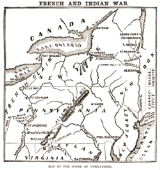
In June of 1749, Galissonière, the Govenor-General of New France, ordered Pierre-Joseph Céloron to mount an expedition to the Ohio Country with the objective of removing British influence from the area. Céloron was also to confirm the allegiance of the Aboriginals inhabiting the territory to the French crown.

Céloron's expedition consisted of 213 soldiers of the Troupes de la Marine , who would be transported by 23 canoes. The expedition left Lachine on June 15, 1749 and two days later reached Fort Frontenac. The expedition then continued along the shoreline of present day Lake Erie. At Chatutauqua Protage , the expedition moved inland to the Allegheny River.

The expedition headed south to Ohio, and Céloron buried some lead plates which were engraved with the French claim to the Ohio Country. Whenever British merchants or fur-traders were encountered by the French, they were informed of the illegality of being on French territory and told to leave the Ohio Country.

When Céloron's expedition arrived at Logstown, the Aboriginals in the area informed Céloron they owned the Ohio Country and that they would trade with the British regardless of what the French told them to do.

The French continued their expedition. At its farthest point south, Céloron's expedition reached the junction between the Ohio River and the Miami River. The junction lay just south of the village of Pickawillany, where the Miami Chief, "Old Britain" lived.

When Céloron arrived at Pickawillany, he informed "Old Britain" of the "dire consequences" if the elderly chief continued to trade with the British. "Old Britain" ignored the warning.
After his meeting with Old Britain, Céloron and his expedition began the trip home. They didn't reach Montreal until November 10, 1749.

The best sum of the expedition's findings came from none other than Céloron himself. In his report, Céloron wrote: "All I can say is that the Natives of these localities are very badly disposed towards the French, and are entirely devoted to the English. I don't know in what way they could be brought back."

Langlade's expedition


Attack on Pickawillany


At dawn on June 21, 1752 a French war party attacked the Miami village, killing fourteen people of the Miami nation, including chief "Old Britain". The expedition then returned home.

Marin's expedition


On March 17, 1752, the Govenor-General of New France, Marquis de la Jonquière died. His temporary replacement was Charles le Moyne de Longueil. It wasn't until July 1, 1752 that Ange Duquense de Menneville arrived in New France to take over the "reigns".

In the spring of 1753, Paul Marin de la Malgue, was given command of a 2,000 man force of Troupes de la Marine and Aboriginals. His orders were to protect the King's land in Ohio from the British.

Marin followed the route that Céloron had mapped out four years previously. The main difference in the two expeditions were that whereas Céloron had buried lead plates Marin was constructing and garrisoning forts.

Marin's Forts


The first fort that was constructed by Paul Marin was at Presque Isle on Lake Erie's south shore. He then had a road built to the headwaters of Rivière aux Boeuf. Marin then constructed a second fort at Le Boeuf . This fort was designed to guard the headwaters of the Rivière aux Boeuf.

Tanaghrisson's proclamation


On September 3, 1753, Tanaghrisson, Chief of the Mingo Mingo

The Mingo are an Iroquois [i] group of Native Americans [i] that m ... 

 arrived at Fort Le Boeuf. Tanaghrisson hated the French because, as legend had it the French killed and ate his father. Tanaghrisson told Marin, "I shall strike at whoever..." This was of course a threat to the French.

The show of force by the French had alarmed the Iroquois in the area. They sent Mohawk runners to William Johnson's manor in Upper New York.

William Johnson was known to the Iroquois as "Warraghiggey", meaning "he who does big business". Johnson was an Anglo-Irish man, born in County Meath, Ireland. He felt that in Ireland he had no future. When his Uncle, Sir Peter Warren asked Johnson to manage his affairs in the New World, Johnson quickly agreed. He arrived in 1738, and quickly became a respected member of the Iroquois Confederacy in the area. In 1746, Johnson was made a colonel of the Iroquois, and later a colonel of the Western New York Militia.

At Albany, New York there was a meeting between Govenor Clinton of New York and Chief Hendrick, as well as several other officials from a handful of American colonies. Chief Hendrick inisted that the British abide by their obligations and block French expansion. When an unsatisfactory respose was offered by Clinton, Chief Hendrick proclaimed that the "Covenant Chain", a long standing friendly relationship between the Iroquois Confederacy and the British Crown was broken.

Dinwiddie's reaction


Govenor Robert Dinwiddie of Virginia found himself in a predicament. Many merchants had invested heavily in fur-trading in Ohio. If the French made good on their claim to the Ohio Country and drove out the British then the Virginian merchants would be out a lot of money.

Dinwiddie could not possibly allow the loss of the Ohio Country to France. To counter the French military presence in Ohio, in October 1753 Dinwiddie ordered Major George Washington George Washington

George Washington commanded the American colonies' [i] Continental Army [i] during th ... 

 of the Virginia militia to deliver a message to the commander of the French forces in the Ohio Country, Jacques Legardeur de Saint-Pierre. Washington along with his interpreter Jacob Van Braam and several other men left for Fort Le Boeuf on the 31st of October.

Dinwiddie's Ultimatum


A few days later, Washington and his party arrived at Wills Creek . Here Washington enlisted the help of Christopher Gist, a surveyor who was familiar with the area. Gist joined the party.

Washington and his party arrived at Logstown on November 26, 1753. At Logstown, Washington met with Tanaghrisson, Chief of the Mingo. Tanaghrisson was angry over the encroachment by the French military of his land. Washington convinced Tanaghrisson to accompany his small group to Fort Le Boeuf.

Washington meets Saint-Pierre


On November 12, 1753, Washington and his men reached Fort Le Boeuf. Jacques Legardeur de Saint-Pierre invited Washington to dine with him that evening. Over dinner Washington presented Saint-Pierre with the letter from Dinwiddie that demanded an immediate French withdrawal from the Ohio Country. Saint-Pierre was quite civil in his response, saying, "As to the Summons you send me to retire, I do not think myself obliged to obey it."

Washington's party left Fort Le Boeuf early on November 13, 1753. By December 12, 1753 they had arrived in Williamsburg, Virginia. In his report, Washington stated, "The French had swept south." They had constructed and garrisoned forts at Presque Isle, Le Boeuf and Venango.

Overview


The French and Indian War was the last of four major colonial wars French and Indian Wars

The French and Indian Wars is a name used in the United States [i] for a series of conflicts in North America [i] ... 

 between the British, the French, and their Native American allies. Unlike the previous three wars, the French and Indian War began on North American soil and then spread to Europe Europe

Europe is one of the seven traditional continent [i]s of the Earth [i]. ... 

, where Britain and France continued fighting. Britain officially declared war on France on May 15, 1756, marking the beginnings of the Seven Years' War in Europe. Native American Native Americans in the United States

American Indian and Alaskan NativesU.S. state [i]s and several of the inhabited insular areas [i] that a ... 

s fought for both sides but primarily alongside the French . The first major event was in 1754. Major George Washington George Washington

George Washington commanded the American colonies' [i] Continental Army [i] during th ... 

, then twenty-one years of age, was sent to negotiate boundaries with the French, who did not give up their forts. Washington led a group of Virginian troops to confront the French at Fort Duquesne Fort Duquesne

Fort Duquesne was a fort [i] established by the French [i] in 1754 [i]... 

 . Washington stumbled upon the French, and in the ensuing skirmish, a French Officer was killed, news of which would certainly provoke a strong French response. Washington pulled back a few miles and established Fort Necessity Fort Necessity National Battlefield

Fort Necessity National Battlefield, located near Farmington, Pennsylvania [i], commemorates the first m ... 

. The French forced Washington and his men to retreat. Meanwhile, the Albany Congress Albany Congress

The Albany Congress was a meeting of representatives of seven of the British North America [i]n colonies ... 

 was taking place as means to discuss further action.

Edward Braddock Edward Braddock

General Edward Braddock was a British soldier and commander-in-chief for North America during the action... 

 led a campaign against the French in 1755; Washington was among the British and colonial troops. Braddock employed European tactics: bold, linear marches and firing formations. This led to disaster at the Monongahela Braddock expedition

The Braddock expedition was a failed British [i] attempt to capture the French [i] ... 

, where the French and natives, though heavily outmanned and outgunned , used superior tactics to gun down and rout the British. Braddock was killed; Washington, despite four close calls, escaped unharmed and led the survivors in retreat. When he took off his jacket, it had four bullet holes in it. Major French victories continued at Fort William Henry, Fort Duquesne Battle of Fort Duquesne

The Battle of Fort Duquesne was a failed attempt by elements of General John Forbes [i]'s British [i] ... 

, and Carillon Battle of Carillon

The Battle of Carillon was fought at Fort Carillon [i], on the shore of Lake Champlain [i] in what was t ... 

, where Montcalm Louis-Joseph de Montcalm

Louis-Joseph, Marquis de Montcalm was the commander of the French forces in North America during the Seven Years' War [i] ... 

 famously defeated five times his number. The only British success in 1755 was the taking of Fort Beausejour Fort Beauséjour

... 

 by Colonel Robert Monckton Robert Monckton

Robert Monckton was an officer [i] of the British army [i] and a colonial administrator [i]... 

, thus protecting the Nova Scotia Nova Scotia

Nova Scotia is a Canadian province [i] located on Canada [i]'s southeastern coast. ... 

 frontier. An unfortunate consequence of this was the subsequent forced deportation of the Acadian Acadian

The Acadians are the descendants of the original French [i] settlers of parts of the northeaster ... 

 population of Nova Scotia Nova Scotia

Nova Scotia is a Canadian province [i] located on Canada [i]'s southeastern coast. ... 

 and the Beaubassin Tantramar Marshes

The Tantramar Marshes are on the southern part of the Isthmus of Chignecto [i], which joins Nova Scotia [i] ... 

 region of Acadia Acadia

Acadia was the name given by the French [i] to a colonial territory [i] i ... 

.

1756 brought with it William Pitt William Pitt, 1st Earl of Chatham

[i] [[British Whig Party|Whig]... 

, Secretary of State of Great Britain. His leadership, and France's continued neglect of the North-American theatre, turned the tide in favour of the British. The French were driven from many frontier posts such as Fort Niagara, and the key Fortress Louisbourg Fortress of Louisbourg

The Fortress of Louisbourg is a Canadian [i] National Historic Site and the location of a partial ... 

 fell to the British in 1758. In 1759, the Battle of the Plains of Abraham Battle of the Plains of Abraham

The Battle of the Plains of Abraham, fought September 13 [i], 1759 [i], was a decisive battle of the North American [i] ... 

 gave Quebec City Quebec City

Quebec City or Qubec* [i] is the capital [i] of the Canadian [i] ... 

 to the British, who had to withstand a siege there after the Battle of Sainte-Foy Battle of Sainte-Foy

The Battle of Sainte-Foy, sometimes called the Battle of Quebec, was fought on April 28 [i], 1760 [i] ... 

 a year later. In September of 1760, Pierre François de Rigaud, Marquis de Vaudreuil-Cavagnal Pierre François de Rigaud, Marquis de Vaudreuil-Cavagnal

Pierre Franois de Rigaud, Marquis de Vaudreuil-Cavagnal was a Canadian [i]-born French colonial g ... 

, the King's Governor of New France, negotiated a surrender with British General Jeffrey Amherst Jeffrey Amherst, 1st Baron Amherst

Jeffery Amherst, 1st Baron Amherst, KB [i] served as an officer in the British Army [i].
... 

. General Amherst granted Vaudreuil's request that any French residents who chose to remain in the colony would be given freedom to continue worshiping in their Roman Catholic Roman Catholic Church

The Roman Catholic Church or Catholic Church is the Christian [i] Church [i] ... 

 tradition, continued ownership of their property, and the right to remain undisturbed in their homes. The British provided medical treatment for the sick and wounded French soldiers and French regular troops French Army

The French Army is the land-based component of the French Armed Forces [i]. ... 

 were returned to France aboard British ships with an agreement that they were not to serve again in the present war.
French and Indian War timeline
Year Dates Event Location
1754 May 28
July 3
Battle of Jumonville Glen 
Battle of the Great Meadows
Uniontown, Pennsylvania Uniontown, Pennsylvania

Uniontown is a city in Fayette County [i], Pennsylvania [i], 50 miles south... 

 
Uniontown, Pennsylvania Uniontown, Pennsylvania

Uniontown is a city in Fayette County [i], Pennsylvania [i], 50 miles south... 

1755 May 29 – July 9
June 3 – 16
July 9
September 8
Braddock expedition Braddock expedition

The Braddock expedition was a failed British [i] attempt to capture the French [i] ... 

 
Battle of Fort Beauséjour Battle of Fort Beauséjour

... 

 
Battle of the Monongahela Braddock expedition

The Braddock expedition was a failed British [i] attempt to capture the French [i] ... 

 
Battle of Lake George
Western Pennsylvania Pennsylvania

The Commonwealth of Pennsylvania is a state [i] in the northeastern [i] ... 

 
Sackville, New Brunswick Sackville, New Brunswick

Sackville is a town in Westmorland County [i], located in South-Easter... 

 
Pittsburgh, Pennsylvania Pittsburgh, Pennsylvania

Pittsburgh is the second largest city in the Commonwealth of Pennsylvania [i] in the United States [i] ... 

 
Lake George, New York
1756 August 10 – 14
September 8
Battle of Fort Oswego 
Kittanning Expedition
Oswego, New York 
Western Pennsylvania Pennsylvania

The Commonwealth of Pennsylvania is a state [i] in the northeastern [i] ... 

1757 August 2 – 6 Battle of Fort William Henry Lake George, New York
1758 June 8 - July 26
July 7 – 8
September 14
October 12
Second Battle of Louisbourg Fortress of Louisbourg

The Fortress of Louisbourg is a Canadian [i] National Historic Site and the location of a partial ... 

 
Battle of Carillon Battle of Carillon

The Battle of Carillon was fought at Fort Carillon [i], on the shore of Lake Champlain [i] in what was t ... 

 
Battle of Fort Duquesne Battle of Fort Duquesne

The Battle of Fort Duquesne was a failed attempt by elements of General John Forbes [i]'s British [i] ... 

 
Battle of Fort Ligonier
Louisbourg, Nova Scotia Louisbourg, Nova Scotia

Louisbourg is a community in Nova Scotia [i]'s Cape Breton Regional Municipality [i] ... 

 
Ticonderoga, New York 
Pittsburgh, Pennsylvania Pittsburgh, Pennsylvania

Pittsburgh is the second largest city in the Commonwealth of Pennsylvania [i] in the United States [i] ... 

 
Western Pennsylvania Pennsylvania

The Commonwealth of Pennsylvania is a state [i] in the northeastern [i] ... 

1759 July
July 6 – 26
July 31
September 13
Battle of Ticonderoga  
Battle of Fort Niagara 
Battle of Beauport 
Battle of the Plains of Abraham Battle of the Plains of Abraham

The Battle of the Plains of Abraham, fought September 13 [i], 1759 [i], was a decisive battle of the North American [i] ... 

Ticonderoga, New York 
Fort Niagara Fort Niagara

Fort Niagara is a three hundred-year-old fortification originally built to protect the interests of New France [i] ... 

, New York New York

New York is a state [i] in the northeastern [i] United States [i]. ... 

 
Quebec City Quebec City

Quebec City or Qubec* [i] is the capital [i] of the Canadian [i] ... 

 
Quebec City Quebec City

Quebec City or Qubec* [i] is the capital [i] of the Canadian [i] ... 

1760 April 28
August 16 – 24
Battle of Sainte-Foy Battle of Sainte-Foy

The Battle of Sainte-Foy, sometimes called the Battle of Quebec, was fought on April 28 [i], 1760 [i] ... 

 
Battle of the Thousand Islands Battle of the Thousand Islands

The Battle of the Thousand Islands was fought between 16 August and 24 August, 1760, in the upper St. Lawrence River [i] ... 

Quebec City Quebec City

Quebec City or Qubec* [i] is the capital [i] of the Canadian [i] ... 

 
Ogdensburg, New York 
1762  Battle of Signal Hill Signal Hill, Newfoundland and Labrador

Signal Hill is a hill which overlooks the city of St. John's, Newfoundland and Labrador [i].
... 

St. John's, Newfoundland St. John's, Newfoundland and Labrador

The Canadian [i] city of St.... 

1763 February 10 Treaty of Paris Paris, France Paris

native_name = Ville de Paris
|common_name = Paris
... 


Outcome


Though the North American fighting ended on Sept. 8, 1760, when the marquis de Vaudreuil surrendered Montreal, indeed all of Canada to Britain , the war officially ended with the signing of the Treaty of Paris on February 10, 1763. The treaty resulted in France's loss of all its North American possessions east of the Mississippi except Saint Pierre and Miquelon Saint-Pierre and Miquelon

Saint-Pierre and Miquelon is a French [i] overseas community [i] consis ... 

, two small islands of Newfoundland Newfoundland

Newfoundland is a large island off the east coast of North America [i], and the most populous part o ... 

. France regained the Caribbean islands of Guadeloupe Guadeloupe

Guadeloupe is an archipelago [i] located in the eastern Caribbean Sea [i] at , with a total area of 1,78 ... 

 and Martinique Martinique

Martinique is an island [i] in the eastern Caribbean Sea [i], having a total area of 1,128 km. ... 

, which had been occupied by the British. The economic value of these islands was greater than that of Canada at the time, because of their rich sugar Sugar

In general use, non-scientists take "sugar" to mean sucrose [i], also called "table sugar" or saccharose, a wh ... 

 crops, and the islands were easier to defend. Spain gained Louisiana Louisiana

cellpadding="2" cellspacing="2">
... 

, including New Orleans New Orleans, Louisiana

New Orleans is a major United States [i] port city and historically the largest city in the U.S. state [i] ... 

, in compensation for its loss of Florida Florida

Florida is a U.S. state [i] located in the southeastern [i] United States [i] ... 

 to the British.

One result of the war was that Britain gained control of a strip of territory along the St. Lawrence River Saint Lawrence River

The Saint Lawrence River is a large west-to-east flowing river [i] in the middle latitudes of North America [i] ... 

 that now forms part of the Province of Quebec Quebec

Quebec, or Qubec in French [i], In 1898, the Canadian Parliament passed the first ... 

 with approximately 54,000 French-speaking, Roman Catholic Roman Catholic Church

The Roman Catholic Church or Catholic Church is the Christian [i] Church [i] ... 

 population. Near the beginning of the war, in 1755, the British had expelled French-speaking populations in Acadia Acadia

Acadia was the name given by the French [i] to a colonial territory [i] i ... 

 to Louisiana, creating the Cajun Cajun

The Cajuns are an ethnic group [i] consisting of the descendants of Acadian [i] exiles and other peoples... 

 population, the Acadians would not be allowed to return until 1764.
The European theatre of the war was settled by the Treaty of Hubertusburg on February 15, 1763.It also changed economic, political and social relations between Britian and its colonies.

Minor facts

  • The Battle of Fort Necessity, one of the opening engagements of the war, marked the first and only instance of George Washington George Washington

    George Washington commanded the American colonies' [i] Continental Army [i] during th ... 

     surrendering in battle.
  • Fort Ticonderoga Fort Ticonderoga

    Fort Ticonderoga is a large 18th century [i] fort [i] built at a strategically important narrows in Lake Champlain [i] ... 

     was built by the French after a battle near Lake George, New York New York

    New York is a state [i] in the northeastern [i] United States [i]. ... 

    .
  • The novel and movie The Last of the Mohicans The Last of the Mohicans

    The Last of the Mohicans is an epic novel [i] by James Fenimore Cooper [i], first published in Janua ... 

    is set around the events of the Battle of Fort William Henry
  • The final battle of the war in North America was the Battle of Signal Hill Signal Hill, Newfoundland and Labrador

    Signal Hill is a hill which overlooks the city of St. John's, Newfoundland and Labrador [i].

... 

, in which the French surrendered St. John's St. John's, Newfoundland and Labrador

The Canadian [i] city of St.... 

 to the British under the command of Colonel William Amherst.
  • As part of the peace treaty, France agreed that it would not build any military establishments in India India

    India , officially the Republic of India, is a country in South Asia [i]. ... 

    , thereby allowing Britain to become the dominant European power in India. France was from then on powerless in North America.

Present day locations of battles and expeditions


United States United States

The United States of America, also known as the United States, the U.S., the U.S.A., a... 

  • Pennsylvania Pennsylvania

    The Commonwealth of Pennsylvania is a state [i] in the northeastern [i] ... 

    • Battle of Jumonville Glen
    • Battle of Fort Necessity, aka the Battle of Great Meadows
    • Braddock Expedition Braddock expedition

      The Braddock expedition was a failed British [i] attempt to capture the French [i] ... 

    • Kittanning Expedition
    • Battle of Fort Duquesne Battle of Fort Duquesne

      The Battle of Fort Duquesne was a failed attempt by elements of General John Forbes [i]'s British [i] ... 

    • Battle of Fort Ligonier
    • Forbes Expedition


  • New York New York

    New York is a state [i] in the northeastern [i] United States [i]. ... 

    • Battle of Lake George
    • Battle of Fort Oswego
    • Battle on Snowshoes Rogers' Rangers

      Rogers' Rangers — commanded by Major Robert Rogers — was an Independent Company of Ran... 

    • Battle of Sabbath Day Point
    • Battle of Fort William Henry
    • Battle of Carillon Battle of Carillon

      The Battle of Carillon was fought at Fort Carillon [i], on the shore of Lake Champlain [i] in what was t ... 

    • Battle of Ticonderoga
    • Battle of Fort Niagara
    • Battle of the Thousand Islands Battle of the Thousand Islands

      The Battle of the Thousand Islands was fought between 16 August and 24 August, 1760, in the upper St. Lawrence River [i] ... 

      , 16-25 August, 1760


  • West Virginia West Virginia

    West Virginia is a state [i] of the United States [i] in the region of Appalachia [i], also k ... 

    • Battle of Great Cacapon

Canada Canada

Canada is the world's second-largest [i] country by total area, occupying most ... 


  • Nova Scotia Nova Scotia

    Nova Scotia is a Canadian province [i] located on Canada [i]'s southeastern coast. ... 

    • Battle of Louisburg Fortress of Louisbourg

      The Fortress of Louisbourg is a Canadian [i] National Historic Site and the location of a partial ... 


  • Ontario Ontario

    Ontario is the most populous and second-largest in area of Canada [i]'s ten provinces [i] ... 

    • Battle of Fort Frontenac Battle of Fort Frontenac

      The Battle of Fort Frontenac took place from August 25 to August 27 1758 near the end of the Seven Years' War [i] ... 

    • Battle of the Thousand Islands Battle of the Thousand Islands

      The Battle of the Thousand Islands was fought between 16 August and 24 August, 1760, in the upper St. Lawrence River [i] ... 

      , 16-25 August, 1760


  • Quebec Quebec

    Quebec, or Qubec in French [i], In 1898, the Canadian Parliament passed the first ... 

    • Battle of Beauport
    • Battle of the Plains of Abraham Battle of the Plains of Abraham

      The Battle of the Plains of Abraham, fought September 13 [i], 1759 [i], was a decisive battle of the North American [i] ... 

    • Battle of Sainte-Foy Battle of Sainte-Foy

      The Battle of Sainte-Foy, sometimes called the Battle of Quebec, was fought on April 28 [i], 1760 [i] ... 

    • Surrender of Montreal


  • Newfoundland Newfoundland

    Newfoundland is a large island off the east coast of North America [i], and the most populous part o ... 

    • Battle of Signal Hill Signal Hill, Newfoundland and Labrador

      Signal Hill is a hill which overlooks the city of St. John's, Newfoundland and Labrador [i].

... 


Further reading


See also


  • Fort at Number 4
  • French and Indian Wars French and Indian Wars

    The French and Indian Wars is a name used in the United States [i] for a series of conflicts in North America [i] ... 

  • Great Upheaval Great Upheaval

    The Great Upheaval, also known as the Great Expulsion, The Deportation or the Acadian Exp... 

  • Military history Military history

    Military history is composed of the events in the history of humanity [i] that fall within ... 

  • New Hampshire Provincial Regiment
  • Join or Die Join or Die

    Join or Die [i] is a famous image of a cut up snake, created by Benjamin Franklin [i] in 1754. ... 

    , the famous cartoon by Benjamin Franklin
  • Pontiac's Rebellion Pontiac's Rebellion

    Pontiac's Rebellion was a war launched in 1763 by North American Indians [i] who were dissatisfied with ... 

  • Rogers' Rangers Rogers' Rangers

    Rogers' Rangers — commanded by Major Robert Rogers — was an Independent Company of Ran... 


External links

  • PBS Public Broadcasting Service

    The Public Broadcasting Service is a non-profit [i] public broadcasting [i] television [i] service with ... 

     site and