


Irish Republicanism

Encyclopedia
Irish republicanism is an ideology based on the belief that all of Ireland
should be an independent republic
.
In 1801, under the Act of Union, the Kingdom of Great Britain
and the Kingdom of Ireland
merged to form the United Kingdom of Great Britain and Ireland
. This followed hundreds of years of British conquest and Irish resistance through rebellion, and union of the crowns
of both countries since 1542. The development of nationalist
and democratic
sentiment throughout Europe was reflected in Ireland in the emergence of republicanism, in opposition to British rule. Discrimination
against Catholics, attempts by a subjugating power to create an impression of inferiority and subdue or eliminate cultural identity, and a feeling that Ireland was economically disadvantaged and subservient within the United Kingdom were among the specific factors leading to such opposition.
In Irish history and politics, it is common to draw a distinction between nationalism
and republicanism. The term nationalism is used for any manifestation of national sentiment, including cultural manifestations; for movements demanding autonomy from Britain but not complete independence; and sometimes for secessionist movements committed to constitutional methods. The term republicanism denotes movements demanding complete independence under a republican government. It is frequently associated with a willingness to use physical force
to achieve political goals, and often with a secular
or non-sectarian
outlook, whereas Irish nationalism is almost universally associated with Catholicism
. In addition, Irish republicanism is also associated with left-wing politics
, as many of the key Irish Republican thinkers of the 19th and 20th centuries were avowed socialist
s and/or Marxist
s, while many Republican organisations promote some form of socialism as the system which would govern a hypothetical united Ireland
.
in the 12th century, Ireland, or parts of it, had experienced alternating degrees of rule from England
. While some of the native Gaelic
population attempted to resist this occupation, a single, unified political goal did not exist amongst the independent lordships that existed throughout the island. The Tudor conquest of Ireland took place in the 16th century. This included the Plantations of Ireland
, in which the lands held by Gaelic Irish clans
and Hiberno-Norman dynasties were confiscated and given to Protestant settlers ("Planters") from England and Scotland
. The Plantation of Ulster
began in 1609, and the province
was heavily colonised
with English
and Scottish
settlers.
Campaigns against English presence on the island had occurred prior to the emergence of the Irish republican ideology. In the 1590s, resistance was led by Hugh O'Neill (see the Nine Years' War
). The Irish chieftains were ultimately defeated, leading to their exile (the 'Flight of the Earls
') and the aforementioned Plantation of Ulster in 1609.
Three decades later, the Irish Rebellion of 1641
began. This consisted of a coalition between the Irish
and the Old English
(descendents of the English/Norman settlers who settled during the Norman Invasion) rebelling against the English rulers. Beginning as a coup d'état
with the aim restoring lost lands in the north of Ireland and defending Catholic religious and property rights, (which had been suppressed by the Puritan
Parliament of England
) it evolved into the Irish Confederate Wars
. In the summer of 1642, the Catholic upper classes formed the Catholic Confederation
, which essentially became the de facto
government of Ireland for a brief period until 1649, when the forces of the English Parliament carried out the Cromwellian conquest of Ireland
and the old Catholic landowners were permanently dispossessed of their lands.
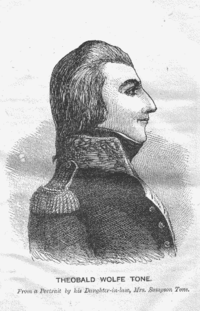 Irish republicanism has its origins in Irish political movements founded in the 18th century. The movement is often seen as beginning with the Society of United Irishmen. In 18th century Ireland, Dissenter
s and Catholics
experienced discrimination as a result of the Penal Laws
, a series of laws imposed by the British ruling class that removed power from those outside of the established Church of Ireland
. In 1791, a group which became known as the United Irishmen was formed with the intention of bringing about Parliamentary
reform. The group evolved into a revolutionary republican organisation, influenced by the revolutions in America
and France
that had taken place earlier.
The United Irishmen opposed British rule in Ireland, and believed that Ireland ought to govern itself, free from external control. The group also sought to remove the religious discrimination that existed in government and law at the time. At the group's first meeting, the following three resolutions were passed:
The issue of national freedom was an important part of the ideology of the United Irishmen. The Declaration of the United Irishmen, written by Theobald Wolfe Tone, contained the following statements regarding the government of Ireland:
 At this stage, the movement was led primarily by liberal Protestants, particularly Presbyterians
from the province of Ulster. Founding members of the United Irishmen, along with Tone, included Thomas Russell
, Henry Joy McCracken
, James Napper Tandy
, and Samuel Neilson
. By 1797, the Society of United Irishmen had around 100,000 members. Crossing the religious divide in Ireland, it had a mixed membership of Catholics, Presbyterians, and even Anglicans
from the Protestant Ascendancy
. It also attracted support and membership from Catholic agrarian
resistance groups, such as the Defenders
, who were eventually incorporated into the Society.
The Irish Rebellion of 1798
began on 23 May, with the first clashes taking place in County Kildare
on May 24, before spreading throughout Leinster
and other areas of the country thereafter. French soldiers landed in Ireland and participated in the rebellion also, landing in Killala
on 22 August. General Napper Tandy, a leader of the uprising, authored a proclamation entitled 'Liberty or Death':
Despite having considerable success against British forces in the County of Wexford
, rebel forces were eventually defeated, and many key figures in the organisation were arrested and executed.
Although the Rebellion of 1798 was unsuccessful in that it failed to bring about independence from Great Britain and establish a republic in Ireland, it is significant in that the conflict and its leaders impacted Irish history
to an enormous extent. The Society of United Irishmen was the first republican organisation in Ireland, and thus essentially founded Irish republicanism as a political ideology, setting the course for later independence movements in the country. Likewise, Wolfe Tone is regarded as the “father of Irish republicanism”, and the principles of the United Irishmen have greatly influenced Irish nationalist and republican philosophies.
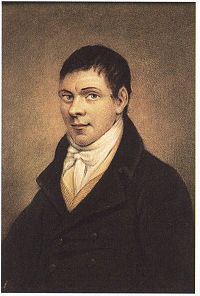 Though the Rebellion of 1798 was eventually crushed, small republican guerrilla campaigns
against the British Army in the Wicklow Mountains
under the leadership of Michael Dwyer
and Joseph Holt
continued for a short time after, conducting attacks on small parties of yeomen
. These activities were perceived by some to be merely “the dying echoes of an old convulsion”, but others feared further large-scale uprisings, due to the United Irishmen continuing to attract large numbers of Catholics in rural areas of the country and arms raids being carried out on a nightly basis. It was also feared that rebels would again seek military aid from French troops, and a rising was expected for 10 April.
This perceived threat of further rebellion resulted in the Parliamentary Union between the Kingdom of Great Britain and Ireland. After some uncertainty, the Irish Parliament
voted to abolish itself in the Acts of Union 1800, forming the United Kingdom of Great Britain and Ireland, by a vote of 158 to 115. A number of tactics were used to achieve this end. Lord Castlereagh
and Charles Cornwallis
were known to use bribery extensively. In all, sixteen Irish borough-owners were given British peerage
s and twenty-eight new Irish peerages
were created, while twenty existing Irish peerages were increased in rank.
Furthermore, the government of Great Britain sought to replace Irish politicians in the Irish parliament with pro-Union politicians, and rewards were granted to those that vacated their seats, with the result being that in the eighteen months prior to the decision in 1800, one-fifth of the Irish House of Commons
changed its representation due to these activities and other factors such as death. It was also promised by Prime Minister William Pitt the Younger
that he would bring about Catholic Emancipation
, though after the Acts of Union were successfully voted through, King George III
saw that this pledge was never realised, and as such Catholics were not granted the rights that had been promised prior to the Acts.
in 1803. Emmet had previously been expelled from Trinity College
, Dublin for his political views. Like those who had led the 1798 rebellion, Emmet was a member of the United Irishmen, as was his brother Thomas Addis Emmet
, who had been imprisoned for membership in the organisation.
Emmet and his followers had planned to seize Dublin Castle
by force, manufacturing weaponry and explosives at a number of locations in Dublin. Unlike those of 1798, preparations for the uprising were successfully concealed from the government and law enforcement, and though a premature explosion at an arms depot attracted the attention of police, they were unaware of the United Irishmen activities at the time and did not have any information regarding the planned rebellion. Emmet had hoped to avoid the complications of the previous rebellion and chose not to organise the county outside of Dublin to a large extent. It was expected that the areas surrounding Dublin were sufficiently prepared for an uprising should one be announced, and Thomas Russell had been sent to northern areas of the country to prepare republicans there.
A proclamation of independence, addressed from 'The Provisional Government' to 'The People of Ireland' was produced by Emmet, echoing the republican sentiments expressed during the previous rebellion:
However, failed communications and arrangements produced a considerably smaller force than had been anticipated. Nonetheless, the rebellion began in Dublin on the evening of 23 July. Emmet's forces were unable to take Dublin Castle, and the rising broke down into rioting, which ensued sporadically throughout the night. Emmet escaped and hid for some time in the Wicklow Mountains and Harold's Cross, but was captured on August 25 and hanged on September 20, 1803, at which point the Society of United Irishmen was effectively finished.
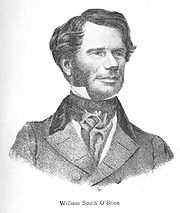 The Young Ireland
movement began in the late 1830s. The term 'Young Ireland' was originally a derogatory one, coined by the press in Britain to describe members of the Repeal Association
(a group campaigning for the repeal of the Acts of Union 1800 which joined the Kingdom of Ireland and the Kingdom of Great Britain) who were involved with the Irish nationalist newspaper The Nation
. Encouraging the repeal of the Acts of Union, members of the Young Ireland movement advocated the removal of British authority from Ireland and the re-istablishment of the Irish Parliament in Dublin. The group had cultural aims also, and encouraged the study of Irish history and the revival of the Irish language
. Influential Young Irelanders included Charles Gavan Duffy
, Thomas Davis and John Blake Dillon
, the three founders of The Nation.
The Young Irelanders eventually seceded from the Repeal Association. The leader of the Repeal Association, Daniel O'Connell
, opposed the use of physical force to enact repeal, and passed 'peace resolutions' declaring that violence and force were not to be employed. Though the Young Irelanders did not support the use of violence, the writers of The Nation maintained that the introduction of these peace resolutions was poorly timed, and that to declare outright that force would never be used was 'to deliver themselves bound hand and foot to the Whigs.' William Smith O'Brien
, who had previously worked to achieve compromise between O'Connell and The Nation group, was also concerned, and claimed that he feared these resolutions were an attempt to exclude the Young Irelanders from the Association altogether. At an Association meeting held in July 1846 at Conciliation Hall
, the meeting place of the Association, Thomas Francis Meagher
, a Young Irelander, addressing the peace resolutions, delivered his 'Sword Speech', in which he stated, "I do not abhor the use of arms in the vindication of national rights ... Be it for the defence, or be it for the assertion of a nation's liberty, I look upon the sword as a sacred weapon." John O'Connell
, Daniel O'Connell's son, was present at the proceedings and interrupted Meagher's speech, claiming that Meagher could no longer be part of the same association as O'Connell and his supporters. After some protest, the Young Irelanders left Conciliation Hall and the Repeal Association forever, founding the Irish Confederation 13 January 1847 after negotiations for a reunion had failed.
The Young Ireland movement culminated in a failed uprising (see Young Irelander Rebellion of 1848
), which, influenced by the French Revolution of 1848
and further provoked by government inaction during the Great Famine and the suspension of habeas corpus
, which allowed the government to imprison Young Irelanders and other political opponents without trial, was hastily planned and quickly suppressed. Following the abortive uprising, several rebel leaders were arrested and convicted of sedition. Originally sentenced to death, Smith O'Brien and other members of the Irish Confederation were transported
to Van Diemen's Land
.
movement consisted of the Fenian Brotherhood
and the Irish Republican Brotherhood
(IRB), fraternal organisations founded in the United States and Ireland respectively with the aim of establishing an independent republic in Ireland.
The IRB was founded on Saint Patrick's Day
1858 in Dublin. Members present at the first meeting were James Stephens, Thomas Clarke Luby
, Peter Langan, Joseph Denieffe, Garrett O'Shaughnessy, and Charles Kickham
. Stephens had previously spent time exiled in Paris, along with John O'Mahony
, having taken part in the uprising of 1848 and fleeing to avoid capture. O'Mahony left France for America in the mid-1850s and founded the Emmet Monument Association
with Michael Doheny
. Stephens returned to Ireland in 1856.
The original oath of the society, drawn up by Luby under Stephens' direction, read:
The Fenian Brotherhood was the IRB's counterpart organisation, formed in the same year in the United States by O'Mahony and Doheny. The Fenian Brotherhood's main purpose was to supply weapons and funds for its Irish counterpart and raise support for the Irish republican movement in the United States. The term "Fenian" was coined by O'Mahony, who named the American wing of the movement after the Fianna
— a class of warriors that existed in Gaelic Ireland
. The term became popular and is still in use today, especially in Northern Ireland and Scotland, where it has expanded to refer to all Irish nationalists and republicans, as well as being a pejorative term for Irish Catholics.
Public support for the Fenian movement in Ireland grew in November 1861 with the funeral of Terence MacManus
, a member of the Irish Confederation, which Stephens and the Fenians had organised and which was attended by between twenty thousand and thirty thousand people. Following this, Stephens (accompanied by Luby) undertook a series of organisational tours throughout the island.
In 1865 the Fenian Brotherhood in America had split into two factions. One was led by O'Mahony with Stephens' support. The other, which was more powerful, was led by William R. Roberts
. The Fenians had always planned an armed rebellion, but there was now disagreement as to how and where this rebellion might be carried out. Roberts' faction favoured focusing all Fenian military efforts on British Canada (Roberts and his supporters theorised that victory for the American Fenians in nearby Canada would propel the Irish republican movement as a whole to success). The other, headed by O'Mahony, proposed that a rising in Ireland be planned for 1866. In spite of this, the O'Mahony wing of the movement itself tried and failed to capture New Brunswick
's Campobello Island in April 1866. Following this failure, the Roberts faction of the Fenian Brotherhood carried out its own, occupying the village of Fort Erie
on 31 May 1866 and engaging Canadian troops at the battles of Ridgeway
and Fort Erie
on 2 June. It was in reference to Fenians fighting in this battle that the name "Irish Republican Army" was first used. These attacks (and those that followed) in Canada are collectively known as the "Fenian raids
".
 After the Act of Union in 1801 merging Ireland with Britain into the United Kingdom, Irish independence movements were suppressed by the British. Nationalist rebellions against British rule in 1803, by Robert Emmet, 1848 (by the Young Irelanders) and 1865 and 1867 (by the Fenians) were followed by harsh reprisals by British forces.
In 1916 the Easter Rising
organised by the Irish Republican Brotherhood was launched in Dublin and the Irish Republic
was proclaimed. The Rising was suppressed after six days, and most of its leaders were executed
by the British. This was a turning point in Irish history, leading to the end of British rule in most of Ireland.
From 1919-1921 the Irish Republican Army
(IRA) was organized as a guerilla army, led by Michael Collins
and fought against British forces. During the Anglo-Irish War (or Irish War of Independence
) the British sent paramilitary
police, the "Black and Tans
" and the Auxiliary Division
, to help the British Army
and Royal Irish Constabulary
. These groups committed atrocities which included killing captured POWs and Irish civilians viewed as being sympathetic to the IRA. The most infamous of all their actions was the burning of half the city
of Cork
in 1920 and the Bloody Sunday
massacre of 1920. These atrocities, together with the popularity of the republican ideal, and British repression of republican political expression, led to widespread support across Ireland for the Irish rebels.
In 1921 the British government led by David Lloyd George
negotiated the Anglo-Irish Treaty
with Arthur Griffith
, Michael Collins, and the other republican leaders all of whom acted as plenipotentiaries on behalf of the provisional Irish government, thus ending the conflict.
, not a partitioned dominion
under the British crown
), some republicans were satisfied that the Treaty was the best that could be achieved at the time. However, a substantial number opposed it. Dáil Éireann
, the Irish parliament, voted by 64 votes to 57 to ratify it, the majority believing that the treaty created a new base from which to move forward. Éamon de Valera
, who had served as President of the Irish Republic
during the war, refused to accept the decision of the Dáil and led the opponents of the treaty out of the House. The IRA itself split between pro-Treaty and anti-Treaty elements, with the former forming the nucleus of the new Irish National Army
.
Michael Collins became Commander-in-Chief of the National Army. Shortly afterwards, some dissidents, apparently without the authorisation of the anti-Treaty IRA Army Executive, occupied the Four Courts
in Dublin, and kidnapped a pro-Treaty general. The government, responding to this provocation and to intensified British pressure following the assassination by an IRA unit in London of Sir Henry Wilson, ordered the regular army to take the Four Courts
, thereby beginning the Irish Civil War
.
It is believed that Collins continued to fund and supply the IRA in Northern Ireland
throughout the civil war but, after his death, W. T. Cosgrave (the new President of the Executive Council
) discontinued this support.
By May 1923, the war (which had claimed more lives than the War of Independence) had ended in the call by the IRA to dump arms. However, the harsh measures adopted by both sides, including assassinations of politicians by the Republicans and executions and atrocities by the Free State side, left a bitter legacy in Irish politics for decades to come.
De Valera, who had strongly supported the Republican side in the Civil War, reconsidered his views while in jail, and came to accept the ideas of political activity under the terms of the Free State constitution. Rather than abstaining from Free State politics entirely, he now sought to republicanise it from within. However, he and his supporters failed to convince a majority of the anti-treaty Sinn Féin
of these views and the movement split again. In 1926, he formed a new party called Fianna Fáil
(Soldiers of Destiny), taking most of Sinn Féin's deputies with him. In 1932 he was elected President of the Executive Council of the Free State and began a slow process of turning the country from a constitutional monarchy
to a constitutional republic, thus fulfilling Collins's prediction of "the freedom to achieve freedom".
By then, the IRA was engaged in confrontations with the Blueshirts, a quasi-fascist
group led by a former War of Independence and pro-Treaty leader, Eoin O'Duffy
. O'Duffy looked to Fascist
Italy
as an example for Ireland to follow. Several hundred supporters of O'Duffy briefly went to Spain to volunteer on the Nationalist
side in the Spanish Civil War
, and a smaller number of IRA members, communists and others participated on the Republican
side.
In 1937 the Constitution of Ireland
was written by the De Valera government and approved by the people of the southern 26 counties voting in a referendum. The Constitution changed the name of the state to Éire
in the Irish language (Ireland in English) and claimed jurisdiction over the whole of Ireland. The new state was headed by a President of Ireland
elected by universal manhood suffrage. The role of the King of Ireland
diminished to ceremonial functions in relation to diplomatic affairs. He is believed to have been left with those residual functions as a concession to Unionist
opinion. The new state had the objective characteristics of a republic, and was referred to as such by de Valera himself, but it remained within the British Commonwealth
and was regarded by the British as a "dominion" like Canada
, Australia
, New Zealand
and South Africa
. Furthermore, the claim to the whole of the island did not reflect practical reality and inflamed anti-Dublin sentiment among northern Protestants.
Despite the successive splits of 1922 and 1926, the remainder of the IRA rejected compromise with the de facto political situation and continued to consider themselves to be original and sole Republican Movement.
.
Ireland
Ireland is an island to the northwest of continental Europe. It is the third-largest island in Europe and the twentieth-largest island on Earth...
should be an independent republic
Republic
A republic is a form of government in which the people, or some significant portion of them, have supreme control over the government and where offices of state are elected or chosen by elected people. In modern times, a common simplified definition of a republic is a government where the head of...
.
In 1801, under the Act of Union, the Kingdom of Great Britain
Kingdom of Great Britain
The former Kingdom of Great Britain, sometimes described as the 'United Kingdom of Great Britain', That the Two Kingdoms of Scotland and England, shall upon the 1st May next ensuing the date hereof, and forever after, be United into One Kingdom by the Name of GREAT BRITAIN. was a sovereign...
and the Kingdom of Ireland
Kingdom of Ireland
The Kingdom of Ireland refers to the country of Ireland in the period between the proclamation of Henry VIII as King of Ireland by the Crown of Ireland Act 1542 and the Act of Union in 1800. It replaced the Lordship of Ireland, which had been created in 1171...
merged to form the United Kingdom of Great Britain and Ireland
United Kingdom of Great Britain and Ireland
The United Kingdom of Great Britain and Ireland was the formal name of the United Kingdom during the period when what is now the Republic of Ireland formed a part of it....
. This followed hundreds of years of British conquest and Irish resistance through rebellion, and union of the crowns
Crown of Ireland Act 1542
The Crown of Ireland Act 1542 is an Act of the Parliament of Ireland , declaring that King Henry VIII of England and his successors would also be Kings of Ireland. Since 1171 the monarch of England had held the title Lord of Ireland...
of both countries since 1542. The development of nationalist
Nationalism
Nationalism is a political ideology that involves a strong identification of a group of individuals with a political entity defined in national terms, i.e. a nation. In the 'modernist' image of the nation, it is nationalism that creates national identity. There are various definitions for what...
and democratic
Democracy
Democracy is generally defined as a form of government in which all adult citizens have an equal say in the decisions that affect their lives. Ideally, this includes equal participation in the proposal, development and passage of legislation into law...
sentiment throughout Europe was reflected in Ireland in the emergence of republicanism, in opposition to British rule. Discrimination
Discrimination
Discrimination is the prejudicial treatment of an individual based on their membership in a certain group or category. It involves the actual behaviors towards groups such as excluding or restricting members of one group from opportunities that are available to another group. The term began to be...
against Catholics, attempts by a subjugating power to create an impression of inferiority and subdue or eliminate cultural identity, and a feeling that Ireland was economically disadvantaged and subservient within the United Kingdom were among the specific factors leading to such opposition.
In Irish history and politics, it is common to draw a distinction between nationalism
Irish nationalism
Irish nationalism manifests itself in political and social movements and in sentiment inspired by a love for Irish culture, language and history, and as a sense of pride in Ireland and in the Irish people...
and republicanism. The term nationalism is used for any manifestation of national sentiment, including cultural manifestations; for movements demanding autonomy from Britain but not complete independence; and sometimes for secessionist movements committed to constitutional methods. The term republicanism denotes movements demanding complete independence under a republican government. It is frequently associated with a willingness to use physical force
Physical force Irish republicanism
Physical force Irish republicanism, is a term used to describe the recurring appearance of non-parliamentary violent insurrection in Ireland between 1798 and the present...
to achieve political goals, and often with a secular
Secularity
Secularity is the state of being separate from religion.For instance, eating and bathing may be regarded as examples of secular activities, because there may not be anything inherently religious about them...
or non-sectarian
Sectarianism
Sectarianism, according to one definition, is bigotry, discrimination or hatred arising from attaching importance to perceived differences between subdivisions within a group, such as between different denominations of a religion, class, regional or factions of a political movement.The ideological...
outlook, whereas Irish nationalism is almost universally associated with Catholicism
Catholicism
Catholicism is a broad term for the body of the Catholic faith, its theologies and doctrines, its liturgical, ethical, spiritual, and behavioral characteristics, as well as a religious people as a whole....
. In addition, Irish republicanism is also associated with left-wing politics
Left-wing politics
In politics, Left, left-wing and leftist generally refer to support for social change to create a more egalitarian society...
, as many of the key Irish Republican thinkers of the 19th and 20th centuries were avowed socialist
Socialism
Socialism is an economic system characterized by social ownership of the means of production and cooperative management of the economy; or a political philosophy advocating such a system. "Social ownership" may refer to any one of, or a combination of, the following: cooperative enterprises,...
s and/or Marxist
Marxism
Marxism is an economic and sociopolitical worldview and method of socioeconomic inquiry that centers upon a materialist interpretation of history, a dialectical view of social change, and an analysis and critique of the development of capitalism. Marxism was pioneered in the early to mid 19th...
s, while many Republican organisations promote some form of socialism as the system which would govern a hypothetical united Ireland
United Ireland
A united Ireland is the term used to refer to the idea of a sovereign state which covers all of the thirty-two traditional counties of Ireland. The island of Ireland includes the territory of two independent sovereign states: the Republic of Ireland, which covers 26 counties of the island, and the...
.
Background of English rule in Ireland
Following the Norman invasion of IrelandNorman Invasion of Ireland
The Norman invasion of Ireland was a two-stage process, which began on 1 May 1169 when a force of loosely associated Norman knights landed near Bannow, County Wexford...
in the 12th century, Ireland, or parts of it, had experienced alternating degrees of rule from England
England
England is a country that is part of the United Kingdom. It shares land borders with Scotland to the north and Wales to the west; the Irish Sea is to the north west, the Celtic Sea to the south west, with the North Sea to the east and the English Channel to the south separating it from continental...
. While some of the native Gaelic
Gaels
The Gaels or Goidels are speakers of one of the Goidelic Celtic languages: Irish, Scottish Gaelic, and Manx. Goidelic speech originated in Ireland and subsequently spread to western and northern Scotland and the Isle of Man....
population attempted to resist this occupation, a single, unified political goal did not exist amongst the independent lordships that existed throughout the island. The Tudor conquest of Ireland took place in the 16th century. This included the Plantations of Ireland
Plantations of Ireland
Plantations in 16th and 17th century Ireland were the confiscation of land by the English crown and the colonisation of this land with settlers from England and the Scottish Lowlands....
, in which the lands held by Gaelic Irish clans
Irish clans
Irish clans are traditional kinship groups sharing a common surname and heritage and existing in a lineage based society prior to the 17th century.-History:...
and Hiberno-Norman dynasties were confiscated and given to Protestant settlers ("Planters") from England and Scotland
Scotland
Scotland is a country that is part of the United Kingdom. Occupying the northern third of the island of Great Britain, it shares a border with England to the south and is bounded by the North Sea to the east, the Atlantic Ocean to the north and west, and the North Channel and Irish Sea to the...
. The Plantation of Ulster
Plantation of Ulster
The Plantation of Ulster was the organised colonisation of Ulster—a province of Ireland—by people from Great Britain. Private plantation by wealthy landowners began in 1606, while official plantation controlled by King James I of England and VI of Scotland began in 1609...
began in 1609, and the province
Ulster
Ulster is one of the four provinces of Ireland, located in the north of the island. In ancient Ireland, it was one of the fifths ruled by a "king of over-kings" . Following the Norman invasion of Ireland, the ancient kingdoms were shired into a number of counties for administrative and judicial...
was heavily colonised
Plantation (settlement or colony)
Plantation was an early method of colonization in which settlers were "planted" abroad in order to establish a permanent or semi-permanent colonial base. Such plantations were also frequently intended to promote Western culture and Christianity among nearby indigenous peoples, as can be seen in the...
with English
English people
The English are a nation and ethnic group native to England, who speak English. The English identity is of early mediaeval origin, when they were known in Old English as the Anglecynn. England is now a country of the United Kingdom, and the majority of English people in England are British Citizens...
and Scottish
Scottish people
The Scottish people , or Scots, are a nation and ethnic group native to Scotland. Historically they emerged from an amalgamation of the Picts and Gaels, incorporating neighbouring Britons to the south as well as invading Germanic peoples such as the Anglo-Saxons and the Norse.In modern use,...
settlers.
Campaigns against English presence on the island had occurred prior to the emergence of the Irish republican ideology. In the 1590s, resistance was led by Hugh O'Neill (see the Nine Years' War
Nine Years' War (Ireland)
The Nine Years' War or Tyrone's Rebellion took place in Ireland from 1594 to 1603. It was fought between the forces of Gaelic Irish chieftains Hugh O'Neill of Tír Eoghain, Hugh Roe O'Donnell of Tír Chonaill and their allies, against English rule in Ireland. The war was fought in all parts of the...
). The Irish chieftains were ultimately defeated, leading to their exile (the 'Flight of the Earls
Flight of the Earls
The Flight of the Earls took place on 14 September 1607, when Hugh Ó Neill of Tír Eóghain, Rory Ó Donnell of Tír Chonaill and about ninety followers left Ireland for mainland Europe.-Background to the exile:...
') and the aforementioned Plantation of Ulster in 1609.
Three decades later, the Irish Rebellion of 1641
Irish Rebellion of 1641
The Irish Rebellion of 1641 began as an attempted coup d'état by Irish Catholic gentry, who tried to seize control of the English administration in Ireland to force concessions for the Catholics living under English rule...
began. This consisted of a coalition between the Irish
Irish people
The Irish people are an ethnic group who originate in Ireland, an island in northwestern Europe. Ireland has been populated for around 9,000 years , with the Irish people's earliest ancestors recorded having legends of being descended from groups such as the Nemedians, Fomorians, Fir Bolg, Tuatha...
and the Old English
Old English (Ireland)
The Old English were the descendants of the settlers who came to Ireland from Wales, Normandy, and England after the Norman invasion of Ireland in 1169–71. Many of the Old English became assimilated into Irish society over the centuries...
(descendents of the English/Norman settlers who settled during the Norman Invasion) rebelling against the English rulers. Beginning as a coup d'état
Coup d'état
A coup d'état state, literally: strike/blow of state)—also known as a coup, putsch, and overthrow—is the sudden, extrajudicial deposition of a government, usually by a small group of the existing state establishment—typically the military—to replace the deposed government with another body; either...
with the aim restoring lost lands in the north of Ireland and defending Catholic religious and property rights, (which had been suppressed by the Puritan
Puritan
The Puritans were a significant grouping of English Protestants in the 16th and 17th centuries. Puritanism in this sense was founded by some Marian exiles from the clergy shortly after the accession of Elizabeth I of England in 1558, as an activist movement within the Church of England...
Parliament of England
Parliament of England
The Parliament of England was the legislature of the Kingdom of England. In 1066, William of Normandy introduced a feudal system, by which he sought the advice of a council of tenants-in-chief and ecclesiastics before making laws...
) it evolved into the Irish Confederate Wars
Irish Confederate Wars
This article is concerned with the military history of Ireland from 1641-53. For the political context of this conflict, see Confederate Ireland....
. In the summer of 1642, the Catholic upper classes formed the Catholic Confederation
Confederate Ireland
Confederate Ireland refers to the period of Irish self-government between the Rebellion of 1641 and the Cromwellian conquest of Ireland in 1649. During this time, two-thirds of Ireland was governed by the Irish Catholic Confederation, also known as the "Confederation of Kilkenny"...
, which essentially became the de facto
De facto
De facto is a Latin expression that means "concerning fact." In law, it often means "in practice but not necessarily ordained by law" or "in practice or actuality, but not officially established." It is commonly used in contrast to de jure when referring to matters of law, governance, or...
government of Ireland for a brief period until 1649, when the forces of the English Parliament carried out the Cromwellian conquest of Ireland
Cromwellian conquest of Ireland
The Cromwellian conquest of Ireland refers to the conquest of Ireland by the forces of the English Parliament, led by Oliver Cromwell during the Wars of the Three Kingdoms. Cromwell landed in Ireland with his New Model Army on behalf of England's Rump Parliament in 1649...
and the old Catholic landowners were permanently dispossessed of their lands.
Society of United Irishmen and the Irish Rebellion of 1798
Dissenter
The term dissenter , labels one who disagrees in matters of opinion, belief, etc. In the social and religious history of England and Wales, however, it refers particularly to a member of a religious body who has, for one reason or another, separated from the Established Church.Originally, the term...
s and Catholics
Irish Catholic
Irish Catholic is a term used to describe people who are both Roman Catholic and Irish .Note: the term is not used to describe a variant of Catholicism. More particularly, it is not a separate creed or sect in the sense that "Anglo-Catholic", "Old Catholic", "Eastern Orthodox Catholic" might be...
experienced discrimination as a result of the Penal Laws
Penal Laws (Ireland)
The term Penal Laws in Ireland were a series of laws imposed under English and later British rule that sought to discriminate against Roman Catholics and Protestant dissenters in favour of members of the established Church of Ireland....
, a series of laws imposed by the British ruling class that removed power from those outside of the established Church of Ireland
Church of Ireland
The Church of Ireland is an autonomous province of the Anglican Communion. The church operates in all parts of Ireland and is the second largest religious body on the island after the Roman Catholic Church...
. In 1791, a group which became known as the United Irishmen was formed with the intention of bringing about Parliamentary
Parliament of Ireland
The Parliament of Ireland was a legislature that existed in Dublin from 1297 until 1800. In its early mediaeval period during the Lordship of Ireland it consisted of either two or three chambers: the House of Commons, elected by a very restricted suffrage, the House of Lords in which the lords...
reform. The group evolved into a revolutionary republican organisation, influenced by the revolutions in America
American Revolution
The American Revolution was the political upheaval during the last half of the 18th century in which thirteen colonies in North America joined together to break free from the British Empire, combining to become the United States of America...
and France
French Revolution
The French Revolution , sometimes distinguished as the 'Great French Revolution' , was a period of radical social and political upheaval in France and Europe. The absolute monarchy that had ruled France for centuries collapsed in three years...
that had taken place earlier.
The United Irishmen opposed British rule in Ireland, and believed that Ireland ought to govern itself, free from external control. The group also sought to remove the religious discrimination that existed in government and law at the time. At the group's first meeting, the following three resolutions were passed:
- That the weight of English influence on the Government of this country is so great as to require a cordial union among all the people of Ireland to maintain that balance which is essential to the preservation of our liberties and the extension of our commerce.
- That the sole constitutional mode by which this influence can be opposed is by a complete and radical reform of the representation of the people in Parliament.
- That no reform is practicable, efficacious, or just, which shall not include Irishmen of every religious persuasion.
The issue of national freedom was an important part of the ideology of the United Irishmen. The Declaration of the United Irishmen, written by Theobald Wolfe Tone, contained the following statements regarding the government of Ireland:
Presbyterianism
Presbyterianism refers to a number of Christian churches adhering to the Calvinist theological tradition within Protestantism, which are organized according to a characteristic Presbyterian polity. Presbyterian theology typically emphasizes the sovereignty of God, the authority of the Scriptures,...
from the province of Ulster. Founding members of the United Irishmen, along with Tone, included Thomas Russell
Thomas Russell (rebel)
Thomas Paliser Russell was a co-founder and leader of the United Irishmen was executed for his part in Robert Emmet's rebellion in 1803.-Background:...
, Henry Joy McCracken
Henry Joy McCracken
Henry Joy McCracken was an Irish industrialist and a founding member of the Society of the United Irishmen.-History:...
, James Napper Tandy
James Napper Tandy
James Napper Tandy , was an Irish rebel leader.-Political activism:A Dublin Protestant and the son of an ironmonger, Tandy went to the famous Quaker boarding school in Ballitore, south Kildare, also attended by Edmund Burke who was eight years older.He started life as a small tradesman...
, and Samuel Neilson
Samuel Neilson
Samuel Neilson was one of the founder members of the Society of United Irishmen and the founder of its newspaper the Northern Star.-Background:...
. By 1797, the Society of United Irishmen had around 100,000 members. Crossing the religious divide in Ireland, it had a mixed membership of Catholics, Presbyterians, and even Anglicans
Anglicanism
Anglicanism is a tradition within Christianity comprising churches with historical connections to the Church of England or similar beliefs, worship and church structures. The word Anglican originates in ecclesia anglicana, a medieval Latin phrase dating to at least 1246 that means the English...
from the Protestant Ascendancy
Protestant Ascendancy
The Protestant Ascendancy, usually known in Ireland simply as the Ascendancy, is a phrase used when referring to the political, economic, and social domination of Ireland by a minority of great landowners, Protestant clergy, and professionals, all members of the Established Church during the 17th...
. It also attracted support and membership from Catholic agrarian
Agrarianism
Agrarianism has two common meanings. The first meaning refers to a social philosophy or political philosophy which values rural society as superior to urban society, the independent farmer as superior to the paid worker, and sees farming as a way of life that can shape the ideal social values...
resistance groups, such as the Defenders
Defenders (Ireland)
The Defenders were a militant, vigilante agrarian secret society in 18th century Ireland, mainly Roman Catholic and from Ulster, who allied with the United Irishmen but did little during the rebellion of 1798.-Origin:...
, who were eventually incorporated into the Society.
The Irish Rebellion of 1798
Irish Rebellion of 1798
The Irish Rebellion of 1798 , also known as the United Irishmen Rebellion , was an uprising in 1798, lasting several months, against British rule in Ireland...
began on 23 May, with the first clashes taking place in County Kildare
County Kildare
County Kildare is a county in Ireland. It is part of the Mid-East Region and is also located in the province of Leinster. It is named after the town of Kildare. Kildare County Council is the local authority for the county...
on May 24, before spreading throughout Leinster
Leinster
Leinster is one of the Provinces of Ireland situated in the east of Ireland. It comprises the ancient Kingdoms of Mide, Osraige and Leinster. Following the Norman invasion of Ireland, the historic fifths of Leinster and Mide gradually merged, mainly due to the impact of the Pale, which straddled...
and other areas of the country thereafter. French soldiers landed in Ireland and participated in the rebellion also, landing in Killala
Killala
Killala is a village in County Mayo in Ireland, north of Ballina. The railway line from Dublin to Ballina once extended to Killala. To the west of Killala is a Townsplots West , which contains numerous ancient forts.- History :...
on 22 August. General Napper Tandy, a leader of the uprising, authored a proclamation entitled 'Liberty or Death':
Despite having considerable success against British forces in the County of Wexford
County Wexford
County Wexford is a county in Ireland. It is part of the South-East Region and is also located in the province of Leinster. It is named after the town of Wexford. In pre-Norman times it was part of the Kingdom of Uí Cheinnselaig, whose capital was at Ferns. Wexford County Council is the local...
, rebel forces were eventually defeated, and many key figures in the organisation were arrested and executed.
Although the Rebellion of 1798 was unsuccessful in that it failed to bring about independence from Great Britain and establish a republic in Ireland, it is significant in that the conflict and its leaders impacted Irish history
History of Ireland
The first known settlement in Ireland began around 8000 BC, when hunter-gatherers arrived from continental Europe, probably via a land bridge. Few archaeological traces remain of this group, but their descendants and later Neolithic arrivals, particularly from the Iberian Peninsula, were...
to an enormous extent. The Society of United Irishmen was the first republican organisation in Ireland, and thus essentially founded Irish republicanism as a political ideology, setting the course for later independence movements in the country. Likewise, Wolfe Tone is regarded as the “father of Irish republicanism”, and the principles of the United Irishmen have greatly influenced Irish nationalist and republican philosophies.
Acts of Union
Guerrilla warfare
Guerrilla warfare is a form of irregular warfare and refers to conflicts in which a small group of combatants including, but not limited to, armed civilians use military tactics, such as ambushes, sabotage, raids, the element of surprise, and extraordinary mobility to harass a larger and...
against the British Army in the Wicklow Mountains
Wicklow Mountains
The Wicklow Mountains form the largest continuous upland area in Ireland. They occupy the whole centre of County Wicklow and stretch outside its borders into Counties Carlow, Wexford and Dublin. Where the mountains extend into County Dublin, they are known locally as the Dublin Mountains...
under the leadership of Michael Dwyer
Michael Dwyer
Michael Dwyer was a Society of the United Irishmen leader in the 1798 rebellion. He later fought a guerilla campaign against the British Army in the Wicklow Mountains from 1798-1803.-Early life:...
and Joseph Holt
Joseph Holt (rebel)
Joseph Holt was a United Irish general and leader of a large guerrilla force which fought against British troops in County Wicklow from June–October 1798. He was exiled to Australia in 1799 where he worked as a farm manager and eventually returned to Ireland in 1814.-Background:Holt was one of six...
continued for a short time after, conducting attacks on small parties of yeomen
Yeoman
Yeoman refers chiefly to a free man owning his own farm, especially from the Elizabethan era to the 17th century. Work requiring a great deal of effort or labor, such as would be done by a yeoman farmer, came to be described as "yeoman's work"...
. These activities were perceived by some to be merely “the dying echoes of an old convulsion”, but others feared further large-scale uprisings, due to the United Irishmen continuing to attract large numbers of Catholics in rural areas of the country and arms raids being carried out on a nightly basis. It was also feared that rebels would again seek military aid from French troops, and a rising was expected for 10 April.
This perceived threat of further rebellion resulted in the Parliamentary Union between the Kingdom of Great Britain and Ireland. After some uncertainty, the Irish Parliament
Parliament of Ireland
The Parliament of Ireland was a legislature that existed in Dublin from 1297 until 1800. In its early mediaeval period during the Lordship of Ireland it consisted of either two or three chambers: the House of Commons, elected by a very restricted suffrage, the House of Lords in which the lords...
voted to abolish itself in the Acts of Union 1800, forming the United Kingdom of Great Britain and Ireland, by a vote of 158 to 115. A number of tactics were used to achieve this end. Lord Castlereagh
Robert Stewart, Viscount Castlereagh
Robert Stewart, 2nd Marquess of Londonderry, KG, GCH, PC, PC , usually known as Lord CastlereaghThe name Castlereagh derives from the baronies of Castlereagh and Ards, in which the manors of Newtownards and Comber were located...
and Charles Cornwallis
Charles Cornwallis, 1st Marquess Cornwallis
Charles Cornwallis, 1st Marquess Cornwallis KG , styled Viscount Brome between 1753 and 1762 and known as The Earl Cornwallis between 1762 and 1792, was a British Army officer and colonial administrator...
were known to use bribery extensively. In all, sixteen Irish borough-owners were given British peerage
Peerage
The Peerage is a legal system of largely hereditary titles in the United Kingdom, which constitute the ranks of British nobility and is part of the British honours system...
s and twenty-eight new Irish peerages
Peerage of Ireland
The Peerage of Ireland is the term used for those titles of nobility created by the English and later British monarchs of Ireland in their capacity as Lord or King of Ireland. The creation of such titles came to an end in the 19th century. The ranks of the Irish peerage are Duke, Marquess, Earl,...
were created, while twenty existing Irish peerages were increased in rank.
Furthermore, the government of Great Britain sought to replace Irish politicians in the Irish parliament with pro-Union politicians, and rewards were granted to those that vacated their seats, with the result being that in the eighteen months prior to the decision in 1800, one-fifth of the Irish House of Commons
Irish House of Commons
The Irish House of Commons was the lower house of the Parliament of Ireland, that existed from 1297 until 1800. The upper house was the House of Lords...
changed its representation due to these activities and other factors such as death. It was also promised by Prime Minister William Pitt the Younger
William Pitt the Younger
William Pitt the Younger was a British politician of the late 18th and early 19th centuries. He became the youngest Prime Minister in 1783 at the age of 24 . He left office in 1801, but was Prime Minister again from 1804 until his death in 1806...
that he would bring about Catholic Emancipation
Catholic Emancipation
Catholic emancipation or Catholic relief was a process in Great Britain and Ireland in the late 18th century and early 19th century which involved reducing and removing many of the restrictions on Roman Catholics which had been introduced by the Act of Uniformity, the Test Acts and the penal laws...
, though after the Acts of Union were successfully voted through, King George III
George III of the United Kingdom
George III was King of Great Britain and King of Ireland from 25 October 1760 until the union of these two countries on 1 January 1801, after which he was King of the United Kingdom of Great Britain and Ireland until his death...
saw that this pledge was never realised, and as such Catholics were not granted the rights that had been promised prior to the Acts.
Robert Emmet
A second attempt at forming an independent Irish republic occurred under Robert EmmetRobert Emmet
Robert Emmet was an Irish nationalist and Republican, orator and rebel leader born in Dublin, Ireland...
in 1803. Emmet had previously been expelled from Trinity College
Trinity College, Dublin
Trinity College, Dublin , formally known as the College of the Holy and Undivided Trinity of Queen Elizabeth near Dublin, was founded in 1592 by letters patent from Queen Elizabeth I as the "mother of a university", Extracts from Letters Patent of Elizabeth I, 1592: "...we...found and...
, Dublin for his political views. Like those who had led the 1798 rebellion, Emmet was a member of the United Irishmen, as was his brother Thomas Addis Emmet
Thomas Addis Emmet
Thomas Addis Emmet was an Irish and American lawyer and politician. He was a senior member of the revolutionary republican group United Irishmen in the 1790s and New York State Attorney General 1812–1813.-Background:...
, who had been imprisoned for membership in the organisation.
Emmet and his followers had planned to seize Dublin Castle
Dublin Castle
Dublin Castle off Dame Street, Dublin, Ireland, was until 1922 the fortified seat of British rule in Ireland, and is now a major Irish government complex. Most of it dates from the 18th century, though a castle has stood on the site since the days of King John, the first Lord of Ireland...
by force, manufacturing weaponry and explosives at a number of locations in Dublin. Unlike those of 1798, preparations for the uprising were successfully concealed from the government and law enforcement, and though a premature explosion at an arms depot attracted the attention of police, they were unaware of the United Irishmen activities at the time and did not have any information regarding the planned rebellion. Emmet had hoped to avoid the complications of the previous rebellion and chose not to organise the county outside of Dublin to a large extent. It was expected that the areas surrounding Dublin were sufficiently prepared for an uprising should one be announced, and Thomas Russell had been sent to northern areas of the country to prepare republicans there.
A proclamation of independence, addressed from 'The Provisional Government' to 'The People of Ireland' was produced by Emmet, echoing the republican sentiments expressed during the previous rebellion:
However, failed communications and arrangements produced a considerably smaller force than had been anticipated. Nonetheless, the rebellion began in Dublin on the evening of 23 July. Emmet's forces were unable to take Dublin Castle, and the rising broke down into rioting, which ensued sporadically throughout the night. Emmet escaped and hid for some time in the Wicklow Mountains and Harold's Cross, but was captured on August 25 and hanged on September 20, 1803, at which point the Society of United Irishmen was effectively finished.
Young Ireland and the Irish Confederation
Young Ireland
Young Ireland was a political, cultural and social movement of the mid-19th century. It led changes in Irish nationalism, including an abortive rebellion known as the Young Irelander Rebellion of 1848. Many of the latter's leaders were tried for sedition and sentenced to penal transportation to...
movement began in the late 1830s. The term 'Young Ireland' was originally a derogatory one, coined by the press in Britain to describe members of the Repeal Association
Repeal Association
The Repeal Association was an Irish mass membership political movement set up by Daniel O'Connell to campaign for a repeal of the Act of Union of 1800 between Great Britain and Ireland....
(a group campaigning for the repeal of the Acts of Union 1800 which joined the Kingdom of Ireland and the Kingdom of Great Britain) who were involved with the Irish nationalist newspaper The Nation
The Nation (Irish newspaper)
The Nation was an Irish nationalist weekly newspaper, published in the 19th century. The Nation was printed first at 12 Trinity Street, Dublin, on 15 October 1842, until 6 January 1844...
. Encouraging the repeal of the Acts of Union, members of the Young Ireland movement advocated the removal of British authority from Ireland and the re-istablishment of the Irish Parliament in Dublin. The group had cultural aims also, and encouraged the study of Irish history and the revival of the Irish language
Irish language
Irish , also known as Irish Gaelic, is a Goidelic language of the Indo-European language family, originating in Ireland and historically spoken by the Irish people. Irish is now spoken as a first language by a minority of Irish people, as well as being a second language of a larger proportion of...
. Influential Young Irelanders included Charles Gavan Duffy
Charles Gavan Duffy
Additional Reading*, Allen & Unwin, 1973.*John Mitchel, A Cause Too Many, Aidan Hegarty, Camlane Press.*Thomas Davis, The Thinker and Teacher, Arthur Griffith, M.H. Gill & Son 1922....
, Thomas Davis and John Blake Dillon
John Blake Dillon
John Blake Dillon was an Irish writer and Politician who was one of the founding members of the Young Ireland movement....
, the three founders of The Nation.
The Young Irelanders eventually seceded from the Repeal Association. The leader of the Repeal Association, Daniel O'Connell
Daniel O'Connell
Daniel O'Connell Daniel O'Connell Daniel O'Connell (6 August 1775 – 15 May 1847; often referred to as The Liberator, or The Emancipator, was an Irish political leader in the first half of the 19th century...
, opposed the use of physical force to enact repeal, and passed 'peace resolutions' declaring that violence and force were not to be employed. Though the Young Irelanders did not support the use of violence, the writers of The Nation maintained that the introduction of these peace resolutions was poorly timed, and that to declare outright that force would never be used was 'to deliver themselves bound hand and foot to the Whigs.' William Smith O'Brien
William Smith O'Brien
William Smith O'Brien was an Irish Nationalist and Member of Parliament and leader of the Young Ireland movement. He was convicted of sedition for his part in the Young Irelander Rebellion of 1848, but his sentence of death was commuted to deportation to Van Diemen's Land. In 1854, he was...
, who had previously worked to achieve compromise between O'Connell and The Nation group, was also concerned, and claimed that he feared these resolutions were an attempt to exclude the Young Irelanders from the Association altogether. At an Association meeting held in July 1846 at Conciliation Hall
Tivoli Variety Theatre
The Tivoli Theatre in Dublin, Ireland, started life as the Conciliation Hall in 1834. It was built as a meeting place for Daniel O'Connell's Repeal Association. In 1897, it was rebuilt as a concert hall called the Grand Lyric Hall and changed name to the Lyric Theatre of Varieties the following...
, the meeting place of the Association, Thomas Francis Meagher
Thomas Francis Meagher
-Young Ireland:Meagher returned to Ireland in 1843, with undecided plans for a career in the Austrian army, a tradition among a number of Irish families. In 1844 he traveled to Dublin with the intention of studying for the bar. He became involved in the Repeal Association, which worked for repeal...
, a Young Irelander, addressing the peace resolutions, delivered his 'Sword Speech', in which he stated, "I do not abhor the use of arms in the vindication of national rights ... Be it for the defence, or be it for the assertion of a nation's liberty, I look upon the sword as a sacred weapon." John O'Connell
John O'Connell (MP)
John O'Connell JP DL was one of seven children of the Irish Nationalist leader Daniel O'Connell and his wife Mary...
, Daniel O'Connell's son, was present at the proceedings and interrupted Meagher's speech, claiming that Meagher could no longer be part of the same association as O'Connell and his supporters. After some protest, the Young Irelanders left Conciliation Hall and the Repeal Association forever, founding the Irish Confederation 13 January 1847 after negotiations for a reunion had failed.
The Young Ireland movement culminated in a failed uprising (see Young Irelander Rebellion of 1848
Young Irelander Rebellion of 1848
The Young Irelander Rebellion was a failed Irish nationalist uprising led by the Young Ireland movement. It took place on 29 July 1848 in the village of Ballingarry, County Tipperary. After being chased by a force of Young Irelanders and their supporters, an Irish Constabulary unit raided a house...
), which, influenced by the French Revolution of 1848
French Revolution of 1848
The 1848 Revolution in France was one of a wave of revolutions in 1848 in Europe. In France, the February revolution ended the Orleans monarchy and led to the creation of the French Second Republic. The February Revolution was really the belated second phase of the Revolution of 1830...
and further provoked by government inaction during the Great Famine and the suspension of habeas corpus
Habeas corpus
is a writ, or legal action, through which a prisoner can be released from unlawful detention. The remedy can be sought by the prisoner or by another person coming to his aid. Habeas corpus originated in the English legal system, but it is now available in many nations...
, which allowed the government to imprison Young Irelanders and other political opponents without trial, was hastily planned and quickly suppressed. Following the abortive uprising, several rebel leaders were arrested and convicted of sedition. Originally sentenced to death, Smith O'Brien and other members of the Irish Confederation were transported
Penal transportation
Transportation or penal transportation is the deporting of convicted criminals to a penal colony. Examples include transportation by France to Devil's Island and by the UK to its colonies in the Americas, from the 1610s through the American Revolution in the 1770s, and then to Australia between...
to Van Diemen's Land
Van Diemen's Land
Van Diemen's Land was the original name used by most Europeans for the island of Tasmania, now part of Australia. The Dutch explorer Abel Tasman was the first European to land on the shores of Tasmania...
.
The Fenian movement
The FenianFenian
The Fenians , both the Fenian Brotherhood and Irish Republican Brotherhood , were fraternal organisations dedicated to the establishment of an independent Irish Republic in the 19th and early 20th century. The name "Fenians" was first applied by John O'Mahony to the members of the Irish republican...
movement consisted of the Fenian Brotherhood
Fenian Brotherhood
The Fenian Brotherhood was an Irish republican organization founded in the United States in 1858 by John O'Mahony and Michael Doheny. It was a precursor to Clan na Gael, a sister organization to the Irish Republican Brotherhood. Members were commonly known as "Fenians"...
and the Irish Republican Brotherhood
Irish Republican Brotherhood
The Irish Republican Brotherhood was a secret oath-bound fraternal organisation dedicated to the establishment of an "independent democratic republic" in Ireland during the second half of the 19th century and the start of the 20th century...
(IRB), fraternal organisations founded in the United States and Ireland respectively with the aim of establishing an independent republic in Ireland.
The IRB was founded on Saint Patrick's Day
Saint Patrick's Day
Saint Patrick's Day is a religious holiday celebrated internationally on 17 March. It commemorates Saint Patrick , the most commonly recognised of the patron saints of :Ireland, and the arrival of Christianity in Ireland. It is observed by the Catholic Church, the Anglican Communion , the Eastern...
1858 in Dublin. Members present at the first meeting were James Stephens, Thomas Clarke Luby
Thomas Clarke Luby
Thomas Clarke Luby was an Irish revolutionary, author, journalist and one of the founding members of the Irish Republican Brotherhood.-Early life:...
, Peter Langan, Joseph Denieffe, Garrett O'Shaughnessy, and Charles Kickham
Charles Kickham
Charles Joseph Kickham was an Irish revolutionary, novelist, poet, journalist and one of the most prominent members of the Irish Republican Brotherhood.-Early life:...
. Stephens had previously spent time exiled in Paris, along with John O'Mahony
John O'Mahony
John O'Mahony may refer to:*John O'Mahony , founder of the Irish Republican Brotherhood *John O'Mahony , Irish Fine Gael politician representing Mayo and twice an All-Ireland winner managing the Galway Football Team*Sean Matgamna , also known as John O'Mahony, Trotskyist theorist*Seán O'Mahony ,...
, having taken part in the uprising of 1848 and fleeing to avoid capture. O'Mahony left France for America in the mid-1850s and founded the Emmet Monument Association
Emmet Monument Association
The Emmet Monument Association was a mid-nineteenth century secret military organization with the special purpose of training men to attack England and free Ireland. It was established in the mid 1850s, by John O'Mahony and Michael Doheny refugees from the Young Irelander Rebellion of 1848...
with Michael Doheny
Michael Doheny
Michael Doheny was an Irish writer and member of the Young Ireland movement.-Early life:The third son of Michael Doheny, of Brookhill, he was born at Brookhill, near Fethard, Co. Tipperary, and married a Miss O'Dwyer of that county...
. Stephens returned to Ireland in 1856.
The original oath of the society, drawn up by Luby under Stephens' direction, read:
I, AB., do solemnly swear, in the presence of Almighty God, that I will do my utmost, at every risk, while life lasts, to make [other versions, according to Luby, establish in'] Ireland an independent Democratic Republic; that I will yield implicit obedience, in all things not contrary to the law of God [ 'laws of morality'] to the commands of my superior officers; and that I shall preserve inviolable secrecy regarding all the transactions [ 'affairs'] of this secret society that may be confided in me. So help me God! Amen.
The Fenian Brotherhood was the IRB's counterpart organisation, formed in the same year in the United States by O'Mahony and Doheny. The Fenian Brotherhood's main purpose was to supply weapons and funds for its Irish counterpart and raise support for the Irish republican movement in the United States. The term "Fenian" was coined by O'Mahony, who named the American wing of the movement after the Fianna
Fianna
Fianna were small, semi-independent warrior bands in Irish mythology and Scottish mythology, most notably in the stories of the Fenian Cycle, where they are led by Fionn mac Cumhaill....
— a class of warriors that existed in Gaelic Ireland
Gaelic Ireland
Gaelic Ireland is the name given to the period when a Gaelic political order existed in Ireland. The order continued to exist after the arrival of the Anglo-Normans until about 1607 AD...
. The term became popular and is still in use today, especially in Northern Ireland and Scotland, where it has expanded to refer to all Irish nationalists and republicans, as well as being a pejorative term for Irish Catholics.
Public support for the Fenian movement in Ireland grew in November 1861 with the funeral of Terence MacManus
Terence MacManus
Terence Bellew MacManus was a radical Irish rebel who participated in the Young Irelander Rebellion of 1848. Sentenced to death for treason, he and several other participants were given commuted sentences in 1849 and transported for life to Van Diemen's Land in Australia...
, a member of the Irish Confederation, which Stephens and the Fenians had organised and which was attended by between twenty thousand and thirty thousand people. Following this, Stephens (accompanied by Luby) undertook a series of organisational tours throughout the island.
In 1865 the Fenian Brotherhood in America had split into two factions. One was led by O'Mahony with Stephens' support. The other, which was more powerful, was led by William R. Roberts
William R. Roberts
William Randall Roberts was a diplomat, Fenian Society member, and United States Representative from New York . Born in County Cork, Ireland, he immigrated to the United States in July 1849, received a limited schooling, and was a merchant in New York City until 1869, until he retired.In 1865,...
. The Fenians had always planned an armed rebellion, but there was now disagreement as to how and where this rebellion might be carried out. Roberts' faction favoured focusing all Fenian military efforts on British Canada (Roberts and his supporters theorised that victory for the American Fenians in nearby Canada would propel the Irish republican movement as a whole to success). The other, headed by O'Mahony, proposed that a rising in Ireland be planned for 1866. In spite of this, the O'Mahony wing of the movement itself tried and failed to capture New Brunswick
New Brunswick
New Brunswick is one of Canada's three Maritime provinces and is the only province in the federation that is constitutionally bilingual . The provincial capital is Fredericton and Saint John is the most populous city. Greater Moncton is the largest Census Metropolitan Area...
's Campobello Island in April 1866. Following this failure, the Roberts faction of the Fenian Brotherhood carried out its own, occupying the village of Fort Erie
Fort Erie
Fort Erie was the first British fort to be constructed as part of a network developed after the Seven Years' War was concluded by the Treaty of Paris at which time all of New France had been ceded to Great Britain...
on 31 May 1866 and engaging Canadian troops at the battles of Ridgeway
Battle of Ridgeway
The Battle of Ridgeway was fought in the vicinity of the town of Fort Erie across the Niagara River from Buffalo, NY near the village of Ridgeway, Canada West, currently Ontario, Canada on June 2, 1866, between Canadian troops and an irregular army of Irish-American invaders, the Fenians...
and Fort Erie
Battle of Fort Erie (1866)
The Battle of Fort Erie was a bloody skirmish in the afternoon immediately following the Battle of Ridgeway on June 2, 1866 in Canada West. The Fenian force, withdrawing from Ridgeway towards the United States, met and defeated a small force of Canadian militia at Fort Erie, then known as the...
on 2 June. It was in reference to Fenians fighting in this battle that the name "Irish Republican Army" was first used. These attacks (and those that followed) in Canada are collectively known as the "Fenian raids
Fenian raids
Between 1866 and 1871, the Fenian raids of the Fenian Brotherhood who were based in the United States; on British army forts, customs posts and other targets in Canada, were fought to bring pressure on Britain to withdraw from Ireland. They divided many Catholic Irish-Canadians, many of whom were...
".
Nineteenth century onward
In 1916 the Easter Rising
Easter Rising
The Easter Rising was an insurrection staged in Ireland during Easter Week, 1916. The Rising was mounted by Irish republicans with the aims of ending British rule in Ireland and establishing the Irish Republic at a time when the British Empire was heavily engaged in the First World War...
organised by the Irish Republican Brotherhood was launched in Dublin and the Irish Republic
Irish Republic
The Irish Republic was a revolutionary state that declared its independence from Great Britain in January 1919. It established a legislature , a government , a court system and a police force...
was proclaimed. The Rising was suppressed after six days, and most of its leaders were executed
Capital punishment
Capital punishment, the death penalty, or execution is the sentence of death upon a person by the state as a punishment for an offence. Crimes that can result in a death penalty are known as capital crimes or capital offences. The term capital originates from the Latin capitalis, literally...
by the British. This was a turning point in Irish history, leading to the end of British rule in most of Ireland.
From 1919-1921 the Irish Republican Army
Irish Republican Army
The Irish Republican Army was an Irish republican revolutionary military organisation. It was descended from the Irish Volunteers, an organisation established on 25 November 1913 that staged the Easter Rising in April 1916...
(IRA) was organized as a guerilla army, led by Michael Collins
Michael Collins (Irish leader)
Michael "Mick" Collins was an Irish revolutionary leader, Minister for Finance and Teachta Dála for Cork South in the First Dáil of 1919, Director of Intelligence for the IRA, and member of the Irish delegation during the Anglo-Irish Treaty negotiations. Subsequently, he was both Chairman of the...
and fought against British forces. During the Anglo-Irish War (or Irish War of Independence
Irish War of Independence
The Irish War of Independence , Anglo-Irish War, Black and Tan War, or Tan War was a guerrilla war mounted by the Irish Republican Army against the British government and its forces in Ireland. It began in January 1919, following the Irish Republic's declaration of independence. Both sides agreed...
) the British sent paramilitary
Paramilitary
A paramilitary is a force whose function and organization are similar to those of a professional military, but which is not considered part of a state's formal armed forces....
police, the "Black and Tans
Black and Tans
The Black and Tans was one of two newly recruited bodies, composed largely of British World War I veterans, employed by the Royal Irish Constabulary as Temporary Constables from 1920 to 1921 to suppress revolution in Ireland...
" and the Auxiliary Division
Auxiliary Division
The Auxiliary Division of the Royal Irish Constabulary , generally known as the Auxiliaries or Auxies, was a paramilitary organization within the Royal Irish Constabulary during the Irish War of Independence....
, to help the British Army
British Army
The British Army is the land warfare branch of Her Majesty's Armed Forces in the United Kingdom. It came into being with the unification of the Kingdom of England and Scotland into the Kingdom of Great Britain in 1707. The new British Army incorporated Regiments that had already existed in England...
and Royal Irish Constabulary
Royal Irish Constabulary
The armed Royal Irish Constabulary was Ireland's major police force for most of the nineteenth and the early twentieth centuries. A separate civic police force, the unarmed Dublin Metropolitan Police controlled the capital, and the cities of Derry and Belfast, originally with their own police...
. These groups committed atrocities which included killing captured POWs and Irish civilians viewed as being sympathetic to the IRA. The most infamous of all their actions was the burning of half the city
The Burning of Cork
The Burning of Cork is the name commonly given to a devastating series of fires that swept through the centre of Cork City on the night of 11 December 1920. The burning and the subsequent controversy is one of the most significant events of the Irish War of Independence.-Fire:During the War of...
of Cork
Cork (city)
Cork is the second largest city in the Republic of Ireland and the island of Ireland's third most populous city. It is the principal city and administrative centre of County Cork and the largest city in the province of Munster. Cork has a population of 119,418, while the addition of the suburban...
in 1920 and the Bloody Sunday
Bloody Sunday (1920)
Bloody Sunday was a day of violence in Dublin on 21 November 1920, during the Irish War of Independence. In total, 31 people were killed – fourteen British, fourteen Irish civilians and three republican prisoners....
massacre of 1920. These atrocities, together with the popularity of the republican ideal, and British repression of republican political expression, led to widespread support across Ireland for the Irish rebels.
In 1921 the British government led by David Lloyd George
David Lloyd George
David Lloyd George, 1st Earl Lloyd-George of Dwyfor OM, PC was a British Liberal politician and statesman...
negotiated the Anglo-Irish Treaty
Anglo-Irish Treaty
The Anglo-Irish Treaty , officially called the Articles of Agreement for a Treaty Between Great Britain and Ireland, was a treaty between the Government of the United Kingdom of Great Britain and Ireland and representatives of the secessionist Irish Republic that concluded the Irish War of...
with Arthur Griffith
Arthur Griffith
Arthur Griffith was the founder and third leader of Sinn Féin. He served as President of Dáil Éireann from January to August 1922, and was head of the Irish delegation at the negotiations in London that produced the Anglo-Irish Treaty of 1921.-Early life:...
, Michael Collins, and the other republican leaders all of whom acted as plenipotentiaries on behalf of the provisional Irish government, thus ending the conflict.
The Irish Free State
Though many across the country were unhappy with the Anglo-Irish Treaty (since, during the war, the IRA had fought for independence for all Ireland and for a republicRepublic
A republic is a form of government in which the people, or some significant portion of them, have supreme control over the government and where offices of state are elected or chosen by elected people. In modern times, a common simplified definition of a republic is a government where the head of...
, not a partitioned dominion
Dominion
A dominion, often Dominion, refers to one of a group of autonomous polities that were nominally under British sovereignty, constituting the British Empire and British Commonwealth, beginning in the latter part of the 19th century. They have included Canada, Australia, New Zealand, Newfoundland,...
under the British crown
Monarchy of the United Kingdom
The monarchy of the United Kingdom is the constitutional monarchy of the United Kingdom and its overseas territories. The present monarch, Queen Elizabeth II, has reigned since 6 February 1952. She and her immediate family undertake various official, ceremonial and representational duties...
), some republicans were satisfied that the Treaty was the best that could be achieved at the time. However, a substantial number opposed it. Dáil Éireann
Dáil Éireann
Dáil Éireann is the lower house, but principal chamber, of the Oireachtas , which also includes the President of Ireland and Seanad Éireann . It is directly elected at least once in every five years under the system of proportional representation by means of the single transferable vote...
, the Irish parliament, voted by 64 votes to 57 to ratify it, the majority believing that the treaty created a new base from which to move forward. Éamon de Valera
Éamon de Valera
Éamon de Valera was one of the dominant political figures in twentieth century Ireland, serving as head of government of the Irish Free State and head of government and head of state of Ireland...
, who had served as President of the Irish Republic
President of the Irish Republic
President of the Republic was the title given to the head of the Irish ministry or Aireacht in August 1921 by an amendment to the Dáil Constitution, which replaced the previous title, Príomh Aire or President of Dáil Éireann...
during the war, refused to accept the decision of the Dáil and led the opponents of the treaty out of the House. The IRA itself split between pro-Treaty and anti-Treaty elements, with the former forming the nucleus of the new Irish National Army
Irish National Army
The Irish National Army or National Army was the army of the Irish Free State from January 1922-1 October 1924. Michael Collins, its Chief of Staff from June 1921 until his death in August 1922, was the last Chief of Staff of the IRA that had fought the Irish War of Independence...
.
Michael Collins became Commander-in-Chief of the National Army. Shortly afterwards, some dissidents, apparently without the authorisation of the anti-Treaty IRA Army Executive, occupied the Four Courts
Four Courts
The Four Courts in Dublin is the Republic of Ireland's main courts building. The Four Courts are the location of the Supreme Court, the High Court and the Dublin Circuit Court. The building until 2010 also formerly was the location for the Central Criminal Court.-Gandon's Building:Work based on...
in Dublin, and kidnapped a pro-Treaty general. The government, responding to this provocation and to intensified British pressure following the assassination by an IRA unit in London of Sir Henry Wilson, ordered the regular army to take the Four Courts
Battle of Dublin
The Battle of Dublin, a week of street fighting in Dublin from 28 June to 5 July 1922, marked the beginning of the Irish Civil War. The fighting began with an assault by the Provisional Government of the proposed Irish Free State on the Four Courts building which had been occupied by a hard-line...
, thereby beginning the Irish Civil War
Irish Civil War
The Irish Civil War was a conflict that accompanied the establishment of the Irish Free State as an entity independent from the United Kingdom within the British Empire....
.
It is believed that Collins continued to fund and supply the IRA in Northern Ireland
Northern Ireland
Northern Ireland is one of the four countries of the United Kingdom. Situated in the north-east of the island of Ireland, it shares a border with the Republic of Ireland to the south and west...
throughout the civil war but, after his death, W. T. Cosgrave (the new President of the Executive Council
President of the Executive Council of the Irish Free State
The President of the Executive Council of the Irish Free State was the head of government or prime minister of the Irish Free State which existed from 1922 to 1937...
) discontinued this support.
By May 1923, the war (which had claimed more lives than the War of Independence) had ended in the call by the IRA to dump arms. However, the harsh measures adopted by both sides, including assassinations of politicians by the Republicans and executions and atrocities by the Free State side, left a bitter legacy in Irish politics for decades to come.
De Valera, who had strongly supported the Republican side in the Civil War, reconsidered his views while in jail, and came to accept the ideas of political activity under the terms of the Free State constitution. Rather than abstaining from Free State politics entirely, he now sought to republicanise it from within. However, he and his supporters failed to convince a majority of the anti-treaty Sinn Féin
Sinn Féin
Sinn Féin is a left wing, Irish republican political party in Ireland. The name is Irish for "ourselves" or "we ourselves", although it is frequently mistranslated as "ourselves alone". Originating in the Sinn Féin organisation founded in 1905 by Arthur Griffith, it took its current form in 1970...
of these views and the movement split again. In 1926, he formed a new party called Fianna Fáil
Fianna Fáil
Fianna Fáil – The Republican Party , more commonly known as Fianna Fáil is a centrist political party in the Republic of Ireland, founded on 23 March 1926. Fianna Fáil's name is traditionally translated into English as Soldiers of Destiny, although a more accurate rendition would be Warriors of Fál...
(Soldiers of Destiny), taking most of Sinn Féin's deputies with him. In 1932 he was elected President of the Executive Council of the Free State and began a slow process of turning the country from a constitutional monarchy
Constitutional monarchy
Constitutional monarchy is a form of government in which a monarch acts as head of state within the parameters of a constitution, whether it be a written, uncodified or blended constitution...
to a constitutional republic, thus fulfilling Collins's prediction of "the freedom to achieve freedom".
By then, the IRA was engaged in confrontations with the Blueshirts, a quasi-fascist
Fascism
Fascism is a radical authoritarian nationalist political ideology. Fascists seek to rejuvenate their nation based on commitment to the national community as an organic entity, in which individuals are bound together in national identity by suprapersonal connections of ancestry, culture, and blood...
group led by a former War of Independence and pro-Treaty leader, Eoin O'Duffy
Eoin O'Duffy
Eoin O'Duffy was in succession a Teachta Dála , the Chief of Staff of the Irish Republican Army , the second Commissioner of the Garda Síochána, leader of the Army Comrades Association and then the first leader of Fine Gael , before leading the Irish Brigade to fight for Francisco Franco during...
. O'Duffy looked to Fascist
Fascism
Fascism is a radical authoritarian nationalist political ideology. Fascists seek to rejuvenate their nation based on commitment to the national community as an organic entity, in which individuals are bound together in national identity by suprapersonal connections of ancestry, culture, and blood...
Italy
Italy
Italy , officially the Italian Republic languages]] under the European Charter for Regional or Minority Languages. In each of these, Italy's official name is as follows:;;;;;;;;), is a unitary parliamentary republic in South-Central Europe. To the north it borders France, Switzerland, Austria and...
as an example for Ireland to follow. Several hundred supporters of O'Duffy briefly went to Spain to volunteer on the Nationalist
National Faction (Spanish Civil War)
The National faction also known as Nationalists or Nationals , was a major faction in the Spanish Civil War of 1936 to 1939. It was composed of a variety of political groups opposed to the Second Spanish Republic, including the Falange, the CEDA, and two rival monarchist claimants: the Alfonsists...
side in the Spanish Civil War
Spanish Civil War
The Spanish Civil WarAlso known as The Crusade among Nationalists, the Fourth Carlist War among Carlists, and The Rebellion or Uprising among Republicans. was a major conflict fought in Spain from 17 July 1936 to 1 April 1939...
, and a smaller number of IRA members, communists and others participated on the Republican
Republican Faction (Spanish Civil War)
The Republican faction also known as the Republicans was the side in the Spanish Civil War of 1936 to 1939 that supported the Second Spanish Republic against the National faction.-Popular Front:-CNT/FAI:-People's Republican Army:...
side.
In 1937 the Constitution of Ireland
Constitution of Ireland
The Constitution of Ireland is the fundamental law of the Irish state. The constitution falls broadly within the liberal democratic tradition. It establishes an independent state based on a system of representative democracy and guarantees certain fundamental rights, along with a popularly elected...
was written by the De Valera government and approved by the people of the southern 26 counties voting in a referendum. The Constitution changed the name of the state to Éire
Éire
is the Irish name for the island of Ireland and the sovereign state of the same name.- Etymology :The modern Irish Éire evolved from the Old Irish word Ériu, which was the name of a Gaelic goddess. Ériu is generally believed to have been the matron goddess of Ireland, a goddess of sovereignty, or...
in the Irish language (Ireland in English) and claimed jurisdiction over the whole of Ireland. The new state was headed by a President of Ireland
President of Ireland
The President of Ireland is the head of state of Ireland. The President is usually directly elected by the people for seven years, and can be elected for a maximum of two terms. The presidency is largely a ceremonial office, but the President does exercise certain limited powers with absolute...
elected by universal manhood suffrage. The role of the King of Ireland
Monarchy of Ireland
A monarchical polity has existed in Ireland during three periods of its history, finally ending in 1801. The designation King of Ireland and Queen of Ireland was used during these periods...
diminished to ceremonial functions in relation to diplomatic affairs. He is believed to have been left with those residual functions as a concession to Unionist
Unionism in Ireland
Unionism in Ireland is an ideology that favours the continuation of some form of political union between the islands of Ireland and Great Britain...
opinion. The new state had the objective characteristics of a republic, and was referred to as such by de Valera himself, but it remained within the British Commonwealth
Commonwealth of Nations
The Commonwealth of Nations, normally referred to as the Commonwealth and formerly known as the British Commonwealth, is an intergovernmental organisation of fifty-four independent member states...
and was regarded by the British as a "dominion" like Canada
Canada
Canada is a North American country consisting of ten provinces and three territories. Located in the northern part of the continent, it extends from the Atlantic Ocean in the east to the Pacific Ocean in the west, and northward into the Arctic Ocean...
, Australia
Australia
Australia , officially the Commonwealth of Australia, is a country in the Southern Hemisphere comprising the mainland of the Australian continent, the island of Tasmania, and numerous smaller islands in the Indian and Pacific Oceans. It is the world's sixth-largest country by total area...
, New Zealand
New Zealand
New Zealand is an island country in the south-western Pacific Ocean comprising two main landmasses and numerous smaller islands. The country is situated some east of Australia across the Tasman Sea, and roughly south of the Pacific island nations of New Caledonia, Fiji, and Tonga...
and South Africa
South Africa
The Republic of South Africa is a country in southern Africa. Located at the southern tip of Africa, it is divided into nine provinces, with of coastline on the Atlantic and Indian oceans...
. Furthermore, the claim to the whole of the island did not reflect practical reality and inflamed anti-Dublin sentiment among northern Protestants.
Despite the successive splits of 1922 and 1926, the remainder of the IRA rejected compromise with the de facto political situation and continued to consider themselves to be original and sole Republican Movement.
Republic of Ireland
Ireland declared itself a republic in 1949 when the Republic of Ireland Act 1948 came into effect. This finally severed the State's remaining constitutional connection with the United Kingdom and terminated its membership of the Commonwealth. Today, the two neighbouring states enjoy a cordial relationship, expressed formally most recently in the 1998 Belfast AgreementBelfast Agreement
The Good Friday Agreement or Belfast Agreement , sometimes called the Stormont Agreement, was a major political development in the Northern Ireland peace process...
.
Political parties
The following are active republican parties in Ireland.- Fianna FáilFianna FáilFianna Fáil – The Republican Party , more commonly known as Fianna Fáil is a centrist political party in the Republic of Ireland, founded on 23 March 1926. Fianna Fáil's name is traditionally translated into English as Soldiers of Destiny, although a more accurate rendition would be Warriors of Fál...
- The Republican Party (Rough translation: Soldiers of Destiny). A populist party, it was historically Ireland's largest and most successful political organisation and is currently the main opposition party. Its origins are in the 1926 split of the anti-treaty fraction of the original Sinn Féin. Anti-Treaty activists who decided to end abstention from Dáil Éireann left Sinn Féin to form a constitutional republican party, Fianna Fáil, led by anti-Treaty leader Eamon de Valera. Until recently membership was not open to residents of Northern Ireland. Its new northern members regularly meet informally as the Northern Fianna Fáil Forum. Some within the party advocate formally organising on a thirty two county basis either in its own right or by merging with a party in Northern Ireland, preferably the Social Democratic and Labour PartySocial Democratic and Labour PartyThe Social Democratic and Labour Party is a social-democratic, Irish nationalist political party in Northern Ireland. Its basic party platform advocates Irish reunification, and the further devolution of powers while Northern Ireland remains part of the United Kingdom...
. However the current leader of the SDLP has ruled out a future merger with Fianna Fáil. It suffered significant losses in the 2011 Irish general election and is currently behind Fine GaelFine GaelFine Gael is a centre-right to centrist political party in the Republic of Ireland. It is the single largest party in Ireland in the Oireachtas, in local government, and in terms of Members of the European Parliament. The party has a membership of over 35,000...
and the Labour PartyLabour Party (Ireland)The Labour Party is a social-democratic political party in the Republic of Ireland. The Labour Party was founded in 1912 in Clonmel, County Tipperary, by James Connolly, James Larkin and William X. O'Brien as the political wing of the Irish Trade Union Congress. Unlike the other main Irish...
.
- Sinn FéinSinn FéinSinn Féin is a left wing, Irish republican political party in Ireland. The name is Irish for "ourselves" or "we ourselves", although it is frequently mistranslated as "ourselves alone". Originating in the Sinn Féin organisation founded in 1905 by Arthur Griffith, it took its current form in 1970...
is now Northern Ireland's biggest republican party and throughout the Northern Ireland troublesThe TroublesThe Troubles was a period of ethno-political conflict in Northern Ireland which spilled over at various times into England, the Republic of Ireland, and mainland Europe. The duration of the Troubles is conventionally dated from the late 1960s and considered by many to have ended with the Belfast...
was closely allied with the Provisional Irish Republican ArmyProvisional Irish Republican ArmyThe Provisional Irish Republican Army is an Irish republican paramilitary organisation whose aim was to remove Northern Ireland from the United Kingdom and bring about a socialist republic within a united Ireland by force of arms and political persuasion...
, publicly arguing for the validity of its armed campaign. Its policy platform combines civic nationalism with socialist views on economic and social issues. It is led by Gerry AdamsGerry AdamsGerry Adams is an Irish republican politician and Teachta Dála for the constituency of Louth. From 1983 to 1992 and from 1997 to 2011, he was an abstentionist Westminster Member of Parliament for Belfast West. He is the president of Sinn Féin, the second largest political party in Northern...
, and organises in both the Republic of IrelandRepublic of IrelandIreland , described as the Republic of Ireland , is a sovereign state in Europe occupying approximately five-sixths of the island of the same name. Its capital is Dublin. Ireland, which had a population of 4.58 million in 2011, is a constitutional republic governed as a parliamentary democracy,...
and Northern Ireland. The Party was also known as "Provisional" Sinn Féin by the media and commentators, having split from what later became known as the "Official" Sinn Féin (later the Workers' PartyWorkers' Party of IrelandThe Workers' Party is a left-wing republican political party in Ireland. Originating in the Sinn Féin organisation founded in 1905 by Arthur Griffith, it took its current form in 1970 after a split within the party, adopting its current name in 1982....
) in 1970, because the latter had voted to enter a 'partitionist parliament'. In 1986 it reversed its original policy of not taking seats in Dáil Éireann, prompting another split, when Republican Sinn FéinRepublican Sinn FéinRepublican Sinn Féin or RSF is an unregisteredAlthough an active movement, RSF is not registered as a political party in either Northern Ireland or the Republic of Ireland. minor political party operating in Ireland. It emerged in 1986 as a result of a split in Sinn Féin...
was formed. By the early 21st century it had replaced the SDLP as Northern Ireland's largest nationalist party. As of 2010, it holds five seats in the British parliament, fourteen seats in the Dáil, three in the Seanad and 28 seats in the Northern Ireland AssemblyNorthern Ireland AssemblyThe Northern Ireland Assembly is the devolved legislature of Northern Ireland. It has power to legislate in a wide range of areas that are not explicitly reserved to the Parliament of the United Kingdom, and to appoint the Northern Ireland Executive...
. Sinn Féin members elected to the British parliament refuse to take their seats in that parliament and are elected on an abstentionist basisAbstentionismAbstentionism is standing for election to a deliberative assembly while refusing to take up any seats won or otherwise participate in the assembly's business. Abstentionism differs from an election boycott in that abstentionists participate in the election itself...
, as they refuse to accept the right of that body to rule in any part of Ireland.
- Workers' Party of IrelandWorkers' Party of IrelandThe Workers' Party is a left-wing republican political party in Ireland. Originating in the Sinn Féin organisation founded in 1905 by Arthur Griffith, it took its current form in 1970 after a split within the party, adopting its current name in 1982....
- After the IRA split in 1969 between the "Provisional" IRA and the "Official" IRA, Sinn Féin split as well between those who supported the leadership's Marxist line and more traditional republicans who supported Seán Mac StíofáinSeán Mac StíofáinSeán Mac Stíofáin was an Irish republican paramilitary activist born in London, who became associated with the republican movement in Ireland after serving in the Royal Air Force...
and the "Provisional" IRA Army CouncilIRA Army CouncilThe IRA Army Council was the decision-making body of the Provisional Irish Republican Army, more commonly known as the IRA, a paramilitary group dedicated to bringing about the end of the Union between Northern Ireland and the rest of the United Kingdom. The council had seven members, said by the...
. In 1972 after a two-year armed campaign, the Official IRA called a ceasefire. In 1977, Official Sinn Féin changed its name to Sinn Féin the Workers Party and in 1982 to simply the Workers' Party of Ireland. The Workers' Party took a Marxist-Leninist position, stressing "class politics", hoping to attract working-class Catholics and Protestants in Northern Ireland away from sectarian politics. The party performed well in the 1980s in the south of Ireland benefitting from disillusion with Fianna Fáil and a poor economy. It had its best result in the 1989 elections with 7 Teachta DálaTeachta DálaA Teachta Dála , usually abbreviated as TD in English, is a member of Dáil Éireann, the lower house of the Oireachtas . It is the equivalent of terms such as "Member of Parliament" or "deputy" used in other states. The official translation of the term is "Deputy to the Dáil", though a more literal...
's (TD) and a Member of the European ParliamentMember of the European ParliamentA Member of the European Parliament is a person who has been elected to the European Parliament. The name of MEPs differ in different languages, with terms such as europarliamentarian or eurodeputy being common in Romance language-speaking areas.When the European Parliament was first established,...
(MEP). However their efforts yielded little electoral success in Northern Ireland, where the party has performed very poorly at the polls. In 1992, Democratic LeftDemocratic Left (Ireland)Democratic Left was a democratic socialist political party active in Ireland between 1992 and 1999. It came into being after a split in the Workers' Party and, after just seven years in existence, it merged into the Irish Labour Party.-Origins:...
split from the party taking the bulk of TD's and councillors away from the party, and eventually merged with the Irish Labour PartyLabour Party (Ireland)The Labour Party is a social-democratic political party in the Republic of Ireland. The Labour Party was founded in 1912 in Clonmel, County Tipperary, by James Connolly, James Larkin and William X. O'Brien as the political wing of the Irish Trade Union Congress. Unlike the other main Irish...
.
- Republican Sinn FéinRepublican Sinn FéinRepublican Sinn Féin or RSF is an unregisteredAlthough an active movement, RSF is not registered as a political party in either Northern Ireland or the Republic of Ireland. minor political party operating in Ireland. It emerged in 1986 as a result of a split in Sinn Féin...
- The party operates on an abstentionist basis therefore it would not take seats in the assemblies of the Republic of Ireland or Northern Ireland because it views both as illegitimate. It is linked to the Continuity IRAContinuity Irish Republican ArmyThe Continuity Irish Republican Army, otherwise known as the Continuity IRA and styling itself as Óglaigh na hÉireann, is an Irish republican paramilitary organisation that aims to bring about a united Ireland. It emerged from a split in the Provisional IRA in 1986 but did not become active until...
, whose goals are the overthrow of British rule in Northern Ireland and the unification of the island to form an independent country. Until November 2009 they were led by former Sinn Féin leader Ruairí Ó BrádaighRuairí Ó BrádaighRuairí Ó Brádaigh is an Irish republican. He is a former chief of staff of the Irish Republican Army , former president of Sinn Féin and former president of Republican Sinn Féin.-Early life:...
who had led radicals in a break with Sinn Féin in 1986 to create the party. In the 1970 split of Sinn Féin, Ó Brádaigh sided with the Provisionals. In November 2009, Des DaltonDes DaltonDes Dalton is the president of Republican Sinn Féin . Previously a member of Ógra Fianna Fáil, he joined RSF aged 18 and has been a member of the RSF Ard Comhairle for over a decade. Dalton ran in the Athy town council Elections in 2004 and 2009 in his home town of Athy, Co Kildare. In both...
replaced Ó Brádaigh as leader of Republican Sinn Féin.
- Irish Republican Socialist PartyIrish Republican Socialist PartyThe Irish Republican Socialist Party or IRSP is a republican socialist party active in Ireland. It claims the legacy of socialist revolutionary James Connolly, who founded the Irish Socialist Republican Party in 1896 and was executed after the Easter Rising of 1916.- History :The Irish Republican...
- The IRSP was founded by former Official IRA militant Seamus CostelloSeamus CostelloSeamus Costello was a leader of Official Sinn Féin and the Official Irish Republican Army and latterly of the Irish Republican Socialist Party and the Irish National Liberation Army ....
in 1974, who possibly had an eye towards James ConnollyJames ConnollyJames Connolly was an Irish republican and socialist leader. He was born in the Cowgate area of Edinburgh, Scotland, to Irish immigrant parents and spoke with a Scottish accent throughout his life. He left school for working life at the age of 11, but became one of the leading Marxist theorists of...
's Irish Socialist Republican PartyIrish Socialist Republican PartyThe Irish Socialist Republican Party was a pivotal Irish political party founded in 1896 by James Connolly. Its aim was to establish an Irish workers' republic...
of the late 19th/early 20th century when coining the party's name. Costello led other former Official IRA members dissatisfied with Goulding's policies and tactics. The party quickly organized a paramilitary wing called the Irish National Liberation ArmyIrish National Liberation ArmyThe Irish National Liberation Army or INLA is an Irish republican socialist paramilitary group that was formed on 8 December 1974. Its goal is to remove Northern Ireland from the United Kingdom and create a socialist united Ireland....
(INLA) which has decommissioned recently. It claims to follow the principles of republican socialism as set out by the 1916 rebellion leader Connolly and radical 20th-century trade unionist James LarkinJames LarkinJames Larkin was an Irish trade union leader and socialist activist, born to Irish parents in Liverpool, England. He and his family later moved to a small cottage in Burren, southern County Down. Growing up in poverty, he received little formal education and began working in a variety of jobs...
.
- Communist Party of IrelandCommunist Party of IrelandThe Communist Party of Ireland is a small all-Ireland Marxist party, founded in 1933. An earlier party, the Socialist Party of Ireland, was renamed the Communist Party of Ireland in 1921 on its affiliation to the Communist International but was dissolved in 1924. The present-day CPI was founded in...
- The present incarnation of the Communist Party of Ireland was formed in 1970 when the Communist Party of Northern IrelandCommunist Party of Northern IrelandThe Communist Party of Northern Ireland was a small communist party operating in Northern Ireland. Its origins lay in the 1941 split in the Communist Party of Ireland, which also produced the Irish Workers' Party in the Republic of Ireland...
and the Irish Workers' PartyIrish Workers' PartyIrish Workers' Party was the name used by the communist party in the Republic of Ireland from 1948 until 1962. The Southern section of the party had suspended its activities from 1941 onwards because of police interference in its activities and the difficulties imposed by the emigration of many...
joined together. The party is committed to Irish unification. The Communist Party of Northern Ireland played a key role in the Northern Ireland Civil Rights AssociationNorthern Ireland Civil Rights AssociationThe Northern Ireland Civil Rights Association was an organisation which campaigned for equal civil rights for the all the people in Northern Ireland during the late 1960s and early 1970s...
, but took a position in opposition to the armed struggle from then on, on the basis that it entrenched sectarianism and therefore British rule. There is, however, evidence that some individuals did provide limited support, at least in the early 1970s and during the 1981 Hunger strikes1981 Irish hunger strikeThe 1981 Irish hunger strike was the culmination of a five-year protest during The Troubles by Irish republican prisoners in Northern Ireland. The protest began as the blanket protest in 1976, when the British government withdrew Special Category Status for convicted paramilitary prisoners...
. In 1987 the Communist Party wrote to the Provisional Republican MovementRepublican Movement (Ireland)The Republican Movement is a collective term used to describe the Irish Republican Army and other political, social and paramilitary organisations associated with it.The term is not restricted to any one movement and can include:...
asking to open up discussion with regard to the use of armed struggle as a tactic at this stage of the struggle. They received replies from Sinn Féin and some IRA prisoners such as Tommy McKearneyTommy McKearneyTommy McKearney is an Irish republican, socialist, and former hunger striker and volunteer of the Provisional Irish Republican Army.-Background:McKearney was born into a family with a long republican tradition...
. This was later republished as a document entitled 'Armed Struggle'. The Communist Party, since 1998, has critically supported the Belfast Agreement as a means to achieving unification, but also of opening up the possibility for more radical socio-economic policies to be pursued in the North.